
NL Central Notes: Cardinals, Garcia, Snider
The Cardinals have announced that they are cutting ties with Dr. George Paletta, an orthopedic surgeon who had served as the club's medical director since 1998, in favor of a relationship with Mercy Sports Medicine, Joe Strauss of the St. Louis Post-Dispatch reports. GM John Mozeliak made it clear that the team expects to reap dividends from the move. "The Mercy Sports Medicine model allows us to improve the level of innovative care available to our team by tapping into a remarkable team of physicians who are leaders in sports medicine," explained Mozeliak. "The biggest change I see with the approach is that it is truly a team model — a model that leverages the strengths of multiple physicians within the Mercy Sports Medicine group. This is a strategic plan that will handle our short-term needs, but also focus on long-term goals." As Strauss notes, St. Louis has undergone a series of changes in its medical and training departments.
- One notable injury situation for the Cards is that of starter Jaime Garcia. As Strauss reports, Garcia says he has "never" been able to pitch with complete freedom due to ongoing elbow and then shoulder issues, but is ready to move forward as best he is able. "What I have to learn now is that fine line where you can go out and compete and the point where you can't," said the 27-year-old. "It's not about feeling 100 percent. It's not about feeling great. That's not the case. It never will be. It's a matter of finding something that allows you go compete."
- We learned earlier today that the Pirates could be looking to deal outfielder Jose Tabata and are willing to listen on reliever Vin Mazzaro. Also potentially available is outfielder Travis Snider, Rob Biertempfel of the Pittsburgh Tribune-Review further reports. Though Biertempfel says that the willingness to deal Snider is somewhat surprising since he has looked good, dropped some weight, and brings some upside to the table, he notes that those factors also potentially increase his trade value. While clearing out corner outfield inventory would ultimately make way for the call-up of top prospect Gregory Polanco, Biertempfel says that the team is still likely to let Polanco spend some time at Triple-A and avoid starting his service clock soon enough for him to become a Super Two.
Offseason In Review: Los Angeles Dodgers
Major League Signings
- Alexander Guerrero, 2B: four years, $28MM.
- Erisbel Arruebarrena, SS: five years, $25MM.
- Juan Uribe, 3B: two years, $15MM.
- J.P. Howell, LHP: two years, $11.25MM.
- Brian Wilson, RHP: one year, $10MM. Includes $9MM player option for 2015.
- Dan Haren, RHP: one year, $10MM.
- Chris Perez, RHP: one year, $2.3MM.
- Jamey Wright, RHP: one year, $1.8MM.
- Paul Maholm, LHP: one year, $1.5MM.
- Total Spend: $113.85MM (Including Wilson option)
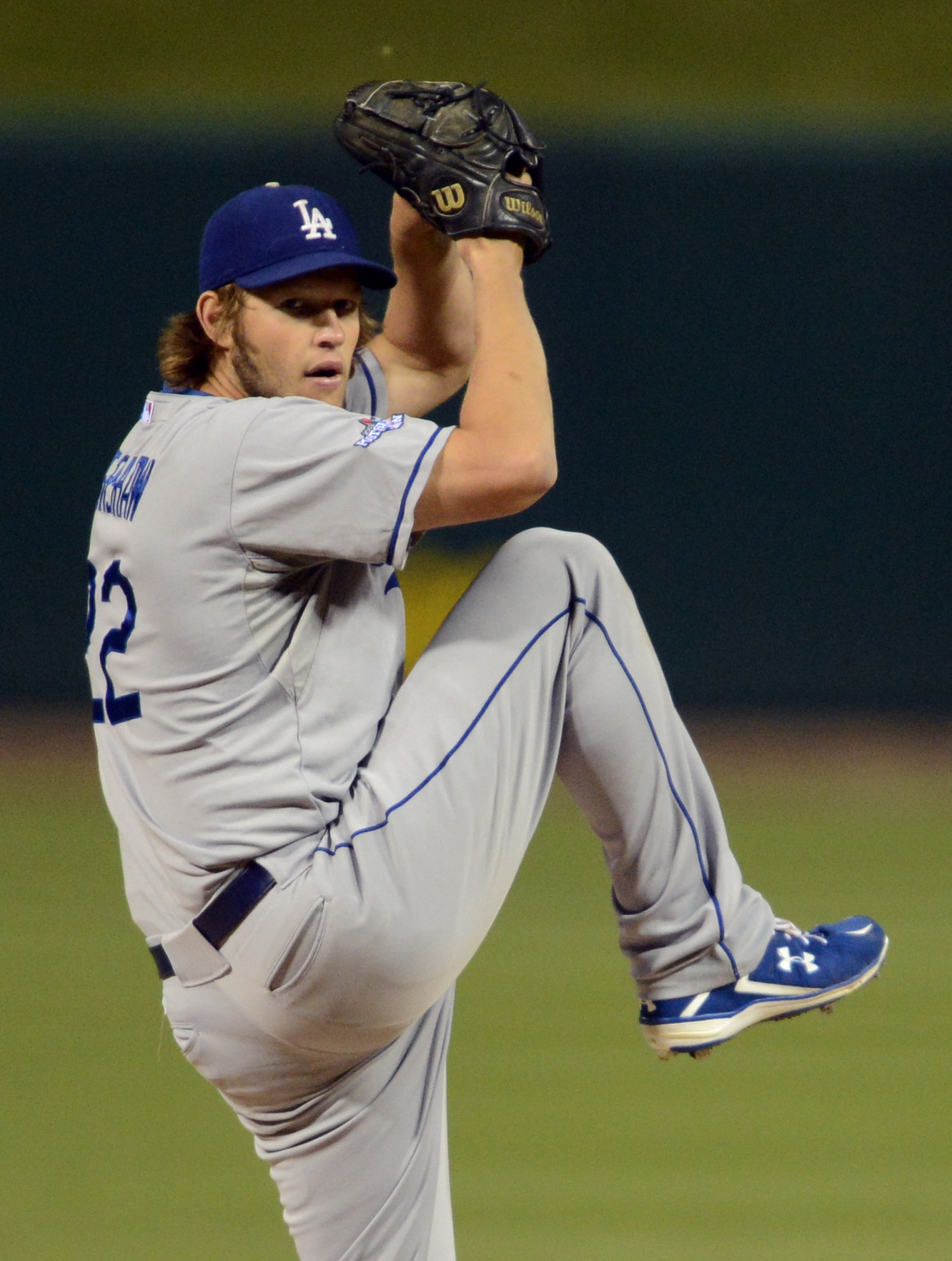
- Clayton Kershaw, LHP: seven years, $215MM. Opt-out after five years.
- Acquired RHP Seth Rosin (Rule 5 pick) from Mets in exchange for cash considerations.
- Acquired OF Jeremy Hazelbaker from Red Sox in exchange for OF Alex Castellanos.
- Claimed OF Mike Baxter off of waivers from Mets.
- Ronald Belisario, Chris Capuano (declined option), Mark Ellis (declined option), Jerry Hairston (retired), Carlos Marmol, Peter Moylan, Ricky Nolasco, Nick Punto, Skip Schumaker, Edinson Volquez, Michael Young (retired)
NL Notes: Wieland, Stewart, Detwiler, Mets, Stanton
With all the bad news on pitching injuries in recent days, it was refreshing to hear at least some positive reports. Earlier today, we learned that Jon Niese of the Mets is not in need of surgery. And later this evening, Padres GM Josh Byrnes said that an MRI on Joe Wieland's right elbow did not reveal UCL damage, as Jeff Sanders of the San Diego Union Tribune reports. Wieland will still be monitored and assessed closely over the coming days, particularly as he is still working back from Tommy John surgery, but will hopefully remain on track to re-start his career and give the club some depth over the coming season.
- One injury situation that seems headed in the wrong direction is that of Pirates backup catcher Chris Stewart, who suffered a knee injury. Surgery is "probable," the club said today, as Bill Brink of the Pittsburgh Post-Gazette tweets. Stewart is set to visit Dr. James Andrews before deciding on a course of action.
- ESPN.com's Buster Olney weighed in on the possible opening in Pittsburgh (Twitter links), noting that the team probably prefers to give Tony Sanchez another year of seasoning in Triple-A before promoting him. That could, Olney suggests, leave the club interested in adding a player like Miguel Olivo or one of the Yankees' surplus backstops. (As Olney notes, the Pirates' own surplus of relief arms might make for a good match with New York.)
- The Nationals will start the year with lefty Ross Detwiler working from the pen, reports MLB.com's Bill Ladson. While Tanner Roark, Taylor Jordan, and Chris Young battle it out for the fifth and final rotation slot, Detwiler will slide in alongside Jerry Blevins as a southpaw relief option. "He provides something special out of the bullpen," said manager Matt Williams. "… We just feel we are a better team with him coming out of our bullpen. He is a power lefty, mid-90s lefty. It doesn't mean he won't start in the future … ."
- For the Mets, several starting positions still appear to be in flux. At first base, the long-anticipated showdown between Lucas Duda and Ike Davis has not gone anywhere with both still not cleared to run or play defense, writes Anthony Rieber of Newsday. If neither is ready, Josh Satin could take the Opening Day gig by default. Elsewhere, Wilmer Flores is surely a longshot to start at shortstop, but nevertheless he'll get another look there tomorrow, reports ESPN.com's Adam Rubin. While the move comes as Ruben Tejada continues to struggle at the plate and in the field, manager Terry Collins said that the decision is unrelated.
- Marlins star Giancarlo Stanton says he is pleased with how things are going in Miami, but nevertheless "need[s] a season" to assess his long-term future with the club, reports Jon Heyman of CBSSports.com. "There's a good vibe here," said Stanton, "and I'd say so if it wasn't."
AL Central Notes: Iglesias, Ventura, Twins
Here's the latest from the A.L. Central:
- While the picture remains somewhat unclear, it seems apparent that the Tigers are preparing to deal with life without young shortstop Jose Iglesias for some time. The club made an inquiry with the Diamondbacks about shortstop Chris Owings, tweets Jon Morosi of FOX Sports, but the discussions were not fruitful.
- Of course, one obvious possibility involves the signing of free agent Stephen Drew, which seems not to be the club's first option. While there is a seeming fit — Drew is a solid veteran, the Tigers are a win-now club — some pundits agree with Detroit's inclination to look internally while exploring the trade market. Dave Cameron of Fangraphs, for example, argues that Detroit is better off patching things over to start the year and evaluating as time goes on. The performance of the fill-ins, recovery of Iglesias, and developments in the market could all lead to solutions and increase clarity, and Cameron says the team is likely good enough to absorb some performance decline in the meantime.
- The Royals are expected to tab prospect Yordano Ventura to open the season in the rotation, tweets Andy McCullough of the Kansas City Star. The 22-year-old has backed up his billing as one of the game's top pitching prospects with a stellar spring. Of course, if Ventura breaks camp on the active roster, the Royals will lose the chance to delay his service clock and retain control for an additional season.
- There is an increasing sense of urgency in Minnesota with ticket sales lagging, and the Twins will be aggressive with roster changes if need be in the early going, reports ESPN.com's Buster Olney (Insider piece). The club already spent the sixth-most cash in the game through free agency, and Olney says it may be willing to move up some high-end talent if it struggles out of the gate. Twins manager Ron Gardenhire admitted today that he was intrigued by the possibility of utilizing the towering Alex Meyer out of the pen for his first taste of MLB action, Mike Berardino of the St. Paul Pioneer Press reports.
2013-14 Free Agent Spending By Team To Date
While some prominent names remain available, the free agent market is relatively settled at this point. (Click here to see who is left.) It would be surprising to see more than a few additional guaranteed MLB deals.
Given that, it seems like a good time to break down what each club has spent. You'll notice also that this provides some update on the total spending figures that I most recently calculated in late January. The total spend has now surpassed $2B. Unlike that post, I'll keep it simple and just give you the numbers today.
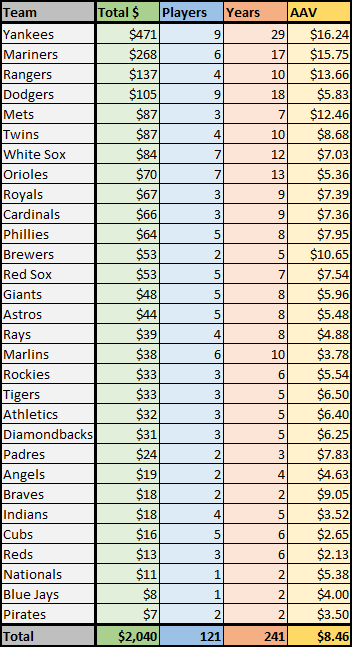
And in chart form (click image for full size):

NL West Notes: Corbin, Owings, Gregorius, Rockies
Patrick Corbin of the Diamondbacks has suffered "damage to the ulnar collateral ligament in his left elbow," the club announced today. Tommy John surgery is the initial recommended course of action for Corbin, a source tells the Arizona Republic's Nick Piecoro (Twitter). The 24-year-old, however, will seek a second opinion and will not be with the team to start the year. Needless to say, the injury could have wide-ranging implications for the club, which has spent big to win and has top prospect Archie Bradley waiting in the wings. Corbin is the most recent in a sudden run of young pitchers facing arm issues, Ken Rosenthal of FOX Sports wrote earlier this morning, discussing the state of pitching injuries in the game. Here are some more notes from the division, as it gets ready to kick-start the season in Australia:
- The Diamondbacks plan to give Chris Owings the starting shortstop job, reports ESPN.com's Jim Bowden (Insider link). Preferring his bat to the glove of fellow youngster Didi Gregorius, Arizona could now be in a position to trade the latter. Gregorius had a solid rookie debut last year, putting up average defensive marks and a .252/.332/.373 triple-slash (along with seven home runs) in 404 plate appearances. Some believe he will have greater defensive value moving forward, making him a fairly attractive piece for teams in need of shortstop help, though Arizona appears determined to command a big return in a trade.
- The Rockies are looking at the trade market for a right-handed setup option, Bowden reports in the same piece. Of course, he also adds that LaTroy Hawkins is likely to cede the closer role to lefty Rex Brothers at some point, which would make Hawkins available (along with Matt Belisle) as a late-inning righty.
- Meanwhile, Colorado "remain[s] concerned with their leadoff spot and center field," both of which were vacated when the team decided to trade Dexter Fowler to the Astros to create payroll flexibility. This report caps off a confusing round of musical chairs for the Rockies. After trading away Dexter Fowler and his $7.35MM salary (along with whatever he'll earn through arbitration next year), the team added an aging Justin Morneau for nearly as much (two years, $12.5MM) and gave situational lefty Boone Logan the third-largest guarantee of any reliever this offseason (three years, $18.5MM). The team then dealt serviceable southpaw Josh Outman for Drew Stubbs, who is now part of a three-man group (including Brandon Barnes, who came in the Fowler deal, and Charlie Blackmon) that will probably form some kind of platoon in center, according to Bowden.
- Of course, Bowden adds, the Rockies also took on salary in adding starter Brett Anderson via trade. He has reportedly been very impressive, looking healthy and throwing like he did before his string of injury issues.
- The Rockies face a number of roster battles that are still too close to call, reports Troy Renck of the Denver Post. The team is not inclined at present to trade away Blackmon or fellow left-handed-swinging Corey Dickerson, though that may become an option at some point.
- We learned earlier this morning that Dodgers catcher Miguel Olivo is seeking his release to pursue opportunities with another club.
Miguel Olivo Requests Release From Dodgers
Veteran catcher Miguel Olivo has asked the Dodgers to release him after learning he would not be part of the club's trip to Australia to open the season, reports MLB.com's Tyler Emerick. The report indicates that Olivo has not yet been released, but hopes to pursue a MLB job elsewhere if he is. The Dodgers did announce they have reassigned Olivo to their minor league camp.
The 36-year-old said he would not report to minor league camp and accept a MiLB assignment, as the team has requested (the Dodgers have tweeted Olivo has been reassigned to their minor league camp). He has been battling with Drew Butera to be the team's third catcher to open the year, behind A.J. Ellis and Tim Federowicz, as the club will get to bring five additional players to Australia. Olivo, who reportedly has had a solid spring thus far, is at a disadvantage in that Butera would have to pass through waivers to be stashed in the minors.
It is not yet clear whether the Dodgers will grant the backstop's request. Olivo, who is not a Rule XX(B) free agent, apparently does not have an opt-out date until June. He went through a controversial end to his time with the Marlins last year, when he asked to be released due to lack of playing time.
Assessing The Qualifying Offer System & Its Purposes
In a recent post, I set forth some context for understanding the overall impact of the qualifying offer system. Now, I would like to try to connect those effects to the actual or potential purposes of the qualifying system, to assess its function and fairness.
While a ready response to the fairness of the system is that it was subject to the collective bargaining process, that does not insulate it from critique. If nothing else, representation of all MLB players does not always ensure that the resulting system will be fair for all player subclasses. The same holds true on the other side of the ledger, as the qualifying offer system has important implications for competitive parity among teams. Putting aside the overall balance between league and union, how does the system function within each of those two entities?
And there is more to consider than just the suppression of salaries (however minimal) and elements of fairness. Just as in setting the rules for the game itself, the rules of the market should aim for consistency of results, a smoothly functioning process, and minimization of situations in which the rules interfere with play (the game being, in this case, a contest of roster construction).
It is fair to ask: what are the reasons to have a system of this kind, and how well does the current iteration serve them while minimizing collateral effects?
A. Taxing Free Agency
One rather obvious purpose of the QO system is that presented already in the first post: it functions as a tax on free agency that allow clubs to allocate money to other purposes.
1. Resource Reallocation
As discussed at length already, the system undeniably serves this purpose by directly limiting the new contracts of players that have declined qualifying offers and transferring leverage to teams that are negotiating extensions. Though its overall impact on a league-wide basis is relatively limited — I estimated that the total value of draft pick compensation transferred annually has been only about 2% to 2.5% of the overall dollars committed through free agency — the system certainly weighs heavily for particular teams assessing a particular player. Taking that as a valid aim of MLB and its member teams, however, questions remain.
2. Disproportionate Burden
Accepting that current MLB players as a whole take on some limitation of overall earning capacity through free agency, that says little about where the burden should fall. It is apparent that, under the current system, the overall benefit to teams is extracted from a limited subset of the market.
The impact is especially severe, in relative terms, for an even smaller group: the relatively marginal QO recipients. While I will not restate the entire point here — see my first post on the topic — suffice it to say that mid-level free agents (and free agents to-be) face potentially wide-ranging impact. Not only is the value of a lost draft pick greater relative to those players' own open-market values, but it can have huge effects on how their market develops and plays out.
It has been suggested that players and teams will do an increasingly accurate job of evaluating the market; a player like Nelson Cruz, for example, might accept the QO, or his former team might not even extend it in the first place. That would lower the relative impact of the system as against overall spending, and would reduce the instances of specific players bearing a severely disproportionate cost.
But the overall benefit-burden ratio would remain largely intact. And, because of the offer's single rate, those players who are just good enough to draw a QO would carry a relatively much larger burden. Surely, there are better ways to take some of the money off of the top of free agency and reserve it for the teams. Were that the only purpose, it is doubtful the qualifying offer system would have been arrived at.
3. Slowing Spending Growth
Could it be that, more than just functioning as a straight tax, the system was intended in part to dampen the growth of spending? By forcing teams to sacrifice non-monetary value, perhaps, would reduce the incidence of unrestrained bidding wars.
One ready response, of course, is that the QO system has seemingly done little to stem record free agent spending, which at last check was up nearly 40% over last year. If the league hoped that stemming the tide of spending growth would result in some part, it seemingly has not. Moreover, as discussed below, the system contains several massive holes that — among other things — severely limit its potential for impacting overall market spending.
B. Distributive And Competitive Purpose
Another oft-noted reason for employing mechanisms that grant rights to teams with respect to players reaching free agency is to compensate them for potentially losing their current MLB talent, or perhaps to help them instead retain it. Likewise, teams signing impact free agents arguably should be forced to sacrifice some future value to do so. Underlying these possible goals are purposes both distributive (roughly, high-revenue to low-revenue) and competitive (i.e., maintaining general parity for the league's overall benefit) in nature.
1. Limitations On The Use Of The Qualifying Offer
At present, a player must start the year with the same club he finishes with in order to be eligible for a qualifying offer. Thus, Matt Garza and Zack Greinke hit the market without compensation attached, while Ubaldo Jimenez and Ervin Santana entered free agency with the burden of a pick.
This potentially serves some functions: First, it prevents contenders from replacing sacrificed future value (through a mid-season trade) with a pick reaped through a qualifying offer. This could be thought to have the effect of preventing the system from passing on too great a benefit to large-market teams, as a general matter. Of course, it also hypothetically limits the return that selling clubs can reap through mid-season trades to a corresponding degree, so the overall balance may not be impacted.
Likewise, the limitations could provide some speculative incentive for teams to retain their own players at mid-season, which also carries competitive implications. Because a mid-season acquisition cannot bring his new team a draft pick, clubs that are out of contention are slightly more likely to hold onto their established players and either extend them or make them a qualifying offer of their own. Were acquiring clubs able to recoup future value after the rental period was over, they would be willing to give up more at the point of acquisition. Of course, it could be that no players really fall in the sweet spot: good enough to hypothetically command a QO from a non-contender at the end of the year, but not so good that they can still bring back greater value through prospect return and/or cost savings in a mid-season swap.
On the whole, the rule that a player cannot receive a qualifying offer from a team he was not with on Opening Day appears to have quite limited benefits.
2. Market-Skewing Results
Once more, however, there is a cost. When Jimenez requires a pick, and Garza does not, it not only leaves the former to bear the burden, but also impacts the resulting player-acquisition market. While the actual results are impossible to pin down, they are far-reaching. Most obviously, there is an effect on where certain players end up in a given free agent period.
Remember, much of the impulse for shedding the old Type A/B system, which was heavily dependent upon the unreliable the Elias Bureau rankings, was to avoid illogical results. Market-driven decisions play a role in the current QO system, but the limitations inherent in its current form lead to drastically skewed results.
Nothing illustrates this better, perhaps, than the fact that compensation free agents Stephen Drew and Kendrys Morales have had to consider waiting until after Opening Day, or even the June amateur draft, to sign. By waiting until the season starts, the player can ensure he will not receive a qualifying offer in the ensuing offseason; by waiting until after the draft, the player can shed the compensation altogether.
These strategies (or, at least, the threat thereof) are available to players as ways to push back against the system and gain some leverage. The alternative is to accept a one-year deal (as did Cruz and Santana) and face another qualifying offer in the next year — if they even play well enough and stay healthy. But the possibility of players waiting out the market into (let alone halfway through) a season is hardly representative of a smoothly functioning market, even if it does not come to fruition. While a multitude of factors played into the situations that these players ended up in, the result is clearly not a ringing endorsement of the current arrangement.
3. Sacrificing Future Value
Less obviously, but perhaps more importantly, the rule prohibiting qualifying offers to mid-season acquisitions means that it is often possible to obtain current production without sacrificing future value. If one purpose of the system is to force teams to give up expected future production to add impact talent to their current roster — thus serving general competitive and even distributional imperatives — then the qualifying offer process is at best highly inconsistent.
While, on the one hand, teams that acquire players mid-season cannot cash them in for picks, the clubs that subsequently sign such players need not give up a future choice. The Dodgers were able to sign Greinke without giving up a draft slot. Certainly, the club could have simply priced a pick into its offer had Greinke been eligible for and received a qualifying offer; or, it could have ignored the draft choice and made the same offer. Either way, Los Angeles would be without its fifth overall prospect (Chris Anderson, as rated by Baseball America), who it used its first choice to select last year.
4. One Size Does Not Fit All
Equally important, another aspect of the current arrangement — the level at which the qualifying offer is set — serves largely to undermine any distributive purpose. As many have noted, larger-market clubs have made many of the qualifying offers, and thus gained many of the resulting compensatory picks. This has been somewhat overstated, however.
The more notable observation, I would suggest, is that every team to have gained a supplemental choice has done so coming off of a winning season. (In 2012-13: Cardinals, Rays, Rangers, Braves, Yankees. In 2013-14: Yankees, Royals, Reds, Rangers, Indians, Braves, Red Sox, Cardinals.) In part, this resulted because players like Greinke and Garza were traded during the season by non-contending clubs, which were able to recoup greater value through trade. On the other hand, of course, those players likely drew less of a return than they would have had the rule allowed their new teams to make them a qualifying offer at the end of the year.
The issue, perhaps, is more that the high-floor, one-size-fits-all approach tends to harm smaller-market clubs on the margins. Indeed, the Pirates allowed A.J. Burnett to hit the market without an offer. As GM Neal Huntington explained, the price was too high for the club to commit in the event that Burnett accepted the offer. He argued that the system "didn't really do what it was intended to do" in that regard. Supporting Huntington's position is the fact that the Yankees — a higher-payroll, but not necessarily more immediately competitive club — made two consecuive qualifying offers to Hiroki veteran starter coming off of an excellent year but looking for a short-term deal).
Had Burnett remained in New York, might he, too, have received a QO? Did the system fail the low-payroll Pirates, who ultimately lost Burnett without compensation? Whatever one thinks of the validity of the decisions and public reasoning of Huntington (and others who have expressed similar sentiment), it makes intuitive sense that smaller-market teams bear a larger risk in extending qualifying offers, which could prevent them from recouping future value for losing impact players. (Somewhat perversely, in the case of the Pirates, their excellent season also played a role; the club's post-season run removed the possibility of a mid-season trade of Burnett.)
5. Talent Retention And The Buyer's Market
Moreover, the current arrangement has not noticeably helped small-market clubs retain talent when the offer has been extended. This is likely because, as I noted previously, those teams still stand to lose a valuable draft choice (the compensation pick) if they re-sign a player, which they must factor into any offer like any other team.
If anything, the system on its whole may make it less likely, at least in some cases, that such players will return to their former clubs. Teams acquiring multiple compensation free agents (like the Yankees and Orioles this year) are able to decrease the overall future sacrifice that they make by doing so.
Take the case of the just-signed Santana: as things stood before the sudden entry of the injury-riddled Braves into his market, his former club (the Royals) would have lost the top overall supplemental choice (29th overall) if they had re-signed him, while teams like the Yankees (55th), Mariners (74th), and Orioles (90th) would have given up far less valuable slots to ink him, having already forfeited earlier picks. Kansas City GM Dayton Moore made clear that the club was happy that Santana decided to sign rather than waiting out the June draft (which would have prevented the Royals from getting compensation): "I think Erv's going to do very well, and we're going to get the pick. And it all worked out."
As the latest point would imply, there is a plain advantage to making commitments to multiple qualifying offer-declining free agents, since it significantly decreases the per-player cost in terms of sacrificed draft picks. As Orioles GM Dan Duquette put it, "if you do one, I think that makes the second one easier, frankly."
Of course, many teams do not have the resources to pull off that feat. Even the Orioles, whose spending capacity may be greater than their usual recent payroll, only pulled off the feat when it was left with cash and a market still full of quality players late in the spring. "This is the first full year of the [qualifying offer] implementation, and I'm not sure people understood how the market was going to play out. I can't tell you we envisioned that the market would get to this point," Duquette said.
Wise big-budget teams can take advantage of this situation much more than can low-revenue clubs. Just as low-revenue teams may find it harder to operate in the system to obtain draft compensation, they may be put at an even greater disadvantage in the buyer's market.
C. Conclusion
In the final analysis, the QO system performs its asset-shifting function, but achieves that at the cost of arguably unbalanced results. Likewise, it appears that the distributive and pro-competitive impacts of the system carry some significant side-effects (in terms of skewing the market), and that the effects are quite limited (if not self-undermining) in operation.
As explained in my prior piece, the direct financial shift effected by the qualifying offer mechanism is both relatively well-defined and relatively limited. Though the leverage-transferring effects of pre-free agent extension negotiations are difficult to pin down, they, too, can at least be understood. Might it be possible to re-cast the system in a way that matches its current market impact, retains and improves upon its purposes, and minimizes its negative effects? I think so.
The key step, perhaps, lies in de-coupling the compensation and the forfeiture aspects of the system. At present, a player's original team decides whether to make itself eligible for compensation by making the qualifying offer; that decision, in turn, dictates both whether the player's new team will forfeit a draft choice to sign him and whether the player will have to bear that cost. A better system would not make the loss of a pick by a new team depend upon the unilateral action of the original team.
Likewise, instituting other changes — such as mechanisms to enhance participation by smaller-payroll clubs and to more closely tie compensation/forfeiture to a player's actual market value – could vastly improve the system's function going forward by more evenly spreading its benefits and burdens. There are, of course, many ways to approach this and many details to be worked out; I will save an attempt at that undertaking for another day.
Brewers Notes: Attanasio, Garza, Lohse, Duke
Earlier, we learned that the Brewers are reportedly considering whether to offer young shortstop Jean Segura a contract extension, and if so on what terms. MLBTR's Steve Adams recently broke down the team's offseason moves. Here are more notes out of Milwaukee:
- In a fascinating interview, Brewers principal owner Mark Attanasio spoke with Ken Rosenthal of FOX Sports about a host of topics, including the inside stories of his purchase of the club and the signings of Kyle Lohse and Matt Garza. Explaining that the club has gone away from its once "very rigid budgets" in favor of general fiscal responsibility while stretching the budget when it makes sense, Attanasio said that the Garza signing was a reflection of the organization's desire to add an impact pitcher at the MLB level. The ball got rolling during a conversation at Ryan Braun's wedding between the owner and agent Nez Balelo. Per Attanasio: "So the next morning, I called [GM] Doug [Melvin] and said, 'How about Matt Garza?' Doug's first question was, 'Isn't he too expensive?'"
- Attanasio explains that the Lohse signing came together quite differently; afterward, he says, agent Scott Boras remarked that he'd set a personal record in call volume to ownership to complete the deal. Attanasio said the complicated decision came down to his desire to "bring up the quality of the product we were giving our fan base," even if it was not going to change the team's destiny for 2013.
- In the case of Lohse, moreover, Attanasio saw a chance to take advantage of a reluctant market. He rightly echoed his GM in noting that the value of draft picks lies in the drafted players' trade value as well as their ultimate MLB production. But, he indicated, their value is not limitless: "What happened with Kyle, the new CBA had this rule about giving up a draft choice. And giving up a draft choice evolved in our sport from giving up a lottery ticket to giving up your first born." As I wrote in two recent pieces – contextualizing and assessing the qualifying offer system — organizational reluctance to give up picks, potentially even going beyond teams' internal valuations, could have a major impact on how a compensation free agent's market develops.
- Now that the club has put together a potentially solid rotation, and overseen the return of Ryan Braun, Attanasio says the club is looking to be a winner, tweets David Laurila of Fangraphs from the ongoing SABR Analytics Conference in Phoenix. The club is prepared to be aggressive at the trade deadline rather than adhering to a budget, Attanasio indicated.
- Meanwhile, down at camp, southpaw Zach Duke is making a good impression as he looks to make the squad as a non-roster invitee, reports Tom Haudricourt of the Milwaukee Journal Sentinel. "He's doing a great job of letting us know that he's definitely a guy we should look at," said manager Ron Roenicke. "He's got better stuff than I thought, maybe because I saw him so much as a starter. Now that he's a reliever, maybe his stuff is different. I like what I see." Indeed, Duke has continued to work on honing his repertoire for a pen role. Of course, with Will Smith now clearly locked in as the top lefty in the pen after losing his chance at a rotation spot through the Garza signing, the well-travelled 30-year-old still faces an uphill battle to crack the Opening Day roster.
Minor Moves: McDade, Taylor, Lorin
Here are the day's minor moves, all via Matt Eddy of Baseball America unless otherwise noted:
- First baseman Mike McDade has agreed to a minor league deal with the Blue Jays, tweets Gregor Chisholm of MLB.com. The 24-year-old had a tough run at Triple-A for the Indians and White Sox last year, slashing just .250/.313/.371 after posting superior on-base and slugging figures over his previous time in the upper minors. McDade will return to the organization with which he spent his first six years in professional baseball.
- The Angels have released lefty Andrew Taylor, who was looking to work back after missing all of 2013, tweets Eddy. The 27-year-old saw a cup of coffee with the Halos back in 2012, but has spent most of his time in the upper minors in recent years. In 2012, he thre 59 innings of 4.27 ERA ball at Double-A and Triple-A, striking out 8.5 batters per nine innings while walking 3.8 per nine.
- Towering Diamondbacks righty Brett Lorin has also been cut loose, Eddy tweets. The 26-year-old reached Triple-A for the first time last year, and posted a solid 2.96 ERA in 51 2/3 innings across the upper minors in 2013. Lorin came to the organization as a Rule 5 pick, and the team liked him well enough to work out a trade to keep him, but he never reached the bigs in Arizona.