
Ervin Santana Seeks To Sign One-Year Deal Before Opening Day
6:46pm: The Royals are "moving forward" without Santana even if he is available on a one-year pact, GM Dayton Moore tells Andy McCullough of the Kansas City Star (via Twitter). "The candidates for our rotation are in-house," said Moore.
6:29pm: Free agent starter Ervin Santana has switched gears and is now looking for a one-year deal, reports FOX Sports' Ken Rosenthal (links to Twitter). Santana wants to get signed and into camp as soon as possible, and does not intend to wait to ink a deal until after Opening Day.
Of course, if Santana signs a one-year deal before Opening Day, he could still be made a qualifying offer again next year. That type of scenario was said to be out of the question by Santana's agent, but we learned last night and this morning that Santana's team of representatives was undergoing some changes. It would appear that a change of strategic direction has resulted.
With the new focus on achieving a pillow contract, Santana hopes to land on a team with a strong offense, says Rosenthal. The Blue Jays and Orioles are two teams that could meet that requirement and have had interest, Rosenthal adds. It is not clear whether there is anything connecting those teams specifically to Santana since his shift of plans.
Neither is it clear whether other clubs remain in the mix, or whether Santana's market could expand. Earlier today, there were conflicting reports as to whether the Phillies had (Nick Cafardo of the Boston Globe, via Twitter) or had not (Matt Gelb of the Philadelphia Inquirer, via Twitter) inquired about the righty's services. Of course, in theory, many other clubs could potentially have renewed interest in Santana under these changed circumstances.
Rangers Sign Joe Saunders
FRIDAY: Saunders can earn up to $3.65MM if he makes the club and hits all of the incentives in his contract, according to the Associated Press. Just $250K of Saunders' $500K base salary is guaranteed.
If Saunders makes the roster, his salary will jump to $1.5MM, as previously reported by Heyman. He also receives a $500K bonus for 90 days on the active roster. Saunders will receive an additional $150K for reaching each of 130, 140, 150, 160, 170 and 180 innings. He'll earn $250K for reaching each of 190, 200 and 210 innings. He can also earn between $25K and $100K for various awards bonuses.
WEDNESDAY, 10:00am: Saunders is guaranteed just $500K but will earn $1.5MM, plus incentives, if he makes the Major League roster, according to Jon Heyman of CBS Sports (on Twitter).
9:34am: The Rangers announced today that they have signed left-hander Joe Saunders to a one-year, Major League contract. Financial terms remain in unknown, though reports have indicated that it is a non-guaranteed deal, suggesting that it could be in the mold of Tommy Hanson's one-year, split Major League contract with Texas that pays him a separate salary in the minors should he not make the big league club.
Saunders, 32, promises to add depth to the back of a Texas rotation mix that has increasingly looked in need of it. Derek Holland is going to miss the entire first half, Matt Harrison is still working back from surgery (and had a more recent injury scare), and other options come with a variety of uncertainties.
Working for the Mariners last year, Saunders struggled to a 5.26 ERA in 183 innings. That was the worst full-season mark of his career, however, as the southpaw had thrown at least 174 2/3 innings and posted between a 3.41 and 4.60 ERA over his previous five seasons.
Advanced metrics thought his 2013 season was better than the resuls, as he posted a 4.72 FIP, 4.23 xFIP, and 4.42 SIERA. However, those numbers remain underwhelming, and a look at advanced stats also tends to place a negative spin on some of Saunders' more productive previous years. Indeed, he has never finished a year below the 4.00 line by any of those measures.
The signing was first reported by Evan Grant of the Dallas Morning News. Jon Heyman of CBSSports.com first tweeted that it was a MLB deal, with Joel Sherman of the New York Post tweeting that it was of the non-guaranteed variety.
Steve Adams contributed to this post.
NL West Notes: Jobe, Maybin, Headley, Betancourt
Dr. Frank Jobe, the man who performed the first — or, perhaps more accurately, the – Tommy John surgery, has passed away at the age of 88. As MLB.com's Ken Gurnick writes, the longtime Dodgers medical director was instrumental in pioneering that now-commonplace, immensely impactful procedure: "it was Jobe who invented it, performed it, refined it and taught it to hundreds of training orthopedic surgeons." Needless to say, Jobe's contributions to the game will continue to have impact for generations to come, and MLBTR joins the rest of the baseball world in saluting him in passing. If you're interested in learning more about his remarkable life, see this excellent bio piece from MLB.com's Doug Miller.
More from the NL West:
- Padres outfielder Cameron Maybin suffered an arm issue of his own, rupturing his left biceps tendon, but will not need surgery at this point, MLB.com's Corey Brock reports. GM Josh Byrnes said he feared the worst — a season-ending injury — but that after consulting the medical staff "the strong consensus was no surgery." Though a timeline has not yet been set, Maybin could return within four to six weeks. San Diego should have plenty of depth to cover in Maybin's absence, though the club will certainly hope for a positive resolution of this latest setback for the 26-year-old, who signed a five-year, $25MM deal before the 2012 season.
- Meanwhile, the Padres have let third baseman Chase Headley know that they fully intend to make him a qualifying offer at the end of the year, reports Jon Heyman of CBSSports.com via Twitter. While this does not come as a surprise, it indicates that San Diego — like the Indians with Justin Masterson — views the QO as a card to be played in extension talks.
- Former Rockies closer Rafael Betancourt will work out with the club for a ten-day stretch as he seeks another shot at a MLB job, reports Troy Renck of the Denver Post. The club previously declined to exercise its half of a mutual option on the 38-year-old after he underwent — you guessed it — Tommy John surgery late last year. It is surely worth it for Colorado to take a look, as Betancourt has largely been an outstanding reliever since breaking into the bigs at the late age of 28 back in 2003.
2013-14 Article XX(B) Free Agents
As has been previously discussed on MLBTR, the MLB collective bargaining agreement contains a provision that allows certain free agents who are signed to minor league contracts to receive a $100K retention bonus if they do not receive a binding promise to be added to the team's 25-man roster (or the Major League disabled list) five days prior to the season. If the team decides to pay the retention bonus, the player also receives a June 1st opt-out clause. Contracts can permissibly include terms that are more favorable to the player, such as greater retention bonuses and/or earlier opt-out clauses.
For the current season, MLBTR's Tim Dierkes tweets, decisions must be made by March 17th for the Diamondbacks and Dodgers, and by March 25th for the rest of the league. (Of course, at present, neither of the clubs opening play in Australia has signed an XX(B) free agent.) Last year, numerous XX(B) free agents received either a roster guarantee or a bonus from teams hoping to maintain control over the player.
There are many different ways to become a free agent, but only those players who reach free agency through Article XX(B) and certain international free agents are eligible for this added protection. There are two types of players who can qualify in this manner at the end of a season. (In either case, of course, the player must not already be a free agent; i.e., he must be on a club's 40-man roster upon the conclusion of the World Series.) First are those players who have accrued at least six years of Major League service time and are not under contract for the following season. Second are those players with expiring contracts who signed with an MLB club after turning 23 and after playing five seasons in one of the major international leagues. (In the below list, Kawasaki and Wada are examples.) In either case, the XX(B) free agenty must sign his minor league deal ten or more days prior to Opening Day to qualify for the added contractual protections.
Here is a list of this year's crop of Article XX(B) free agents who have signed minor league deals and thus come within the ambit of the rule, as of today. (Several other players likely to land minor league deals could also qualify — including names like Kevin Gregg and Juan Pierre — if they sign in time.)
Angels: John McDonald, Carlos Pena, Yorvit Torrealba, Chad Tracy
Astros: Cesar Izturis
Blue Jays: Munenori Kawasaki
Braves: Freddy Garcia
Brewers: Zach Duke, Lyle Overbay, Mark Reynolds
Cubs: Tsuyoshi Wada
Giants: Kameron Loe
Indians: David Aardsma, Aaron Harang
Mariners: Scott Baker, Endy Chavez, Humberto Quintero
Marlins: Reed Johnson
Mets: Kyle Farnsworth, Daisuke Matsuzaka
Nationals: Luis Ayala, Mike Gonzalez, Chris Snyder
Orioles: Alexi Casilla, Johan Santana, Delmon Young
Philies: Ronny Cedeno
Rays: Erik Bedard
Red Sox: Rich Hill
Reds: Jeff Francis, Ramon Santiago
Rockies: Nick Masset
Twins: Matt Guerrier, Jason Kubel
Yasiel Puig Switches Representation
Dodgers outfielder Yasiel Puig has changed agents, hiring Adam Katz and Andy Mota of Wasserman Media Group, reports Ken Rosenthal of FOX Sports (via Twitter). As shown in MLBTR's Agency Database, Puig had been represented by Jaime Torres.
As Rosenthal notes, Wasserman represents a host of high-profile players, including fellow Dodgers Hanley Ramirez and Kenley Jansen. The deal that Puig signed out of Cuba carries him through 2018 (his age-27 season), so there is little pressure to begin considering a new deal. Puig does have the ability to trade out his guaranteed salary for arbitration earnings once he's racked up enough service time to qualify. As Puig has only 119 days of service at present, that will likely not occur until the 2017 season.
Ervin Santana Rumors: Thursday
Let's take a look at the latest on the best arm left on the market, starter Ervin Santana.
- Seemingly contradicting Alou, Dionisio Soldevila of ESPNDeportes.com reports (Twitter links) that Santana has fired Stringfellow. Santana does not have plans to hire a replacement, and could negotiate his own deal, according to Soldevila.
- Another of Santana's reps at Proformance, Jay Alou, tweets that there has been "no change" in Santana's representation. "Ervin Santana is still represented by the same person that he first signed with 15 years ago," wrote Alou.
Earlier Updates
- Santana is now considering a change of representation, reports Ken Rosenthal of FOX Sports (on Twitter). Santana is currently represented by Proformance. We heard from Proformance managing director Bean Stringfellow recently, as he spoke in strong terms about his determination to land Santana a contract befitting his talent, and said they had discussed the possibility of waiting to sign until after the June amateur draft (to shed the draft pick compensation tied to Santana).
- The Blue Jays are still unlikely even to make Santana an offer, reports Gregor Chisholm of MLB.com. Though GM Alex Anthopoulos said that he has still had some contact with the representatives of some free agents, he added that "I don't think we have anything active."
- Updating the market situation of Santana, Jon Heyman of CBSSports.com writes that teams still in touch with Santana include the Mariners, Orioles, Rockies, Rangers, and aforementioned Blue Jays. Stringfellow weighed in to say that Santana was dealing well with the wait. "He's concentrating on his workout," he said. "Obviously, he'd rather be in camp, as he's always in camp at this time. But he understands the process, and the business aspect of it. He's doing well."
- Though the Orioles would have no problem sacrificing a third-round pick to add Santana, reports Dan Connolly of the Baltimore Sun, the team has not engaged in "real dialogue" over the past few days. As with the team's previous signing of compensation free agents, Baltimore is looking to achieve value in any deal.
Rick Ankiel To Retire
One of the most fascinating ballplayers of his generation, Rick Ankiel, has officially retired, Cardinals broadcaster Dan McLaughlin announced on the air today (story via MLB.com's AJ Cassavell). Ankiel is hoping to stay in the game by catching on in a front office.
Ankiel is a 34-year-old, power-hitting, free-agent outfielder who was cut loose by two different clubs last year. That seemed an unlikely ending when he cracked the league at age 19 as a big-armed pitcher, announcing himself with a 3.27 ERA in 33 innings for the Cardinals. He followed that up with an outstanding rookie year, throwing 175 innings of 3.50 ERA ball, notching 10.0 K/9 against 4.6 BB/9.
Then, of course, came Ankiel's sudden and stunning meltdown on the mound during the 2000 postseason. He never recovered to regain his former promise, and seemed destined to fade into obscurity.
Things took a second, almost equally startling turn when Ankiel re-emerged as an outfielder. Returning to the bigs in August of 2007, Ankiel swatted a home run in his debut and never looked back. He ultimately logged 2,019 plate appearances, notching 74 home runs and compiling a .242/.304/.427 line. And, of course, he put his powerful arm to good use, unleashing a number of memorable throws that cut down baserunners looking to stretch an extra base.
Though he was reportedly still interested in playing as recently as February, Ankiel had not received any interest at that point. He apparently decided to hang up his spikes now, rather than waiting for another opportunity.
After his time in St. Louis, Ankiel roamed the outfield for several clubs, starting with the Royals and Braves. He played for two seasons with the Nationals before finishing his career in 2013 with the Astros and Mets. Ankiel's overall stat line does not stand out, at least until one notices that it encapsulates two separate careers. Ultimately, his remarkable story, hard-nosed play, and incredible arm ensure that he'll long be remembered as a ballplayer.
Offseason In Review: Arizona Diamondbacks
One would be hard-pressed to offer a better description of this year’s Diamondbacks offseason than that written at the same time last year by MLBTR’s Steve Adams: “The Diamondbacks made a number of moves that raised eyebrows and invited skepticism this offseason, and they’ll have to improve on last year’s .500 record to silence those naysayers.”
Major League Signings
- Bronson Arroyo, RHP: Two years, $23.5MM. Club option for 2016.
- Eric Chavez, 3B: One year, $3.5MM.
- Total spend: $27MM.
- Henry Blanco, Daniel Hudson (non-tendered and re-signed), Mike Jacobs, Blake Lalli, Tommy Manzella, Andy Marte, Ryan Rowland-Smith, Adam Russell, Jess Todd
- Acquired RHP Justin Choate and OF Todd Glaesmann from the Rays in exchange for RHP Heath Bell (to Rays) and LHP David Holmberg (to Reds).
- Acquired OF Mark Trumbo and RHP A.J. Schugel from the Angels and OF Brandon Jacobs from the White Sox in exchange for LHP Tyler Skaggs (to Angels) and OF Adam Eaton (to White Sox).
- Acquired RHP Addison Reed from the White Sox in exchange for 3B Matt Davidson.
- Claimed Alex Sanabia, Matt Tuiasosopo, Santos Rodriguez, Marcos Mateo (Rule 5)
- Josh Collmenter, RHP: two years, $2.425MM. Club option for 2016 and mutual option for 2017.
- Brad Ziegler, RHP: two years, $10.5MM. Club option for 2016.
- Willie Bloomquist, Wil Nieves, Davidson, Bell, Holmberg, Skaggs, Eaton, Patrick Schuster (Rule 5), Kevin Munson (Rule 5)
What Might James Shields Earn In Free Agency?
We heard earlier today that the Royals have no intentions of making a run at extending ace hurler James Shields. That would seem to confirm what has long been expected: namely, barring a surprising change of circumstances, Shields will hit the market next year looking to sell his services for age-33 and beyond.
As Andy McCullough of the Kansas City Star noted earlier today, Shields and his camp have rejected rumors that he is seeking to land a deal in the realm of Zack Greinke's six-year, $147MM pact. (Note that Greinke did not require draft compensation to sign, as Shields almost certainly will unless he too is dealt mid-season.)
But, as McCullough notes, Shields compares well to Greinke — indeed, he compares well to just about anyone not named Clayton Kershaw — in terms of recent production. He has pitched at least 200 innings (and often quite a bit more) for each of the last seven seasons, and has logged ERA totals of between 2.82 and 3.52 over the last three. Shields has been among the 20 or so most valuable pitchers since he cracked the league, and has looked more like a top-ten guy more recently.
So, can Shields earn Greinke money? Though his numbers make that contract look like a solid comp, another major factor speaks firmly against it: namely, age. At the time Greinke inked with the Dodgers, he was just over 29 years old, and threw at that age for the entire season in the first year of his deal. Shields will be four years older when he faces the open market for the first time.
This series of observations led MLBTR's Tim Dierkes to suggest that, perhaps, it would be worthwhile to look at the historical results of top-level, slightly older hurlers. The results of that research, and my discussions on the topic with both Tim and fellow MLBTR writer Steve Adams, make up what you'll read below.
Unsurprisingly, it turns out that slightly older pitchers have not readily landed huge contracts. That makes sense, for at least two major reasons. First is simply the factor of selection bias. Most really good pitchers accrue service time early in their careers and thus hit the open market slightly earlier than will Shields, who did not crack the bigs until age 24 and then gave up two years of free agency in an early-career extension. Likewise, as age increases, the likelihood of significant injury goes up, further attriting the possibly worthy arms. The second reason is even easier: older pitchers have less near-peak years left to sell.
Let's take a look at all pitchers to have signed deals with at least a $60MM guarantee at a $15MM or greater average annual value — after having turned 31 years of age. (The last column represents the player's age at Opening Day of the first season of their deal).
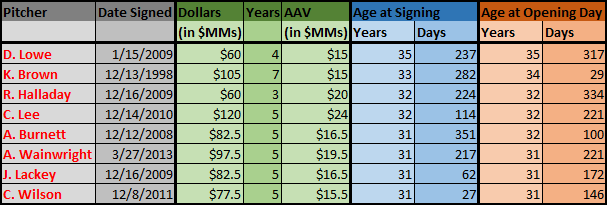
Among these potential comps, we can reject several out of hand. First, Brown and Lowe were both significantly older and signed deals in quite a different market. (Frankly, I only kept them on the chart to show how remarkable their contracts were.) Wainwright signed an under-market extension, while Halladay was also probably on a different performance/perception level and signed his own deal under somewhat odd circumstances.
That leaves us with four potential free agent comps, all of whom are near in age to where Shields will be when he hits the market. All signed five-year deals in early-to-mid-March of their free agent year. (If Shields signs before his birthday on December 20th, he'd be just shy of 33 years of age, making him slightly older than the other four were.)
How does Shields stack up to that quartet? Let's look at both three-year averages and walk-year performances to get an idea, and look at the salary numbers through the lens of inflation (present dollar value estimated via US Inflation Calculator). I have used ERA and fWAR not to suggest that those are the proper means by which to value pitchers, but to represent two sides of the overall picture: the former captures pure results, while the latter incorporates FIP as its baseline and thereby captures some of the underlying talent and rate-based results that teams surely examine closely when signing deals of this magnitude.
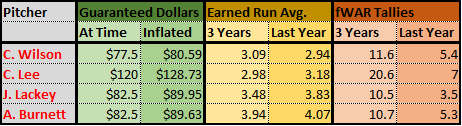
Needless to say, Lee paced the grouping — at least in the eyes of advanced metrics and in dollars achieved. He still fell well short of Greinke's guarantee, though of course he inked his deal a few years back and reportedly could have signed for seven years and $148MM.
As for Shields, his current three-year and last-year ERA both stand at 3.15. He has been worth 12.9 fWAR over the last three seasons, and earned 4.5 wins in 2013. Assuming he hits the market with approximately the same profile — i.e., he logs another 200+ innings of pitching in the low-to-mid-3.00 ERA range and has underlying metrics to support a 4-5 fWAR season — where might he land?
The answer, probably, is not in the realm of Greinke's contract (or the commensurate offer that Lee could have signed). Even accepting that baseball inflation has outpaced that of the general economy — or, at least, understanding that MLB salary levels are subject to wide variation due to the league's comparatively tiny player market, small sample of transactions, and range of non-market-based influences — the Wilson-Lackey-Burnett line of arms equate at most to a five-year, $100MM present-day value.
Importantly, Dierkes noted, those three were clearly the best available arms in their free agent years. While it is still conceivable that Shields will ultimately be the most attractive starter available when the market opens, odds are he will slot in behind Max Scherzer and possibly Jon Lester. (Of course, if Scherzer repeats his 2013 season, he might be on another plane altogether.) And if Justin Masterson hits the market, he might be more appealing to some clubs because of his significantly younger age. Regardless, unless each of those arms is extended off the market or takes a large value hit, Shields will not be the sole target for clubs looking to add an impact starter.
Moreover, as I recently noted in discussing extensions, teams have evinced an increasing willingness to value age. That attention to the aging curve probably also implies a corresponding unwillingness to roll the dice on continued production on its downside. Still-excellent pitchers Hiroki Kuroda (age 39) and A.J. Burnett (age 37) just signed one-year deals that will pay them $16MM. Can Shields really beat that AAV on a five-year pact that would buy out his age 33-37 campaigns, especially if there are alternative arms on the market? As Adams noted, Shields' slightly more advanced age means that a fifth year would push his guarantee into somewhat uncharted territory as compared with his most direct comps. It is worth wondering whether clubs would be willing to guarantee another year at such an elevated rate.
In the aggregate, it looks as though Shields could reasonably expect to top out at five years, with a $20MM AAV a seeming longshot at that term. On a four-year deal, Shields might land in the $75MM to $80MM range, perhaps with a vesting/club option of some kind attached on the end. But barring a massive jolt to the market that leaves Shields as the unquestioned prize with multiple suitors, it is somewhat difficult to imagine him reaching the $100MM threshold — if he is able to get a guaranteed fifth year at all.
One possible twist would be the inclusion of an opt-out clause. As Dierkes notes on Twitter, Lee actually had one offer that included an opt-out before he signed on with the Phillies. In his excellent piece on the use of opt-out clauses, Dierkes wrote that such provisions may not be that onerous to the team since, if exercised, the club is able to re-assess whether to take on further obligations (and, I would note, can do so with the advantage of insider knowledge on that pitcher). If clubs are unwilling to guarantee as much cash as Shields hopes for, he could potentially press instead for a deal that includes an opt-out, allowing him to re-enter the market if he carries his production into his mid-30's. And at that point, perhaps the Lowe contract would take on increasing relevance.
AL Notes: FA Spending, Ichiro, Dirks, Skaggs
We already know that the 2013-14 free agent market has featured incredible spending levels, but what does that mean for how teams value a win (above replacement)? Dave Cameron of Fangraphs breaks down the cost of a projected win for each player that signed a major league deal. The results show that teams have spent at levels that, depending upon what discount rate and precise methodology is employed, value an expected win at between $5MM and $7MM. In a follow-up piece, Cameron observes that, at least for players who are expected to be regular contributors, the spending shows a non-linear escalation of the price of a win (i.e., teams are paying a premium to lock up high-WAR players). Then again, says Cameron, one team — the Yankees — bid on all and signed most of the top (3+-win) players who were on the market, which could have skewed the results. Be sure to read both pieces for all the details on this fascinating topic.
Here are more notes from around the league:
- The Yankees' rash of spending may have pushed him to the periphery of the team's roster, but Ichiro Suzuki is not changing his approach, writes Dave D'Alessandro of the Newark Star-Ledger. "Whatever my role is here — whether I'm a starter or not — my preparation never changes," said Ichiro. "Every day I'm going to do the exact same thing regardless of what my role will be. … If I was the type of player who changes the way I prepare myself, I wouldn't be the player I have been."
- Outfielder Andy Dirks of the Tigers will undergo back surgery and is expected to be out of action for three months, reports the Detroit Free Press (via Twitter). Dirks had been expected to be the left-handed-hitting side of a left field platoon with Rajai Davis. GM Dave Dombrowski indicated that the club hopes to rely on its internal options — including Davis, the switch-hitting Steve Lombardozzi, and left-handed swinging Don Kelly — to fill the void, James Schmehl of MLive.com reports. "We think we have some good candidates," said Dombrowski, "but we'll just have to wait and see. I don't want to proclaim that to be 100 percent, but we do have some people that we feel have the chance to play a bigger role for us."
- After coming over as the key piece in the Mark Trumbo deal, 22-year-old lefty Tyler Skaggs is a key to a high-priced Angels club, writes Richard Justice of MLB.com. "He's very important to our season, very important to our future," said GM Jerry Dipoto. "Tyler, being that he's the youngest and least-experienced of our starters, it's an important spring for him to take that next step and establish himself at the major league level."