
Rays Notes: Uwasawa, Devenski, Alexander, Ramirez
Longtime NPB right-hander Naoyuki Uwasawa will be one of the more interesting non-roster players in Rays camp but also throughout the league in general. The 30-year-old righty reportedly turned down guaranteed offers to ink a minor league deal with Tampa Bay that’d pay him a $2.5MM base in the big leagues with another $1MM available via incentives. The former Nippon-Ham Fighters righty brings a sharp 3.19 career ERA from NPB to the Rays organization, but his lack of velocity (90.8 mph average fastball in ’23) and sub-par strikeout rate (17.8% in ’23, 19.7% career) limited his appeal on the market.
The Rays’ knack for maximizing pitching talent played a role in Uwasawa’s decision to sign there. If they’re able to help him successfully make the jump from NPB to MLB, it’ll serve as a launching pad back to free agency. As Marc Topkin of the Tampa Bay Times writes, Uwasawa’s deal follows the industry standard for players coming over from NPB, the KBO and the CPBL in that it allows him to become a free agent after its conclusion. Uwasawa obviously won’t have the requisite six years of MLB service that’s typically required for free agency, but this provision is included in most (though not all) contracts for players signing out of foreign professional leagues.
Uwasawa’s ability to handle big league opponents (or his lack thereof) will be important for a Rays club that is rife with uncertainty in the rotation. Tampa Bay is no stranger to patchwork starting staffs, but this year’s group tests the limits of even their piecemeal approach to rotation construction. Top starters Zach Eflin and Aaron Civale both have lengthy injury histories. The former tossed a career-high 177 2/3 innings in 2023 but has averaged only 22.8 starts per 162-game season since 2017, due largely to chronic knee troubles that have led to a trio of surgeries. Civale has never reached 125 innings in a big league season.
Beyond that group, there’s reliever-turned-starter Zack Littell, who pitched just 104 innings last year and hasn’t been a full-time starter since the 2018 minor league season. Young arms like Ryan Pepiot and Taj Bradley have high ceilings but are unproven. Pepiot pitched just 46 innings between the majors and minors last year, thanks to injuries, while Bradley was one of the game’s most homer-prone starters (1.98 HR/9) as he posted a 5.59 ERA during last year’s debut effort. The Rays will get Drew Rasmussen and Jeffrey Springs back later in the season, but likely not until the second half. Both are rehabbing from major arm surgeries. Righty Shane Baz will be back in the fold after completing his own rehab from 2022 Tommy John surgery, but he’ll surely be on an innings limit.
The wobbly nature of the Tampa Bay starting staff will lead to some interesting pitcher usage. Adam Berry of MLB.com writes that relievers Chris Devenski and Tyler Alexander will both be stretched out to pitching three innings in camp. Neither is expected to take a full starting gig early on, but both are being viewed as potential bulk relievers who can be deployed behind openers or as swingmen who can work long relief as game script dictates. Alexander is no stranger to that role, having been a multi-inning reliever in Detroit.
For Devenski, it’s not a role he’s filled in the big leagues, but the right-hander tells Berry he’s excited for it. “My whole Minor League career, I was a starter, so I have experience there doing that,” says the 33-year-old righty. “It’s something that’s in me that I’ve always taken a liking to. Let’s go with it.”
Devenski was a powerhouse reliever with the Astros early in his career, pitching to a 2.38 ERA with a 28.2% strikeout rate and 6.4% walk rate in his first 189 innings from 2016-17. His production dipped in the two years thereafter, and injuries eventually derailed his career even further. From 2020-22, Devenski pitched just 25 2/3 big league innings, thanks largely to a Tommy John procedure. He tossed 42 1/3 frames between the Halos and Rays last season, logging a 4.46 ERA, 24.3% strikeout rate and 6.4% walk rate.
Turning to the team’s position player mix, it’s fair to wonder whether an ever-active Rays club is done shuffling the roster just yet. Last week’s signing of Amed Rosario on a one-year deal worth just $1.5MM came as a surprise on multiple levels, for instance, and Topkin notes in the same piece linked above that the addition of Rosario could make it easier for the Rays to move first baseman/designated hitter Harold Ramirez.
The two players don’t necessarily overlap in terms of positional fit, but both will see the bulk of their playing time against left-handed pitching. Rosario is a career .298/.339/.467 hitter against southpaws (121 wRC+), while Ramirez hits for a higher average but with lesser power at .323/.364/.453 (129 wRC+). Against lefties anyhow, Rosario is a comparable hitter with more speed and certainly more defensive utility. For a Rays team that’s concerned about payroll, signing Rosario at $1.5MM and trading Ramirez and his $3.8MM makes some sense. Becoming more versatile, saving a net $2.3MM and perhaps netting some talent in return for Ramirez could be a nice gambit all around.
Then again, Ramirez has been on the trade block for much of the offseason, and no deal has come to fruition. His limited defensive skill set and lack of power don’t help his trade value, but the 29-year-old is an affordable righty bat who’s posted a combined .306/.342/.438 slash in 869 plate appearances over the past two seasons.
Giants Sign Nick Ahmed To Minor League Deal
The Giants announced Monday that they’ve signed veteran infielder Nick Ahmed to a minor league deal and invited him to spring training. Ahmed, a client of Excel Sports Management, has long been a division rival of the Giants, spending his entire big league career with the D-backs until now.
San Francisco has reportedly been mulling a variety of veteran options at shortstop. Ahmed will add a glove-first option to their spring group. He’ll compete with prospect Marco Luciano, 25-year-old Casey Schmitt and 26-year-old Tyler Fitzgerald for playing time at that position. Ahmed was recently linked to the Cardinals as well, where he’d also have been competing with a young prospect (Masyn Winn) for playing time, and the Marlins before that. It’s not clear whether St. Louis or Miami ever made an offer, but that’s largely moot now that Ahmed has signed on with the Giants.
The past two seasons have been a struggle for Ahmed, a two-time Gold Glove winner at shortstop. Shoulder surgery in 2022 limited him to just 17 games, and his already modest offensive production cratered upon returning in 2023. Ahmed hit just .212/.257/.303 last year, losing playing time to Geraldo Perdomo. In September, the Diamondbacks designated Ahmed for assignment and released him. It was an unceremonious end to a 10-season tenure as Arizona’s primary shortstop, but the veteran’s dwindling role and production prompted the organization to move on.
In the five seasons prior to his shoulder surgery, Ahmed had still been below-average at the plate, but not nearly to the extent he was in ’23. From 2017-21, Ahmed tallied 2057 plate appearances and batted .242/.300/.402 (83 wRC+). As is to be expected from a right-handed hitter, he’s been far better against lefties in his career, slashing .257/.309/.430 (93 wRC+).
Ahmed offsets his lackluster offensive output by playing defense as well as virtually any player in the sport. From ’17-’21, Ahmed’s 58 Defensive Runs Saved ranked fifth among all big leaguers, regardless of position. His 87 Outs Above Average, per Statcast, tied him with Francisco Lindor for the most of any player — shortstop or otherwise — in the big leagues.
Whether Ahmed can return to those heights in the field remains to be seen, though last year’s showing in a small sample was promising. He only logged 488 innings in the field but still tallied 1 DRS, 6 OAA and a 1.6 Ultimate Zone Rating. The typically surehanded Ahmed did make an uncharacteristic eight errors in that small sample, but his range remained excellent.
Ahmed will have some youthful competition as he looks to grab a roster spot. The 22-year-old Luciano currently ranks 56th on Baseball America’s Top 100 list. He didn’t hit much in a tiny sample of 45 plate appearances during last summer’s MLB debut, however, and also struggled in Triple-A following a promotion from Double-A (where he’d struck out in 29.8% of his plate appearances). Questions about his glovework and contact profile could lead Luciano to Triple-A to begin the season.
Both Schmitt and Fitzgerald made their MLB debuts last season as well. Schmitt is a plus defender at multiple infield positions but hit just .206/.255/.324 in 277 trips to the plate during last year’s debut effort. His .300/.346/.435 slash in Triple-A was a far sight better, but he’s not yet proven himself against MLB pitching. Fitzgerald didn’t play shortstop at all in the majors last season, but that’s been his primary spot in the minors. He went just 7-for-32 in 34 MLB plate appearances but connected on a pair of homers and doubles alike. Fitzgerald popped 20 homers and swiped 29 bags in Triple-A, but scouts see him as more of a utilityman than an everyday option at shortstop, in part for defensive reasons.
Kodai Senga Diagnosed With Posterior Capsule Strain In Right Shoulder, Will Open Season On IL
TODAY: Senga received a PRP injection in his right shoulder and won’t throw for at least three weeks, the Mets told Anthony DiComo and other reporters. This creates a rough timeline of late April/early May for Senga’s return if he returns from his shutdown period and is then able to ramp up as per usual, though things are still very fluid for a recovery plan. “We’ve got to be careful, but we’ll be flexible, as well,” Mets manager Carlos Mendoza said. “Senga knows his body well. He knows he’s going to be pretty honest, and this is the conversation I’m having with him — making sure he voices his opinion, so we will have to adjust as we get going with his throwing program.”
FEBRUARY 22: The Mets were dealt some difficult injury news on Thursday morning. New York president of baseball operations David Stearns announced that staff ace Kodai Senga was diagnosed with a moderate posterior capsule strain in his throwing shoulder (relayed by Anthony DiComo of MLB.com). Senga is being shut down until his symptoms subside. He’s out indefinitely and will open the year on the injured list.
Senga sat out the team’s workout yesterday after reporting arm fatigue. The Mets sent him for testing yesterday. That evidently revealed the shoulder strain. It subtracts the team’s best starter from the Opening Day rotation mix, although Stearns downplayed the urgency to go outside the organization for additional help (video link via the New York Post).
Senga, 31, signed a five-year, $75MM deal with the Mets last offseason after an 11-year run in Japan’s Nippon Professional Baseball. The former Softbank Hawks ace outperformed even some of the more optimistic expectations for his MLB debut, pitching 166 1/3 innings of 2.98 ERA ball with a 29.1% strikeout rate and 11.1% walk rate. Senga made the NL All-Star team, finished second in NL Rookie of the Year voting and even landed seventh on the NL Cy Young ballot.
Following last summer’s trades of Max Scherzer and Justin Verlander, Senga stood as the presumptive favorite to take the ball for the Mets on Opening Day. He’d have been followed, in some order, by Jose Quintana and offseason acquisitions Adrian Houser, Sean Manaea and Luis Severino. Instead, with Senga sidelined, one of those four (Quintana, most likely) will take the ball on Opening Day, while a battle for the fifth spot among in-house options like Tylor Megill, Joey Lucchesi and Jose Butto plays out during spring training. Many Mets fans will surely hope that the Senga injuries spurs further activity on either the trade or free agent front, but that seems quite unlikely.
“I don’t thinks so,” Stearns replied when asked whether Senga’s injury increases the likelihood of adding someone from outside the organization. “We’re always going to be opportunistic and hear what’s out there, but I don’t think it really changes our thought process.”
The free agent market still features several notable names; each of Blake Snell, Jordan Montgomery, Michael Lorenzen and Mike Clevinger remains unsigned. Presumably, the agents for all of those arms will be reaching out to the Mets in the wake of an ominous injury to their top starter.
However, the team’s mindset throughout the offseason has been to avoid long-term investments ahead of what looks like a largely transitional season. (Yoshinobu Yamamoto was the lone exception to that thinking, due to the 25-year-old’s atypical youth relative to other free agents.) That aversion to long-term deals will surely rule out a run at Snell or Montgomery, barring a change of heart from owner Steve Cohen, and the Mets’ luxury-tax status might make them reluctant to spend further on back-of-the-rotation arms like Lorenzen and Clevinger. Any spending for the Mets at this point comes with a 110% tax, so they’d effectively be paying double for any rotation additions.
Reds, Mike Ford Agree To Minor League Deal
TODAY: The Reds officially announced their deal with Ford, and MLB.com’s Mark Sheldon (via X) has the contractual details. Ford will earn $1.3MM if he makes the big league roster, and another $125K is available in bonus money. Ford can opt out of his contract on March 23 if he hasn’t been promised a spot on the Opening Day roster.
FEBRUARY 23: The Reds have agreed to a minor league deal with first baseman/designated hitter Mike Ford, reports Jon Heyman of the New York Post. The ZS Sports client would earn $1.3MM in the big leagues and can pick up another $125K worth of incentives on the deal, which contains opt-out dates both during spring training and during the regular season.
Ford, 31, posted huge power numbers with the Mariners in 2023, slashing .228/.323/.475 with 16 homers in just 251 trips to the plate. That power was accompanied by an above-average 9.6% walk rate but also a bloated 32.3% strikeout rate. The former Yankee farmhand has long had plus power and questionable contact rates, so the 2023 season wasn’t out of the norm in that regard. However, last season also represented Ford’s longest and most productive stretch in the big leagues. He’d never reached even 200 plate appearances in a major league season prior.
The left-handed-hitting Ford hasn’t been allowed to face lefties much in his career but torched them in 24 plate appearances last year and has actually fared better against fellow southpaws in his career at large. It’s only 108 plate appearances, but he’s a .268/.343/.577 hitter versus lefties compared to .200/.303/.389 against righties (in a much larger sample of 611 plate appearances).
Cincinnati already has more infielders than infield at-bats available — so much so that Spencer Steer is being moved to left field on a full-time basis in 2024. Even still, the Reds have Jeimer Candelario, Jonathan India, Noelvi Marte, Elly De La Cruz, Matt McLain and Christian Encarnacion-Strand in line to rotate around the infield and throughout the DH spot. Ford gives Cincinnati a left-handed depth option who can handle first or DH work in the event of injuries or some regression from any of its promising young infielders. As it stands, Candelario, Encarnacion-Strand and India are in line to see the most action at first base and DH, but a strong spring could thrust Ford into that mix — or, considering the spring opt-out date(s) in the deal, at least serve as an audition for another club seeking some lefty-hitting thump.
Mariners Notes: Brash, Santos, Urias, Phillips
The Mariners have shut relievers Matt Brash and Gregory Santos down from throwing for the time being, reports Ryan Divish of the Seattle Times. Neither the team nor Brash would get into specifics regarding his injury, though Divish notes that the M’s don’t believe it to be a serious issue. Brash simply told Divish that he’s “banged up” and “didn’t feel great” after his most recent bullpen session. GM Justin Hollander added that the organizational hope is for Brash to resume a throwing progression next week. Santos, meanwhile, is dealing with some discomfort near his teres major muscle that popped up during his most recent ‘pen session. There’s no specific timetable for his return to throwing.
While the team hasn’t yet conveyed significant concerns on either player, both should be watched with a keen eye. Brash quietly emerged as one of the most dominant setup men in the league last season. His 3.06 ERA in 70 2/3 innings is impressive on its own, but that masks a sensational four-month run to close out the season.
Brash posted strong secondary marks but pedestrian run-prevention numbers in the season’s first two months. But from Memorial Day weekend onward, the righty delivered a 2.36 ERA with a 32.4% strikeout rate and 9.7% walk rate. Brash averaged a blazing 98.2 mph on his heater in 2023, saved four games and picked up another 24 holds. He’s expected to be the primary setup man for closer Andres Munoz and is slated for regular high-leverage work; even an absence of moderate length would be a sizable blow for the M’s.
That’s also true of Santos, whom the Mariners just acquired from the White Sox earlier this month (in a trade sending outfielder Zach DeLoach, righty Prelander Berroa and a Competitive Balance draft pick back to Chicago). The Sox’ acquisition of Santos from the Giants flew under the radar last offseason, but he’d pitched his way into the likely closer’s role on the South Side before being flipped to Seattle. Santos pitched 66 1/3 innings in 2023, posting a sharp 3.39 ERA with a 22.8% strikeout rate, 5.9% walk rate and 52.5% grounder rate while averaging 98.8 mph on his fastball. ERA alternatives like FIP (2.65) and SIERA (3.32) generally support his unexpected breakout as an impact reliever.
The team will presumably have updates on both relievers in the days ahead, but they’re critical cogs in manager Scott Servais’ setup corps. The Mariners have a strong bullpen and are generally adept at turning low-profile pickups into successful bullpen arms, but overcoming the loss of both pitchers would be a tall order.
Unfortunately for the Mariners, Brash and Santos aren’t the only ones banged up. Third baseman Luis Urias isn’t throwing for the time being after experiencing some shoulder inflammation while playing winter ball in his native Mexico this offseason (link via MLB.com’s Daniel Kramer). The team believes it’ll be a short-term issue, but there’s still no clear timetable as to when he’ll begin throwing.
Urias, 26, struggled to a dismal .199/.307/.299 slash in 177 plate appearances with the Brewers and Red Sox last year but slashed .244/.340/.426 in 1042 plate appearances with Milwaukee from 2021-22. He’s also a career .276/.353/.442 hitter against lefties. A healthy Urias would be a fine option in the short half of a platoon at either third base or second base, although the acquisition of Polanco at second base paints third base as the obvious place for the Urias/Rojas platoon.
If Urias misses any time or is at all delayed to start the season, Seattle could just stay in-house and give fellow righty-swinger Dylan Moore some platoon work at the hot corner. Moore hasn’t been as good against lefties as Urias, however, and putting him in that role would thin out the team’s bench depth, perhaps paving the way for Sam Haggerty or Samad Taylor to crack the roster. The M’s could also just go with Rojas on an everyday basis at third; he has near-identical splits throughout his career.
Kramer also notes that right-hander Cole Phillips, the 2022 second-rounder acquired from the Braves in the Jarred Kelenic deal, recently underwent his second Tommy John surgery. Phillips also underwent the procedure during his senior year of high school in 2022, just months before the draft. He’d been trending up as a potential first-round pick before blowing out his elbow in ’22 and has yet to throw a pitch in the pros while rehabbing that injury. Unfortunately, his debut will now be delayed even further. Phillips won’t turn 21 until May, so there’s plenty of time for him to get back on track and develop into a contributor for the Mariners, but a pair of Tommy John procedures prior to a pitcher’s 21st birthday is as ominous as it gets for a pitching prospect.
Diamondbacks Sign Kyle Garlick, Albert Almora To Minor League Deals
The D-backs announced Friday that they’ve signed right-handed-hitting outfielders Kyle Garlick and Albert Almora to minor league contracts. Both have been invited to major league spring training.
Arizona has been on the lookout for right-handed-hitting bats to complement lefty-hitting designated hitter Joc Pederson as well as lefty outfielders Alek Thomas and Corbin Carroll. The Snakes recently signed Randal Grichuk to a one-year, $2MM big league contract, and he’ll get the first crack at that role as a result. However, both Garlick and Almora make some sense for a team seeking additional right-handed depth in the outfield — though the pair brings fairly different skill sets.
Garlick, 32, is a classic lefty masher who offers limited defensive value in the outfield corners. He’s hit just .240 with a .289 OBP against lefties in his career but has slugged a hefty .510 against them. Garlick has popped 14 homers and 10 doubles in just 208 plate appearances against southpaws at the MLB level. He’s a career .207/.264/.348 hitter against righties, however. Garlick has spent the past three seasons in the Twins organization and has been used far more often against lefties than righties, as one would expect.
As for the 29-year-old Almora, he’s more of a glove-first option in the outfield with less power but solid all-around production against southpaws. The former Cubs top prospect is a .259/.300/.383 hitter in 1605 big league plate appearances — including .267/.321/.389 against left-handed pitching. Almora has ample experience at all three outfield spots and offers a plus glove at each of the three. The bulk of his production at the MLB level came early in his career; he didn’t appear in the majors last season and posted a tepid .219/.265/.344 line in 686 plate appearances from 2019-22.
Royals Notes: Catchers, Hernandez, Pasquantino
The Royals’ recent deal with Austin Nola gives them three catchers on the 40-man roster, and the organization has considered carrying all three to open the season, general manager J.J. Picollo suggested Friday (X link via Jaylon Thompson of the Kansas City Star). Picollo voiced confidence that Freddy Fermin would break camp as the team’s backup to Salvador Perez but noted that “there’s a chance” all three of Perez, Fermin and Nola could be on the Opening Day club. Thompson notes that Kansas City pursued Nola earlier in the offseason before yesterday’s deal as well.
Carrying three catchers could make it easier for the Royals to get Perez some extra time at designated hitter. That’d be a boost to the team’s overall defense, as while Perez graded as a plus defender and won five Gold Gloves earlier in his career, he’s not the same defensive player now as he approaches his 34th birthday. Perez has long been one of the sport’s iron men behind the dish, working one of the largest workloads of any catcher in the game. It’s natural that such heavy usage would take its toll on his 6’3″, 255-pound frame, as would the Tommy John surgery that wiped out his 2019 season. Even with that missed season, Perez has caught more innings (9,071) than anyone other than Yadier Molina since the 2013 season.
Even post-Tommy John surgery, in 2021, Perez led the league with a massive 44% caught-stealing rate behind the dish. That number plummeted over the two subsequent seasons, however, bottoming out at a career-low 14% in 2023. Statcast still credits Perez with solid blocking skills on pitches in the dirt, but he’s also among the league’s least-effective backstops in terms of framing pitches by that same measure. Perez posted a combined 28 Defensive Runs Saved from 2012-16 and was roughly average from 2017-19, but he’s been below average in each of the past three seasons, including -11 DRS in just 738 innings this past season.
Fermin, meanwhile, posted strong defensive grades in 2023 and delivered a surprisingly solid .281/.321/.461 slash as a 28-year-old rookie. There’s an argument to be made that based on defense alone, he deserves a larger share of playing time than a traditional backup. Nola’s defensive grades have waned as he’s entered his mid-30s, but rostering him would make it easier for the Royals to DH Perez, start Fermin behind the dish and still have another catching option. He’s also spent time at first base and second base, with more sparse appearances at third base and in the outfield corners. Nola does have a minor league option remaining, so it’s also possible he heads to Triple-A Omaha as a more conventional depth option.
Turning to the Kansas City bullpen, right-hander Carlos Hernandez has been slowed by injury to this point in camp, Picollo announced (X link via Anne Rogers of MLB.com). The flamethrowing 26-year-old (27 next month) hasn’t thrown off a mound in two weeks due to soreness in his right shoulder, but the team anticipates he’ll have enough time to make six to seven spring appearances. That’s position him to be ready for Opening Day, assuming there are no setbacks with that ailing shoulder.
Hernandez is coming off an unsightly 5.27 ERA in 70 innings last season, although a poor finish to the year torpedoed what had been solid numbers for much of the ’23 campaign. Through the first four months of the year, Hernandez pitched 53 innings with a 3.57 ERA, 30% strikeout rate and 7.1% walk rate. Everything trended in the wrong direction over the final two months, however; Hernandez’s strikeout rate nearly halved, clocking in at 15.6%, and his walk rate exploded to 17.8%. Six of the ten homers he surrendered last year came over his final 17 innings, and he would up yielding a grisly 20 earned runs in that time.
Whether the shoulder was healthy to close out the season or was quietly bothering him, Hernandez showed for two-thirds of the season that he has the ability to be a key piece in the Kansas City bullpen. His health will be a notable factor for K.C. fans to track throughout spring training.
On the other end of the health spectrum, the Royals welcomed first baseman Vinnie Pasquantino back to the lineup Friday — his first game appearance in more than 250 days since undergoing surgery to repair a torn labrum in his right shoulder. Pasquantino chatted with Sam McDowell of the Kansas City Star about the rigors of the rehab process — not only the physical ones but also the mental difficulty of being sidelined.
The 26-year-old called his time away from the field “miserable,” particularly given some added guilt stemming from the fact that he elected to undergo surgery at a time when the Royals were in Baltimore, just a three-hour drive from his native Richmond, Va. Friends and family had flocked to Camden Yards to see Pasquantino play, only for him to instead opt for a season-ending surgical procedure. Pasquantino offered plenty of candid comments on the nature of his rehab and detailed the intense video work he underwent during his down time as he studied all aspects of the game and searched for ways to improve.
Pasquantino came roaring out of the gate in 2023, slashing .298/.383/.539 with seven homers and more walks (11.7%) than strikeouts (11%) in his first 163 trips to the plate. He fell into a deep slump thereafter, hitting just .167/.227/.278 in his next 97 trips to the plate before undergoing surgery.
A healthy Pasquantino would be a boon for a Royals team that has spent aggressively this offseason in an effort to turn the page on a series of losing seasons. Kansas City signed Seth Lugo, Michael Wacha, Will Smith, Chris Stratton, Hunter Renfroe, Adam Frazier and Garrett Hampson for a combined $109.5MM and traded for relievers John Schreiber and Nick Anderson in an effort to assemble a better club. There’s a massive gap to close after finishing the 2023 season with 106 losses, but there’s little doubting that Kansas City will be an improved club in 2024.
White Sox Claim Peyton Burdick
The White Sox announced Friday that they’ve claimed outfielder Peyton Burdick off waivers from the Orioles, who’d designated him for assignment earlier in the week. Chicago placed righty Matt Foster on the 60-day injured list to open a spot on the 40-man roster. Foster is recovering from Tommy John surgery performed late last April and was therefore already likely to miss at least the first 60 days of the 2024 season.
Burdick will turn 27 on Monday. The righty-swinging slugger has seen limited big league action over the past two seasons in Miami, though the Marlins traded him to the O’s for cash earlier this month after also designating the former third-round pick for assignment. Burdick is just a .200/.281/.368 hitter with a huge 38% strikeout rate in the majors, although that comes with a notable small-sample caveat, as he’s tallied just 139 plate appearances. He’s hit for a low average but shown power and plate discipline in the upper minors, slashing .214/.324/.424 in 952 Triple-A plate appearances. Burdick has gone down on strikes in 32.7% of his Triple-A plate appearances as well, but scouting reports have long been enamored of his plus-plus power and above-average speed.
Miami selected Burdick with the No. 82 overall pick back in 2019, and he posted huge numbers up through the Double-A level as he climbed the ranks in their system. His bat has stalled out in Triple-A and the big leagues, but Burdick’s blend of easy right-handed pop, speed and an ability to play all three outfield positions still make him an intriguing depth pickup for a White Sox club with ample uncertainty in the outfield. Burdick has a pair of minor league options remaining as well, so he can be sent to Triple-A Charlotte with his new club without needing to first clear waivers.
The White Sox are leaning toward trade acquisition Dominic Fletcher as their primary right fielder to begin the season, and they’ll have Andrew Benintendi in left field and Luis Robert Jr. in center. Burdick could make the club as a fourth outfielder, though he’ll face competition from veteran Kevin Pillar, who’s in camp on a non-roster deal and could give the South Siders a righty-hitting backup outfielder off the bench as well. Oscar Colas, Zach DeLoach and first baseman/outfielder Gavin Sheets are among the ChiSox’ other outfield options on the 40-man roster, though each hits left-handed.
Pirates Extend Mitch Keller
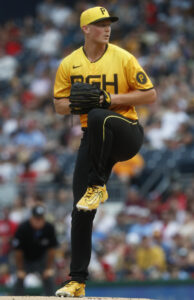
The Pirates announced that they have signed right-hander Mitch Keller to five-year contract extension. The deal was previously-reported by Jeff Passan and Kiley McDaniel of ESPN. It’s a $77MM guarantee for the 27-year-old righty, per Jason Mackey of the Pittsburgh Post-Gazette. Kevin Gorman of the Pittsburgh Tribune-Review reports that the new contract includes the 2024 campaign and runs through 2028. The Tidal Sports Group client had previously been slated to reach free agency following the 2025 campaign.
Keller had already agreed to a one-year, $5.4425MM deal for the upcoming season, avoiding an arbitration hearing in the process. As such, he’ll be guaranteed four years and $71.5575MM in new money. The Associated Press reports the financial breakdown. While Keller’s salary for 2024 is unchanged, he also collects a $2.0575MM signing bonus. He’ll make $15MM in 2025, $16.5MM in ’26, $18MM in ’27 and $20MM in 2028.
That aligns closely with the four-year, $73.5MM extension between the Twins and Pablo Lopez a year ago. Lopez, like Keller now, had between four and five years of big league service at the time of the agreement. A look at MLBTR’s Contract Tracker shows several other comps of note, including Kyle Freeland‘s five-year, $64.5MM deal with the Rockies.
A 2014 second-round pick and longtime top prospect, Keller has taken major steps forward over the past two seasons, pitching to a combined 4.08 ERA in 353 1/3 innings. That solid but unspectacular ERA masks some more promising underlying trends. Keller’s 2022 season took off when he added a sinker to his arsenal in mid-May, helping to take some pressure off what had been a rather hittable four-seam fastball. He was dominant for the first two-thirds of the 2023 season before stumbling with a handful of meltdown starts over the final couple months as he pitched to a new career-high workload (194 1/3 frames).
That ugly start in 2022 and similarly rocky finish in 2023 bookend a stretch of 41 starts that underscore the upside the Pirates are chasing with this signing. At his best from ’22-’23, Keller rattled off a stretch of 240 1/3 innings of 3.25 ERA ball, fanning 23.5% of his opponents against a sharp 7.9% walk rate and strong 48.4% ground-ball rate. And even with the tough finish to his 2023 campaign, Keller ended the year with career-best marks in strikeout rate (25.5%), walk rate (6.7%), average exit velocity (87.7 mph) and hard-hit rate (35.6%). There are plenty of arrows pointing up with regard to the 6’2″, 220-pound righty, and the Bucs surely view him as someone capable of that low-3.00s ERA who can team with 2023 No. 1 overall pick Paul Skenes to anchor the rotation moving forward.
Skenes figures to debut this summer, and the Keller extension gives the organization a chance at a dynamic one-two punch atop the staff for the foreseeable future. For the 2024 season, the Bucs’ rotation will also include veterans Martin Perez and Marco Gonzales, though neither lefty is guaranteed anything beyond the current campaign. (Gonzales has a $15MM club option with no buyout.)
The Pirates’ ability to either develop or acquire sufficient rotation help beyond the ’24 season will be critical to their chances of reversing a nearly decade-long run of losing baseball at PNC Park. Prospects like Quinn Priester, Kyle Nicolas, Jackson Wolf, Jared Jones, Anthony Solometo and Bubba Chandler give the Pirates a solid stock of promising young arms alongside Skenes. Each of Skenes, Jones and Chandler has garnered some top-100 fanfare this season (as Priester has in the past).
Of course, the Pirates’ history of developing starting pitching has been suspect, at best. Much of the struggles came under the now-former front office regime, but we’ve seen touted talents like Gerrit Cole, Tyler Glasnow, Jameson Taillon and Joe Musgrove all struggle to reach their ceilings with the Bucs before being traded. Cole, Glasnow and Musgrove, in particular, broke out with their new clubs. Even Keller took a long road to reach the form that led to today’s five-year agreement. It’ll be imperative for the Pirates that they improve their development of young pitchers and/or find help outside the organization. Notably, they’ve been in constant contact with the Marlins about Miami’s bevy of young pitchers and have explored other trade possibilities as well.
Keller joins outfielder Bryan Reynolds and third baseman Ke’Bryan Hayes as core pieces the Pirates have signed to long-term deals over the past few years. It’s a breath of fresh air for Bucs fans who’d grown accustomed to seeing their best players traded as their arbitration prices escalated. The long-term deals signed by each player don’t necessarily preclude eventual trades — as evidenced by Andrew McCutchen — but it’s nevertheless an encouraging trend for Pittsburgh fans to see a trio of extensions that each top $70MM in guaranteed money, considering their $60MM extension with Jason Kendall back in 2000 stood as the richest in franchise history for upwards of two decades.
Each of Keller, Reynolds and Hayes are now signed through at least the 2028 season — the same year that the team’s control windows over shortstop Oneil Cruz and outfielder Jack Suwinski extend. That quintet, paired with Skenes and catchers Henry Davis and Endy Rodriguez, could form the nucleus of the Pirates’ next contending club. Reynolds’ seven-year, $100MM extension and Hayes’ eight-year, $70MM pact are both generally affordable, even by the Pirates’ modest standards, which should give the Bucs flexibility to supplement that core in other ways.
It’s unlikely the Pirates ever dive into the deep end of the free agent market. But if owner Bob Nutting ever decides he’s finally comfortable spending in even the second tiers of the open market — Francisco Liriano‘s three-year, $39MM contract is the largest free agent signing in Pirates history — the Pirates would have the chance to complement their growing foundation with some meaningful talent and break away from their lengthy run near or at the bottom of the NL Central.
Tigers Sign Gio Urshela
The Tigers added to their infield on Thursday, announcing the signing of Gio Urshela to a one-year, $1.5MM guarantee. Detroit added that Urshela, a client of Rep 1 Baseball, would receive $100K bonuses at each of 500, 530, 560, 590 and 620 plate appearances. That pushes the deal’s maximum value to $2MM.
It’s the second instance this week of a veteran infielder agreeing to a $1.5MM free agent deal that falls well shy of what most pundits expected entering the offseason. Urshela’s deal matches the $1.5MM deal that Amed Rosario inked with the Rays on Tuesday. Detroit president of baseball operations Scott Harris recently suggested his club wasn’t likely to sign any “everyday-type” hitters to big league deals, citing a desire to commit to the wave of young prospects bubbling up to the majors. However, at this price point, Urshela was likely too enticing an opportunity for a team without a clear answer at third base.
Prior to this agreement, the Tigers looked to be preparing to begin the season with a platoon of Zach McKinstry and either Andy Ibanez or Matt Vierling at the hot corner. That pair would presumably hold things own until 2022 first-round pick Jace Jung worked his way to the big leagues.
The Tigers, perhaps not coincidentally, informed Jung today that he wouldn’t be making the Opening Day roster (X link via Evan Woodbery of MLive.com). They’ve also said fellow prospect Justyn-Henry Malloy will move off of third base and focus exclusively on outfield work. The addition of Urshela gives the Tigers a viable everyday option at third base while Jung finishes off his development — or at the very least provides a strong right-handed bat to complement with the lefty-swinging McKinstry.
Beyond the fit at third base, Urshela provides insurance in other ways. He’s played some shortstop in the big leagues, including 71 innings with the Angels in 2023, and could step in for Javier Baez at times. He also gives Detroit a veteran to be leaned upon in the event that top prospect Colt Keith, who signed a six-year extension before making his MLB debut and is expected to open the year as the Tigers’ second baseman, struggles early on. Urshela could handle second base himself or take up a more prominent role at the hot corner, with McKinstry sliding over to second base should Keith ultimately be determined to be in need of some more time in the minors.
Based on track record alone, Urshela was a candidate for a multi-year deal — and he’d likely have been a lock for one had he been fully healthy last season. Dating back to a 2019 breakout with the Yankees, he carries a .291/.335/.452 batting line in 1871 trips to the plate. He’s struck out at an 18.9% clip overall in that time but improved his bat-to-ball skills over the past two seasons between Anaheim and Minnesota; since Opening Day 2022 he’s fanned in just 16.9% of his plate appearances.
Solid as his career has been since becoming a big league regular, Urshela is a rebound candidate. His power output with the Angels was curiously low to begin the 2023 season, with just two home runs and a paltry .075 ISO (slugging minus batting average) through mid-June. He never got much of a chance to right the ship after suffering a pelvic fracture on June 15 of last season. Urshela didn’t require surgery but was on crutches in the aftermath of the injury and wound up missing the remainder of the season as it healed.
Urshela has fairly even platoon splits throughout his career, though he does skew slightly more productive against left-handed pitching (.290/.328/.445 against southpaws; .272/.320/.414 versus righties). That surely held extra appeal for a Tigers club that posted a tepid .241/.312/.398 slash against lefties in 2023, with the resulting 95 wRC+ ranking 22nd among MLB teams.
From a payroll vantage point, the Urshela deal barely makes a dent. He’s effectively replacing a league-minimum player on the roster, so he’s only adding about $750K of additional guarantees to the Tigers’ projected payroll. Roster Resource pegs Detroit at a $108.4MM projection for the 2024 season, which checks in more than $90MM shy of the team’s franchise-record mark set back in 2017 (under late owner Mike Ilitch, whose son, Chris, now runs the team). As such, there ought to be further resources available if similar bargain options to this Urshela addition present themselves. There’s no indication, however, that the Tigers have considered a higher-profile splash in free agency or on the trade market in the late stages of the offseason.
ESPN’s Jeff Passan first reported the Tigers and Urshela were in agreement on a one-year, $1.5MM deal. Jon Heyman of the New York Post reported the presence of incentives, which Evan Petzold of the Detroit Free-Press specified as being worth up to $500K.