
Orioles Sign Kolten Wong To Minor League Deal
The Orioles announced Wednesday that they’ve signed veteran second baseman Kolten Wong to a minor league deal. The PSI Sports Management client will join their big league camp as a non-roster invitee. Baltimore also confirmed its previously reported signing of right-hander Julio Teheran — also on a minor league deal and non-roster invitation.
Wong split the 2023 season between the Mariners and Dodgers, struggling mightily over a monthslong stint in Seattle before posting sharp numbers in a tiny sample of 34 plate appearances with the Dodgers late in the season. The now-33-year-old veteran hit just .165/.241/.227 in 216 trips to the plate as a Mariner — 65% worse than league average, by measure of wRC+ — before batting .300/.353/.500 with a pair of homers in his brief time with Los Angeles.
Prior to last season’s uneven and generally ugly showing, Wong was a relatively consistent source of slightly above-average production at the plate and standout defense. A two-time Gold Glove winner at second base, he was the game’s premier defensive option at the position for a few years. And from 2017-22, Wong tallied 2564 plate appearances between the Cardinals and Brewers, slashing a combined .269/.349/.414 (about 7% better than average, per wRC+).
Wong has never been a premier power hitter or speed threat, but he does have five seasons of double-digit home run totals and another five seasons of double-digit stolen base totals. He’s fanned at a 16% clip that’s well south of the league average while walking at a 7.7% rate that’s less than one percentage point shy of the league mean.
Given the sheer volume of infield talent the Orioles possess, Wong will face an uphill battle to make the club. Gunnar Henderson can handle either position on the left side of the diamond, and he’ll be joined by a combination of ballyhooed prospects including Jordan Westburg, Connor Norby and Jackson Holliday — the current No. 1 overall prospect in baseball.
Baltimore also has veteran depth/utility options in the form of Ramon Urias and Jorge Mateo, the latter of whom is seeing more time in the outfield this spring on account of the wealth of infield talent the O’s have in house. Corner infielder Coby Mayo is also rapidly climbing the minor league ranks and could debut this season, while yet another top prospect, Heston Kjerstad, is also in the mix for at-bats alongside veteran Ryan Mountcastle at first and Anthony Santander in right field. One thing perhaps working in Wong’s favor is his left-handed bat. Each of Westburg, Norby, Mayo, Urias and Mateo bats right-handed. If the O’s want a veteran lefty bat off the bench who can spend some time at second and provide insurance for their bevy of talented but inexperienced infielders, Wong could fit the bill.
Guardians Shut Trevor Stephan Down For Three Weeks
The Guardians have shut setup man Trevor Stephan down for the next three weeks due to a deep bone bruise in his right elbow, manager Stephen Vogt announced to reporters this morning (X link via Mandy Bell of MLB.com). There’s no concern about Stephan’s ulnar collateral ligament or any structural damage in his elbow, Vogt added.
A three-week shutdown for Stephan makes a potential season-opening stint on the injured list a strong possibility — if not a likelihood. Opening Day is just one month away, and it seems as though Stephan won’t pick up a ball until we’re around eight days out from that point.
Stephan, 28, was a Rule 5 pick out of the Yankees organization heading into the 2021 season and has proven to be one of the most shrewd Rule 5 selections by any team in recent seasons. He’s pitched at least 63 innings out of the Cleveland ‘pen in each of the past three seasons, saved six games and piled up 50 holds in that time. Stephan moved from low-stakes outings into a high-leverage role in 2022, and over the past two seasons he’s given the Guards 132 1/3 innings of 3.40 ERA ball with even better marks from metrics like FIP (2.90) and SIERA (3.18) thanks in large part to his excellent rate stats. Since 2022, Stephan has whiffed 28% of his opponents against a 7.8% walk rate while keeping the ball on the ground at a solid 44.6% clip.
Stephan is less than two weeks into his spring training and will now be shut down for at least 21 days. He’ll effectively be starting his spring over whenever he does resume throwing. If there are no further setbacks and the issue heals within the provided three-week window, there’s a chance he could still ramp up and be back with the big league club before the end of April, but only time will tell how his elbow mends.
Assuming Stephan is indeed out to begin the season, trade acquisition Scott Barlow will likely step up as the primary setup man to closer Emmanuel Clase. James Karinchak, Sam Hentges, Eli Morgan and Nick Sandlin could all see some extra leverage situations early in the 2024 campaign as well. In general, the Guardians have a deep bullpen that can absorb a relatively short absence for one of its top relievers to begin the season.
The depth of that relief corps is perhaps one reason the team at least listened to trade offers on Clase back in December, but a deal never seemed likely due to the closer’s remaining five years of affordable control under the terms of the extension he signed in 2022. Clase is guaranteed just $15MM over the next three seasons and, via a pair of club options, could earn a total of $33MM from 2024-28. Given that affordable deal, the asking price in a trade was always going to be enormous — and thus unlikely to be met. That’s become even more true as the season has drawn nearer, and an injury to Stephan even further reduces what was already a minuscule chance of a deal coming together.
Padres, Tim Locastro Agree To Minor League Deal
The Padres have agreed to a minor league contract with fleet-footed outfielder Tim Locastro, reports Jon Morosi of MLB Network. The Warner Sports Management client will join their big league camp as a non-roster invitee.
Locastro, 31, spent the 2023 season with the Mets organization, appearing in 43 big league games and another 19 minor league contests while also missing time with a thumb injury that required surgery. He received just 67 plate appearances in his 43 big league games — a reflection of his prowess as a pinch-runner and defensive replacement but generally light bat at the plate. Locastro batted .232/.338/.393 in his small sample of MLB work, bringing his career line to .228/.327/.337 in 616 MLB plate appearances.
While Locastro doesn’t walk much (5.8%), he’s generally had solid bat-to-ball skills (20.8% strikeout rate) and has also made an artform out of bolstering his OBP by crowding the plate and leaving himself susceptible to being plunked by opponents. It’s perhaps a dubious (and painful) “skill” to master, but Locastro has been hit in a borderline comical 7% of his MLB plate appearances. That’s allowed him to further capitalize on his elite speed; he’s swiped 45 bags in 50 attempts as a big leaguer.
Locastro has lost a bit of that speed as he’s aged but still remains among the game’s fastest players. Statcast credited him as the very fastest player in MLB from 2019-21 and ranked him in the 99th percentile in 2022, but he was “only” in the 93rd percentile of big leaguers in terms of sprint speed in 2023.
The Padres already have a heavily right-handed-hitting roster, and Locastro would further add to that if he were to make the roster. But he’s an elite source of speed off the bench who can handle all three outfield spots, and the Friars are perilously thin on outfield depth — regardless of handedness. At the moment, the Padres have only three outfielders on the 40-man roster: Fernando Tatis Jr., Jose Azocar and Jurickson Profar.
Locastro joins Oscar Mercado as a veteran non-roster option in camp, as well as former big leaguers Cal Mitchell and Bryce Johnson (who each have far less MLB experience). There’s a chance that top shortstop prospect Jackson Merrill will break camp with the club as a left fielder as well, but the 20-year-old has just 46 games above A-ball and none in Triple-A, so he could also head to the minors to begin the season.
Let’s Find A Home For Michael Lorenzen
In case you hadn’t heard, there’s a group of high-profile free agents still available this offseason. They’re all represented by the same agency. A few people have pointed this out. There were four of them, and with Cody Bellinger‘s new deal with the Cubs, there are now three. (Although J.D. Martinez still could be included to make it a quartet.) It’s garnered some mild attention around the baseball world.
So much focus has been placed on the “Boras Four” — and not just for the cringe nickname — that it’s overshadowed the fact that the free agent market still has a handful of good, quality big leaguers who can help teams. None rejected a qualifying offer. None are looking for nine-figure deals. None will require a team to commit money into the 2028 season or beyond.
Arguably most prominent among the remaining “second tier” of the free agent market at this juncture of the offseason is right-hander Michael Lorenzen. The 32-year-old righty is fresh off a career-high 153 innings in what was only his second full season as a starter after a six-year run in the Cincinnati bullpen.
Lorenzen isn’t an ace, but he started 25 games last year (plus four relief appearances) and made the All-Star team after a strong first half of the season with the Tigers. Part of his selection to the Midsummer Classic was by default — every team needs an All-Star representative, and the Tigers didn’t have many candidates — but that shouldn’t be used to downplay the strength of Lorenzen’s first few months of the season.
Heading into the All-Star Game, Lorenzen was sporting a solid but unspectacular 4.03 ERA in 87 innings. He’d started 15 games, fanned 19% of his opponents and issued walks at a tidy 5.7% clip. On a one-year, $8.5MM contract, he was providing fine value. Lorenzen pitched two-third of an inning in the All-Star Game, and then came roaring out of the second-half gates in what wound up being his best stretch of the season. The right-hander finished his first half with five shutout frames and began the second half with another 13 2/3 scoreless innings. By the time the Phillies traded for him in the run-up to the annual trade deadline, Lorenzen was sitting on a 3.58 ERA and 3.86 FIP in 105 2/3 innings.
By now, most fans and readers are familiar with Lorenzen’s first outings as a Phillie. He held the Marlins to a pair of runs through eight excellent innings in his team debut before blanking the Nationals in a 124-pitch no-hitter during his first appearance pitching in front of Philly fans at Citizens Bank Park. That pair of gems dropped his season ERA all the way to 3.23. From July 6 through Aug. 9, Lorenzen pitched 40 2/3 innings with a 1.11 ERA and 31-to-12 K/BB ratio.
And, just as most readers were likely already aware of those heights, the subsequent lows for Lorenzen have also been well-documented. In his followup to that no-hit gem, Lorenzen was rocked for six runs by that same Nationals offense, lasting just 3 1/3 innings. That commenced a calamitous stretch where he was torched for 27 runs over his next 26 1/3 innings. The Phillies were always likely to move Lorenzen to the bullpen for the postseason, given his experience in the role and the strength of the top of their staff, but they took that step several weeks early.
Lorenzen finished out the year with four shutout innings of relief across three appearances, but that did little to repair the damage of his disastrous late-August meltdown. He finished the season with a 4.18 ERA (4.46 FIP, 4.87 SIERA), 17.8% strikeout rate, 7.5% walk rate, 41% grounder rate and 1.18 HR/9 — solid production for a fourth starter but nowhere near as enticing as his numbers looked with just six weeks to go in the season.
It’s worth wondering the extent to which Lorenzen simply wore down. He pitched only 110 1/3 innings the year prior between the big leagues and a minor league rehab stint with the Angels. He didn’t pitch more than 85 innings in a season from 2016-21. Ramping up to more than 150 frames on the year meant pushing his body to levels it hadn’t reached since his age-23 season back in 2015 — his rookie MLB campaign and final season as a starter before the Reds moved him to relief.
Despite the shaky finish, Lorenzen wound up with solid numbers on the season for a second straight year. He’s yet to make a full slate of 30+ starts in a season, but it’s not unreasonable to think he could do so in 2024-25 after building up to 153 innings in 2023. And dating back to his return to a rotation in 2022, he’s pitched 250 2/3 innings of 4.20 ERA ball with a 19% strikeout rate, 8.8% walk rate and 44.5% ground-ball rate. Lorenzen has averaged 94.6 mph on his heater, induced chases off the plate at a nice 32.6% clip and logged a 10.2% swinging-strike rate that’s not far below the 11.1% MLB average.
It’s not an ace profile by any means, but there are plenty of big league teams that are preparing to trot out an unproven and/or below-average arm in the fourth or fifth spot of their rotation. Plugging a roughly league-average starter into one of those spots makes sense for a number of clubs, and Lorenzen shouldn’t break the bank. He’s signed one-year deals for $6.75MM and $8.5MM over the past two seasons. A relatively modest two-year deal or even a one-year deal at a bump over last year’s salary doesn’t seem unreasonable.
For teams seeking rotation help but unwilling/unable to spend at the necessary levels to sign Snell or Montgomery, a short-term deal with Lorenzen could make sense. That’s not true of every team, however. Let’s take a run through the league and look for some potential fits.
Teams with generally full rotations
Each of the Astros, Blue Jays, Braves, Cardinals, Guardians, Mariners, Marlins, Phillies, Reds, Royals and Tigers have a largely set rotation featuring five veterans and/or young starters who are locked into jobs and unlikely to be displaced by Lorenzen.
Kansas City and Detroit might be stretches to land in this group, but for the Royals, signing Lorenzen would mean pushing Jordan Lyles and his $8.5MM salary to the bullpen or cutting him loose. Based on 2023 performances, they’d be better for it, but that’s a lot of money for the Royals to eat. The Tigers, meanwhile, have one rotation spot up for grabs after signing Jack Flaherty and Kenta Maeda this winter. They’d presumably like to leave that open for Matt Manning, Casey Mize and any other young arms to try to seize.
Top luxury payors who’d effectively owe double
Each of the Dodgers, Yankees and Mets are third-time luxury tax payors who’d be taxed at a 110% rate for any additional free agent signings. Even adding Lorenzen on a modest one-year, $9MM deal would mean taking on $9.9MM of taxes and put the total cost of signing at $18.9MM. The Mets recently saw Kodai Senga go down with a shoulder injury, but shelling out nearly $19MM for one year of Lorenzen doesn’t seem like a plausible outcome.
Rebuilding/non-competitive teams
The A’s, White Sox and Nationals are all at various stages of a rebuilding effort. Any of the three could have been a fit for Lorenzen earlier this offseason, but none seem likely now. The A’s signed Alex Wood and traded for Ross Stripling, giving them four set starters and a deep stock of unproven arms to vie for the fifth spot. The White Sox signed Erick Fedde and Chris Flexen in addition to acquiring Michael Soroka and Jared Shuster. They also didn’t trade Dylan Cease. Lorenzen might be an upgrade, but it seems like they’ve added what they’re going to add. The Nationals haven’t done anything to bolster a sub-par rotation beyond signing Zach Davies to a minor league deal, but GM Mike Rizzo has effectively declared his team out of the market for additional big league arms.
I’d argue that another non-competitive club, the Rockies, should absolutely be interested in signing Lorenzen, given the dearth of quality innings among their group of incumbents. But Colorado has shown minimal interest in spending this offseason, and convincing any pitcher to take a short-term deal at Coors Field is a tall order.
Payroll and/or luxury tax issues
- Cubs: The Cubs’ re-signing of Bellinger put them around $3MM shy of the base luxury tax threshold. They wouldn’t face a major penalty for signing Lorenzen — likely just a couple million dollars or so — but they have four locked-in starters and a deep collection of arms vying for the fifth spot (e.g. Jordan Wicks, Hayden Wesneski, Ben Brown, Javier Assad) with top prospect Cade Horton not far behind. They’re not a great fit.
- Rangers: Despite last year’s World Series win, Texas has had an unexpectedly quiet offseason amid uncertainty regarding the team’s television broadcast outlook. The Rangers could clearly use another arm with each of Max Scherzer, Jacob deGrom and Tyler Mahle opening the season on the injured list. The team seems content to ride with an in-house quintet of Nathan Eovaldi, Jon Gray, Dane Dunning, Andrew Heaney and Cody Bradford while waiting on that veteran trio to return, though. GM Chris Young said earlier this month that he doesn’t foresee any further additions of note.
- Rays: The Rays should be shopping in this tier for rotation help, given that they’re relying on a pair of injury-prone veterans (Zach Eflin, Aaron Civale), a converted reliever (Zack Littell) and a pair of talented but unproven prospects (Ryan Pepiot, Taj Bradley) to open the season. Shane Baz, once the game’s top pitching prospect, will be back from 2022 Tommy John surgery but on an innings limit. Jeffrey Springs (Tommy John surgery) and Drew Rasmussen (flexor surgery) will be back at some point in 2024 but perhaps not until the season’s second half. Getting to that point could be a challenge with the Rays’ current group, but Tampa Bay’s projected $99MM Opening Day payroll is (somehow) a franchise record as it is. There’s room to sign Lorenzen for two years on a backloaded deal (particularly if the Rays eventually trade Harold Ramirez and his $3.8MM salary), but their current financial outlay makes them a reach — even if there’s a clear need in the rotation.
- Twins: The Twins have shown interest in Lorenzen but, like the Rangers, have scaled back their spending amid TV revenue concerns. After acquiring Manuel Margot yesterday, president of baseball ops Derek Falvey suggested he’s likely finished adding to the big league roster. The Twins have a decent starting mix with Pablo Lopez, Joe Ryan, Bailey Ober, Chris Paddack, Anthony DeSclafani and Louie Varland as it is. Signing Lorenzen would deepen the group, but an addition apparently isn’t viewed as an imperative so long as the current group remains healthy in camp.
Plausible fits
- Angels: Perhaps their attitude toward Lorenzen is “been there, done that,” but the Halos have plenty of uncertainty with a rotation of Reid Detmers, Patrick Sandoval, Griffin Canning, rebound hopeful Tyler Anderson and the inexperienced Chase Silseth. They took a shot on Zach Plesac, but he has minor league options remaining. Jose Suarez is another option, but he’s also in need of a rebound. If owner Arte Moreno wants to continue his resistance to long-term deals for pitchers, the Angels could bring Lorenzen back without coming close to their franchise-record for payroll or to the luxury tax threshold.
- Brewers: Gone are the days of the Brewers’ nearly unrivaled rotation depth. Freddy Peralta is back to lead a staff that also features a re-signed Wade Miley and Colin Rea. Newcomers Jakob Junis and DL Hall — acquired in the surprise late-offseason trade of Corbin Burnes — round things out. Lefty Aaron Ashby will vie for a spot, and prospect Robert Gasser isn’t far from the big leagues himself. But the Brewers lack some certainty in the rotation and project for a $109MM Opening Day payroll that’s modest even by their standards.
- D-backs: Arizona already signed Eduardo Rodriguez to join Zac Gallen, Merrill Kelly and Brandon Pfaadt in the rotation. Between Ryne Nelson, Slade Cecconi, Tommy Henry and Corbin Martin, they have some depth for the fifth slot, but none of it is proven. The Snakes’ $143MM payroll will already be a franchise record by about $11MM, but if there’s room for one more addition, Lorenzen would solidify the final rotation spot on a win-now club that’s looking to follow up on last year’s surprise World Series bid.
- Giants: The Giants’ rotation looked like a mess even before injury scares to presumptive fourth and fifth starters Keaton Winn and Tristan Beck. San Francisco is reportedly still in the mix to sign Blake Snell, so there’s clearly money left to spend. Right now, they’ll follow ace Logan Webb with top prospect Kyle Harrison, reliever-turned-starter Jordan Hicks, Winn and Beck — if the latter two are healthy. (Winn recently resumed throwing after experiencing nerve discomfort in his elbow; Beck left camp to be evaluated for a hand injury.) Frankly, they could stand to add one of Snell/Montgomery and Lorenzen.
- Orioles: The acquisition of Burnes quelled some anxiety from O’s fans after an otherwise silent offseason on the starting pitching front, but there’s now concern elsewhere in the rotation, as No. 2 starter Kyle Bradish is trying to rehab a UCL strain in his pitching elbow. He wouldn’t be the first pitcher to avoid going under the knife after a UCL injury, but the overwhelming majority of such injury scares end in surgery. Meanwhile, John Means is behind schedule and likely to open the season on the injured list due to his own elbow troubles. Grayson Rodriguez, Tyler Wells, Dean Kremer, Cole Irvin, Bruce Zimmermann and Jonathan Heasley create some depth on the 40-man, but the Orioles are much deeper in high-end position player prospects than in pitchers. Baltimore has just $1MM on the 2025 books and is projected for a mere $96MM payroll. They should absolutely be looking for an addition of some sort, and they reportedly showed interest in Lorenzen before acquiring Burnes.
- Padres: Another team that’s reportedly shown interest in Lorenzen, the Padres have cut payroll significantly and are now more than $20MM from the luxury threshold and nearly $100MM shy of their 2023 payroll. They only have two clear-cut, proven starters: Joe Musgrove and Yu Darvish. Michael King, acquired in the Juan Soto trade, will fill the third spot in the rotation after a strong showing with the Yankees in 2023, but he’s never started more than nine games in a big league season. The other two spots are entirely up for grabs among a group of largely untested arms. There might not be a clearer on-paper fit, although…
- Pirates: …if there is one, it might be in Pittsburgh. The Bucs will roll with recently extended Mitch Keller, Martin Perez and Marco Gonzales in the top spots of their rotation. Johan Oviedo had Tommy John surgery earlier this offseason. Last year’s No. 1 pick, Paul Skenes, should quickly ascend to the big leagues but that probably won’t happen until this summer. Bailey Falter, Quinn Priester, Jackson Wolf, Kyle Nicolas, Luis Ortiz and Roansy Contreras are all on the 40-man, but either lack MLB success or are (in the case of Falter and Contreras) are looking to put an ugly 2023 behind them. The Pirates have been talking to the Marlins about Edward Cabrera and other starters, and GM Ben Cherington has been open about his desire to further add to the rotation.
- Red Sox: Not to be outdone in their need for rotation help amid a shaky collection of starters, Boston has been in a staring contest with Montgomery all winter. If he signs elsewhere or they deem the price too high, Lorenzen could easily fit into the budget of a team that’s nearly $60MM from its franchise record and not close to the luxury tax. Lucas Giolito and Brayan Bello are set, but the combination of Nick Pivetta (who lost his rotation spot for a time in ’23), Tanner Houck, Kutter Crawford and Garrett Whitlock lacks reliability. The Sox need quality innings, but ownership clearly put its foot in its mouth earlier this offseason with a “full-throttle” proclamation that has been followed up with payroll reduction and modest additions on the margins of the roster.
—
If payroll weren’t an object, the Rays would join the Padres, Pirates, Red Sox, Giants and Orioles as the clearest fits for a solid, if unspectacular back-of-the-rotation arm like Lorenzen. Finances very likely are an issue for Tampa Bay, however, but any of those five other clubs — arguably in that order — should be able to find room to raise their rotation’s floor by plugging Lorenzen in at a price that won’t break the bank.
A’s Notes: Coliseum, Wood, Spence
The Athletics are set to meet with the African American Sports & Entertainment Group next week to discussing selling their 50% stake in the Oakland Coliseum, reports Mick Akers of the Las Vegas Review-Journal. The city currently owns the other 50% of the Coliseum complex. Oakland’s AASEG also offered to purchase a stake in the Coliseum last year but were rebuffed, Akers adds.
A’s fans will want to check out the report for full details, but the A’s could sell off their share of the Coliseum complex entirely, with the AASEG looking to develop potential sites for expansion franchises in the NFL and WNBA. Akers adds that the A’s are “open” to sharing the Coliseum with the Oakland Roots and Oakland Soul soccer clubs and selling their share of the facility if it can facilitate an agreement wherein the city of Oakland allows the club to extend its lease at the Coliseum from 2025-27 — the interim years between the current lease expiration (at the end of 2024) and the planned opening of their new Las Vegas ballpark.
Turning to the team itself, the ’24 Athletics will feature a largely revamped rotation. The team’s hope had been that an aggressive fire sale of talents like Matt Olson, Matt Chapman, Chris Bassitt, Sean Manaea, Sean Murphy and others would create a base of controllable young talent around which to build. That hasn’t played out. Most of the young pitchers acquired thus far in the rebuild have failed to progress. That led the front office to look outside the organization, signing Alex Wood to a one-year deal worth $8.5MM and swinging a trade to acquire Wood’s former Giants teammate, Ross Stripling.
Wood spoke with John Shea of the San Francisco Chronicle about both his excitement to be back into a full-time starting role and some frustration with the manner in which the Giants handled last year’s staff. Wood made three starts to begin the season, briefly landed on the injured list, and was surprised to be asked to pitch in relief upon returning.
“When I came back [from the injured list] four weeks later, it was like, ‘Hey can you throw an inning out of the bullpen against Arizona Friday, and we’ll start you on Monday in Philly?’” Wood explained. “It was from the beginning of the year we were doing stuff like that. It definitely wasn’t the easiest thing.”
The Giants used 13 starting pitchers in 2023, but that included a handful of relievers who were regularly used as openers. Ryan Walker, Scott Alexander (also an Athletic now) and John Brebbia were the most frequent openers for a Giants club that deployed that tactic a whopping 35 times in 2023 despite rostering several veteran rotation pieces. Wood, Stripling, Sean Manaea and Jakob Junis have all worked as starters in the past but were used in similar hybrid roles in ’23, with the results ranging from pedestrian to sub-par. Finding a more stable rotation role was a priority in free agency, Wood told Shea.
Further down the rotation pecking order is right-hander Mitch Spence, the top pick in December’s Rule 5 Draft. Spence, selected out of the Yankees organization, is in camp with the A’s competing for a spot on the roster, ideally in the rotation. But with four spots spoken for — Wood, Stripling, Paul Blackburn and JP Sears — securing a spot is a tall order. Manager Mark Kotsay spoke highly of Spence in chatting with Martin Gallegos of MLB.com, however, and suggested that there could be a long relief role available for Spence even if he doesn’t seize a spot on the starting staff.
“He’s going to compete for a rotation spot,” said Kotsay of Spence, “and we’ll probably entertain looking at a long role for him if the rotation doesn’t make sense or if he doesn’t make it.”
The 25-year-old Spence paced all minor league pitchers with 163 innings over the course of 29 starts in 2023. He posted a 4.47 ERA with the Yankees’ top affiliate in Scranton, fanning 21.8% of his opponents against a sharp 7.3% walk rate. Spence notched an already impressive 50% ground-ball rate last season, but he tells Gallegos he’s also working to incorporate a sinker into his repertoire this spring, in an effort to up that grounder rate even further. Kotsay likened Spence to his new teammate, Blackburn, noting that he’s not overpowering and is more location-focused while praising his ability to pitch inside.
If Spence doesn’t make Oakland’s roster, he’ll need to be exposed to waivers and, if he clears, offered back to the Yankees for a nominal sum of $50K. So far, the right-hander has made just one appearance in camp, pitching two innings and allowing a run on three hits with no walks and three punchouts. Spence will compete with names like Luis Medina, Joe Boyle, Joey Estes, Adrian Martinez, Freddy Tarnok, Kyle Muller and Osvaldo Bido for either a rotation or swingman spot with the A’s.
MLBTR Chat Transcript
Click here to read a transcript of Tuesday’s chat with MLBTR’s Steve Adams.
White Sox Acquire Bailey Horn From Cubs
The White Sox and Cubs have agreed on a trade sending left-hander Bailey Horn from the Cubs to the Sox in exchange for minor league righty Matt Thompson, per announcements from both clubs. Sahadev Sharma and Ken Rosenthal of The Athletic reported on the deal prior to the official announcement. Sharma reported last night that the Cubs were exploring deals to trade a pitcher off the back end of their 40-man roster, in order to open a spot for the newly re-signed Cody Bellinger.
Horn, 26, will return to the club that originally selected him in the fifth round of the 2020 draft. He pitched in the Sox’ system for a portion of the 2021 season but was traded to the Cubs in exchange for veteran reliever Ryan Tepera just over a year after being drafted. Current Sox general manager Chris Getz was the team’s farm director in 2020-21 and clearly saw plenty in Horn to like, given that he’s now reacquired the lefty.
Horn split the 2023 season between the Cubs’ Double-A and Triple-A affiliates, pitching to a combined 4.21 ERA in 65 innings out of the bullpen. He fanned a hearty 28.7% of his opponents but struggled with his command, issuing walks at a 12.5% clip. Baseball America ranked him 28th among Cubs farmhands this season, touting a fastball that sits 94-96 mph and a pair of potentially above-average breaking balls (a plus slider and a solid curveball). However, BA’s report also noted that Horn has a “violent arm action that yields well below-average control and significant injury risk.”
Now back with the South Siders, Horn will give the Sox a near-term option in the bullpen. He’s pitched exclusively in relief in each of the past two seasons and was only just added to the 40-man roster this offseason, meaning he has a full slate of three minor league option years remaining.
In exchange for Horn, the Cubs will receive the 23-year-old Thompson — a starting pitching prospect whom the White Sox selected in the second round of the 2019 draft. He started 27 games at the Double-A level in ’23, pitching to a 4.85 ERA with a 23.9% strikeout rate, 15% walk rate and 40.7% ground-ball rate. Scouting reports on Thompson tout a heater that reaches 97 mph and a potentially plus curveball, but like Horn he’s working to overcome below-average command. Baseball America tabbed him 30th among ChiSox prospects heading into the 2024 season.
Much like Horn, Thompson is a project who’s reached the upper minors but will likely need to make some refinements before earning a look at the MLB level. He’s pitched 109 and 124 innings, respectively, over the past two seasons. He could join the rotation in Double-A Tennessee or in Triple-A Iowa and will provide the Cubs with some upper-level rotation depth. The Cubs are increasingly deep in that regard, with names like Jordan Wicks, Hayden Wesneski, Ben Brown and Javier Assad all in the mix for their final rotation spot, and top prospect Cade Horton rapidly climbing the organizational ladder.
Yankees Continue Talks With Blake Snell
As Blake Snell continues to linger in free agency, speculation regarding him and the Yankees persists. The Yanks reportedly offered the lefty five years and $150MM before pivoting to sign Marcus Stroman on a two-year deal last month. Since then, it’s been reported that the Yankees still have an offer out to Snell, though the shape of that offer is presumably different after signing Stroman and pushing themselves into the top tier of luxury-tax penalization in the process. Whatever is presently on the table doesn’t appear to be a “take it or leave it” type of offer, as the New York Post’s Jon Heyman writes that the Yankees and Snell talked about various contract parameters as recently as yesterday.
Notably, Heyman writes that agent Scott Boras has suggested the possibility of a shorter-term deal with higher annual salaries and opt-out opportunities. That’d be a pivot from Snell seeking maximum guarantees, as has been the case throughout the winter. It’s also not a concept that works well with a team in the Yankees’ situation.
The Yankees are a third-time luxury tax payor who are in the top tier of penalization. Any additional spending at this point will be taxed at 110%. And since the luxury tax is based on a contract’s average annual value, there’s no skirting the issue by backloading a deal. In that sense, dialing up the contract’s AAV only further penalizes the Yankees. The taxes are only part of the issue. New York would also be forfeiting its second- and fifth-highest draft selections, as well as $1MM from next year’s international bonus pool, in order to sign Snell, who rejected a qualifying offer from the Padres.
A longer-term pact that stretches out an agreed-upon guarantee while weighing down the AAV would be more sensible. The Yankees took that approach with DJ LeMahieu in free agency a couple years back, when he inked a six-year deal at a time when a contract around four years was widely expected. There’s no indication such an arrangement is currently being discussed, however, and going longer term on Snell would present the Yankees with its own slate of worrying factors. New York already has Gerrit Cole, Aaron Judge, Carlos Rodon and Giancarlo Stanton under contract through the 2027 season. Each of Cole, Rodon and Judge are on the books through 2028, giving the Yankees $103MM in guaranteed money on the books in a season that’s still four years down the road. Add in the $10MM buyout on Stanton’s 2028 option, and that’s $113MM of considerations for that season.
Furthermore, they’ll very likely wind up tacking an extra year onto Cole’s contract this coming offseason. The reigning AL Cy Young winner has an opt-out in his contract after the ’24 season, but the Yankees can void that by picking up a 2029 club option at $36MM. That’d give the Yanks $76MM on the books as far down the line as 2029; adding Snell on a long-term deal designed to tamp down his contract’s AAV could push them close to or even north of $100MM in commitments a half-decade from the current season. Not only that, but Judge will be 37 that year and Cole will be 38. Snell would be 36. It’d be plenty understandable if the Yankees have some trepidation about locking in $100MM+ in guarantees to three players who’ll be 36 or older in 2029.
Heyman also notes that the Yankees have some interest in fellow lefty and fellow unsigned Boras client Jordan Montgomery, whom they of course originally drafted and developed. However, the Yankees prefer Snell, and the financial hurdles just laid out regarding Snell applies to Montgomery — but on a slightly smaller scale, as he doesn’t have quite the earning power of a two-time Cy Young winner.
Twins Acquire Manuel Margot
The Twins announced the acquisition of veteran outfielder Manuel Margot, infield prospect Rayne Doncon and cash from the Dodgers in exchange for minor league shortstop Noah Miller. Los Angeles is reportedly covering $6MM of Margot’s $10MM salary for the upcoming season. The Dodgers originally received $4MM from the Rays when acquiring Margot alongside Tyler Glasnow earlier this winter; Tampa Bay also remains on the hook for a $2MM buyout on a $12MM club option for 2025.
The Twins placed right-hander Josh Winder on the 60-day injured list to open a roster spot for Margot, announcing that Winder has a scapular stress fracture. His exact timeline in unclear but he’ll be ineligible to rejoin the club until late May at the earliest.
Minnesota has been on the lookout for a right-handed-hitting outfielder who could cover all three spots for much of the offseason. They’d previously been tied to free agents like Adam Duvall and Enrique Hernandez, and they’d also maintained an interest in re-signing Michael A. Taylor, who belted 21 home runs as a Twin in 2023. However, it seems they’ve found a deal to their liking on the trade front, presumably ending those free agent pursuits.
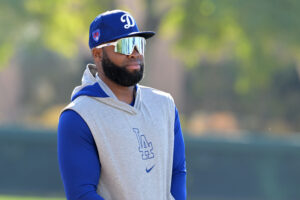
In Margot, the Twins are acquiring that righty bat they’ve been seeking but are also buying low on a player who’s been hampered by knee troubles dating back to the 2022 season. Margot missed roughly half of the ’22 campaign with a significant strain of the patellar tendon in his right knee. He was limited to just 363 plate appearances and turned in a solid, if unspectacular .274/.325/.375 slash (101 wRC+). He followed that up with a .264/.310/.376 line in 336 plate appearances this past season.
Had Margot enjoyed a season of his typical defensive excellence in ’23, that offensive output would’ve made him an above-average all-around contributor. But in the wake of that knee injury, his once-elite defensive grades slipped closer to average. Statcast noted that Margot’s range and sprint speed both declined in 2023. Defensive Runs Saved pegged him at -3 on the season, while Statcast’s Outs Above Average credited him at +3. Either way, it’s a notable drop for a player who posted 13 DRS and 16 OAA as recently as 2021. The Twins, presumably, are confident that as Margot distances himself from that knee injury, he can rebound in the field — if not back to peak form than at least to a clearly above-average defender at all three spots.
In Minnesota, Margot will provide the Twins with some insurance in the event of another injury to rarely-healthy center fielder Byron Buxton. Beyond that, he’ll give the Twins a righty bat that can spell lefty-swingers Matt Wallner and Max Kepler in the corners. Margot is a career .281/.341/.420 hitter (109 wRC+) against left-handed pitching, so he’ll likely see his fair share of pinch-hitting opportunities for a Twins club that tends to play matchups throughout the game. Margot can also serve as a late-game defensive upgrade in left over Wallner or a late-game pinch runner. Even with a downturn in his sprint speed, he still ranked in the 75th percentile of MLB players last year, per Statcast.
The Twins will also pick up Doncon, a 20-year-old infielder who signed with the Dodgers for just under $500K as an international amateur during the 2021-22 signing period. FanGraphs ranked him 12th among Los Angeles prospects as recently as last season, touting potentially plus raw power and an above-average hit tool as his best tools. The Athletic’s Keith Law ranked him 19th among L.A. farmhands just last week.
Doncon has played shortstop, second base and third base in the Dodgers’ system and climbed as high as A-ball during 2023 — his age-19 season. He spent the entire year at that level and posted underwhelming numbers (.216/.283/.368) — but did so against much older competition. Scouting reports suggest he’ll have to move to either third base, second base or the outfield as he fills out his projectable 6’2″, 176-pound frame. Doncon possesses significant power potential but questions about his pitch recognition and eventual defensive home. He’s a couple years off from being a potential big league factor, but at this point he’s a more highly regarded prospect than Miller.
Doncon’s inclusion in the deal aligns with the Twins’ general M.O. in deals of this nature; Minnesota tends to push trade partners to include prospects of varying quality even when they’re the team acquiring the established player (e.g. Jose Salas in the Pablo Lopez trade, Gabriel Gonzalez in the Jorge Polanco deal, Ronny Henriquez in the Isiah Kiner-Falefa swap, Brayan Medina in the Chris Paddack trade, Francis Peguero in the Sonny Gray trade, etc.).
As for the Dodgers’ end of things, they’ll add a former supplemental first-rounder in the deal. Miller, 21, was the No. 36 overall pick by the Twins in 2021 but hasn’t lived up to that billing at the plate thus far. He’s regarded as a solid defender at shortstop but has posted only a .220/.326/.318 batting line in the minor leagues, including a .223/.309/.340 slash in High-A last year. Miller gives the Dodgers a glove-first shortstop option who can begin the 2024 season either with a second run at High-A or in Double-A. Even if his bat never comes around, there’s utility upside for Miller within the next few years based on the quality of his defense.
Like Doncon, it should be noted Miller’s pedestrian production in 2023 came against much older and more advanced competition. Both players were more than two years younger than the average player at their respective minor league levels. Neither needs to be protected from the Rule 5 Draft until after the 2025 season.
As with the Twins getting Doncon included in this deal, the Dodgers’ acquisition of Miller fits a recent pattern. Los Angeles has bought low on recent high-profile draftees that needn’t be added to their 40-man roster this winter while performing maintenance to make room for new acquisitions. In addition to Miller, the Dodgers picked up former Yankees first-rounder Trey Sweeney in their Victor Gonzalez swap and former Cubs second-rounder Jackson Ferris in trading away Michael Busch.
Perhaps most importantly for the Dodgers, the trade of Margot frees up a roster space. In that sense, this trade has largely facilitated the team’s re-signing of utilityman Enrique Hernandez to a one-year contract. The Twins had been in the mix to sign Hernandez and were reportedly one of four finalists. Instead they’ll go with a hitter who’s been more productive over the past few seasons and can capably fill the same role in the outfield, but lacks the infield versatility. Taking on $4MM of Margot’s deal makes the transactions cash-neutral for the Dodgers, who subsequently guaranteed Hernandez the same amount in free agency.
Juan Toribio of MLB.com first reported that Margot had been traded to Minnesota. Jon Heyman of the New York Post reported that Miller was going back to Los Angeles. Daniel Alvarez Montes of El Extra Base reported Doncon’s inclusion in the deal. Jeff Passan of ESPN added that the Dodgers were sending cash to the Twins as well. Aaron Gleeman of the Athletic first reported the Twins were taking on $4MM.
Rays Notes: Uwasawa, Devenski, Alexander, Ramirez
Longtime NPB right-hander Naoyuki Uwasawa will be one of the more interesting non-roster players in Rays camp but also throughout the league in general. The 30-year-old righty reportedly turned down guaranteed offers to ink a minor league deal with Tampa Bay that’d pay him a $2.5MM base in the big leagues with another $1MM available via incentives. The former Nippon-Ham Fighters righty brings a sharp 3.19 career ERA from NPB to the Rays organization, but his lack of velocity (90.8 mph average fastball in ’23) and sub-par strikeout rate (17.8% in ’23, 19.7% career) limited his appeal on the market.
The Rays’ knack for maximizing pitching talent played a role in Uwasawa’s decision to sign there. If they’re able to help him successfully make the jump from NPB to MLB, it’ll serve as a launching pad back to free agency. As Marc Topkin of the Tampa Bay Times writes, Uwasawa’s deal follows the industry standard for players coming over from NPB, the KBO and the CPBL in that it allows him to become a free agent after its conclusion. Uwasawa obviously won’t have the requisite six years of MLB service that’s typically required for free agency, but this provision is included in most (though not all) contracts for players signing out of foreign professional leagues.
Uwasawa’s ability to handle big league opponents (or his lack thereof) will be important for a Rays club that is rife with uncertainty in the rotation. Tampa Bay is no stranger to patchwork starting staffs, but this year’s group tests the limits of even their piecemeal approach to rotation construction. Top starters Zach Eflin and Aaron Civale both have lengthy injury histories. The former tossed a career-high 177 2/3 innings in 2023 but has averaged only 22.8 starts per 162-game season since 2017, due largely to chronic knee troubles that have led to a trio of surgeries. Civale has never reached 125 innings in a big league season.
Beyond that group, there’s reliever-turned-starter Zack Littell, who pitched just 104 innings last year and hasn’t been a full-time starter since the 2018 minor league season. Young arms like Ryan Pepiot and Taj Bradley have high ceilings but are unproven. Pepiot pitched just 46 innings between the majors and minors last year, thanks to injuries, while Bradley was one of the game’s most homer-prone starters (1.98 HR/9) as he posted a 5.59 ERA during last year’s debut effort. The Rays will get Drew Rasmussen and Jeffrey Springs back later in the season, but likely not until the second half. Both are rehabbing from major arm surgeries. Righty Shane Baz will be back in the fold after completing his own rehab from 2022 Tommy John surgery, but he’ll surely be on an innings limit.
The wobbly nature of the Tampa Bay starting staff will lead to some interesting pitcher usage. Adam Berry of MLB.com writes that relievers Chris Devenski and Tyler Alexander will both be stretched out to pitching three innings in camp. Neither is expected to take a full starting gig early on, but both are being viewed as potential bulk relievers who can be deployed behind openers or as swingmen who can work long relief as game script dictates. Alexander is no stranger to that role, having been a multi-inning reliever in Detroit.
For Devenski, it’s not a role he’s filled in the big leagues, but the right-hander tells Berry he’s excited for it. “My whole Minor League career, I was a starter, so I have experience there doing that,” says the 33-year-old righty. “It’s something that’s in me that I’ve always taken a liking to. Let’s go with it.”
Devenski was a powerhouse reliever with the Astros early in his career, pitching to a 2.38 ERA with a 28.2% strikeout rate and 6.4% walk rate in his first 189 innings from 2016-17. His production dipped in the two years thereafter, and injuries eventually derailed his career even further. From 2020-22, Devenski pitched just 25 2/3 big league innings, thanks largely to a Tommy John procedure. He tossed 42 1/3 frames between the Halos and Rays last season, logging a 4.46 ERA, 24.3% strikeout rate and 6.4% walk rate.
Turning to the team’s position player mix, it’s fair to wonder whether an ever-active Rays club is done shuffling the roster just yet. Last week’s signing of Amed Rosario on a one-year deal worth just $1.5MM came as a surprise on multiple levels, for instance, and Topkin notes in the same piece linked above that the addition of Rosario could make it easier for the Rays to move first baseman/designated hitter Harold Ramirez.
The two players don’t necessarily overlap in terms of positional fit, but both will see the bulk of their playing time against left-handed pitching. Rosario is a career .298/.339/.467 hitter against southpaws (121 wRC+), while Ramirez hits for a higher average but with lesser power at .323/.364/.453 (129 wRC+). Against lefties anyhow, Rosario is a comparable hitter with more speed and certainly more defensive utility. For a Rays team that’s concerned about payroll, signing Rosario at $1.5MM and trading Ramirez and his $3.8MM makes some sense. Becoming more versatile, saving a net $2.3MM and perhaps netting some talent in return for Ramirez could be a nice gambit all around.
Then again, Ramirez has been on the trade block for much of the offseason, and no deal has come to fruition. His limited defensive skill set and lack of power don’t help his trade value, but the 29-year-old is an affordable righty bat who’s posted a combined .306/.342/.438 slash in 869 plate appearances over the past two seasons.