
Marlins, Trey Mancini Agree To Minor League Deal
The Marlins have agreed to a minor league contract with free agent first baseman/outfielder Trey Mancini, reports Jon Heyman of the New York Post. Mancini, who’s represented by Frontline, will be in big league camp as a non-roster invitee this spring.
Mancini is still technically playing under the two-year, $14MM deal he signed with the Cubs last offseason, so the Marlins will only owe Mancini the prorated league minimum for any time he spends on the active roster. Chicago released Mancini after the trade deadline. The Reds added him on a minor league deal later that month but didn’t call him to the Majors before cutting him loose themselves.
As one would expect for a player who was twice released the prior season, the 2023 campaign was not a good one for Mancini. The longtime Orioles slugger appeared in 79 games with the Cubs after signing that contract but scuffled at the plate throughout his Wrigley tenure, batting just .234/.299/.336 with four home runs and a career-worst 29.7% strikeout rate.
Mancini’s struggles date all the way back to the 2022 All-Star break, however. He was enjoying yet another productive season in Baltimore, hitting .285/.359/.429 through his first 351 trips to the plate, but Mancini scuffled following the Midsummer Classic and never rebounded following a trade to Houston, where he batted .176/.258/.364 in 51 games while receiving erratic playing time. Since that year’s All-Star break, Mancini has 499 plate appearances with only a .204/.280/.335 batting line to show for it.
Of course, at his best, Mancini rates anywhere from “clearly above average” to “bona fide heart-of-the-order presence.” His peak offensive performance came during 2019’s juiced ball season, when he hit .291/.364/.535 with a career-high 35 long balls. Even if that peak performance can be written off as anomalous in nature, Mancini entered the 2023 campaign as a lifetime .265/.330/.457 hitter who’d typically walk around 9% of the time against a strikeout rate that routinely sat between 21-23%. He’s not considered a strong defender in the outfield corners but can play a solid first base.
Beyond his on-field production over a long stint in Baltimore, Mancini became one of the easiest players to cheer on throughout all of MLB. Heading into the 2020 season, a then-28-year-old Mancini stunningly announced that he’d been diagnosed with Stage 3 colon cancer. He underwent surgery to remove a malignant tumor and then embarked on a six-week regimen of chemotherapy. Mancini eventually received a clean bill of health, returned in 2021 and was named the American League Comeback Player of the Year after swatting 21 homers and 33 doubles while batting .255/.326/.436 in 147 games.
With the Marlins, Mancini will compete for a bench spot and perhaps for time at designated hitter. The Fish currently have Josh Bell at first base, with Bryan De La Cruz and Jesus Sanchez likely ticketed for corner outfield work. Struggling veteran Avisail Garcia remains with the club due primarily to his contract status — two years, $29MM remaining — but Mancini could challenge him for a similar role as a righty-swinging option at DH and in the outfield corners. Garcia has batted just .215/.260/.316 since signing a four-year, $53MM contract prior to the 2022 season.
With catcher Christian Bethancourt and utilityman Vidal Brujan both out of minor league options, the Marlins effectively have two bench spots up for grabs. Mancini will compete with outfielder Peyton Burdick and infielders Xavier Edwards, Jordan Groshans and Jacob Amaya for one of those two spots. A third roster spot could conceivably open if the new-look Marlins front office opts to move on from Garcia this spring.
Angels To Sign Matt Moore
The Angels are in agreement with reliever Matt Moore on a $9MM contract, reports Jon Heyman of the New York Post (X link). Moore, a client of Apex Baseball, will sign with the Halos for a second straight offseason. He inked a one-year, $7.55MM deal with the Angels last winter.
The first run in Anaheim was a good one for the now 34-year-old Moore, who’s enjoying a nice second act of his career since moving to the bullpen. In 44 innings with the Angels during the 2023 season, the veteran southpaw notched an excellent 2.66 earned run average. Moore logged a strong 28% strikeout rate against a lower-than-average 6.9% walk rate.
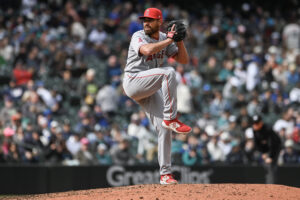
The Halos wound up waiving Moore in August, but not due to his performance. Rather, the Angels made a last-ditch effort to get under the luxury tax threshold with a mass waiver purge just weeks after an aggressive, win-now trade deadline. Moore, Lucas Giolito, Reynaldo Lopez, Hunter Renfroe, Randal Grichuk, Dominic Leone and Tyler Anderson all wound up on waivers in hopes that another club would take their contracts (not all were claimed).
Moore was quickly snapped up by the Guardians as they made their own last-minute push, claiming Giolito in addition to Moore. His stint with Cleveland only lasted 4 2/3 innings, as the Guards waived Moore themselves to save some cash after they, too, fell out of postseason contention. The Marlins scooped Moore up and enjoyed four shutout innings for him down the stretch.
Overall, Moore finished out a bizarre 2023 season with a 2.56 ERA, 27.5% strikeout rate and vastly improved 6.9% walk rate in 52 2/3 innings between the three teams. That marked Moore’s second consecutive year of productive pitching following a move to the bullpen. He turned in a 1.95 ERA for the Rangers in 2022 after signing a minor league deal. When combining the two seasons, Moore touts a 2.20 ERA with five saves, 36 holds, a 27.4% strikeout rate and 10.3% walk rate in 126 2/3 innings.
It’s a strong second act for the southpaw, who’d struggled as a starter for the few seasons preceding his bullpen move. It has clearly impressed Halos GM Perry Minasian and his staff, who have added him on a notable one-year pact in consecutive years. That’s in line with a broad willingness to attack the relief corps on free agency.
Los Angeles has signed five relievers this winter. Their first three acquisitions — Luis Garcia, Adam Kolarek and Adam Cimber — were fairly modest one-year deals. In recent days, they’ve been more aggressive. The Angels finalized a three-year, $33MM pact with Robert Stephenson this afternoon. Moore adds a lefty option to a relief group that otherwise figures to lean heavily on righties Carlos Estevez, Stephenson, Garcia, Ben Joyce and Jose Soriano.
The Angels are now up to roughly $172MM in payroll commitments for the upcoming season, as calculated by Roster Resource. That’s still well shy of last year’s $212MM Opening Day mark. Minasian and his staff very likely aren’t finished. They’ve been tied to various possibilities in both the lineup and the starting rotation. There’s still opportunity for the Angels to continue adding in the next few weeks.
Image courtesy of USA Today Sports.
Orioles, Cionel Perez Avoid Arbitration
January 23: Perez will make $1.2MM in 2024, per Robert Murray of FanSided. The 2025 option comes with a base salary of $2.2MM can be increased by various escalators. It goes up by $25K for 55, 60, 65 and 70 innings pitched, $50K for 20 and 25 games finished, $100K for 30 and 35 games finished, $150K for 40 and 45 games finished, as well as $200K for 50 games finished.
January 22: The Orioles announced Monday that they’ve avoided arbitration with left-handed reliever Cionel Perez. The Octagon client agreed to a one-year deal with a club option for the 2025 season. Since Perez is under team control for three more years, he’d remain an Oriole (and be arbitration-eligible once again) even if the team declines the 2025 option. Perez had filed at a $1.4MM salary, with the team countering at $1.1MM. Today’s agreement will be somewhere between those two sums and will avoid a potentially contentious hearing.
Like most clubs throughout the sport, Baltimore has taken a “file-and-trial” approach to arbitration in recent years. That is to say, once the team and player have exchanged numbers and filed those respective figures with the league, talks on a straight one-year deal are cut off. However, multi-year deals and one-year pacts that contain options are still on the table for discussion.
To many, it seems an odd line to draw on the surface. But one-year deals containing club or mutual options are not considered “one-year” contracts in arbitration — at least not in the sense that they’re considered relevant data points in future arbitration cases. Because of that, even file-and-trial clubs will generally discuss them, considering those deals more akin to multi-year pacts that don’t have long-term ramifications in a process where salaries are determined based overwhelmingly on prior, comparable one-year agreements.
Perez, 27, has had a breakout showing in Baltimore over the past two seasons after being plucked off waivers from the Reds in November 2021. The southpaw has made 131 appearances for the O’s and turned in a terrific 2.43 earned run average in 111 innings, picking up four saves and 35 holds along the way. Perez took a step back in ’23, as his ERA spiked from 1.40 to 3.54 while his strikeout and walk rates both trended in the wrong direction (23.5% and 9%, respectively, in 2022; 17.8% and 10.9% in 2023). Even with those red flags, Perez’s fastball velocity held at nearly 97 mph on average, he remained one of the toughest pitchers to take out of the ballpark (0.32 HR/9), and his 60.9% ground-ball rate was elite.
Perez will likely join fellow lefties Danny Coulombe and DL Hall in what should once again be a very strong Baltimore bullpen. There’s no compensating for the loss of All-Star closer Felix Bautista, who had Tommy John surgery in October, but the team’s hope is that by signing Craig Kimbrel to join Perez, Coulombe, Hall, All-Star setup man Yennier Cano and potentially right-hander Tyler Wells (if he’s not back in the rotation), the bullpen will again be quite formidable.
With Perez’s case now settled, the Orioles still have four players whose arbitration status remains up in the air. The O’s also exchanged figures with outfielder Austin Hays ($6.35MM vs. $5.85MM), first baseman/designated hitter Ryan O’Hearn ($3.8MM vs. $3.2MM), Coulombe ($2.4MM vs. $2.2MM) and righty Jacob Webb ($1MM vs. $925K).
Phillies Sign Kolby Allard
2:55pm: It’s a split deal for Allard that’d pay him at a $1MM rate in the Majors with another $125K via incentives, reports Matt Gelb of The Athletic. Allard will earn at a $375K rate in the minors, Gelb adds.
2:32pm: The Phillies announced Tuesday that they’ve signed free agent left-hander Kolby Allard to a one-year contract. The Excel Sports Management client will be added to Philadelphia’s 40-man roster, although he has a minor league option remaining, so it’s not a lock he’ll be on the Opening Day roster. Allard, who was non-tendered by the Braves back in November, has three-plus years of MLB service (3.162) and is controllable through the 2026 season.
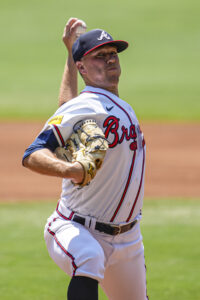
Originally selected by the Braves with the No. 14 overall pick back in 2015, Allard long rated as one of the sport’s top pitching prospects. Back injuries hobbled him throughout the early stages of his career, however, and he’s yet to establish himself at the MLB level in parts of six seasons with the Braves and Rangers. Atlanta traded Allard to Texas in the 2019 swap that sent reliever Chris Martin to Atlanta, and the Rangers sent him back to the Braves following the 2022 season in exchange for righty Jake Odorizzi (plus $10MM to cover the bulk of Odorizzi’s $12MM salary).
In 2023, Allard opened the season on the 60-day injured list owing to a Grade 2 oblique strain suffered in camp. He returned over the summer but made only four appearances before inflammation in his shoulder led to him being shut back down and shelved for the remainder of the year. He was limited to just 12 1/3 innings overall, yielding nine runs on 16 hits and four walks with 13 strikeouts (6.57 ERA).
Allard has just one season with a sub-5.00 ERA under his belt — the 4.96 mark he recorded through nine starts (45 1/3 innings) during his first season as a Ranger. He’s made 38 MLB starts and another 31 relief appearances, accumulating a total of 245 innings but with an unsightly 6.10 ERA to show for it. Allard has missed bats at close to league-average levels in brief looks over the past two seasons, but he has a below-average 18.8% strikeout rate in his career and sits in the 90-91 mph range with his fastball. He’s regularly shown strong command, evidenced by a 7.7% walk rate in his time as a big leaguer.
While he hasn’t found sustained MLB success yet, Allard does have a nice track record in the upper minors. He’s pitched in parts of four Triple-A seasons, totaling 323 innings at that level, and recorded a solid 3.71 earned run average in that time. Along the way, he’s fanned 23.4% of his opponents against an 8.3% walk rate — all while working exclusively out of the starting rotation.
Phillies president of baseball operations Dave Dombrowski said earlier this month that he’d been engaged with several free agents in an effort to bolster his team’s rotation depth behind its top five starters: Zack Wheeler, Aaron Nola, Ranger Suarez, Taijuan Walker and Cristopher Sanchez. Allard is one step toward doing so, and he’ll cost little more than the 40-man roster spot which the team has promised to him.
It’s certainly feasible that Allard could eventually join the big league club as a swingman or lefty reliever, but out-of-options journeyman Dylan Covey seems likely to hold that long relief job to begin the season. And, given that Dombrowski was speaking on record about pursuing exactly this type of rotation depth just a few weeks ago, it seems fair to expect that the initial plan for Allard is for him to open the year in the rotation in Triple-A Lehigh Valley. A spring injury to one of the current starters or perhaps a strong showing (and matching poor performance from Covey) could alter that trajectory, of course.
MLBTR Chat Transcript
Click here to read a transcript of Tuesday’s chat with MLBTR’s Steve Adams.
Infield Options For The Mariners
To say the current offseason hasn’t panned out the way fans hoped would be putting things mildly. Fresh off a heartbreaking 2022 postseason exit and a narrow 2023 postseason miss, Seattle fans hoped to see significant investment in the team that would help put the on-field product over the top. Instead, ownership has opted to place some rather clear payroll restrictions on the front office in light of ongoing uncertainty regarding the team’s television rights.
The M’s are hardly alone in that regard, but that’s of little consolation to a fan base that has seen Eugenio Suarez, Teoscar Hernandez and Jarred Kelenic all depart. Incoming bats like Mitch Garver, Luke Raley, Luis Urias and the reacquired Mitch Haniger all have upside, but with the exception of Garver they lack the recent track records of Suarez and Hernandez. President of baseball operations Jerry Dipoto said early in the offseason that much of the turnover would be in service of improving the team’s contact skills, but each of Garver, Haniger and especially Raley have strikeout concerns of their own. That’s not true to the same extent as Suarez, Hernandez and Kelenic, but the M’s haven’t exactly stockpiled plus bat-to-ball skills and overhauled their offensive identity, either.
The offseason isn’t over, but a good bit of the Mariners’ heavy lifting has been completed. Dipoto said recently that he still envisions potential additions both in the infield and the bullpen. However, that doesn’t mean there’s a blank check or that there aren’t caveats to consider. He indicated earlier in the offseason that the payroll would likely increase but perhaps not by a significant level. The Mariners are currently about $10-11MM shy of last year’s mark. There’s some spending room, but they’ll also likely want to leave some room for in-season acquisitions. On the trade front, Dipoto acknowledged that he’s received interest in young starters like Logan Gilbert, Bryce Miller and Bryan Woo but also all but stated he has little appetite to deal from his coveted stock of youthful arms.
What options could the Mariners take to fit those bullpen and infield goals, then? Focusing on the former seems like a fool’s errand; there are any number of relievers who could be acquired, and the Mariners under the current front office regime have often focused on lesser-known names whom they believe they can take to a new level. That’s been the case with a number of success stories, including Paul Sewald, Justin Topa, Andres Munoz, Drew Steckenrider, Tayler Saucedo, Gabe Speier and others.
It’s possible there’s a similar preference for an unexpected acquisition in the infield, but the supply of names is both more finite and easier to pinpoint. Let’s run through some options who could be acquired without seismically increasing payroll.
Free Agents
- Whit Merrifield: Merrifield might be the most straightforward answer. He’s a high-contact second baseman with modest pop who’s spent the bulk of his career in a pitcher-friendly setting (Kauffman Stadium) not entirely dissimilar from the Mariners’ own pitcher-friendly venue, T-Mobile Park. Merrifield fits the previously stated goal of reducing the team’s strikeout rate better than any of their offseason acquisitions to date. He could play second base regularly, pushing Josh Rojas and Urias into a platoon at third base. And, in the event of injuries in the outfield, Merrifield is an experienced contingency option who could slide into the outfield, with Rojas moving back over to second base. Merrifield hit .272/.318/.382 last year with Toronto, though he struggled in the season’s final six weeks. His end-of-season numbers are more or less in line with his slash dating back to the 2021 season. Merrifield will soon turn 35, so he’s likely limited to a two-year deal.
- Gio Urshela: Urshela boasts plenty of contact with less speed than Merrifield but a bit more pop and solid defense at third base. His 2023 season came to an end after just 228 plate appearances due to a pelvic fracture. He hit .299/.329/.374 before landing on the injured list, and since 2021 he’s a .281/.323/.425 hitter. Assuming he’s healthy, Urshela would give the Mariners plenty of contact, good defense at third and 10 to 15 home runs. Given his injury-shortened 2023 season, he’s probably capped at two years and could settle for a one-year pact.
- Tim Anderson: Anderson has already said he’s willing to move to second base, which is where the Mariners would play him in deference to J.P. Crawford. He hasn’t rated as a strong defensive shortstop for the past few years anyhow, and last year his bat experienced a precipitous decline; in 524 trips to the plate, he batted just .245/.286/.296. Awful as that output was, Anderson isn’t far removed from being one of the best-hitting infielders in the game. From 2019-22, he led the Majors with a .318 average. His .318/.347/.473 line during that time helped him make two All-Star teams and win a Silver Slugger Award. Given last year’s disastrous season, a one-year deal worth less than the $14MM option the White Sox declined seems likely.
- Justin Turner: He’s 39 years old, but you wouldn’t know it looking at Turner’s .276/.345/.455 batting line in 2023 or his overall .277/.352/.455 slash dating back to 2021. Turner might not be a good defensive option at the hot corner anymore, but he doesn’t necessarily need to be a full-time infielder with both Urias and Rojas on the roster. The Mariners could play Turner at the hot corner occasionally, giving either Rojas or Urias the nod at second on those days, depending on the matchup. Turner has never whiffed in more than 18% of his plate appearances in a season, and while he ought to command a nice price on a one-year deal, even a $16MM guarantee would only put the Mariners about $5MM north of where they finished the 2023 season.
Trade Candidates
- Jorge Polanco, Twins: Polanco has been locked into the Twins’ infield since 2017, and over his past 2695 plate appearances he’s batted .270/.338/.455 with 95 homers. The veteran switch-hitter is earning $10.5MM this season and has a $12MM option for 2025. On paper, there’s a strong matchup between a Twins club looking to add some MLB-ready pitching and a Mariners club looking for a clear infield upgrade but unwilling to part with any of its young arms in order to acquire a pure 2024 rental. Young pitchers like Bryce Miller likely have more trade value than Polanco on his own, but the Twins typically have little issue balancing the scales with minor leaguers or back-end 40-man pieces (as they did in last year’s Pablo Lopez/Luis Arraez swap and the year prior in the Chris Paddack/Taylor Rogers trade).
- Kyle Farmer, Twins: Farmer is a one-year rental who has less of a track record of production than Polanco. He’s a lefty masher that can handle any infield position and even has ample experience behind the plate (albeit primarily as a minor leaguer). At $6.05MM for the coming season, he’s well within the Mariners’ budget. Farmer hit .256/.317/.408 last year — numbers right in line with his .258/.316/.402 slash in nearly 1500 plate appearances since 2021. He wouldn’t be a slam-dunk upgrade to the infield mix but could deepen it and provide some insurance in the event that Urias and/or Rojas continue to struggle in 2024.
- Isaac Paredes, Rays: The Mariners showed interest in Paredes in early December. Rays president of baseball operations Erik Neander downplayed the possibility of moving his breakout third baseman but acknowledged he’d listened to interest, as he does on most players. Paredes ripped 31 homers while hitting .250/.352/.488 for Tampa Bay this past season. He’ll play next season at just 25. It’d be hard for the Rays to part with him, but he’s already into arbitration as a Super Two player and the team does have more third base depth than rotation depth after major injuries to Shane McClanahan, Drew Rasmussen and Jeffrey Springs. If the Rays were to move Paredes, they have top prospects Curtis Mead and Junior Caminero right behind him. With four years of club control and the type of production he showed in 2023, Paredes is the type of player who could command four, five or even six years of a plug-and-play big league rotation piece.
- Christopher Morel, Cubs: Trade talk on Morel has cooled down. President of baseball ops Jed Hoyer and GM Carter Hawkins downplayed the chances of a deal coming together at last week’s Cubs Convention. Still, Hoyer himself acknowledged early in the winter that Morel lacked a path to playing time at second base, his best position, thanks to the presence of Nico Hoerner and Dansby Swanson in the middle infield. A Morel trade isn’t likely, and his prodigious strikeout totals run counter to the idea of bolstering the Mariners’ contact profile anyhow. But he’d add punch in the middle of the lineup — 42 homers in 854 MLB plate appearances — and the Cubs could perhaps use some more solidity at the back of the rotation. They have a growing number of young arms themselves but lack a clear fifth starter and could see Kyle Hendricks become a free agent next winter.
- Ha-Seong Kim, Padres: Trade talk surrounding Kim has died down a bit since the Padres trimmed their payroll in other ways, but Kim is entering the final season of his contract before free agency. (His contract has a 2025 mutual option, but he’ll turn that down in favor of free agency.) After a tough first season in the Majors, Kim has come around with a .256/.338/.391 batting line over the past two seasons and emerged as an elite defender with above-average speed and contact skills. He swiped 38 bags and won his first Gold Glove at second base in 2023. He’s also adept at both shortstop and third base. He’s owed just $8MM for the 2024 season. The Athletic’s Dennis Lin wrote last week that the Padres have continued discussing the possibility internally.
- Jake Cronenworth, Padres: Taking on the entirety of the seven-year, $80MM deal still owed to Cronenworth isn’t something the Mariners or even a team without current payroll constraints would be willing to do. But Cronenworth hit .256/.338/.431 from 2020-22, including a 21-homer, .266/.340/.460 showing in 2021. If the Padres are willing to cover some of Cronenworth’s deal — which only pays him $7MM this coming season — or take on some money of their own (e.g. Mitch Haniger), Cronenworth could be acquired relatively cheaply.
Teams with Various Young, Controllable Infielders
- Cardinals: It’s an oversimplification at this point to note that the Cardinals are deep in young infielders and the Mariners are deep in young starters. The two teams have discussed their respective “surpluses,” and no trade has come together. Much as some fans may see merit in swapping Nolan Gorman for Logan Gilbert, or Brendan Donovan for Bryan Woo or whatever other iterations of an infielder-for-starter swap you care to dream up, Dipoto and St. Louis counterpart John Mozeliak have yet to agree. Between Gorman (five years of control), Donovan (four years), Tommy Edman (signed through 2025), Jordan Walker (six years) and top prospect Masyn Winn (six-plus years), there are more players than at-bats to go around. The Cards will see Paul Goldschmidt become a free agent at season’s end, however, possibly opening up first base for one of their young infielders. Walker has already moved to the outfield. Donovan and Edman can play anywhere. All of these players can still be optioned, too. There’s no grave urgency for the Cards to deal from their wealth of talent, but conceptually, the fit makes sense.
- Reds: Different NL Central team, similar story. Cincinnati was already deep in infielders before adding Jeimer Candelario on top of Spencer Steer, Noelvi Marte, Elly De La Cruz, Matt McLain, Jonathan India and Christian Encarnacion-Strand. The Candelario signing prompted many — myself included — to expect an infield-for-pitching trade that has yet to materialize. But if the Reds indeed plan to play Steer in left field full-time, there’s a lack of urgency to get a deal done here as well. None of Marte, De La Cruz, McLain or Encarnacion-Strand has a full season in the Majors. McLain is the closest, and while he was excellent as a rookie, he might also be needed at shortstop if De La Cruz requires more Triple-A time. Marte was terrific but only saw 123 plate appearances. India won NL Rookie of the Year honors in 2021, but his bat has declined considerably since then. He’s no longer the clear infield fixture he once looked to be, and a below-average defender at second base with a roughly average .246/.333/.394 slash line (98 wRC+) over the past two seasons isn’t going to fetch a meaningful rotation upgrade on his own.
- Orioles: Baltimore fans are still wondering when the organization’s move to upgrade the rotation is coming. Much of the focus has been on White Sox righty Dylan Cease, but the Mariners have a bevy of controllable arms to match the Orioles’ impressive stock of infielders. Gunnar Henderson is the long-term third baseman. Shortstop is earmarked for current No. 1 overall prospect Jackson Holliday. First base currently belongs to a pair of Ryans: O’Hearn and Mountcastle. That’d be a strong group of infielders as it is, but it’s only scratching the surface. The O’s have top prospects Jordan Westburg and Joey Ortiz already on the 40-man roster. Both debuted in 2023. Fellow top prospect Connor Norby isn’t far off, nor is slugging third baseman Coby Mayo, who could also muscle his way into the first base or corner outfield mix. Veterans Jorge Mateo and Ramon Urias give the Orioles some insurance if the kids don’t hit right away, but they also provide critical depth that makes it easier for the O’s to move someone like Westburg, Norby, Ortiz or Mayo to get a controllable pitcher.
The Chapman Effect
Unless Matt Chapman determines the long-term deal he wants isn’t attainable this winter and opts for some type of pillow arrangement, he’s not going to sign in Seattle — not without a serious pivot from ownership in terms of willingness to spend. Even on a one-year deal, he’d probably cost more than the Mariners prefer to spend. But Chapman still could impact Seattle’s infield pursuit. For instance, if he signs with the Giants — his top rumored fit — that could make San Francisco more willing to trade J.D. Davis. If Chapman goes back to Toronto, it becomes more feasible that the Jays would consider dealing young Davis Schneider. Wherever Chapman lands, he could prompt a domino effect that adds a new entrant or two to the trade market.
Collin McHugh Announces Retirement
Veteran right-hander Collin McHugh announced his retirement from the game Monday (Instagram link). The 36-year-old pitched in parts of 11 MLB seasons from 2012-23 and accrued more than nine years of big league service along the way.
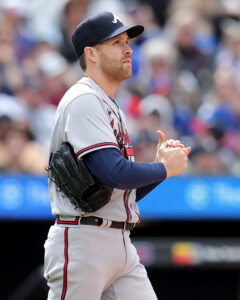
“I was never the best player on any team I played for,” McHugh wrote in his announcement. “Including my 7th grade church league team, on which I played catcher. I never did travel baseball. I went to a small private high school and a small NAIA college. I got drafted in the 18th round by the Mets, most likely as a favor to my college coach. I threw 90 mph. I was NEVER supposed to make it out of A ball. 16 years later, it’s finally time for me to hang ‘em up. And as cringey as it might sound, I’m proud of myself. Proud that I didn’t give up. Proud of the clubhouses I’ve been lucky enough to have a locker in. Proud to be a member of the MLBPA alongside this generation of amazing ballplayers. To the Mets, Rockies, Astros, Red Sox, Rays, and my hometown Braves: Thanks for taking a chance on a kid like me. I’ll never forget it. And don’t worry, I’m pretty sure I’ll be around the game forever. So if we see each other at a park near you, come say hey!”
McHugh, indeed, was never regarded as a top prospect. He debuted with the 2012 Mets and was tagged for a 7.59 ERA in 21 1/3 frames as a rookie. His struggles in Queens continued into the following season, and McHugh was traded to the Rockies in exchange for outfielder Eric Young Jr., who’d been designated for assignment in Colorado. Things didn’t pan out at Coors Field either; McHugh was torched for 21 runs in 19 innings as a Rockie.
Despite the lack of success, the Astros both tried to trade for McHugh prior to his Rockies acquisition and then later claimed him off waivers when Colorado removed him from its 40-man roster. That interest and subsequent acquisition came back in 2013, prior to the public advent of a great deal of pitching data that is now commonplace. At the time, the high spin rate on McHugh’s curveball gave the Astros confidence that with some tweaks to his repertoire and general approach to hitters on the mound, that could be a plus breaking pitch that fueled a breakout for the little-known righty.
Houston’s interest proved prescient. In 2014, McHugh stepped into the Astros’ rotation and made 25 starts while working to an excellent 2.74 ERA over 154 2/3 frames. He fanned just over a quarter of his opponents against a tidy 6.6% walk rate while keeping the ball on the ground at a roughly average clip. A year later, McHugh followed up with a career-high 203 2/3 innings, pitching to a 3.89 ERA in a full slate of 32 trips to the hill.
McHugh finished fourth in AL Rookie of the Year voting during that 2014 breakout and was eighth in Cy Young voting during his followup effort. He made another 33 starts for Houston during the 2016 season before sustaining a shoulder injury that limited him to 12 starts of 3.55 ERA ball in 2017. McHugh returned as a reliever in 2018 and went from a key member of the Houston rotation to a similarly important reliever; he fired 72 1/3 innings of 1.99 ERA ball in 2018 before struggling to more pedestrian results in a 2019 campaign split between the rotation and bullpen.
Overall, McHugh went from a nondescript late-round pick to a clear-cut big leaguer during his time in Houston. He pitched 753 1/3 innings of 3.63 ERA ball there before hitting free agency and taking a one-year deal with the Red Sox that was wiped out by injury and the pandemic-shortened schedule. McHugh landed with the Rays in 2021 and bounced back in a major way: a 1.55 ERA in 64 innings. That prompted a two-year deal with the Braves — a homecoming for a pitcher who went to high school in Lilburn and college in Mount Berry — where McHugh went on to throw another 128 innings of 3.38 ERA ball.
All told, McHugh’s career will draw to a close with a 71-47 record, 46 holds, one save and a 3.72 ERA in 992 2/3 innings at the MLB level. He struck out 967 hitters against 280 walks and added another 27 innings of 4.00 ERA performance in the postseason. McHugh won a World Series ring with the controversial 2017 Astros club that is now infamous for its sign-stealing setup. FanGraphs valued McHugh’s career at nearly 16 wins above replacement, while Baseball-Reference pegged him at 12.4 WAR in a career that netted him just under $27MM in earnings. Few 18th-round signees can boast anything close to that type of success; McHugh and Mike Cameron stand as two of the best ever selected in that round. McHugh’s comment about being “around the game forever” seems to leave the door open for some kind of role with a team in the future. Best wishes to the righty on whatever the next step may be.
Latest On Marlins’ Edward Cabrera, Jesus Luzardo
As with the past several offseasons, there’s been plenty of speculation and reporting about the Marlins’ willingness to deal from their starting rotation. Chatter surrounding the possibility of Miami dealing a starter didn’t bring about a high-profile trade two winters ago — Miami did deal Zach Thompson to the Pirates as part of the Jacob Stallings deal — but last offseason saw the Fish ship righty Pablo Lopez to Minnesota alongside prospects Jose Salas and Byron Chourio in a deal that brought Luis Arraez to Miami. Talk this offseason has centered primarily around lefty Jesus Luzardo and righty Edward Cabrera, but Ken Rosenthal of The Athletic writes that a trade involving Luzardo is “less likely” than a trade of the younger Cabrera. MLB.com’s Mark Feinsand wrote late last week that the Marlins have been open to discussing both in trades.
While Cabrera has more club control remaining — five years, compared to Luzardo’s three — he’s also the less-established arm of the two, so it makes sense that the Marlins would be a bit more reluctant to part with the more experienced Luzardo.
Cabrera, who’ll turn 26 in April, has already spent parts of three seasons in the big leagues. After getting roughed up as a rookie, the former top prospect has made strides in the past two seasons, logging a combined 3.73 ERA with a sharp 26.6% strikeout rate. He throws hard (96.2 mph average fastball), has generally been good at keeping the ball in the yard (1.10 HR/9) and boasts a strong 50.6% ground-ball rate. However, Cabrera has also walked far too many opponents, issuing free passes to 13.7% of batters faced.
That lack of command has at times prevented him from working deep into games. While some of his short starts have been attributable to the Marlins monitoring his workload as he’s worked through a shoulder impingement and elbow inflammation, Cabrera’s average of 4 2/3 innings per start to this point in his career is quite brief, even by today’s standards. Cabrera worked a career-high eight shutout innings against the A’s in August of 2022, but that was one of just two career outings where he’s recorded an out beyond the sixth inning (the other was in his MLB debut a year prior).
Clearly, there are still some final steps to take in Cabrera’s development, but his body of work over the past two years offers plenty of reason for optimism. Couple that with club control that stretches through the 2028 season — he’ll likely be arbitration-eligible four times as a Super Two player — and Cabrera should appeal to plenty of pitching-hungry clubs, even if he’s the less-established of Miami’s two “available” starters.
As for the Marlins’ goals in a trade, they’ll surely vary from prospective trade partner to prospective trade partner. The Fish entered the offseason looking for long-term help behind the plate and at shortstop. Rosenthal suggests that a viable long-term option at short, in particular, might pique the Marlins’ interest when it comes to moving a controllable pitcher. As things stand, utilityman Jon Berti, glove-first prospect Jacob Amaya and former top prospects Vidal Brujan and Xavier Edwards are among the organization’s options there.
That said, Miami also hasn’t done much to upgrade its long-term catching outlook this winter. Christian Bethancourt was acquired in a small trade with Cleveland, who’d acquired him from the Rays. He and Nick Fortes are the only catchers on Miami’s 40-man roster. None of the organization’s current top 10 prospects at Baseball America are catchers.
There’s no indication yet that a trade of Cabrera, Luzardo or any other Marlins starter should be considered especially likely. But the Marlins have sat out free agency entirely this offseason, and the market hasn’t exactly been deep in options at their foremost positions of need anyhow. They likely view the trade market as their best path to addressing those needs in the short- and long-term, as in addition to the thin free-agent market, the team’s projected $97MM payroll (via Roster Resource) is already about $5MM greater than last year’s Opening Day mark.
The Fish are still about $13MM shy of where they ended the 2023 season, but it’s fair to wonder just how much appetite ownership has for additional spending. Rosenthal writes, for instance, that Josh Bell‘s $16.5MM salary (which the club acquired in order to dump the majority of Jean Segura‘s contract on the Guardians) is one of the reasons that the Marlins have been reluctant to spend this winter. If that’s the case, it’s hard to envision owner Bruce Sherman greenlighting additional free-agent spending of note, which either sets the stage for some trade activity or a disappointing offseason on the player acquisition front (possibly both).
Adam Ottavino On Decision To Decline Player Option
Veteran right-handed reliever Adam Ottavino turned down a $6.75MM player option to remain with the Mets at the beginning of the offseason. The decision was a surprise to some, as it’s always risky for any 38-year-old reliever to test the free-agent waters — particularly in lieu of accepting a locked-in salary that’s near the going market rate for a veteran setup man. However, Ottavino was a guest on Foul Territory this morning and, when asked, explained that his decision wasn’t so much a financial one but rather one of wanting to ensure he was in a competitive situation as he progresses into the latter stages of his career.
“To be clear, I wanted to stick with the Mets,” Ottavino explained to host Scott Braun (video link). “It’s the best situation for me, being a New York guy. I loved my time with the Mets. It’s just more of a function of, at the moment I had to make the decision, there was just so much uncertainty with the team. They hadn’t hired a manager yet. There was no coaching staff. They hadn’t gotten any free agents yet. We’d kind of scuffled down the stretch. There was this narrative that the team wasn’t going to try to compete this year. Obviously, I’m not getting any younger. I tried to talk to [president of baseball operations] David Stearns and get a little certainty on my end. Obviously, he’s going to play things close to the vest. That’s the way front offices operate, and I totally understand that. But from my perspective, I just didn’t feel 100% certain of what direction the team was going to look like, come spring training. I also had a lot of deferred money in my contract for this year. In that moment, it made sense for me to test the waters. I’d still like to be back there, but my mind is open to lots of different outcomes this time around. I feel like I’m on a year-to-year basis at this point with my age. I just don’t want to sell myself short; I’ve still never won, and I would like the opportunity to do that.”
Ottavino is an accomplished reliever with more than $50MM in career earnings to date, which also surely factored into his comfort level with turning down that guaranteed sum. It’s understandable, given his age and career earnings, that maxing out his salary in 2024 perhaps isn’t the right-hander’s top priority. Ottavino has pitched in five different postseasons for four different teams (Rockies, Yankees, Red Sox, Mets) but never advanced beyond the League Championship Series.
Given his track record and his 2023 platform year, it’s certainly possible that Ottavino can come close to or even exceed the money he declined from the Mets, particularly when factoring for the deferrals. At the time he declined his option, Ottavino told Joel Sherman of the New York Post that $4MM of that $6.75MM sum was deferred. The right-hander said he approached the Mets about a two-year deal (that would extend into a 2025 season where the club ostensibly will be taking larger strides to be competitive), but the team did not reciprocate that interest.
The 2023 season was yet another solid one for Ottavino. The former No. 30 overall pick (2006, Cardinals) pitched 61 2/3 innings of 3.21 ERA ball for the Mets and picked up a dozen saves and holds apiece along the way. Ottavino’s average sinker dipped for a second straight season (94.2 mph in ’22, 92.8 mph in ’23), and he saw both his strikeout and walk rates take a turn for the worse (30.6% and 6.2%, respectively, in 2022; 23.8% and 11.1% in 2023). This year’s 56.3% ground-ball rate was his highest mark since an injury-shortened 2016 season with the Rockies, however, and was the largest single-season mark he’s posted in his lengthy career.
Only once in the past six years has Ottavino had a sub-par season — that being the shortened 2020 campaign, when he had a 5.89 ERA in a tiny sample of just 18 1/3 innings. Collectively, he touts a 2.89 ERA, 29.7% strikeout rate, 11.2% walk rate and 46.4% ground-ball rate in 351 2/3 innings since Opening Day 2018. There ought to be at least a one-year deal out there in free agency, and it sounds as though Ottavino will prioritize signing with a team that has a rather clear chance at a postseason berth.
Hoyer, Hawkins Downplay Possibility Of Christopher Morel Trade
There’s been plenty of chatter regarding Cubs slugger Christopher Morel as a potential trade candidate this offseason, but president of baseball operations Jed Hoyer and general manager Carter Hawkins downplayed any such possibilities over the weekend when talking with fans in a Q&A at Cubs Convention (link via Marquee Sports’ Tim Stebbins). Hoyer repeatedly used the phrase “zero basis in truth” regarding Morel speculation. He added that while the slugger might not have a set position this coming season, he’ll likely be used all over the diamond.
“We’re gonna have injuries all the time,” Hoyer said. “We’re gonna need [versatility], and the more positions you can play, the better. He’s going to have a big impact on the team.”
Morel’s name has indeed surfaced a lot on the rumor circuit this winter — in part due to a lack of a clear defensive home. His best position, second base, is spoken for by Nico Hoerner, who was pushed there by the team’s signing of Dansby Swanson. Morel has played all three outfield positions, but the Cubs have Ian Happ and Seiya Suzuki locked into corner spots. Veteran Mike Tauchman is in the mix in center field but perhaps only as a placeholder to top prospect Pete Crow-Armstrong, who is considered one of the best defensive center fielders in the sport. The Cubs have gotten Morel some looks at first base during winter ball, but their recent acquisition of slugger Michael Busch from the Dodgers might impact that possibility.
It should be noted, of course, that some of the speculation regarding Morel’s status stems from comments Hoyer himself made on the record earlier this winter. While he never plainly stated that Morel was available in a trade or even being discussed, Hoyer acknowledged “another team might be able to put him [at second base]” when discussing his defensive home and the decision to get Morel some winter exposure at first base. As we noted at the time, that’s far from a declaration a player is on the trade block, but it’s nevertheless understandable that many took the comment and began to consider the possibility. At various points this winter, reporting from the Chicago Tribune, ESPN and USA Today have all suggested that, to varying extents, Morel’s name has at least surfaced in trade talks.
Hoyer and Hawkins pushing back on the narrative is natural, particularly given the backdrop against which those comments were made. Cubs Convention is heavily attended by fans, many of whom would bristle at the notion of seeing Morel shipped out. Publicly pushing back on the notion of a trade surely offers some peace of mind to the player himself, too. The offseason is now months old, and other clubs have surely called to at least inquire on Morel. The Cubs presumably have a feeling on what the realistic possibilities might be, and if there’s nothing that’s piqued their interest by now, the chances of something new being presented in the remaining few weeks seem quite thin. Neither Hoyer nor Hawkins definitively stated Morel will not be traded, but the obvious implication was that it’s a highly unlikely scenario.
Morel, 24, has seen big league time in each of the past two seasons with the Cubs and shown off considerable power in addition to alarming swing-and-miss tendencies. In 854 plate appearances, the righty-swinging slugger has belted 42 home runs while adding 36 doubles and seven triples. He’s swiped 16 bags as well, albeit in 25 tries (64% success rate).
Morel has walked at a roughly average clip and doesn’t chase off the plate at an egregious rate — his 32.8% rate is less than one percentage point north of 2023’s league average 31.9% rate. However, Morel’s contact skills are suspect. He’s fanned 31.6% of his MLB plate appearances while logging contact rates more than 10 percentage points south of the league average both on pitches off the plate and those within the strike zone. Morel’s 64.5% contact rate on pitches inside the zone is well shy of last season’s 76.4% league average, and his 50.5% contact rate on pitches off the plate is similarly distanced from the league-average 62.4%. He’s had issues with contact in the minors as well; Morel fanned in 30.6% of his Triple-A plate appearances in 2023 and in 29.7% of his Double-A plate appearances in 2021.
Suffice it to say, while Morel’s power is quite intriguing, there are still some notable areas for improvement. That’s true of many 24-year-olds, of course, most of whom don’t have the type of power output Morel has already shown in the big leagues. He may need to improve his contact skills, pitch selection and/or defensive aptitude — Morel hasn’t graded as an above-average defender at any of the six positions he’s played — but the Cubs clearly believe in his long-term potential. Scouting reports on Morel have long questioned his hit tool, but his power, speed and throwing have consistently drawn plus marks.
The Cubs control Morel all the way through the 2028 season, and he still has a minor league option remaining as well. There’s little urgency for them to move him, and even if he never makes huge gains in terms of contact rate, there’s a role as a bat-first utilityman with impressive power that can clearly be achieved.