
Nationals Sign Wily Peralta To Minor League Deal
The Nationals announced Tuesday that they’ve signed veteran right-hander Wily Peralta to a minor league contract. He’s been invited to Major League camp this spring, per the team.
Peralta, 33, was a starter early in his career with the Brewers but has pitched primarily out of the bullpen dating back to 2017. He’s spent the past two seasons with the Tigers — ’21 in the rotation and ’22 in the ‘pen — for whom he’s logged a combined 2.93 ERA in 132 innings of work.
It’s rare to see a healthy pitcher with an ERA that impressive over a sample that large sign a non-guaranteed pact, but Peralta’s well below-average 15.8% strikeout rate and lofty 10.9% walk rate surely gave clubs some pause. Peralta has also benefited from a .268 average on balls in play and a massive 80.2% left-on-base rate, both of which are likely to regress. Metrics like FIP (4.93) and SIERA (5.15) feel he’s highly unlikely to sustain anything close to the level of performance he displayed in Detroit.
That said, the contract still represents a nice add for a rebuilding Nationals club that is light on established arms — particularly in the bullpen. Closer Kyle Finnegan has stepped up as Washington’s top reliever over the past couple seasons, and he’ll be joined by Carl Edwards Jr., veteran swingman Erasmo Ramirez and oft-injured but talented arms like Hunter Harvey and Victor Arano.
If the Nats are viewing Peralta as more of a rotation option than a bullpen arm, he’ll have opportunity there as well. On paper, Washington’s rotation looks full with Stephen Strasburg, Patrick Corbin, Trevor Williams, Josiah Gray and prospects Cade Cavalli and MacKenzie Gore among the in-house options. However, Strasburg’s career has been calamitously derailed by injuries over the past several seasons; he’s pitched in eight games since re-signing in Washington after the 2019 season, due largely to a bout with thoracic outlet syndrome that wiped out his 2021 season and led to a stress reaction developing in his ribcage in 2022. Neither Gore nor Cavalli has established himself in the big leagues, meanwhile, and Gray is still working to curtail the massive home run issues that have thus far prevented him from living up to his former top prospect status.
Peralta is one of several non-roster invitees of note who’ll have a chance to open the season on the Nationals’ pitching staff. Sean Doolittle and Alex Colome will both vie for bullpen spots in camp this spring, as will less-experienced NRIs like Anthony Banda, Anthony Castro and Francisco Perez.
D-backs, Jandel Gustave Agree To Minor League Deal
The Diamondbacks have agreed to a minor league contract with right-hander Jandel Gustave, tweets Robert Murray of FanSided. He’ll be invited to big league camp this spring.
The 30-year-old Gustave has spent the past two seasons with the Brewers, turning in solid bottom-line results despite some shakier secondary marks. Gustave carries a 3.69 ERA in 46 1/3 innings over 41 games with Milwaukee dating back to 2021, and he’s averaged a hearty 96.7 mph on his heater during that time. Fielding-independent marks are a bit more skeptical of his efforts, albeit not overwhelmingly so (4.52 FIP, 3.94 SIERA).
Despite his strong velocity, Gustave owns a sub-par 20.1% strikeout rate since 2021. His 8% walk rate during that time is a bit better than average. It’s worth noting that he did up his strikeout rate in 2022 (22.5%), but that was accompanied by an uptick in walks as well (9.2%). Gustave wasn’t particularly homer-prone with the Brewers (1.17 HR/9), and his overall 48.2% ground-ball rate (50% in ’22) is also comfortably ahead of the 42.9% league average.
Injuries played a part in Gustave’s departure from the Brewers. A strained right hamstring cost him more than a month in the first half of the 2022 season, and he was placed on the injured list on Aug. 2 with a forearm injury that wound up ending his season. Gustave never wound up requiring surgery, but his final pitch of the 2022 season nonetheless came on July 31. The Brewers non-tendered him back in November despite the fact that he had two years of club control remaining and a projected salary of just $900K (via MLBTR contributor Matt Swartz).
Assuming he’s healthy, Gustave figures to have a decent chance to crack the D-backs’ bullpen at some point, whether it be on Opening Day or early in the season. Arizona has a generally unsettled mix of relievers, with a few exceptions. Lefty Joe Mantiply had a breakout showing in 2022, and the Snakes will hope for better results from veteran Mark Melancon in the second season of a two-year deal. Veteran Miguel Castro was signed a to a one-year deal earlier in the winter, and 28-year-old righty Kevin Ginkel (29 in March) impressed in 29 1/3 innings down the stretch after posting rough results in 2020-21. The Diamondbacks also once again tapped into the NPB/KBO market by signing former Marlins righty Scott McGough to a two-year contract on the heels of a terrific four-year run in Japan.
Beyond those names on the 40-man roster, Gustave will join Jeurys Familia as a non-roster invitee of particular note this spring. Other minor league signees with varying levels of MLB experience in the bullpen include Austin Adams, Austin Brice, Jesse Biddle, Sam Clay, Ryan Hendrix, Zach McAllister and Eric Yardley.
Dexter Fowler Announces Retirement
Former All-Star center fielder and 2016 World Series champion Dexter Fowler announced via Instagram and Twitter this morning that he’s retiring after a 14-year Major League career. The 36-year-old offered the following statement:
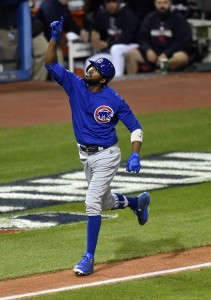
“It’s here. I’m hanging up my cleats. From an 18-year-old draft pick in Colorado to a ‘vet’ in Anaheim — there are a few things I will never forget. Getting THAT call to the big leagues in September 2008. Wow. My world was spinning. My first ‘you’ve been traded to Houston’ heart pounding call.
The feeling of bliss while hearing the words ‘All-Star’. Never knew what it felt like to be that guy! Forever grateful. Soaking wet and freezing on the field with tears in my eyes after winning the World Series in Chicago. The comfort of calling St. Louis home and being a Red Bird. Today is one of those moments where you metaphorically step down from your throne with a standing ovation, a tip of the cap, and the world stops spinning. I’m mostly proud to look back at my career knowing that I played the game the right way and did my best to make a positive impact beyond the win.
Denver, Houston, Chicago, St. Louis and Anaheim. My family, friends, teammates and staff. Thank you for 14 years. I gave you my all.”
Fowler will go down as one of the best 14th-round picks in the sport’s history. (The only 14th-rounders with more career WAR are Dave Parker, Bob Welch, Rick Honeycutt and Keith Foulke, for those keeping score.) Selected out of Milton High School in Georgia back in 2004, Fowler was in the Majors four years later, enjoying a 13-game cup of coffee with the Rockies that year before cementing himself as a big leaguer the following season when he slashed .266/.363/.406 in 135 games and landed an eighth-place finish in National League Rookie of the Year voting.
Over the next eight years, Fowler averaged 541 plate appearances and 130 games per season, batting a combined .269/.368/.443 with the Rockies, Astros, Cubs and Cardinals. Twice traded along the way, Fowler went from Colorado to Houston and from Houston to Chicago before reaching free agency.
It originally looked as though Fowler’s stop in Chicago would last just one year. He slashed .250/.346/.411 in a career-high 156 games while tallying a career-best 690 plate appearances before setting out into free agency. Reports of an agreement with the Orioles emerged but were shot down by both parties, and Fowler kept quiet until stunning his teammates and the baseball world at large when he walked into Cubs spring training with a new one-year contract to return for a second season (Bally’s Kelly Crull tweeted video of Fowler’s stunning return at the time).
That twist of fate reinstalled Fowler atop the Cubs’ lineup — the same position in which he found himself eight months later when he became the only player to ever lead off Game 7 of the World Series with a home run. The 2016 season proved to be the best of Fowler’s career, as he batted .276/.393/.447, made his lone All-Star appearance, and hit .250/.280/.444 with three home runs and five doubles throughout a 17-game march to the Cubs’ curse-breaking World Series victory in Cleveland.
Fowler parlayed that outstanding season into a five-year, $82.5MM deal with the division-rival Cardinals, who enjoyed a strong first year from their new center fielder before injuries began to take their toll. Fowler appeared in just 271 games over the next three seasons of the deal — one of which was the shortened 2020 campaign — and batted a collective .218/.320/.370 in that time. The Cardinals traded him to the Angels in Feb. 2021, and Fowler suffered a torn ACL just seven games into the season with the Halos. He rehabbed the injury and latched on with the Blue Jays on a minor league pact prior to the 2022 season, but Fowler was granted his release after just three games in Triple-A.
All told, Fowler’s career will draw to a close with a lifetime .259/.358/.417 batting line, 127 home runs, 253 doubles, 82 triples, 149 stolen bases, 817 runs scored, 517 runs batted in and a total of 1306 hits. That batting line was seven percent better than league average, by measure of wRC+, and both FanGraphs and Baseball-Reference peg Fowler’s career at 19.5 wins above replacement — a total that surely would’ve been higher had it not been for the tear in his wrist, the fractured foot and the torn ACL that eventually combined to wear Fowler down in what would be his final seasons.
Fowler will be fondly remembered for his role in the Cubs’ historic 2016 World Series win — both his regular season production and his Game 7 long ball — and for the gregarious personality and charismatic smile he so frequently brandished throughout his career. Congrats to Fowler on a lengthy and productive career, and best wishes in whatever the next chapter holds. As Fowler himself said in his retirement announcements today: “Stay tuned for what’s next.”
Mets Sign Jeff McNeil To Four-Year Extension
Jan. 31: The Mets formally announced McNeil’s extension this morning. He’ll be paid $6.25MM in 2023, $10.25MM in 2024 and $15.75MM in both 2025 and 2026, tweets Jon Heyman of the New York Post. The club option for 2027 is also valued at $15.75MM, and it comes with a $2MM buyout.
Jan. 27: The Mets and second baseman Jeff McNeil are in agreement on a four-year, $50MM contract extension, ESPN’s Jeff Passan reports. The contract contains a club option for a fifth season, which could allow the extension to max out at $63.75MM over five years. The deal buys out the final two arbitration seasons for the Paragon Sports International client, and the Mets will gain control over what would’ve been McNeil’s first three free-agent seasons.
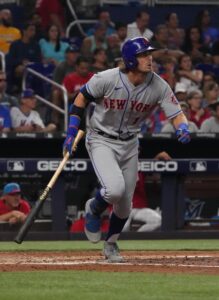
Unable to come to terms on a one-year salary for the upcoming season, McNeil and the Mets appeared headed toward an arbitration hearing. He’d filed for a $7.75MM salary on the heels of his first National League batting title in 2022, whereas the Mets had countered with a $6.25MM figure. Those sums can now be thrown out, as McNeil’s final two arbitration years are locked in. If we count 2023 at the $7MM midpoint of those two sums and figure McNeil could’ve earned anywhere from $12-13MM in what would’ve been his final arbitration season, the Mets are guaranteeing somewhere in the vicinity of an additional $30MM to lock in two more free-agent seasons and secure a reasonably priced club option on a third free-agent year.
McNeil, 31 in April, is now locked in through at least his age-34 campaign and possibly his age-35 season. He’s fresh off one of the finest seasons of his career, having turned in a .326/.382/.454 batting line with nine home runs, 39 doubles, a triple and four stolen bases in 589 plate appearances. Unsurprisingly, that season earned him a second career All-Star nod and won him Silver Slugger honors in the National League — his first such award.
McNeil was one of the toughest strikeouts in the Majors, fanning in a career-low 10.4% of his plate appearances. He’s never walked much and didn’t change that in 2022 (6.8%), but it’s difficult to argue with the results. McNeil benefited to an extent from a career-high .353 average on balls in play, but even if that mark regresses toward the .324 mark he carried into the 2022 season, his bat-to-ball skills and penchant for finding the gaps will allow him to remain the well above-average hitter he was for the majority of the 2018-21 seasons.
The 2022 season was also very arguably the finest defensive season of McNeil’s career. Each of Defensive Runs Saved (3), Ultimate Zone Rating (3.5) and Outs Above Average (7) pegged him as a strong handler of the glove at second base. He also logged some brief time in the outfield corners (278 innings) and drew average or better reviews for his work there, and he even chipped in a lone inning at third base for good measure. Second base will continue to be his primary home on the diamond, but McNeil has shown in the past that he’s a capable third baseman, left fielder or right fielder, which only adds to his value for the Mets.
Of course, since we’re discussing the Mets, the financial ramifications of the contract extend well beyond the $50MM that McNeil himself will receive. The Mets are already over the fourth and final luxury-tax barrier this season, meaning any dollars they spend are taxed at a 90% clip. Had McNeil won his arbitration hearing and secured a $7.75MM salary, that would’ve meant the Mets would’ve paid $6.975MM in taxes on his salary — bringing the total expenditure to $14.725MM. Instead, the Mets will now be taxed based on the $12.5MM average annual value of McNeil’s contract. That means they’ll pay $11.25MM in taxes on McNeil’s contract this year — an increase of $4.275MM over what they’d have paid him had he won an arbitration hearing.
There’s some down-the-road tax benefit to extending McNeil — even beyond the obvious value in keeping an excellent player at a reasonable rate for the next half decade. Had McNeil won an arbitration hearing next month — and coming off a batting title, he’d have had a strong case — he’d have landed that $7.75MM salary. With another strong season, he’d quite possibly have been in for a raise beyond the $12.5MM AAV of his current contract in his final arb season, when the Mets will likely again be in the top tier of luxury penalization (with overages being taxed at a 110% clip). The extension, then, could wind up saving the Mets $1MM or so off their luxury ledger for the 2024 season — assuming McNeil has a healthy and productive 2023 campaign.
Setting aside any such minutiae, the primary benefit to the Mets is simply keeping a two-time All-Star and paying an annual rate that, with good health for McNeil, will likely clock in below his true open-market value by the time the 2024-25 offseason rolls around. There’s certainly some risk for the Mets, as one need only look at McNeil’s pedestrian .251/.319/.360 batting line from 2021 to see that his lack of power (outside of the juiced ball campaign in 2019) leaves him with a fairly tepid floor. The Mets already had control over McNeil’s age-31 and age-32 seasons, and it’s always possible that preemptively buying out a player’s age-33 through age-35 seasons could look regrettable in hindsight.
That said, the aforementioned ’21 campaign is the lone below-average offensive season of McNeil’s career, and his contact skills and defensive aptitude at multiple positions figure to make him a perennially useful player even into his mid-30s. It’s not realistic to expect him to replicate his 2022 production in the years ahead, but there’s little reason to think this deal will turn into some form of egregious misstep, either.
McNeil now joins Max Scherzer ($43MM), Justin Verlander ($43MM), Francisco Lindor ($34.1MM), Brandon Nimmo ($20.5MM), Starling Marte ($20.75MM), Edwin Diaz ($21.25MM), Kodai Senga ($15MM), Jose Quintana ($13MM) and Tomas Nido ($2.1MM) as players locked into their 2024 salaries.
Assuming an even distribution of McNeil’s salary, that’d come out to just over $225MM guaranteed to 10 players, with another four club options (Mark Canha, Eduardo Escobar, Brooks Raley, Darin Ruf), two player options (Omar Narvaez, Adam Ottavino) and a nine-player arbitration class headlined by Pete Alonso all potentially adding to the bill.
Guardians’ Prospect George Valera Recovering From Hand Surgery
Top Guardians outfield prospect George Valera will likely be behind schedule this spring after recently undergoing surgery on the hamate bone in his right hand, Paul Hoynes of the Cleveland Plain Dealer reports.
The 22-year-old Valera has ranked among Cleveland’s top prospects for several years and has landed among the game’s top 100 prospects on rankings at Baseball America, MLB.com and Baseball Prospectus in each of the past two offseasons. Valera appeared in the 2022 Futures Game and climbed as high as Triple-A last season, making him a relatively near-term option for the Guardians — though this surgery will slow that trajectory a bit.
Valera split the 2022 season between Double-A and Triple-A, slashing .264/.367/.470 (129 wRC+) in 387 plate appearances at the former and batting .221/.324/.448 (103 wRC+) in 179 trips to the plate with the latter. He was playing in the Dominican Winter League this summer, but the hand has been problematic — evidenced by a tepid .171/.244/.220 output in 11 games there.
The Guardians haven’t formally announced Valera’s surgery, nor has the team provided an update on his expected recovery period. Hamate fractures and the subsequent surgeries typically sideline hitters for at least four weeks but can require an absence upwards of two months in length.
There’s no immediate spot in the Cleveland outfield for Valera, though with a full, healthy and productive spring he’d have had a chance to force his way into the mix. Third-place Rookie of the Year finisher Steven Kwan has left field locked down, and while Myles Straw‘s bat left plenty to be desired in 2022, his elite defense and the contract extension he inked last spring both make him the clear option in center field. In right field, 25-year-old Oscar Gonzalez figures to get the nod after surprising with a .296/.321/.461 batting line and 11 home runs in 382 trips to the plate as a rookie in 2022.
Valera secured a spot on the Cleveland 40-man roster over the 2021-22 offseason once he’d have become eligible for the Rule 5 draft. He’ll be going into his second minor league option year and seems likely to start next season in Triple-A if he’s ready for Opening Day.
Cardinals Sign Andrew Suarez To Minor League Deal
The Cardinals announced Friday that they’ve signed lefty Andrew Suarez to a minor league contract and invited him to Spring Training. He’ll provide some left-handed depth and a potential bullpen option after spending the past two seasons pitching in the Korea Baseball Organization (2021) and Japan’s Nippon Professional Baseball (2022).
A second-round pick by the Giants back in 2015, Suarez pitched parts of three big league seasons in San Francisco, impressing with a solid 4.49 ERA in 160 1/3 frames as a rookie in 2018 before regressing to a 5.79 ERA in 32 2/3 innings during his sophomore season. Suarez tossed just 9 2/3 innings during the shortened 2020 campaign, bringing his career ERA to 4.66 in 202 2/3 innings. He’s fanned a below-average 17.8% of his MLB opponents but also posted strong 7.8% walk and 49.8% ground-ball rates as a big leaguer.
Suarez, 30, was excellent with the KBO’s LG Twins back in 2021, pitching 115 1/3 innings of 2.18 ERA ball with a 26.6% strikeout rate, 8.7% walk rate and 57.1% grounder rate. That landed him a deal with NPB’s Yakult Swallows for the 2022 season, which he surely hoped to use as a stepping stone for either a raise on a second season in NPB or a return directly to the big leagues. Unfortunately, things didn’t pan out that way; Suarez spent more time with Yakult’s minor league club than he did their top team, and he was roughed up for a 6.23 ERA in 21 2/3 frames while pitching with the Swallows’ top-level club.
It’s not clear whether the Cardinals view Suarez as a starter or reliever, though he’d have a better path to their roster if he were to head to the bullpen for the upcoming season. He’s worked primarily as a starting pitcher in his career, but the Cardinals have Jordan Montgomery, Adam Wainwright, Miles Mikolas, Steven Matz and Jack Flaherty penciled into the rotation now, with several depth options behind them (e.g. Dakota Hudson, Jake Woodford, Matthew Liberatore, top prospect Gordon Graceffo). In the bullpen, however, he could compete with Genesis Cabrera, Zack Thompson, Packy Naughton and JoJo Romero.
Rays Sign Pete Fairbanks To Extension
The Rays announced Friday afternoon they’ve signed reliever Pete Fairbanks to a three-year extension with a 2026 club option. The deal buys out his three remaining seasons of arbitration eligibility, while the club option covers what would’ve been his first free-agent season.
Fairbanks, a client of Republik Sports, is reportedly guaranteed $12MM over the next three seasons (including a $1MM buyout on the 2026 option). Fairbanks will be paid $3.666MM annually between 2023-25, while the option comes with a $7MM base value. The deal also contains various incentives and escalators that could max it out at $24.6MM over four seasons.
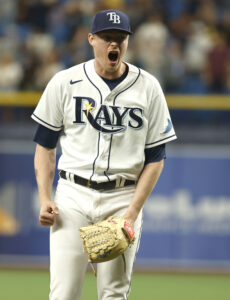
Fairbanks and the Rays had yet to settle on a salary for the upcoming season, as he’d filed for a $1.9MM figure in his first time through the arbitration process, while the team countered at $1.5MM. Fairbanks would’ve been in line for another pair of raises in 2024 and 2025, but those salaries are now locked into place. In exchange for a guarantee that could err toward the high end of what he might’ve earned going year to year, Fairbanks will give the Rays control over his first free-agent campaign — his age-32 season.
The 29-year-old Fairbanks, acquired from the Rangers in a straight-up swap for infielder/outfielder Nick Solak back in 2019, has become one of the Rays’ top late-inning options. Tampa Bay doesn’t typically deploy one set closer, but Fairbanks is among the favorites to lead the club in saves during the upcoming season. Over the past three years, he’s pitched to a 2.70 ERA with a 33.8% strikeout rate and 9.7% walk rate in 93 1/3 innings.
Injuries have kept Fairbanks from working a full slate of innings over a 162-game season, however. In 2021, he twice landed on the injured list due to shoulder troubles — first a strained rotator cuff, then a bout of inflammation — missing roughly a month each time. He missed more than three months of the 2022 season due to a lat strain.
Though there are some durability concerns, Fairbanks’ 2022 campaign, in particular, illustrate the potentially dominant arm the Rays are locking up on this deal. Fairbanks averaged a blistering 99.2 mph on his heater while pitching to a 1.13 ERA with a comical 43.7% strikeout rate, a brilliant 3.4% walk rate and a well above-average 53.3% ground-ball rate. He also registered a 17% swinging-strike rate that ranked 16th out of the 546 pitchers who tossed at least 20 innings in 2022. Fairbanks didn’t allow a run over his final 22 innings of the season.
It’s the second multi-year extension this week for the Rays, who exchanged arbitration figures with a whopping seven players ago two weeks ago on exchange day. Southpaw Jeffrey Springs agreed to a four-year, $31MM contract that bought out two arbitration seasons and two free-agent years earlier in the week. The Rays, like many other clubs, have taken a file-and-trial approach to arbitration in recent years — effectively cutting off talks on one-year deals once figures are exchanged. Those clubs will typically remain open to working out multi-year arrangements if the player is amenable, and otherwise, an arbitration hearing is the typical outcome.
The Rays still have another five players with unresolved cases. Infielder Yandy Diaz (requested $6.3MM to the Rays’ $5.5MM), first baseman/outfielder Harold Ramirez ($2.2MM vs. $1.9MM), lefty Colin Poche ($1.3MM vs. $1.175MM), righty Ryan Thompson ($1.2MM vs. $1MM) and righty Jason Adam ($1.775MM vs. $1.55MM) all exchanged figures with the team on Jan. 13 after being unable to come to terms on a one-year salary figure.
With the recent rash of extensions over the past year-plus — Wander Franco, Tyler Glasnow, Manuel Margot and Springs also agreed to multi-year deals — and the Rays’ signing of Zach Eflin to a three-year contract, Tampa Bay is in the rare position of having a decent bit of cash already on the books two years down the road. The Rays already have $65.666MM guaranteed to seven players for the 2024 campaign, and that’s before factoring in what’s currently slated to be 13 arbitration-eligible players, league-minimum players to round out the group and, of course, any forthcoming additions via trade or free agency over the next 12 months or so.
The Rays have never opened a season with a payroll higher than last year’s $83.8MM total. That won’t change in 2023, barring an unexpected late addition to the roster, but barring a major trade or trades, they look like locks to set a new franchise record in player payroll in 2024. And with each of Diaz, Ramirez, Poche, Thompson and Adam all still unsettled, it’s possible Tampa Bay could yet add a few more guaranteed salaries to that ledger by hammering out additional multi-year pacts with the currently outstanding members of their arbitration class.
Jeff Passan of ESPN was first to report the Rays and Fairbanks had agreed to a three-year, $12MM guarantee with a fourth-year club option. Joel Sherman of the New York Post reported the option’s base value and buyout. Marc Topkin of the Tampa Bay Times reported the contract’s maximum value and specific salary breakdown.
Image courtesy of USA Today Sports.
Nationals Sign Alex Colome
The Nationals announced Friday that they’ve signed veteran reliever Alex Colome to a minor league contract and invited him to Major League spring training. Colome is represented by Wasserman. According to Jesse Dougherty of The Washington Post, Colome has long been on the Nationals’ radar.
Colome, 34, pitched for the Rockies last year and struggled mightily. In 47 innings, he posted a 5.74 ERA, 14.9 K%, and 10.2 BB%. The silver lining was a career-best 55.6% groundball rate, which ranked tenth in the National League for relievers with at least 40 frames. That allowed Colome to post a slightly above-average 0.96 HR/9 despite half his innings coming at Coors Field.
Some of Colome’s best work came with the Rays, the team that signed him as an 18-year-old out of the Dominican Republic. He made his lone All-Star team in 2016, and led MLB in saves the following year. The Rays traded Colome to the Mariners in 2018, who shipped him to the White Sox six months later. He’s since signed a series of one-year deals in free agency, first with the Twins and then with the Rockies.
2022 represented the first time Colome failed to tally double digit saves since 2015, which was also the last season he was used partially as a starter. The Rockies chose to give their highest-leverage work and most save opportunities to Daniel Bard. Colome spent part of the summer as manager Bud Black’s third-most trusted reliever, but fell out of favor around August. His ERA stood at 3.20 on July 30th, and then he proceeded to allow 16 earned runs over his next 7 2/3 innings to close out his season. Those innings came over 12 appearances, as he recorded zero or one out in five of them. Perhaps on a related note, Colome had an IL stint in August for right lateral epicondylitis, also known as tennis elbow. He also spent some time on the bereavement list in September.
Colome has put together a ten-year MLB career with 159 saves, despite missing bats at an above-average clip only twice: in 2016 and 2018. His control, once pretty strong, has slipped into the 9 BB% range since he joined the White Sox. Around that same point in his career, Colome started abandoning his four-seam fastball for a cutter. That has at least allowed him to post a 54.2% groundball rate since 2020. There was a point when Colome was at least limiting hard contact, but last year 10% of the batted balls he allowed were barrels, which is not a good place to be.
Coming off the season he had, the most important factor in free agency is opportunity, and Colome chose the right team for that. The Nationals’ highest-leverage reliever from last year, Tanner Rainey, underwent Tommy John surgery in August. Holdovers include Kyle Finnegan, Carl Edwards Jr., Victor Arano, and Hunter Harvey. Some of those pitchers had better years than you might have realized, but the rebuilding Nats are a good destination for a veteran reliever trying to rebuild value.
The Nats also brought Sean Doolittle and Francisco Perez back on a minor league deals and retained Erasmo Ramirez on a $1MM contract, so their ‘pen features surprisingly little turnover. Anthony Banda will also fight for a job in spring training, having signed a minor league deal after pitching for the Pirates, Blue Jays, and Yankees last year.
Perhaps working against a Colome resurgence, USA Today’s Bryan Kalbrosky has noted that he was one of the game’s slowest workers in 2022. With the implementation of a pitch clock at 15 seconds with bases empty and 20 seconds with runners on, Colome will have to speed things up to avoid getting penalized.
Royals Sign Matt Duffy To Minor League Deal
The Royals signed veteran infielder Matt Duffy to a minor league contract Friday, per a team announcement. The TWC Sports client will be invited to Major League Spring Training and compete for a roster spot.
Duffy, 32, spent the 2022 season with the Angels, where he played three different spots around the infield and posted a combined .250/.308/.311 batting line in 247 plate appearances. Duffy held a similar role with the Cubs in 2021 when he batted .287/.357/.381 and played all four infield positions in addition to left field.
Once the starting third baseman for the Giants and a key piece in the trade that sent Matt Moore from Tampa Bay to San Francisco, Duffy’s career has been severely hampered by injuries. An ailing Achilles tendon in 2016 eventually required surgical repair. That, paired with a separate procedure to remove bone spurs from his heel, cost him the entire 2017 season. Duffy returned to play in 132 games with the 2018 Rays, but a hamstring injury cost him the first four months of the 2019 season and ultimately held him to 46 games.
Duffy doesn’t have much power, but he tends to have a low strikeout rate and is capable of playing all over the infield with passable or better defense (generally plus defense at the hot corner). He’ll give the Royals the type of contact-oriented profile that is so often a hallmark of their roster, and he provides some insurance at second base, third base or shortstop in the event of injuries or a trade.
Kansas City has reportedly drawn trade interest in Nicky Lopez — including from the division-rival White Sox — and their top option at third base is Hunter Dozier, whose contract team would surely prefer to move, if at all possible. Twenty-four-year-old Michael Massey is expected to have the opportunity to win the second base job, but Duffy provides a veteran alternative if Massey struggles this spring.
Dodgers Agree To Minor League Deals With Jordan Yamamoto, Dylan Covey
The Dodgers have agreed to minor league contract with right-handers Jordan Yamamoto and Dylan Covey. Yamamoto announced his own deal with the Dodgers on Instagram yesterday. Taiwan’s United Daily News first reported that Covey, who spent 2021-22 pitching for the Rakuten Monkeys in Taiwan’s CPBL, was signing with the Dodgers (hat tip: CPBL Stats, on Twitter).
Yamamoto, 26, was one of the four players who went from Milwaukee to Miami in the Christian Yelich blockbuster several years ago. He turned in a solid debut effort with Miami in 2019, pitching to a 4.46 ERA with a strong 25.2% strikeout rate against a rough 11.1% walk rate through 15 starts — a total of 78 2/3 innings. That looked to set the stage for Yamamoto to be a contributor on the Miami staff for the foreseeable future, but the righty was blasted for 23 runs in just 11 1/3 innings during the shortened 2020 season.
That nightmarish 2020 season was perhaps impacted by some health troubles. Yamamoto’s 2019 season ended with an IL placement due to a forearm strain, and his velocity in 2020 was down more than 1.5 mph from its 2019 levels. He was traded to the Mets in the 2020-21 offseason but pitched in just 6 2/3 Major League innings for New York in 2021, as a right shoulder injury shelved him for much of the season. Overall, Yamamoto has a 6.05 ERA in 96 2/3 big league innings, although that’s skewed heavily by the 2020 season. Subtract those 11 1/3 innings, and Yamamoto is at a much more palatable 4.43 ERA in 85 1/3 frames.
Covey, 31, has pitched in parts of four big league seasons, logging time with the White Sox each year from 2017-19 and with the Red Sox in 2020. He’s been tagged for a dismal 6.57 ERA in that time, but he has a strong track record both in Triple-A (2.63 ERA, 95 2/3 innings) and in the Chinese Professional Baseball League, where he tallied 198 1/3 innings of 3.63 ERA ball while pitching for the Monkeys.
The Dodgers already have a deep rotation mix with Clayton Kershaw, Julio Urias, Tony Gonsolin, Dustin May and Noah Syndergaard locked into big league spots (and Walker Buehler rehabbing from Tommy John surgery). That’s not counting top pitching prospects Bobby Miller, Ryan Pepiot and Gavin Stone, each of whom could factor into the plan as soon as this season. Righties Michael Grove and Andre Jackson, both on the 40-man roster, represent further depth options. Both Yamamoto and Covey will add some experience to that group.