
AL West Notes: Astros, Rangers, A’s
The Athletic’s Jake Kaplan takes a look at the Astros‘ depth chart for the upcoming season, highlighting a few minor areas the club could look to pursue depth. With top prospect Jeremy Pena currently atop the depth chart at shortstop and Aledmys Diaz slated to back up at all four infield positions, Kaplan suggests an additional shortstop candidate — ideally one with a minor league option remaining — would be a prudent addition. Obviously, the whole situation would change in the event that the ‘Stros re-sign Carlos Correa or pivot by inking fellow free agent Trevor Story. There aren’t too many free-agent options available in that bucket, but that’s the sort of player who can be found in a smaller-scale trade or on the waiver wire as teams make cuts amid the forthcoming flurry of transactions.
Kaplan also raises the “wild card” possibility of the Astros adding another corner outfielder (thus moving Kyle Tucker to center field) and suggests that if there’s one area from which the Astros are likely to trade in order to address other deficiencies, it’d be from their enviable starting pitching depth. (MLBTR listed veteran righty Jake Odorizzi among our likeliest trade candidates last week.) It’s a solid, broad-reaching look at where the Houston roster stands and how the team might attack some depth needs post-lockout, and ‘Stros fans in particular will want to take a full read-through.
Here’s a few more notes from the division…
- While the Rangers are likely to give Adolis Garcia the starting nod in center field again in 2022, Evan Grant of the Dallas Morning News suggests that there’s enough uncertainty that the club could pursue additional depth in the outfield. Seiya Suzuki has been connected to Texas, of course, but even absent a big splash like Suzuki or Michael Conforto, smaller-scale outfield additions seem plausible. Specifically, someone capable of playing center and also handling left field would be of intrigue, Grant notes. Garcia got out to a blistering start but cratered with a .219/.266/.386 slash from July 1 onward (334 plate appearances). Meanwhile, backup option Eli White is recovering from elbow surgery, while top prospect Leodys Taveras has yet to hit in the big leagues. Over in left field, Willie Calhoun has not yet proven himself capable of consistently hitting MLB pitching or remaining healthy. Speculatively, names like Kevin Pillar, Jake Marisnick and Jarrod Dyson could all fit the billing described by Grant, though there’s little reason to discount the possibility of Texas making a bigger splash, given their pre-lockout levels of aggression.
- In running through some of the minor league free agents already brought aboard by the Athletics this winter, Melissa Lockard of The Athletic suggests that the A’s probably aren’t done adding catching help. Twenty-eight-year-old Austin Allen received only eight plate appearances despite a robust .317/.351/.584 slash in 299 trips to the plate at the Triple-A level. The A’s instead gave 94 plate appearances to light-hitting Aramis Garcia and acquired veteran Yan Gomes at the trade deadline as a second catcher to pair with young backstop Sean Murphy. Neither Garcia nor Gomes is with the organization anymore, and the top option in Triple-A at the moment is journeyman Christian Bethancourt. Catching depth, then, indeed figures to be an area of focus for the A’s — be it via minor league free agency, the waiver wire or perhaps as part of the return in some of the trades they’re widely expected to execute when transactions resume.
Minor MLB Transactions: 2/16/22
Major League transactions remain frozen while the lockout drags on, but minor league transactions are still allowed — and the many independent leagues throughout the country are still up and running. It’s common for former minor league and major league players alike to suit up for teams on the indie circuit, regularly using them as a catapult back into affiliated ball. Here’s a quick look at a couple former big leaguers who’ve signed on with independent teams over the past week…
- Former White Sox outfielder Charlie Tilson has signed on with the Chicago Dogs of the American Association, per a team announcement. The 29-year-old’s last big league action came with the ChiSox in 2019, when he appeared in 54 games and batted .229/.293/.285 through 157 trips to the plate. Tilson, a 2011 second-round pick of the Cardinals, originally landed in Chicago in a trade that sent lefty reliever Zach Duke to St. Louis. It was a dream scenario for the Illinois native and childhood White Sox fan, who debuted with his hometown club just two days after the trade. Unfortunately, Tilson tore his hamstring during his MLB debut and required season-ending surgery. That’s a particularly problematic injury for a player whose speed was his top tool. Tilson, who swiped 46 bags in 134 Double-A games back in 2015, has stolen just 36 bases over his past 298 professional games since that surgery. He spent the bulk of his 2021 season with the Phillies’ Triple-A affiliate, where he hit .296/.361/.404 in 232 plate appearances. Overall, he’s a .246/.311/.290 hitter in 279 Major League plate appearances.
- Right-hander Rob Whalen signed with the Washington Wild Things of the Frontier League, per the team. The former Braves and Mariners right-hander briefly retired a couple of years ago but returned to professional ball in 2020 when he signed a minor league pact with the Mets. That deal effectively went up in smoke when the Covid-19 shutdown prompted teams throughout the league to release the majority of its minor league signees due to the lack of a minor league season. Whalen pitched with the Wild Things last season as well, parlaying a strong 15 1/3-inning showing into a minor league deal with the Twins. He struggled with Minnesota’s Double-A and Triple-A affiliates, however, yielding 23 runs in 24 innings during his first stint in affiliated ball since 2018. Whalen has just a 5.75 ERA in 36 big league innings, but he sports a 3.73 ERA as a minor leaguer. Back in 2018, Whalen spoke with FanGraphs’ David Laurila about his battles with anxiety and depression, which prompted his brief retirement, and the importance of prioritizing mental health and seeking help when needed.
Multiple MLB Players Testify In Eric Kay Trial
Rockies first baseman C.J. Cron, free-agent right-handers Matt Harvey and Mike Morin, and Phillies righty Cam Bedrosian were called as witnesses in the ongoing Eric Kay trial today, as covered in detail by ESPN’s T.J. Quinn and The Athletic’s Sam Blum. Kay, formerly the Angels director of communications, is accused of providing the pills that led to the tragic death of left-hander Tyler Skaggs.
In questioning Skaggs’ former teammates, the prosecution sought to prove that Kay alone was the source of the pills that proved fatal. Kay’s defense looked to create reasonable doubt in that allegation and bring to light the possibility that Skaggs could have received the drugs from another source.
Each of Harvey, Cron, Morin and Bedrosian admitted to using oxycodone that was provided to them by Kay — Harvey, Morin and Bedrosian during their time with the Angels, and Cron both during his time with the Angels and, at least once, during his time as a member of the Rays. Harvey acknowledged that Skaggs, at one point, spoke of another source of pills — an unnamed contact in Santa Monica. Cron indicated during his testimony that Kay was, to his knowledge, Skaggs’ only source of pills. Kay provided Cron himself with pills around eight times, Cron said.
Morin acknowledged being provided with pills on five to six occasions, detailing a payment scheme wherein he would leave cash in a locker room cubby, which Kay would then replace with pills. It was Skaggs who introduced him to the possibility of procuring pills from Kay, according to Morin’s testimony. He later added that Kay was not profiting from providing the players with drugs. Bedrosian also indicated he received pills from Kay, later stating that he was “scared” upon hearing of Skaggs’ death because he’d “taken those (same drugs) a couple of times” himself.
Harvey stated within his testimony that he did not know Skaggs to have a problem. (Dodgers hurler Andrew Heaney — Skaggs’ close friend and former teammate in Anaheim — testified last week that he was also unaware Skaggs had an opioid issue). Harvey spoke this afternoon of the lengths to which active players will go to remain on the field in the face of severe injury. He candidly acknowledged, when prompted, that today’s testimony could negatively impact his own playing career moving forward. Morin, meanwhile, stated he stopped using after leaving the Angels organization, citing the mental toll of failing to meet his lofty expectations for himself as a catalyst for his usage.
The prosecution rested their case against Kay this afternoon. The trial will resume tomorrow morning, at which time the defense will present its case. The finer details of the players’ testimonies are available both at ESPN and at The Athletic, for those who wish to delve into the full breadth of the scandal. Broadly speaking, today’s testimonies both underscore the likelihood of prescription drug abuse on a greater level than many fans realize and provide additional context to the sad and untimely death of Skaggs.
Ryan Zimmerman Announces Retirement
Two-time All-Star and 2019 World Series champion Ryan Zimmerman announced his retirement from Major League Baseball today. The decision marks an end to a 17-year MLB career spent entirely as a member of the Nationals organization.
Zimmerman released a statement via his agency CAA Baseball, the full extent of which can be found on Twitter. Therein, the 37-year-old thanks the Washington fanbase, Nationals’ ownership and front office, his former teammates, coaches/training staff and agents, and his family. “Although my baseball career has come to an end, my family and I will continue to be heavily involved in the DMV community. You have given so much to us over the past 17 years; it is now time for us to give back to you. We look forward to continuing many of our community programs and starting new ones in the future. Our kids will be raised here, as this is now our home, and we couldn’t be more excited. So this is not a goodbye but more of a ‘see you around.'”
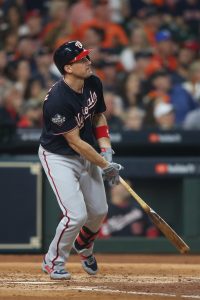
The franchise made the transition from the Expos to the Nationals over the 2004-05 offseason, relocating from Montreal to Washington. That summer, they selected Zimmerman with the fourth overall pick coming out of the University of Virginia. The first official National draftee, the right-handed hitter would debut in the major leagues just a couple months later. So kicked off an MLB career that’d span nearly two decades and cement him as one of the most important players in franchise history.
Zimmerman hit very well as a September call-up in 2005, and he was pencilled into the starting lineup at the beginning of the following year. Immediately, he proved a quality all-around performer. He hit .287/.351/.471 as a rookie, pairing that above-average offensive output with excellent third base defense. He narrowly finished behind Hanley Ramírez in that season’s NL Rookie of the Year balloting, but Zimmerman would land some accolades before long.
Between 2007-08, he posted slightly above-average offensive marks while continuing to rate as one of the league’s best glovemen at the hot corner. Yet his career really took off in 2009, when Zimmerman made important strides in both his power output and walk rate en route to a .292/.364/.525 showing. That checked in 30 percentage points above the league average offensive performance (130 wRC+), and Zimmerman collected his first career All-Star appearance, Silver Slugger award and Gold Glove while garnering some down-ballot MVP support.
Not only did he back up that breakout showing the following season, he arguably got even better. Zimmerman hit .307/.388/.510 that year, collecting another Silver Slugger and a few more MVP votes. Despite the accolades, he was perhaps a bit underrated over that two-year run as the team stumbled to a pair of last-place finishes. Only five position players (Albert Pujols, Evan Longoria, Joe Mauer, Carl Crawford and Chase Utley) topped Zimmerman by FanGraphs’ Wins Above Replacement measure between 2009-10.
Zimmerman had signed an early-career contract extension before his 2009 breakout, locking him in as a building block for a franchise that finally emerged from a long-term rebuild a few years into the 2010’s. He didn’t quite maintain his 2009-10 level of play as he got into his late-20s, but Zimmerman remained a solidly above-average regular for the next few seasons. He combined for a .281/.348/.464 showing between 2011-13, playing a key role in the Nats winning the division in 2012 for the first time since relocating.
Along the way, Washington again inked Zimmerman to a long-term extension. This one, a $100MM guarantee that ran through 2019 with full no-trade protection, promised to keep him a member of the organization for at least the vast majority of his career. Injuries limited his workload between 2014-15, and he turned in an uncharacteristically poor season in 2016. Yet Zimmerman rebounded late in the deal.
Working exclusively as a first baseman as he got into his 30s, he posted one of the better showings of his career in 2017. Zimmerman popped a career-best 36 homers and hit .303/.358/.573 over 576 plate appearances that year, earning his second All-Star nod in the process. Recurring injuries kept him from ever again exceeding 350 at-bats in a season, but Zimmerman continued to hit at an above-average level when healthy in 2018.
Remaining with the Nationals throughout his career paid off most handsomely in 2019. Zimmerman only played in 52 regular season games, but he was no doubt a revered member of the clubhouse. He saw a fair bit of action during Washington’s run to a World Series title, collecting his first ring in his age-34 campaign. Zimmerman opted out of the 2020 season owing to COVID-19 concerns but returned for a final year with the Nats in 2021.
While he hit free agency at the end of last year, there’s no question the Nationals would have welcomed him back had he wanted to continue playing. General manager Mike Rizzo said in October that “Ryan Zimmerman has a place on this roster as a player as long as Mike Rizzo is the GM” and flatly stated he had a standing MLB contract offer on the table. Yet Zimmerman pointed to a desire to spend more time with his family and suggested he didn’t feel he had the drive to fully commit to playing another season (via Jesse Dougherty and Barry Svrulga of the Washington Post).
Zimmerman concludes his playing career having left an indelible mark on the franchise, highlighted by the “Mr. National” moniker long ago bestowed upon him by fans. His #11 jersey seems a lock to be retired by the organization, and he’ll no doubt be finely remembered by the Washington fanbase.
Altogether, Zimmerman compiled a .277/.341/.475 line across parts of 16 big league seasons. He totaled 1846 hits, 284 home runs and 417 doubles, driving in 1061 runs and scoring 963 times. Both FanGraphs and Baseball Reference valued his career around 40 WAR, and BRef estimates he compiled a bit more than $134MM in earnings. Zimmerman earned MVP votes in four separate seasons, and it wouldn’t be a surprise if he garners some votes for the Hall of Fame when he appears on the ballot five years from now. MLBTR congratulates him on an excellent career and wishes him all the best in retirement.
MLBTR Chat Transcript
Click here to read a transcript of Tuesday’s chat with MLBTR’s Steve Adams.
8 Post-Tommy John Pitchers Who’ll Impact Next Year’s Market
We’ve grown accustomed to seeing headline after headline indicating that a pitcher is slated to undergo Tommy John surgery in today’s game. The procedure has become so commonplace, in fact, that it’s no longer surprising to see teams guarantee multi-year deals to rehabbing pitchers who’ll be sidelined for a full season of that contract as they work back from the injury. Such deals have produced varying levels of success in the past. Nathan Eovaldi‘s two-year deal with the Rays worked out great; Drew Smyly didn’t pitch for the Cubs and posted a 6.24 after being traded to the Rangers.
Heading into the 2022 season, there are a handful of notable pitchers who were either signed under just that circumstance or are now playing for a contract on the heels of a Tommy John surgery that, hopefully, is more or less in the rearview mirror. A strong rebound will position any of this bunch either as a prominent member of next winter’s free-agent crop or, in some cases, to have a lucrative 2023 club option picked up. Here’s a look at a handful of Tommy John recoveries that could have a notable impact on next year’s market.
Starting Pitchers
Mike Clevinger: A marquee addition by the Padres at the 2020 trade deadline, Clevinger made only four regular-season starts and a one-inning postseason cameo before requiring Tommy John surgery in the 2020-21 offseason. San Diego, knowing he’d miss the entire 2021 season, signed him to a two-year, $11.5MM deal that paid him $2MM during his rehab season but will more heavily compensate him in 2022, now that he’s expected to be back to full strength. It was the second Tommy John procedure of Clevinger’s career, as he also had the surgery as a minor leaguer back in 2012.
There’s little questioning Clevinger’s talent, as the now-31-year-old righty was one of the most effective starters in all of baseball from 2017 until the time of his injury in 2020. In 489 1/3 innings over that stretch, Clevinger posted a 2.96 ERA while punching out 28% of his opponents against a 9% walk rate. Among big league pitchers with at least 400 innings thrown during that time, Clevinger ranked seventh in ERA and 14th in FIP (3.39). That said, he’s also only reached 130 innings in a big league season on one occasion, when he threw an even 200 frames in 2019.
That relatively limited workload, coupled with this being Clevinger’s second Tommy John procedure, will surely impact his free agency next winter to an extent. That said, a strong and healthy season out of the righty will still position him as one of the top arms on next winter’s market. Clevinger, teammate Joe Musgrove, Sean Manaea and Noah Syndergaard are among the more prominent free agents still in their early 30s next winter (to say nothing of older veterans with contract options or opt-outs, such as Jacob deGrom, Justin Verlander and Charlie Morton).
James Paxton: Paxton isn’t necessarily playing for a free-agent contract. He signed a complicated multi-year deal with the Red Sox that’ll pay him $6MM in 2022 before he can either trigger a $4MM player option or the team can exercise a pair of $13MM club options for the 2023-24 seasons. For luxury-tax purposes, that should be considered a two-year, $10MM deal, as the player option for 2023 is considered to be guaranteed money. Of course, there’s also the possibility that with a healthy season, the contract will effectively balloon to a contract that pays Paxton $32MM over a three-year term. The deal contains further incentives, as Paxton could boost those 2023-24 salaries by $250K apiece for reaching 12, 14, 16 and 18 starts.
It’s a heavily incentive-laden deal that speaks both to the considerable risk in signing Paxton and the considerable upside he’ll bring to Boston. A healthy Paxton is a high-quality big league starter, evidenced the career 3.50 ERA he carried into an injury-ruined 2020 season with the Yankees. Among the 149 big league starters to toss at least 200 innings from 2017-19, Paxton’s 30.1% strikeout rate ranked seventh, and his 7.3% walk rate was markedly better than league average. His 22.7 K-BB% was among the best in the game, as were his strong ratings in the eyes of fielding-independent metrics like FIP (3.26) and SIERA (3.45).
Since that 2019 season, however, Paxton has undergone back surgery, missed significant time with a forearm strain and eventually undergone Tommy John surgery. Earlier in his career, he’d dealt with lat, forearm and pectoral injuries, among a litany of smaller-scale issues.
There’s probably a scenario where Paxton pitches well enough to turn down his $4MM player option even if the Red Sox decline the effective two-year, $26MM option they hold over him. (We saw a comparable situation play out with Yusei Kikuchi earlier in the winter.) That said, the ideal scenario for Paxton and the Sox is that he pitches well enough to reestablish himself as a quality MLB hurler and boost those two club options to $14MM apiece in total value in the process.
Paxton underwent his Tommy John procedure in late April, so he’s not likely to be ready to help the Red Sox at the beginning of the season. By late May or June, however, he could represent a boost to a rotation that is not exactly shy of other injury concerns.
Justin Verlander: Even though he hasn’t pitched since undergoing Tommy John surgery, Verlander still got a hefty $25MM guarantee from the Astros — plus a conditional $25MM player option that kicks in if he reaches 130 innings pitched. The two-time Cy Young winner and former AL MVP has a track record that speaks for itself; when we last saw Verlander in a full, healthy season, he was edging then-teammate Gerrit Cole for the 2019 AL Cy Young Award.
Verlander has said in the past that he hopes to pitch into his 40s, and he has a good chance at doing so if he can bounce back this coming season. He’ll turn 39 later this week, and if he goes out and looks anything like he did from 2015-20 — 1010 innings, 2.94 ERA, 29.7% strikeout rate, 6% walk rate — Verlander will likely turn down that $25MM option, or at least leverage it into a new multi-year arrangement with the ‘Stros. He was just promised a $25MM guarantee despite having thrown only six innings since Opening Day 2020, so there’s little reason to accept that he’d take a year and $25MM on the heels of a healthy return effort at Minute Maid Park.
Noah Syndergaard: Perhaps it’s not quite fair to label Syndergaard as a Tommy John rehabber; after all, he did make it back to the mound with the Mets late in the 2021 season — albeit for only two innings. That said, this is Thor’s first full season back from that ligament replacement procedure, and he’ll be pitching for a big contract next winter from the moment he suits up in Orange County. Signed by the Angels to a one-year, $21MM contract, Syndergaard will be pitching with a team other than the Mets for the first time in his big league career.
It’s a hefty price to pay, particularly considering the fact that Syndergaard had rejected an $18.4MM qualifying offer, but his career to date is all the evidence needed to suggest that at his best, Syndergaard is plenty worth that gamble. He’s never walked more than 6.1% of his opponents in a given season and has never failed to strike out a batter per inning. Few pitchers can match Syndergaard’s blend of pure velocity, missed bats and impeccable command, and he manages all that while still turning in a ground-ball rate that’s well higher than the league average.
Syndergaard has always felt like he’s one step away from solidifying himself as a bona fide ace, and as Robbie Ray showed in winning the AL Cy Young Award this season, one dominant season for a player with this type of track record can result in a nine-figure payday if things break right. The market has already proven to value Syndergaard at more than $20MM per year, and given that he’d be 30 years old in 2023, it’s not hyperbole to suggest that he’s pitching for a $100MM contract this season.
Luis Severino: As with Syndergaard, Severino may not quite fit the criteria for this list. The 27-year-old (28 later this week, on the same day Verlander turns 39) returned to give the Yankees six innings out of the bullpen late in the 2021 season, and his protracted absence from the team’s pitching staff cannot be solely attributed to Tommy John surgery. Severino has also battled groin, shoulder and lat injuries along the way. That said, Severino really hasn’t pitched since undergoing Tommy John surgery in Feb. 2020, and it’s that operation that is the primary reason for his absence over the past two seasons.
Severino isn’t yet slated to hit the open market at season’s end — at least not before the Yankees make a call on a $15MM club option or a $2.75MM buyout. The resulting $12.25MM net decision would be a straightforward one for general manager Brian Cashman if Severino at all looks like his former self. From 2017-18, Severino gave the Yankees 384 2/3 innings of 3.18 ERA ball with outstanding strikeout and walk rates, prompting the team to sign him to a four-year contract extension that promised him $40MM.
That deal looked like a bargain for the team at the time but has since gone south, due largely to repeated injury woes. Severino made a combined 63 regular-season starts for the Yankees in 2017-18, looking every bit like a foundational piece to the pitching staff, but he’s combined for just 25 starts and another 18 relief appearances in the five seasons surrounding that brilliant run.
With a big season in 2022, Severino could still see that $15MM option picked up, and if he can remain healthy into 2023, he’d hit the open market heading into his age-30 season. There’s a long way to go before that scenario becomes reality, however.
Relievers
Tommy Kahnle: Signed by the Dodgers to a two-year, $4.75MM contract last offseason, Kahnle was never expected to contribute in 2021 — hence the backloaded nature of his contract, which will pay him $3.45MM in 2022. The hard-throwing righty only managed one inning for the 2020 Yankees, meaning this coming season will be the first since 2019 in which he’ll potentially pitch anything resembling a full workload.
The 32-year-old Kahnle has been inconsistent but has dominated more often than he’s struggled. From 2016-20, he logged a combined 3.48 ERA, 32.9% strikeout rate and 9.9% walk rate while averaging 97.1 mph on his heater. That includes a disastrous but also fluky-looking 2018 campaign in which he was tattooed for a 6.56 ERA in 23 1/3 frames. From 2016-20, Kahnle’s 32.9% strikeout rate ranks 17th among the 155 relievers to have thrown at least 150 innings, while his 15.9% swinging-strike rate is tied for sixth.
Kahnle’s Tommy John surgery came way back on Aug. 5, 2020, so there should be no restrictions on him by the time the season gets underway. He’ll be heading into his age-33 season next winter, and a return to his vintage form should position him as one of the top relievers on a free-agent market that is lacking in big-name right-handed relievers.
Ken Giles: Like Kahnle, Giles was signed by the Mariners — two years, $7MM — knowing full well that he would not pitch in 2021. Unlike Kahnle, his contract includes a club option for the 2023 season, which is valued at $9.5MM (with a $500K buyout).
Many of the same superlatives that apply to Kahnle apply even more so to Giles. His 18% swinging-strike rate, for instance, tops Kahnle and sits third among the 155 relievers who totaled at least 150 frames from 2016-20. His 3.33 ERA in that time is a bit more toward the middle of the pack, but Giles misses bats, induces chases outside the zone and throws as hard as nearly any reliever in the sport. He’s had a pair of 4.00-something ERAs sprinkled in amid a series of pristine marks throughout his big league career. Those two blemishes have coincided with spikes in his average on balls in play and dips in his strand rate.
On the whole, Giles is a power arm who can pile up strikeouts in droves. He’s a sometimes forgotten piece of the puzzle when looking at the 2022 Mariners and their hopes of contending, but he’ll join a deep bullpen mix that also features Diego Castillo, 2021 breakout closer Paul Sewald, former Marlins stopped Drew Steckenrider (who enjoyed a tremendous rebound in 2021) and the underappreciated Casey Sadler, who notched a 0.67 ERA in 40 1/3 innings last year.
A healthy Giles would very likely see that $9.5MM club option for the 2023 season picked up, and at his best, he’s a bargain at that price. If Giles is pitching well but things go south for the Mariners, teams will come calling at the trade deadline. Of course, the Mariners are hoping to be squarely in the postseason mix, and they’re likely not done with their offseason shopping just yet.
Jose Leclerc: Armed with a fastball in the mid to upper 90s, Leclerc’s ability to return to form (or his lack thereof) will have major implications for the Rangers moving forward. His four-year, $14.75MM contract extension includes a $6MM club option for the 2023 season and a $6.25MM option for the 2024 season. A rebound effort makes that 2023 option a no-brainer for the Rangers to pick up as they hope to ride a hyper-aggressive offseason into their next competitive window.
Leclerc, 28, has fanned just shy of a third of the hitters he’s faced so far in his big league career and has only allowed a dozen homers in 189 Major League innings (0.57 HR/9). His 14.9% walk rate is far too high, but he looked to be making considerable strides in that department in 2019 when he posted a sub-2.00 ERA, a 38.1% strikeout rate and an 11.2% walk rate. He’ll be a highly intriguing lottery ticket on next year’s market if he pitches poorly enough that the Rangers buy that option out (or if they do so on the heels of another injury). If he rebounds, he’ll be a bargain piece of an on-the-rise Rangers club in 2023-24.
Minor MLB Transactions: 2/15/22
Major League free agency remains in a transactions freeze, but teams are still inking players to minor league pacts as we await a new collective bargaining agreement. Here’s a quick look at a couple former prospects of note who’ve agreed to deals in recent days…
- The Phillies signed former Red Sox prospect and Philadelphia native Josh Ockimey to a minor league contract, as announced by Ockimey himself (on Twitter). The 26-year-old slugger was Boston’s fifth-round pick back in 2014 and consistently ranked among the organization’s top 25 prospects at Baseball America throughout his time there, peaking at No. 10 in the 2016-17 offseason. A left-handed-hitting first baseman, Ockimey posted solid numbers up through Double-A before beginning to struggle in Triple-A. He’s still drawn his walks (16.6%) and hit for power (.221 ISO) at the minors’ top level, but Ockimey’s 31.4% strikeout rate in Triple-A has contributed to a .214/.349/.435 overall slash line in 933 plate appearances there. He’ll give the Phillies some additional depth at first and at designated hitter — assuming the universal DH is implemented after the lockout, as expected.
- Catcher Chris Betts is headed to the Dodgers on a minor league contract, per the transactions log at MLB.com. The 24-year-old was the No. 52 overall pick by the Rays back in 2015 but missed his first full season after requiring Tommy John surgery. He ranked among Tampa Bay’s top prospects at Baseball America up until the 2018 season but has struggled to stay healthy throughout his pro career. Betts appeared in a career-high 110 games with the Rays’ Class-A affiliate in ’19, hitting .210/.333/.400 in 472 plate appearances. He appeared in just 27 games and tallied only 89 plate appearances in 2021, but he’ll give the Dodgers a once well-regarded catching prospect to stash in the middle levels of their system in 2022, if healthy. Betts drew praise for his bat speed and raw power back when BA ranked him as the 2015 draft’s No. 28 overall prospect, but he’s a project for the Dodgers at this point.
The Rangers’ Underappreciated Trade Chip
The Rangers’ decision to cannonball into the deep end of the free-agent pool this offseason has radically reshaped their infield mix and given them one of the top offensive double-play tandems in Major League Baseball. Corey Seager and Marcus Semien are slated to hold down the shortstop/second base pairing in Arlington for the next seven seasons.
One side effect of that seismic splash is that it leaves Isiah Kiner-Falefa without a clear-cut defensive home. A Gold Glove winner at third base in 2020, Kiner-Falefa played a strong shortstop in 2021 and had been squarely atop the depth chart there prior to the Seager/Semien stunner. That’s no longer the case, though not through any fault of his own. Kiner-Falefa has been an elite fielder by measure of Defensive Runs Saved and finished third among MLB shortstops in the Fielding Bible’s voting this past season. Metrics like Ultimate Zone Rating and Outs Above Average aren’t as bullish, but Kiner-Falefa is at worst regarded as a roughly average defender (and generally agreed upon as a good bit more than that).
Beyond his accolades with the glove, Kiner-Falefa is fairly a solid performer at the plate, albeit in more of an “old school” manner. He’s been 13 percent worse than the average hitter, by measure of both wRC+ and OPS+, over the past two seasons — but that’s primarily due to a lack of power. Kiner-Falefa has still posted a solid .273 batting average and a respectable .316 on-base percentage in that time. He’s only drawn a walk in 4.6% of his past 905 plate appearances, but he’s also only fanned in 13.5% of those trips to the plate.
There’s plenty of value derived from Kiner-Falefa’s ability on the basepaths as well. He went 20-for-25 in stolen-base attempts this past season and ranked in the 75th percentile of MLB players in terms of average sprint speed, per Statcast. On top of that, Kiner-Falefa has played in all but six of the Rangers’ games dating back to 2020. Only six big league players have appeared in more games than Kiner-Falefa over those two years.
He may not be a star, but Kiner-Falefa is a good defender and baserunner who rarely strikes out and, despite a lack of power, at least gives his club solid at-bats. That’s a valuable player, even if the overall skill set is a bit less typical now than it’d have been a generation ago. A simple course of action is to just shift Kiner-Falefa back to the hot corner, where he won that previously mentioned Gold Glove in 2020. That’d be a straightforward means of addressing the infield, were it not for the presence of fast-rising prospect Josh Jung.
The 24-year-old Jung was the No. 8 overall draft pick in 2019 and has done nothing but hit since he made his professional debut. The former Texas Tech star is widely considered to be among the 40 or so best prospects in all of Major League Baseball and is expected to make his debut in 2022. It’s even arguable that with a good Spring Training showing, Jung could merit an immediate look in the big leagues. He posted a dominant .326/.398/.592 slash between Double-A and Triple-A last year, after all, including a ridiculous .348/.436/.652 output with nine home runs and 14 doubles in 156 Triple-A plate appearances.
Jung has played exclusively at third base in the minors, although as The Athletic’s Keith Law noted in ranking Jung 32nd on his Top 100 prospect list, the Rangers did play him at a few different positions in 2020 at their alternate site. Still, Law calls Jung a solid-average third baseman, and scouting reports at Baseball America, FanGraphs and MLB.com have generally agreed that Jung should be able to handle the position from a defensive standpoint.
Even if the expectation is that Jung rises quickly to the big leagues — be it Opening Day, late April or mid-June — the Rangers don’t necessarily need to do anything with Kiner-Falefa. He’s projected by MLBTR contributor Matt Swartz to earn an affordable $4.9MM salary in 2022 and is controllable via arbitration through the 2023 season. Asking Kiner-Falefa to keep the hot corner warm for Jung before moving into a super-utility role is a perfectly sound and defensible course of action for a team that is striving for immediately improved on-field results. Kiner-Falefa has strong defensive ratings at each of shortstop, third base and second base — and while he struggled when trying to work as a catcher early in his career, he does at least have 586 MLB innings at the position. At the very least, he’s a better option there than most emergency catchers.
Still, that versatility and affordability also create another path for the Rangers to take: trade Kiner-Falefa to a team that has an immediate infield need. Even with Seager, Semien, Jon Gray and Kole Calhoun, the Rangers aren’t expected to compete in 2022. They’re likely looking at 2023 and beyond, when Jung, Jack Leiter, Cole Winn and other top prospects will be more seasoned at the MLB level. Trading Kiner-Falefa now for one more jolt of young talent does carry some long-term appeal, even if it perhaps costs Texas a few wins in the forthcoming season.
The Yankees, for instance, have already been linked to Kiner-Falefa. If they’re indeed reluctant to sign one of the remaining premier shortstops (i.e. Carlos Correa, Trevor Story) to a long-term contract as they instead await the arrival of ballyhooed prospect Anthony Volpe, then Kiner-Falefa would make sense as a quality stopgap who could hold the fort down for the entire 2022 season at the least.
New York is far from the only on-paper fit. The Twins don’t have a clear starter at shortstop at the moment, nor do the Angels. The Astros are still planning for how they’ll replace Correa if he ultimately signs elsewhere, and the Phillies could use a defensive upgrade over Didi Gregorius. Looking to other positions that Kiner-Falefa can handle, the White Sox could install him at second base. The Blue Jays could look for help at either third base or second base.
Suffice it to say, there’s a fairly wide swath of teams that could and quite likely will show interest in Kiner-Falefa when the lockout lifts. Will the Rangers actually make a move, though? That much depends on the strength of offers received.
Texas isn’t going to move Kiner-Falefa solely because of his modest arbitration salary and the fact that he could eventually be used in more of a utility role. If a team makes a strong offer, though, the newfound infield depth will surely prompt president of baseball ops Jon Daniels and GM Chris Young to consider the idea. Evan Grant of the Dallas Morning News has suggested a couple of times this month that a trade might be likelier late in Spring Training, once Texas has a better sense of where Jung is and once other clubs know what to make of their internal options around the infield.
However things play out, Kiner-Falefa is now a rather valuable luxury item in Texas: well-rounded enough to start at three different infield positions but still likely one step down the depth chart at each spot by season’s end in 2022. Kiner-Falefa has quietly become an underappreciated trade chip, but if the offers presented to Daniels & Co. aren’t sufficient, it never hurts to have an overqualified depth piece in the event of injuries to big-name veterans or a slow start from a top prospect.
Latest On David Stearns’ Contract
Back in October, when the Mets were still in search of a new baseball operations leader, SNY’s Andy Martino reported that Brewers president of baseball operations David Stearns — known to be of interest to Mets owner Steve Cohen — may have a vesting option for the 2023 season on his contract. Stearns was already known to be signed through 2022 at the least, and the presence of a clause extending that date through the 2023 season only further reduced the likelihood that he’d be a realistic candidate in Queens.
Now, Martino adds some additional context, writing that Stearns is technically signed through the 2023 season, but his contract allows him to become a free agent this offseason if Milwaukee wins the National League pennant in 2022. Essentially, one of his perks based on the team’s on-field success would be the right to explore his market and field interest from other clubs a year earlier than otherwise scheduled.
The Mets, in particular, are known to covet Stearns. Their courtship of Stearns goes back two years now, as Cohen has sought permission to interview Stearns — and been denied by the Brewers — in each of the past two offseasons. Stearns has always been a long-shot target for the Mets, as most clubs generally only allow executives to interview with other teams if the opportunity in question would mark a promotion. Stearns already has baseball operations autonomy in Milwaukee and holds the title (president, baseball operations) that is now most commonly given to front office leaders.
Even if the Brewers don’t make a World Series appearance and trigger Stearns’ early out, it’s quite possible a fresh round of Mets/Stearns rumors will kick up again this winter nonetheless. After all, nothing had changed from Nov. 2020 to Nov. 2021 — Stearns was still under contract for multiple years — but the Mets still placed him atop their front office wishlist, only to again be rebuffed by the Brewers. Cohen hired Billy Eppler under the title of “general manager,” not “president of baseball operations,” so it’s technically possible that he could hire Stearns to head up the Mets’ baseball operations staff even with Eppler on board as GM.
One way to more firmly put an end to any pursuits of Stearns from rival clubs would be for Brewers owner Mark Attanasio to sign Stearns to a new extension. It’s now been more than three years since Stearns was promoted from general manager to president and signed to the extension on which he’s currently operating. Perhaps Stearns, who’ll turn 37 later this week, is intrigued by the possibility of fielding interest from other clubs and wouldn’t want to explore a new contract at this time, but there’s nothing stopping the Brewers from discussing a Stearns extension during the lockout, should they choose.
Poll: Who Will Play First Base In The Bronx?
Following the 2020 season, first base didn’t look like it’d be an area of concern for the Yankees for the next few years. Luke Voit led the Majors with 22 home runs in the pandemic-shortened 2020 season, turning in a stout .277/.338/.610 batting line that was 53 percent better than the league-average hitter, by measure of wRC+. A series of injuries derailed much of Voit’s 2021 season, however, prompting the Yanks to trade for Anthony Rizzo at the deadline.
Fast forward several months, and Rizzo is a free agent, Voit is a possible trade candidate, and the Yankees have been linked to big-fish names like Oakland’s Matt Olson and even free agent Freddie Freeman, who has yet to put pen to paper on a new deal in Atlanta. Everyone’s wondering who’ll play shortstop at Yankee Stadium in 2022, but first base is a question mark in its own right, so let’s take a quick look at each of the most plausible possibilities.
Luke Voit: There’s certainly an argument for sticking with the status quo and giving Voit another go-around. Last year was blown up by a torn meniscus that required surgery, an oblique strain that wiped out another month, and then continued knee troubles in the season’s second half. Voit, who turned 31 just yesterday, managed just eight more plate appearances in 2021 than he did in the 60-game 2020 sprint.
When he was healthy, Voit was a solid hitter, slashing .239/.328/.437 (111 wRC+) with 11 long balls, seven doubles and a triple in 241 trips to the dish. However, he also saw his strikeout rate spike to a career-worst 30.7% as he struggled through those injuries, and that batting line is a far cry from his aforementioned dominance in 2020.
In the three seasons leading up to 2021, Voit batted a combined .278/.371/.541 with 58 home runs, an 11.6% walk rate and a 26.4% strikeout rate in 905 plate appearances. He grades out as a poor defender at first base, but it’s easier to overlook the glovework if he’s hitting like he did from 2018-20. If he’s hitting like he did in 2021, that defense becomes harder to hide. Voit is controlled three more seasons and projected by MLBTR contributor Matt Swartz to earn $5.4MM in 2022. He’s affordable and has plenty of upside with the bat — but there are red flags to consider as well. For his part, Voit told Dan Martin of the New York Post that he loves playing in New York and hopes to remain. He also acknowledged that a trade is possible.
DJ LeMahieu: The 33-year-old thrived with the 2019-20 Yankees, playing all over the infield and turning in a combined .336/.386/.536 showing with a tiny 12.7% strikeout rate. However, with a .268/.349/.362 batting line in 2021 (100 wRC+), LeMahieu had his own downturn at the plate this past season.
If LeMahieu were still hitting at his 2019-20 levels, that’d be more than enough offense even if he moved to first base on a full-time basis. If he’s “only” an average or slightly above-average hitter moving forward, then his versatility and ability to play other positions becomes more important.
The Yankees could still give LeMahieu the bulk of the work at first base in 2022, though it doesn’t seem like it’d be a top choice. It’s hard to see them doing so with Voit still on the roster, meaning they’d likely need to move Voit and spend the bulk of whatever resources they have remaining on other needs (shortstop, pitching, etc.).
Anthony Rizzo: Rizzo had a big start in New York, but by the time the season had run its course, his overall offensive production as a Yankee looked pretty similar to Voit’s 2021 output: .249/.340/.428 (113 wRC+). Rizzo was an offensive force with the Cubs from 2014-19, batting a collective .284/.388/.513 in that time and topping 30 home runs in four different seasons. He’s since settled in as more of a 20 to 25-homer threat who makes good contact (15.1% strikeout rate) and draws some walks but is no longer an MVP-caliber hitter.
Two points in Rizzo’s favor over Voit: he’d give the Yankees a left-handed bat to help further balance a lineup that skews heavily toward right-handed hitters, and he’s also generally considered to be a strong defender. Defensive metrics were down on Rizzo in 2021, but he still graded out better than Voit typically has. That’s also the only time in his career he’s ever drawn negative marks for his glovework at first base.
Rizzo would be a costlier option, even though his stock has dropped from the point at which the Cubs were offering him extensions to keep him beyond 2021. MLBTR predicted a three-year deal at a rate of $15MM per season heading into the offseason, and even that was in part due to some of the narrative building up Rizzo as a difference-making clubhouse presence and leader. Post-lockout, an even shorter deal can’t be completely ruled out. He’ll still cost quite a bit more than Voit, but he won’t break the bank relative to, say…
Freddie Freeman: Braves fans and pundits alike are still a bit surprised things have gotten to this point with Freeman, the homegrown Braves icon whom most onlookers considered a slam dunk to spend his entire career in Atlanta. It’s still wholly plausible that after a protracted set of contract negotiations, Freeman returns to anchor the lineup at Truist Park, settling in as a lifelong Brave. At the same time, there have been reports that the Yankees, Dodgers and perhaps the Blue Jays could at least try to pry Freeman from Atlanta by offering the lengthier deal and/or weightier annual salary he’s thought to seek.
Freeman, the 2020 National League MVP, shook off some early-season doldrums in 2021 and finished out the year with a pretty typical (for him) .300/.393/.503 slash through 695 plate appearances. These endpoints are completely arbitrary, so take them with a grain of salt, but on May 7, Freeman finished the day with a .195/.326/.407 slash. From that point forth he hit .324/.409/.526.
Freeman will turn 33 in September, so the always-prominent concerns about paying for a player’s decline phase exist here as well. It might take six years and an annual salary in the $30MM range to sign him (or at least a salary well north of $30MM on a five-year term). The Yankees obviously have the resources to do that — particularly if they take an affordable approach at shortstop, as has been rumored — but there’s plenty of long-term risk.
Matt Olson: Perhaps the most-speculated trade match of the entire offseason, Olson-to-the-Bronx makes a good deal of sense. He’s an elite fielding left-handed bat who broke out as one of the game’s most well-rounded offensive players in 2021. Always a 30-homer threat — he swatted 29 homers in 2018 and 36 in 2019 — Olson slashed his strikeout rate from 26.3% all the way to 16.8% this past season. He did so while maintaining a walk rate north of 13%, and the resulting .271/.371/.540 slash and 39 home runs were career-best marks.
The A’s control Olson through 2023, but he’s projected to earn $12MM in arbitration (via Swartz) at a time when the A’s are reportedly aiming to reduce payroll. He’d give the Yankees a clear upgrade for at least two years, coming with an affordable (for them) salary in both seasons. It’s always possible that the Yankees could look into a long-term deal in the aftermath of a trade, too.
That said, Olson’s going to come with one of the heftiest asking prices of any player on the trade market. Yankees fans are surely loath to even consider the possibility of including a headliner such as top shortstop prospect Anthony Volpe, but any trade scenario involving Olson is probably going to come at a prospect cost that upsets many fans. Olson will (or at least certainly should) command multiple players from the top echelon of any team’s farm system.
—
Those are just a few possibilities for the Yankees, but they seem to be the most plausible paths for GM Brian Cashman and his staff to tread. After Freeman and Rizzo, the free-agent market doesn’t offer a clear everyday option at first base who’d be an upgrade over Voit and LeMahieu. There are other speculative trade candidates to consider (e.g. Dominic Smith, Josh Bell), but none who promise the impact and clear upgrade that Olson would bring to the fold.
Let’s open this up for readers to discuss and to take their best guess (link to poll for Trade Rumors iOS/Android app users) …
Who will be the Yankees' starting first baseman in 2022?
-
Luke Voit 25% (3,052)
-
Anthony Rizzo 24% (2,937)
-
Matt Olson 22% (2,672)
-
Freddie Freeman 16% (1,973)
-
DJ LeMahieu 12% (1,503)
-
Other (specify in comments) 2% (272)
Total votes: 12,409