
Post-Lockout Trade Candidates: Impact Players With A Chance To Move
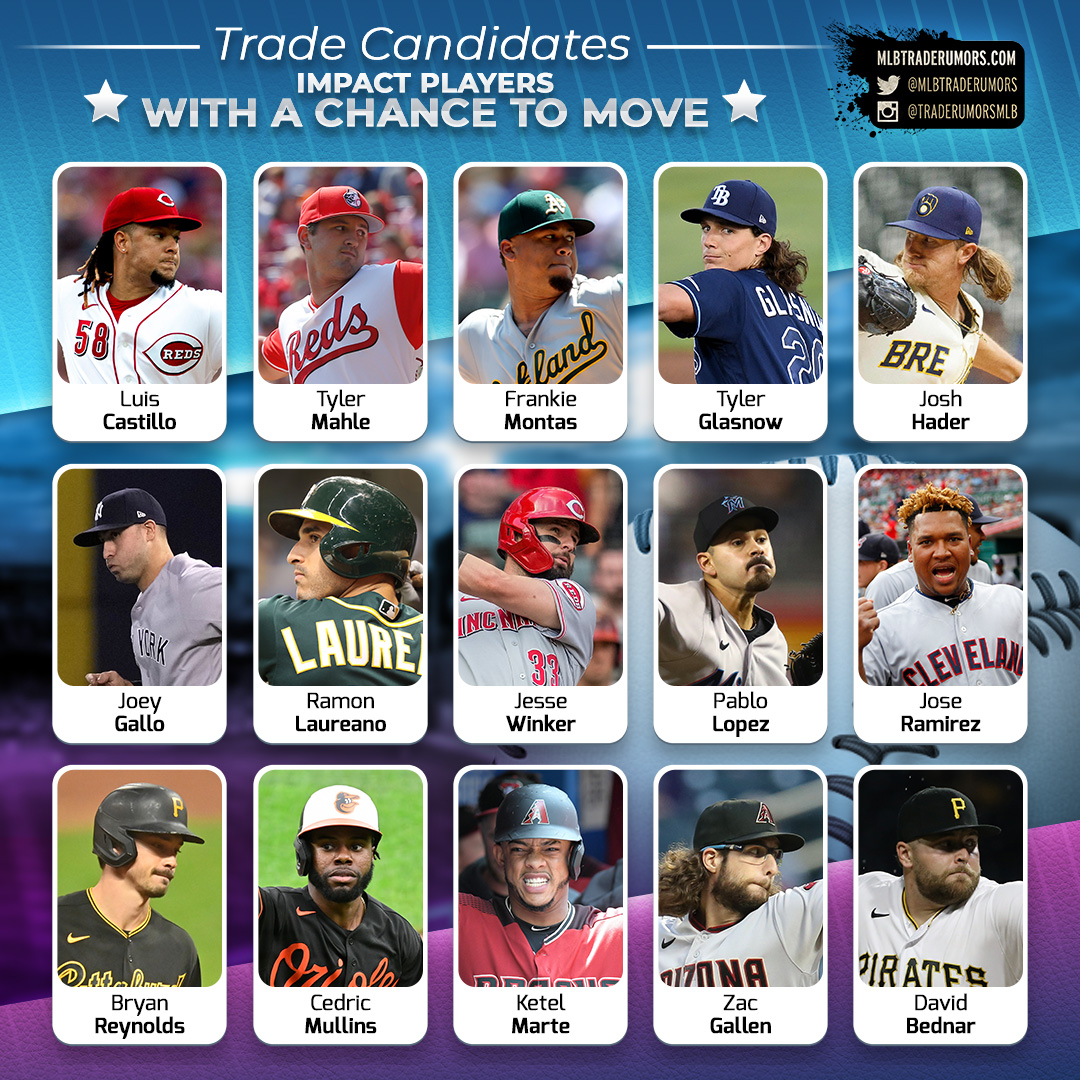
Earlier in the week, MLBTR owner Tim Dierkes published our list of the 14 players we consider to be the likeliest trade candidates following the ongoing MLB lockout. That list was the result of an extensive talk with Tim, myself and Anthony Franco, wherein we considered the possibility of more than 100 players and whether they could (or could not) viably change hands. While that Athletics-heavy list contained who we agreed to be the likeliest, it certainly didn’t represent every plausible trade candidate in our eyes.
As Tim noted within that post, we wound up sorting our list of plausible trade candidates into various buckets/tiers. The top 14 was simply the likeliest, regardless of contract or quality of player, but for the remainder of the exercise, we chose to categorize things based on how impactful a player might be to his new team. This, admittedly, is subjective. We didn’t establish a defined set of concrete parameters in labeling this group “impact” players; rather, we focused on mid-rotation (or better) starting pitchers, high-leverage relievers and hitters with recent All-Star-worthy performances (even if they didn’t necessarily result in an actual All-Star berth). Three wins above replacement in a given season wasn’t a firm cutoff, but we did ask at multiple points whether we a player had recently or could be reasonably expected/projected to turn in a 3-WAR season while sorting them.
Once these players were tiered, we further broke them down by whether they were legitimately plausible candidate to change teams or just someone whom other clubs would be trying to pry away. Basically, none of Tim, Anthony or myself would bat an eye to see Luis Castillo or Frankie Montas traded. Bryan Reynolds or Cedric Mullins, though? We’ll probably hear about teams trying to pry those players loose from their respective clubs (hence their inclusion), but a deal coming together seems like a long shot and would register as a mild surprise (if only because of the asking price and remaining club control).
As Tim explained, some of these players are interconnected. While the Reds have three starters who could plausibly change hands, we don’t necessarily think all three will move. It’s the same with the A’s roster. They could plausibly move multiple players — GM David Forst said amid November reports of a mandate to slash payroll that they’d have to listen on the whole roster — but that doesn’t mean the A’s are going to trade seven or eight players.
Anthony will follow this list up in the near future with a collection of solid regulars who we believe could change hands and/or will be in high demand following the lockout, but for now, here’s our second tier of trade candidates — legitimate impact players who could plausibly change teams but perhaps aren’t as likely to go as those listed by Tim earlier in the week…
Plausible/Decent Chance to Move
Luis Castillo / SP / Reds
The Reds’ offseason transactions since the close of the 2020 season have included a salary dump of Raisel Iglesias, non-tendering another quality reliever (Archie Bradley), trading Tucker Barnhart to Detroit, and placing Wade Miley on waivers rather than picking up a reasonable $10MM option. GM Nick Krall kicked off the 2021-22 offseason by declaring a need to “align our payroll to our resources.” Rumors of trades involving Luis Castillo, Sonny Gray (listed among our 14 likeliest candidates due to his age and larger price tag) and Tyler Mahle naturally followed.
Even if the Reds aren’t actively shopping the 29-year-old Castillo, teams will be calling to inquire, and Krall and his staff will be listening. The Reds probably aren’t going to shop him and simply let him go for the best offer, as they control him through 2023. They could always hold and market him again this summer or next offseason if no enticing offer materializes post-lockout.
Still, Castillo might be the best starting pitcher who could feasibly change hands. He got out to a brutal start in 2021, but over his final 22 starts, Castillo was excellent. He racked up 135 1/3 innings (six-plus innings per start) and notched a 2.73 ERA with a 26% strikeout rate, a 9.4% walk rate and a massive 59.9% ground-ball rate. Castillo’s ugly April/May results skew both his 2021 numbers and his collective numbers from 2019-21, but over the past three seasons he’s still posted a 3.61 ERA while fanning 27% of his opponents.
Maybe he’s not a true “ace,” but Castillo is a playoff-caliber starter for virtually any team. He’s projected to earn $7.6MM in 2022 and would be owed one more arbitration raise in 2023. Essentially, he’ll cost somewhere in the neighborhood of $20MM for the next two seasons — a bargain rate that should be reflected in a huge asking price from the Reds.
Tyler Mahle / SP / Reds
Mahle doesn’t have the name value that Castillo brings to the table, and his track record of success is shorter. Nonetheless, he’s blossomed into a sharp mid-rotation arm over the past two seasons, sporting a 3.72 ERA with a 28.1% strikeout rate and 8.9% walk rate. Unlike Castillo, he’s a fly-ball pitcher, which has at times bitten him at his bandbox of a home stadium; Mahle has given up 30 home runs in 227 2/3 frames dating back to Opening Day 2020, and 24 of them have come at home. He posted a 2.30 ERA away from Great American Ball Park in 2021 and, in his career, has a 5.09 ERA at home versus a 3.72 mark on the road.
A spacious home park would benefit Mahle perhaps even more than your average starter, although his penchant for yielding fly-balls will likely always make him a bit susceptible to the long-ball. Mahle has also been more of a guy who pitches into the sixth rather than completes six or seven frames (5 1/3 innings per start since 2020), but that’s increasingly common in today’s era of aggressive bullpen usage.
Mahle’s shorter track record may give some fans pause, but teams are likely comfortable projecting him as a quality arm based on the past two seasons of missing bats at a high level. And, that shorter track record has left him with a lower price point in arbitration, as he’s projected to earn $5.6MM in 2022. Like Castillo, he’s controlled through 2023, so there’s no immediate urgency to move him — especially given his affordable price tag. Still, teams will be calling, and the Reds can justifiably ask for a strong return.
Frankie Montas / SP / Athletics
Sticking with pitchers who have two remaining years of club control, Montas joins a long list of Athletics who could be traded post-lockout. Amid reports of a mandate to slash payroll, GM David Forst outwardly acknowledged back in November that the A’s will have to listen to offers on the majority of their roster.
Montas, unlike free-agents-to-be Sean Manaea and Chris Bassitt, is controlled through 2023. And unlike Matt Olson and Matt Chapman, his projected $5.6MM salary is a bit easier for the A’s to stomach. That’s why Montas is in this “bucket” of our trade candidate rankings, but even if he’s not as likely to move as some of his teammates, a deal is certainly still plausible.
Though Montas isn’t without red flags — he served an 80-game PED suspension in 2019 and had never reached 100 innings in a big league season prior to 2021 — it’s hard to ignore the quality results. Since 2018, Montas has pitched 401 innings of 3.57 ERA ball with a 24.4% strikeout rate, 7.3% walk rate and 43.7% ground-ball rate. His swinging-strike rate has continued to improve, and this past season’s 26.9% strikeout rate was a career-best. He’ll turn 29 in May, and he’s an upgrade for any team’s rotation.
Tyler Glasnow / SP / Rays
Glasnow is the most talented name on this list and, when healthy, looked the part of a legitimate ace with Tampa Bay. From 2019-21, Glasnow tallied 206 innings with a 2.80 ERA and fielding-independent marks to match. He punched out a ridiculous 36% of his opponents, walked just 7.8 percent of them and kept the ball on the ground at a 45% clip. Among the 114 starting pitchers who totaled at least 200 innings in that time, Glasnow ranks tenth in swinging-strike rate and second to only Shane Bieber in his combined percentage of called and swinging strikes. Only Jacob deGrom and Gerrit Cole had higher strikeout rates.
With that type of profile, two years of team control remaining and a projected $5.8MM salary for the 2022 season, a healthy Glasnow would be a no-brainer for the Rays to keep. Of course, Glasnow is not healthy. He’s likely to miss most, if not all of the upcoming season after undergoing Tommy John surgery last August. Arb-eligible players who miss an entire season due to injury typically sign on for a repeat of their prior year’s salary, meaning that in 2023 Glasnow will likely pitch on the same salary as 2022. Using that same $5.8MM projection, the Rays would be looking at about $11.6MM for one season of Glasnow, when his workload would need to be monitored coming back from major surgery.
Glasnow’s career-high innings total in the Majors is 2018’s 111 2/3, and his career-high for any professional season is when he reached 155 innings between Triple-A and Pittsburgh combined back in 2017. Realistically, the Rays would probably be thrilled to get 100-120 innings from Glasnow in 2023 — and an $11-12MM price tag on that modest total is rather steep for a team with Tampa Bay’s general payroll concerns.
Other clubs would welcome the opportunity to take that chance, however. We’ve seen two-year pacts for Tommy John rehabbers like Drew Smyly ($10MM with the Cubs), Michael Pineda ($10MM with the Twins) and Garrett Richards ($15.5MM with the Padres). Glasnow’s price tag is toward the lower end of that spectrum in terms of dollars, but the cost of trading prospects also has to enter into the equation. For an arm of this caliber, however, there are plenty of teams that would take the plunge.
Glasnow, for his part, recently told Chris Rose that he strongly hopes to remain with the Rays (YouTube link). Perhaps there’s a contract to be worked out that could benefit both parties, but Glasnow himself acknowledged the uncertainty surrounding his status and that president of baseball operations Erik Neander will have to listen to some offers if and when other teams come calling.
Josh Hader / RP / Brewers
Teams have been trying to get their hands on Hader for years, and the Brewers have steadfastly refused all overtures. The reluctance is understandable, as Hader has established himself as arguably the best reliever in the sport. In 282 1/3 career innings, he’s posted a 2.26 ERA and fanned exactly four out of every nine batters faced. No longer being used for multiple innings at a time, Hader posted a career-best 1.23 ERA in 58 2/3 frames this past season. The homer he allowed to Freddie Freeman in the NLDS isn’t a great note on which to close a season, but looking at Hader’s broader playoff track record, he has a 1.88 ERA and 23-to-3 K/BB ratio in 14 1/3 innings.
Trading the game’s most impactful reliever wouldn’t be easy for president of baseball operation David Stearns, but Hader’s value is at its apex. He’s also projected to see his salary spike to $10MM in 2022, with a fourth and final arbitration raise coming in 2023. Hader is dominant, but the typically low-payroll Brewers are flirting with what would be a record $123MM payroll. It’s not accurate to suggest that the presence of a second powerhouse reliever, Devin Williams, makes Hader expendable, but Williams’ excellence would at least slightly soften the blow of a theoretical Hader trade.
Milwaukee could still stand to improve its offense, and moving Hader could both free up some financial resources and simultaneously net some immediate help for the big league lineup. The Brewers don’t have to move Hader now, to be clear. However, they probably wouldn’t move him in-season if they’re contending — meaning it’s now or next winter, when they’d be marketing one year and a $15MM+ salary. That would net far less long-term value. It’s a fine line to walk.
Joey Gallo / OF / Yankees
Gallo popped 13 homers in 58 games following a July trade from Texas to the Bronx, but it’s fair to say the deal didn’t work out as New York had hoped. Gallo’s strikeout rate, which had dipped a bit with the Rangers, spiked to 38.6% as a Yankee. The resulting .160/.303/.404 batting line in 228 plate appearances is one of the more bizarre slashes you’ll ever see from a regular player.
Struggles in New York aside, Gallo was hitting .223/.379/.490 through 388 plate appearances in Texas and had bashed 25 homers in that span — putting him on pace for what would’ve been his third career 40-homer season had he not dropped off with the Yankees.
Gallo has as much power as anyone in baseball, and he’s made himself into a strong defender in the outfield corners (who can handle center from time to time). However, he’s projected to earn $10.2MM in arbitration this season, and it’d be understandable if the Yankees were hesitant at that price based on his post-trade struggles. New York is projected to top $226MM in luxury tax concerns, so moving Gallo could prove beneficial if owner Hal Steinbrenner is again intent on dipping beneath the threshold (wherever that’ll ultimately lie in 2022).
The Yankees have Aaron Judge, Aaron Hicks and Giancarlo Stanton as outfield options, with Estevan Florial serving as a possible reserve. Were they to give Gallo a change of scenery by moving him to a team seeking pop in the outfield, they could always sign a free agent to replenish some of the depth. It’s not clear that the Yankees will shop Gallo once the lockout lifts, but the New York Post’s Joel Sherman wrote about the possibility back in October, reporting within that as many as seven other teams tried to land Gallo at the deadline. If he’s on the block, there’ll be interest.
Longer Shots due to Asking Price and/or Remaining Club Control
Ramon Laureano / CF/ Athletics
Given Forst’s comments and the reports of forthcoming payroll reduction, it’s viable that anyone earning a salary of some note will at least be discussed. Laureano, projected to earn $2.8MM this coming season after his first trip through the arbitration process, also represents one of the few plausible center field options on the market, which should lead to plenty of teams inquiring on his availability.
Trading Laureano is more complicated than moving some of his teammates. He’s currently in the midst of an 80-game PED ban which, beyond raising questions about his performance to date, could come with major service time implications. Laureano still needs to serve 27 games of that suspension, which could impact his path to free agency. He currently has three years and 14 days of service time, meaning he’d need 158 days in 2022 to cross the threshold into four years of service and remain on track to hit the open market post-2024. There are only 187 days in a standard season, making it unlikely he’ll end up accruing the necessary time on the roster to get to that point. (Remember that off-days spent on the MLB roster count as a day of service.)
There’s always the small chance that some other factor impacts this trajectory (e.g. the ongoing labor talks, a potentially shortened 2022 schedule, a grievance filing), but as it stands, Laureano could wind up under team control through 2025 rather than 2024. An extra year of team control both heightens his appeal but also makes it tougher to trade him.
Beyond the service-time considerations, Laureano underwent core muscle surgery after the season, which adds another layer to a complicated scenario. But looking solely at Laureano’s numbers, he’s a difference-maker for a team in need of a center fielder (e.g. Phillies, Marlins, Guardians). A career .263/.335/.465 hitter with 25-homer pop, good speed and plus center field defense isn’t a hard sell.
Jesse Winker / OF / Reds
I explored Winker’s situation at length last week, with the bottom-line point being that it makes little sense to listen to offers on starting pitchers with two years of club control remaining (e.g. Castillo, Mahle, Gray) without doing the same on Winker. The 28-year-old slugger has had some issues with durability, doesn’t hit lefties well (though he’ll still draw his walks against them) and isn’t a great defender. That’s an odd trio of qualities to focus on when talking about someone’s trade candidacy, but the other side of the coin is more compelling: Winker’s production against right-handed pitching is at Bryce Harper/Juan Soto levels of brilliance.
Since 2020, Harper and Soto are the only two qualified hitters in baseball with a better mark than Winker’s 169 wRC+ against righties. In terms of more traditional slash metrics, he’s batting an outrageous .322/.417/.619 when holding the platoon advantage. With all the talent on the Reds’ roster, I think Cincinnati should be in aggressive, win-now mode. Krall’s early comments and their dealings since 2020 suggest otherwise, however, and if you’re going to listen on the other guys with four-to-five years of MLB service — why not listen on Winker as well? Cleveland, Colorado, Philadelphia and so many others are looking for offensive upgrades in the outfield corners.
Pablo Lopez / SP / Marlins
As is a common refrain on this list, the Marlins have no urgency to move Lopez, who’ll turn 26 in March. He was limited to 102 2/3 innings by shoulder issues last season and has yet to top 111 2/3 frames in a Major League season, but Lopez has been pretty darn good when healthy. From 2020-21, in particular, he’s compiled 31 starts and 160 innings of 3.26 ERA ball with a 26.4% strikeout rate and a 6.7% walk rate. He’s in his first trip through arbitration and projected for a highly reasonable $2.5MM salary.
So, why even bother considering a move? The Marlins are still hopeful of landing some help in center field, and they’re also so deep in pitching talent that it borders on comical. The old adage that a team can never have too much pitching always rings in the back of our minds, but the Marlins aren’t short on options beyond Lopez. Sandy Alcantara, Trevor Rogers, Elieser Hernandez, Jesus Luzardo, Sixto Sanchez, Edward Cabrera, Braxton Garrett, Nick Neidert, Cody Poteet and Daniel Castano are all on the 40-man — and top prospect Max Meyer is quickly rising through the minors. Injured top prospect Jake Eder will be back in 2023.
Jose Ramirez / 2B, 3B / Guardians
The favorite subject of so many hypothetical trade scenarios from fans, Ramirez does feel likely to end up traded … at some point. The question is whether now’s the time. Cleveland has him for $11MM this year plus a $13MM option in 2023. Given Ramirez’s elite play, there’s little chance of the Guardians extending him beyond that 2023 season, but there’s also good sense in Cleveland taking another run at the AL Central with Ramirez as a focal point. The pitching is still excellent, and while the lineup clearly needs another bat or two, the 2022 payroll is currently projected at only $49MM. There’s room to add some help for Ramirez and Franmil Reyes, and a deep farm system could also provide some in-house upgrades.
It’s also impossible to look at the situation without accounting for public relations. We’re only a year removed from Cleveland trading Francisco Lindor in a wildly unpopular move, and many fans’ anger with further fueled by the team’s name change. The newly-named Guardians are looking to usher in a “new era” of Cleveland baseball, and trading their best player for a second straight offseason isn’t a great way to foster good will.
If the first half of the season goes poorly, I’d expect Ramirez to be among the most talked-about names at the 2022 trade deadline, and there’d be a much stronger chance he moves at that point. With regard to the offseason, however, there’s just not enough urgency to push something across the line unless Toronto or another on-paper suitor puts forth an over-the-top offer. Even then, fans who’ve already purchased new Guardians gear bearing Ramirez’s name are going to feel rather jilted. It’d be tough for the front office to make this move now.
Bryan Reynolds / OF / Pirates
Reynolds is the best player on a last-place team that’s squarely in the midst of a rebuild so it’s hardly a surprise that he’s been in trade rumors dating back to the summer. Rival teams know the Pirates are open for business, and it’s only natural they’d try to acquire a center fielder capable of posting a .302/.390/.522 slash like the one Reynolds logged in 2021.
On the one hand, there’s an argument that the rebuilding Buccos ought to listen on anyone — and they surely will. But on the other hand, Reynolds is 27 and controlled another four seasons. His trade value won’t diminish substantially if the Pirates hold onto him, giving the fans at least one recognizable and marketable star player. Reynolds is a Super Two player who’s projected to earn an eminently affordable $4.5MM in 2022, so there’s no financial pressure. Everyone has their price in a trade, especially on a team like the Pirates, but for some context, that price reportedly included Mariners uber-prospect Julio Rodriguez (and more) when the two teams last talked. Baseball America currently ranks Rodriguez as the No. 2 prospect in all of baseball.
Cedric Mullins / OF / Orioles
Most of what was written about Reynolds applies to Mullins. The Orioles’ breakout star put together a 30-30 season last year while hitting .291/.360/.518 and is controllable for another four seasons — through age 30. No one expects the Orioles to contend in 2022, but they’ll get a look at top prospects like Adley Rutschman, Grayson Rodriguez and D.L. Hall this year. Reinforcements from the farm are on the way, and it’s feasible that by 2023 (and certainly by 2024), they could be on the cusp of turning a corner. Mullins will be under control, affordable and in his prime at that point.
The Orioles aren’t going to declare anyone on their Major League roster “untouchable,” but Mullins would only be available for a staggeringly strong offer. A Mullins trade doesn’t seem likely, but teams are going to at least try to force GM Mike Elias’ hand.
Ketel Marte / 2B, CF / Diamondbacks
Teams have been trying to pry Marte from the D-backs for more than a year. Arizona reportedly took the extra step of plainly telling rival clubs in early July — weeks before the trade deadline — that Marte wouldn’t be moved. That probably didn’t stop clubs from trying, and teams will be trying again post-lockout. The Marlins, Yankees, Mariners and quite a few others have at least been speculatively linked to Marte, whose team-friendly deal heightens his appeal. Marte will earn $8MM in 2022, and his contract calls for a $10MM team option in 2023 and a $12MM team option in 2024.
Dating back to 2019, Marte boasts a .318/.374/.543 batting line with 48 dingers, 79 doubles, 11 triples and a lowly 14% strikeout rate (versus a 7.6% walk rate). He’s rated poorly in center field, from a defensive standpoint, but is well-regarded defensively at second base. A 28-year-old switch-hitter with power, some speed, plenty of versatility and a grand total of $30MM owed to him over the next three years ($21MM of which isn’t even guaranteed) is wildly appealing. The D-backs, however, have shown little inclination to move him in the past, and assistant GM Amiel Sawdaye echoed that sentiment in November, calling Marte a “cornerstone” player around whom the D-backs can build.
Zac Gallen / SP / Diamondbacks
Twenty-six years old and controlled another four seasons, Gallen is precisely the type of pitcher that pitching-needy teams like the Rangers, Twins, Nationals and so many others would dream of acquiring. A forearm issue slowed him in 2021 and limited his workload, but Gallen has now made 50 starts in the Majors with a 3.46 ERA, a 27.6% strikeout rate and a 9.6% walk rate to show for it. He’s already been traded twice — going from St. Louis to Miami in the Marcell Ozuna deal before being flipped to Arizona in what amounted to a rare prospect-for-prospect swap sending Jazz Chisholm back to the Fish.
The D-backs didn’t even trade Merrill Kelly at this past summer’s deadline when he was a fourth starter with 1.5 cheap years left on his contract. It’s hard to imagine they’ll be excited about the idea of giving up four seasons of Gallen — particularly when his stock is down a bit, owing to last season’s arm issue. Gallen closed out the 2021 season quite well, with a 3.19 ERA and 52-to-15 K/BB ratio in his final 48 frames (eight starts). Sawdaye listed Gallen as a “cornerstone” player right alongside Marte, adding that the D-backs never plan to fully punt on a given season. Their signing of Mark Melancon for two years and $14MM meshes with the notion that this is not a team on the brink of a full-fledged teardown. Teams can try to nab Gallen, but it’d likely require some young MLB-ready talent going back to Arizona. Overall, the odds are low.
David Bednar / RP / Pirates
One of several pieces acquired in last winter’s Joe Musgrove trade, the 27-year-old Bednar stepped up and solidified himself as the Pirates’ likely closer in 2022. Through 60 2/3 innings, Bednar posted a tiny 2.23 ERA with a 32.5% strikeout rate, an 8.0% walk rate and a 41.4% grounder rate. Bednar yielded only five home runs all season (0.74 HR/9) and averaged 97 mph on his heater. He looks the part of a legitimate high-leverage weapon, and he’s controlled for five more years — all the way through 2026.
With such good results, a pre-arbitration salary and so much team control remaining, Bednar probably isn’t going anywhere. (As a bonus, he’s a Pittsburgh-area native.) The Pirates can’t (or at least won’t) simply trade every player who shows some semblance of value, after all. That said, the last thing most rebuilding clubs need is a high-end closer, and bullpen help is always in demand. Bednar will be 29 or 30 by the time the Pirates are realistically turning a corner, and the attrition rate on relievers is higher than anywhere else on the diamond. The argument for capitalizing on his value right now is pretty clear, but as with the rest of this “long shot” list, it’s hard to see a team meeting what would surely be a pretty substantial asking price.
White Sox, Raudy Read Agree To Minor League Deal
The White Sox have agreed to a minor deal with catcher Raudy Read, as first reported by Antonio Puesan (Twitter link). He’s represented by Octagon.
Read, 28, spent five seasons ranked among the Nationals’ top 30 prospects over at Baseball America. He reached the Majors both in 2017 and 2019 but received very brief auditions, going 4-for-22 and only drawing three starts behind the dish. The 2017 Nats had Matt Wieters locked in as their primary catcher, with Jose Lobaton backing him up. Read served an 80-game PED suspension in 2018, and by 2019 the Nats had moved onto Yan Gomes and Kurt Suzuki as their veteran tandem behind the plate.
There’s no immediate path to playing time in Chicago, where Yasmani Grandal is installed as the starter behind the plate. The backup situation is a bit more fluid, with less-established names like Seby Zavala and Zack Collins currently in the mix. Yermin Mercedes caught 18 games for the ChiSox’ Triple-A affiliate last year as well, though he was used more frequently at first base and at designated hitter.
Read ought to get plenty of reps behind the dish in the upper minors with the South Siders. He’s spent parts of three seasons in Triple-A and owns a .275/.313/.523 batting line with 26 home runs, 24 doubles and three triples through 466 plate appearances at that level. He’s also halted 36% of stolen-base attempts in his pro career, and BA noted in its 2019 report that he’d made strides in terms of his footwork and receiving over the years.
Mariners, Asher Wojciechowski Agree To Minor League Deal
The Mariners have agreed to bring righty Asher Wojciechowski back to the organization on a minor league contract, per their official transactions log. The journeyman starter signed on with the M’s on a minor league deal back in July but didn’t get a call to the big leagues. He subsequently became a minor league free agent at season’s end, thus allowing him to sign a minor league deal this offseason.
Wojciechowski, 33, has seen action in parts of five big league seasons, including in each of the past three. He appeared in just one game with the 2021 Yankees, allowing a pair of runs over four innings in a spot start, but was a fairly consistent presence with the Orioles in 2019-20. Baltimore originally acquired Wojciechowski from Cleveland in a cash deal back in 2019, and it looked as though he might simply make a spot start or two at the time of the swap.
Instead, Wojciechowski pitched well enough to quickly grab a spot in a patchwork O’s rotation. He worked to a 3.60 ERA in his first 30 innings, providing the Orioles plenty of reason to give him some leash from there on. Overall, while Wojciechowski didn’t exactly dominate, he gave an Orioles roster that was desperate for pitching a total of 82 1/3 innings of 4.92 ERA ball from July 2 through season’s end.
That proved enough for the O’s to keep Wojciechowski on the 40-man roster all winter, and he headed into the shortened 2020 season with a rotation spot. He continued to hold his own through the first four starts of the 2020 season, but after a swift decline — 19 runs over his next 18 1/3 frames — Wojciechowski was designated for assignment and passed through outright waivers.
Overall, Wojciechowski has 202 innings at the big league level, albeit with an unsightly 5.93 ERA to show for it. He’s fanned a respectable 21.9% of his opponents and posted a better-than-average 7.9% walk rate, but Wojciechowski is also an extreme fly-ball pitcher who’s shown a proclivity for surrendering the long ball. Most of his big time in the Majors has been spent in homer-friendly home parks — Houston, Cincinnati, Baltimore, the Bronx — so if he makes it to Seattle, perhaps T-Mobile Park could help to slightly reduce that problem. Still, with an average of 2.0 homers per nine innings pitched, Wojciechowski’s struggles go beyond the dimensions of his home parks.
As things stand, Wojciechowski is a pure depth option for the M’s. Seattle inked reigning Cy Young winner Robbie Ray to lead its staff in 2022 and beyond. He’ll be followed by stalwart southpaw Marco Gonzales, promising sophomore Logan Gilbert and righty Chris Flexen — a KBO reclamation project that has turned into a resound success for the M’s. Former top prospects Justus Sheffield and Justin Dunn could factor into the mix as well, but the general expectation is that the Mariners will add another veteran to round out the rotation in the days and weeks coming out of the lockout.
Wojciechowski isn’t likely to emerge as an option unless the Mariners incur several injuries, but as far as depth options go, a well-traveled veteran with a 4.33 ERA in 664 2/3 Triple-A innings is a solid one to have on hand.
Poll: Will The Season Start On Time?
For the second time in three seasons, we’re faced with the possibility that Major League Baseball will fall shy of a full 162-game schedule. Unlike in 2020, when the truncated season was an inevitability due to the Covid-19 pandemic, the potential for missing games in 2022 is entirely of MLB and the MLBPA’s doing. The expiration of the 2016-21 collective bargaining agreement wasn’t some secret, and a second contentious set of negotiations between the league and union has been widely expected for quite some time — particularly since return-to-play talks went about as poorly as one could possibly imagine in 2020.
While there was some talk of proactive negotiations at times, discussions were infrequent, at best. The MLBPA made a core economics proposal back in May. The league countered in August, suggesting — among other major changes — that free agency be linked directly to a player’s age (29.5 years, in MLB’s proposal). The MLBPA, looking to young stars like Juan Soto, Vladimir Guerrero Jr., Fernando Tatis Jr. and many others who’ll reach free agency well before 29, considered age-based a non-starter. (The league’s proposal also contained a $100MM salary floor — but that came with a major reduction in the luxury-tax threshold, from the prior $210MM down to $180MM.)
A second iteration of the union’s economic plan was put forth on Nov. 5, with key points including a raised minimum salary, earlier arbitration, changes to the draft order (with an eye on eliminating tanking), changes the league’s revenue-sharing structure and earlier free agency for certain players. The league was nonplused.
The MLBPA’s second proposal was met with a counter the following week, wherein the league reportedly kept the age-based free agency requirement and also sought to replace the arbitration system entirely — instead awarding pre-free agent salaries according to a WAR-based algorithm. That came with its own fairly obvious set of issues, as explored here at the time of the offer.
As the CBA’s Dec. 1 expiration ticked nearer, it became clear a deal would not be reached. MLB and the MLBPA agreed to move the deadline to tender contracts to arbitration-eligible players (which had been set for Dec. 2) up to Nov. 30. A flurry of free-agent and (to a lesser extent) trade activity ensued in the week leading up to the CBA’s expiration, as a handful of motivated teams sought to get some of their offseason business done before the lockout.
Commissioner Rob Manfred announced in a letter to fans on Dec. 2 that the league had locked out the players. Manfred claimed to have been “forced” into a lockout, which he described as a “mechanism to protect the 2022 season” — one that would “jumpstart” negotiations with the MLBPA. The two sides did not return to the table until mid-January, just over six weeks later.
Major League Baseball has made one formal proposal since implementing the lockout. The MLBPA has made two and has now been awaiting a counter to that second offer for ten days. In the interim, MLB made a request for federal mediation; the MLBPA swiftly rejected, with players banding together to voice a desire for daily negotiations with MLB rather than turning things over to a third party. Daily negotiations (obviously) have not occurred.
Players are still seeking increased minimum salaries, a bonus pool to reward pre-arbitration players based on performance, an increased luxury-tax threshold and measures to eliminate tanking, among other items. An expanded playoff format and the associated spike in television/streaming/gate revenues is among the league’s top priorities, but owners are also pushing back heavily on the extent to which minimum salary should increase and to which pre-arbitration players should be compensated.
Manfred confirmed yesterday that the league will submit a new proposal Saturday. He also declined to announce a delay to the start of Spring Training (although that feels like an inevitability), called missing regular season games “a disastrous outcome for the industry,” and maintained optimism that the season will begin on March 31, as scheduled.
All of that sounds nice, but it’s increasingly difficult to believe the two parties will make swift progress, given the acrimonious nature of talks to date. It’s also worth noting that back in October, Manfred made similar comments about agreeing to a new CBA before Dec. 1, calling an agreement the league’s “number one priority” and expressing optimism a deal would be reached in time.
That rundown of where things stand out of the way, let’s open this up for (further) debate among readers with a poll…
Will the 2022 MLB season start on time?
-
No, it won't start until sometime in May. 24% (4,276)
-
No, it will start between April 15 and April 30. 24% (4,248)
-
No, it will start between April 1 and April 15. 19% (3,290)
-
Yes, it'll start on March 31 as scheduled. 16% (2,827)
-
At this rate, I don't think we'll have a 2022 season at all. 8% (1,383)
-
No, it won't start until sometime in June. 6% (1,053)
-
No, it won't start until after the All-Star break. 2% (421)
Total votes: 17,498
Manfred Expresses Optimism For Full Season, Says MLB Has Proposed Universal DH And Elimination Of Draft-Pick Compensation
Major League Baseball commissioner Rob Manfred met with the media for about 30 minutes Thursday morning as the quarterly owners’ meetings drew to a close, discussing the status of the ongoing labor dispute with the MLB Players Association. Among the more concrete takeaways, Manfred said that the league has “agreed” both to the implementation of a universal designated hitter and the elimination of draft-pick compensation for free agents who reject qualifying offers.
However, as MLBTR’s Tim Dierkes reports (Twitter links), the use of “agreed” is a bit misleading. The two parties have not reached a formal agreement on either issue. Rather, Manfred’s use of “agreed” merely indicates that both the universal DH and elimination of draft-pick compensation were included as components of a broader proposal put forth by MLB some time ago.
Still, with regard to the universal designated hitter, this is one of the most concrete indicators of its likely implementation. Both parties, after all, have in the past shown a desire to add a DH to the National League. For the players, this creates another spot in 15 lineups and could create a handful of jobs for free agents. For teams, this all but eliminates the risk of pitchers being injured at the plate and on the bases. Because of that mutual interest, though, the league’s desire to frame the universal DH as something of a concession is somewhat questionable. It’s not clear the union will perceive it as a concession.
With regard to the elimination of pick compensation, Dierkes reports that the league’s proposal instead would award draft picks to teams for losing free agents, based on the quality of player, with no offer of any sort required. That raises issues on how to specifically determine that player’s value, however, and the MLBPA likely harbors concern that by giving teams a pick for losing a free agent, the league is actually disincentivizing clubs from re-signing some of their own players.
Beyond those two more concrete elements of his side’s recent proposal, Manfred offered little in the way of definitive statements. Asked about the status of Spring Training (i.e. whether it will be delayed), the commissioner replied that the “status of Spring Training is no change right now.”
We’re only a week out from the original report date for players and have, to this point, seen no meaningful progress in negotiations between the league and union. A delayed Spring Training feels like a foregone conclusion, but Manfred at least kicked the can down the road a couple days on any such formal declaration, suggesting that the decision was contingent on how Saturday’s meeting with the MLBPA plays out. That said, while Manfred didn’t explicitly state that Spring Training will be delayed, he addressed the possibility, acknowledging that the three-week ramp up period to the pandemic-shortened 2020 season was insufficient.
“The injury data shows that,” Manfred said of 2020’s training period. “We’d like to be [at] 28 [days] — we think four weeks makes sense.” A four-week Spring Training would still fall a good ways shy of the typical six-week period, but the extra week of build-up time in that theoretical scenario would prove beneficial to players, particularly to starting pitchers.
Manfred declared himself an optimist, stating more broadly that he believes the two sides will reach an agreement in time for the regular season to begin, as planned, on March 31. Missing regular-season games would be a “disastrous outcome to this industry,” Manfred said, adding that MLB is “committed to reaching an agreement to avoid that.”
Upon being asked about the league making just one proposal in the ten weeks since implementing the lockout, Manfred demurred and stated that “phones work two ways,” painting the lack of meaningful talks as a two-way street. Whichever side you take in the increasingly ugly battle — and it’s plenty fair if your answer is, “neither!” — it was ownership that locked out the players in, as Manfred stated at the time, an effort to “jumpstart” progress toward a deal. A silent period of more than six weeks followed. It’s plenty defensible to say the union should have been more proactive in instigating talks, but at the very least, the players have spent the past two weeks publicly declaring a desire for daily negotiations.
In one of the more eyebrow-raising moments of the press conference, Manfred was asked whether purchasing an MLB franchise was a “good investment.” He bizarrely implied the contrary, stating that between the purchase price of the team and the money invested into the club on a year-over-year basis, the “return on those investments is below what you’d expect to get in the stock market,” adding that there was greater risk in owning a team. Comments of that nature are sure to further galvanize a union that has repeatedly suggested the league isn’t being genuine or negotiating in good faith.
That term, “good-faith,” is a recurring theme when both sides discuss negotiations, as each indicates that the other is effectively neglecting to operate in such a fashion. For his part, Manfred vowed to make a “good-faith, positive proposal” to the players when the two sides meet Saturday, implying that perhaps this weekend could serve as a turning point.
“One correct move sometimes opens the way to an agreement,” said Manfred. “My view of the world is you always keep looking for that one move that creates that opportunity.”
Rays, Dusten Knight Agree To Minor League Deal
The Rays have agreed to a minor league contract with free-agent righty Dusten Knight, per the team’s official transactions log.
Knight, 31, made his big league debut with the Orioles this past season after spending parts of eight seasons in the minors. A former 28th-round pick by the Giants (2013), Knight parlayed a strong Triple-A showing — 1.30 ERA, 27-to-12 K/BB ratio in 27 2/3 frames at the time of his promotion — into his first call to the big leagues. Things didn’t go as smoothly in Baltimore, however, as Knight yielded a pair of runs in one inning during his debut effort. He appeared in a total of seven games and was ultimately tagged for 10 runs (nine earned) on 11 hits and five walks with 11 strikeouts through 8 2/3 frames.
Rocky showing in his debut season notwithstanding, Knight has a solid track record in Triple-A, where he’s posted a 3.11 ERA with a 23% strikeout rate and 10.6% walk rate in parts of three seasons — a total of 104 1/3 innings. On the whole, in Knight’s eight minor league seasons, he’s surrendered just 32 home runs in 397 innings of work while whiffing more than 27% of his opponents against an 8.5% walk rate.
Mariners Notes: Haniger, Rodriguez, Kirby, Bryant
Mitch Haniger‘s sensational rebound on the heels of four surgeries was one of the highlights in a generally exciting 2021 season for Mariners fans. The now-31-year-old Haniger belted a career-high 39 home runs in a career-high 691 plate appearances, announcing his return from a gruesome sequence of injuries with authority and cementing himself in the heart of Seattle’s order — at least for now.
Haniger is set to become a free agent next offseason, and Ryan Divish of the Seattle Times takes a lengthy look at his status within the organization, noting that it’s quite possible this is Haniger’s final year with the club. The Mariners, to this point, haven’t had much interest in an extension due both to Haniger’s recent injury woes and the fact that he’ll be 32 in the first season of a new deal. It’s always possible that stance could change and talks could pick up when the lockout lifts, but barring that, Haniger would play out the current season and reach the market next winter, at which point all 30 teams would have the ability to sign him.
Further complicating the Haniger situation, of course, is the enviable depth the Mariners have in the outfield. While Haniger is entrenched in right field for the 2022 season, the Mariners hope that can be the long-term home for top prospect Julio Rodriguez, whom most outlets peg among the game’s top five to ten overall prospects. Seattle also has Jarred Kelenic, who struggled early in his debut campaign before a much stronger finish, 2020 Rookie of the Year Kyle Lewis and former top-100 prospect Taylor Trammell as potential long-term options — to say nothing of current part-time options like Jake Fraley and Dylan Moore.
Rodriguez, in particular, is on the cusp of the Majors after hitting a combined .347/.441/.560 between Class-A Advanced and Double-A this past season. The Athletic’s Corey Brock takes a look the immediate outlook for Rodriguez and three other Mariners prospects, noting that there’s at least a small chance that Rodriguez could play his way onto the Opening Day roster. As Brock notes, president of baseball ops Jerry Dipoto has stated that there’s “no unrealistic expectation” for someone as talented as the 21-year-old Rodriguez.
Of course, Rodriguez has yet to play in Triple-A, and Mariners fans in particular will recall that the organization kept Kelenic in the minors to open the 2021 campaign under similar circumstances. That was a controversial decision, due largely to comments made by former Mariners CEO Kevin Mather, though Kelenic’s early struggles and his subsequent option back to Triple-A Tacoma at least made the Mariners’ decision look justifiable.
Heading into the 2022 season, Seattle could reasonably look to Haniger, Kelenic, Lewis, Fraley and newcomer Adam Frazier in the outfield (the latter depending heavily on what type of infielder or infielders Seattle adds in trade or free agency). There’s no urgent need for Rodriguez to break camp, but a big enough showing in whatever limited exhibition games we get could make his future a bigger talking point.
Also knocking on the door to the big leagues is 24-year-old right-hander George Kirby — a consensus top-100 prospect himself who’s expected to make his big league debut this coming season. He’s yet to pitch in Triple-A and only logged 26 frames in Double-A last season, so that’ll quite likely come later in the season — and Brock suggests it’d likely happen only if a legitimate rotation spot is opened due to injury or other circumstances. Kirby pitched in just 67 2/3 innings last season, and electric as they were, he could still use some further development.
In some respects, Rodriguez and Kirby are similar to last year’s ballyhooed duo of Kelenic and righty Logan Gilbert. Both debuted with huge fanfare, and while there were plenty of highlights (particularly down the stretch), there were plenty of ups and downs as well. Still, Seattle reliever Paul Sewald mentioned both Kelenic and Gilbert in an interview with Stacy Rost and Jake Heaps on 710 ESPN (YouTube link), pointing to both as potential examples of service-time manipulation when explaining the MLBPA’s stance in the ongoing labor talks.
Sewald, a close friend of Kris Bryant, pointed back to the longtime Cubs slugger’s delayed debut as the most egregious incident of service-time manipulation but also used the 2021 Mariners to rhetorically raise another aspect of the service-time debate.
“If we had Logan Gilbert and Jarred Kelenic from Opening Day, are we two games better and maybe we make the playoffs?” Sewald said. “I don’t know. I don’t know that for a fact. I’m just saying, if we weren’t looking at service-time manipulation, could they make an impact where you [instead of] finishing one game back, two games back, you maybe make the playoffs? It’s disappointing.”
Sewald certainly isn’t claiming Seattle would’ve been postseason-bound had both players debuted earlier — Kelenic certainly didn’t hit the ground running, after all — but it’s another aspect of the puzzle to consider. A more prominent example of that could be the 2010 Braves, who did make the decision to carry Jason Heyward on the Opening Day roster and ultimately edged out the Padres by one game for a Wild Card berth. Had they withheld Heyward, who hit .277/.393/.456 and finished second in Rookie of the Year voting, they could well have missed the postseason. There are obvious business reasons for teams to keep players down, and those who choose to do so aren’t necessarily doing anything wrong and are simply using the current system to their long-term advantage. Still, Sewald’s general point, outside of any specific examples, is one piece of the issue that isn’t always discussed.
Of greater note to Mariners fans, perhaps, is Sewald’s mention that he and Bryant are close friends. The Las Vegas natives are college teammates who’ve known each other since high school, and Sewald acknowledged that he’s lobbied for a reunion.
“I convinced him to go to University of San Diego with me and play with me there,” Sewald said with a laugh. “I am doing the best that I possibly can to convince him to be a Seattle Mariner for the next few years.”
Dollars and years figure to win the day whenever Bryant puts pen to paper, and Sewald’s comments are little more than anecdotal. That said, Mariners fans surely don’t mind having a close friend of Bryant on the roster who’s attempting to sell him on the team, city and fan base — all else being equal.
Tigers, Jack Lopez Agree To Minor League Deal
The Tigers have agreed to a minor league contract with free-agent infielder Jack Lopez, as first reported by former big league infielder Carlos Baerga (on Instagram). Evan Petzold of the Detroit Free Press tweets that Lopez has signed a deal and will head to the Tigers’ spring facility in Lakeland, Fla. for minicamp.
The 29-year-old Lopez won a Silver Medal as part of Team USA during last summer’s Olympics. He made his Major League debut with the Red Sox not long after returning, going 2-for-13 with a pair of doubles in a tiny sample of seven games. He split the rest of his season between Double-A (five games) and Triple-A (68 games), batting a combined .285/.355/.413 with four homers, 17 doubles, a triple and 15 steals (in 17 tries) over the life of 273 plate appearances.
Lopez, a 16th-round pick by the Royals back in 2011, has appeared in parts of nine minor league seasons and logged a collective .241/.295/.331 batting line in that time. The vast majority of his professional experience has come at the two middle infield slots, with more time at shortstop than at second base. Lopez also has more than 1200 professional innings at the hot corner, in addition to some more sparse work in the outfield.
Baseball America at one point ranked Lopez among the middle tiers of the Royals’ farm system, noting that his range, soft hands and solid arm gave him a chance to handle shortstop at the big league level. That was seven years ago, and the the bat obviously hasn’t panned out as hoped, but Lopez will give the Tigers some defensive value and versatility to stash in the upper minors.
Rangers Expected To Explore Matt Olson Deal Post-Lockout
Whenever the lockout ends, transactions — both on the trade and free agent fronts — figure to pile up in a hurry. Among the likelier names to change hands is star Oakland first baseman Matt Olson, who has been the subject of rumors for several months. That’s only natural after A’s GM David Forst plainly acknowledged that the team has reached a point in its “cycle” where they’ll need to be open to moving established players (though the writing had already been on the wall for some time before that).
The Yankees have been frequently reported as an interested suitor for Olson, and prior to the lockout, Evan Grant of the Dallas Morning News wrote that the Rangers had “already begun investigating” what an Olson acquisition might cost them. Whatever exactly occurred in those pre-lockout talks seemingly wasn’t a huge deterrent, as Grant writes this week that Texas will “absolutely” circle back with the A’s to see if there’s a potential fit.
Perhaps of greater intrigue to fans, however, is that Grant suggests an Olson package would require, at minimum, current big league first baseman Nathaniel Lowe, plus of the organization’s top prospects and a pair of other mid-tier names from down on the farm. As one might expect, it’s a rather broad and subjective set of parameters. Josh Jung and Justin Foscue are both “top prospects” for the Rangers, for instance, but Jung’s value is considerably higher at the moment. It’s hard to see the Rangers parting with Jung, who’s expected to debut in 2022, or either of the top pitching prospects in the system (2021 No. 2 overall pick Jack Leiter and 2018 first-rounder Cole Winn).
Regardless of specific permutations on the prospect side of things, a package headlined by Lowe and two or even three intriguing farmhands would figure to be appealing to A’s brass. Lowe, 26, isn’t on the same level as Olson offensively or defensively, but he’s been an above-average hitter in the big leagues and is controlled another five seasons. He’ll likely be a Super Two player (assuming Super Two designation remains unchanged in current labor talks), thus putting him on a path to arbitration eligibility next offseason. Lowe’s first two or even three arbitration salaries should be relatively affordable, however.
Texas acquired Lowe in a Dec. 2020 trade that sent four prospects to the Rays, and he responded with a solid first year at the plate in his new environs. Through 642 plate appearances, Lowe slashed .264/.357/.415 with 18 home runs, 24 doubles, three triples, eight stolen bases (in eight attempts) and a hearty 12.5% walk rate. Lowe had fanned in 31.8% of his first 245 trips to the plate in Tampa Bay, but he dropped that number to a more manageable 25.8% in Texas. Defensively, he put up sub-par marks in Defensive Runs Saved (-3), Ultimate Zone Rating (-4.2) and Outs Above Average (-3). Scouting reports from Lowe’s prospect days pegged him as a solid defender at first base, however, so there’s likely some room for improvement.
Notably, Grant adds that if Olson isn’t acquired, first base isn’t likely to be a priority for the Rangers. A pursuit of Olson, then, seemingly isn’t about being dissatisfied with the work Lowe has put in, but rather about jumping at the opportunity to grab an elite player with multiple years of club control remaining.
While there’s no guarantee Olson is ultimately moved, it’s an interesting look at a potential framework for a swap. The A’s have, historically speaking, tended to prefer returns that included immediate help for the big league roster when dealing away star players. Lowe would certainly fall under that umbrella, and some immediate production from him could help to soften the blow of losing Olson.
Olson, 28 next month, has emerged as one of the premier first basemen in the game over the past few years, with his 2021 season in particular towering above the rest of the league. In 673 plate appearances, Olson batted .271/.371/.540 (146 wRC+) with 39 home runs, 35 doubles and standout defense at first base. He dramatically reduced his strikeout rate, cutting it from 26.1% (2016-20) all the way to 16.8% — and he did so without sacrificing any of his plate discipline. To the contrary, Olson’s walk rate jumped from 10.8% in 2016-20 to 13.1% this past season.
Trading a player of this caliber is a tough pill for the A’s to swallow but also, as Forst alluded to, a familiar process in the Oakland front office. Olson is due his second arbitration raise once the lockout ends, and MLBTR contributor Matt Swartz projects that he’ll jump from $5MM to $12MM for the 2022 season. Add in a third and final arbitration raise in 2023, and Olson figures to cost upwards of $30MM over the next two seasons combined.
That’s a bargain rate for most clubs, but for a perennially low-payroll A’s team that has seen its best players reach the late stages of arbitration simultaneously, it’s a problematic scenario. Olson, Matt Chapman, Sean Manaea, Chris Bassitt and Frankie Montas are projected to combine for $45.7MM alone; the A’s payroll is set to rise to its second- or third-highest mark ever in 2022 before the team even makes a single addition.
Trading Olson within the division may not be preferable for the A’s, but longtime baseball ops boss Billy Beane and Forst have never shied away from intra-division swaps. Texas and Oakland lined up on a deal just last offseason, swapping out Elvis Andrus and Khris Davis in a financially-motivated arrangement. A year prior, Texas and Oakland matched up in a Mike Minor swap, and the two teams also struck an accord in the 2019-20 offseason when Jurickson Profar went from Texas to Oakland as part of a three-team trade. Suffice it to say, Beane and Rangers president of baseball operations Jon Daniels are comfortable trading within the division, although moving a star of Olson’s caliber perhaps changes that calculus a bit.
If the Rangers were to ultimately pry Olson loose from their divisional foe, one would have to imagine they’d take a run at signing him to a long-term extension. They still have a ways to go before stepping back into the AL West running and aren’t yet expected to contend in 2022, so losing any trade acquisition after just two seasons could be deemed counterproductive. That’s putting the cart well before the horse, however, as Texas will face competition from several other clubs in trying to put together the best offer for Olson. Beyond the Yankees, Olson has been reported as a target for the Braves, should Freddie Freeman sign elsewhere. Others yet will view the situation similarly to the Rangers, feeling that while first base isn’t a dire need, Olson himself is so appealing that he’s worth moving some other pieces around to fit into the puzzle.
MLBTR Chat Transcript
Click here to read a transcript of Tuesday’s chat with MLBTR’s Steve Adams.