
Mets Make Initial Extension Offers To Lindor, Conforto
MARCH 25: Lindor and the Mets remain in talks, per MLB Network’s Jon Heyman, who tweets that “it feels like there’s a bit of optimism” they’ll reach an agreement.
MARCH 22: As of now, there isn’t much optimism that the Mets and Conforto will reach a deal, Jon Heyman of MLB Network tweets.
MARCH 21: Conforto told reporters (including Mike Puma of the New York Post) that negotiations were ongoing, though didn’t commit on any specific details. In regards to any deadline on talks, Conforto said “Ideally, I would not like” negotiations to extend beyond Opening Day.
MARCH 19: The Mets have made an initial extension offer to shortstop Francisco Lindor and to right fielder Michael Conforto, reports SNY’s Andy Martino. No deal is close with either player at this time. The New York Post’s Mike Puma tweets that there’s no real movement in talks at this point.
The initial offer to Lindor, according to Martino, clocked in slightly below $300MM in guaranteed money. Lindor and agent David Meter unsurprisingly countered with a number “well over” $300MM in total guarantees. While the team’s first offering didn’t begin with a three, Martino adds that the Mets are “almost certainly” willing to go to that $300MM mark to sign Lindor.
That said, a $300MM mark as long seemed something of a floor for Lindor in extension talks. Manny Machado received ten years and $300MM from the Padres two years ago — albeit at a younger age. In the 24 months since that time, we’ve seen Bryce Harper (13 years, $330MM), Mike Trout (10 years, $360MM on top of his contract’s two preexisting years), Mookie Betts (12 years, $365MM) and Fernando Tatis Jr. (14 years, $340MM) eclipse the $300MM mark as well.
The length of the Mets’ offer and Lindor’s counter isn’t known, though given his age (27), it stands to reason that he could also be in line for a deal spanning a decade or more at $30MM-plus annually. The Harper and Tatis deals don’t come with that $30MM AAV, but that’s by design in Harper’s case, as he took a longer deal to deflate the AAV and reduce the Phillies’ luxury hit. The Tatis contract, meanwhile, includes all of his arbitration seasons, which naturally suppresses the annual rate. A Lindor deal, assuming it begins in 2022 — he’s already signed for the ’21 season — would be solely be buying out free-agent seasons.
There are no details known yet on the Mets’ offer to Conforto, though as a Scott Boras-represented All-Star who is set to hit free agency as well this winter, history suggests a deal could be tough to put together. It’s well documented that Boras clients largely tend to go to the open market, though the narrative that they “never” sign extensions is also something of an overstatement. Carlos Gomez, Carlos Gonzalez, Jered Weaver and Elvis Andrus all inked extensions in the early 2010s, and more recent examples include Stephen Strasburg, Jose Altuve (his second extension) and Xander Bogaerts. There’s certainly precedent for an extension, even if it’s not commonplace.
Lindor has made known that he prefers to cut off talks once the season begins, although Boras declined to state there was any such endpoint with regard to Conforto. Asked by Martino whether April 1 (Opening Day) was a firm deadline for a deal, he replied: “Michael is focused on the season and his performance. Not addressing any contract questions.” That deliberately vague answer doesn’t tip his hand one way or another, but it’s semi-notable that Boras chose not to limit the negotiation period to a confined window, as many players and agents seem to do. Also notable is the fact that the aforementioned Strasburg extension (seven years, $175MM) came in May 2016 — well after Opening Day.
Mets fans are strongly hoping to see one or both players extended beyond the 2021 season, although even if no deal comes together, it’s always possible the club could still pull off a deal in free agency next winter. The Mets needn’t look beyond their own division to see a prominent example of a star player who couldn’t come to terms on an extension with his club but ultimately stayed there via free agency: Phillies catcher J.T. Realmuto.
Gio Gonzalez Announces Retirement
Veteran left-hander Gio Gonzalez took to Instagram this afternoon to announce his retirement from baseball after a 13-year Major League career. The 35-year-old Hialeah, Fla. native was in camp with the Marlins on a minor league deal and called simply donning the jersey of his hometown club one of his “biggest dreams.” However, Gonzalez also added that his “body wasn’t keeping up with [his] mind.” The lefty offered a heartfelt thanks to the Athletics, Nationals, Brewers, White Sox, Yankees and Marlins organizations.
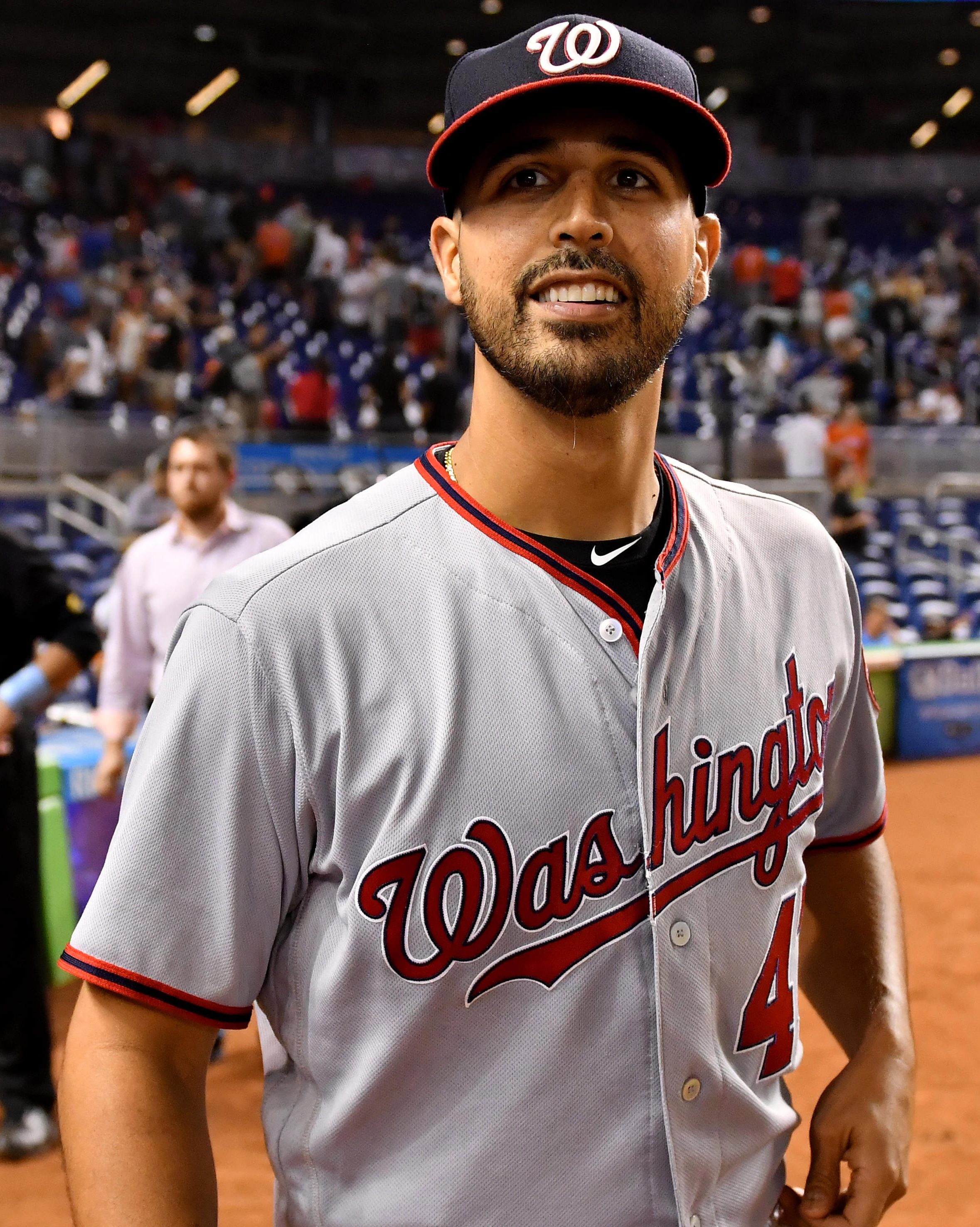
“My heart and mind are finally at peace with my decision,” Gonzalez wrote at the conclusion of his post. “Here’s one last tip of the cap! I’m coming home to my wonderful family. I love u!”
Gonzalez was the No. 38 overall draft pick by the White Sox back in 2004 and had, to say the least, an unconventional career arc with the team. Chicago traded him to the Phillies in Dec. 2005 as part of the Jim Thome blockbuster, only to reacquire him a year later alongside Gavin Floyd in the trade that sent Freddy Garcia to Philadelphia. Gonzalez was close to big league ready at that point and looked as though he could make his debut with the team that originally drafted him … until the White Sox again traded him away — this time to the Athletics as part of the return for Nick Swisher.
Between his draft status, his inclusion in trades for three high-profile big leaguers and his annual placement on Baseball America’s Top 100 prospect list from 2006-09, it was clear that Gonzalez was highly regarded within the industry. It took him a bit to deliver on that talent, but he did so in a big way with a breakout showing in 2010, when he tossed 200 2/3 innings of 3.23 ERA ball and solidified himself as part of the Athletics’ rotation.
That marked the first of six consecutive seasons in which the durable Gonzalez would make at least 27 starts and pitch to a sub-4.00 ERA. Oakland, as is often the case, traded him when he was on the cusp of arbitration eligibility, shipping him to the Nationals in return for a prospect package of four future big leaguers: A.J. Cole, Tommy Milone, Derek Norris and Brad Peacock.
Gonzalez was nothing short of excellent in Washington, finishing third in National League Cy Young voting in his first season as a Nat. He inked a five-year, $42MM contract extension with the Nats in Jan. 2012 and would go on to spend the next seven seasons in D.C. under the terms of that deal (which contained a pair of club options). Gonzalez’s first season with the Nationals was his best, but he finished sixth in NL Cy Young voting in 2017 — his final full year with the club. In parts of seven years there overall, Gonzalez racked up 1263 1/3 innings of 3.62 ERA ball and helped the Nats to four postseason berths.
With the Nats out of playoff contention in 2018, they traded Gonzalez to the Brewers for a pair of prospects. Gonzalez was brilliant in five starts down the stretch with Milwaukee, helping pitch the Brewers into the postseason. He re-signed with the Brewers in April 2019 after being granted his release from a minor league deal with the Yankees organization and again pitched quite well, tossing 87 1/3 frames of 3.50 ERA ball.
In the 2019-20 offseason, Gonzalez had a full-circle moment when he signed a one-year contract to return to the White Sox. He finally took the mound with his original organization on July 26 last summer. Gonzalez was tagged for six runs in his first appearance, but he bounced back with 28 innings of 3.54 ERA ball for the South Siders the rest of the way.
Gonzalez will walk away from baseball as a two-time All-Star who twice finished sixth or better in his league’s Cy Young voting. Long one of the game’s more underrated starters, his career body of work stands as a testament to his consistency: in 1933 innings, Gonzalez went 131-101 a 3.70 ERA and 1860 strikeouts. He earned more than $73MM in a career valued by Baseball-Reference at 30.1 wins above replacement and valued by FanGraphs at 32.1 WAR. Gonzalez never won a ring but appeared in the postseason five different times, made a pair of All-Star Games and was always good for an entertaining interview. It was a strong career by any measure, and Gonzalez will head into retirement having left his mark on several fanbases and countless teammates and coaches around the sport.
Carl Edwards Jr. Opts Out Of Braves Deal
Right-handed reliever Carl Edwards Jr. has opted out of his minor league deal with the Braves and is now a free agent, tweets Gabe Burns of the Atlanta Journal-Constitution. He’d been vying for one of the final spots in the Atlanta ‘pen.
Edwards has allowed just one run and punched out eight batters in 8 1/3 innings this spring, but he’s also surrendered seven hits and walked six batters. Control has never been a strong point for the lanky right-hander, and his lackluster command of the zone this spring seemed to leave him behind fellow non-roster invitee Nate Jones in terms of the pair’s chances to make the roster.
Now 29 years old, Edwards was a key reliever for the Cubs from 2015-18, pitching to a combined 3.06 ERA with a hefty 33.9 percent strikeout rate over the life of 159 innings. His effectiveness dipped early in the 2019 season, however, and he’s been mired in something of a downward spiral since. Edwards has been tagged for 18 runs on 14 hits and 14 walks apiece over his past 21 2/3 big league innings, battling shoulder and forearm injuries along the way.
Ivan Nova, Hector Rondon Granted Release By Phillies
Veteran right-handers Ivan Nova and Hector Rondon have requested and been granted their release by the Phillies, per a club announcement. They were both in camp on minor league deals and hoping to win roster spots. Both had out clauses in their deals.
The 34-year-old Nova was signed in late January — not long after president of baseball operations Dave Dombrowski voiced a desire to add some veteran rotation depth on minor league pacts. However, his hopes of making the Opening Day roster were likely dashed just a few weeks after he inked his deal; the Phillies signed both Matt Moore and Chase Anderson to one-year, Major League contracts in early February. A poor showing in camp didn’t do him any favors, either. Nova yielded 10 runs on 15 hits and an uncharacteristic nine walks in 12 1/3 innings of work, striking out six along the way.
Rondon, 33, has been tagged for six earned runs on eight hits in seven innings, but he has a more encouraging 8-to-2 K/BB ratio in that time. The Phillies have some openings in their bullpen, but it’s widely expected that Brandon Kintzler and Tony Watson are leading the pack of non-roster invitees competing for those remaining jobs. It’s plausible that one or both of Kintzler and Watson make the club. Both have March 24 opt-outs in their deals — the same as Rondon — but the team hasn’t announced a move regarding either pitcher yet. Assuming both Kintlzer and Watson triggered their out clauses, the Phils have until tomorrow afternoon to add them to the roster or grant them their release.
Yankees Receiving Trade Interest In Mike Tauchman
11:00am: Eight clubs have contacted the Yankees about Tauchman, Martino tweets.
9:10am: The Yankees are receiving trade interest in outfielder Mike Tauchman, SNY’s Andy Martino reports. They’re looking past his 2020 season and valuing him more in line with his 2019 output, per Martino, who adds that it’d take a reliever with some team control or another piece with legitimate value for the Yanks to part with the 30-year-old outfielder.
That teams are inquiring on Tauchman comes as little surprise at this juncture of Spring Training. He’s out of minor league options and looks to be without much of a path to regular playing time, given the presence of Clint Frazier, Aaron Hicks, Aaron Judge, Brett Gardner and Giancarlo Stanton all on the roster.
The Yankees also have veterans Jay Bruce and Derek Dietrich in camp on non-roster deals. Bruce, in particular, has been rumored to pique the Yankees’ interest. Neither has put together a particularly overwhelming spring performance thus far, but both are left-handed bats with pop who could bring some versatility to the mix. While Tauchman is capable of playing all three outfield spots, he doesn’t have any experience in the infield. Bruce has spent a good bit of time at first base, however, and Dietrich can play second base in addition to all four corner positions.
Yankees skipper Aaron Boone acknowledged the looming decisions after yesterday’s game, telling reporters: “The reality is we — and a few of our players — have decisions to make in the next 24, 48, 72 hours,” (link via the New York Post’s Dan Martin). “But no decision has been made as of right now.”
Bruce’s minor league deal with the club contained an opt-out clause yesterday, which gives the Yankees 48 hours to put him on the roster. There’s no formal indication that Bruce triggered that clause, although there’s little reason for him not to have done so. Exercising the clause puts pressure on the Yankees and, if he’s not going to make the Opening Day roster in the Bronx, gives him the opportunity to pursue a roster spot with another club.
Martino has suggested it’s possible that both Tauchman and Bruce make the Opening Day roster, with infielder Tyler Wade being optioned to Triple-A to begin the season, although that’s obviously not the most ideal scenario for the Yankees. Doing so would mean a bench of Gardner, Tauchman, Bruce and backup catcher Kyle Higashioka. Each of Gio Urshela, Gleyber Torres and DJ LeMahieu can play multiple spots around the infield, but there’s not much of a safety net on the bench if one of them needs to depart a game with an injury. Keeping Dietrich, who has ample experience at both second base and third base, would be a cleaner fit in the event that Wade is optioned.
The simplest course of action for the Yankees would be to let Bruce and Dietrich pursue other opportunities, keeping Tauchman and Wade both on the bench to begin the season. However, there’s a case to be made that Tauchman is somewhat redundant with Gardner back in the fold and so many other outfield options on the roster. And with the Yankees losing Zack Britton for up to four months and Justin Wilson working through some shoulder tightness — yesterday’s MRI came back clean — it could work to their benefit if they could pry a useful reliever away from another club in a deal for Tauchman.
The 2020 season was a rough one for Tauchman, who played through a shoulder injury and recently acknowledged (via Martin in the previously linked piece) that he “developed some bad swing-path patterns” while trying to compensate for the pain he was experiencing. Tauchman hit just .242/.342/.305 in 111 plate appearances last season, maintaining the strong plate discipline he displayed from 2017-19 but showing nowhere near the power he did the prior year.
The 2019 season was a breakout campaign for Tauchman, whom the Yankees plucked from the Rockies in exchange for lefty Phillip Diehl. In 296 plate appearances with the Yankees that year, Tauchman slashed .277/.361/.504 with 13 home runs. He won’t be eligible for arbitration until next winter, and the Yankees control Tauchman through the 2024 season.
Orioles Select Matt Harvey
The Orioles have selected the contract of veteran right-hander Matt Harvey, per a club announcement. The move fills Baltimore’s 40-man roster and assures Harvey of a spot on the Opening Day club. Harvey had an opt-out clause in his contract yesterday, which gave the O’s 48 hours to add him to the roster or cut him loose, Dan Connolly of The Athletic tweets.
Harvey inked a minor league deal with the O’s back in mid-February and reported to camp as non-roster invitee this spring. He’s started three Grapefruit League contests, during which he’s yielded six runs on 10 hits and a walk with six punchouts through 10 innings of work. He and fellow veterans Felix Hernandez and Wade LeBlanc have been vying for spots on an extremely inexperienced pitching staff. Lefty John Means is the only other true lock for the rotation, though young righty Dean Kremer and southpaw Keegan Akin both seem likely to leave Spring Training with starting jobs.
Harvey, 32 this weekend, is years removed from his status as one of the game’s most promising young aces and from the “Dark Knight” moniker that took baseball by storm. The No. 7 overall pick in the 2010 draft, Harvey was in the big leagues by 2012 and flat-out dominated opposing hitters early in his career. Through his first 427 big league frames, the righty notched an outstanding 2.53 ERA while striking out 26.6 percent of the batters he faced against an excellent 5.6 percent walk rate.
Injuries, however, have wreaked havoc on what looked to be a brilliant career in the making. Harvey missed the 2014 season due to Tommy John surgery, and while he was terrific during his 2015 return, he dealt with shoulder discomfort in 2016 before ultimately undergoing the much more ominous thoracic outlet surgery. The general track record of pitchers coming back from a thoracic outlet procedure isn’t great in the first place, and Harvey is one of few pitchers who underwent both Tommy John surgery and thoracic outlet surgery in a span of under three years.
Unsurprisingly, Harvey simply hasn’t been the same since. He regained some velocity following a trade to the Reds in 2018 and parlayed a decent showing with Cincinnati into a one-year, $11MM free-agent deal with the Angels. However, that contract proved regrettable for the Angels, who released Harvey that July. A 2020 comeback attempt with the Royals was similarly unproductive.
Overall, since returning from throacic outlet surgery, Harvey has tallied 319 innings in the Majors and limped to a 6.09 earned run average. He’s yielded 365 hits, including 67 home runs, in those 319 frames while watching both his strikeout and walk rates trend in the wrong direction. His fastball, which averaged 95.9 mph at his peak, sat at 93.2 mph with the Angels in 2019 and 94.1 mph with Kansas City last year (when he was working in shorter stints).
The Orioles will hope to catch lightning in a bottle and see Harvey bounce back to an extent, although at this point the expectations for a rebound should be rather low. Harvey’s deal guarantees him just a $1MM base salary, so it’s a low-cost roll of the dice for a tanking Orioles club.
Williams: White Sox Won’t Hold Vaughn Back For Service-Time Reasons
The White Sox have had extension talks with top prospect Andrew Vaughn, the No. 3 overall pick from the 2019 draft, but they’re willing to carry him on the Opening Day roster even without a long-term deal in place, writes USA Today’s Bob Nightengale. White Sox vice president Kenny Williams wouldn’t directly confirm that Vaughn is likely to make the Opening Day roster, though he certainly implied that could be in the works.
“We’d like to have that message coming from the manager,” Williams tells Nightengale, “and not me through USA Today.” Sox skipper Tony La Russa tells Nightengale that Vaughn “hasn’t made the club yet” but has made a “very good impression” to this point in camp.
That’s probably understating the matter. Vaughn has never played a game at the Double-A level, but he’s nevertheless tattooed Cactus League pitching at a .289/.396/.489 clip through 53 plate appearances. He’s fanned just nine times against an impressive seven walks, adding a pair of homers, a double and a triple to the mix.
While many clubs around the game would keep Vaughn down at the alternate training site for three weeks to buy an extra year of service time, Williams indicates that the team won’t sacrifice immediate wins even for benefit down the line.
“…[O]ur feeling is that when you’re ready to help the major-league club, there’s a spot for you,” says Williams. “…I think there is a residual effect if you play those type of service-time games. As a former player, maybe I’m a little more sensitive to it than others. If you do that, the player and the agent don’t forget any time soon.”
Last offseason, the White Sox inked veteran slugger Edwin Encarnacion to serve as their primary designated hitter, but they’ve made no efforts to bring in a full-time DH this time around. The South Siders quickly brought Adam Eaton back to serve as their right fielder early in the offseason, but he’s been the lone bat added to a lineup composed largely of impressive young players.
Vaughn, one of the sport’s most promising young hitters, would only further the ChiSox’ youth movement. The former Cal star raked at a .374/.495/.688 clip in 745 NCAA plate appearances, launching 50 homers and drawing 123 walks against just 75 strikeouts along the way. He played in 55 pro games after being drafted in ’19 and put together a strong .278/.384/.449 slash through 245 plate appearances. Because the 2020 minor league season was canceled, that’s the only pro experience to date for Vaughn, though the young slugger tells Nightengale he feels he learned quite a bit while taking as many as seven to eight plate appearances daily against high-end pitching at the Sox’ alternate training site last summer.
If Vaughn were to break camp with the White Sox and never be sent back to the minors, he’d be controlled via arbitration through the 2026 season, reaching arbitration eligibility after the 2023 campaign. Leaving him in the minors for just three weeks would push that free-agent trajectory back to the 2027-28 offseason, but Williams’ comments and the White Sox’ past actions strongly suggest that’s not a priority for them. And even if Vaughn does break camp without first agreeing to a contract extension, the two sides could always continue talks about a long-term pact — be they early in the spring or next offseason.
Cardinals Granted Fourth Option On Justin Williams
The Cardinals have been granted a fourth minor league option on outfielder Justin Williams, as first reported by Derrick Goold of the St. Louis Post-Dispatch (via Twitter). President of baseball ops John Mozeliak confirmed as much in an afternoon call with reporters.
The extra minor league option might have dampened Williams’ chances of making the club more substantially under normal circumstances, but today’s Harrison Bader injury news puts Williams more squarely in the mix for a spot. With Bader sidelined anywhere from four to six weeks due to a forearm issue, Dylan Carlson will likely slide over to center field, giving the trio of Williams, Lane Thomas and Austin Dean a greater chance of making the roster.
Williams, 25, was acquired along with Genesis Cabrera and Roel Ramirez in the trade that sent Tommy Pham to the Rays. He’s logged just seven MLB plate appearances but is a career .271/.333/.423 hitter in 581 Triple-A plate appearances and is batting .259/.333/.407 in 30 trips to the dish this spring. Williams’ numbers to this point in his career don’t show it, but scouting reports throughout his minor league tenure have pegged him for plus raw power and bat speed. That power has been curbed in large part by a penchant for hitting the ball on the ground; Eric Longenhagen and Kiley McDaniel wrote at FanGraphs in January 2020 that Williams had the second-best exit velocity in the Cardinals’ system and the lowest launch angle.
Williams was one of several players awaiting ruling from an arbiter on whether he was out of options or had a fourth minor league option. The process, as is the case with most debates between MLB and the MLBPA, took longer than expected, but rulings have been filing in for the past day. The discrepancy stems from the truncated length of the 2020 season and how it should be treated with regard to fourth option eligibility.
Typically, fourth options are granted to players who have exhausted all three of their minor league options before being healthy enough to play five “full” seasons of pro ball. The league defines “full” as 90-plus days on an active Major League or Minor League roster (not the injured list), but last year’s 60-game season lasted just 67 days, and there were no active roster/injured list distinctions at teams’ alternate training sites.
Harrison Bader Out Four To Six Weeks With Forearm Injury
2:40pm: President of baseball operations John Mozeliak tells reporters that Bader will be down for four to six weeks (Twitter link via ESPN’s Marly Rivera).
9:30am: Cardinals center fielder Harrison Bader will begin the season on the injured list due to a “flare up” of a forearm injury that required a platelet-rich plasma injection, manager Mike Shildt announced to reporters Wednesday (Twitter link via Jeff Jones of the Belleville News). He’ll be sidelined for a “solid four weeks at minimum,” according to Shildt.
The injury to Bader lends some clarity to the Cardinals’ outfield mix. Tyler O’Neill and Dylan Carlson are locks at this point thanks to huge spring showings. Carlson can play center field early if needed or slide over to right field, where he’d been initially projected with a healthy Bader in play.
Justin Williams, Lane Thomas and Austin Dean are likely vying for the remaining starting job, and it’s possible that all three could make the roster (two as reserves). Dean does have some experience at first base, giving him a bit more utility in a bench role. Williams, meanwhile, is still awaiting ruling on whether he has a minor league option remaining or not. If he does not, then he’d be all but assured an Opening Day roster spot, as he wouldn’t be able to be sent to the minors without first clearing waivers.
Bader has become a polarizing figure among Cardinals fans due to his low batting average, but he’s among the game’s best defensive center fielders and has some power at the dish. Over the past three seasons, he’s posted a combined .234/.326/.401 batting line with 28 homers, 41 doubles and seven triples through 958 plate appearances — good for a 97 wRC+ (about three percent worse than league-average offense when weighted for home park and league). Some of Bader’s OBP is propped up by frequently batting eighth in front of the pitcher, however, and his 29.4 percent strikeout rate in that stretch is problematic for obvious reasons. Still, a player with his defensive aptitude and a solid .167 ISO (slugging minus batting average) needn’t be an offensive force to provide value.
That said, the Cards will now get a longer look at several outfield candidates who have quite a bit of offensive upside themselves, so it’ll be interesting to see if any of them run with the opportunity and challenge the 26-year-old Bader for playing time upon his eventual return. That four-week timeline from Shildt would take Bader out through at least April 21, though the absence could very well be longer in the likely event that he needs a tune-up at the team’s alternate site/in Triple-A once his forearm discomfort has cleared up.
Angels Return Rule 5 Pick Jose Alberto Rivera To Astros
The Angels have returned right-hander Jose Alberto Rivera, their pick in the most recent Rule 5 Draft, to the Astros, according to a club announcement.
Rivera, 24, pitched just one inning in an official spring game for the Halos, though he’d spent the entirety of camp working out with the club. He ranked as Houston’s No. 18 prospect at Baseball America in the 2019-20 offseason and was tabbed 11th among Angels farmhands by BA this winter. However, Rivera also hasn’t pitched above A-ball, and carrying him for a full season would give the Angels five bullpen arms who can’t be optioned to the minors (joining closer Raisel Iglesias and relievers Mike Mayers, Alex Claudio and Junior Guerra).
It’s common for Rule 5 picks to be returned this time of year, particularly by clubs with postseason aspirations, as the Halos have. The Angels also hadn’t signed either Claudio or Guerra at the time they selected Rivera, and both moves further restricted their ability to experiment with keeping the hard-throwing righty on the roster. Rivera’s most recent minor league action came in the Class-A Midwest League in 2019, when he tossed 75 2/3 frames of 3.81 ERA ball with a 29.8 percent strikeout rate and an 11.3 percent walk rate.