
Rays Sign Danny Jansen
The Rays have upgraded behind the plate. Tampa Bay announced they have signed free agent catcher Danny Jansen on a one-year deal with a mutual option for 2026. The contract reportedly guarantees the ISE Baseball client $8.5MM — taking the form of an $8MM salary and a $500K buyout on the $12MM option. Jansen reportedly declined multi-year proposals in order to return to the open market next winter.
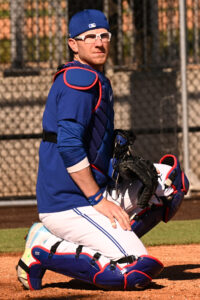
Jansen, 29, is a longtime division foe, having spent his entire career to date with the Blue Jays and, briefly this summer, the Red Sox. He’s a rebound candidate looking to bounce back after a down year at the plate in which he slashed just .206/.308/.348 in 328 plate appearances. It was a rough year and a particularly rough finish for Jansen, but heading into the season he looked primed for a notable deal in free agency. From 2021-23, he slashed a combined .237/.317/.487 (121 wRC+) — including a huge .260/.339/.516 showing in 2022.
Any discussion of Jansen’s downturn at the plate should take note of the fact that he opened the season on the injured list due to a fracture in his wrist he suffered during spring training. Jansen raced out of the gate with a .295/.375/.533 slash through his first 120 plate appearances before falling into a prolonged slump from which he never really recovered. Jansen hit just .150/.270/.237 over his final 204 trips to the plate.
(Anecdotally, Jansen also became the first player in MLB history to play for both teams in the same game, starting for the Jays in a rain-suspended game against the Red Sox that was subsequently finished in the second half — after he’d been traded to Boston.)
Jansen still walked at a stout 12.7% clip in that time and fanned in a slightly lower-than-average 21% of his plate appearances. However, his quality of contact went into the tank (85 mph average exit velocity, 24.2% hard-hit rate). Jansen’s .172 average on balls in play during that span of just over 200 plate appearances was surely indicative of some poor fortune, but the lack of quality contact underscores that it wasn’t mere bad luck on its own.
The Rays will hope a healthier Jansen can help them solve a need behind the plate that has persisted for several seasons. Tampa Bay’s catchers last year were predictably among the least-productive in the league — as one would expect when opening the year with journeyman Alex Jackson and a defensive specialist like Ben Rortvedt as the big league catching tandem. By measure of wRC+, the Rays’ catchers were 33% worse than average at the plate. Only the Marlins and White Sox received less-productive output from the position. Tampa Bay catchers combined for a disastrous .194/.272/.291 slash on the season, though Rortvedt’s knack for drawing walks and strong glovework at least made things slightly more palatable.
Even if Jansen simply matches last year’s lackluster output, it’d be an offensive upgrade for the Rays. If he can recapture a portion of his 2021-23 form, it could be a massive improvement to the lineup. Defensively, he’s probably a step down, though there’s reason to hope for improvement in 2025. Jansen has typically rated as a solid but not elite defender. Statcast gave him plus grades for blocking pitches in the dirt and slightly below-average framing marks last year. Jansen has a career 20% caught-stealing rate but sits just over 13% in the past two seasons. However, he’s fractured the middle finger and the wrist in his throwing hand over those two seasons, either of which could have a subsequent impact on his throwing; Jansen’s average 1.99 second pop time is still right in line with where it sat in 2022 (1.98 seconds).
Jansen’s signing should push the Rays’ payroll into the $86MM range. That number could still change dramatically, however, as the Rays have received trade interest in veterans like Jeffrey Springs ($10.5MM in 2024), Yandy Diaz ($10MM), Pete Fairbanks ($3.666MM) and Zack Littell (projected $4.8MM) — among others. It’s not clear just how willing ownership is to spend in the wake of the hurricane damage that ruined Tropicana Field’s roof and forced the Rays to relocate to Tampa’s Steinbrenner Field (home of the Yankees’ Class-A affiliate). The Jansen deal, however, at least signals a willingness to spend modestly, even if the eventual plan is to balance things out by trading other veterans for young, controllable (and cheaper) talent.
Marc Topkin of the Tampa Bay Times first reported the Rays and Jansen were nearing a deal. Ken Rosenthal and Sahadev Sharma of the Athletic reported that it would be a one-year contract. Robert Murray of FanSided reported the $8.5MM guarantee, as well as Jansen’s decision to decline multi-year offers. Topkin was first with the mutual option and salary breakdown.
Phillies Trade Rule 5 Pick Mike Vasil To Rays
5:20 PM: Marc Topkin of the Tampa Bay Times notes that the trade between the Phillies and Rays could be for a player to be named later or cash considerations.
5:11 PM: Mike Vasil wasn’t with the Phillies for long. Soon after the Phillies selected the right-hander from the Mets in the Rule 5 draft, they turned around and flipped him to the Rays for cash considerations. Both teams have confirmed the deal.
Once a promising draft prospect in high school, Vasil suffered an injury in his senior year. He ended up withdrawing himself from the 2018 draft and attended the University of Virginia instead. Unfortunately, his stock plummeted after a rough few years in college. The Mets ultimately took him in the eighth round of the 2021 draft. To make matters worse, his struggles have only continued in affiliated ball. Over 43 starts at Triple-A across the past two seasons, he has pitched to a 5.78 ERA and 5.42 FIP.
Nevertheless, the Rays evidently saw something they liked in the soon-to-be 25-year-old. Entering the 2024 season, The Athletic’s Keith Law described Vasil as “a league-average starter at his peak with the potential to eat some innings.” Similarly, the staff at Baseball America considered him “a high-probability starter who might fit at no. 4 or 5 in a rotation.” Of course, both of those observations came before his rough 2024 season (6.04 ERA, 5.75 FIP in 134 IP at Triple-A). Still, Vasil’s selection in the Rule 5 draft suggests the Rays see him as an arm that could eat major league innings in 2025. What’s more, the Rays are known to enjoy tinkering with pitchers’ arsenals, and Vasil’s wide array of pitches seems to have made him a particularly appealing target. According to Baseball Savant, Vasil threw six different pitches in 2024: a sinker, cutter, four-seam fastball, changeup, sweeper, and curveball.
Rays assistant GM Kevin Ibach praised Vasil’s versatility, telling Jonathan Mayo of MLB.com, “There are a lot of different ways he can impact a 26-man roster, more so than just a traditional reliever.”
It’s possible the Rays and Phillies tentatively agreed to this swap before the draft. Then again, if the Phillies hadn’t picked Vasil, the Rays could have scooped him up themselves in the second round. The vast majority of teams pass in round two; this year, only the Braves made a second-round selection. Regardless, the Rays are presumably better able to imagine giving Vasil significant innings to pitch in 2025. As a Rule 5 pick, he needs to stay on his new team’s 40-man roster (or the 60-day IL) all season. Otherwise, he has to be placed on waivers, and if he clears waivers, he must be offered back to his original club (the Mets).
If Vasil thrives in a Rays uniform, he wouldn’t be their first Rule 5 trade success. Two years ago, the Rays acquired Kevin Kelly from the Rockies for cash considerations shortly after Colorado selected him in the Rule 5 draft. Kelly has been one of Tampa Bay’s top relievers over the past two seasons, pitching to a 2.88 ERA and 3.34 SIERA in 125 appearances.
2024 Rule 5 Draft Results
The 2024 Rule 5 draft took place this afternoon at the Winter Meetings in Dallas. The results of the draft are below.
As a refresher, the Rule 5 draft is a way for players potentially talented enough for the big leagues but blocked by their current clubs to find opportunities elsewhere. Any players that were 18 and under at the time of their original signing and have played five professional seasons, and any players who signed at 19 years of age or older at signing that now have four professional seasons, who are not on a club’s 40-man roster are eligible to be selected in the Rule 5 draft.
Though the amateur (Rule 4) draft now has a lottery to determine the selection order, the Rule 5 draft still goes the old-fashioned way of reverse order of standings from the season that just ended. Clubs need to have an open 40-man roster spot in order to make a pick but aren’t obligated to make a selection on their turn. If they do make a pick, they will have to pay $100K to the team they select from. The selected players must stay on the active roster (or injured list) for the entire 2025 season or else be placed on waivers. If they clear waivers, they must be offered back to their original team. They cannot be optioned to the minors.
Last year’s edition saw some key players change clubs. The A’s took Mitch Spence from the Yankees with the top pick and kept him all year. Justin Slaten was plucked from the Rangers by the Mets and then traded to the Red Sox. Players like Anthony Santander and Ryan Pressly have been notable picks in other recent years while guys like George Bell and Roberto Clemente are found deeper in the history books.
Here are this year’s picks…
- White Sox: RHP Shane Smith (Brewers) (Jonathan Mayo of MLB Pipeline relayed the pick on Bluesky prior to the draft)
- Rockies: pass
- Marlins: C Liam Hicks (Tigers)
- Angels: LHP Garrett McDaniels (Dodgers)
- Athletics: RHP Noah Murdock (Royals)
- Nationals: RHP Evan Reifert (Rays)
- Blue Jays: RHP Angel Bastardo (Red Sox)
- Pirates: pass
- Reds: 2B Cooper Bowman (Athletics)
- Rangers: pass
- Giants: pass
- Rays: LHP Nate Lavender (Mets)
- Red Sox: pass
- Twins: RHP Eiberson Castellano (Phillies)
- Cardinals: pass
- Cubs: 3B Gage Workman (Tigers)
- Mariners: pass
- Royals: pass
- Tigers: pass
- Astros: pass
- Mets: pass
- D-backs: pass
- Braves: RHP Anderson Pilar (Marlins)
- Orioles: pass
- Guardians: pass
- Padres: RHP Juan Nunez (Orioles)
- Brewers: LHP Connor Thomas (Cardinals)
- Yankees: pass
- Phillies: RHP Mike Vasil (Mets); Phillies later traded Vasil to Rays for cash considerations, per announcements from both clubs.
- Dodgers: pass
Second round (all but one club passed)
- Braves SS Christian Cairo (Guardians)
The minor league phase of the Rule 5 draft also occurred this afternoon. Those players will not go onto the selecting teams’ 40-man roster. Right-hander Hobie Harris, who pitched for the Nationals in 2023 and signed a minor league deal with the Mets last month, was taken by the Red Sox.
AL East Notes: O’Neill, Grichuk, Holmes, Rays
At the end of last season, both Tyler O’Neill and Red Sox chief baseball officer Craig Breslow expressed interest in the possibility of O’Neill returning to Boston on a new contract. That possibility is now officially off the board after O’Neill signed a three-year, $49.5MM deal with the Orioles yesterday, and as per WEEI.com’s Rob Bradford (Bluesky link), the Sox “were not very aggressive” in their attempts to re-sign the outfielder. Boston’s pursuit of Juan Soto simply took precedence, the Boston Globe’s Alex Speier writes, as since the Red Sox are one of the teams still waiting on Soto to make his decision, the Sox didn’t make O’Neill any offers.
More from around the AL East…
- Speaking of the O’Neill signing, the move likely closes the door on the possibility of Randal Grichuk landing in Baltimore, as MLB.com’s Mark Feinsand (X link) writes that the Orioles had interest in Grichuk’s services. Grichuk would’ve been more of a clear-cut platoon player, but like O’Neill, is a right-handed bat who crushes left-handed pitching. This skillset was on full display with the Diamondbacks in 2024, when Grichuk hit .319/.386/.528 in 184 PA against southpaws. Grichuk turned down a $6MM mutual option for 2025 to enter free agency, and he figures to score a solid contract based on his lefty-mashing offense and his ability to at least passably play all three outfield positions.
- The Blue Jays had interest in Clay Holmes before Holmes signed with the Mets earlier this week, according to The Athletic’s Ken Rosenthal and Will Sammon. Toronto was looking at Holmes just as a reliever, which isn’t surprising given how fixing the bullpen is one of the Jays’ top offseason priorities. Holmes hasn’t started a game since his rookie year in 2018, but he’ll move back into a starting role with the Mets on his new three-year, $38MM contract.
- By a 4-3 vote on Thursday, the St. Petersburg city council approved a deal to issue bonds to help cover some of the city’s contribution to the Rays‘ new ballpark project. Colleen Wright of the Tampa Bay Times (separate links) looks at both Thursday’s decision and the next step in the process, which is a Pinellas County Commission meeting on December 17 to approve the bonds and $312.5MM in tourism taxes towards the ballpark project. It isn’t yet clear how the county commission will vote, and even in the event of a yes vote, the delays in these votes have already led the Rays to threaten to abandon the deal altogether and leave the Tampa/St. Pete area, as the team says it isn’t feasible for the ballpark’s opening to be put off until 2029. The initial plan saw the new ballpark set to be ready by Opening Day 2028, but Hurricane Milton’s destruction of the Tropicana Field roof has left the Rays in a temporary home of George M. Steinbrenner Field in Tampa in 2025, and uncertain about their location for at least the 2026-27 seasons.
Mets Acquire Sean Harney From Rays
The Rays announced that they have sent minor league right-hander Sean Harney to the Mets in exchange for international bonus pool money. The exact amount of bonus pool space heading to the Rays hasn’t yet been reported, but Will Sammon of The Athletic (X link) reports that this it’s part of the 2024 pool.
Under baseball’s international bonus pool system, each team has a hard-capped limit on how much they can spend on international amateurs each year. Broadly speaking, the big-spending teams get smaller pools and the smaller-market clubs gets more. Teams that don’t receive revenue sharing can also have their pool size reduced by signing players who rejected qualifying offers. A team is allowed to increase the size of its pool via trade, though they can only go to 60% beyond their initial allotment.
That pool space is normally used to sign teenagers out of countries like the Dominican Republic and Venezuela, but this winter as a more notable player in the mix: Japanese hurler Roki Sasaki. Since he is going to be posted ahead of his 25th birthday, having just turned 23, he will be considered an amateur. Therefore, he will need to be signed within the international bonus system. That’s been a key storyline this winter so many fans might immediately connect this deal to Sasaki, but this trade is unrelated. It doesn’t signal that the Mets are uninterested in signing Sasaki nor that the Rays feel they have a shot at him. Sasaki has not yet been posted and all reports have suggested he will be available as part of the 2025 international signing period.
Speculatively speaking, it’s possible that the Mets didn’t use all of their 2024 pool money because they were waiting to see exactly when Sasaki would be posted. If he were available in the 2024 period, it would be good to have a bit of powder dry for that, but that won’t be happening. The 2024 international spending period ends very soon, on December 15, with the 2025 international period starting up on January 15 of next year.
With just a few days left to use that pool space, it seems the Mets didn’t have any plans for it and would rather have Harney. The Rays, meanwhile, must have some sort of idea for a late international signing. It’s unclear what those plans are but they seemingly felt like giving up Harney was worth it for that extra pool space, which they only have a few days to make use of.
Harney, 26, was selected by the Rays in the eighth round of the 2022 draft. Since then, he has been working his way up the minor league ladder, mostly in relief but with a few starts. He has thrown 124 2/3 innings on the farm, not having reached the Triple-A level yet. He has allowed 3.90 earned runs per nine innings, striking out 24% of batters faced while walking 8.5%.
Rays’ Jeffrey Springs, Pete Fairbanks Drawing Trade Interest
There’s never an offseason where the Rays don’t have multiple players circulating the rumor mill, and this winter is no exception. Tampa Bay already flipped center fielder Jose Siri to the Mets last month, and there’s been plenty of speculation about the possibility of trades of some of their veteran players earning notable salaries. Yandy Diaz has often been the focus, but he’s one of several players who could draw interest. MLB Network’s Jon Morosi reports that closer Pete Fairbanks and left-hander Jeffrey Springs are among the Rays who’ve been popular in trade talks recently.
It’s not a huge surprise to see either player’s name pop up in trade rumblings. Fairbanks featured prominently on MLBTR’s list of top offseason trade candidates back in early November. Springs is the most expensive of at least six healthy rotation options for the Rays. Both players are signed for multiple seasons.
Springs, 32, has two years and $21MM remaining on a four-year, $31MM extension he signed prior to the 2023 season. The contract contains a $15MM club option for the 2027 season ($750K buyout). To this point, that contract hasn’t panned out as hoped, though not necessarily through any real fault of Springs. The journeyman southpaw broke out with the Rays in 2022, posting a sparkling 2.46 ERA with a strong 26.2% strikeout rate and terrific 5.6% walk rate in 135 2/3 innings. He looked like another late-blooming diamond in the rough unearthed by a Rays front office with a knack for just that type of discovery.
Unfortunately, Springs hasn’t been healthy since. He made three dominant starts to open the 2023 season (16 innings, one run allowed, 24-to-4 K/BB ratio) and then suffered a UCL tear that required Tommy John surgery. He missed the remainder of the ’23 campaign and made it back to the mound for seven big league starts and 33 innings late last year. The results were good in that limited sample. Springs posted a sharp 3.27 earned run average, fanned 26.1% of opponents and held his walks to a 7.7% rate. His average four-seamer was down from 91.4 mph in 2022 to 89.8 mph in 2024, however, and he saw similar velocity drops on his slider and changeup. Springs’ 12.9% swinging-strike rate was still strong, but it’s down from the 14.2% clip he displayed in 2021-23.
In addition to Springs, the Rays have Drew Rasmussen, Ryan Pepiot, Zack Littell, Taj Bradley, Shane Baz and a returning Shane McClanahan (2022 Tommy John surgery) all in the mix for starts next year. That’s in addition to yet-to-debut prospects like Joe Rock and Ian Seymour, who both excelled in the upper minors last year. Springs has looked the part of a high-end starter in the past but only for a fleeting span of about 150 innings across 2022-23. The Rays would be selling a bit low, but his $10.5MM salary is steep for them under normal circumstances — let alone at a time when the club is facing likely revenue losses following Hurricane Milton’s decimation of Tropicana Field’s roof and the club’s subsequent agreement to play at Tampa’s Steinbrenner Field — the spring training and Class-A home of the Yankees.
Fairbanks, 30, has been terrific when healthy in five seasons with the Rays. “When healthy” is an unfortunately crucial caveat, however, as the flamethrowing 6’6″ righty has never reached 50 appearances or topped 45 1/3 innings in a big league season. Dating back to 2020, Fairbanks touts a 2.89 ERA. He fanned nearly 35% of his opponents from 2020-23 but saw that number slip to a roughly average 23.7% this past season. Fairbanks didn’t have a huge loss of velocity on his heater, but it dipped from an average of 98 mph from ’20-’23 to 97.3 mph in 2024. His slider saw a larger drop, going from an average of 86.4 mph to 85 mph over those same periods.
The Rays signed Fairbanks to a three-year, $12MM contract that bought out all three arbitration years (2023-25) and guaranteed them control over his first free-agent season in the form of a 2026 club option. He’s owed $3.666MM this season with a $7MM option ($1MM buyout) on his ’26 campaign. Even for a partial season of a reliever with Fairbanks’ upside, it’s a pretty modest price to pay. As such, there’s no inherent urgency for the Rays to move him. They might feel a bit more motivated to move Springs and his weightier salary, but to this point it’s not clear the Rays are necessarily shopping either — just that they’ve drawn interest.
The Rays’ lot in life, of course, is to constantly listen on all of their players as they progress through their arbitration years or the latter stages of any contract extensions. This year’s stadium troubles and the uncertainty surrounding their home in 2026 and beyond only add to that.
At the same time, Tampa Bay already significantly culled payroll with their series of deadline trades and via the departures of some arb-eligible players (via trade and non-tender). RosterResource projects a bit less than $79MM in payroll for the Rays this coming season — already a drop of more than $10MM from their 2024 levels. Trading Springs, Fairbanks or other veterans like the aforementioned Diaz or Brandon Lowe could further reduce spending and free up the Rays to take on some money in other trades. With regard to free agency, they’re in a similar spot to the A’s in that they’ll have to persuade players to sign on for at least one year (and likely more) playing their home games in a minor league facility.
Diamondbacks Interested In Re-Signing Joc Pederson
Free agent Joc Pederson is one of the better left-handed bats available and the Diamondbacks are interested in bringing him back, per Ken Rosenthal of The Athletic. Rosenthal also mentions the Rays and Rangers as possible landing spots, though those seem more speculative, so it’s unclear to what degree those clubs are interested.
Pederson, 33 in April, is a limited player but does one thing very well. He doesn’t run well nor provide much of anything defensively. He’s also been a liability when a left-hander is on the mound, but he does crush righties.
Last winter, the Diamondbacks signed Pederson to a one-year deal with a $12.5MM guarantee. He got into 132 games for the Snakes this year but didn’t take the field at all. On account of his poor defensive track record, he was used exclusively as a designated hitter or pinch hitter. Of his 449 plate appearances on the year, only 42 of them were against southpaws. He actually produced a strong .219/.405/.344 line and 124 wRC+ in that split thanks to a 16.7% walk rate, and in spite of a 42.9% strikeout rate. But for his career, he has a .210/.300/.330 line and a 76 wRC+ without the platoon advantage.
In his 407 plate appearances against righties this year, his strikeout rate was a far more palatable 21.4%. His 11.8% walk rate was quite a strong, a few ticks above league average. He also hit 22 home runs, which helped him produce a slash of .281/.392/.531 and a 154 wRC+.
Overall, Pederson hit .275/.393/.515 on the year for a 151 wRC+, the second of the past three years with very strong offensive production. He hit .274/.353/.521 with the Giants in 2022 for a 144 wRC+. San Francisco gave him a $19.65MM qualifying offer on the heels of that showing, which he accepted. His batting line dropped to .235/.348/.416 in 2023, for a 109 wRC+, but the Snakes may have had a hunch that was bad luck. His batting average on balls in play went from .310 in 2022 to .268 in 2023, despite his batted ball metrics staying strong. His BABIP corrected to .322 in 2024 and his overall offense climbed back up along with it.
Even with that unlucky dip last year, Pederson has still managed to produce a 135 wRC+ over the past three years combined. Among players with at least 1200 plate appearances in that time frame, that figure is one of the top 15 in the majors, just ahead of guys like José Ramírez, Matt Olson and Rafael Devers. Pederson’s deficiencies put limits on his ability to contribute, but he’s a huge difference maker at the plate. MLBTR predicted him for a two-year, $24MM contract as part of the annual Top 50 Free Agents post.
It’s understandable that the Diamondbacks would want Pederson back, as they saw first-hand what a huge impact he can make at the plate. General manager Mike Hazen has said that he expects the 2025 payroll to be in the same range as 2024. RosterResource currently projects the club for $149MM in spending next year, which is about $14MM shy of last year’s Opening Day figure. Re-signing Pederson would eat up most of that but trading some of Jordan Montgomery‘s salary could perhaps create some extra wiggle room for further offseason moves.
For the Rays, they usually aren’t big players in free agency but it wouldn’t be unprecedented to do something like this. Just two years ago, they gave Zach Eflin a $40MM guarantee. RosterResource pegs them at $79MM for next year’s payroll, about $20MM shy of where they started 2024. That could give them some room to work with this offseason, depending on how their ongoing stadium uncertainty is going to impact their spending plans.
In terms of the roster construction, it would be a bit of a pivot for the Rays, as they usually place a high value on defensive versatility. The last time they had one player take more than 400 plate appearances as a designated hitter was Johnny Damon in 2011. But if they view Pederson as the best bat available in their price range, perhaps they would be willing to have him lock up the DH spot, at least against righties.
For the Rangers, as mentioned by Rosenthal, squaring up right-handed pitching was a struggle this year. They put up a collective line of .238/.304/.379 for a wRC+ of 95, putting them in the bottom third of the league. Installing Pederson in their lineup would be the most straightforward way of improving that line in 2025. The club didn’t have a strict designated hitter in 2024, so fitting Pederson in shouldn’t be too hard. 11 different players took at least 22 trips to the plate in that spot in 2024, with Wyatt Langford leading the pack with 105 plate appearances. Pederson’s presence would make it more difficult to spread around the DH time to so many guys, but it could be viewed as worth it, given how good he’s been at the plate recently.
Casey Sadler Announces Retirement
Right-hander Casey Sadler announced his retirement from baseball today on X. In his statement, he thanks many people, including baseball fans, young players, his parents, his coaches and his agent.
Sadler, now 34, was selected by the Pirates in the 25th round of the 2010 draft out of Western Oklahoma State College. He worked his way up the minor league ladder, mostly as a starter, getting some brief big league looks in 2014 and 2015. Unfortunately, he required Tommy John surgery in October of 2015 and had to miss the entire 2016 season. In 2017 and 2018, he was back on the hill and pitching in relief a bit more but mostly in the minors, only getting into two big league games in 2018.
He was no longer on Pittsburgh’s roster at the end of 2018 and was able to become a free agent. He ended up having a bit of a breakout in 2019, split between the Rays and Dodgers. He signed a minor league deal with Tampa for that year and eventually tossed 19 1/3 innings for them, with a 1.86 earned run average. He was designated for assignment and flipped to the Dodgers in July, then posting a 2.33 ERA in 27 innings for his new club after the swap. He finished the year with a combined 46 1/3 innings with a 2.14 ERA. His 16% strikeout rate was subpar but he limited walks to a 6.7% clip and got grounders on 51.8% of balls in play.
In 2020, he wasn’t able to build off that performance in the pandemic-shortened season. He was flipped to the Cubs and later to the Mariners, finishing the year with a 5.12 ERA in 19 1/3 innings. His strikeout rate jumped to 24.4% but he also gave free passes to 14% of opponents.
But an even better breakout than 2019 followed in 2021. He tossed 40 1/3 innings for the Mariners that year with a miniscule ERA of 0.67. He had a 25.5% strikeout rate, 6.9% walk rate and 62.9% ground ball rate. He moved up the bullpen pecking order, eventually earning 15 holds that year.
Unfortunately, he was never able to build on that incredible campaign. He and the M’s avoided arbitration by agreeing to a $1.025MM salary for 2022 but Sadler required season-ending surgery in March, before the campaign even began. He spent the entire season on the injured list and was outrighted off the roster in November. He re-signed with the Mariners on a minor league deal for 2023 but spent much of that year on the minor league injured list and struggled when on the mound.
Per Sadler’s retirement announcement, he recently thought he would require another Tommy John surgery but then found out the problem was mental. His wife had started a pitching lesson business, which she asked him to get involved in. Sadler says that working with the younger pitchers gave him a renewed sense of purpose and improved his mental health, but also reduced his own desire to play.
Injuries prevented him from being on the big stage for long, but he performed exceptionally well when under the lights. Sadler retires with 101 major league games under his belt and a 2.86 ERA in that time. He struck out 104 opponents, recording one save, 22 holds and six wins. We at MLBTR congratulate him on a fine career and wish him the best in all his future endeavors.
AL East Notes: Romano, Loaisiga, Hays, Rays
The Blue Jays didn’t make Jordan Romano a contract offer before the closer was non-tendered this week, the Toronto Star’s Gregor Chisholm reports. This apparent lack of interest in retaining Romano at any price (let alone his projected $7.75MM arbitration salary) probably closes the door on any chance of a reunion between Romano and the Jays, so the two-time All-Star will almost surely be pitching elsewhere in 2025. It wasn’t necessarily a surprise that Romano was non-tendered, given his high price tag and the uncertainty over his health situation after his injury-riddled 2024 campaign.
Romano didn’t pitch after May 29 and he underwent an arthroscopic surgery on his right elbow in July. As Chisholm notes, Romano told the Toronto Star’s Mike Wilner earlier in November that he was soon going to start throwing off a mound, and “that he was feeling great” in the recovery from his surgery. While more specifics on Romano’s health are sure to emerge over the offseason, it is clear that the Jays didn’t share the reliever’s confidence in his elbow. Finding a new closer is now the latest item on Toronto’s lengthy winter to-do list, and the Jays already had a lot of work to do in fixing a bullpen that was one of baseball’s worst last season.
More from around the AL East….
- The Yankees are open to a reunion with Jonathan Loaisiga, though Mark W. Sanchez of the New York Post reports that the Bombers are one of 14 teams that have shown interest in the reliever. Loaisiga has pitched only 21 2/3 big league innings over the last two seasons, as elbow problems (including a bone spur removal surgery) limited him to 17 2/3 frames in 2023, and he tossed only four innings before a UCL surgery brought his 2024 season to a quick end. Loaisiga’s procedure wasn’t a Tommy John procedure, and he was throwing from 90-foot distances for scouts earlier this week, with the Yankees among the clubs with an evaluator on hand. All 163 of Loaisiga’s MLB games have come in a Yankees uniform, so the team has plenty of familiarity with the right-hander’s ability when healthy, and also the inside scoop on his health status. Signing Loaisiga wouldn’t be expensive for the Yankees or any team that might offer him a contract this winter, making him an interesting buy-low candidate on the bullpen market.
- Austin Hays was traded from the Orioles to the Phillies prior to the trade deadline, but now that Hays is a free agent after being non-tendered, Roch Kubatko of MASNsports.com thinks there’s a chance Hays could return to Baltimore. Hays had an injury-plagued 2024 season that included a severe kidney infection that emerged during his time in Philadelphia, and he wound up with a below-average 98 wRC+ from a .255/.303/.396 slash line in 255 total plate appearances. The outfielder was significantly better both offensively and defensively during the 2021-23 seasons when healthy, and Baltimore has a clear need for right-handed hitting outfielders (and right-handed hitting in general).
- It remains to be seen if the Rays will ever again play at Tropicana Field, but for at least the 2025 season, the club will play at George M. Steinbrenner Field in Tampa. The move will impact the Rays’ roster construction plans, as some adjustment is naturally necessary simply by dint of the fact that the Rays will now be playing outdoors during the Florida summer rather than within the confines of a domed stadium. With multiple rainouts now a likelihood, president of baseball operations Erik Neander is looking to add multi-inning pitching depth at both the Major and minor league levels. As Neander told Marc Topkin of the Tampa Bay Times, “it’s…making sure that we can protect our arms and maneuver the roster in a way where if a game gets disrupted and delayed after two innings and you lose a starter, and then you’ve got to cover four or five [innings] as it comes back before you can go to the bullpen, that you have the ability to maneuver day to day as needed, to cover that and do it in a way that’s responsible for the well-being of the group.” More pitching will also be needed since the Stein is expected to be a much more hitter-friendly environment than the Trop, though the Rays’ own hitters can also benefit from the situation.
Latest On Rays’ Stadium Situation
The Rays are in a precarious situation regarding both their long- and short-term future in the Tampa Bay area. Hurricane Milton destroyed the roof of Tropicana Field, leaving the club’s home ballpark unusable for at least the 2025 season. They’ve solved that obstacle by moving to nearby Steinbrenner Field, the Spring Training stadium of the Yankees, but that move helped to spur local officials to postpone the approval of bonds that would finance the development plan the Rays and Pinellas County had previously agreed upon that would construct a new stadium near the Trop in time for the 2028 season.
With the bond approval now postponed, the Rays’ long-term future in Tampa seems to be up in the air, with club owner Stu Sternberg having gone so far as to put the possibility of relocation back on the table. In addition to that renewed long-term instability, it now seems as though the club’s short-term future is even more up in the air than it was previously. Marc Topkin of The Tampa Bay Times reported recently that while the city council of St. Pete initially voted to approve spending $24MM on repairs to the Trop, they reversed course shortly thereafter. The reversal from local officials in St. Pete comes in part thanks to the uncertainty surrounding around the previously agreed-upon stadium deal, with city councilwoman Brandi Gabbard telling Topkin that she wasn’t prepared to put tens of millions toward funding a project for “an entity we may never have a deal with again.”
That change in plans seems to have created uncertainty regarding whether the Rays would ever play at the Trop again, as Topkin adds that club president Brian Auld suggested that the Rays may be better off negotiating a settlement with the city of St. Pete regarding the final years of their lease than having the city repair the stadium because of uncertainty regarding whether the Trop would be repaired in time for Opening Day 2026. Per Auld, creating a contingency plan for the 2026 season that would only be used in the event that the Trop isn’t ready would cause more trouble for the Rays than simply ruling out a return to their home ballpark entirely.
Whether repairs for Tropicana Field will ultimately be approved and set into motion or if the sides will instead pursue a settlement remains to be seen, but the latest setback casts further doubt on the city’s ability to repair the Trop in time for the 2026 season. As Auld alludes to, reaching a settlement with the city could ultimately behoove the Rays in more ways than one. In addition to avoiding the costs associated with balancing contingency plans based on the Trop’s 2026 availability, Topkin notes that Auld added that receiving a settlement check from the city would “obviously” provide the club a financial boost amid the loss of revenue associated with the club’s temporary displacement.
While the city deciding to abandon the Trop could come with some advantages for the Rays, Topkin notes it could further jeopardize the team’s long- and short-term future in the greater Tampa area. The club’s current deal with the Yankees allowing them to use Steinbrenner Field in 2025 is expected to last for only the upcoming season, and Topkin suggests that if the club has to find a new home for the 2026 campaign as well that destination will “almost certainly” be outside of Florida as MLB looks to avoid scheduling complications caused by rainouts. A temporary move outside of Florida for the 2026 and ’27 seasons would seemingly make the threat of relocation all the more real as the club’s lease in St. Pete expires ahead of the 2028 season, though Auld suggested that the club’s “preference” would still be to remain in the greater Tampa area in a new stadium rather than explore relocation even if they were to temporarily move out of market.