
Contextualizing The Jon Singleton Extension
Eyebrows were raised recently when the Astros agreed to an extension with first base prospect Jon Singleton that was reported simultaneously with his first promotion to the big leagues. Extensions have broken new ground in different ways of late, and this deal represented a heretofore unseen foray into long-term guarantees for young players who are completely untested at the MLB level. Let’s take a look …
Framing the Contract
The deal pays Singleton $1.5MM for this season and $2MM annually from 2015 to 2018. It also includes three club option years over 2019-2021, progressing as follows: $2.5MM ($500K buyout), $5MM ($250K buyout), $13MM ($250K buyout). Singleton is assured of earning $10MM for the next five years, would earn up to $30.5MM in base salary if the options are exercised, and could max out the deal with an additional $5MM in incentives.
Since Singleton had zero days of MLB service at the point the contract was agreed upon and was highly unlikely to reach Super Two status, the standard means of describing the contract would be as follows: it pays him an above-minimum MLB salary for his partial first season, guarantees his three pre-arbitration and first arb-eligible campaign, and gives the club options over his final two years of arbitration and first year of free agent eligibility.
But the notion that the deal gives the Astros control over Singleton through to his first free agent year is heavily dependent on a key assumption — namely, that Singleton will stay in the big leagues over the life of the deal. In actuality, it is far from a certainty that Singleton’s play (and/or the team’s impossible-to-predict circumstances) will actually warrant his continued presence on the team’s active roster through to 2021.
Testing the Criticism
Of course, it remains obvious that Singleton has cut off a good chunk of the upside he might have realized through arbitration, and has potentially even delayed his entry to the free agent market by a season. That is the major complaint that has been logged against the deal. Defenders, meanwhile, have generally focused on Singleton’s off-field issues, noting that he may have had valid non-pecuniary motivations for signing.
It strikes me, however, that something basic is being overlooked here. Singleton — a $200K bonus signee out of high school — not only got his cash up front, but has completely avoided the downside scenario. And it is not as if the contract is completely without upside. At worst, Singleton is a bust who walks away with $10MM. At best, he is a top-rate big leaguer who earns over $35MM through his age-22 through age-29 seasons and hits the open market as an attractive commodity at the reasonably youthful age of 30. (That is, if he has not already agreed to a new extension in the meantime.)
Likewise, it has largely been overlooked that the contract is significantly front-loaded. Singleton will earn $7.5MM before reaching arbitration eligibility, which is much greater than he’d expect to bring in at the league minimum rate (this year, $500K). That certainly increases its value.
The real issue, I think, relates to that simple, timeless maxim of which Baseball Prospectus is fond of reminding us: prospects will break your heart. Singleton is every bit a prospect, as he entered the year facing questions about his maturity and ability to hit left-handed pitching. He rose to 27th on Baseball America’s top-100 list last year, only to slide to 82nd before this season. He is a first baseman who will need to hit — a lot — to keep his place in the big leagues.
His situation, in other words, is highly variable — perhaps more so than many have acknowledged. Some observers have touched on the implications of this fact. BP’s Zachary Levine tackled the Singleton extension from an economics perspective, applying marginal value concepts and game theory to the deal, explaining how Singleton’s individual value-maximization strategy may not have aligned with that of the collective (i.e., other union members). Likewise, looking at it from a labor perspective, the Economist recently noted that the Astros “acquired all of Mr. Singleton’s upside without taking on any of his downside risk.”
I am not sure I agree with the Economist’s notion that the team has not added downside; if anything, it has done just that, albeit at a manageable level ($10MM and a relatively firm commitment of a roster spot for some time.) To my thinking, the team agreed to take on some risk from Singleton in exchange for some of Singleton’s upside. He can still achieve significant earnings above his guarantee, and Houston could ultimately be enticed to pay more through the options than it would have through arbitration if Singleton has injury or performance questions but still carries enough promise that the team wishes to retain him.
But that still leaves unanswered whether, based on the reasonably possible outcomes that a player in Singleton’s situation might look forward to, the deal represents a fair exchange of risk and upside. To help answer this, I think it worthwhile to look at some actual, real-world scenarios that have played out in the recent past.Read more
Cubs Gauging Market On Samardzija, Hammel, Arrieta, Jackson
JUNE 16: In addition to discussing Samardzija and Hammel trades, the Cubs are at least willing to consider the possibility of moving additional arms, Jon Morosi of FOX Sports reports (Twitter links). Morosi hears Chicago is trying to gauge the market on Samardzija, Hammel, Edwin Jackson and even Jake Arrieta.
It’s not surprising that they’d be willing to move Jackson, as they undoubtedly would be pleased to shed some of his salary obligations — he is owed roughly $28.3MM through 2016 — but Arrieta is somewhat of a surprise. Chicago acquired him in last year’s Scott Feldman trade, and he’s off to an outstanding start in 2014, having pitched to a 2.09 ERA with 9.2 K/9, 2.9 BB/9 and a 52.1 percent ground-ball rate in 43 innings. Still just 28 years old, Arrieta is not yet arbitration eligible and is under team control through 2017, so it stands to reason that the asking price would be high.
Listening on Arrieta is a bit puzzling, as one would think he’s the type of arm the Cubs would like to build their rotation around, but he’s also battled injuries and has never been able to consistently succeed in the Majors, despite having the talent to do so. As Morosi notes, the Cubs aren’t planning to trade all four starters, but rather is doing its due diligence to know the market value of each starter heading into trade season.
JUNE 14: The Cubs are already discussing trades involving starting pitchers Jeff Samardzija and Jason Hammel with at least two teams, Gordon Wittenmyer of the Chicago Sun-Times reports. Interested teams include the Braves, Blue Jays and Mariners, and Wittenmyer cites one source from within baseball who tells him Hammel is likely to wind up with Seattle.
With about six weeks left to go before the trade deadline, the Cubs are 27-38, 11 1/2 games behind the Brewers in the NL Central. It is, of course, not necessarily surprising that the Cubs would consider trading two veteran pitchers who are having good seasons. Samardzija, who is eligible for free agency following the 2015 season, currently has a 2.77 ERA with 8.1 K/9 and 2.6 BB/9 in 91 innings. Hammel, who’s signed to a one-year deal for $6MM, is in the midst of the best season of his career, with a 2.81 ERA with 8.2 K/9 and 1.9 BB/9.
Steve Adams contributed to this post.
Matt Wieters To Undergo Tommy John Surgery
The Orioles have announced that Matt Wieters is scheduled to undergo Tommy John surgery tomorrow and miss the remainder of the 2014 season. Recovery time for Wieters is estimated at nine months.
The news is a big blow for an Orioles team that hoped to have Wieters back in the middle of its lineup for a potential playoff push. The switch-hitting Wieters was off to the best start of his career in 2014, slashing .308/.339/.500 with five homers and five doubles through the season’s first 26 games (112 plate appearances).
Baltimore has been relying on Steve Clevenger, Caleb Joseph and the recently acquired Nick Hundley at the catcher position while Wieters has been on the shelf, but none of those players has provided any help on the offensive side of the game. In fact, they’ve combined to bat just .185/.253/.241 in 182 plate appearances. It wouldn’t be a surprise to see Baltimore pursue further help on the trade market if none of that trio can turn it around at the dish, though that is speculation on my part.
Wieters projects to return for Opening Day 2015, so catchers on long-term deals might not make sense for Baltimore to pursue. Two potential options could be Minnesota’s Kurt Suzuki and Pittsburgh’s Russell Martin, should either the Twins or Pirates become sellers by next month’s deadline. For the time being, each team is within striking distance of a playoff spot.
Wieters is earning $7.7MM in 2014 as a second-time arbitration eligible player and remains under control through the 2015 campaign. He will be eligible for arbitration for the final time this offseason, meaning this injury will deflate his earning potential for his final year before free agency.
Marlins Promote Heaney; Slowey, Wolf Designated For Assignment
The Marlins announced that they have designated right-hander Kevin Slowey and left-hander Randy Wolf for assignment as part of a series of roster moves. Additionally, Christian Yelich and Jarrod Saltalamacchia have been placed on the 15-day DL, and Donovan Solano has been optioned to Triple-A New Orleans. Miami will recall right-hander Anthony DeSclafani, outfielder Jake Marisnick and first baseman Justin Bour. Most notably, top prospect Andrew Heaney will also be promoted to the Majors for the first time.
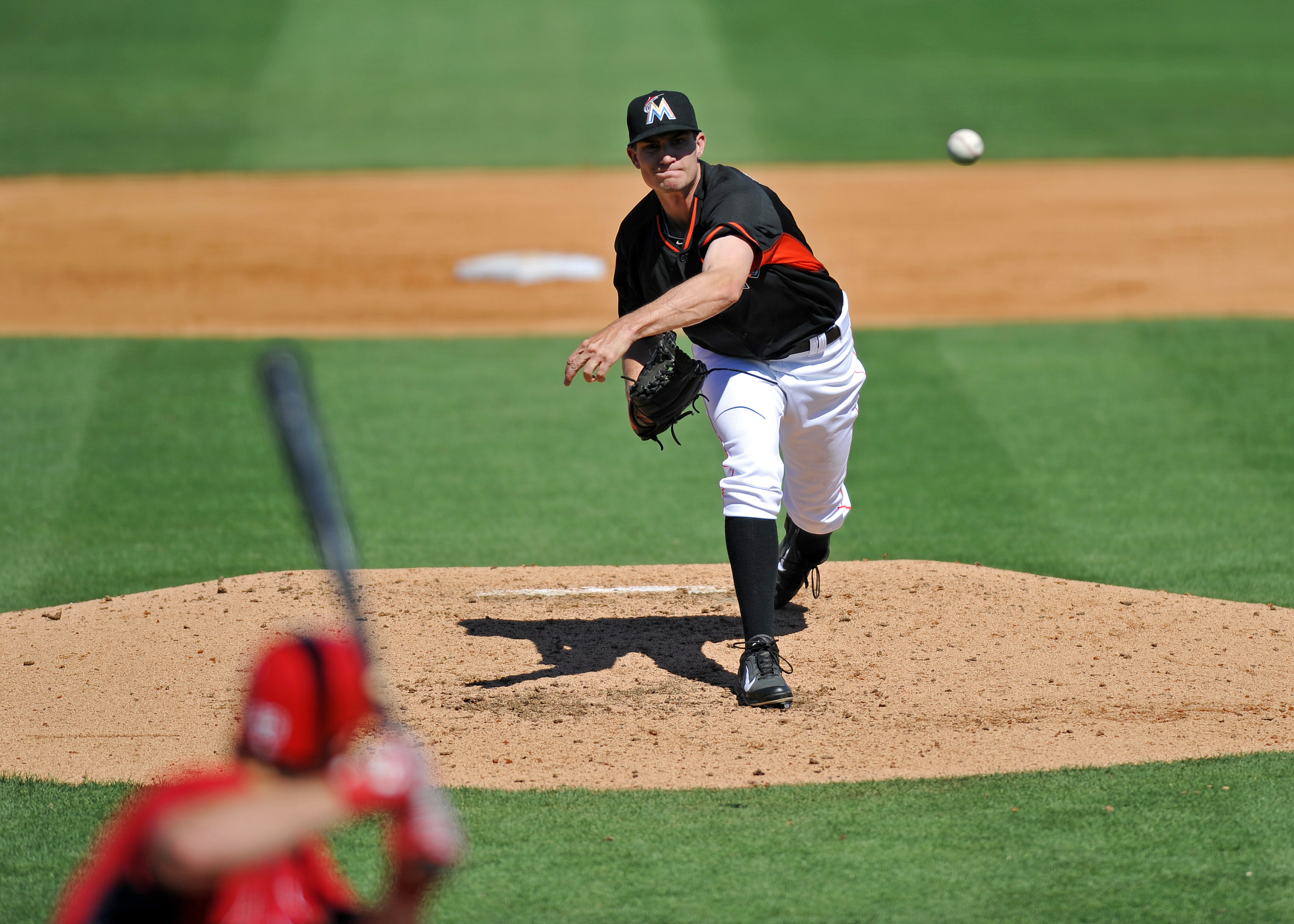
Heaney (pictured) was the ninth overall selection in the 2012 draft and entered the season ranked as the game’s No. 30 prospect according to both Baseball America and Baseball Prospectus. MLB.com ranked the 23-year-old as the game’s No. 29 prospect, and ESPN’s Keith Law ranked him 34th entering the season.
Heaney has shredded minor league hitters this season, pitching to a 2.47 ERA with 9.3 K/9 and 1.8 BB/9 in 76 2/3 innings between Double-A Jacksonville and Triple-A New Orleans. Should he remain with the team through season’s end, he would accrue 106 days of Major League service time, meaning that he should fall well shy of Super Two status.
The former Oklahoma State ace has a fastball that sits in the low 90s and touches 95 mph regularly, per Jonathan Mayo and Jim Callis of MLB.com. That plus heater is accompanied by a “wipeout” slider that Mayo and Callis grade as Heaney’s best pitch, as well as a changeup that the duo describes as a “good third pitch.” BA’s scouting reports notes that his fastball can reach 97 mph when he needs the heat, but Heaney has learned that he pitches with better command when throwing in the 91 to 93 mph range. BA also noted that holding runners has been a weakness for Heaney dating back to college (19 of 20 attempted base-stealers were successful against him in 2013), but he’s allowed just six steals in nine attempts in 2014.
The 37-year-old Wolf signed a Major League deal with the Marlins in May after opting out of his minor league deal with the Diamondbacks. He posted a 5.26 ERA with a strong 19-to-6 K/BB ratio in 25 2/3 innings with the Fish, and his 87.7 mph fastball velocity wasn’t too far off his career mark of 88.2 mph. Wolf’s stint with the Marlins was his first Major League work since late 2012, as he missed last season after undergoing Tommy John surgery. Sabermetric ERA estimators such as FIP (4.33), xFIP (3.87) and SIERA (3.99) all feel that he was the victim of some poor luck.
Slowey, 30, posted similar numbers to Wolf, compiling a 5.30 ERA with 5.8 K/9 and 2.2 BB/9 in 37 1/3 innings. He, too, was the victim of a very lofty batting average on balls in play (.382), which no doubt contributed to his lofty ERA. Slowey has always been a soft-tossing fly-ball pitcher, but he has excellent command and a respectable 4.62 ERA in 662 career innings with the Twins and Marlins.
Photo courtesy of USA Today Sports Images.
Giants Sign Daniel Carbonell
12:45pm: Carbonell will earn $1MM in a signing bonus, according to Henry Schulman of the San Francisco Chronicle (Twitter link). He’ll earn $500K, $525K, $550K and $600K in each respective year of the four-year contract, and at least the first year of the deal is a split contract.
Also from Schulman (Twitter links), Giants VP/assistant GM Bobby Evans said that Carbonell is “more of a project” than other high-profile Cuban outfielders such as Yasiel Puig and Yoenis Cespedes. The club doesn’t expect Carbonell to reach the majors in 2014.
12:10pm: The Giants have signed Cuban outfielder Daniel Carbonell to a Major League contract, the club announced. Carbonell will earn a guaranteed $3.5MM in the four-year deal, MLB.com’s Jesse Sanchez reports, and the 23-year-old outfielder can earn another $3.5MM in bonuses. Because he signed before July 2, Carbonell’s bonus will not count against San Francisco’s international draft pool. Carbonell is represented by the Culture 39 agency.
Carbonell was rumored to be choosing between five suitors who were offering contracts of five-to-seven years in length, though he managed to find his desired four-year deal in taking the Giants’ offer. The 6’3″, 196-pound Carbonell is now on the Giants’ 40-man roster and he’ll report to camp in Arizona once he obtains his work visa, the team said.
In his most recent season for Camaguey, Carbonell hit .298/.369/.449 with five homers, 40 runs scored and 28 steals (in 29 attempts) over 223 PA. Baseball America’s Ben Badler has the scouting breakdown on Carbonell, with talent evaluators praising his speed and defensive potential, though his hitting is very raw.
Red Sox Sign Second-Rounder Sam Travis
The Red Sox have signed second-round draft pick Sam Travis, MLB.com’s Jim Callis reports (Twitter link). Travis was taken with the 67th overall selection and will sign for that pick’s exact slot value of $846.8K.
Travis, a 20-year-old first baseman, posted three strong seasons playing for Indiana University and earned himself a solid mid-tier rank in several top-100 prospect lists (Baseball America had Travis at #56, ESPN’s Keith Law at #57 and MLB.com at #63). BA’s scouting report describes Travis as owning pull power and the ability to drive the ball to all fields, while also noting that he walks as often as he strikes out. “A team that drafts Travis is buying a bat, though he is a sure-handed but not flashy defender at first and fringe-average runner,” according to Baseball America.
Tony Gwynn Passes Away
Tony Gwynn, the Padres legend and eight-time NL batting champion, passed away today at age 54 following a battle with cancer. Gwynn is survived by his wife Alicia and his children Anisha and Tony Jr., who plays for the Phillies. (Just yesterday, CSNPhilly.com’s Jim Salisbury wrote a touching Father’s Day piece on the relationship between the Gwynn men.)
The elder Gwynn was drafted by the Padres out of San Diego State in the third round of the 1981 draft and he went on to spend his entire 20-year career with the Friars. Gwynn quickly established himself as one of the best pure hitters in the game’s history and was the model of consistency over his career, finishing with a .338/.388/.459 slash line, 3141 hits (19th all-time), 135 homers and 319 stolen bases. Gwynn twice led the Padres to the NL pennant, and also collected 15 All-Star Game appearances, seven Silver Slugger Awards and five Gold Gloves.
After retiring, Gwynn remained in the game as both a part-time broadcaster and the head baseball coach at San Diego State. Gwynn was a shoo-in for Cooperstown and garnered one of the highest vote totals in history (532 of 545 votes) for a first-time inductee when he entered the Hall Of Fame in 2007.
We at MLBTR all loved watching Gwynn play and greatly admired a man who by all accounts was one of baseball’s true gentlemen. We send our condolences to Gwynn’s family and many friends and teammates.
Mets, Pirates Complete Ike Davis Trade
The Mets and Pirates have completed the Ike Davis trade with the Bucs sending Blake Taylor to the Mets as the player to be named later, according to Travis Sawchik of the Pittsburgh Tribune-Review (on Twitter). Taylor was the Pirates second-round pick (No. 51) overall in last year’s draft. The CBA prevents teams from trading drafted players within their first year in the organization, so the two sides had to wait until after the one-year mark.
At the time of the trade, it was reported that the PTBNL would be more significant than the other piece the Mets received in minor league righty Zack Thornton. The soon-to-be 19-year-old probably comes with more upside than the 26-year-old Thornton, but this may not be the impact prospect that some Mets fans had in mind. In seven starts and one relief appearance in rookie ball last season, Taylor pitched to a 2.57 ERA with 5.6 K/9 against 3.9 BB/9.
Taylor was ranked as the 40th-best prospect of the 2013 draft class by ESPN’s Keith Law (Insider subscription needed) and was also ranked 55th by Baseball America and ranked 61st by MLB.com’s Jonathan Mayo.
The Mets announced (via Twitter) that Taylor will report to the rookie-level Gulf Coast Mets.
Giants Showing Strong Interest In Jeff Samardzija
The Giants are showing strong interest in Cubs ace Jeff Samardzija, according to Bob Nightengale of USA Today (on Twitter). Other clubs in the picture include the Yankees, Orioles, Angels, Red Sox, and Blue Jays.
Yesterday it was reported that the Cubs have already started discussing trades involving Samardzija and Jason Hammel with at least two teams. Gordon Wittenmyer of the Chicago Sun-Times cited the Braves, Blue Jays, and Mariners as clubs that have interest in bolstering their pitching through a deal with Chicago. Seattle is viewed as the most likely landing spot for Hammel at present.
Samardzija, who is eligible for free agency following the 2015 season, currently has a 2.77 ERA with 8.1 K/9 and 2.6 BB/9 in 91 innings. It has been long expected that the Cubs would dangle the 29-year-old and the future-minded club should find a ripe market this summer. The Red Sox could be a suitable trade partner given their strong pitching and catching depth in the minors and Theo Epstein’s familiarity with their system. The Orioles, meanwhile, have top-tier pitching prospects such as Dylan Bundy, Kevin Gausman, Hunter Harvey, and Eduardo Rodriguez that they can use to entice Theo & Co.
While some of the Samardzija suitors are playing catchup, the Giants are enjoying a 6.5 game lead over the Dodgers in the NL West and the top record in baseball. Adding the Cubs ace to their rotation would further bolster their already strong pitching. The Giants have a team ERA of 3.22, the third best in the majors.
Astros To Sign Jose Veras
The Astros have agreed to sign right-hander Jose Veras to a minor league deal, tweets Brian McTaggart of MLB.com. Veras will report to Kissimmee, Florida to gear up before heading to Triple-A Oklahoma City.
Veras, 33, was designated for assignment by the Cubs earlier this month and subsequently released. The veteran was signed to serve as Chicago’s closer after the Tigers declined to pick up his club option, but things did not work out as planned.
The Cubs gave Veras a $4MM guarantee (between this year’s salary and a $150K buyout for a 2015 club option at $5.5MM) and in return he gave the club a 8.10 ERA across 13 1/3 innings with 8.8 K/9 against 7.4 BB/9 and missed 17 games with an oblique strain.
The deal brings Veras back to where he did some of the best work in his career. In 42 outings in 2013, Veras posted a 2.93 ERA with 9.2 K/9 and 2.9 BB/9 as the team’s closer.