
Cubs Designate Eli Whiteside For Assignment
The Cubs have designated catcher Eli Whiteside for assignment, Bruce Miles of the Daily Herald reports (Twitter link). Welington Castillo has been activated from the disabled list in a corresponding move.
Whiteside was called up from Triple-A Iowa when Castillo hit the DL earlier this month. Whiteside hit only .120/.115/.160 in 26 PA over eight games with Chicago, his first taste of big league action since 2012 when he was a member of the Giants. The 34-year-old signed a minor league deal with the Cubs in the offseason and Miles believes Whiteside will return to Iowa if he isn’t claimed.
According to the MLB Trade Rumors DFA Tracker, Whiteside joins Kevin Slowey (Marlins), J.J. Putz (Diamondbacks), Josh Outman (Indians), Roger Bernadina (Reds), Jake Dunning (Giants) and Evan Reed (Tigers) in “DFA limbo.”
Cafardo’s Latest: Morales, D’Backs, Kemp
Nick Cafardo of the Boston Globe has lots of hot stove information to share in his latest Sunday Notes column…
- Kendrys Morales has already become a positive clubhouse figure in his short time with the Twins and Cafardo wouldn’t be surprised to see Minnesota try to extend the slugger. It’s also possible the Twins could deal Morales before the deadline and then re-sign him as a free agent this winter.
- The Diamondbacks seem willing to listen about trade offers for any player except Paul Goldschmidt, Cafardo notes. Martin Prado could be an attractive trade chip, though possible trade candidates like Bronson Arroyo and Mark Trumbo might not have enough time before the deadline to show that they’re healthy. “We’re meeting on it. Figures we are sellers, not buyers,” D’Backs chief baseball officer Tony La Russa said.
- The Red Sox “spent significant time watching Matt Kemp last week,” though Dodgers GM Ned Colletti told Cafardo that Kemp isn’t being traded. Kemp’s recent hot streak has “reinforced” his value to Colletti given the dearth of right-handed power options around the game.
- The Nationals could make Danny Espinosa available to second base-needy teams like the Giants or Blue Jays once Bryce Harper returns from the DL. With Harper back in the outfield, Washington would use Ryan Zimmerman at third and Anthony Rendon at second, leaving Espinosa without a regular job. Given Zimmerman’s shoulder problems and questionable future as a third baseman, however, I’d tend to think that the Nats would keep Espinosa as a valuable depth piece.
- Phillies outfielders Marlon Byrd and Ben Revere appear to be available, as Cafardo adds them to the long list of notable Philadelphia players who could be trade targets before the deadline.
- Red Sox catching prospect Christian Vazquez would be the top ask for any team looking to make a major trade with Boston. “That would be across the board, even for a major hitter. He’s major league-ready right now offensively and defensively,” a scout tells Cafardo. “We also think he’ll hit for some power in the majors. Because they have Blake Swihart, who a lot of teams will ask for as well, they probably would reluctantly give up Vazquez.” This same scout, however, says that between the two young catchers, he would keep Swihart.
- While Nate Schierholtz has only hit .207/.261/.313 in 249 PA this season, the Cubs will likely still trade the outfielder. Schierholtz is only signed through the end of the season and he is owed approximately $2.78MM in remaining salary.
- The Padres “would like to conduct a fire sale” and Chris Denorfia, Chase Headley, Carlos Quentin and Seth Smith could all be available. Cafardo notes that Smith would be a good fit in the Red Sox outfield.
- Several teams are interested in Grady Sizemore, who one scout feels will perform better now that he has had time to get re-accustomed to playing. “Whoever gets him next will probably get a better player than what Boston had. He needed more time, and with that problem offensively up there they [the Red Sox] couldn’t wait,” the scout said.
- The Blue Jays, Cubs, Marlins, Phillies and Rangers have been the teams who have been most aggressively scouting the major and minor league rosters of other clubs, Cafardo reports.
Minor Moves: Fisher, Clay, Diaz, Panik, Stinson
Here’s a look at today’s minor moves from around the league.
- The Braves have purchased the contract of Carlos Fisher from the Somerset Patriots and assigned him to Triple-A, tweets Chris Cotillo of MLBDailyDish.com. Fisher, 31, previously spent parts of three seasons with the Reds, most recently in 2011. He posted a 4.74 ERA, 7.84 K/9, and 5.02 BB/9 in 98 2/3 innings.
- The Angels have signed Caleb Clay from the Korean Baseball Organization’s Hanwha Eagles and assigned him to Triple-A, according to Cotillo (via Twitter). Clay was selected 44th overall by the Red Sox during the 2006 amateur draft. He’s since pitched for the Sox and Nationals organizations but never reached the majors. The 26-year-old right-hander struggled in his first season overseas, with a 8.33 ERA, 4.50 K/9, and 5.63 BB/9.
- Once again from Cotillo (on Twitter), the Diamondbacks have signed 27-year-old Argenis Diaz to a minor league deal. Diaz was with the Reds until recently. Interestingly, Arizona’s Triple-A affiliate has only used Didi Gregorius and Nick Ahmed at shortstop to date in 2014. Diaz will presumably provide depth up the middle.
From earlier…
- The Tigers will promote lefty Pat McCoy, Mark Anderson of TigsTown.com tweets. McCoy will have to be added to their 40-man roster. McCoy, 25, has posted a 2.94 ERA with 7.0 K/9 and 2.1 BB/9 in 33 2/3 innings this season divided between Double-A Erie and Triple-A Toledo. The Tigers signed McCoy, a product of the Nationals system, to a minor league deal last fall.
- The Giants will promote prospect Joe Panik, Henry Schulman of the San Francisco Chronicle tweets. Panik, the team’s first-round pick in 2011, will need to be added to the Giants’ 40-man roster. The second baseman was hitting .321/.382/.447 in 326 plate appearances for Triple-A Fresno.
- The Orioles have announced that pitcher Josh Stinson has cleared waivers and been outrighted to Triple-A Norfolk. The Orioles designated Stinson for assignment on Tuesday. He has pitched 13 innings for the Orioles this season, allowing nine runs while striking out six and walking six.
- The Rockies have purchased the contract of pitcher Wilton Lopez, MLB.com’s Thomas Harding tweets. They’ve made space for Lopez by optioning pitching Chris Martin to Triple-A Colorado Springs and moving Michael Cuddyer to the 60-day DL. The Rockies outrighted Lopez last week.
- The Yankees have released 1B/OF Russ Canzler, Donnie Collins of the Scranton Times-Tribune tweets. Canzler last appeared in the big leagues with the Indians in 2012. He hit .263/.332/.389 in 199 plate appearances for Triple-A Scranton/Wilkes-Barre in 2014.
- The Royals have added selected the contract of OF Justin Maxwell, Jeffrey Flanagan of FOX Sports Kansas City tweets. Maxwell will take Norichika Aoki’s place on the active roster as Aoki heads to the disabled list with a groin injury. The Royals outrighted Maxwell in May, and he’s hit .316/.358/.541 in 106 plate appearances since then.
- The Astros will add Jake Buchanan to their 40-man roster to start Saturday, and Evan Drellich of the Houston Chronicle notes (via Twitter) that fellow pitcher Jose Cisnero will head to the 60-day disabled list to make room for Buchanan on the 40-man roster. Buchanan, 24, has posted 5.2 K/9 and 1.2 BB/9 in 76 1/3 innings for Triple-A Oklahoma City this season.
Quick Hits: Hardy, Betts, Mets, Hinshaw
In his 65th game of the season, J.J. Hardy launched his first home run of 2014 off Yankees reliever Jose Ramirez. Hardy, who will turn 32 years old in August, has hit at least 22 home runs in each of the last three seasons. He’s in the final year of a three-year, $22.5MM contract with the Orioles. Despite the power outage, he hasn’t been a total loss at the plate with a .288/.317/.354 line entering today. Aside from home runs, Hardy is best known for superb defense at shortstop, so he should have suitors lined up regardless of his offensive value. Obviously, a return to his previous home run bashing ways will improve his leverage as a free agent.
- Mookie Betts may be moving closer to a major league promotion, speculates Scott Lauber of the Boston Herald. Red Sox manager John Farrell mentioned Betts unprompted when asked about recent signee Andres Torres, saying “I know Mookie Betts is swinging the bat well.” Betts natural position is second base, but he’s been learning the outfield due to the presence of incumbent Dustin Pedroia. According to leaderboards available at FanGraphs, Red Sox outfielders rank third to last in baseball with a .233/.310/.339 line. A shot in the arm appears justified.
- Rather than trade for an elite slugger like Giancarlo Stanton, the Mets may employ a strategy similar to the Rays and Athletics, writes Andy Martino of the New York Daily News. To further reinforce Martino’s point, one Mets official asks “what big bat is out there to trade for?” With the Marlins in the playoff race, Carlos Gonzalez on the disabled list, and Matt Kemp underperforming his contract, there aren’t many places to look for franchise altering bats. Instead, it might be easier to find and develop hidden values like Josh Donaldson, Brandon Moss, and Ben Zobrist. Mets fans who are waiting to turn Noah Syndergaard and Zack Wheeler into a superstar are liable to be disappointed.
- The Cubs are the only team jumping into the trade market with both feet according to Joel Sherman of the New York Post. GMs are cautious about pulling the plug too quickly, which keeps negotiations from moving forward until the deadline approaches. League wide parity and the second Wild Card have conspired to allow most teams to dream of contention. There’s also the annual game of roster chicken. Says one AL executive, “Everyone overvalues their prospects and they wait because they are always convinced the prices are going to come down.”
- Former big league lefty Alex Hinshaw is once again drawing the interest of major league teams, tweets Ben Nicholson-Smith. The 31-year-old is now pitching for the Independent League Wichita Wingnuts, with 18 strikeouts in eight and two-thirds innings. He last spent time in the majors in 2012, when he threw 28 innings for the Padres and one-third of an inning for the Cubs. Walks plagued Hinshaw, as evidenced by his 6.04 ERA, 11.44 K/9, and 6.67 BB/9.
Rosenthal’s Latest: Padres, Mariners, Indians, Braves
Early this morning, Ken Rosenthal of FOX Sports wondered if the Padres might contemplate trading right-handed starter Andrew Cashner. Such a trade could help the club quickly rebuild. In his latest video, a rival executive rebuts Rosenthal’s theory. The executive believes the Padres are much more likely to move expensive veterans like Chase Headley, Carlos Quentin, Ian Kennedy, Huston Street, and Joaquin Benoit, citing impatience from the ownership group and an over budget roster. It’s also widely thought that Padres GM Josh Byrnes is on the hot seat, which could affect trade talks. Here is more from Rosenthal’s latest:
- Speaking of GM’s on the hot seat, Jack Zduriencik is on a mission to win games and save his administration, according to rival executives. The Mariners have been branded as one of the most active teams on the trade market, with Nick Franklin as the most obvious trade asset. Rosenthal notes that the team lacks financial flexibility, which may make it hard to acquire high impact talent.
- Rival executives believe the Indians would like to add “Miami Marlins type pitching,” leading several clubs to scout Cleveland’s farm system. While the Indians may want a front line starter, Rosenthal suggests they may be forced in another direction.
- The Braves bullpen could potentially benefit from experience. Closer Craig Kimbrel has the most service time with four years. The ‘pen currently includes four rookies – two of whom made their big league debut on Friday. The Braves could use a starter, but they may lack the assets necessary to acquire a top hurler like Jeff Samardzija.
Draft Signings: Karsten Whitson
We’ll keep track of Saturday’s notable mid-to-late draft signings here…
- The Red Sox have signed 11th round selection Karsten Whitson for $100,000, according to Alex Speier of WEEI.com. Whitson was formerly selected ninth overall in the 2010 Rule 4 draft by the Padres, but he turned down a $2.1MM bonus to attend the University of Florida. Speier adds that Whitson was recently gunned at 96 mph with an 88 mph slider (via Twitter).
Giants Designate Jake Dunning
The Giants have designated right-handed reliever Jake Dunning for assignment, tweets Henry Schulman of the San Francisco Chronicle. The move creates room on the active roster for Joe Panik.
Last season, the 25-year-old Dunning contributed a 2.84 ERA, 5.68 K/9, and 3.91 BB/9 over 25 and one-third innings. This year, he made just one appearance for the big league club, walking one batter and unleashing two wild pitches in just two-thirds of an inning. Dunning also struggled in the minors this season with a 5.88 ERA. His fastball averaged 87.7 mph in his lone major league appearance, down over two mph from his average velocity last year.
Per MLBTR’s DFA Tracker, Dunning joins five other players in DFA limbo: Roger Bernadina, J.J. Putz, Evan Reed, Kevin Slowey, and Josh Outman.
Should The Super Two Designation Be Changed?
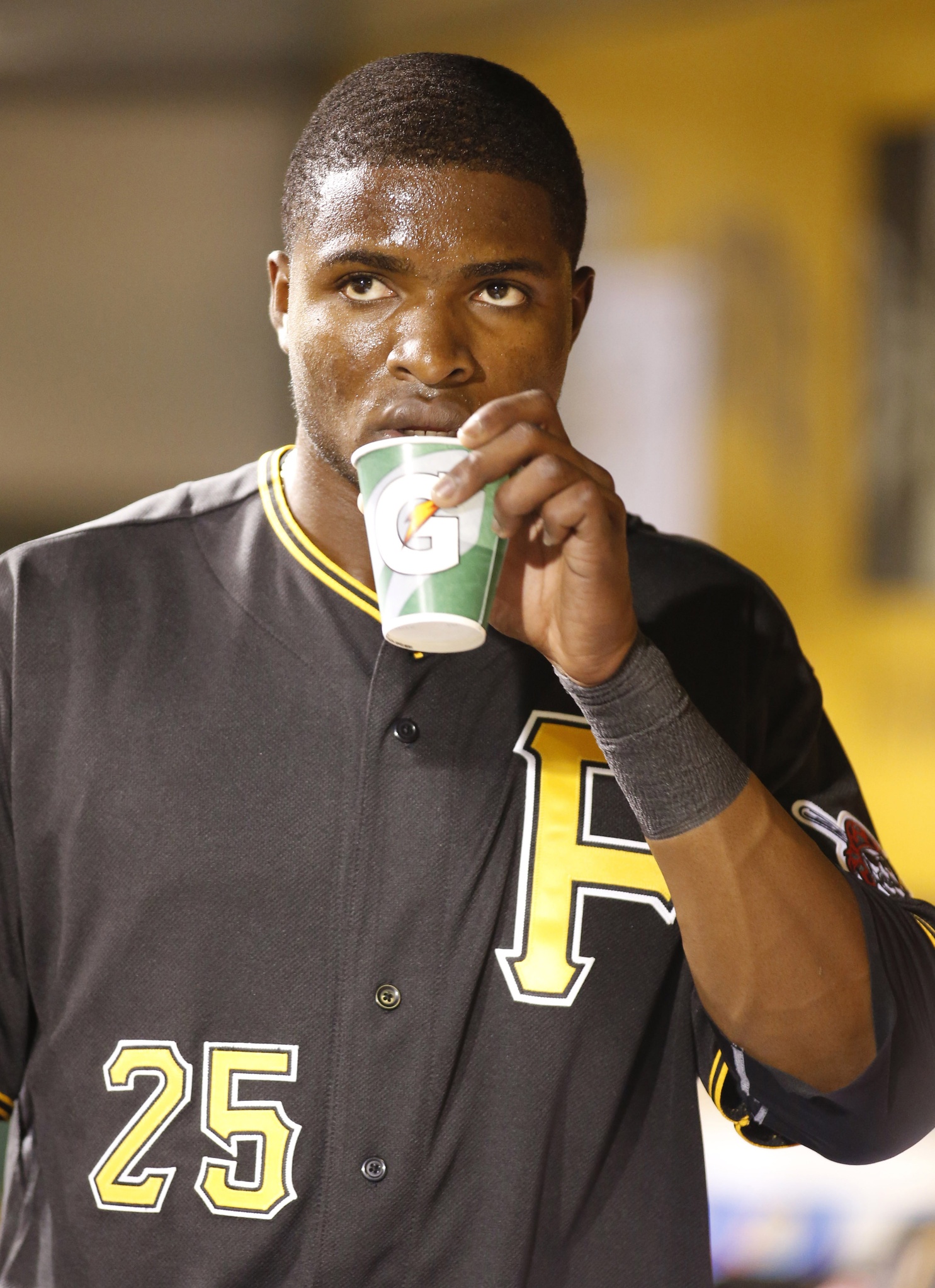 The Pirates’ decision to wait until June 10 to promote top outfield prospect Gregory Polanco set off a new round of debate, both in Pittsburgh and nationally, about the Super Two designation in particular and top prospect promotion timelines in general. The Pirates have said that their decision to wait to promote Polanco was due to developmental reasons, but whatever their motivations, the current system incentivizes waiting to promote top prospects even if they seem to be ready for the big leagues. That’s unfortunate, and MLB perhaps ought to consider reforming the Super Two designation. It’s probably impossible, however, to completely disincentivize manipulation of players’ promotion dates.
Overview
Teams must consider two thresholds when promoting a top prospect. A player is eligible for an extra arbitration season as a Super Two player if he has between 2.086 and three years of service time and he ranks in the top 22 percent in service time among players with between two and three years. The 22 percent clause means that the Super Two threshold is a moving target, but teams can usually feel safe about promoting a player in early to mid-June with the idea that he won’t be a Super Two player three offseasons later. A Super Two player can be eligible for arbitration four times rather than three, which means that a Super Two star player can make millions more in his arbitration seasons than a similar player who does not have that designation.
Teams must also consider a player’s free agency threshold. A player becomes eligible for free agency after six full years of service time, which means teams must consider a separate date in mid-April before which a player can become a free agent a year early.
We’ll leave aside, for now, the question of whether it’s wise for teams to delay promotion of top prospects in order to avoid Super Two status or free agency, and simply observe that the current system provides them at least some incentive to do so. The Pirates promoted Polanco on June 11, after months of criticism from analysts and fans who watched Polanco post great numbers at Triple-A while Jose Tabata and Travis Snider struggled in right field for the Pirates. (Josh Harrison handled the position for about a month before Polanco arrived and played much better.) Major League Baseball received some criticism, too, for creating the rules that made the Pirates’ decision rational (or arguably rational. Few commentators offered viable alternatives to the Super Two system, however, with Baseball Prospectus’ R.J. Anderson (subscription-only) being among the few to make a strong attempt.
If the Pirates held Polanco in the minors for two months longer than they would have without the Super Two system in place, that’s not nearly the tragedy many fans and commentators made it out to be. ESPN’s Dan Szymborski, the creator of the ZiPS projection system, tells MLBTR that based on information available in mid-April, promoting Polanco on June 10 rather than April 15 projected to cost the Pirates about one win. (And the Pirates might well have waited to promote Polanco even without the Super Two rule, given their longstanding record of allowing players time to develop in Triple-A before promoting them.) That’s unfortunate for the Pirates and their fans, but it’s hardly a travesty. A few cases like Polanco’s each year likely do not justify sweeping changes to the existing system.
Many large-scale rules involve thresholds that can be less than ideal on the micro level while producing good results on the macro level. For example, it isn’t ideal, or fair, for an irresponsible 16-year-old to be legally allowed to drive (if he or she can pass a driving test), while a responsible 15-year-old with excellent hand-eye coordination cannot. But the 15-year-old will soon be 16, and so that unfairness will soon be rectified. Meanwhile, the existence of a threshold that permits small-scale unfairness keeps the rules simple and helps prevent charges of arbitrariness.
Preventing teams from manipulating players’ service time is not a simple matter. As long as arbitration eligibility and/or free agency eligibility are tied to service time, and as long as teams control when their players’ service time clocks begin, teams will be able to use players’ promotion dates to manipulate their salaries and/or years of control.
So, for example, even if MLB were to eliminate the Super Two designation while maintaining current rules regarding free agency eligibility, teams could delay the promotion of top prospects who appeared to be ready in August or September and wait instead to promote them in mid-April. We would see fewer mid-June promotions for top prospects, but we would also see fewer mid-August promotions and more mid-April promotions, and the criticism of MLB’s rules would simply take place in August and September rather than April or May. If the goal is to prevent teams from delaying the promotion of top prospects who appear to be ready, simply changing the thresholds of arbitration or free agency eligibility will not work.
Untethering Free Agency, Arbitration Eligibility From Service Time
One solution to eliminate thresholds that can prevent teams from promoting players when they’re ready might be to untether free agency eligibility and arbitration eligibility from MLB service time. If a team were not worried about the number of years it could control a player, or about his salary during his arbitration seasons, it would be free to promote him whenever it deemed him ready.
This would, however, be a radical change with far-reaching consequences. With enormous payroll disparities between teams, MLB depends heavily on young players’ cost-controlled salaries to maintain competitive balance. Without cost control, it would be nearly impossible for smaller-payroll teams like the Athletics, Rays and Pirates to compete. The current rules regarding free agency and arbitration eligibility are the mechanism that allows player salaries to remain cost controlled. So if MLB and the players’ union were to agree to untether free agency and arbitration eligibility from service time, they would need some other mechanism to allow cost control.
One possibility would be to base free agency and arbitration eligibility not on service time, but on when a player was drafted or signed as an amateur, similar to the way Rule 5 Draft eligibility is determined. A player’s eligibility for the Rule 5 Draft in a given year depends upon his age on the June 5 before he signs and the number of Rule 5 Drafts that have passed since then. A similar system could be devised to determine free agency and arbitration eligibility. For example, a player under 19 by the June 5 before he signs might become eligible for arbitration after nine full years and eligible for free agency after 12 full years. A player who is at least 19 by the June 5 before he signs might become arbitration-eligible after eight full years and eligible for free agency after 11 years. (Players posted from Japan would continue to be exempt from these rules.) This system would enable the Pirates, for example, to promote Polanco whenever they deemed him ready, without concern for arbitration or free agency timelines.
Unfortunately, this rule would produce plenty of unintended consequences, and the cure would likely be worse than the disease. This system would be tremendously unfair to players who move quickly through the minors.
For example, the Expos drafted Chad Cordero in 2003 with the idea that he could make it to the big leagues quickly. He did exactly that and was a successful closer for several years before succumbing to injury. Because he was eligible for arbitration after his third full season, he was able to make over $11MM in his career, a total that seems reasonable, given the quality of his pitching. Under a system that connected arbitration eligibility to signing date rather than service time, he likely would have made only about a third that much, since he would have been close to the MLB minimum for his entire career. Meanwhile, a player who struggled in the minors and arrived in the big leagues after many years in Triple-A might become arbitration eligible after just one or two years. Also, such a system would dramatically limit the long-term earning capabilities of top players like Mike Trout who reach the Majors at young ages.
Allowing Neutral Parties To Determine Readiness
Another possibility might be to maintain the basic outline of the current arbitration and free agency timelines but to allow arbitrators to determine when those timelines might begin. So, for example, an arbitrator might have ruled that Polanco was ready May 1, forcing the Pirates to begin his big-league service clock then even if they did not promote him. Clearly, though, this is perverse and heavy-handed, putting the determination of the player’s readiness in the hands of an outside party who would have had far less information about the player’s development than his team did. Such a system would surely also create even more complaints of unfairness than the current one.
The problem here, of course, is the existence of thresholds. When there are thresholds that determine how long a team controls a player and how much they’ll have to pay him, there will be incentives to manipulate those thresholds. One of those thresholds, the one that determines free agency eligibility, probably isn’t going anywhere, since it helps prevent star players from becoming free agents while seasons are in progress. (That is, there could be a system in which a player who is promoted for the first time in August also could become a free agent in August six years later. But that would be chaotic, and the current threshold of six-plus years before free agency eligibility helps prevent that.)
The free agency threshold is probably here to stay, and as long as there’s a threshold, there will be occasional cases like Polanco’s where teams delay promotions of top prospects even when they’re dominating at Triple-A. It’s unfair on the small scale, but reasonable on the larger scale, and that might be as much as MLB can do.
Eliminating The Super Two, Redistributing Super Two Salaries
There are, however, some more modest reforms that MLB might consider to change the Super Two threshold, leaving teams with only one threshold to consider, rather than two. One possibility might be to eliminate the Super Two completely, as Pirates president Frank Coonelly recently suggested in an interview with USA Today’s Bob Nightengale.
The players’ union would, of course, be reluctant to make such a change, given that the existence of Super Two status means more money for them. But MLBTR’s Tim Dierkes suggests that MLB could, instead, calculate the approximate percentage of overall player income Super Two status typically produces and redistribute it as a modest, across-the-board raise for players making the MLB minimum salary. (Dierkes points out, however, that it’s possible the union would still dislike the idea, given that Super Two arbitration salaries for players like David Price help set arbitration salaries for other players.)
Prorating First Year Arbitration Salaries
MLBTR’s Jeff Todd suggests making all players with between two and three years of service time Super Two players, but prorating their first year of arbitration salary based on their service time. So a player with two years and 50 days of service time would receive an arbitration-year salary prorated for those 50 days of MLB service (combined with an MLB minimum salary prorated for the rest of the year), whereas a player with two years and 100 days would receive an arbitration-year salary prorated for 100 days. Players with three or more years of service time would then go through arbitration as they do now.
Either of the last two proposals would effectively eliminate the Super Two threshold. The free agent threshold probably can’t be eliminated, and its existence should continue to provide teams with incentive to manipulate players’ service time. But at least there would only be one threshold, rather than two. Also, either proposal to change the Super Two would eliminate the uncertainty involved in Super Two status, given that there’s currently no way for teams interested in promoting a player to know where exactly the Super Two threshold will fall two and a half years later.
Photo courtesy of USA Today Sports Images.
Angels Release Raul Ibanez
The Angels have announced that they’ve released Raul Ibanez. Ibanez collected 190 plate appearances with the Angels this season and hit .157/.258/.265. The Angels have endured criticism recently for playing Ibanez at designated hitter ahead of the much younger C.J. Cron.
The Angels signed Ibanez to a big-league deal in December, paying him $2.75MM plus bonuses based on playing time. Ibanez was effective offensively for the Mariners last season, hitting .242/.306/.487 with 29 homers in 596 plate appearances, but he never got untracked with the Angels, and he has been a consistently weak defender and baserunner for years, so he doesn’t add value if he’s not hitting. Ibanez, 42, has played in parts of 19 seasons with the Mariners, Royals, Phillies, Yankees and Angels.
Reds Designate Roger Bernadina For Assignment
The Reds have announced that they’ve designated Roger Bernadina for assignment. The move clears space on the Reds’ active roster for pitcher Carlos Contreras.
Bernadina, who turned 30 last week, has hit .153/.286/.203 in 71 plate appearances for Cincinnati this year. The Reds signed him to a minor league deal in January. The outfielder has a career .236/.306/.352 line in parts of seven seasons with the Nationals, Phillies and Reds.
Contreras, 23, has not pitched above Double-A Pensacola, but he’s gotten good results there, posting a 2.70 ERA with 12.2 K/9 and 5.0 BB/9 in 20 innings this season. MLB.com ranks him as the Reds’ No. 5 prospect.