
Quick Hits: Cars, Opt-Outs, DH
Here are MLBTR, we routinely toss around dollar figures in the tens or hundreds of millions in reference to players’ salaries. It’s rare, though, that we get as clear a glimpse into what those tens or hundreds of millions can actually buy as we do in this look at MLB players’ cars, courtesy of Tim Rohan of the New York Times. Specifically, Rohan profiles Alex Vega, who owns a custom car shop in the Miami area. Vega frequently works with baseball players during the offseason, because, he says, “Spring training is when business gets the craziest because everybody wants to show up with something new. I’m already getting calls. I’m already preparing cars.” For example, Rohan notes that Pablo Sandoval recently entered the shop hoping to buy a 2016 Rolls Royce Ghost; he left behind a customized Porsche that he had bought just two years before, only driving it for just over 15,000 miles. The quiz accompanying the article — in which the reader is asked to match the car to the star who bought it — is amusing. Here’s more from around the league.
- This offseason has seen the proliferation of opt-out clauses in long-term contracts, Tim Britton of the Providence Journal writes. Opt-out clauses were so rare in the past that the industry doesn’t have much concrete experience with what their results will be (although, I’ll note, it would be easy to study how opt-outs might have worked in past contracts by imagining what players might have done had they had opt-outs after, say, a year, or two years). The obvious conclusion is that opt-outs are a lose-lose for teams, who should theoretically lose productive players as they opt out while being stuck with the ones who don’t produce. But it might not be so simple, as Red Sox president of baseball operations Dave Dombrowski points out. “There may be other cases where somebody opts out and after a year — I’m not going to say this is going to happen but I’ll use it as an example — after a year something happens to him and he’s not pitching as well, and [a team says], ‘See? That was a benefit to us,'” he says. “So we really haven’t reached that second step yet.”
- It’s looking more and more likely that the designated hitter will be implemented in the NL as well as in the AL, Jared Diamond of the Wall Street Journal writes. The players’ association has long supported the change, and taking bats out of pitchers’ hands will help create more runs in an increasingly offense-starved playing environment. Also, Diamond points out that pitchers are hitting even worse than they used to, posting four of their five lowest season OPS marks since 1974 in the last four years.
MLBTR Podcast: Landing Spots For The Top Remaining Outfielders
Jeff covers the league’s latest moves in the weekly Quick Hits rundown, then welcomes MLBTR’s Steve Adams to the show to discuss the Nationals’ reported pursuit of Yoenis Cespedes. Jeff and Steve also run through other possible landing spots for Cespedes, Dexter Fowler and Austin Jackson and examine the moves that several teams would have to make in order to accommodate a free-agent addition.
Click here to subscribe to the podcast on iTunes, and please leave a review! The podcast is also available via Stitcher at this link.
The MLB Trade Rumors Podcast runs weekly on Thursday afternoons.
Free Agent Prediction Contest Leaderboard
36 players from MLBTR’s Top 50 Free Agents have signed so far. Our prediction contest was open for a week after qualifying offers came in back in November, and 3,092 people entered. So far, two people are batting over .400, with 15 correct picks. The leaderboard is available here; my apologies for the delay. You may notice some blank names in the leaderboard. If you believe your own name is blank, please click the “Login with Facebook” button from the leaderboard and your name should appear later.
This was the fifth year using this framework for the free agent prediction contest, and I intend to upgrade it for the 2016-17 offseason. At that time, we’ll drop the Facebook requirement so that all interested MLBTR readers can play.
Marlins Beat Writer Juan C. Rodriguez Passes Away
Juan C. Rodriguez, the Sun Sentinel’s beat writer for the Marlins, has passed away after a battle with brain cancer. His friend, Andy Barkett, conveyed the unfortunate news today on Twitter, and the team he covered also acknowledged his untimely passing in a tweet.
MLBTR joins all those around the game in extending its condolences to Juan’s family and friends. You can learn more about his story and consider giving to the Rodriguez family at this link. Juan’s good work was often featured here at MLBTR, and the outpouring of sympathy from the ballwriting community stands as a testament to his impact on colleagues. Mike Berardino provides a fitting quote, from Rodriguez himself: “We can’t impose our will on brain cancer, but we can take charge of how we choose to live with it.”
Arbitration Roundup: 34 Players Remain Unsigned
Now that the dust has settled from the morning’s rash of arbitration-avoiding deals, it is time to look out for reports on the arbitration numbers filed by players and teams that have yet to reach agreement. As MLBTR’s Arbitration Tracker shows, of the 156 players to file, 34 have still yet to agree to terms on a contract. (Lorenzo Cain exchanged figures but is said to be nearing a two-year deal with the Royals, so he isn’t included.)
Remember, deals avoiding arbitration can still be reached even after the exchange of numbers. Hearings will be scheduled between February 1st and 21st, so there is plenty of time for the sides to come together before making their cases. In 2014, for the first time ever, no arbitration hearings took place, but several took place again last season.
That being said, some teams are known for their “file and trial” approach to arb-eligible players, meaning that they refuse to negotiate after the exchange deadline and go to a hearing if agreement has not been reached. Of those clubs believed to continue to utilize such a strategy, only the Blue Jays (Josh Donaldson, Jesse Chavez) and Rays (Drew Smyly) have open cases remaining. Also, the Reds reportedly will take any sub-$2MM contracts to a hearing, which could suggest that reliever J.J. Hoover may appear before a panel. The Astros are also said to be taking a “file-and-go” approach with catcher Jason Castro.
Other notable players who have yet to agree upon a 2016 salary include Jake Arrieta of the Cubs; Brandon Belt of the Giants; Zach Britton of the Orioles; Aroldis Chapman of the Yankees; Neil Walker, Lucas Duda, and Jeurys Familia of the Mets; Mike Moustakas of the Royals; Trevor Plouffe of the Twins; and A.J. Pollock of the Diamondbacks. Be sure to keep a close eye on MLBTR’s pages for information on those and other situations, and in the meantime click here to review MLBTR contributor Matt Swartz’s projections for all arbitration-eligible players.
MLBTR Podcast: Marlins’ Moves, Opt-Outs, And Outfielders
MLBTR’s Steve Adams joins host Jeff Todd to talk about a variety of topics. In a wide-ranging discussion, Steve and Jeff chatted about the Marlins’ extension of Dee Gordon and signing of Wei-Yin Chen, creative uses of opt-out clauses, and the still-developing free agent market for outfielders.
Click here to subscribe to the podcast on iTunes, and please leave a review! The podcast is also available via Stitcher at this link.
The MLB Trade Rumors Podcast runs weekly on Thursday afternoons.
Alexei Bell Departs Cuba In Search Of MLB Deal
Yet another Cuban ballplayer has departed the island, as 32-year-old outfielder Alexei Bell has left in search of an opportunity in the majors, according to Jorge Ebro of Baseball de Cuba. Bell is preparing for a showcase in two or three weeks, MLB.com’s Jesse Sanchez adds.
Bell, a long-time mainstay on the national team, is said to have left Cuba legally. It’s unclear whether that will impact his clearance timeline in any way, but regardless, the first order of business for his representatives at DPX Sports will presumably be to obtain an official declaration of free agency. Bell will not be subject to international bonus restrictions due to his age and long experience in Cuba.
Starring with Santiago in Cuba’s Serie Nacional for many years, Bell compiled a robust .319/.417/.547 batting line in 3,441 career plate appearances. That made him one of the island nation’s most productive hitters. Notably, he has just eight more strikeouts (439) than he does walks (431) in that span, and didn’t end a Cuban campaign with more K’s than walks in a single season after 2008.
As Ben Badler of Baseball America wrote this time last year, however, Bell has shown inconsistency at times with the Cuban national team. He does feature a plus arm and could fit in right field, said Badler.
Bell’s current status and major league prospects remain somewhat unclear, however. He spent the 2015 season with the Capitales of Quebec, in the Canadian-American Association, and the results weren’t all that promising. Over 241 plate appearances, Bell slashed .317/.363/.424 with two home runs (and an uncharacteristic 24:14 K:BB ratio).
Arbitration Breakdown: Manny Machado
Over the next few weeks, I will be discussing some of the higher profile upcoming arbitration cases. I will rely partly on my arbitration model developed exclusively for MLB Trade Rumors, but will also break out some interesting comparables and determine where the model might be wrong.
Manny Machado has reached arbitration eligibility at the young age of 23, and has already put up solid numbers in his career, including a breakout year in 2015. Machado hit .286 this past year, which is not all that much better than the .278 career mark he had going in, but his 35 home runs more than doubled his career high. After Machado’s 51 doubles in 2013 suggested he would eventually show more power than the 14 home runs that accompanied them, injuries in 2014 limited him to 354 PA. As a result, Machado’s pre-platform performance and overall career numbers are not as strong as his platform year, which makes him somewhat of a tricky case. Few comparables cases present themselves, so although his $5.9 million projected salary seems plausible, it could easily miss by a lot.
Machado’s strong defense also makes his case trickier as well. Although my model has repeatedly shown that defense does not consistently affect arbitration cases, many of the hitters who could be considered comparables for Machado were far worse fielders, and this could certainly help him earn more than them. Just because the model does not prove the importance of any specific defensive statistic, that does not mean that defense never enters into a case—we know from firsthand reports that it does. Machado’s relatively low number of RBIs for a guy who hit 35 home runs also makes his case unique as well.
Perhaps the best comparable could be Chris Davis’ case three years ago, although nearly everything about Davis’ case is slightly worse. Davis hit .270 with 33 home runs and 85 RBIs, which is a near match of Machado’s .286/35/86 in his platform year. Davis also did not have many home runs pre-platform, so his career 77 home runs at the time are not much different than Machado’s 68. However, Davis’ career average of .258 is way below Machado’s .281. Davis also plays an easier defensive position than Machado. However, the Orioles could certainly try to argue that Machado should not out-earn Davis’ $3.3 million award by too much.
Although it was seven years ago, Ryan Ludwick’s case looks very similar to Machado’s when Ludwick earned $3.7 million in 2009. He hit .299/37/113 in his platform year and had .273/65/209 career numbers, and although Ludwick’s platform numbers were slightly better, Machado’s career .281/65/215 is extremely similar. The Orioles could try to argue that a little salary inflation on Ludwick’s $3.7 million would put Machado between $4 and $5 million.
If Machado wants to argue for a salary closer to his $5.9 million projection, one potential comparable that Machado could consider is Dan Uggla, who had 32 home runs and 92 RBIs in his platform year before reaching arbitration eligibility, and who received $5.3 million. However, this was back in 2009 and cases that old are rarely used. Uggla also only hit .260, although he did have 90 career home runs, far exceeding Machado’s 68.
Another possibility Machado could use to try to push his salary closer to his projection, who is more recent than Uggla, is Giancarlo Stanton’s case just two years ago. Although Machado could be a similar match in terms of stardom, Stanton’s injuries kept him to 504 PA in his platform year and only 24 home runs, while he hit .249. He did have 117 career home runs though. While he played a different position, Stanton could be considered a comparable. He earned $6.5 million in 2014. Like with Uggla, the difficulty for Machado if he tries to argue for Stanton as a comparable is that both Uggla and Stanton had many more career home runs than Machado does.
Other potential comparables that Machado could use are Mark Trumbo, Chris Carter, and Pedro Alvarez, who all reached their first year of arbitration eligibility in the last couple years and earned $4.8, $4.175, and $4.25 million. They each hit between 34 and 37 home runs and between 88 to 100 RBIs in their platform year. Although they had more career home runs than Machado, ranging from 85 to 95 between them, their batting averages are much worse than Machado’s. They each hit between .227 and .233 in their platform year and between .222 and .250 in their careers. Machado could make the case that he had similar power to them, but a better average, so he deserves to have somewhere above $5 million.
It is difficult to find obvious cases where Machado exceeds his $5.9 million projection. There are a number of players with higher salaries who had similar platform years, but more home runs, while there are a couple of players who earned less money with career numbers that look similar to Machado, but whose cases are weaker in one way or another. Machado has a better batting average and defense than just about all of these players, including the players with more career home runs. However, I think Machado is probably likely to under-earn his projection.
A potential wild card that could come into play is a similar player who is also reaching his first year of eligibility this year, Nolan Arenado. With a similar breakout performance in 2015 along with strong defense at the same position, Arenado could easily help or hurt Machado’s case for arbitration this year if he reaches an agreement first.
MLBTR Podcast: Talking White Sox with Scott Merkin
MLBTR’s Jeff Todd runs down the latest from around the league before being joined by Scott Merkin of MLB.com to discuss his experience covering new Hall of Famer Ken Griffey Jr. in his days with the White Sox as well as the outlook of the ChiSox after a disappointing 2015 season. Specifically, Jeff and Scott talk about the Sox’ philosophy, the potential of further additions to the roster and trade talks that have taken place between Chicago and Colorado.
Click here to subscribe to the podcast on iTunes, and please leave a review! The podcast is also available via Stitcher at this link.
The MLB Trade Rumors Podcast runs weekly on Thursday afternoons.
Arbitration Breakdown: Josh Donaldson
Over the next few weeks, I will be discussing some of the higher profile upcoming arbitration cases. I will rely partly on my arbitration model developed exclusively for MLB Trade Rumors, but will also break out some interesting comparables and determine where the model might be wrong.
The reigning Most Valuable Player of the American League enters his second year of arbitration eligibility due for a healthy raise on the $4.3MM he earned in his award-winning season. Josh Donaldson hit .297 with 41 home runs and 123 runs batted in 711 plate appearances, with an All-Star appearance and a Silver Slugger Award to add to his MVP honors.
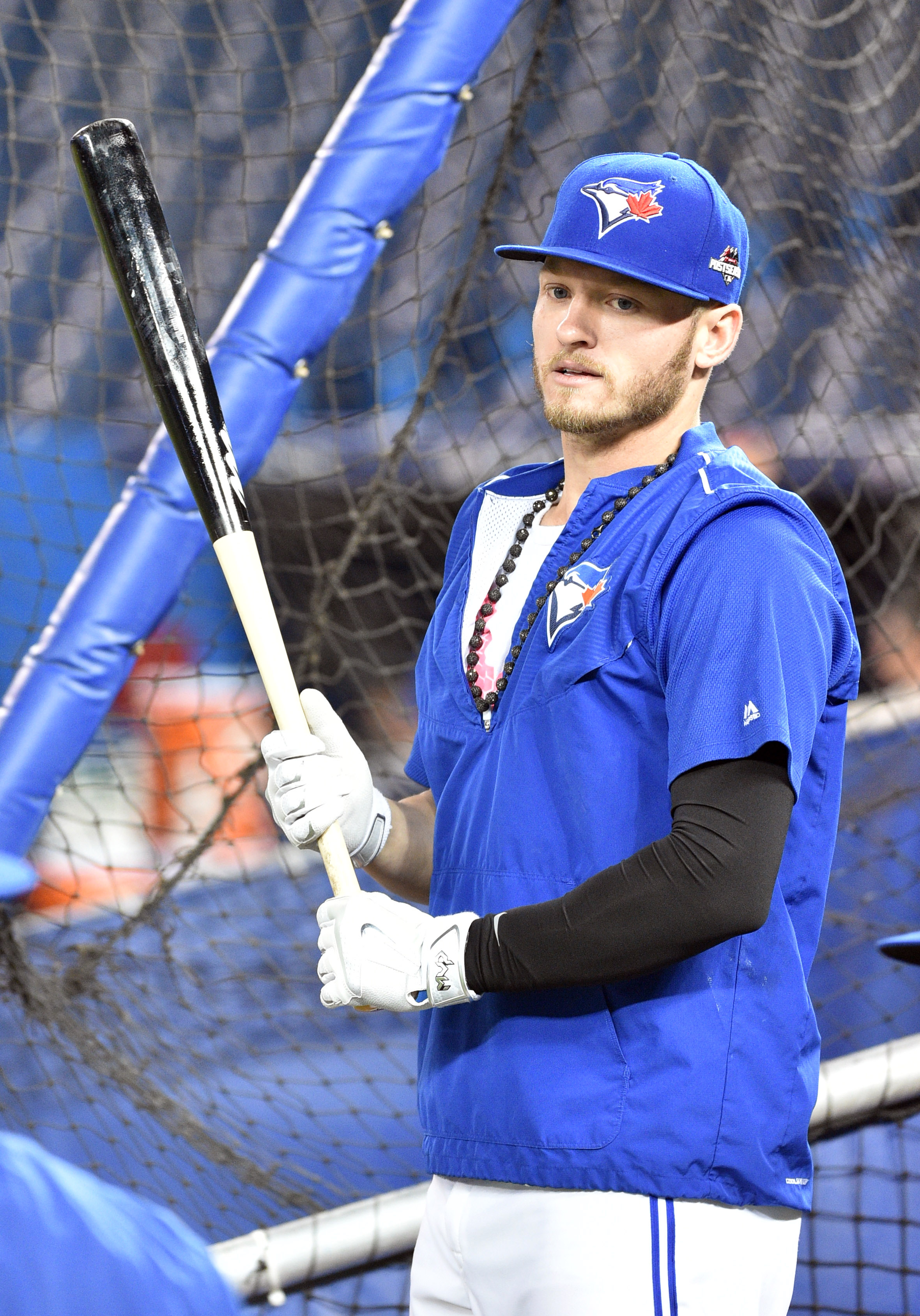
It was the third baseman’s first year with the Blue Jays after a solid career in Oakland, and he certainly made a great impression on his new employers. Now, they will have to pay up in his second year of arbitration. Our model and several knowledgeable sources have confirmed that after the first year of arbitration eligibility, most players’ cases are treated as raises based almost exclusively on the previous year’s statistics. This helps explain why the model projects that Donaldson will receive a $7.7MM raise to a total of $12MM, which would be a record raise for a second-time eligible player.
The model’s projection of a record raise seems appropriate. The current record belongs to Chris Davis in 2014, who did not win an MVP Award when received a $7.05MM raise. Davis did out-homer Donaldson, 53 to 42, and had 138 RBIs — 15 more than Donaldson — as well. But, Donaldson had a higher average, .297 versus .286, and played a harder defensive position (third base versus first base) and is known for his excellent defense. While defensive performance usually does not matter much in arbitration cases (other than position played), I believe that Donaldson should be able to use his defense and his hardware to argue that he should have a bigger raise than Davis did– probably something in line with the $12MM projection, I would guess.
The last hitter to enter his second year of arbitration eligibility after winning an MVP Award was five years ago, when Josh Hamilton earned a $5.5MM raise. Hamilton had hit .359 with 32 home runs and 100 RBIs, but in only 571 plate appearances. Donaldson’s 140 extra trips to the plate with nine more home runs and 23 more runs knocked in should help him argue for a much larger raise than Hamilton received on the heels of his MVP season in 2010. Even if Donaldson cannot effectively argue that his raise should be larger than Davis’ due to the power gap, he should have less trouble arguing that he is deserving of a bigger raise than Hamilton received five years ago.
Few other players seem likely to make better arbitration cases for Donaldson than Hamilton and Davis. As a result, I think the case will likely come down to an argument about whether Donaldson should get something like a $6MM raise to top Hamilton by a decent margin, or whether Donaldson should get a $7.5MM raise to set a new record beyond Davis. It’s unlikely that Donaldson out-earned the $12MM salary I have projected for him, but I think it is more likely than not that he is close to this range. If he cannot argue that his case is stronger than Davis, though, he might end up around $10.3MM — a hefty raise, to be sure, but a fair margin shy of the current record increase that our model currently projects.
Photo courtesy of USA Today Sports Images.