
Qualifying Offer And Draft Pick Compensation Update
Unsurprisingly, the Yankees and Red Sox are at the center of the draft pick movement relating to players who declined qualifying offers. After all, they made six of this year's thirteen QOs, all of which were declined. (Click here for a refresher on how things work, courtesy of former MLBTR writer Ben Nicholson-Smith.)
Yesterday, we saw quite a few moves that had draft pick implications. The Yanks added Hiroki Kuroda and Carlos Beltran. Meanwhile, the club saw outgoing free agents Robinson Cano and Curtis Granderson sign with the Mariners and Mets, respectively. Finally, Boston agreed to terms with Mike Napoli.
With Kuroda and Napoli rejoining their former clubs, their signings will not result in any draft pick changes. But the Yankees' other signings, in concert with their earlier deals with Jacoby Ellsbury and Brian McCann, mean that the team stands to lose one pick in the aggregate: New York will give up its first round pick while sacrificing the two compensatory picks it would otherwise have received for the departure of Cano and Granderson. (As Mark Feinsand of the New York Daily News reports via Twitter, an MLB official confirmed this result.)
As things stand, the Mariners and Mets also stand to sacrifice a pick (both of which will be second-rounders), while the Cardinals, Red Sox, and Braves are each in line to gain a compensatory selection. The remaining free agents that are tied to compensation are Shin-Soo Choo, Nelson Cruz, Stephen Drew, Ubaldo Jimenez, Kendrys Morales, and Ervin Santana.
Market Reset: 2013-14 Free Agent Spending To Date
*Updated to reflect last night's signings of Mike Napoli by the Red Sox and Carlos Beltran by the Yankees.
We have all heard the talk of new money infusing the game of baseball, and early free agent spending seems to reflect that. The numbers on the recent run of free agent signings sound high, but what do they tell us about overall spending levels? A quick look reveals that, indeed, spending seems destined to rise significantly this year.
Working from the MLBTR Free Agent Tracker, and taking out the non-guaranteed deals and exercised options that are reflected in that database, MLB clubs have now committed nearly $1.24B to free agents for the 2013-14 signing period. (That number includes today's share of the binge, at least as of the moment of publication.) That money has gone to 55 players and guaranteed a total of 126 years. Teams have, to date, given out an average guarantee of $22.52MM per player at an average annual value of $9.83MM.
Let's try and put that in context. I have been hard at work compiling various information on spending over the 2007-08 through 2012-13 signing seasons. (There will be plenty more to come on that, so consider this a preview.) The results show that we could be looking ahead to some remarkable new levels.
Here are the total dollars committed by season through free agency over the last six, completed signing seasons, compared to the current one. Note that prior years include all free agent spending, while this year's figures are only as of today (in $MMs):
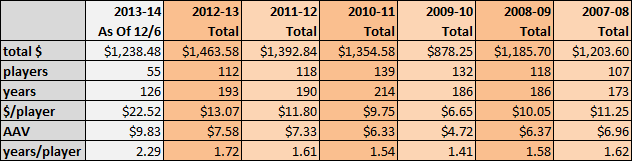
As these numbers show, the league is well on its way to shattering previous high free agent spending totals: current commitments are already just under 85% of last year's sum, but we have probably seen less than half of the MLB deals that ultimately will be signed. Indeed, at last look, only half of MLBTR's top fifty free agents have reached agreement so far.
Of course, the rate figures presented in the table will probably drop as the Robinson Cano and Jacoby Ellsbury deals are balanced out by smaller, shorter contracts. And it is doubtful that the other half of the market will command as much as the first half has. Indeed, as the table shows, the total number of years guaranteed through free agency has been fairly uniform. If that is any indication, teams may not be handing out all that many more multiyear deals, having already signed up to pay for 126 years to date; over 60% of the deals signed thus far have been for multiple seasons, an unsustainable level.
If we do a more apples-to-apples comparison, the multiyear deals we've seen thus far are also coming in above historical levels. Again, we might expect some regression here, but the initial returns are interesting to look at. Compared only to multiyear deals signed in past seasons, here is where the rates presently stand:

As this chart hints, there are some interesting similarities so far between this signing season and the 2007-08 period, which came before the global economic downturn. But that will have to remain a topic for another day. For now, while it is still too early to know where things will fall out, the total commitments per player and AAV numbers will be worth watching over the rest of the signing season.
And it is probably not too early to say that, at this point, it would be a considerable surprise not to see a sizeable jump in overall free agent spending levels when we ultimately look back on this signing season.
MLBPA Names Dave Winfield Special Assistant To Tony Clark
Two days ago, the Major League Baseball Players Association named former big league first baseman Tony Clark its new executive director following the tragic passing of former executive director Michael Weiner. Today, the MLBPA announced, in a second press release, that Hall of Famer Dave Winfield has been hired as a special assistant to Clark. Clark offered the following statement on his new colleague:
"It is an honor to welcome Dave Winfield to the MLBPA staff. Dave’s passion and dedication to the game and the cause of players is legendary among the brotherhood of players. His prominence and reputation inside and outside the game will serve all players – past, present and future – well."
Winfield himself offered his own thoughts on his new role:
"As a former union leader, I’m thrilled to be joining the ranks of the most accomplished and respected sports union in the country to help provide a generational link and historical perspective to today’s players. I have participated in nearly every aspect of the game, and I look forward to putting that experience to good use in support of Tony Clark and various MLBPA activities and initiatives."
During his playing days, Winfield spent 15 years as a player representative for the union. He then went on to serve as a founding member of the adivsory board of the Major League Baseball Players Trust following his retirement from the game. He's also served as a senior advisor in the Padres' front office. Winfield was a first-ballot Hall of Famer in 2001 after a career that saw him post a .283/.353/.475 batting line with 465 home runs, 223 stolen bases, 1833 RBIs and 1669 runs scored in a 22-year Major League career.
43 Players Non-Tendered
43 players joined the free agent ranks today after being non-tendered Monday by their respective teams. MLBTR's Non-Tender tracker has the full list, which includes J.P. Arencibia, John Axford, Andrew Bailey, Ronald Belisario, Chris Coghlan, Chris Getz, Tommy Hanson, Jeremy Hefner, Daniel Hudson, Jayson Nix, Xavier Paul, Omar Quintanilla, Sandy Rosario, Ryan Webb, Jerome Williams, and Wesley Wright.
All those with at least 50 plate appearances or 20 innings pitched in the Majors last year have been added to MLBTR's free agent list and tracker. For a look at the players who have avoided arbitration so far, check out our arbitration tracker.
Explaining Non-Tenders And Tonight’s Deadline
The free agent market has shrunk over the past few weeks, with names ranging from Brian McCann to Brayan Pena coming off the board (MLBTR's Free Agent Tracker can be used to see all of the action to this point). However, the free agent class figures to grow substantially today, as 11:00pm CT marks the deadline for teams to tender contracts to arbitration eligible players.
That, of course, means that it is also the deadline for teams to non-tender players that they feel are set to become too expensive via the arbitration process. As MLBTR's Charlie Wilmoth pointed out last night, John Axford is a prime example of a non-tender candidate. The former closer projects to earn roughly $5MM in 2014. The Cardinals could feel that's too steep a price to pay for a pitcher who won't close for their club, especially considering the wealth of relief options they have available.
A player's first trip through the arbitration process is usually fairly inexpensive (and the ones that are expensive are typically worth the price), but upon reaching arbitration for the second, third and fourth times, prices can begin to make teams uncomfortable. By non-tendering a player, the team is allowing him to become a free agent. It's certainly not unheard of for a player to be non-tendered and re-sign with his former club, however, as was the case with Jeff Karstens and Geovany Soto last year.
Players may also be non-tendered for injury concerns or due to the fact that a team simply feels it has a surplus at a position and doesn't want to commit a 40-man roster spot to a potentially superfluous player. Also, players who are not yet arbitration eligible can be non-tendered.
While many non-tendered players are borderline Major Leaguers that don't go on to have meaningful careers, there are others who provide large boosts to their new clubs. Nate Schierholtz and Manny Parra are two examples from last year's crop of non-tenders that thrived in new settings. Should a non-tendered player sign with a new team, that team secures control of his remaining arbitration seasons until free agency. For example, Schierholtz had four-plus years of service time last offseason and now has five years, 78 days, so the Cubs control him through arbitration this offseason before he accumulates six years of service time and hits the open market next winter.
The non-tender deadline also means that many players will simply avoid arbitration with their clubs today. We're still quite a ways from the deadline to do so, but several players have already avoided arb and a few more figure to see their 2014 contracts agreed upon and locked into place today.
Of course, we'll be keeping track of all the non-tender action here at MLBTR today. I'll be keeping track of non-tenders in a pair of posts (one for the American League, one for the National League), and you can follow along using MLBTR's Non-Tender Tracker as well. Also of use today could be MLBTR's Arbitration Tracker. First and foremost, though, is MLBTR's list of non-tender candidates, which includes most of the names to watch with regard to tonight's deadline.
MLB And MLBPA Release 2013 Report On PED Testing
Yesterday, MLB and the MLB Player's Association released the 2013 public report on the Joint Drug Prevention and Treatment Program (commonly referred to as the JDA). The report was compiled by Dr. Jeffrey M. Anderson, the Independent Program Administrator.
The report addresses drug testing over the period between the start of the 2012-13 off-season and the end of the 2013 post-season. A total of 5,391 drug tests were conducted, 4,022 of which were urine samples analyzed for PEDs and/or stimulants. The remaining 1,369 instances were blood samples tested for human growth hormone (hGH).
Of the samples analyzed, eight resulted in "an adverse analytical finding that resulted in discipline," all of which were for the stimulants Adderall or Methylhexaneamine. The report also notes thirteen "non-analytical positives" that resulted in discipline. In addition, the league granted 122 therapeutic use exemptions, the vast majority of which were for Attention Deficit Disorder.
Comparison to last year's report shows marginal increases in overall testing numbers. In 2012, there were 5,136 samples taken, 3,955 of which were urine tests and 1,181 of which were for blood. That means that, along with 67 more of the former, there were an additional 188 instances of blood testing this time around. Therapeutic use exemptions remained relatively constant. The most interesting fact, perhaps, is that no positive PED tests were identified, down from seven last year. Instead, this time around, we saw the thirteen suspensions based upon Biogenesis-related investigation rather than testing.
Of course, the JDA provides careful parameters for testing. Every player is subject to a urine test upon reporting to Spring Training and is subject to an additional random urine test at some point between the commencement of Spring Training and the end of the championship season (i.e., the conclusion of the regular season). The JDA allows 1,400 additional random tests, 200 of which were allowed to be performed during the off-season in the 2012-13 testing period. As for blood testing for hGH, every player must provide a sample at an unannounced point during Spring Training and a sample can also be taken in conjunction with an off-season urine test. The JDA also provides for further testing based upon reasonable cause as well as follow-up testing for disciplined players.
In large part, of course, the figures released yesterday confirm that the testing program took the form that the JDA contemplated. Last year, about 4.5 tests were performed for each of MLB's 1,200 available roster spots. (Of course, roster spots aren't always all full, and a good number of players cycle through them in a given season.)
But a good portion of the testing is not truly unpredictable, as it takes place at the start of or during the six-week Spring Training period. Assuming that the MLB testing figures reflect a relatively low number of reasonable cause and follow-up tests, something in the vicinity of 3,000 tests were essentially random. With about 320 non-Spring Training days on which those tests could theoretically have fallen, and 1,200 MLB roster spots available on a given day, the percentage of "player-days" that see some kind of surprise PED test is a comfortable bit less than 1%.
Depending upon how baseball plans to implement and report its in-season hGH testing program, those testing rates stand to remain essentially constant through the life of the current JDA, which expires on December 1, 2016. So, is that sufficient, at least for the time being?
As MLB COO Rob Manfred has explained, the frequency and randomness of testing is critical. Discussing minor league testing back in 2010, he said:
"We not only incrased the number of tests conducted this year in the [Dominican Republic], but significantly altered the pattern of testing. And, whenever we do that, we get a spike. Major League, Minor League, in the DR, whenever we change the pattern so that it's not predictable, we get a spike."
These old-but-illuminating comments are especially interesting in light of the fact that the testing system registered no PED hits this season after logging seven in 2012. It would seem naive to assume that the shift reflects a sudden and drastic reduction in PED use. But if it instead constitutes a step back for testing efficacy, what is the solution? Unless a numerical increase in tests can be negotiated, Manfred's past statement indicates that the league may need to get creative with its process to ensure that baseball's PED testing protocol adequately supports its disincentive system.
Managers And GMs Entering Their Contract Years
The 2014 season will be a big one for some of these managers and general managers entering the final years of their current contracts. For a few, it's just a matter of time until they get extensions; for others, 2014 is their last chance to prove they belong in their current jobs. This post may not include every eligible skipper or GM, as some clubs don't make management contract terms available to the public. Thanks to the invaluable Cot's Baseball Contracts for providing many of the contract details.
* Angels. There were rumors throughout the summer that GM Jerry Dipoto or manager Mike Scioscia could be fired given the Halos' underachieving performance in both 2012 and 2013, but both men will be back in 2014. Scioscia, of course, is under contract through 2018 but Dipoto is entering the last guaranteed year of his deal. The Angels have options for both 2015 and 2016 on Dipoto's services, though if the team doesn't contend this season, it seems very likely that Dipoto won't be retained.
* Mariners. GM Jack Zduriencik had his contract extended through the 2014 season, a move that angered some Seattle fans given the club's run of four consecutive losing seasons. The team's pursuit of free agent sluggers has been described as "desperate" by some industry sources, which is a long-term danger for a team being led by a general manager who is only focused on his short-term job security. Zduriencik will be judged harshly if he doesn't obtain a top hitter, but the Mariners simply need to top (or at least approach) the .500 mark for Zduriencik to have any chance to continuing in his current role. The recent retirement of Mariners president and COO Chuck Armstrong also hints at larger changes coming to the franchise's management structure.
* Astros. GM Jeff Luhnow and manager Bo Porter both signed multiyear deals when they were respectively hired after the 2011 and 2012 seasons, and those deals could almost be up since the lengths of the contracts aren't known. It's almost impossible to believe that the club would abandon its vaunted long-term rebuilding plan by letting Luhnow go, of course, and ditching Porter after two years would also seem like an odd move. Wins and losses won't dictate Porter's fate, as he'll be judged by how the Astros' young talent continues to develop at the Major League level.
* Rangers. Ron Washington is entering his last year under contract but GM Jon Daniels wants to keep his manager in the fold beyond 2014. Washington has previously signed a pair of two-year extensions with Texas, though those deals weren't signed until Washingon had already completed his final season. It's possible the Rangers could again wait to extend their skipper, and despite Daniels' comments, the club might consider a change if it again fails to make a significant postseason run. Then again, the "wait-and-see" strategy with Washington in the past could have been inspired by former club president Nolan Ryan, and with Ryan gone and Daniels now with more power in the organization, the Rangers may not wait to extend Washington.
* White Sox. Speaking of "wait-and-see," Robin Ventura took that same tack himself when he turned down a contract extension during Spring Training. The Pale Hose manager wants to complete his original three-year deal before discussing his future with the team, though Ventura says he's eager to return. Another 99-loss season, of course, will likely inspire GM Rick Hahn to make a change in the dugout.
* Indians. This is another situation where details are murky, as GM Chris Antonetti is known to have had his contract extended beyond his original five-year deal with the Tribe that ran out in 2012. His extension could possibly be up this season, though the odds are Antonetti was locked up for more than just two extra years. In any case, it's a moot point since Cleveland's playoff appearance last season has certainly given Antonetti more job security.
* Royals. GM Dayton Moore is entering the final year of his contract and he could be an extension candidate this winter given that the club is coming off its first winning season of Moore's tenure. The Royals have long been aiming to become legitimate contenders in 2014, so it's possible upper management will see what Moore does this offseason and perhaps what the team does over its first couple of months before locking the general manager up to a new deal. There's quite a bit of pressure on Moore this season since another dip below the .500 mark could cost him his job.
* Twins. Terry Ryan's contract specifics aren't known, the Minnesota GM has been rumored to have virtually unlimited job security. You'd wonder if another 66-96 season would test that security, as the Twins have posted identical losing records in the two full seasons since Ryan returned as the club's general manager. Given the strong state of the Twins' minor league system, I'd guess that Ryan will be given more time (if he even is a contractual lame duck) to rebuild the franchise even if the Major League team isn't doing well, though the signing of Ricky Nolasco is a sure indicator that Ryan wants better results.
* Blue Jays. There was speculation that John Gibbons would be fired even before the midway point of the Jays' disappointing 2013 campaign, and while he's still in charge in Toronto, another poor season will surely lead the team to decline their 2015 option for the manager. GM Alex Anthopoulos' contract status isn't confirmed but he's rumored to be locked up beyond 2014 — if not, however, he could also be facing some heat if the Jays don't contend.
* Red Sox. Ben Cherington is another GM whose contract tenure isn't known, though in the wake of a World Series title, Boston isn't going to let him go anywhere.
* Yankees. Brian Cashman is entering one of the most important offseasons of his tenure as New York's general manager, and the fact that Cashman is entering the last year of his deal only adds to the pressure. Brian McCann is the first major signing of what should be a busy winter for the Yankees, though if Cashman's additions don't get the Yankees back into the playoffs, his job will be in serious jeopardy.
* Braves. Both manager Fredi Gonzalez and GM Frank Wren are entering the final year of their contracts. Consecutive playoff appearances bode well for one or the both of them to receive contract extensions before Opening Day.
* Mets. Sandy Alderson is facing pressure to upgrade the Mets lineup this offseason, though any hopes of contending in 2014 probably went down the drain thanks to Matt Harvey's Tommy John surgery. The Mets hold an option on Alderson for 2015 that I'd expect them to exercise (perhaps as soon as this winter) given his reputation in baseball, though adding a big bat or two would certainly cement Alderson's case.
* Pirates. The club holds options on both manager Clint Hurdle and GM Neal Huntington for 2015, which will surely be exercised in the wake of Pittsburgh's breakthrough playoff season. You can probably expect discussions about longer-term deals for both men as well this winter.
* Reds. Dusty Baker's firing hints at some impatience in Cincinnati, as the Reds failed to advance past the NLDS in 2010 and 2012, and then lost the NL wild card game last season after spending just under $107MM in payroll (a club record). With one change already made at manager, you wonder if GM Walt Jocketty could also be on the hot seat as he enters the final year of his deal.
* Brewers. Ron Roenicke is contracted through 2014 and the Brew Crew hold an option on their manager for 2015. You could argue that the Brewers' poor record last season was due to factors beyond Roenicke's control (i.e. injuries and the Ryan Braun PED suspension) but the club will definitely need to show some improvement if Roenicke is to continue in Milwaukee.
* Diamondbacks. Kirk Gibson and Kevin Towers share the same contract situation; both the manager and general manager are signed through 2014 with club options for 2015 and 2016, and the D'Backs have reportedly declined to pick up those options. While the options could be exercised at a later date, between that news and the shakeup of Arizona's coaching staff, it appears as if Towers and especially Gibson have little wiggle room. Both men need the Snakes to take a step forward after finishing with consecutive 81-81 records.
* Dodgers. It's been a roller-coaster season for Don Mattingly, who was seemingly on the verge of being fired in June before the Dodgers went on an incredible hot streak to win the NL West and advance to the NLCS. That NLCS appearance triggered a vesting option that gave Mattingly another year under contract for 2014, though the manager has been quite open about his desire for a long-term commitment. While Mattingly and the club are negotiating that extension, expectations are high enough in Los Angeles that Mattingly will need at least another NLCS appearance to keep his job past this season.
MLBTR Apps, Features, Functions
An explanation of the many ways to enjoy MLB Trade Rumors:
- Be sure to pick up the MLBTR apps for the latest news and rumors, for iPads, iPhones, and Android devices.
- If you want only the hard news in the form of transactions, our transactions page is the ticket. You can also get only the transactions via Twitter or RSS.
- To return to the main page at any time, just click on the title or the Home button on the navigation bar below the title.
- The navigation bar will cover many of your needs. Use the About dropdown to learn about this site or any of its writers.
- The Contact button takes you to a page where you can write an email message to the MLBTR writers. If you have a link to a rumor we've missed, please send it in through the Contact page! Also use the Contact page to inquire about advertising on MLBTR.
- The Archives dropdown shows you 15 months worth. If you need to go back further, click on Site Map at the very bottom of the page. Site Map also lists out every MLBTR post category, including players, teams, and features.
- The Tools dropdown takes you to a number of different places. The MLBTR Widget allows website owners to easily add a constantly updated box with all of MLBTR's headlines to their sites.
- Also under the tools tab is our Transaction Tracker, which enables you to search about anything and everything to do with baseball trades, signings and extensions.
- Our DFA Tracker helps you monitor the many players who are designated for assignment throughout the year.
- We also have an Extension Tracker, with details on all contracts that include at least one arbitration year.
- MLBTR's Agency Database lets you know which agencies represent which players. It's searchable by team, agency or player, so be sure to check it out.
- Follow Teams is a very useful dropdown. Hover over it to see all 30 teams. Click on the team name to bring up a page of every post containing information about that team, with the latest on top. These are the same pages you'll find if you go to the Rumors By Team section on the sidebar and select A's Rumors, Angels Rumors, etc.
- Also under the Follow Teams dropdown, you'll find RSS and Twitter buttons. Those links allow you to follow a single team's rumors via RSS or Twitter. Did you know we have a separate Twitter account for each of the 30 teams? For example you can follow @mlbtrtigers, where you would get the latest Tigers updates.
- You can also follow Tim Dierkes on Twitter for more MLBTR content.
- On the far right of the Navigation bar, you'll see buttons for Twitter, Facebook, and RSS. MLBTR has over 301,000 Twitter followers, over 79,000 Facebook fans, and over 61,000 RSS subscribers. Sign up for these and you'll be the first to receive all of our posts.
- Be sure to check out your favorite team's MLBTR page on Facebook so you can receive and comment on the latest rumors.
- On to the sidebar. It begins with a list of our Top Stories, which our writers update any time major hard news occurs. Go here for a quick update on the most important stories. Below that is the site's Search Box, where you can type in any player's name and get the latest on him.
- MLBTR Features has all kinds of goodies, including our free agent lists. Many of the MLBTR Features are constantly updated by our writers, so be assured that our free agent lists are always fresh.
- Below Features you've got headlines for all the Recent Posts, in case you'd rather not scroll to see all the headlines. Then there's a box for our Mailing List, where you can sign up to receive a daily email containing MLBTR's posts. Use this option if you don't need the news as soon as possible.
- Next we have Featured Posts, where you'll find original work from MLBTR writers we consider noteworthy.
- If the main site doesn't load perfectly on your cell phone, try the more mobile-friendly mlbtraderumors.mobi. It's a simple page that shows you just the headlines and lets you click through to what you want to read.
- MLBTR is available on the Kindle as well.
Reactions To The Freese-Bourjos Trade
Now that the dust has settled, let's take a look around at some reactions to today's important deal sending third baseman David Freese and righty Fernando Salas to the Angels in exchange for center fielder Peter Bourjos and outfield prospect Randal Grichuk.
- For a broad account of the deal, including some reactions from participants, see this piece from MLB.com's Jenifer Langosch. Cards' GM John Mozeliak emphasized that the club pulled the trigger to add speed and center field capability, while noting that Grickhuk's inclusion was a "critical" factor in getting the deal done.
- Though Mozeliak said that a veteran second bagger could still be brought in, he also indicated that the club was prepared to rely primarily on Kolten Wong. Meanwhile, top prospect Oscar Taveras could see time in right field and play a bench role, leaving the club with what Mozeliak calls "more flexibility moving forward," reports Derrick Goold of the St. Louis Post-Dispatch (via Sulia).
- While the two sides discussed including shortstop Erick Aybar, writes Goold, the asking price was too steep for Mozeliak to bite. With both the Orioles and now the Angels having dangled a shortstop at St. Louis from a position of strength, and the expected free agent money for the few attractive options going higher by the day, Goold says we are seeing a clear seller's market at the position. His Post-Dispatch colleague Bernie Miklasz says that the Angels were eyeing Shelby Miller, making Mozeliak's refusal understandable.
- Miklasz was among the many who liked this deal for the Cards. As he put it: "Mozeliak did a good job here. It's as simple as that. He received plus value and added youth, speed and defense — and saved payroll – in moving an expendable player in Freese."
- From the Halos' perspective, GM Jerry Dipoto said that his club "feel[s] like we're getting one of the most productive third base bats in baseball over the last three years," tweets the Los Angeles Times' Bill Shaikin. As Shaikin later noted, Freese does rank tenth in composite OPS out of the 21 players with at least 1,000 hot corner plate appearances since 2011. Dipoto also said that Freese "knows how to drive in the important run" and "provides what we think is a more-than-acceptable solution" to the team's third base hole, as MLB.com's Alden Gonzalez reports in his write-up of the deal. Looking back, Mozeliak explained that Freese's magical 2011 run of success raised expectations to an unsustainable point and makes a fresh start a good idea, MLB.com's Gonzalez reports via Twitlonger.
- With relatively little open salary space and a major starting pitching void in Anaheim, Shaikin indicates that this deal carries a lot of risk for Dipoto. Other trade candidates like Mark Trumbo and Howie Kendrick have not sparked interest from other teams that would consider parting with young starting pitching, Shaikin says, and Aybar was not enough (yet, at least) to get St. Louis to budge on one of its prime young arms. Yet by sending out Bourjos, whose low cost, good defense, and fairly high floor would have appealed to a wide range of other clubs, the Angels have parted with a player that could have been a significant piece in a deal for a new arm.
- Even while casting doubt on Bourjos's ability to replicate his 2011 campaign at the dish, ESPN.com's Keith Law (Insider link) likes it for the Cards, though he notes that Freese has enough power upside that the deal could ultimately turn out well for the Halos.
- For Dave Cameron of Fangraphs, who rates Bourjos as at least a three-win player while noting that his career Isolated Slugging mark is higher than that of Freese, the swap is a clear win for St. Louis. His takeaway: "The Angels needed a third baseman, I guess, but they traded a good player for a worse player who costs more."
- MLBTR's Steve Adams nicely summed up the trade: "All told, the Angels are dealing three years of Bourjos and one of their top prospects for two years of Freese and three years of Salas in addition to agreeing to take on roughly $4MM in additional salary in the 2014 season." From that perspective, particularly given that the Cards got the younger players, it is tough not to like it for St. Louis — even if you are relatively high on Freese as a bounceback player and think that Bourjos has a limited ceiling. (For what it's worth, 2014 Steamer projections expect 2.3 WAR for Freese over 535 plate appearances and 2.6 WAR over 493 plate appearances for Bourjos.) It is worth noting that the low likely starting point for Bourjos's arbitration salary, along with his generally meager home run and RBI output, mean that he will very likely be on a lower arbitration salary arc than Freese for the rest of his years of eligibility.
Michael Weiner Passes Away
MLBPA executive director Michael Weiner has died of brain cancer, Diamondbacks pitcher Brad Ziegler tweets. Weiner was 51.
Weiner joined the union staff as a lawyer in 1988 and replaced Don Fehr as its executive director in 2009. In 2011, Weiner led the union to agree to the Collective Bargaining Agreement that currently governs Major League Baseball. Weiner will likely be remembered in part for paving the way for punishments for the use of PEDs throughout the game. But he also helped negotiate the addition of a second Wild Card team, the move of the Houston Astros to the American League, the expansion of instant replay, and changes in team compensation for departing free agents.
In August 2012, it was reported that Weiner was being treated for a brain tumor, which turned out to be inoperable. He continued to work despite the diagnosis, keeping a full schedule even during the 2013 season. Weiner is survived by his wife, Diane, and three daughters.
Former MLB first baseman Tony Clark was Weiner's deputy executive director. He will become MLBPA's acting executive director.