
Heyman On Pujols, Reyes, Feliz
SI's Jon Heyman leads his latest column with a discussion of Albert Pujols' impending free agency. Three GMs Heyman spoke to speculate that Pujols will re-sign with the Cardinals after the season. One significant factor could be the lack of involvement from the Yankees and Red Sox, big spenders who already have long-term solutions at first base. A Yankees person told Heyman there was "no chance" of a pursuit, while a Red Sox person agreed that his club is unlikely to get involved. Cardinals GM John Mozeliak didn't have much to say on the topic, other than, "Nothing's changed." On to Heyman's other notes…
- Mozeliak told Heyman the Cardinals "have a pretty good idea" of what they'll do when Adam Wainwright's two-year, $21MM club option comes up after the season. Heyman takes that to mean that the Cardinals will pick up the option, the expected course of action.
- Heyman feels that the Cubs and Orioles could be possibilities for free agent Kevin Millwood, though I heard yesterday that it's doubtful the Cubs get involved.
- One Giants person said, "There's nothing to it," regarding the recent Jose Reyes speculation. Andrew Baggarly of the San Jose Mercury News explained today that "If any conversations have happened at all, it’s nothing more than tire kicking." That makes sense, since trading season begins about two months from now. For a look at who the Giants might have to give up to get Reyes at that point, click here.
- Heyman finds the Rangers likely to move Neftali Feliz into the rotation next year, despite the righty's recent comments. Heyman feels that a strong free agent closer market is a factor.
- The Tigers have decided this will be Joel Zumaya's last year in Detroit, according to Heyman. That was written prior to today's report that Zumaya will have exploratory elbow surgery.
Latest On Dodgers’ Payroll Problems
The Dodgers lack the funds to meet their second May payroll due at month's end, wrote Bill Shaikin of the L.A. Times last night. Last month's $30MM loan from Fox will only carry them through the first May payroll. According to Shaikin, MLB would cover the team's expenses if the Dodgers can't and would have the option to seize the team.
As Shaikin notes, owner Frank McCourt believes MLB has already effectively seized the Dodgers by failing to approve the Fox television contract and appointing Tom Schieffer to be in charge of the team's finances. But this payroll situation could accelerate the MLB-McCourt showdown, says Shaikin. He explains the possibilities:
McCourt [may be forced] to find outside financing to meet the second May payroll, surrender the team or file suit against MLB. It is "very unlikely" that Fox would extend another loan to McCourt, a person familiar with the matter said.
Rangers Sign Leonys Martin
WEDNESDAY: Martin's five-year Major League deal includes a $5MM signing bonus, tweets Anthony Andro of the Fort Worth Star-Telegram. MLB.com's T.R. Sullivan confirms that the deal is official, noting that Martin is likely to start at Double-A. By the way, Martin is represented by Praver/Shapiro.
TUESDAY: The Rangers' contract with Cuban outfielder Leonys Martin is official, tweets Jorge Ebro of El Nuevo Herald. The deal is worth $15.5MM over five years. The Rangers currently have a full 40-man roster, so they'll have to clear a spot for Martin.
Martin, 23, defected from Cuba last year and established residency in Mexico. Back in September, Baseball America's John Manuel wrote that Martin's "best tools are his speed and defense." ESPN's Jorge Arangure Jr. tweeted in March that Martin is "considered an elite prospect." ESPN's Buster Olney talked to three talent evaluators about Martin in April, with one saying he's "similar to Juan Pierre, with a better arm." Another called him a "capable, average major league center fielder," questioning the price paid by Texas.
Braves Acquire Jeff Fiorentino
The Braves acquired outfielder Jeff Fiorentino from the Orioles for cash, reports David O'Brien of the Atlanta Journal-Constitution.
Fiorentino, 28, signed a minor league deal to return to the Orioles in January after spending a year in Japan. The Orioles drafted him in the third round in 2004, and he owns a .270/.341/.324 line in 173 plate appearances. Last year he hit .246/.356/.325 in 151 plate appearances for the Hiroshima Carp. He'll report to Double-A initially, reports O'Brien.
How Much Will Jered Weaver Make Next Year?
Jered Weaver's upcoming arbitration case won't be as groundbreaking as Tim Lincecum's, but Weaver should still continue to set arbitration records. Let's see what's in store for the 28-year-old righty.

The Impact Of Losing A Hearing
Weaver will be arbitration eligible for the third time after this season, and most consider him the first and second-time record holder with $4.365MM and $7.365MM salaries. However, that $7.365MM figure was actually the Angels' submission, as Weaver and agent Scott Boras filed at $8.8MM and lost the February hearing.
Aside from setting Weaver back $1.435MM, losing the case might have minimal impact on his 2012 salary. The focus should still be on Weaver's 2011 season and his career numbers, both of which should be better than they were at the hearing if the pitcher's first seven starts are any indication. Scott Boras is not generally one to back down from an arbitration hearing, so another one is possible unless Weaver is opposed.
The Raise Argument
One agent explained the general strategy each side takes in an arbitration hearing: "Owners always make the raise argument, whereas the union always concentrates on comparable players and numbers notwithstanding what “raise” a player is getting. The teams have been somewhat successful with their raise arguments in some cases."
The raise argument for Weaver starts with Carlos Zambrano's $5.9MM increase in 2007. Since Weaver is expected to have better career and platform numbers than Zambrano did, a bigger raise is appropriate – maybe $2MM more, putting him over $15MM. There's also the current class factor – if John Danks and Matt Garza settle before Weaver, each side can try to spin those pitchers' raises into arguments about what Weaver should earn.
Boras could be compelled to shoot for the moon with Weaver, if for example he wins a Cy Young award. Boras could eschew the Zambrano/Danks/Garza comparables, instead making the argument that there is no pitcher comparable to Weaver who went this far in arbitration going year to year. That could open the door to A.J. Burnett/John Lackey comparisons, allowing Boras to argue for something around $16.5MM. That's probably the ceiling.
The Extension Possibility
Surprisingly, one agent predicted Weaver will sign an extension with the Angels. We haven't seen many high-profile Boras clients take that route one year away from a free agent payday, and the Angels aren't on the best of terms with Boras. Plus, Weaver attended the February hearing, and there's no telling how that affected him. On the other hand, Weaver is a California guy and the Angels have minimal commitments beyond Vernon Wells in 2013 and beyond. In recent memory, the only Boras client who chose not to explore free agency with one year remaining was Ryan Madson.
In an email discussion, members of the MLBTR writing team pointed out that Weaver will turn 30 in October of 2012, meaning he will be older than C.C. Sabathia, Barry Zito, and Johan Santana were when they signed huge extensions. Nonetheless, we all see $20MM+ per year as likely, even if the term only covers six free agent seasons. The MLBTR writing team believes Weaver could land something like a six-year, $140-150MM deal on the open market after '12. If Weaver were to sign an extension before the '12 season, I don't imagine much of a discount, though perhaps he'd give up his last arbitration year for $12MM or so instead of battling for every last dollar in that season.
The Bottom Line
When the 2012 season begins, Weaver's name could occupy all three spots in the starting pitcher arbitration record book (some wouldn't count Tim Lincecum's third-year salary, since he didn't go year to year). Weaver will still be a bargain for the Angels next year even if his salary doubles and he lands around $15MM.
Photo courtesy of Icon SMI.
2012 Contract Issues: Houston Astros
The Astros are next in our 2012 Contract Issues series. Here's what the team faces after the 2011 season:
Eligible For Free Agency (2)
- Clint Barmes' Astros career has just begun. He'd like to stay beyond 2011, but the team's willingness to extend him will depend on his performance.
- Jason Michaels is also eligible for free agency.
Contract Options (1)
- Bill Hall: $4MM mutual option with a $250K buyout. Hall has a standard mutual option, which is really just a way for the Astros to push some money onto next year's payroll. He didn't do anything in April to suggest the team should extend him.
Arbitration Eligible (9)
- First time: J.A. Happ, Jeff Fulchino, Alberto Arias, Angel Sanchez
- Second time: Nelson Figueroa
- Third time: Hunter Pence, Michael Bourn, Jeff Keppinger
- Fourth time: Humberto Quintero
Not all of these players will make it to the point of being tendered contracts. Pence and Bourn are the significant cases, assuming they are not traded. Pence had a big arbitration win in February and could make the jump to $10MM in 2012 and well beyond that in '13. Bourn is controlled through '12 and is represented by Scott Boras; his salary next year could exceed $7MM. Happ could top $3MM and Keppinger is already above $2MM. I'll estimate $24MM or so to retain the key players.
2012 Payroll Obligation
The Astros' 2012 payroll obligation, according to Cot's, is $47.25MM. That could climb to $71MM if the main arbitration eligibles are retained, which would be about $6MM below this year's reduced payroll. If Jim Crane buys the team, what path will he take? The new ownership group could purge more of the remaining veterans and build the team from the ground up, using 2012 as a consolidation year (after which Carlos Lee and Brandon Lyon will be off the books). Or, assuming players such as Pence, Bourn, Brett Myers, and Wandy Rodriguez are not traded in July, a new owner could throw around some free agent dollars and try to find a way to compete in '12.
Building The 2011 Indians
Much to the surprise of everyone outside of Ohio and, let’s face it, a good number of people who reside in the Buckeye State, it’s May and the Indians are still in first place. Predictably, many are asking whether the Indians will eventually give way to the White Sox or the Tigers and sink to the bottom of the AL Central standings. Here’s an equally relevant question: how did the Indians assemble the team that has posted the best record and run differential in baseball so far in 2011?
The answer, to a considerable degree, is ‘trades.’ The Indians’ closer (Chris Perez), three fifths of their Opening Day rotation (Justin Masterson, Carlos Carrasco, Mitch Talbot) and seven of their nine everyday players (Carlos Santana, pictured, Matt LaPorta, Asdrubal Cabrera, Michael Brantley, Grady Sizemore, Shin-Soo Choo and Travis Hafner) were all originally acquired in trades. Though he acknowledges that the Indians have built through deals (some of them enormously successful), GM Chris Antonetti says trades are just one avenue the front office considers.
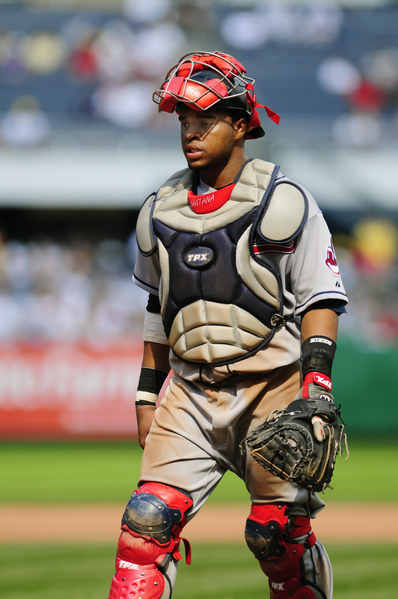
"We’re not wed to that approach,” Antonetti told MLBTR. “Our current roster composition largely reflects value judgments we made at the time we were presented with trading opportunities. In a number of instances, we had a player approaching the end of his contract and we determined that it was better for the organization to trade for more established prospects rather than take the draft picks in return."
Players like C.C. Sabathia and Victor Martinez don’t often appear on the trade market, so Antonetti and GM-turned-team president Mark Shapiro were able to obtain future difference makers such as LaPorta, Brantley and Masterson in summer trades for their stars.
The Indians didn’t want to trade Sabathia in 2008 – what team would? – but they faced the reality that they were struggling. Instead of waiting and obtaining draft picks after losing the left-hander to free agency, they decided to send him to Milwaukee. Trades, the Indians determined, could help them turn the team around more quickly.
"We knew to do it solely through the draft takes a long time and it’s an uncertain course, because you’re dealing with players that are so far away from the Major Leagues,” Antonetti said. “By the time drafted players progress through the development system, establish themselves as Major League players, then take that step to become productive Major League players, there’s a very long lead time in that and there’s also a very high attrition rate."
The Indians knew this from experience. After winning the AL Central six times in seven years from 1995-2001, they rebuilt. A mere four years later, they won 93 games and made an extended playoff bid thanks, in large part, to the haul they obtained from the Expos in the Bartolo Colon trade (Lee, Sizemore and Brandon Phillips).
By trading for players who had already developed in the minor leagues, the Indians accelerated a return to relevance which culminated in 2007, when they made it to within a game of the World Series. However, it would be nearly impossible to repeat the Colon trade, especially considering the human element involved in all deals.
“In the end it’s still very much an art, far more than it is a science,” Antonetti said. “We’re ultimately talking about future human performance and that’s certainly something that’s very difficult to predict."
Antonetti isn’t making predictions for the 2011 Indians, yet it’s clear that they’re further along than expected. Summer trades don’t typically pick up until June at the earliest, at which point the Indians front office will evaluate the club and determine whether it’s time to become buyers, rather than sellers.
“We’re encouraged by our start and remain confident that we have a talented team,” Antonetti said. “Obviously, the more games we play, the more information we’ll have on where we stand in the division."
It’s also possible that Cleveland’s reinforcements will continue to come from the minor leagues. Alex White arrived in the majors last weekend and contributed instantly. Other top prospects, such as Lonnie Chisenhall and Jason Kipnis, could tempt Indians brass if their strong play continues.
“As needs arise, we’ll first look internally and if we don’t feel we have a suitable replacement or fortification internally, then we’ll look externally to improve the team.” Antonetti said.
It may seem unlikely that Indians will make a major acquisition this summer, but it wouldn’t be the first time they’ve surprised us this year. Plus, they certainly aren’t afraid of making a trade or two.
Photo courtesy Icon SMI.
Giants Have Discussed Jose Reyes
The Giants have discussed Jose Reyes as a possible trade target, according to Mychael Urban of CSNBayArea.com. San Francisco is considering addressing its shortstop problems with a trade and Urban hears that the Mets have decided to field offers for Reyes and his $11MM salary this summer.
Miguel Tejada struggled at short and at the plate before the Giants moved him to third base, where he’ll cover for the injured Pablo Sandoval and Mark DeRosa. Mike Fontenot is now starting at short for the Giants, so Reyes would represent a definitive upgrade.
Tim Dierkes analyzed the Giants-Reyes connection earlier today, suggesting which players the Mets might target and which players the Giants should hold onto. It's not surprising that the Giants have discussed Reyes – fans and media members have also wondered if he'd be a fit in San Francisco – and it doesn't mean he's available now or that the Giants would meet the Mets' asking price.
Urban hears that Reyes could look to match Carl Crawford’s seven-year, $142MM deal when he hits free agency this winter. The 27-year-old shortstop has two hits and two walks against the Giants tonight, for what it's worth.
Quick Hits: Phillies, Mariners, Twins, Belt
Six years ago today, Robinson Cano made his MLB debut. Since then, all he's done is hit .309/.346/.493, make two All-Star teams, club 124 home runs and help the Yankees win another World Series. Here are today's links, as Cano and the Yankees take on the Tigers…
- As Paul Hagen of the Philadelphia Daily News explains, the Phillies' roster now has far more Latin American players than it did two-plus decades ago, when current third base coach Juan Samuel was still playing.
- Mariners president Chuck Armstrong told Peter Gammons of MLB.com that the M's have no intention of trading the defending Cy Young winner. "It's ridiculous when people talk about our trading Felix," Armstrong said. "We have Felix [Hernandez] and [Michael] Pineda for five years. Why would we move either one?"
- As Yahoo's Jeff Passan explains, the 9-18 Twins could use former teammate Mike Redmond and his… unconventional way of busting out of slumps.
- Giants manager Bruce Bochy acknowledged that he and GM Brian Sabean have discussed promoting Brandon Belt back to the Major Leagues, according to Andrew Baggarly of the San Jose Mercury News.
Minor Deals: Halsey, Cintron
We'll keep track of the day's minor league deals right here:
- The Yankees have signed left-hander Brad Halsey to a minor league contract, according to the AP (via the Washington Post). Halsey began his MLB career with the Yankees, who drafted him in 2002, but he hasn't appeared in a big league game since 2006. The 30-year-old has a 4.84 ERA with 5.0 K/9 and 3.1 BB/9 in 286 1/3 career innings for the Yankees, Diamondbacks and Athletics.
- The Padres signed Alex Cintron to a minor league deal, according to Jon Heyman of SI.com (on Twitter). Cintron, 32, last appeared in the big leagues as a member of the 2009 Nationals. The nine-year veteran has a .275/.313/.394 line and experience at every infield position. He played for the Mets' Triple-A affiliate last year.