
In two years, Chase Headley has gone from an MVP candidate to an afterthought, regressing from .286/.376/.498 in 2012 to .250/.347/.400 in 2013 to .238/.315/.363 this season. In July, Headley finally left San Diego behind, heading to the Yankees for infielder Yangervis Solarte and pitching prospect Rafael De Paula. Solarte is a solid, cost-controlled player, and De Paula a reasonable pitching prospect, but the return the Padres got when they traded Headley shows that his value isn’t nearly what it once was — the Yankees had signed Solarte to a minor league deal just months earlier.
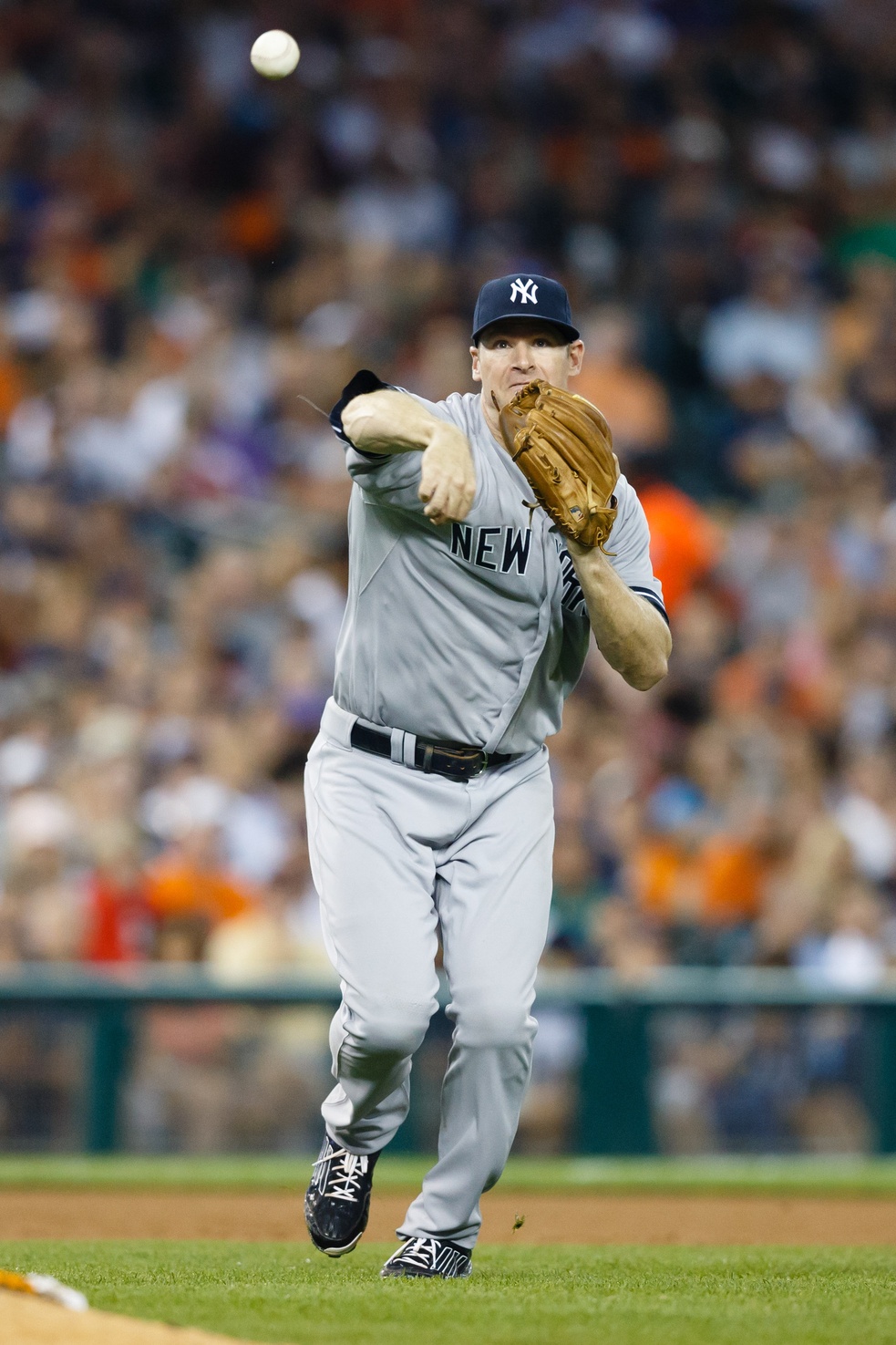 Still, Headley is an important free agent, and he and his representation at Excel Sports Management might be able to negotiate a surprisingly good contract, given a number of factors that will be in their favor this offseason. Even when Headley struggles to hit, he provides good value thanks to his glove at third base, which routinely ranks among the best at his position. UZR rates Headley as about 43 runs above average at third over his career, including 16.2 runs above average this year. Due to his defensive chops and the tough offensive environment in San Diego, Headley has always posted strong fWAR numbers, rating as 3.5 wins above replacement in 2013 and 3.2 this season. His 2014 fWAR puts him in the same neighborhood as players like Evan Longoria, Edwin Encarnacion and Nelson Cruz, even in a season in which Headley is perceived as being a disappointment.
On top of that, Headley, like many other free agents, will have the benefit of a weak free agent hitting class. Headley, Pablo Sandoval and possibly Aramis Ramirez (who has a mutual option) will top a fairly good group of third basemen, with the possibility that Hanley Ramirez could market himself as a third baseman as well. Elsewhere, Cruz, Russell Martin and Melky Cabrera headline a class of hitters so weak that the Red Sox, for example, already appear to have tried to remake their 2015 offense by doing their shopping during the season (acquiring Rusney Castillo, Yoenis Cespedes and Allen Craig) rather than waiting until it’s over. Any team trying to improve its collection of position players will have a rough time this offseason.
That Headley did not sign a pre-free agency extension with the Padres could also work in his favor. Early-career extensions have enabled many ballplayers to mitigate risk and make millions early in their careers, but Headley and the Padres never agreed on one, perhaps in part because he was already into his arbitration seasons by the time he broke out in 2012. As a result, he’ll hit free agency as a 30-year-old. With free agents getting older and older, a young-ish free agent like Headley should be able to do relatively well. That’s not to say he’s low-risk — Shin-Soo Choo and Brian McCann were around the age Headley is now when they signed free agent contracts last offseason, and one year in, neither of those deals look good. But all things considered, it’s better to sign a 30-year-old than a 34-year-old.
Both Ramirezes — Aramis and Hanley — have had trouble staying healthy, and Aramis’ advanced age suggests that’s not likely to change. Sandoval has been more durable, but given his physique, that might not continue. Headley, meanwhile, has had his own health issues, with a broken thumb, calf strain and a herniated disc in his back included in his list of medical troubles the past couple years. He’s generally been able to stay on the field and provide value despite them, however.
Headley will also have an edge on his third base free agent competition in that the Yankees will not be able to extend a qualifying offer, since they traded for him this season. Sandoval and both Ramirezes will be eligible for qualifying offers (depending on the results of Aramis’ mutual option), and the markets for any of those players would be diminished somewhat if they declined them. Sandoval and Hanley Ramirez are somewhere near that awkward point where they’re clearly worth qualifying offers but not worth so much that qualifying offers won’t harm their value. For a Robinson Cano-type player, the qualifying offer is little more than a blip on the radar, but there isn’t anyone in this winter’s entire class of free agent hitters for whom that’s the case.
Sandoval and Hanley Ramirez are too good for the qualifying offer purgatory Kendrys Morales and Stephen Drew endured last year, but there will likely be teams for whom Headley’s lack of qualifying offer issues will make him a strong alternative. And, of course, there’s no guarantee that Sandoval will be on the market at all — the Giants signed Hunter Pence to an extension near the end of last season, and it’s not out of the realm of possibility that they could do the same with Sandoval.
Headley’s combination of defensive skill and relative youth, perhaps along with the perception that he still has offensive upside (his .286/.376/.498 2012 season in PETCO Park is too recent to be dismissed completely), make him a good bet to receive a contract of two or perhaps three years. It’s also not impossible that he could opt for a one-year deal, hoping to produce at 2012 levels next season before hitting the free agent market again. If the Giants and Brewers fail to retain their current third basemen, Headley could be a possibility for either team. The Tigers or Astros could also make sense.
Photo courtesy of USA Today Sports Images.
I’m hoping a 2 year/$20 million deal in the exclusive negotiating period locks him down. Headley has said he likes New York, he likes the Yankees, that everyone’s been great to him since he arrived. With the uncertainty surrounding A-Rod and Teix, this is a guy that would definitely come in handy to keep around. Headley and Brandon McCarthy are two guys I hope the Yankees are sign before they’re open to open negotiations.
Headley is going to want to start unless the Yanks can find a way to convince A Rod to retire or trade Beltran so A Rod can DH. Then am afraid Headley won’t be coming back.
The Yanks are constructed weird they have two center fielders they have 3 players who are about to become full time dh’s. In my opinion they are going to have to trade Beltran, Gardner.
3 players who are about to become full-time DH’s? A-Rod, Beltran and……? No one is going to want Beltran coming off of this season when he’s essentially a DH and due a good deal amount of money for the next 2 years. And why would they trade Brett Gardner? He is literally their best everyday player right now and if they traded him, who would play left field every day? They don’t have a young prospect coming up through the system and I don’t even know who their back-up is at this point. Zealous Wheeler? The Yankees are not going to trade Gardner to start Wheeler.
And Headley would start at third, with A-Rod and Beltran splitting time at DH and Beltran getting the occasional start in right. Given the fact that A-Rod will be 40 and coming off 2 essentially lost seasons and Teix’s poor health record these last two seasons, I wouldn’t worry too much about finding starts for Headley. That will work itself out. There’s almost no way they all stay healthy at the same time.
Sign Headley and start working ARod out at 1st base. Arod can back up Teix with his inevitable injury and spell Headley at third.
You’re dreaming if you think ARod will be willing to move to first. Honestly, I bet he’ll expect to go back to shortstop with Jeter gone.
There’s no way he’s going back to short. He doesn’t have the range and mobility any more. We’re about 4-6 years past his “shortstop expiration” date. Plus, there’s no way the Yankees will want to have back-to-back seasons with a 40 year old at shortstop. The Yankees gave Brendan Ryan a 2 year contract with an option for a third year, I think, with the main intent being having him as an option for short for the post-Jeter years.
I was being facetious.
Oh, sorry. That doesn’t always translate via text.
I laughed.
Moving A rod to short makes no sense at this point. A rod will be 40 once he comes back. Also Tex at minimum has 2 years left of playing 1st on an everyday bases. That’s why i think it makes sense to trade Gardner for a young 1st baseman so they can develop that first baseman that way when Tex becomes a full time dh they already have a 1st baseman fully developed and ready to go.
Teix is only signed for 2 more seasons so if you estimate he has 2 seasons left as a first baseman, that’s perfect. And it makes no sense to trade a Gold Glove level outfielder with speed and a little bit of power for the easiest spot defensively to fill on the diamond. After Teix leaves, it’s very possible the Yankees will move McCann to first and hopefully top prospect Gary Sanchez (or John Ryan Murphy) will be ready to start at catcher.
Gary Sanchez is more of a catcher than a first baseman. Ellsbury is a better player than Gardner and younger. It makes more sense to me to trade Gardner get a very good young first baseman. Remember Gardner has a very friendly contract.
Again, why move Gardner to fill a hole on a team when doing so would only open another, harder-to-fill hole? First base is a hole that doesn’t even exist yet, for 2 more seasons. Really, to say Ellsbury is a younger player, 11 months younger is really pretty negligible. It’s not like there’s going to be one season where Gardner is going to look like an old man and Ellsbury still looks like a shining All-Star. As for Ellsbury being a better player, this season:
Ells: .281/.340/.429, 14 homers, 66 RBIs, 37/42 SBs, 67 R.
Gardner: .269/.342/.442, 16 homers, 56 RBIs, 19/24 SBs, 81 R.
Remember, for much of the season, Ells was miscast as a no.3 hitter and Gardner batted lead-off so that provided Ells with more opportunities to drive runs in and Gardner, with more opportunities to score runs. It wasn’t until Gardner had to miss a few days that Ells was returned to his customary lead-off spot. I’m telling you this season Gardner was the Yankees best everyday player and last season, he was their second best everyday player behind only Robinson Cano, who, no disrespect to Gardner, has a much higher talent ceiling. Unless they can get a package of 3-4 top 100 prospects, it makes no sense to deal him.
3-4 top 100 prospects? Are you sitting on Stanton? Gardener is good, but not that good.
Seller’s market. I’m not saying 3-4 Top 50 prospects but a guy in the #45-50 range plus 2 more in the #75-90 range. Hey, if Ruben Amaro Jr. can ask for Aaron Judge in exchange for the fearsome player that is Marlon Byrd (and a 37 year old Marlon Byrd, as opposed to the 31 year old Gardner, mind you), why shouldn’t the Yankees ask for a lot for their best position player? You don’t think a contender like the Mariners would rather have Gardener starting for them rather than Dustin Ackley or Michael Saunders? Or the Royals, rather than Norichika Aoki? And yes, I know it’s a moot point since Gardner couldn’t be added to a team’s play-off roster for this season but as some else pointed out, Gardner is signed to a team friendly deal and the Yankees don’t have any reason to WANT to move him. This is all hypothetical so it’s not worth getting worked up over but why should the Yankees even hypothetically entertain giving him away for less than that?
They already have several likely 1B prospects. Teix isn’t locked up for much longer, and it’s not like he is becoming a dh next year. His bigger problems have been batting, not injuries from fielding.
He also expects to be made captain and for Thurman Munson’s locker to be installed back into the clubhouse for his cleats.
He’s got 65 million reasons.
Murphy’s Law would say that if you sign Headley to a 2 year/$20MM deal with that mindset, then A-Rod and Teixeira would both play 162 games for both seasons. That would happen if I was the Yankees GM, at least.
I think your odds of being struck by lightning, 3 times, in a calendar year, are better than the odds of A-Rod playing 162 games last season. In fact, I guarantee that Girardi, who makes sure that his 31 year old left fielder Brett Gardner gets a day off every two or 3 weeks or so, makes sure that 40 year old A-Rod gets a day or two off per week. That’s taking into account the .0000001% chance that A-Rod doesn’t go on the DL for an extended period or they may just give him his $60 million and say, “Go away”.
Why would Headly come back an play part time on a team that lets face it has 2 more years of lackluster baseball. When he can go to teams like the Giant’s, Dodgers, Angels play everyday and have a chance to compete?
2013, the Yankees were forced to play Options C and D at multiple every day positions for just about all of the season. You can’t really say those were the “Yankees” that Girardi was trotting out there every day. When you’re starting players that other teams just cut, in exchange for no compensation, for roster space, how good of results can you expect? Players don’t only take “chance of winning” in account when signing a contract. Chase Utley knew he had opportunities to win another World Series if he would accept a deal to another team (and who knows, if he had gone to the Yankees, they might still be in it but that’s neither here nor there) but he chose to stay in Philly because he’s comfortable there. Headley has said he likes New York. Doesn’t mean he will necessarily sign there but it also doesn’t necessarily mean that he will sign somewhere else either.
Brian Mccann, Tex, Beltran.
There hasn’t been any problems with Brian McCann’s catching. He’s had a few issues with “concussion like symptoms” but I think that’s true of every single catcher in the majors. His issue has been hitting so there’s no logic in moving him to a position where that’s ALL he would do.
I give Brian, 3 more years of catching before his knees start to bother him. That’s the problem with the Yanks, for them it’s all about home runs, manufacture runs a different way.
I don’t think that’s the case any more. Power wasn’t the main factor that drove the Yankees to sign Jacoby Ellsbury and trade for Martin Prado and Chase Headley. Power was just one part of the equation that attracted them to Brian McCann–his ability to handle a staff was also a big part of it. And Beltran was brought in because they had to add a little more power after they lost Robinson Cano to the Mariners. If they were valuing power above all else, they might have matched that insane offer the Mariners made Cano.
Touchy on that. It’s insane know but look at what Cano was able to do with the M’s.
“but look at what Cano was able to do with the M’s.”
Which shouldn’t come to much surprise, nor would it come as a surprise to see him be at best maybe an average hitter in the latter years of his deal when he’s still making $24 million per.
Yankee fans need to stop being sore about it. Not everyone cares about pinstripes pride honor or becoming a Yankee legend. Bottom line if the season ended today he’d be in the playoffs the Yank’s wouldn’t be.
And how does what I said express soreness? All I said was him having a great year should come as no surprise.
About what? Cano’s contract? Not sore about it–many of us were extremely grateful the Yankees didn’t match the Mariners’ offer. Nobody doubts he’s going to be a great player for the next 3, 4 years but years 7-10? $20+ million for that? No thank you. We’re already going through a certain degree of buyer’s remorse with CC, Teix and Beltran. Why set the team up for more of that?
No worries Mr Armstrong has a tv deal coming up that will bring in 360 million.
Ok so who is younger Gardner or Ellsbury?
Ellsbury, by not quite a full year. Roughly, 11 months.
Headley wants a 4+ year contract. He’s not going to take 2 yrs 20 mill after turning down a 3 yr 33-39 deal from the padres. Headley will want 4 years at 12-13 mill per. He knows the Yankees can pay him and need his glove.
He is going to want to start and lot’s of teams could use a 3rd baseman like him.
Headley is not getting 4 years at 12-13mil per. He’s only had 1 good season. And if any team does give him that, it won’t take long for them to regret it.
Truthfully if I were Headley, I’d sign a 1 year contract somewhere to re-build value (similar to Nelson Cruz).
Yankee Stadium would help build value for his offense, but as log as he stays away from Petco or Seattle he should be ok on a 1 year deal.
“Headley wants a 4+ year contract”
Source?
Look how much Omar Infante went for.
He’s a better player than Infante
Okay but they play 2 different positions.
Look at there numbers closely Infante is 32, Headly is 30. Headly has a lifetime batting average of 261, compared to Infante, 277. Headly’s lifetime rbi’s are 413, Infante, 480. Omar Infante is making $7 million per year. Headly is making $10.525 million. Headly is going to be asking for more than $10 million.
Right, but again, what does Infante’s contract have to do with what Headley Wants? You, nor I, nor anyone here knows what he wants
He went for 30,25, what makes anyone think that Healdy will take a pay cut just to go back to a lackluster team? When he can go back to the west coast and play with better teams in the Dodgers, Giant’s, Angles. Oh right because the pin stripes.
Okay, now I know for sure you, like usual, are just posting nothing but anti-Yankee posts. No one said anywhere that he should go back to the Yankees
Also, Infante was coming off a very good season, Headley thusfar has not had a good season, so you expect him to get a great contract suddenly?
Again, I have absolutely No clue why you’re comparing the 2.
I am a proud Dodgers fan so I don’t care how the Yankees are. At least both of my teams in the Dodgers and Broncos are going far. Come talk to me when the Yanks are relevant. Until then go Dodgers and Broncos
So….
Your quoting lifetime RBI’s as reasoning for a large Headley contract?
Lester is also going to be asking for more than 10 million. He too plays baseball.
No wonder baseball’s ratings are gradually falling, full of heavy opinionated people who don’t respect them.
Infante was coming off a career best year and was the clearly the second best option on the market at second base behind Cano, meaning the best option, realistically, for many clubs. Headley is coming off a slightly below average season, offensively, and is among a number of options at third base.
What does Infante’s contract have to do with Headley?
After the Padres made that offer, Headley continued to hit poorly. His value went down. Look at how little trade value he fetched in terms of prospects. It’s all relative but I don’t know if Headley would fetch a 3 year, 33-39 million now. Or, if he does, the Yankees can counter with 3 years, $33 million. There would be a certain amount of risk on both sides: if Headley continues to bat in the .240s, it’s not a great use of $11 mill/season. If he bounces back, he probably be worth more on the open market. That’s why it’s a compromise.
Again- Headley will use his career numbers and defensive prowess to say I should get 11-13 a year. He’s always been a solid .250 guy and great defensively. Which given the Yankees uncertainty all all infield positions they have no leverage to say well pay you a discount. If someone comes out and gives him 4 years the Yankees will have to match and give him more annually. They can’t extend him a QO so they don’t have the luxury of playing around. They toss him 2 yr 20 the agent will say ty we are testing the FA market. Given the lack of quality 3B he has a high chance to get that 4th year.
If it takes 4 years to get it done, I’m comfortable buying a player’s age 30/31-34/35 (his birthday is May 9th) seasons. But I would counter with 3 years, $42 million ($14 per). Pay the high end, for 3 years, rather than go to a 4th.
And if you look at him since the trade he’s .254/.350/.380 with an OPS+ 108. So he’s rebuilt value in himself.
Some, yes. But you’re juxtaposing 2 good months versus a season and a half prior to that where he hit .250 and .229 with 13 homers in all of 2013 and only 7 homers in the first 4 months of 2014. So giving him big money is gambling that he is going to be the Yankee version of himself, not the 2013/14 Padres version of himself. It’s a considerable gamble.
We don’t need Headley, we have Prado
We do have Prado but we also have big openings at second base and shortstop. Rob Refsnyder will be in the equation for second base but I don’t know if you want to just “gift” him the position, sight unseen. Even Derek Jeter, who was a much better thought-of prospect then Refsnyder is now, came in to Spring Training 1996 with veteran Tony Fernandez as a fallback option. For the record, he fractured his right elbow fielding a ground ball at second base late in Spring Training and missed that entire 1996 championship season but the thought was there that he COULD have been an option at short all of that ’95/’96 off-season. Or, if Refsnyder does win the second base job out of Spring Training, Prado can be an option in right field even though it’s not his best position.
Next year’s line-up:
CF Ellsbury
2B Prado
LF Gardner
1B Teixeira
RF Beltran
C McCann
3B Headley
DH A-Rod
SS Ryan/Drew?/some other free agent
Prado is a free agent so is Headly. However i do see Pardo coming back i just think Headly is going back to the west coast.
Prado is NOT a free agent; he’s signed through 2016. And I see no reason to think Headley prefers the West Coast other than your slightly anti-Yankee bias. Do you have any quotes to back it up?
I posted elsewhere in this article feed that I’d rather have Headley back then Drew. Ryan can play SS, Refsnyderat 2B and A-Rod/Prado at 3rd. Prado can play SS too in place of Ryan when A-Rod takes the field.
I think anyone would rather have Headley back over Drew at this point. Despite the fact that the Yankees are technically, barely, still in the post season race, Drew has been relegated to back-up duty (except for that weird Saturday DH start–what was up with that? Was one-handed pitcher Jim Abbott not available?).
I’m happy with the deal from a padres fan stand point. Solarte has done well since coming over. Cheaper than Headley which means they can use money to sign other needed pieces.
I’m happy to see Solarte doing well. He wasn’t smooth in the field but he gave the Yankees way more than they had any right to expect from him as an afterthought/minor league free agent signee.
I don’t see Headley coming back to New York if , as one of the posters below suggests, he wants 4 years at $12/13M per. He’s nothing more than a B player right now, and put at a corner spot with what seems to be diminishing power is problematic. I’m not saying he couldn’t get that type of an offer, but I really wonder if the Yankees aren’t going to focus on the middle infield before bringing back a third basemen when they still have to deal with A-Rod.
Plus the Yanks have Prado to back up A-Rod but if the Yanks chose between Headley and Drew I’d go with Headley.
I can’t see anybody offering him 4 years at this point. The track record just isn’t there.
“His 2014 fWAR puts him in the same neighborhood as players like Evan Longoria, Edwin Encarnacion and Nelson Cruz, even in a season in which Headley is perceived as being a disappointment.”
Which is why, as many have said recently, fWAR extremely overvalues defense.
Longoria has been pretty bad this year, and Cruz has no defensive value.
The Mets are an up coming team. Solid pitching if they get some arms in the bullpen and 3/4 batters they will be in contention.
Do the Diamondbacks have a thirdbaseman? Of all the free agents at 3b, I like Headley followed by Aramis (because he still produces so well, should be the most affordable and will come with a shorter contract). The only other 3b I’d even look at after is that Korean player, can’t recall his name.
The Panda would come with great advertising and panda hat sales, but the weight issue is a big issue, and as he gets older large players tend to drop off the map quickly (Mo Vaughn). Hanley is either hurt or inconsistent and most likely will be seeking and getting too much for poor defense and hot/cold hitting.
I could see the O’s giving Hardy a QO, Hardy signing with someone like the Yankees, Machado moving to SS and Headley taking over third.
If he wants to win why would he go to Houston?