
Nori Aoki‘s one season with the Royals was the franchise’s best in recent history, and he was one of eight players who formed a suffocating defense that was crucial to the team’s run to the playoffs. Now, though, the CAA client is a free agent, and it’s unclear what the market might hold for a 32-year-old corner outfielder with minimal power.
Pros/Strengths
Aoki’s approach at the plate has resulted in excellent and consistent batting averages and OBPs. He’s batted .288, .286 and .285 in his three seasons in the big leagues, with OBPs of .355, .356 and .349. The 2014 AL league average OBP was .316, so Aoki was way ahead of the pack in that regard, and that was no accident — Aoki walks about as often as he strikes out, with 141 career strikeouts and 144 career walks. He hits both righties and lefties well (he batted .363/.428/.435 against lefties this season, which is noteworthy even though it’s unsustainable) and does not need to be platooned.
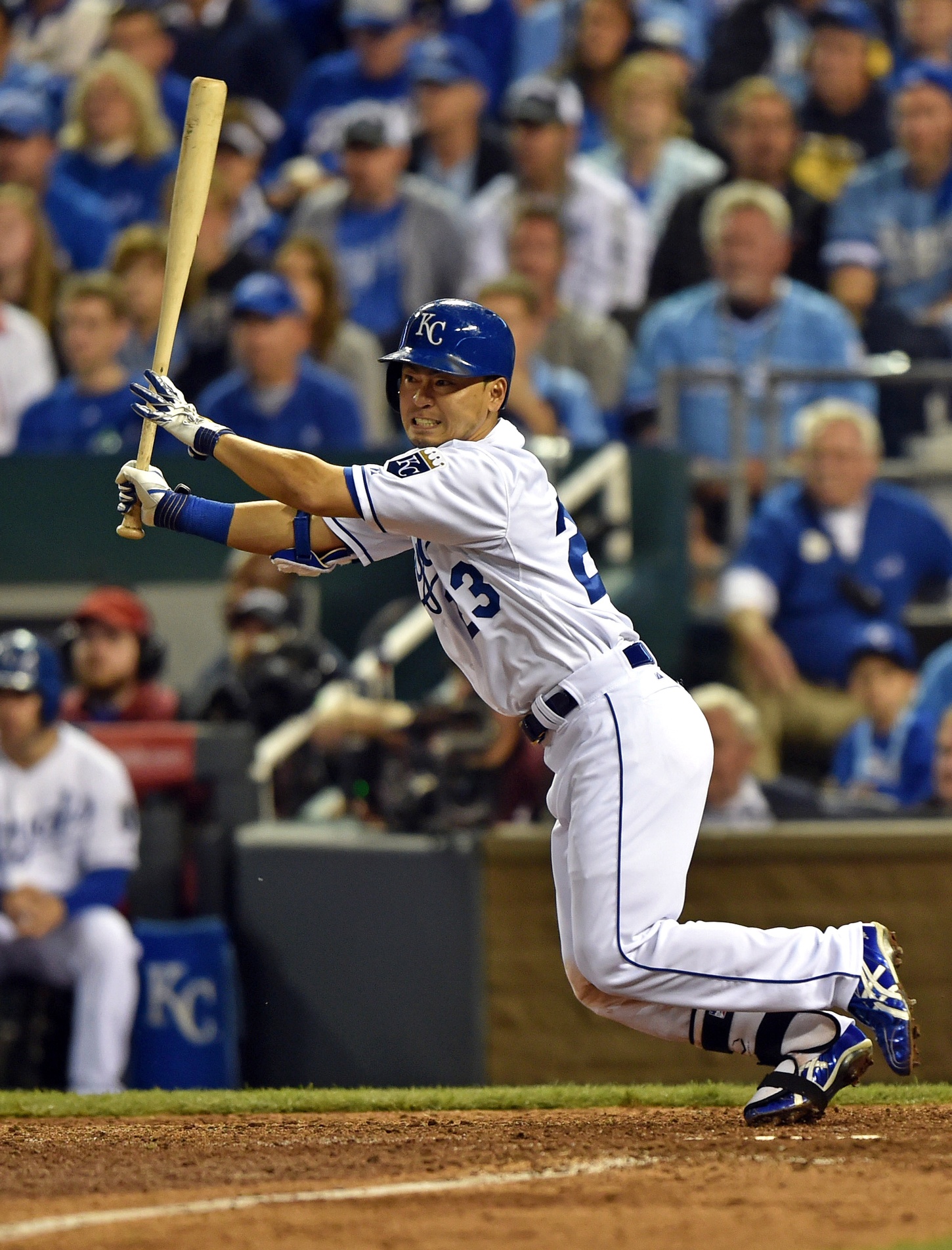 Like most Royals, Aoki is above average defensively for his position — he posted a 5.9 UZR in 2014 and is 8.2 runs above average in his three-year big league career. His speed hasn’t translated to great value on the bases, but it’s served him well defensively. Aoki has also been very durable, with a three-week stint on the disabled list with a groin strain in 2014 as the only significant absence since he arrived in the US.
Aoki has been at least a two-win player in two of his three seasons in the league, and if he can maintain his high on-base percentage, his secondary skills are good enough to hit that threshold. He also did not receive a qualifying offer, so the team that signs him won’t have to give up a draft pick.
Weaknesses/Cons
In 2012, his first season in the US, Aoki hit ten home runs and 51 overall extra-base hits, good power numbers for a table-setter. In the last two years, however, that power has vanished — Aoki had eight homers and 31 extra-base hits in 2013, and just one homer and 29 extra-base hits in 2014.
Aoki’s fly ball percentage has decreased from 27.7% in 2012 to 17.1% in 2014, and the average distance of those fly balls has decreased from about 280 feet in 2012 to 249 feet in 2014, ahead of only Donovan Solano, Elvis Andrus and Emilio Bonifacio on Baseball Heat Maps’ Flyball Leaderboard. Meanwhile, Aoki this year hit ground balls at a 61.9% rate this season, the second highest percentage among qualified hitters throughout MLB, behind Ben Revere and just ahead of an ancient Derek Jeter. In other words, unless there’s something about Aoki that hasn’t been revealed to us, his loss of power doesn’t appear to be a fluke.
A corner outfielder doesn’t need great power to be productive, but Aoki would lose value quickly if any of his other skills were to slip. His lack of power also limits his upside. Aoki’s Isolated Power last year was .075. Of the 13 qualified batters last season with Isolated Power numbers of below .090, only two — Revere and Dee Gordon — produced above average offensive value overall, according to Fangraphs.
Personal
Aoki, of course, starred for eight years with the Yakult Swallows in Japan before arriving in the United States. He was born in Hyuga, a small coastal city in Southern Japan, and his parents still reside there. Aoki and his wife, Sachi, have two young children.
Aoki’s interpreter, Kosuke Inaji, has worked with him in both Milwaukee and Kansas City and is “very much an extension of him,” Vahe Gregorian of the Kansas City Star writes. “He’s like our fifth outfielder,” Carlos Gomez said of Inaji when he and Aoki were with the Brewers.
Aoki wins plenty of praise as a teammate. “He had a great personality,” says former manager Ron Roenicke. “He fit in really well with the guys. We had fun with him. But he worked as hard as you could work. You can’t put more effort into the job than he did.”
Market
There aren’t many good position players available this offseason, but there are a fair number of outfielders, including Melky Cabrera, Yasmany Tomas, Colby Rasmus, Nick Markakis, Alex Rios and Torii Hunter. It’s possible Cabrera, in particular, might have to sign before the rest of the market develops. The Royals appear likely to have interest in retaining Aoki, and he could also fit in with the Reds, Twins, Mets, Cardinals, Blue Jays, Orioles, Rangers, Giants or Tigers. Nick Cafardo of the Boston Globe noted this week that the White Sox could be a possibility as well.
Aoki still profiles as a starter, but it’s unclear what his next team might be getting. His on-base ability is valuable, but the disappearance of his power is worrisome.
Expected Contract
A legitimate on-base threat is hard to find, and at his age (33 in January), Aoki could remain productive for at least two more years. He also has experience at all three outfield positions and could probably slide into a fourth outfielder role if his offense slips.
For all his drawbacks, Aoki was obviously a bargain throughout his previous contract, which paid him just $4.95MM total for the 2012 through 2014 seasons. This time around, he should be able to find a two-year contract at a significantly higher annual salary. He might end up being able to land a two-year, $16MM deal.
Photo courtesy of USA Today Sports Images.
I think this would be a great signing if the Mariners could sign him.
To add to the “personal” section he gave his 10-yr old neighbor a pair of World Series tickets for the kid’s birthday. That was awesome, and shows he is a nice, cool guy.
I really enjoyed watching him play this year, and I went back and forth between thinking he would go to the Reds or the Giants. I finally predicted the Reds.
He fits in so well with the Jays that it hurts. I’d much rather sign Aoki and let Melky walk, then reallocate some of that salary to a 2B/3B, or high-quality reliever to round out the ‘pen. Aoki doesn’t NEED to have power in Toronto… We have plenty of that already.
We could also really benefit from having a proper fielding outfield this year, because even Melky’s greatest supports must admit he’s a liability in the field, posting predominantly negative UZR’s throughout his career.
In Reyes and Aoki, we’d have two table-setters at the top of our lineup who get on base at a 33-35% clip, and although people will point out that Melky, too, had a .350OBP last season, chances are that last season is his ceiling, and he will likely regress from that.
If we can sign Aoki on a 2yr, $16MM deal, we’d be laughing to the bank! That would represent a savings of $5-6MM per year compared to what Melky will be demanding on the open market, and will be less year overall, clearing the books for 2016-2017, when the Jays will have some SERIOUS $$$ to spend to go along with their entire young core attaining the Majors.
Try not to get to excited about the Jays spending serious money on big free agents, remember we have a 5 year max. I do agree Aoki would be a good replacement for Melky as we would also get a draft pick. That said If we don’t get Lowrie or Cabrera to play 2nd it won’t matter. I’d really like Headley to play 3rd but not sure about his back.
Headley’s market seems to be huge though I suppose he is just waiting for Sandoval to sign, so he can clean up. I really like Lawrie, a lot. I just wish he didn’t get hurt so much.
The Jays don’t need to spend serious money in 2015 to contend. They’ve got about $20-30MM to spend to match last year’s total, which is about where everyone expects them to wind up payroll-wise for 2015.
When I talk about serious spending, I’m talking about the 2016 and 2017 seasons when all of the guaranteed money comes off the books, and really only Reyes’ contract remains.
I understood what you said I was just saying that it was inlikely to happen as AA will not go over 5 years and no top Free Agent would sign for less
It will be interesting to see how this offseason shapes up. There’s rumours flying left, right, and centre about what the Jays are up to. Could we trade Happ and a prospect or Howie Kendrick? SURE! Could we sign Russell Martin? SURE! Could we sign Nori Aoki? WHY NOT!
My main point is that reallocating the money that people WANT the Jays to spend on Melky is the best option. Melky in only going to regress from here on in, and the $$$ and years he’s commanding make the whole deal look even worse.
I don’t know why you see Melky regressing so much. It’s not like he’s 34. He can still be very productive over the next 5-6 years.
It’s not that I see him taking a huge dive, or anything. I just see last year’s output as his peak; he’s definitely not going to get any better. He’s also a defensive liability, and he’s definitely on a downward trend there.
To lock up a player that is only sure to decline for 5 years at a $13-14MM AAV is ludicrous when you’ve got a much cheaper, shorter-term option available to you in Aoki. Not to mention that we get an additional sandwich pick in next year’s draft for letting him sign somewhere else.
Aoki hit his peak as well (in 2012) and the numbers show a definite decline since. He was a 1 WAR player in 2014, so you’re probably looking 2 WAR at best on a two-year contract for his age 33-34 seasons (that’s with absolutely no further decline). Cabrera was a 3.1 WAR player last year. Figuring in a generous decline over the nest five years of 3.0, 2.5, 2.0, 1.5 and 1 WAR, you get 10 WAR for his age 30-34 seasons (and I think he’ll produce better than that). Cabrera is by far the better investment. If you’re willing to pay $16 M for 2 WAR, then Cabrera stops being a good investment only after $80 M for 10 WAR (and he’s going to get significantly less money than that).
You treat WAR as if it’s the end-all, be-all of stats. There are plenty of intangibles that WAR doesn’t take into account that make Aoki a great value play for the Jays. Firstly, the Jays have been plagued by numerous all-or-nothing hitters the last few years. I’m talking about HR or K guys like Rasmus, Arencibia, Francisco, etc. Aoki BBs just as often as he Ks. That’s a huge asset to have at the top of your lineup to set up the table for your 3-4 guys (Joey Bats and E5).
You also treat Aoki as an established veteran. Keep in mind that he’s only been around for 3 years. You say he “hit his peak” in 2012, but 2012 was his rookie campaign. Who knows what Aoki is capable of doing next year? Keep in mind that last year he went from a major hitter’s park (Miller) to a decent pitchers park (Kauffman). Perhaps a change of scenery back to one of the greatest hitters’ parks in the league (Rogers Centre) is exactly what Aoki needs to get his offensive value back on track.
And you treat WAR like it’s completely irrelevant.
You mention going from a hitter’s park to a pitcher’s park. OPS plus makes adjustments for that, and his last three seasons have been 109 (2012), 100 (2013) and 98 (2014). His numbers have consistently been heading in the wrong direction. And Aoki is a veteran, as much as Ichiro was a veteran when he came to MLB in 2001. Coming into his age 33 season Aoki is more likely to be what he’s been the last two seasons or regress with age than he is to improve significantly.
OPS does make adjustments for that, but it also values each point of OBP and SLG as equal, which they are not. wRC+ fixes this by assigning each offensive event with a fractional run value, and also adjusts for park and league. Its values for Aoki for each of the last 3 years? 113, 103 and 104.
I don’t think most people think he will regress so much that he doesn’t have value, the draft pick and ability to replace his production is better value.
Aoki has already regressed plenty–from over 3 WAR to 1 WAR in one season.
Having watched many games personally from the stands of Aoki and Melky, I’d take Melky’s defense ANY day over Nori. Aoki was just atrocious. The ONE thing he did well, was he let Cain take MANY gapped balls and long flys to right center (that a normal RF would have caught). Cain’s range probably saved Nori 5 or 6 errors this year. At least Melky can hit.
Consistent batting average by the end of September, but keep in mind he was nothing more than a 4th outfielder from June until September, when he broke out and raised his avg. from .265 to .285. I loved having him in KC because he gave us a huge boost in September when a lot of guys were struggling. At the same time I’m not rooting for his return to KC either. He is a guy that could help a prime time team by filling their weakest spot, but no one that is in bad shape should bother. For instance the Cubs or Mariners or Reds should avoid him. A team like the Angels, Dodgers, Tigers, Braves, or Nationals could use him as again a 4th outfielder or to upgrade over some bum hitting .200. The Royals need power and they should be trying to find that in RF, since they can’t (won’t) move the young guys who never will hit 30 HRs. Aoki’s one bomb was awesome as it was a grand slam in AZ, but again he is just a one bomb kind of guy. His came in September.
This sounds like a typical pre-Moneyball type of comment. Just because Aoki can’t put up big power numbers doesn’t mean he’s not a valuable (and quite underrated, in my opinion) player. The guys plays excellent defence, and last year’s one homer should be looked at as an outlier, not an indication of his ability moving forward. Will he ever hit more than 8-10HRs? Probably not. Aoki’s biggest asset is that he gets on base, and has above-average speed to do some damage on the bases as a table-setter. He slots in perfectly as a #2 guy in your lineup, and will come much cheaper this offseason than any of the bigger names in the OF.
He isn’t really that great defensively. He gets on base, but he really doesn’t have all that much power. He is alright, but as a corner outfielder his bat is certainly below average.
It’s not just his home run numbers. He’s been experiencing an overall decline in extra base power the last two seasons.
However, he doesn’t NEED to be an extra-base hitter to provide value to the Jays. all he has to do to be even remotely close to valuable is to continue to get on base at a .350 clip to set the table for our real sluggers, JBats and E5.
I feel as though everyone is misunderstanding me when I say that the Jays are better off with Aoki. I mean this only in the sense that for the same amount of $$$ and years that Melky is going to command, the Jays can get Aoki, and take on additional salary elsewhere (Kendrick or Cabrera at 2B?). Not the mention the sandwich pick the Jays would get to compensate them for Melky leaving.
He was replaced by the 7th inning of nearly every game he started because of his shaky approaches to line drives hit his way. I watched this guy play every day. I hope he can be a consistent .280 hitter and not someone that needs to hit .450 for a month to justify his presence. But I don’t see that happening. If the Royals can’t get a power hitter, then sure I would try to bring him back, but no one is giving him even 10 mil let alone 16 mil for 2 years. I’m not saying every outfielder has to hit 30 HRs to justify having a job. I’m saying that since the Royals led baseball with the fewest HRs hit, they need to find someone to change that and RF is the only position that will be an option and possibly DH. Every other spot is locked up for 2015.
I know chicks dig the long ball, but the Royals still made it to a 7th game of the World Series while producing the fewest HRs. It seems the game is/has changed and hitting HRs isn’t quite so important to success in MLB anymore. So, I don’t think the “need to find someone to change that,” is so important due to how the game has evolved (or regressed, depending on your perspective).
Sorry, but Aoki does not play excellent defense. In fact, he’s pretty much of a liability, which is why he was replaced from the 5th inning my in games that the Royals were up even a run in. Dyson to CF, Cain to RF. Rusty Kuntz took the odd stpe of moving him in to play shallow in LF sometime around June-July. Aoki has a very poor arm. The Royals took the chance that hitters wouldn’t be able to hit balls over his head with their hard throwing pitching staff. More often then not it worked.
It’s less that Aoki was a liability and more that Dyson and Cain are both elite CFers. The stats disagree vehemently with you regarding his arm — the “arm” component of UZR has him 10.4 runs better than average over the last 3 years cumulatively. It’s less of a fan of his range, which ranks as slightly below average overall, but when combined with the arm and the lack of arms, he ranks a bit above average. Not much above, and given his age, I’d think every front office would have to assume he’d be average at best going forward.
He did seem to take odd routes on balls over his head, from what I saw in the playoffs, but it’s not like he was a train wreck out there.