
The D-backs have officially signed right-hander Tyler Clippard to a two-year, $12.25MM contract, as first reported by Ken Rosenthal of FOX Sports (on Twitter). Clippard is represented by Excel Sports Management. Rosenthal further tweets that the deal is official (though the team has not announced the move just yet) and will give Clippard a $4MM signing bonus plus salaries of $4.1MM and $4.15MM in the next two seasons, respectively. Nick Piecoro of the Arizona Republic reported earlier today that the two sides had made progress on a deal, and ESPN’s Jerry Crasnick later added that an agreement was close.
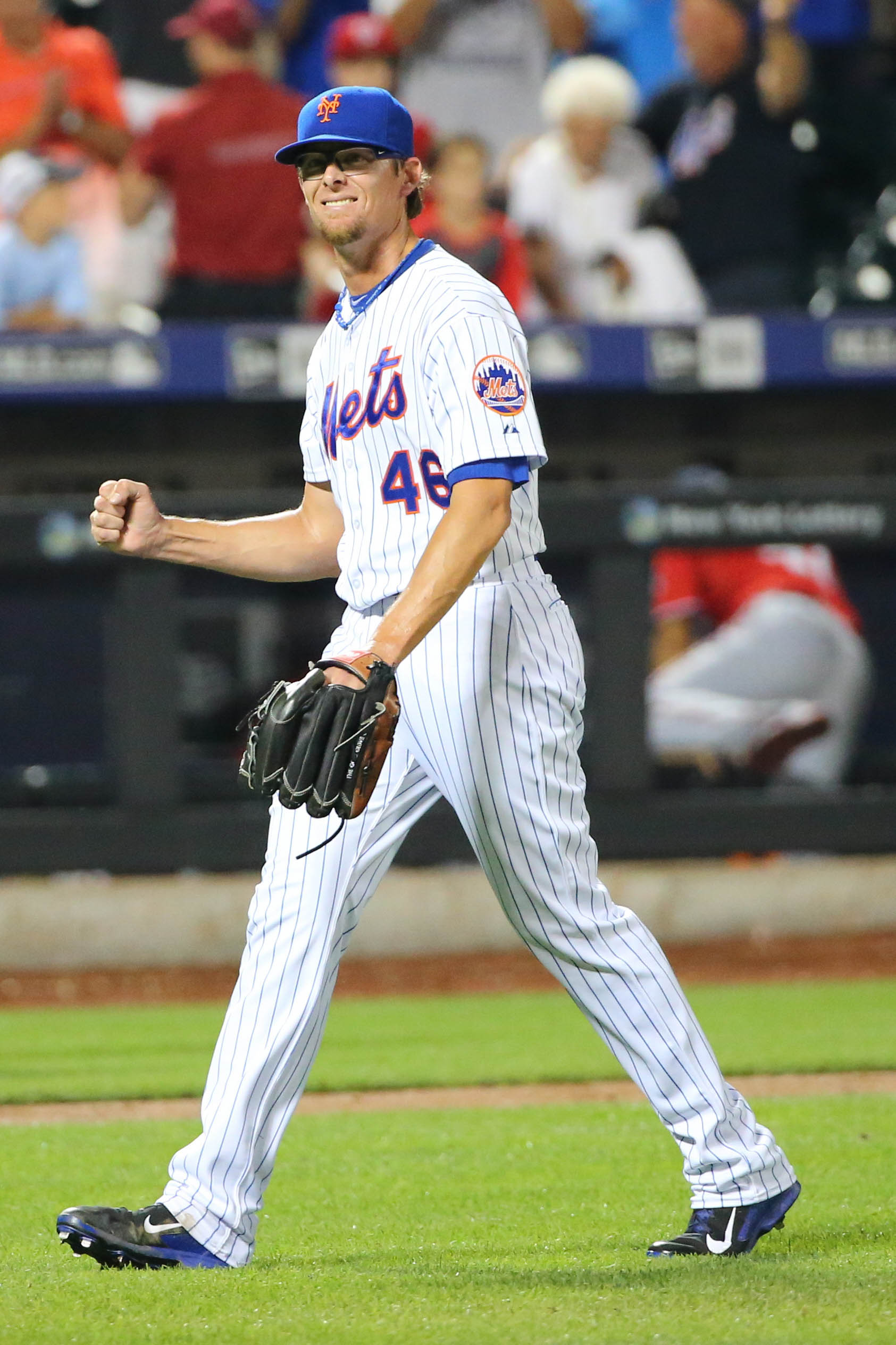
Clippard, 31 on Sunday, will join Brad Ziegler, Daniel Hudson, Andrew Chafin, Randall Delgado and Josh Collmenter at the back of the Arizona bullpen, leaving the team with one unsettled spot. With Chafin representing the only lefty in that mix, it’s possible that Matt Reynolds or non-roster invitee Wesley Wright would have the inside track on that final spot, though GM Dave Stewart has mentioned several other relievers by name recently. Among those listed by Stewart were Silvino Bracho, Enrique Burgos, Jake Barrett, Cody Hall, Sam LeCure, Dominic Leone and Evan Marshall — each of whom is right-handed.
Ziegler, who admirably stepped into the closer’s role last offseason when Addison Reed lost his handle on the ninth inning, will remain the D-backs’ closer, according to the Arizona Republic’s Nick Piecoro (on Twitter). Clippard, then, will join Hudson (who has shown excellent velocity as a setup option since returning from his second Tommy John surgery) as a setup man at the back of the ‘pen. Clippard does have 53 career saves and spent the early portion of the 2015 campaign as Oakland’s closer before being traded to the Mets, and it seems reasonable to expect that he’d be the first line of defense should Ziegler falter.
The addition of Clippard, in some ways, mirrors the D-backs’ previous acquisition of Reed in that both are notorious fly-ball pitchers. The Diamondbacks wound up trading Reed to the Mets in what amounted to a salary dump after Reed posted a 6.36 ERA at the homer-friendly Chase Field over the course of his 18 months with the club, making the decision to replace him with an even more extreme fly-ball pitcher puzzling. Clippard is coming off the second-highest fly-ball rate of his career and will be pitching in what is the most hitter-friendly environment he’s called home (with the exception of his brief call-up at Yankee Stadium in 2007). Last season, Clippard’s 60.6 percent fly-ball rate was easily the highest in baseball, and he also saw his strikeout and walk rates also trend backwards (8.1 K/9, 3.9 BB/9) while his velocity dipped for a third consecutive year.
All that said, Clippard again delivered outstanding bottom-line results between the Athletics and the Mets in 2015, totaling a 2.92 ERA in 71 innings. He also rattled off his sixth consecutive season with at least 70 innings pitched and continued his remarkable track record of durability in the bullpen. Dating back to the 2009 season, Clippard’s 464 1/3 innings are the most by any reliever in baseball by more than 50 innings, meaning he’s essentially thrown an extra season’s worth of innings than anyone else in that time. While there’s undoubtedly some concern that the workload has taken a toll on his arm and the effects began to manifest last season, his consistency and durability is virtually unparalleled by any of his peers in the league.
Stewart said just last Thursday that the team had “nothing going on” in terms of trade talk and free-agent pursuits just last Thursday, though he changed course less than 24 hours later and expressed an interest in reaching out to Clippard’s representatives. The Diamondbacks saved about $4MM in the trade that sent Aaron Hill, Chase Anderson and Isan Diaz to the Brewers in exchange for Jean Segura and Tyler Wagner, and that sum was essentially reallocated to function as Clippard’s signing bonus (or, if you prefer, his 2016 salary). By my calculation, the Clippard signing should put the D-backs around $95MM in terms of Opening Day payroll (including players at or near the league minimum), which is shy of their record $112MM Opening Day mark from 2014 but higher than the $86MM and $83MM marks from 2015 and 2013, respectively.
Photo courtesy of USA Today Sports Images.
Based on what some of the other bullpen arms got this winter in FA Clippard seems like a bargain.
Finally! I couldn’t believe the lack of interest in him this offseason.
Don’t they have to give first round pick??
No, he was traded midseason.
Wouldn’t have gotten a qualifying offer anyhow, but yeah, that eliminated it from even being a possibility.
And by the way, they already gave up their first round pick to sign Greinke, so it would have been a second round/comp. round pick.
Very happy to see the Diamondbacks signing him. He is very effective despite his late season struggles with the Mets. I hope that they keep Brad as the closer though.
32 games with the Mets at a 3.06 ERA is not really a struggle. I bet any team out there would be happy with that.
I don’t know if you got a chance to watch him down the stretch, but he definitely struggled. K rate took a nosedive, FIP over 4.50. His numbers in 14 appearances in Sept/Oct were atrocious as were his postseason numbers.
I’d like to see Ziegler getting DP in activist late game situation.
I don’t think Clippard is the best fit for the Diamondbacks. Reasonable deal though…
This seems like a great deal for the D Backs. I thought for sure he would secure a 3 or 4 year deal in the 8 to 9 million per range.
I know it said his strikeout rate only trended backwards, but isnt a 8.1 strikeout rate not good, or at least above average?
The league-average pitcher posted a 7.8 K/9 last season, so Clippard is above that.
However, he’s below the league average for relievers (8.4), and it’s more than two strikeouts fewer than what he averaged from 2009-14 (10.4).
This confirms it. Dave Stewart is either stupid, unqualified, or is acting like a 16 year with their father’s gold card. I cannot see any rhyme or reason to the moves made this off season. The D’Backs are mortgaging the farm with absolutely no eye toward the future.
lol
Because having your eye on the here and now is so ridiculous. As they say: a bird in the hand is worth two in the bush.
You have no idea what you’re talking about. Their entire core of the team is young and they’ve only dealt 3 prospects this offseason. They still have two top 100 pitching prospects and a young infield locked in until the 2021/2022 season.
They are going all in with Goldy and Pollock entering their primes respectively. As an AZ fan I’d much rather have a 4-5 year window of success than wait on a few prospects that may or may not pan out.
Are you too under the mistaken impression that Clippard had a QO attached to him? Your comment makes no sense otherwise, because the D’backs didn’t mortgage ant part of the pie ML system by making this signing.
While I agree that his moves have been bad, how does a reasonable deal for a free agent reliever mortgage the future?
This completes a very successful off-season for the D’backs. Their entire “wish list” filled superbly! Best off-season of any team in MLB. They now have the horses to successfully compete for a MLBWD title and beyond.
Depends on ur definition of successful.
They slightly improved the bullpen, improved the rotation and arguably weakened the starting lineup all while significantly hurting the farm and getting rid of arguably the most underrated player in baseball in Inciarte to clear up room for Dayan Viciedo v2
Let’s talk Inciarte…but first, let’s decide which Inciarte we should discuss? Should we talk about the Inciarte who was a failed Rule 5 pickup two years ago who was then returned to the D’backs? Or should we talk about the over-rated Inciarte the D’backs sold high on this off-season? Either one was Not the lead off hitter who made the second highest scoring offense go. The stats don’t show or prove that. D’backs have plenty of the other lead off hitters used last season, and their offense will be even better this year.
They were better off signing Mike Leake over trading Inciarte Swanson and Blair for Miller.
The Phillies returned Inciarte because he was unpolished and they considered themselves contenders.
How in the world is Inciarte overrated?
Inciarte put up more WAR in the last 2 seasons than Miller has in the last 3.
Inciarte is a consistent steal threat who hit .300, hes fine as a leadoff man.
Inciarte was with the phillies?
They picked him as a rule 5 pick and returned him on the 2nd day of the season
Wow thats crazy
Or…he’s a one hit wonder? Don’t get me wrong, I like Inciarte and I hope he does a great job for the Braves, but I don’t subscribe to the commonly held belief that he is a certain first ballot HOFer that the D’backs frittered away foolishly. One of the four OF from last year’s team was going to be traded, they wouldn’t part with Pollack, Tomas has very little trade value and a big contract, so it was either Inciarte or Peralta. Both had breakout years. Will either or both sustain that production this year? Whoever stayed with the D’backs is the best bet because they’ll play half their games in an extreme hitters ballpark. Look for Inciarte to regress somewhat.
D’backs actually sold high on all 3 players sent to the Braves for Shelby Miller. Inciarte won’t repeat his career high, one year stats from Arizona in Atlanta, but he became a media and casual fan darling in the reaction to the trade. Blair’s ceiling is as a mid-rotation starter. And the real Dansby Swanson wasn’t traded to Atlanta. Atlanta got suckered into believing that all draft first picks are certain superstars. They traded for a first pick superstar. Let’s review. Prior to the 2015 first year player draft, ALL of the experts and ALL of the GMs agreed that it was a down year at the top end of the draft. The D’backs tried to trade the first pick, but nobody would take it because they could get the same value in any of the first half dozen or more selections. There were no superstars in the 2015 draft. The D’backs took a safe selection at No. 1. They took a college athlete who was well rounded and had a great attitude. I love this guy, but he’s no superstar. Then they signed him for less than most recent first picks had received. He’s a nice player. He’ll probably have a nice, long career. I hope he does. But Dansby Swanson is not a superstar. The media and casual fans thought the Braves fleeced the D’backs because they got a superstar, a starting CF and another highly rated prospect. Problem was, they didn’t get a first pick superstar, they got the guy the D’backs had to settle for because they couldn’t trade the pick on a down year draft.
“The D’backs tried to trade the first pick, but nobody would take it because they could get the same value in any of the first half dozen or more selections”
“they got the guy the D’backs had to settle for because they couldn’t trade the pick on a down year draft”
Suddenly you lose all credibility considering draft picks aren’t tradable in MLB.
Swanson is still a consensus top 25 prospect in the game, Blair is still a top 100 prospect.
As for Inciarte, the only players since 2012 to put up 8.9 WAR (Inciarte’s numbers) in their first 2 seasons in the big leagues are.. Yu Darvish, Mike Trout, and Jose Abreu.
He could take a step back in his hitting and be less valuable, but even if that is the case, Shelby Miller is only a #3.
Good point, sorry for my error. I should have said that the D’backs wished they could trade the pick and rued the fact that they were getting the No. 1 pick on a down year.
As for Shelby being a #3, that’s exactly what the D’backs needed because they already had Greinke #1 and Corbin #2. Though I think Miller is at least a #2/3.
When I read that comment I thought the same thing
they didn’t really weaken their lineup, the thing that might hurt them though is defense – they did take a dip in defense and could give up a couple of games because of it – you would think the gains in the rotation though would more than make up for it.. the west is going to be pretty tough for them with SF, LA looking good (as long as everyone is healthy – both teams could collapse if not) and SD as a dark horse (maybe taking a little out and losing gyroko around their neck can help) AZ needs to either try to do what they can right now or trade away goldy and pollock and tank – they took the former – clippard may not be great but at least it is trying to trend up in the BP
I think the Dbacks can win the west, if everyone stays healthy, The dodgers are a third place team in my eyes, It’s gonna be between the giants and dbacks.
Did you copy and paste this comment from another post?
Not successful at all. He is another Kevin Towers with a scowl.
So with all of the trades
This signing was used with the saved money from the Dbacks-Brewers trade. Now it’s essentially:
AZ- Clippard, Segura, Wagner for Anderson, Hill and Diaz.
Let’s discuss again after the D’backs appearance in the World Series at the end of this season!
I can see Stewart and Preller both jamming on the Xbox at year end, sure.
X-Box baseball games suck (while the Wii U doesn’t even have any licensed baseball sims). Any real fan knows they should be playing MLB the Show on PS4.
I like the signing. People act like there are so many options. I don’t see anything wrong with it.
It has been a good offseason for the Diamondbacks, but they should of signed Mike Leake over trading for Shelby Miller.
That would’ve costed 80 million though. They didn’t spend any $$ to add Miller and have him under control the next 3 years.
But had to give up 3 big pieces to get him, A big over pay.
I don’t think Blair is a big piece, he wasn’t going to see time in the rotation anytime soon. They have a surplus of 4/5 starters and even dealt Anderson away as well to help further clear that jam. Not saying he isn’t valuable, because he could be to other teams, but for AZ he was expendable.
I agree Swanson and Inciarte are valuable, but they sold high on Ender. I love his defense and energy, but I think his bat will end up being a liability in the long run. Yes, his numbers the past year and a half may disagree, but I’ve seen most Dbacks games and his bat has not impressed me.
Swanson is also not your typical #1 overall pick. He could end up having a solid MLB career, but he doesn’t have the star power that most #1 picks have. Scouts said he was the worst #1 pick they’ve seen taken in the last decade when AZ originally drafted him. Again, solid prospect, but overhyped with that #1 pick label.
All in all, AZ gets a valuable rotation piece for the next 3 years while unloading their surplus in SP/OF/IF. Was it an overpay? Sure. Will it kill AZ in the long run? Probably not.
I understand the dislike for Dave Stewart, I however don’t understand the dislike for this move.
If you told me I can have Tyler Clippard for cheaper than Bastardo, I’d told you you’re crazy.
Horrible fit for the home stadium, Plus there’s a very good reason, in a crazy off-season for valuing late inning relievers, no one wanted Tyler Clippard. You could read off a list of every single red flag GM’s look for in relief pitchers, and he’d tick off every one. He’s a guy who relies on velocity to make all those fly balls catchable, and to let his best pitch, his change-up, be effective. He’s lost velocity every year lately and has a ton of mileage on the arm.
This is likely to be a dumpster fire, but at least he wasn’t expensive.
Agree
Thank goodness he’s not coming back to the Mets. He throws kerosene on the fire. $12 million to roast marshmallows on the fire. What a joke!
Yes, he tired in Sept./Oct. and in the playoffs and stunk. But his career stats show that he is The Best Reliever in baseball for the past half dozen years. His career stats in April, May, July and August are phenomenal! But he’s also the most used reliever in baseball over those years, averaging over 70 innings per year and totaling more than 50 more innings than any reliever over those years. He tired, statistically, in every one of those years in Sept./Oct. So, unless his arm falls off from over-use look for him to be dynamite for the first five months of this year too.
The best?? No. Not remotely close.
Kimbrel has twice the WAR over the same period. Chapman’s not far behind. Jansen, Holland, Robertson, etc.
He’s borderline top 10 over that period, though. Problem is, he’s also older than most of the guys ahead of him, and relievers aren’t exactly well-known for long careers. There’s many signs that his best days are behind him.
Decent signing, but he’s not the best, or close to the best.
-C
I’m beginning to believe that the snake – backs are for real good pickup for Arizona
What a scary good bullpen they have now! And I thought it would be in contention for the best bullpen in the league at the very least national, prior to this transaction. Nicely done by the D-Backs FO to play the aggressive card and shell out a couple years for this stud. Good for them.
arizona needs a closer, not another so so 7th 8th inn guy.
Zieglers 1.85 ERA not good enough?. And Clippard is in upgrade over Enrique Burgos.
To many BB and K rate going down. not really a good combination.
jones is an upgrade over cleto in chicago but that wont improve arizonas closer situation. ziegler is an old man. im in shock that arizona hasnt addressed its closer situation after adding all those starters.
Age is not the same factor in regards to submarine pitchers like Ziegler