
10:39am: Rizzo will earn $4MM in each of the two years of the contract, Janes tweets.
9:42am: While salary terms remain unknown, Rizzo intimated that — much like some recent free-agent players — he was able to achieve an appealing salary despite settling for a shorter commitment. “The years are important to me, but the AAV of the deal is right where I wanted it to be,”on Twitter said Rizzo (via Mark Zuckerman of MASNsports.com, ).
7:26am: The Nationals have agreed to a new contract with president of baseball operations and GM Mike Rizzo, as the club announced and Chelsea Janes of the Washington Post reports. Rizzo’s contract will now run through 2020.
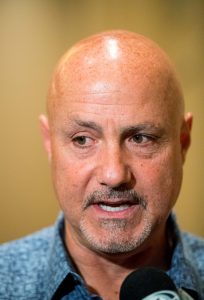
Rizzo, who took over the organization’s baseball operations department in advance of the 2009 season, had been working on a deal that expired at the end of the current campaign. Though both he and the club’s ownership had expressed confidence that a new arrangement would be reached, it took somewhat longer than expected — and, perhaps, will not be for as lengthy a term as might have been anticipated. (Salary terms are not yet known.)
Compared to his peers, the 57-year-old Rizzo will continue to operate with relatively little job security. Numerous other top operations officials with similarly impressive track records have achieved much lengthier terms on their most recent contracts. Most recently, Pirates GM Neal Huntington signed on for another four campaigns while Yankees GM Brian Cashman secured a five-year deal that’s reportedly worth more than $25MM.
Of course, the lack of long-term arrangements has not prevented Rizzo from securing a long run at the helm in D.C. already. As Janes notes, he has run the baseball ops department for longer than all but four of his peers. Rizzo originally joined the Nationals as an assistant GM after running the Diamondbacks’ scouting department.
It also does not seem to bother Rizzo. In an appearance today with 106.7 The Fan’s The Sports Junkies, via Janes on Twitter, Rizzo cited his longstanding relationship with an ownership group that is led by the Lerner family. “The trust level I’ve built up with the Lerners has been great,” he said. “There’ s a bond between us [that] I think is stronger than anything else.”
There have obviously been some disappointments for the Nationals, who have somehow not yet managed to advance past the divisional round of the postseason in four recent attempts. But it’s difficult to lay those failures — which have come in one tightly-contested series after the next — entirely at the feet of the front office. After all, Rizzo has consistently put competitive rosters on the field over a tenure that has otherwise been a resounding success.
In the first season following Rizzo’s ascension to the GM seat — initially, on an interim basis — the club won just 59 games, matching its ugly total from the prior campaign. But the Nats added ten and then eleven wins in each of the next two seasons, setting the stage for a breakout 2012 unit.
Nationals fans will not soon forget that season, when the Nationals shocked the baseball world by posting 98 wins and claiming their first NL East crown and postseason berth. The core of the team was developed from within, with major contributions from then-recent top draft picks Stephen Strasburg and Bryce Harper.
While there were hiccups along the way — specifically, second-place finishes in 2013 and 2015, the latter in humiliating fashion — the Nats have been perennial contenders ever since, winning more total games than any team but the Dodgers. A payroll that now ranks among the highest in the game has certainly helped, but Rizzo’s shrewd dealings have kept the roster stocked with high-end talent.
As with any executive, Rizzo has had his hits and misses. The regrettable but unforgettable acquisition of Jonathan Papelbon certainly rates among the most notable in the latter category. Foibles with managers are by now a worn joke with regard to the Nationals, though perhaps only Rizzo’s hand-picked hiring of Matt Williams is his responsibility moreso than ownership’s. Many would rate the decision to shut down Strasburg in 2012 as a blemish, though the critics have always seemed to ignore that the organization had arrived at its decision before the start of the season and declined to waver from it, despite obvious temptation, to protect a young player who had shown signs of wearing down.
By and large, though he has been remarkably successful at structuring trades and overseeing a drafting and development effort that has consistently produced quality young players. To be sure, Strasburg and Harper largely fell into the Nats’ lap, both carrying unquestionable 1-1 talent in the drafts where the club was choosing first. But Rizzo also scored value in later drafts — especially in nabbing Anthony Rendon in 2011. Over the years, Rizzo brought in key contributors such as Wilson Ramos, Tanner Roark, Felipe Rivero, and Trea Turner in high-value trades.
Even as the Nationals face a future that may not include Harper, they seems primed to continue competing with a core group that could soon include Victor Robles, Juan Soto, and Carter Kieboom. Accomplishing that transition — or, instead, finding a way to keep Harper around without crippling the team’s ability to spend on other talent — may be the biggest challenge yet for Rizzo.
Photo courtesy of USA Today Sports Images.
I can see why they gave a shorter term. Don’t get me wrong, Rizzo seems like a guy who gets the game. But he’s had some pretty impressive teams that haven’t made it past the NLDS. It’s not all his fault but there’s always a fall guy
I don’t see how he can be blamed at all. He did his job and put a competitive product on the field. It is their job to produce.
Also, does anybody else think giving a GM 5 years and $25 million is kind of insane? I know it’s the Yankee’s but that still seems like a boat load of money for a GM. I’m not saying their job is easy, but it seems like quite a bit of money to me.
I’d argue GM’s are underpaid. They have the biggest impact on a team’s success, yet get paid like a meddling RP.
I would argue that there are A LOT more people qualified to be a GM than could be a meddling RP in the majors.
Perhaps. But having Cashman as a GM still goes a helluva lot further to winning games than a Brandon Kintzler in the bullpen.
You guys know its middling right? The Nationals ownership is meddling but the gm and relievers are middling.
Maybe I knew that but I was just retyping what I saw. I’m drunk.
stevewpants: Ha-ha!
However, there have been instances when a front office executive might be considered “meddling” as in the case of Kenny Williams and the infamous Adam LaRoche clubhouse incident with his son that undermined “middling” manager Robin Ventura and pissed off star players like Chris Sale and Adam Eaton who were later launched to jump-start the White Sox rebuild. lol
The Eaton trade could also play a part in Mike Rizzo’s legacy as GM. If “Spanky” can finally help lead the Nationals to the promised land of a World Series championship it would help cement revered status for Rizzo in Washington. If the Nationals continue to fail in that endeavour while pitchers Lucas Giolito, Reynaldo Lopez and Dane Dunning help the White Sox to glory on the South Side of Chicago the opposite could happen. Of course, they say the best trades are those that help both teams win which could very well happen in each city.
I never understood that Laroche thing, like unless he was telling other players not to use bad language in front of his kid or something why would Kenny open his mouth at all? And calling Ventura a middling manager is quite generous. I could watch that clip of him charge Nolan Ryan all day. That alone should’ve been enough to disqualify him from ever managing anything. Who in their right mind would charge Nolan Ryan?
Actually, Williams was most responsible for the LaRoche incident by agreeing to let the player bring his son into the clubhouse on a regular basis. I believe it was a hand-shake type of agreement when LaRoche was negotiating a FA contract with the White Sox following his successful season with the Nationals in 2014.
So, a GM who is experiencing success is worth about the same amount as an aging Curtis Granderson. As to the trade, I don’t see much Glory on the south side of Chicago, so far. Dont worry until, or if, it happens.
Well, to Ventura’a credit, at least he had the balls to charge Ryan..lol..Most, I’m sure, would pull the ol’, please get the catcher ro hold me back routine.” lol..
Although, it just ended up with Ryan basically “big-brothering” Ventura..Like get out of here little kid, before I really hurt you..lol
Then again, it probably should have let people know Ventura didn’t exactly have the best judgment skills..lol
Uh… Ventura got his ass soundly whooped by the Ryan Express
I’d have gotten away with it too if it weren’t for those meddling relievers! 😛
At most sports restaurants in North Texas you can easily find a picture of Ventura in the Ryan headlock, usually with Ryan’s signature.
Phillies have Hunter & Neshek on DL at a combined $18 mil. $4 mil for a GM is a bargain.
GMs also have different levels of involvement. I assume that someone like cashman has a say in how the lineup is constructed on any given day, and as teams go more towards analytics, they become more and more important. If anything, he is probably underpaid because the decisions he makes can have much larger financial implications (e.g. signing an Albert Pujols type contract)
Isn’t he also responsible for the manager who handles the players he brought in? How many managers do you go through before you begin to look at the GM as the problem?
You are assuming Rizzo is actually the one with the final say in who they hire. Im convinced he hasnt been.
For what it’s worth, I believe that Mike Rizzo has finally picked a winner in Dave Martinez, Joe Maddon’s long time bench coach with the Rays and Cubs.
I think postseason series are a crapshoot. The best teams don’t always win a short series. It’s unfortunate but there’s no real better way to do it, unless we went back to old-school baseball and just had the Al winners meet the NL winners and play like an 11-game series.
If MLB ever adds a couple more teams, they could eliminate divisions and go back to a more balanced schedule. Play ten games against each opponent in your league and 12 interleague games.
Regular season winners in each league could have the deck stacked in their favor where they would need to win just two games in the first round and just three games in the LCS. Fifth place plays fourth place as a play-in to face the league winner in the 1st round.
You can crown me Commissioner any day now.
“ . . . postseason series are a crapshoot. The best teams don’t always win a short series.”
Exactly, Mr. coonce. The shorter the series the less likely it is that the better team wins. But as the lottery used to advertise, ‘You gotta be in it to win it.’ A team which regularly makes the postseason will eventually win a championship. Even the Nats. Extending Rizzo was a no-brainer.
I’m not so sure, the whole, ” well at least we had a chance to win it.” Will really work much longer for Gnats fans or their ownership..
However, Rizzoli has seemingly done the impossible as a GM, which is he has actually built a good, working relationship with Boras…lol..That is not an easy task..
That’s why I don’t like the wild card at all! A team that’s been pretty decent all year can lose the whole season to an inferior team in just one game.
Huh? Only a wild card team can be eliminated by another in just one game. The wild card survivor would still have to defeat any other playoff team in the subsequent best of 5 or best of 7 postseason series.
I was talking about the 2nd wild card where you only play one game
and if you lose, you’re gone!
I’m sorry if I didn’t call it the wild card playoff game! But I think you knew what I was talking about. If you didn’t, well that’s on you !
every trade he makes comes up roses. Did he trade for Turner? That trade was a rape of SD.
Another reason for short term is to see if he can hang on to Harper. If not, how will he help improve the team without him. They do have an abundance of outfielders major league ready in their system.
Rizzo is an excellent GM.
The bad moves he’s made have ownership’s fingerprints (like Wieters) on them or were entirely defensible and reasonable at the time that just didn’t work out (like Rivero for Melancon).
You can’t just cherry-pick which moves are Rizzo’s doing and which aren’t…He has made his fair share of mistakes, but he’s also built an excellent scouting department, a great core of instructors in their minor leagues, and he’s done a good job filling his roster with talent.
Every GM makes mistakes, but when you start to cherry pick good and bad moves it sounds like a fan making excuses for Rizzo…
Rizzo doesn’t need excuses, he owns up to the few and far between mistakes he’s made, and he also owns up to the good loves he’s made as well..
My only question regarding Rizzo is why he has such a short leash with coaches: Baker, Williams, Riggleman, etc. among others…I understand having a talented roster, and not getting out of the first round means someone has to be the scapegoat, but what ever happened to giving someone a legit chance!? …
Maybe Martinez will finally be his guy, but even then, what’s going to happen when Martinez is due a raise, if they still haven’t made it past the divisional or even the championship round..?? Will Rizzo pay Martinez??..I guess we will have to wait and see..
Very easy to be an “excellent” GM when you have the chance to spend like the Nats have. Rizzo is a very average GM with two consecutive goldmine 1st picks (Strasburg, Harper), and plenty of overspending with only NLDS losses.
A
He should be terminated not extended.
Silliness.
For sabotaging the best chance at a World Series by hold Strasburg back, Absolutely.
You think the Nats would be in better shape today had they handled Strasburg’s rehab the way the Mets handled Matt Harvey’s? Doubt they would agree. Not even if they knew that letting him pitch in the 2012 postseason would have resulted in a championship. Would you say the same if you knew that, after the ‘12 championship run Strasburg broke down physically, costing the team its ‘14, ‘16 And ‘17 division titles? You wanted them to take a high stakes gamble, they declined. Available evidence indicates that their caution was appropriate.
Players risk injury every time they play and even when they practice. But letting Strasburg pitch until he broke down would have been assuming the very real risk that the Nats entire investment in him would have resulted in only a year or so worth of major league service. That reckless, “hail, Mary” approach to a star player’s well being is no way to run a ML franchise—which is why Rizzo didn’t do it.
Seriously, you want the Nats to be run like the Mets exactly why?
I’ll trade 4 division titles and NLDS defeats for 1 World Series championship. Pitchers are professionals and are paid very well to be ready to pitch in the big leagues. Strasburg was not showing signs of breakdown leading to his benching. Upper management sabotaged the team’s chances, period.
He was bad in his final regular season starts and Ross Detwiler, who replaced him, was the best pitcher in that series. Move on. You are wrong.
Ah yes. The great Ross Detwiler > Stephen Strasburg. I’m sure knowing he’d be shut down didn’t help Strasburg head, and I’m certain many aces had a couple rough starts to end a season only to turn it on in the playoffs. To argue Detwiler over Strasburg on any planet is unfathomable.
Always thought Strasburg signed that extension with the Nats because they put his health first in 2012 and shut him down. I know Chipper Jones will tell you it was the wrong move to not push all in that season Starsburgs arm be damned. But he left money on the table and maybe could’ve got more in free agency and I think he was repaying the loyalty from when they didn’t push past his innings limit that season.
3 more years of poaching the Oakland Athletics.
That’s a chronic issue underscored by Billy Beane. If it’s not Rizzo then it’s someone else.
The top portion of Mike Rizzo’s head in that pic is NSFW.
Third article today that used “intimated”…very high brow day in baseball