
Raise your hand if you thought Brett Gardner would lead Yankees outfielders in fWAR at the All-Star break. Weeks-long, injury-forced absences to starting outfielders Aaron Judge, Giancarlo Stanton and Aaron Hicks helped Gardner ascend to the top of the heap in the season’s first three-plus months, but the long-productive 35-year-old has been legitimately good yet again. With 2.1 fWAR through 323 plate appearances, Gardner is tied for 46th among all qualified position players, having notched the same total as Juan Soto, Anthony Rizzo, Josh Donaldson and others. He’s also continuing to make a case as one of the most valuable Yankees ever in the eyes of that metric, which places him 24th among the storied franchise’s all-time position players.
Even though Gardner is enjoying his latest quality season, there is a chance it’ll be the last in pinstripes for the soon-to-be free agent and career-long Yankee. The club brought Gardner back last offseason for $7.5MM after declining its $12.5MM option over him. At that point, Gardner didn’t look as if he’d be in line for his typical amount of playing time. The team had Judge, Stanton and Hicks, after all, and while they (especially Stanton) have each sat out significant time this year, all three will reprise starting roles next season. The club could also have Edwin Encarnacion, Miguel Andujar (yet another 2019 injury case), Clint Frazier (if he’s still with the organization by then) and an out-of-options Mike Tauchman further clouding the outfield and/or DH mix.
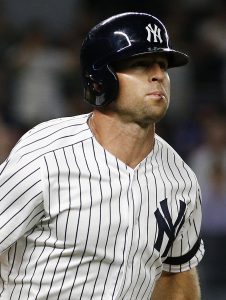
Of course, if you’re Yankees general manager Brian Cashman, there are more important matters at hand than worrying about 2020. He can map out Gardner’s future then. As of now, Cashman’s choice to retain Gardner last winter has proven to be a shrewd decision for a team that has jumped out to the American League’s leading record (57-31).
A roughly league-average offensive player since his career started in 2008, Gardner has posted a 109 wRC+ so far this year. If the season ended now, it would go down as the fourth-best figure of his career. Gardner’s more conventional output – his triple-slash line – checks in at .246/.328/.470. While Gardner has usually derived a sizable portion of his offensive value from his ability to get on base, having done so at a .343 lifetime clip, he’s one of countless major leaguers whose uptick in power has ruled the day in 2019.
Gardner has already piled up 15 home runs, six fewer than the high-water mark of 21 he hit in 2017, with a .225 ISO that comes in 90 points above his career mean. Unlike many other hitters, though, Gardner hasn’t needed to sell out for power by upping his strikeouts. In fact, Gardner has gone down on strikes a meager 15.5 percent of the time – his lowest since 2009 – and is tied with Mike Trout for the game’s eighth-ranked swing-and-miss rate (5.3 percent). Plus, having walked in better than 10 percent of trips to the plate, Gardner’s 0.66 BB/K ratio almost doubles the league average (0.37).
Gardner’s sturdy output this year has come in spite of a .248 batting average on balls in play, down 59 points compared to his .307 lifetime BABIP. Still one of the majors’ fastest runners, Gardner looks like a good bet on paper to see his BABIP skyrocket. That’s not a lock, though, if Gardner’s new approach holds up. He’s hitting more fly balls and fewer ground balls/line drives than usual. That’s not conducive to a high BABIP, and it’s worth noting that hitting the ball out of the park doesn’t count toward the stat.
The question is whether Gardner’s newfound power is here to stay. The fact that he’s pulling the ball at a career-high rate and going opposite field at a personal-low percentage bodes well in that regard. Furthermore, FanGraphs indicates Gardner’s hard-hit rate is his highest since 2012. It also may help that the left-handed Gardner plays his home games at Yankee Stadium, but the venue surprisingly has been a difficult one for lefties to amass HRs at this season, according to Baseball Prospectus. For his part, Gardner has been better on the road (114 wRC+) than at home (102) this year, though he has totaled eight of his homers in the Bronx. Historically, Gardner has offered league-average or better numbers both home and away.
Sticking with Gardner’s history, he has typically been usable, albeit unspectacular, versus same-handed pitchers (88 wRC+). But they’ve stifled Gardner this season, having limited him to a woeful .206/.260/.324 (53 wRC+) in 73 PA. Moreover, Gardner has been far from great in general in the estimation of Statcast, which puts his expected weighted on-base average (.314) significantly below his real wOBA (.339). It also indicates his expected slugging percentage, hard-hit rate, exit velocity and expected batting average are all worse than mediocre.
Elsewhere, however, Gardner remains a defensive and base running stalwart in spite of his advanced age. In almost 700 innings divided between left and center, he has accounted for 4 Defensive Runs Saved and a 3.8 Ultimate Zone Rating. And while Gardner’s no longer the 40-steal threat he once was, the speedster has swiped eight of 10 bags this year and rated as one of FanGraphs’ top base runners.
The overall package has almost always been effective for Gardner, who has quietly been one of the Yankees’ greatest draft picks in recent memory after going in the third round in 2005. Fourteen years later, Gardner remains a legitimate major league regular and someone who could help the franchise to the second World Series title of his career this fall. Whether Gardner will stay with the lone organization he has ever known once its season ends will be one of the Yankees’ main questions when the offseason rolls around.
Photo courtesy of USA Today Sports Images.
Was this written to troll Yankee fans?
#freeFrazier
Your whole account just gives off lonely vibes
You are incorrect. His name is funny. Yours is sad.
Gardner is a solid player. With all the injuries the Yankees had early on, I bet they’re happy they didn’t dump him over the winter for some ain’t-never-gonna-be-anybody prospect. If they decide to move him before the trade deadline, they should have no shortage of suiters. A solid veteran bat in platoon role and/or off the bench. Cardinals and D-Backs, are you listening?
Headline game on point
#freefrazier pog
#freefrazier
Lol no. Frazier ain’t got nothing on Bert
#tradeFrazier
What’s with all the headline jumbling going on. ??
Makes it difficult to wanna read. & Stay interested.
Also looks weak. . . From a business standpoint.
No Real Headlines.
Then go read the pay wall sites. I hear they have better headlines…..
oh honey I’m sorry
I don’t understand why Yankee fans hate this guy so much. Even in his down offensive years he’s still better than league average with his defence.
Yeah as a Yankee fan I find it embarrassing to see all the posts whining about a perennial 3-4 WAR player. He’s definitely not the sexiest player but he’s far from useless.
In the later innings when an opposing pitcher is starting to get up there is pitches there’s nobody else that I want in the box than Gardner. His command of the strike zone and ability to foul off close pitches lengthens at bats and wears the pitcher down.
His defense is sound and his hustle play constant as well. Watch in the dugout as the young players stand around him-what a great influence.
Let’s laugh at the Gardner doubters here, complaining that he was being overpaid this year. Remember earlier in the season, the ones dissing Cash for the signing and how it prevented the Yankees from signing Machado and/or Harper. Like you can compare a one year deal to a decades deal?
They were the same ones who professed gloom and doom in the first few weeks.
Glad they are gone now. We still face a shortage on the squad with injuries and we keep on winning!
Real Yankee fans love Gardner. He plays the game with maximum effort and above his talent level. When he hit free agency he signed with the Yankees for less than he could have gotten elsewhere after they gave Ellsbury that huge contract. If my boy ever looks at a baseball player as a role model I hope it’s Gardner.
The problem is bandwagon Yankee fans expect an all star at every position. They expect a 40 HR threat everywhere in the OF. With the Yankees becoming one of the best teams in baseball again people are going into their closets, dusting off their old Yankees gear and putting their Giants/Cubs stuff on hangers. They don’t understand the Yankees brass has changed their approach to team building.
It’s never made sense to me. He’s been remarkably durable and productive for a long time. But I always get a good laugh at the stupidity.
I agree, I have always respected him. A real dirt dog. He just grinds every day. He reminds me of Pedroia, only healthier. Just a pain in the butt whenever he is at bat. Yankee fans have been bashing him for years.
Nick Markakis, Brett Gardner, Alex Gordon.
All three will be 36 year old free agents at the end of the year. With the way free agency has been going, I thought this could be the last year for all three of them, but they are all putting up decent numbers, and decent defense.
I think Gardner will have the strongest market, Markakis the weakest, which is a shame as I want to see Markakis soldier on in an attempt on 3000 hits.
He’s not gonna make it to 3000 hits. Maybe, just maybe 2700-2750.
A player hustling and producing in a contract year? Shocking!
This is how he plays the game. Whether he has a three-year contract or four month contract. I think he’ll be back next year. Cashman knows how important it is to have someone like Gardner in the clubhouse. Even if it’s as a fourth outfielder.
The clubhouse guy card is played again. lol
Good on the article writer for remembering that little flick.
I’m torn on this performance. If they win the world series, I can understand Gardner being tempted to hang it up as a player for good, on a high note. I could also see him wanting to keep playing as long as he’s productive, even knowing he’s bound to regress a bit next season. The thing is- He’s playing like he’s worth $18M a season, which we know would be absurd. He’s also worth more than the $7.5M he’s making this season….and the Yankees are trying to get younger, stay budget conscious. I think they offer him the kind of contract they gave Youkilis, LeMahieu and Matt Holliday, but with Team Veteran Loyalty bonuses.
With an extension on the horizon for Judge and all our minor league guys worthy of a spot, I think the Yankees and Gardy go year to year, always prepared for him to step back into a bench player and unofficial coach role. But if they play him he’s worthy of a starting spot…
They should extend him by 1 year for $13M with a $5M buy out on a $7M mutual option, so he’s paid fairly, but it doesn’t get awkward and they can all walk away heads held high, roster spot utilized effectively, in any outcome.
Loyalty? HAHAHAHAHA!
Lets be real- teams that love certain guys value them in ways that the rest of the league wouldn’t and the Yankees, amongst other organizations, have been known to “reward” a player for their heroics the prior season, or for a career worth of effort with one last “thank you” pillow contract. Gardy might be able to go on the open market and get a 2 year/$27M deal after this season, but it’s probably more important for him to be a lifetime Yankee and yet it’d be difficult to justify paying him less than the $7.5M he made this season, but very easy to justify paying him much more than that for this kind of performance and his overall consistency. So if that number is $13M or so and the QA is $18M or so, a 1 year/$13M guarantee with a buyout that equals the QA on a second year that would anticipate regression and less playing time if the other OF’s stay healthy next season makes perfect sense for both sides, in my humble opinion.
No he wouldn’t.
Who’s gonna pay a a 36 going on 37 year old player a two year deal for that much, or give him two years?
2.2 WAR, A lot of similar profile guys at 36 have earned 1-3 year deals worth $13MM+ a season. I think we can all agree he has been worth more than $7.5M this year. And if you’re just waiting for guys to drop off, why pay anybody multi-year deals or big money?
I’m not Gardy’s biggest fan. His game has holes, like most. But he’s consistent in his performance and his overall numbers have ticked up throughout his career. Players are better conditioned and humans stay younger longer.
The fact is, Gardy is loyal and not money driven, from what we’ve seen, but he isn’t gonna take the steepest hometown discount, because he has self-respect, and the MLBPA would probably advise him against under selling his services.
So then my question to the 2 guys who replied is:
1) Should he retire? Is he worth $7.5M or less if he’s a safe-ish bet to sort of repeat this performance? 2) What if next year he takes the bench/part time role he was intended for this year? 3) What’s his value in baseball’s economic terms, in your opinions?
Kudos to that headline writer.
Agree. I can’t think of a more appropriate reference than that.
I was thinking more of Chauncey Gardner, the hero of the classic “Being There”……
But really, the guy’s been a class act all his life, playing in a rough place to play, and has been better than an average player. Hoping he stays with the Yanks till he’s ready to hang ’em up.
As long as the roots are not severed, all is well. And all will be well in the garden.
I’m set to write him in on election day.
Oh boy Louie is gonna lose it.
Who’s Louie?
A “Yankees fan” whose sole missions is to inexplicably hate on Brett Gardner to provoke angry responses.
My immediate thought as soon as I saw this wonderful pun of a title.
Gardner is amazingly consistent in his yearly patterns.
Even in the minors it was the same pattern of development every year.
The downside of that pattern is he plays great and is overused the in the first half before falling off in the second half as he never gets any rest and wears down.
As for all of this outfield depth…Little of it is above average defensively in Yankee stadiums left field.
Came to the comments to say exactly this. I’ve always liked him and think Frazier’s always been a defensive liability, but I’m expecting a second-half slide, as usual.
And Yankees fans still hate Gardner. What a crowd of losers.
i would not say hate. I happen to like and appreciate for all he’s done. I just think that for 10 mil this year on a team that has suddenly become budget conscious it raises a lot of questions. Until only a week and a half ago he was really struggling. Plus hard to see value when a guy like Adam Jones took only 3 mil., and Brantley who is superior got slightly more….
Gardy has been a great Yankee and no one can take that away from him
50 players out there just like him but NO he is a Yankee So we gotta say something. This site has become a RAG. Let’s see another article coming up about the METS.
The last of these pseudo player profile articles was also written today about the Oakland Athletics’ Brett Anderson. I believe Luke Voit is the only other Yankee included in this series so far this year. Not sure you’re on base here.
Sadly I prefer Frazier, instead of Hicks or Gardner at this time but Frazier will be part of a deal for an starting pitcher
Ya, have to agree with you, Julio. Giants will get Frazier and like two up and comers for madbum, although I prefer trading will smith and Madison bumgarner for Aaron judge and aroldis Chapman… why not???
Why would you say this? Straight stupid my dude.
I don’t think SF would want Frazier. Hardest OF to play in defensively that I can think of
Couldnt ask for more coming out of a guy who was brought in to be the 4th OFer. Not sure if theyll bring him back next year though since the OF is always so crowded. If they trade Frazier i can see Gardner back for another year. If they hold on to Frazier I just dont see it happening. If his hitting completely falls off the map in future years he is still a great option defensively and on the base paths.
I still dont get the Gardner hate. Its not like its his fault the 3 players ahead of him on the depth chart got injured for a significant amount of time
Gardner stinks. Should have cut this dude 3 years ago. Can’t wait til he is no longer on this roster.
What are you even talking about?
Gardner sucks. Yankees should have cut bait years ago with the trash bag.
I will neve understand why half of the Yankees fan base wants this guy gone . Clint Frazier can only hope to have half of the career gardner has had
That is why Gardy is one of the most liked players on the team and in NY, he does his job. Nice to see he is getting some credit.
Gardner ALWAYS wears down in second half and performance suffers. Based on age and how much he has played I expect the swoon to be even worse than usual. Yes he is a leader but it is time to move on. Hoping he lasts through the year. If he tanks too much I see Frazier back.
Exactly, I’d like to see an article about this guy around early September. Take a look at the numbers Frazier has put up in AAA since getting demoted. The best thing the Yankees can do is trade Frazier while he has some value, but don’t tell Yankees fans that.
Gardner is a perfect complimentary piece. He does a lot of things well, and, at this stage of his career (and were he is on his contract) if he wears down later this season, you sit him. The guy has close to 40 BWAR over his career–that’s a really useful player.
Greetings, fellow Yankees fans. Admittedly, I’m certainly no expert on numbers. In fact, I miss the Girardi days when decisions were based on more than just statistical trends. Regardless, I realize the popular trend is to reduce players to their averages and percentages, over their character and off-field performance. (Call it a clubhouse card, if you will, but that card has tremendous currency, as previously pointed out in this thread.) Gardy has been referred to as a “blue collar” ball player which makes him a true asset to the current (and recent past) lineup – he shows up, does his job, gets himself on base and gets others home. I am proud to wear my Gardner YANKEES jersey and hope to wear it for at least another year. #BronxBombersNeedBrett
Gardner is one of my favorite Yankees but I am a grown man and will never wear the name of a complete stranger on my back.
Well good for you, that real Yankees’ jerseys don’t have the names on the back of them.
He’s a streaky hitter that grinds out at bats driving pitch counts up…. still has great speed, can cover bit LF and backup CF. He has an infectious passion for the game that translates to the younger guys on the team and stays out of the media controversy ( when he’s not throwing his helmet) There’s a lot to like here. That being said I do think his contract value is a bit high for his contributions, but I’m willing to suffer that for a fan favorite that’s spent his career with the same team. Gardy has heart… it’s something you can’t teach.
Gardner gets…
15.3 RAA from batting.
69.7 RAA from baserunning (despite not being able to steal a base in a key spot) and
96.0 RAA from defense.
Defensive stats are not good, especially for former CFers playing in a corner OF spot and double especially with a large LF like Yankees Stadium.
Baserunning (outside of SB/CS) also isn’t team independant. It is more like runs scored.
These may be the best all encompassing numbers we can come up with currently but 15.3 is a very low number and when that is the most solid metric of the 3…I’m sorry. But there isn’t a GM alive (except maybe Cashman who has a man crush) who wouldn’t take Harper’s production this year over Gardner’s, no matter what WAR tells you.
Know the numbers. Know how they are calculated. Know their strengths and weaknesses. Know their limitations. Because 2.1 WAR does not equal 2..1 WAR.
Gardner is a nice player but to claim he is in the upper echelon of Yankees like this article suggests is silly.
Comparing Gardner to Harper here is illogical as the latter has a much higher potential ceiling for production. His defense is pretty good but not elite and he’s not getting paid $25m+. Neither is Harper and super defender.