
Giants left-hander Madison Bumgarner and Mets right-hander Zack Wheeler will garner most of the headlines when it comes to rental starters who could move by the July 31 trade deadline. But for teams that aren’t able to win the bidding for either of them, Reds righty Tanner Roark is seemingly shaping up as a decent consolation price. That is, if the Reds – just 4 1/2 games out of a playoff spot despite being five games under .500 – decide to sell Roark. Even if they keep the 32-year-old through the season, he’ll land on several teams’ radars in free agency during the winter.
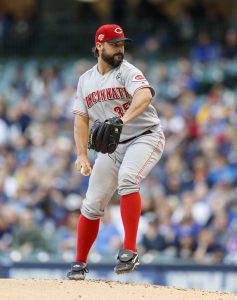
Roark has been a mostly solid starting option since his career began in 2013 with the Nationals. He made 141 starts in D.C. from 2013-18, during which he posted a 3.61 ERA/3.94 FIP with 7.06 K/9, 2.55 BB/9 and a 45.1 percent groundball rate. Although Roark was a quality complement to front-end starters Max Scherzer and Stephen Strasburg in recent years, the Nationals moved on from him last offseason in favor of new acquisitions Patrick Corbin and Anibal Sanchez.
The Reds, seeking to revamp their rotation and make a playoff push in 2019, sent reliever Tanner Rainey to the Nationals for a year of control over Roark. Since then, Roark has held up his end of the bargain for a Cincinnati team whose rotation has indeed taken enormous steps ahead this season. Roark has pitched to a 3.51 ERA/3.86 FIP in 92 1/3 innings and 17 starts, putting him on the cusp of his fourth consecutive season with at least 2.0 fWAR.
An increase in strikeouts has played an important role in Roark’s above-average run prevention in 2019. While he has never been a huge strikeout pitcher, Roark has impressively fanned just under a batter per inning this year. At the same time, he has walked a bit fewer than three per nine, giving him a 3.07 K/BB ratio which sits well above the league mean of 2.65.
Even though Roark has transferred to a home park which is more conducive to HRs, he hasn’t felt the sting thus far. Roark’s groundball percentage has decreased 5 percent since last year and sits at a paltry 35.7 percent, yet his home run-to-fly ball rate has actually dropped a little since 2018 (from 11.7 to 10.8). That has enabled Roark to manage decent numbers at home and on the road. It helps that Roark has generated more infield fly balls, aka automatic outs. At 12.9 percent, he ranks 14th among starters in that category.
Roark has also experienced somewhat of an uptick in velocity since last year. He’s still not going to blow anyone away with his average fastball (92.3 mph), slider (86.2), changeup (84.3) and curveball (76.1), but each pitch has risen around 1 mph compared to 2018. Roark has also mixed those pitches differently than he did a year ago. His sinker’s still his primary offering, but usage of it has plummeted 10 percent, per Statcast, which indicates Roark has turned to his slider about 10 percent more and his fastball at a 5 percent greater rate. According to FanGraphs’ linear weights, Roark’s fastball has been one of the best among starters in 2019.
Now for the bad news: FanGraphs shows the rest of Roark’s offerings all rate in the negatives this year. Although Roark has stifled righty batters, he flat-out hasn’t had an answer for lefties, who have slashed .290/.388/.531 against him. In essence, Roark has turned the typical lefty into Rafael Devers in 2019, in part because he’s yielding more damaging contact than he did in prior years. Roark’s hard-hit rate against is up more than 11 percent relative to his career, while he has surrendered soft contact about 4 percent less, according to FanGraphs. Statcast doesn’t provide any hope in that regard either, noting Roark ranks in the league’s 26th percentile in hard-hit percentage. He’s also far below average in terms of expected batting average (28th percentile), exit velocity (29th), expected weighted on-base average (34th) and expected slugging percentage (39th).
Teams with interest in Roark are no doubt aware of his blemishes, though those issues shouldn’t deter the Reds from finding a taker for him if they try to before the deadline. Roark’s near the top of the league when it comes to curve spin rate (80th percentile), so he could land with an organization which encourages him to utilize that pitch more. Regardless, for clubs that aren’t in position to win bidding wars for more hyped trade candidates such as Bumgarner, Wheeler, Matthew Boyd and Marcus Stroman, among others, Roark will hold appeal. Whether he finishes the season in Cincinnati or elsewhere, Roark will continue attempting to make a case for a raise over his $10MM salary as he prepares for an upcoming trip to free agency.
Photo courtesy of USA Today Sports Images.
They shouldn’t trade Roark but instead sign him, Dietrich and Jose Iglesias to a contract extension! Alex Wood been a bust!
Wouldn’t be a bit surprised if Wood never does take the mound this year. At least he’s in a walk year as well so CIN won’t be saddled with him and his chronic back issues beyond 2019.
DD isn’t a free agent after the season so I’m sure he’ll be back at least for that final year of arbitration
Oh shoot sorry my mistake
The Reds should sign Roark to an extension as he’s an innings eater! They should also sign Dietrich and José Iglesias to an extension! Alex Wood been a bust!
Yes. Because that strategy worked so well with Zack Cozart and Matt Harvey…
They haven’t missed either, no mind!
Which explains why they did the same thing BigRedsFan41017 is suggesting they do now at the trade deadline during their contract years.
Dietrich is a one hit wonder. Comparing him to Cozart is perfect.
tough when a person who knows nothing about baseball makes stupid comments. no comparison between cozart and deitrich, completely different players with different skills.
Bigly, Alex Wood hasn’t been a bust, he’s been hurt. The Reds lack lefty starters, and Wood has put up above average ERA, FIP, ERA+, WHIP numbers, etc. over his career.
Sign him to a prove it extension/contract, and trade the more expensive Roark for a decent prospect or two.
Agree on Iglesias. DD’s future may depend on what Scooter does for the remainder of 2019. Second base is a position that the Reds have very well covered.
Roark has mixed some excellent years with very mediocre years. He’ll also be 33 in October, so he’s far from a sure bet moving forward — the Reds should deal him while his value is high rather than extend him.
Unless of course CIN continues to stay afloat in the division — then by all means keep him through the season.
why trade roark when you are only 4 to 5 games back at the break. add 2 relievers and lets see what we can do
The Reds are not just 4 1/2 games out of a playoff spot, they are only 4 1/2 games out of the division lead. That is a big difference when deciding to sell, 4 1/2 out of the 2nd WC might be a good reason to consider selling. But right now, there should be ZERO NL Central teams considering selling right now.
Assuming the Giants trade anyone. Team starting to gel and JUST 5.5 games back. Plus we get Cueto for the stretch run. The next few weeks could get really interesting.
What’s the end game for the Reds here? Do you really extend Roark when….
– You’re about to lose Puig
– You’re about to lose Scooter
– You’re likely losing Iglesius
– You’ll probably lose Dietrich
– You are 50/50 in re-signing Alex Wood
– Votto is another year old with a nice, fat contract
Are you really prepared to go all out in 2019? Do you have the horses in the minor leagues to obtain the players needed to win? Are you willing to part with the future with little guarantee of a playoff berth?
Put it this way; if you think Pittsburgh should be in buy mode, Cincy is in buy mode.
The Reds have $57 million committed in payroll next year and are expected to have a payroll of $130 million, that leaves $73 million to make a lot of this happen.
-Yes, extend Puig! (5 years/17 mil per season)
-Yes sign the best 1 or 2 pitcher(s) that can be had in free agency
– if scooter gets it going again then resign him but if not there’s a few routes to fixing this:
A. Resign him to a small contract as his value
Will be significantly lowered and he’s a
Hometown player and would most likely
Resign with us as long as the moneys
Nearly equal with other offers
B. You have a 2nd basemen in the minors
That is killing it and should be called up
C. Senzel is a natural at 2nd. Moving him
From the outfield fixes the log jam there
– Vottos still producing and honestly and call me crazy but I’ll take the fat votto contract over the fatter Harper contract any day!
– the rest will sort itself out
Anyways when do you want to win? Should we keep rebuilding like it’s I-75 or finish the build and sustain a good team every year. The cardinals where able to keep a contender nearly every year for the past 2 decades.
Stop being pessimistic and have some faith!
First off, I’m not a Cincy fan so I’m not sure where you see pessimism.
Second, I think my last line showed no pessimism.
Third, you are in-denial if you think those re-signings are going to do the trick.
Forth, I think the team is better off selling at the deadline, bringing up some AAA guys to get their feet wet and going hard in the offseason. I think the Reds can win next year, but not this year.
Why? Because the Reds will have money to spend. With your current squad you aren’t making much of a dent if you squeeze into the 5th WC spot.
– 7 teams in 22 years (have won the World Series, 32% of all World Series champions)
-2006 the cardinals went all the way winning the division by a game and a half and won the World Series with a 83-79 record.
The Reds have the pitching to go
Deep into the playoffs and the offense is finally starting to click. Why be sellers when you have a healthy team with a shot. Outside of Puig, Roark and a few other small pieces they’re not losing anything huge. Sign puig now and spend the other 50 plus million on salary increase and go after the best pitching on the market.
Reds are currently 3.5 games out and just took two series from the brewers and cubs. That’s proof enough that they can make a run at this point.
Proof they won a series in July? Stop the presses, Cincy won a short series before the All Star break. They’re going all the way….
What a weak statement.
I gave you the route to making Cincy and even stronger team next year and you want to weaken it all for a Wild Card loss to, well, pick a team with an ace waiting to shut them down in their park.
After skimming the back and forth between you and Tatis I’d say this is all lost on you and your .500 close-to-last-place Reds.
again 32% of all World Series champions over the past 20 years are wild card teams. The Reds shouldn’t wait until they think everything’s perfect, they have an opportunity now and they shouldn’t waste that opportunity to continually rebuild a team. There’s always going to be the Yankees and the dodgers to beat, the Reds just need to try when opportunity presents itself.
Your plan is to “let’s wait until next year guys” but that year never comes cause you’re too afraid to be bold, too afraid to take a chance.
If you are so sure that Puig is going to sign with Cincy then they should definitely trade him. That way they get Puig and prospects instead of just Puig.
I’m not sure that he’s going to sign, but I hope he does. I’d much rather not take the risk and sign him now. I believe most Reds would be happy just to have it done now rather than take that risk.
There’s no guarantee that he signs if they don’t trade him. Remember Matt Harvey and Zack Cozart?
If they trade him then they’re trading a key factor in multiple wins this past month. He could be the difference if getting into the playoffs this year. The chips picked up from trading him may not do anything for us. I’d rather keep him and make a run and also work on an extension if possible.
The chips they get for trading Puig might not do anything for the Reds. But Puig certainly won’t after 2019 because he can be a FA.
And again, if you are really that sure Cincy will be able to sign him, trading him makes even more sense. Prospects + Puig > just Puig.
I’ve mentioned before that I’m not sure that he’d resign but if I were the GM of this team:
-I’d keep him this year because he puts the Reds in position to get into the playoffs
And
-try my best to get that extension if he’s on the team and having fun that could help bring him to Cincy for years to come. If you trade him, he may think that is a vote of no confidence in him or the team. Or it might tell him that the Reds have no loyalty and would trade him down the road. Some players take that into consideration. Puig also is married and has two kids, so stability could mean a lot to him.
“If you trade him, he may think that is a vote of no confidence in him or the team.”
That’s not true. Players are more aware of the business side of the game than ever before. If the Reds offer him more money than anyone else he would certainly see that as a vote of confidence in him, regardless of who he finishes out this season playing for.
Again, your thinking is precisely what they said when they declined to trade Matt Harvey last year and Zack Cozart the year before that. How did that work out?
Oh and if he’s worried that they’ll trade him again, just give him a no-trade clause. That’ll guarantee him stability.
-You’re still overlooking the fact that I’d keep him for this year and try for the playoffs.
-“That’s not true. Players are more aware of the business side of the game than ever before”
That may be true for a lot of players but that does not mean that some players will see the move in a different light. Why take the risk to gain a minor league prospect?
-“If the Reds offer him more money than anyone else“
If we sign him now, there is potential that we’d save some money and would be able to use that to pick up on another free agent.
“You’re still overlooking the fact that I’d keep him for this year and try for the playoffs.”
And you’re still dancing around the Matt Harvey/Zack Cozart thing.
“That may be true for a lot of players but that does not mean that some players will see the move in a different light. Why take the risk to gain a minor league prospect?”
Unless you can name one player who you can confidently say that trading him away was the difference between him signing with the original team and signing elsewhere, it won’t make a difference. In fact, if I’m Puig, getting traded is the best case scenario. Get to finish out the season playing for a contender and then enter free agency without having a qualifying offer attached. The minor league prospect might not work out, but you are giving up basically nothing to get him.
“If we sign him now, there is potential that we’d save some money and would be able to use that to pick up on another free agent.”
“If” by Rudyard Kipling
It’s a good poem, you should read it sometime.
We lost 94 games the year we could have traded Cozart and were in the middle of a rebuild.
We weren’t in contention last year with Matt Harvey either. This years a bit different, wouldn’t you agree?
I believe that this team is a contender so why trade him?
Also the Reds could have traded Votto before the 2010 season because of his anxiety issues but they stuck it out and Votto has stayed loyal to the Reds. You could say that the money is the glue in that equation but votto has stuck it out with a team that has had numerous 90 loss seasons in a row and hasn’t asked for a trade. Some people value loyalty.
Again Puig gives the Reds a chance to get into the playoffs, why trade him?
You’re missing the point. The reasons the Reds gave for holding onto Harvey and Cozart were the same reasons you gave for holding onto Puig. “We should be looking to extend him, not trade him!” How did that work out?
Oh and Votto was drafted and developed by the Reds and also still had 4 more years of control at the start of the 2010 season even without that contract they gave him. HUGE difference.
I think you’re missing the point:
If the Reds are trying to get into the playoffs this year, They’ll want Puig to remain on the team.
It seams that you’re hung up on Cozart and Harvey. There is no Cozart rule stating that the failure to trade a player in a walking year yields a worse team the follow years.
As for Votto, I believe the way the Reds treated him helped secure that 10 year contract. It might not be the only reason but it probably was a factor.
Now do you think the Reds have a chance at making it into the playoffs? Gray and Castillo pitched back to back gems and the offense is starting to catch fire. If you think that there’s a chance then Puig isn’t something that you would want to trade.
I’m not missing the point. You are.
If you don’t trade a pending FA, then absolutely it yields a worse team the following year because they don’t have that player anymore.
Cozart and Harvey demonstrate the folly of not trading a pending FA when you aren’t contending because you think you will be able to keep him. They both just moved on while the Reds were left with nothing. Closer to home, the Padres did the same thing with Freddy Galvis last year, Jhoulys Chacin the year before that and Justin Upton 2 years before that. They all moved on while the Padres were left with nothing.
The Reds offered Votto a crapton of money well into his decline years and a full NTC. If their plan is to just overpay Puig to sign with Cincy, they can still do that even if they trade him.
You’re overlooking 3 big points:
1. The Reds could make it to the playoffs with Puig. So why trade him if you want to try for the playoffs.
2. If they keep him and give a QO then they automatically get a comp pick that might still be the equivalent of the trade.
3. Trading puig now doesn’t guarantee a better team next year which counters your thinking that it does.
The Reds traded Chapman in a similar scenario to the Yankees in 2015 for 4 players that didn’t better the team in any way. So getting players for a rental doesn’t always equate to a better team. However taking a chance and going for the playoffs does help sell seats and jerseys and that’s a positive!
1. They are at the bottom of their division and would have to leapfrog 7 teams to get the 2nd Wild Card which means a 1-game playoff where they probably run into Max Scherzer or Aaron Nola.
2. They could get a better prospect for Puig than the QO comp pick.
3. Worst case scenario it’s a wash if the prospects they get don’t work out. If they are even marginal contributors then the team is better for the future by trading Puig. Trading him doesn’t mean they can’t bring him back in FA in the offseason.
With Chapman, they played that one miserably. Sold him at an absolute low point in his value when the whole DV thing was going on. But they wouldn’t be looking any better today if they had held onto him and just let him walk after one year.
You STILL refuse to address the Cozart/Harvey thing.
1. They’re 3.5 games back from 1st place. They just took series wins from the two teams that have been in 1st place. The Reds have one of the best pitching staffs in baseball right now and the offense is finally starting to catch up.
2. Again the Reds traded Chapman with a full year of service to the Yankees and received 4 players that did nothing for the team. Trading Puig doesn’t guarantee a better 2020 team.
3. Trading Puig means the Reds are throwing in the towel this year. There’s always potential for a playoff birth and that playoff birth could be a World Series title if the Reds play it right. I believe Puig is essential to the Reds run.
And I did address the Cozart Harvey non trades but it seems that’s chip on your shoulder that you can’t let go of.
The difference between you and I is that I think the Reds have a chance to get into the playoffs this year and you don’t. I think that we need puig for that run and I’d like to have him around for the next 3-5 years. You’d rather trade him and add pieces. I don’t think those pieces are guaranteed to make the reds better and you think keeping puig means that the 2020 Reds are worse off.
In the end you and I have two different philosophies on baseball.
1. And every other team in their division is closer to 1st place.
2. Again, in the worst case scenario, trading Puig guarantees the same team as next year. If the players they get in return are even marginally helpful it means the team will be better for 2020 and beyond.
No you didn’t address the Cozart and Harvey non-trades. You keep saying the Reds should keep Puig so they can extend him. I said that that line of thinking doesn’t usually work and provided Cozart and Harvey as recent examples of it not working for Cincy and you dismissed it.
Again, the pieces they get for Puig might not be guaranteed to make the Reds better for 2020 and beyond. But Puig certainly won’t because he’ll be gone. So if all those pieces they get back end up busting, the trade is a wash.
So the seasons over at the all star break? Any team that’s not in 1st is out? Any team that’s in contention with more than a specified number of teams is disqualified?
Have you been following the Reds this past month?
I have addressed the Cozart/Harvey situation. Maybe you should go back and read.
And trading Puig disrupts this season. Again I believe that the Reds have a chance this year, you don’t. I’m all in and you want to sell. I’m not missing anything, we just don’t see eye to eye.
Trading puig doesn’t guarantee a better future, you can hope that the pieces received will be “marginally better” but they could be non factors and you sold out a chance at the playoffs in 2019.
No you didn’t address the Cozart/Harvey thing. Reds kept them because they wanted to extend them. They lost them anyway. You are suggesting they do the same with Puig.
Trading Puig disrupts THIS season. it doesn’t disrupt the future seasons.
If the players received for Puig are all non-factors the Reds are in the exact same situation they’d be in if they didn’t trade Puig. They aren’t worse off.
It’s ludicrous to even consider trading Puig. Fans have been tortured by bad baseball the past 5 years, and we finally have something to get excited about, and Puig’s play has been at the center of it.
Puig is going nowhere. Maybe. MAYBE if we fall 7-8 games off the division lead by the trade deadline, and his play drops off significantly do we consider it, but then again, his stock will drop, too.
I’ve followed the Reds very closely, as a fan/media member for 40-plus years. As a casual observer of the team, you may not know that:
1. They have an elite pitcher in Luis Castillo.
2. They have a very solid 2-4 in Gray, Disco and Roark.
3. Mahle isn’t a bad No. 5, and has a nice upside. Alex Wood MAY be waiting in the wings.
4. Our offense is starting to click.
5. Our expected wins based on run differential is 11th best in all of baseball, and second to only the Cubs (by 5 runs) in the NLC. In other words, we’ve had a lot of tough, 1- and 2-run losses, and those things tend to even out.
The Reds will beat out the Pirates and Cardinals. Absolutely. If the Brewers don’t improve their rotation, they will get by them, too. No doubt the Reds finish above ..500 this year. If healthy,, I’m guessing 10-over and a wild card spot, as the Cubs are just a bit better.
Reds kept Harvey and Cozart because there were no suitable offers. Teams don’t go stupid for these 2-3-month rent-a-players who are pending free agents. Especially when they are as pedestrian as Harvey and Cozart. Would any team look at either of those guys and say, “This is the guy we need to get us over the hump”? If so, they would have to be damn weak at those positions.
DIdn’t the Yankees flip him to the Cubs for much better prospects than what the Reds got from the Yankees (all of which are out of baseball now).?
Leave that guy alone. Anyone who suggests the Reds shop Puig hasn’t been watching their games. Most HRs in MLB since June 15. Playing great RF and running the bases like a beast. His energy, along with Senzel and to a lesser extent Winker, are what’s catapulted this team. Of course, Votto starting to hit and a nice run from the pitching staff hasn’t hurt!
Excited to be a Reds fan again. Was in the doldrums after the 1-8 start, including those 3 straight 1-run losses to the Brewers in the opening homestand.
I don’t follow the MLB too closely as a whole. Just the Reds. Think there is a catcher available to upgrade the Casalli/Barnhart platoon?
Found someone. James McCann of the White Sox would be a nice upgrade at the catcher position. White Sox are out of it. Perhaps we can deal Cody Reed and Robert Stephenson and TJ Friedl.
“Reds kept Harvey and Cozart because there were no suitable offers.”
Unless you have some empirical evidence that an extra two months with them on the team would make the team play better after they are gone then literally ANYTHING would have been a suitable offer. The alternative was to let them walk for nothing and that’s exactly what happened.
Right. There were no offers.And rightfully so.
Both were claimed on August waivers. Reds honestly would have been better off just letting them go when they were claimed. Especially known clubhouse cancer Matt Harvey.
Also, the Mariners offered Luiz Gohara for Cozart at the 2016 trade deadline. Gohara is probably overrated but he can’t do much worse than the nothing the Reds ended up getting for Cozart.
We’re never going to see eye to eye on this. If I was the owner or GM I’d go all in this year, then in the off season I’d still spend that extra $70 mil and lock down more pieces. That would equate to the following:
-a more confident team with potential playoff experience
-a good team next year as well
-higher attendance
To me the whole nothing for Cozart or Harvey discussion is moot. They had little to no value. I guess you could trade them just for the sake of trading them, but there was no big payoff we missed out on. To me, the biggest mistake this organization has made in the past 5 years was the miserably failed Billy Hamilton experiment. I said he wasn’t an everyday player after reading numerous scouting reports and watching him play. He never improved, yet it took the FO 5 years to figure out he is a bum. Last year we could’ve at least learned if Phillip Ervin is an everyday player. What a waste.
@chettmixx They can still spend that extra $70m to lock down more pieces if they trade Puig and Roark. And maybe the pieces they get back actually help. Even if they don’t, having those guys in the org doesn’t hurt them.
@redrealist the big payoff the Reds missed out on was not having to look at or listen to Matt Harvey anymore.
You continue to overlook why I wouldn’t trade them, I want to go for the playoffs this year! It’s as simple as that, trading Puig, Roark and any other major contributors will significantly decrease any chance the Reds have in 2019.
Your plan scraps 2019 with potentially nothing gained in 2020 and beyond.
Do you mean to reply directly to me, or do we all just get emails if someone responds to this thread in general? I’m new to this “forum.”
Anyway, I agree with you. Stand pat. Add at catcher, if anywhere. Hope Scotter returns to form of past 2 years.
Your plan guarantees nothing gained in 2020 and beyond. Just like holding onto Cozart and Harvey.
Nothing gained? You do realize that winning breeds winning, correct? If this team stands pat and makes the playoffs, the atmosphere will be electric. I’m not saying players will come flocking to Cincy at a deep discount, But winning is fun. Especially as an underdog.
At the core of any sell/buy debate is the simple question: Can this team make the playoffs with what we have?
I say Yes. And with dominant pitching, timely hitting and luck, anything can happen once you get there.
Trading Puig is asinine. I’m done with this topic.
You never started with the topic, except to keep Puig on the basis of 2 months.
What winning has Cincy done?
There are too many teams to climb in the NL. Cincy doesn’t have the team to do it. Leverage the guys in their walk years and reload for next year. Seriously, Cincy could be good next year but punting this year could make them better. Because if you decide to buy, beware. Because you will go nowhere.
Don’t know what you mean by “never started with the topic.”
Regardless, the Reds are 2 games out of first place in the loss column. 5 games from now the entire division could be flipped. Would you say the Cubs have too many teams to climb?
Look at run differential and “expected wins.” The Reds have outscored their opponents by 40-plus runs, yet are 3 games under .500. That, my friend, is what most call a statistical anomaly.
The Reds hitting is starting to come around. More importantly, pitching wins baseball games. The Reds have one of the best rotations in baseball, and their bullpen is among the elite, too.
I’ve watched every game this year. The Reds are much better than their record indicates. Bad luck, untimely hitting, and a tough schedule have contributed to being 3-under. Iggy is 1-7. He’ll be money in the bank the second half.
May not beat out the Cubs, but I’ll bet you anything they finish no worse than 3rd in the division.
“Nothing gained? You do realize that winning breeds winning, correct?”
Really? Did the extra wins from keeping Cozart and Harvey for two months breed more winning? Did the extra wins the Padres received from keeping Justin Upton, Jhoulys Chacin and Freddy Galvis for two months breed more winning?
You continue to bring up Cozart and Harvey as if that’s the reason for 5 losing season in a row. No one on this thread besides you gives a hoot about Cozart and Harvey.
You state “winning breads winning” but you want to give up on this season so we can get a few pieces that may or may not help sometime in the future.
You don’t get that you’re arguing against 2 people that think we have a shot this year and that believe selling at the deadline would screw up any hopes of contention this year.
You’re don’t agree and yet you don’t realize that this is a stalemate for the argument, you and I will never agree on this issue.
The only proof that one of us is right will come in two paths. 1. The Reds keep Puig and make the playoffs, proving my thoughts right. 2. They trade Puig and get pieces that contribute to a playoff run in the next few years. We’ll have to wait and see.
You’re missing the point on the Cozart/Harvey thing. I never said that the decision to hold onto them is the reason for 5 losing season in a row. What I’m saying is that your reasoning for not trading Puig is the same reasoning they gave for not trading them: They wanted to extend them rather than trade them. And then they left after the season anyway.
“You state ‘winning breads winning’ but you want to give up on this season so we can get a few pieces that may or may not help sometime in the future.”
I didn’t state that. I was quoting and responding to someone who did.
“The only proof that one of us is right will come in two paths. 1. The Reds keep Puig and make the playoffs, proving my thoughts right. 2. They trade Puig and get pieces that contribute to a playoff run in the next few years. We’ll have to wait and see.”
Actually, all the pieces they get for Puig have to do in order to prove me right is be above replacement level. That means they contributed more beyond 2019 than Puig would have because Puig will contribute zero beyond 2019.
Trade Puig and Roark if you are not going to make a move to add to the team. Look to extend Iglesias if you can, if not also trade him. Dietrich has 1 more year with the Reds regardless, so no panic there. Avoid resigning Wood, like the plague. Trade Barnhart.
I’d really like the Reds to keep Iggy in 20, but if not they’d still have a solid roster.
1 Senzel RF
2 Trammell CF
3 Suarez 3B
4 Winker LF
5 Votto 1B
6 Dietrich 2B
7 Peraza SS
8 Casali C
U Farmer
U VanMeter
OF Ervin
OF Aquino or O’Grady
1 Castillo
2 Gray
3 Mahle
4 DeSclafani
5 Santillan or FA
HL Iglesias
HL Garrett
HL Lorenzen
ML Hughes
ML Stephenson
ML Reed
ML Herget
LG Romano
Iggy was already extended in the offseason. You know, he’s 1-7, and not having much of a year, to be honest. But I still love him back there with Lorenzen and Garrett. Nasty Boys all over again.
IGNORE!!! I figured out you meant JOSE Iglesias. That Iggy!
Actually, I’m not sure who you mean. Jose Iglesias has been significantly better than Jose Peraza, and has unseated him as the everyday SS.
Yes, I mean Jose Iglesias. He is clearly the best SS we have, I was saying if the Reds, don’t go for it in 19, and are unable to sign him before the trade deadline, that he’d likely be moved. The 25 man roster with Peraza at SS was in that scenario. Also Peraza would still have some completions at SS from A Rodriguez. He’s putting together his best offensive year in AA, and has always been know as a slick fielder.
Ksoze. We can’t settle on Peraza at ss. He’s terrible. Also, Casali and Barnhart aren’t even average. Tyler Stephenson may blossom into that first round pick we made years ago. We’ll see.
But I wouldn’t enter a season thinking Peraza starting at SS is a good option.
If Scooter shows nothing, he’s gone. If he gets it going some they may sign him to a moderate, multi-year deal. DD is controllable for another season. Senzel is excellent at 2B if they trade for or sign a quality CF, or, let Scooter go.
Puig may want to stay. Also, the Org may want him to stay. Stay tuned as it seems there is a love affair developing that could get interesting since our fan base loves the guy.
Winker needs to become an everyday player or he becomes trade bait. Ervin could replace him in a heartbeat. Equally mediocre on D, but Ervin is proving to be a very productive hitter.
Don’t really need a soon to be 33 year old innings eater in Roark after this season. Maybe a 2 year deal at most or let him go. Wood is a myth until he isn’t. The core SP’s are Castillo, Gray, Disco and Mahle. If possible need a lefty SP and another lefty in the pen. Lodolo will be up in a couple years to handle one lefty spot.
You don’t get wild as an org with trades with the roster and performance of this team. They have overcome a horrid start and are just now starting to click. Bell is beginning to figure things out a bit better. Having DJ as the pitching coach is making life much easier for him. There’s some talent on the farm they will blend in over the next few years.
They’re all gone. Remember Matt Harvey and Zack Cozart.
The Reds should and will stand pat. The only position I think they could stand to upgrade is catcher. I’ve never liked Barnhart. Not even when he won a Gold Glove. He was just a plug for Mez with absolutely zero pop in his bat. And defense from the catcher position is vastly overrated, given the pitcher’s roles in holding runners and the diminished running game in the Bigs as a whole.
But I don’t know who’s out there who would be an upgrade over Casalli.
Call me crazy, but I like our platoon in LF with Winker and Ervin. Senzel and Puig in CF and RF are nice. Suarez, Iglesias, and Votto are solid, too. The platoon of Peraza and Dietrich doesn’t hit for average, but DD has pop.
I love our rotation and most of our bullpen. Not as in love with Hernandez as Bell is, but he’s not a total loser.
Reds kept Harvey and Cozart because there were no suitable offers. Teams don’t go stupid for these 2-3-month rent-a-players who are pending free agents. Especially when they are as pedestrian as Harvey and Cozart. Would any team look at either of those guys and say, “This is the guy we need to get us over the hump”? If so, they would have to be damn weak at those positions.
In case my “expert” opinion isn’t sufficient …
“Which division race will be the most interesting the rest of the way?
Passan: There’s a reasonable amount of intrigue in both leagues’ East and Central divisions. The AL East has three extreme haves and two tailor-made have-nots. The AL Central comes down to: Does Cleveland sell or take another crack? The NL East is juicy, with the Braves and Phillies and Nats and whatever comes of the Mets. But the NL Central, with the Cubs’ inconsistency and the Brewers needing another Christian Yelich MVP grab and the Reds’ upside-down run differential, is intriguing enough for a realistic shot at another Game 163.
Olney: NL Central. Five teams enter, one team prevails, and the rest will be left to wonder what the heck went wrong.
Schoenfield: The NL Central. Every team is going to end up 82-80, giving us a five-way tie. How do you break that tie? I don’t know! MLB’s tiebreaker scenarios don’t yet include that one. Better put somebody on it.
Doolittle: Like Buster and Dave said, the NL Central is a true five-team race that could be tilted in any direction by key injuries or trade acquisitions. The Pirates have to be considered the long shots because of their antipathy toward aggressive acquisitions, but they’ve also hung in there with a largely underachieving starting staff. If that group gets going, and the Bucs don’t trade Felipe Vazquez at the deadline, anything could happen. The Cardinals are another team with a lot of positive regression lying ahead of them.
Don’t even know what point you’re trying to make anymore with Cozart and Harvey your logic is so absent. The quicker you get it out of your mind that those two players had any value the better off you are. The Reds did not miss out on anything by not dumping them. They were worthless and would have got nothing for them so they held on to them.
They are certainly keeping Puig as he is a key part to Our Success. We are two games out in the loss column for first place. It is anyone’s division. You’re stupid to even suggest Puig should be traded.
Cozart and Harvey did not help the Reds win enough games to compete for the division title. Puig will. His intensity is contagious. Winning is contagious.I can only hope your stupidity is not contagious as we’re all in trouble if so.
I’ll go slowly. chettmixx said that they should extend Puig rather than trade him. I pointed out that the Reds utilized the same strategy with Cozart and Harvey and both players walked anyway. Showing that just because the Reds don’t trade Puig doesn’t mean he will stay. And just because they do trade him doesn’t mean they won’t.
And again, what they missed out on by not trading Matt Harvey was not having to look at or listen to him anymore.