
Marc Narducci spent 37 years covering all sports for The Philadelphia Inquirer before recently retiring in July. He covered everything from high school sports to the Phillies winning the World Series and the Eagles winning the Super Bowl. A lifelong Southern NJ resident, he remains a freelance writer and broadcaster. Marc reached out to see if MLB Trade Rumors would be interested in publishing his Hall of Fame ballot. I am happy to do it and hope it can be an interesting topic of debate for our readers. Here’s Marc…
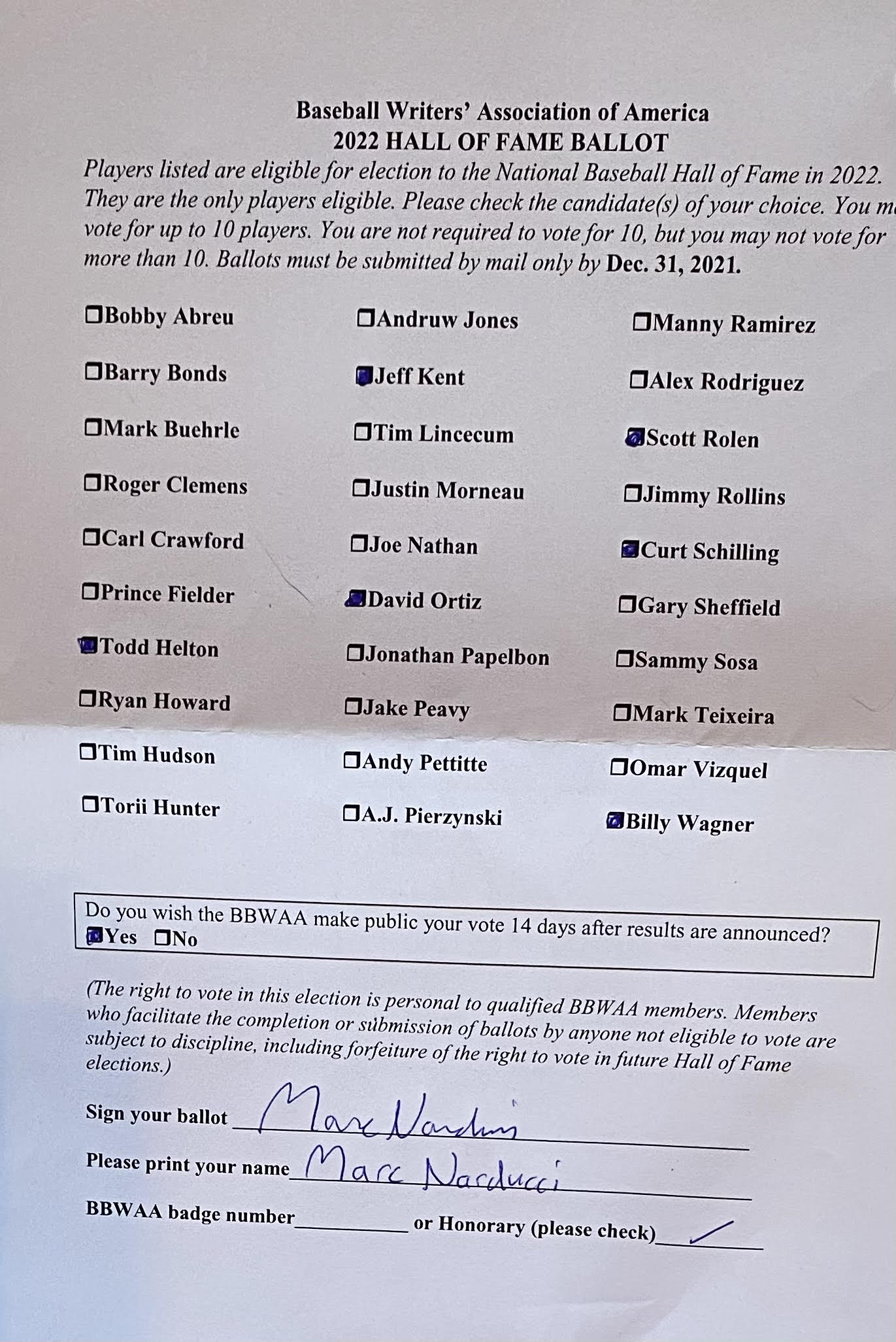 Voting for the Baseball Hall of Fame is an honor, but it’s difficult to see any sport where the task is more challenging.
That’s because of the steroid era.
One thing that should be stated off the bat is that there is no right or wrong answer when filling out the ballot in the opinion of this reporter.
As a former The Philadelphia Inquirer writer for 37 years, the decision of other voters won’t be questioned.
We can all agree to disagree and there will be many disagreements, especially when seeing my ballot.
The steroid era has made things so difficult. Do you vote for players associated with steroids?
One school of thought says the best players should go in regardless and the Hall of Fame would be empty without some of the great stars of the game such as Barry Bonds and Roger Clemens.
Others, and this is the camp will you find me, look at it the opposite way.
The steroid era did permanent damage to the sport. It also hurt the players who followed the rules and were thus competing at a severe disadvantage. Not only that, it hurt former players such as Hank Aaron, who was the all-time home run king and was passed by Bonds.
Due to the damage of the steroid era, Bonds, Clemens, Manny Ramirez, Alex Rodriguez, Sammy Sosa and Gary Sheffield aren’t on my ballot.
Ramirez and Rodriguez tested positive for PEDs. The others didn’t but Sheffield admitted using a steroid cream. Sosa, Bonds and Clemens maintain their innocence.
Sosa was caught with a corked bat, which even without the suspicion of steroids, would be a stain against his candidacy.
Two former federal authorities who were central to the Bay Area Laboratory Co-Operative (BALCO) steroids trafficking case, say there is no doubt that Bonds and Clemens used performance enhancing drugs during their careers.
Again, I know that people feel that writers are being sanctimonious in keeping players out whose on-field exploits deserve induction, but everybody has to vote the way he or she thinks is best.
So why is David Ortiz on this writer’s ballot?
We will get to that in a bit.
Here are the players that I voted for in alphabetical order on my ballot in my second year as a voter. One other thing – we know that stats such as RBI and pitcher’s wins are taboo in the sabermetric world, but we have included them for people who still care about those statistics.
Let’s get this out of the way first – there are those who won’t vote for Helton due to the fact that he played his career at Coors Field. No doubt it helped him, but he was more than solid on the road. Plus, the toll on a hitter having to go from playing in Colorado to another city isn’t easy.
In addition, a lot of players have competed at Coors and didn’t come close to the numbers that Helton posted. (All stats used are courtesy of Baseball-Reference.com and Fangraphs.com).
Here is his career slash line at Coors: .345/.441/.607. This was Helton on the road: .287/.386/.469.
Having an .855 road OPS isn’t too shabby.
Let’s look at two stats that take into account the ballpark – OPS+ and WRC+. Helton’s career OPS+ was 133 and his career WRC+ was 132, which means he was 33 percent and 32 percent above league average in those categories
Helton is off the charts with his career offensive statistics.
He had a career .316/.414/539 slash line with 369 home runs and 1406 RBI.
Helton was a five-time All-Star, a three-time Gold Glove winner and was Top 10 in the MVP voting three times.
His career OPS of .953 is 22nd on the all-time list. He also had more career walks (1,335) than strikeouts (1,175). That is almost unheard of in these free-swinging days.
During a 10-year stretch from 1998-2007, he hit .332/432/.585 with 298 home runs and OPS+ of 144. His career B-WAR is 61.8, which is 17th among first baseman. Of those 17, 11 are in the Hall of Fame.
A former college quarterback and teammate of Peyton Manning at the University of Tennessee, Helton was the No. 8 overall pick of the Rockies in the 1995 draft and would play his entire 17-year career with the Rockies. This is his fourth year on the ballot and he received 44.9% of the vote last year.
Kent has just two years to go on the ballot and last year he earned just 32.4 percent of the vote. He had a special skill that was way above the second basemen in the Hall of Fame – the ability to hit home runs. Kent has the most home runs of any second baseman in history, 377. He hit 351 of them while playing second base.
Even if one takes the 351 total, that is 50 more than the closest Hall of Fame second baseman, Rogers Hornsby, who hit 301.
Hornsby (.577) is the only Hall of Fame second baseman with a higher slugging percentage than Kent’s .500.
Only four Hall of Fame second basemen have a higher career OPS than Kent (.855). His 1.518 RBI are third among all second basemen.
Kent was a five-time All-Star, the 2000 MVP who hit for average (.290) and power. He also had a career 123 WRC+.
His career B-WAR was just 55.5, but that was mainly because he was considered a below average fielder.
Still, his offense was elite, surely enough for HOF induction.
In 2009, the New York Times reported that Ortiz was among the list of players who failed a 2003 anonymous drug test. Commissioner Rob Mandred says there were 10 false positives in the survey testing and it is possible that Ortiz was one of them.
He also said Ortiz never failed a drug test although we cited examples of the above mentioned players who didn’t either. That said, I feel less certain about Ortiz and only he knows the truth.
So giving him the benefit of the doubt, he’s a sure-fire Hall of Fame player even though he spent the majority of his career as a DH. For instance, 485 of his 541 career home runs came as a DH. Ortiz hit for average (.286) and power. Besides the 541 home runs, he had a .931 career OPS and career OPS+.of 141. He is also 22nd on the career RBI list with 1,768.
In the postseason he helped the Boston Red Sox win three World Series titles, and hit .289 with 17 home runs and a .947 OPS in 385 plate appearances.
There are 17 third basemen in the Hall of Fame, fewest of any position. Only nine third baseman have a higher B-WAR than Rolen (70.1), eight of whom are in the HOF and the other, Adrian Beltre, is a sure-fire candidate. (This also includes Paul Molitor as a third baseman, even though just 3,623 of his 1,267 plate appearances came at third base. It does not include Alex Rodriguez, who had a career B-War of 117.5, but only 42.7% of his plate appearances came as a third baseman).
Rolen was a seven-time All-Star and eight time Gold Glove winner. His defense was every bit as strong as his offense. Rolen’s defensive B-WAR (21.2) is behind just one Hall of Famer – Brooks Robinson, who is No. 1 among third basemen (39.1). (Beltre, at 27.1 is a future Hall of Famer ahead of Rolen).
Only eight HOF third basemen have a higher OPS (.855).
Rolen finished with a .281 average, 316 home runs and 1,287 RBI and was NL Rookie of the Year in 1997 with the Phillies. His career WRC+ was 122.
Rolen was a World Series champion with the 2006 St. Louis Cardinals, batting .421 with a 1.213 OPS in the five-game win over the Detroit Tigers.
He was a major threat on offense and defense, both carrying equal weight. This is his fifth year on the ballot and he is trending upward after earning 52.9% of the vote last year.
Schilling may be the first player to talk his way out of the Hall of Fame. His public comments and tweets have been well-documented and he will likely pay for them. This is his 10th and final season on the ballot. Last year he was close to the 75% total with 71.1%. Normally that would mean he would make it this year, but it would be a surprise if he gets in. He even tried to get off the Hall of Fame ballot, saying he doesn’t want to get voted in by the members of the Baseball Writers Association of America. That is not exactly a convincing way to sway voters. The Hall of Fame denied his request.
That said, what he did on the field, despite all his verbal gaffes, make him a Hall of Fame pitcher and he got my vote.
Just a few numbers..
Everybody talks about his 11-2 postseason record in 19 starts, but his WHIP was 0.968 and his strike-to-walk ratio was 4.80.
He was a late bloomer and still went 216-142 with a career a 3.46 ERA and 3,116 strikeouts.
Schilling won three World Series titles, two with Boston and one with the Arizona Diamondbacks and went to another World Series with the Philadelphia Phillies, where he was the 1993 NLCS MVP. He was runner-up for the Cy Young Award three times and fourth another.
Schilling was among the best big-game pitchers of his era and the only thing bigger was his mouth, which will likely keep him out of Cooperstown.
There are eight relief pitchers in the HOF. Only Mariano Rivera has a better ERA and ERA+ than Billy Wagner. A seven-time All-Star, Wagner’s career ERA was 2.31 and his adjusted ERA was 187. His 11.9 strikeouts per nine innings is best in MLB history (minimum of 750 innings pitched). He also has a career 0.998 WHIP.
Wagner had 422 saves in 491 opportunities (85.9 percent). Only two Hall of Fame relievers have a higher save percentage. Mariano Rivera (89.1%) and Trevor Hoffman (88.8%). Wagner also has a higher strikeout ratio (33.2%) than any reliever in the HOF. The closest is Hoffman (25.8%).
Now the negative. Wagner pitched only 903 innings, fewest of the Hall of Fame pitchers. Wagner also didn’t have a stellar postseason record, although it included just 11 2/3 innings over 14 appearances.
We can see why some may keep Wagner out due to the fact that all eight relievers in the Hall of Fame each exceeded 1,000 innings. Yet he has so many top achievements among the best relievers in the game’s history that he belongs with them in Cooperstown.
This is his seventh year on the ballot and he received 46.4% of the vote last year.
You aren’t keeping steroids out of the hall you are just punishing the best players who used them. Get off your high horse and vote at the very least Bonds and Clemons in or you shouldn’t deserve to have a vote.
Clarence Clemons is already in the Hall of Fame.
The big man! Gone way too soon.
“I’ll tell you this, Major League Baseball is going to have a big problem, big problem on their hands when they find out they have a Hall of Famer who’s used.” – Jose Canseco
Most believe he’s referring to a certain former Oakland teammate.
Who’s he talking about? Rickey? Eck?
So your argument is vote in players who were better cheaters?
Yes
Listen, if you’re going to put Harold Baines in you might as well put everybody in. What a joke! Ahahahaha!
Harold Baines was a huge mistake.
As long as Baines and mazoroski are in everyone has a chance.
Willie Mays was caught cheating on the 51 Giants and he gets in. If Mookie keeps hitting well into his 30’s, he could have a shot as a cheater in 17 and 18. Shoot, the Veterans committee could let ’17 cheater Altuve in (after he dies lol).
Let all the cheaters in. Who cares at this point?
This guys ballot is a joke. Not one time during their careers did I think of the Hall Of Fame. This guy is mixed up.
Not clear that Mays was one of the Giants’ cheaters in 1951 or even how much was done. If so, Irvin who would be more likely than Mays to have cheated should not have gotten in. The Giants won in 1951 more on pitching than on hitting (and I’m a bi Brooklyn fan who cried when Thomson homered).
Not one time during their careers did I think of the Hall Of Fame
================================
If you never thought of Rolen, Schilling, or Wagner as HOFers, that’s on you, not him.
I’m actually with him on that one. maybe schilling. probably schilling. I never thought of rolen as one. I’m a Padre fan so I think of Tony gwynn and Trevor Hoffman and Dave Winfield. you knew they were hofers when they were playing
Very true. Primitive reasons and really doesn’t seem to know what the hall is about.
Are you ok? I think you need to see a doctor. Or maybe just someone who knows what they’re talking about.
Rolen career bWAR and bWAR/650 are 70.1 & 5.3
Gwynn career bWAr and bWAR/650 are 69.2 and 4.4.
This isn’t a discussion of whether on is better or worse. More that we have the tools to compare, so it is incumbent upon the voter to explain why they disagree with the numbers.
Hank Aaron was a greenie junkie.
maybe because they A aren’t HOF’ers….
Altuve didn’t cheaaaaat! Idiot
Joe says…:
It’s not about players getting in that were better cheaters. It’s about keeping better players out, while voting in guys that were better at not getting caught..
Those who can, work in the industry for 37 years. Those who can’t, criticize anonymous on websites.
Meh. Why does a media guy decide who goes into the hall of fame? What a pathetic deal for players. Its been proven that these guys hold grudges and withhold their vote because of inferiority. Its like having them decide if you go up or down after you croak.
that is why I used to care about the Hall but now it is a joke. Steroids in the steroid era wasn’t cheating – it was an arms race. If one team was cheating to gain a competitive edge and won all the rings you may have an argument but not letting players in the hall who tested positive is just covering up for MLB because they failed to properly tamp down something that they profited on and dismisses an entire era of players, making the hall non representative.
Because “media guy” is member of the BBWAA which vote for HOF inclusion
20 writers did NOT vote for Theodore Samuel Williams.
I could give plenty more examples of why writers shouldn’t vote, but that alone should be sufficient.
I don’t think known steroid users should be elected. It’s a disgrace to the game. But it’s also a disgrace to the game that the baseball writers have taken the stance that they’ve taken, ignoring their own part in it and washing their own hands of any blame. The beat writers knew who was and wasn’t using all along. They played along all the way up until Congress got involved, then they suddenly became purity judges. The whole thing is a huge stain on the national pastime and everyone involved, not just the players who cheated.
it has been a joke for at least that long. The hall of the very good and of course, NICE.
well said
@mr guy.
Its a simple question: do you reward players who cheat? Much of what was being used was not only against the rules, but against the law (unprescribed).
wrong. it wasn’t again at the rules at that time.
I was kind of surprised that the baseball writers’ ballot was so poorly written.
Excellent.
So, because he does not agree with you he doesn’t deserve a ballot? BS! You do not have to like his selections or his reasoning, but he is more than qualified to have a vote.
Why are media/journalists considered qualified?
Because internet trolls aren’t available to do the voting!
Simply put – They watch all the games. They’re practically a part of it.
Here’s an example – I worked for the Red Sox for one season (tv work for NESN) and saw every pitch in every damn game. You see things even passionate fans don’t see when it’s your focus and job. I even ate in the press lunchroom and sat with all the media people – they have to be at the games early and they stay late. I got to talk to the players when batting practice was going on. I knew that team and that season like I have never known another baseball season, and I had season tickets to the Giants in 2002 and went to every game.
Writers are also there talking with other writers, going to the towns, talking with players of all teams, doing pieces on them, etc.
yes but they also miss the macro view. Watching and analyzing every pitch and being an insider doesn’t give you a better view of the sport, just a different view of the sport. nowadays unlike when I was a kid and the news and box scores told you what was going on, literally any person can gain access to watch and rewatch every pitch and every step a player plays on the field.
“Watching and analyzing every pitch and being an insider doesn’t give you a better view of the sport”
You’re saying seeing the game in person, watching all the pitches, seeing the nuances, how the players behave, etc doesn’t give you a better view of the sport than looking at a box score and reading the recap?
I honestly couldn’t disagree with you more.
“Simply put – They watch all the games.”
no they don’t. if anything, they don’t even watch all the games of one team, let alone the entire league.
Huh? These writers travel with the team – they see road games as well as home games. – they also have to file extra stories on the team they cover. When they are on the road they get intimate details on the opposing team as well. That’s 162 games minimum a year, plus spring training and playoffs and off-season.
They see it all – and as I said they are often chummy with all the other writers of the other teams. They often follow the teams for years.
You don’t think Dan Shaughnessy knows more about Pedro Martinez and David Ortiz than any Joe Schmo Red Sox fan?
I don’t think you read his comment. He literally said that you used to only have box scores and recaps years ago. Now, ANY fan can gain access to watch and analyze every pitch. Outside of going to or watching a game, the box score, recap and maybe the nightly local news highlights were the only way to catch anything when I was a kid. Now you’ve got MLB.tv – you can watch any historical or live game and literally analyze every pitch. You have Statcast which gives numbers behind that analysis. You have baseball reference and Fangraphs for even more numbers and comparisons to other players across the history of baseball. You also have anything the coach or player has said on record. You also have Twitter, which if active, a player displays behaviors.
Ultimately a HOF player is not judged on what they do in batting practice.
I get what he’s saying, but I’m not sure you’re getting what I am saying. Anyone can look at a stat sheet and say “he’s good, he’s bad.”.
The HOF isn’t just about 500 homers, 300 wins, and whatever trendy stat is being touted as the end-all-be-all of defining what a great player is. They watch it day in and day out and can see it with their own eyes. They can see the respect a specific player is given around the league, they can hear other players talk about someone. It’s how a team performs against a player, it’s how the crowd reacts, and so on.
I dunno… I see a certain beauty in how that defines a player as much as what FanGraphs decides.
The writers are awful, awful voters. In Simmons only vote, he got 3.7% of the vote. When people who know the game voted, he got in. And Shank doesn’t know a fraction of what I know about baseball.
porkin – Besides the Red Sox (and maybe the Rays, Yanks, Jays and Orioles) how often did you get to watch players on other teams? Each year there was likely ten teams that you didn’t see at all, and another 15 teams that you saw only 3-6 times a year. And you think THAT is “watching all the games”?
I have the premium MLB.TV package, I can watch every single game being played every single day if I want. According to you, that makes me MORE qualified than writers who have to follow the same one team every day of the year.
Not only that, writers are likely to be a lot more biased than me because of their personal interactions with players and knowledge of off-the-field behavior by the players.
Voters should be completely impartial and make their decisions based solely on statistics and what they have seen on the field of play.
Joe – I agree with you, especially about CHB aka Shank.
It’s not just the HOF voting that writers often embarrass themselves with.
What about award voting? Remember Evan Grant leaving Pedroia completely off his MVP ballot the year Pedey won MVP?
Remember George King and LaVelle Neal leaving Pedro completely off their MVP ballot?
At the very least, writers such as those three should be banned for life from voting for anything.
If you see all the games of just one team it maybe give you a better sense about some players of that especific team but that does not make you an expert for the rest of the league. So, no one can say that is an expert in all the players of all the teams.
@machurucuto
Not all the votes are cast by this writer. There are media members from all the teams. Just like when you vote in elections, you will see it from the perspective of someone from your area. If you’re not in coal country, or the rust belt, perspectives change. So too in HOF voting. The perspective of a NY writer is going to be different from a LA writer, or from Pit, or Hou. If a player had a strong enough career, without cheating, they will get in. If you filled out the ballot above and gave your rationale, it would get torn apart as well. Kudos to this writer for being willing to go public with his. Agree or disagree, he gave his reasons, and I respect that!
your right, it’s not about stats. It’s about being nice to the media and having the reputation as a nice guy. it’s also about finding a way to not have writers make unfounded assumptions about you.
This is obviously an unbiased opinion from giant4life.
There is an argument to be made that had these elite players not used steroids, the rest of the league around them that was using steroids would have outplayed them. Maybe they don’t put up the numbers they did and maybe they don’t stand out as hall of famers because the rest of the league is juiced and producing at or better than what they could without roids. Thus, they are damned if they did and damned if they didn’t because some of the guys that used roids and are in have flown under the radar but these players because they are higher profile are punished. Either let these guys in or remove Pudge, Piazza, and Bagwell and show some consistency. Pathetic to think that the best players any of us have seen won’t be in the hall because they are higher profile roid users than others.
Except Bonds and Clemens would have been first ballot HoFers easily had they stayed clean. Bonds had won 3 MVPs, joined the 40-40 club, and won numerous GG’s all while playing clean. He was unquestionably elite before steroids. Clemens had won 3 CYA’s, an MVP, and led the league in ERA+ numerous times. It wouldn’t have been other players that kept them out, clean or not. As proof, look to Ken Griffey, Jr., and Greg Maddux. Both were clean and got in on the first time. Bonds and Clemens kept themselves out of the Hall.
100% agree
Let me attempt to understand your logic. You are ok with a guy like Piazza or Bagwell getting in even though they likely wouldn’t have had they not used roids but you aren’t ok with a guy like Bonds or Clemons getting in because they likely would have gotten in without roids? So reward the guy who gets good enough to make the hall because of roids but don’t reward the guy who was already good enough? Also, how do you know that guys like Griffey or Rivera or Thome and others didn’t use roids?
Who ever said I was ok with Piazza and Bagwell in there?
How do you know when they started cheating? Why give a cheater the benefit of the doubt?
Unfortunately, the writers already chose to ignore obvious “suspicions”. I don’t want to make it worse however by continuing down that path when others have been ignored. Munson, Evans, Tiant, Belle, McGriff, Garvey, the list never ends. What about Jeff Kent with only two years left? He was batting I recall behind Bonds not in front of him and busted his butt to become a great hitter.
For Bonds, I read an interview with Griffey, Jr., who said Bonds had talked to him about his intention to use steroids. Griffey tried to talk him out of it. I want to say that conversation took place in the late 90’s. There’s also visual evidence. He came into the league looking like a slightly beefier Kenny Lofton, then when he hit 35, he suddenly put on that much muscle and his head magically transformed into a watermelon?
And I do believe that people generally deserve the benefit of a reasonable doubt. This is different than requiring undeniable proof. I’d wager that a relatively small percentage of us fans think Bonds was 100% innocent. There are the aforementioned visual clues, his having Ruthian seasons starting at age 36, and a whole bunch of shady ties. In my mind that’s enough to keep him out of the Hall. He had bulked up some between 1986 and 1996, but that wasn’t as much as after 2000 and it’s natural for men to fill out in their 20’s.
Likewise, Clemens looked like he was slowing down in his early 30’s, which often happens. Then likewise seems bigger and has some of his best years.
So, no, I don’t know for certain when they started cheating, but given certain evidence, I don’t believe they cheated throughout their careers, only in the latter parts of them. I don’t give them the benefit of the doubt on cheating, just on cheating early on.
Nonsense. They cheated. Period! They might have become HOFs without the drugs but they took them anyway. Just look at Bonds physiology over the years. Robbing Hank Aaron of his title was shameful and you know it, giant4life.
You don’t think Bonds was already locked into the HOF prior to the the physical evidence of him using steroids? IMHO he was, from articles I read he craved the adulation that Sosa and McGwire were getting during their HR run off.
Cheaters don’t deserve to be in the Hall of Fame, period. Bonds, Clemens, A-Rod etc, they all chose their path, now they have to reap what they’ve sewn.
*sown.
If you’re going to be doctrinaire and sanctimonious, so shall I revel in the irony.
I’m not sure what the correlation is between my opinion and a misspelled word?
You’re not nearly as intelligent as you believe yourself to be, flamer.
dude, soooooo many people in the HOF cheated in sooooo many ways – enjoy your HOF with just harold baines in it.
Stupid. How do you know Bonds and Clemens didn’t cheat earlier in their career. Cheaters were rewarded with big contracts and applause. Fraud in my book and they took money and playing time that others might have deserved.
Selective hypocrisy, the Hall of Fame is littered with PED users, players who took amphetamines, threw spitballs, Sosa and Mc Guire saved baseball, My rule is if they played in a game, it counts good or bad. People are sick of PED discussions which the MLB brought on themselves. The writers like it because it gives them power. Players in the Hall like Bagwell, Henderson, and Piazza probably took steriods. Recently the MLB gave Victor Cruz the Humanitarian award, he was busted with A-Rod (Biogenisis) in 13 and proceeded to lead the league in homers for the next 6 years. We all know Papi, was on the list of PED users, yet he is well liked and gets a pass. Time to put the best players of all time like Bonds, Clemens, and A-Rod, otherwise it has no cred in my book.
it is also on record that mantle and ruth received steroid injections and mantle actually missed time due to an infection from an injection site.
lol you just describe our current government
Totally agree. Bonds made great contact, could see the ball better than almost anyone and had a great follow through swing. Steroids maybe helped him drive a few more but his talent is few and far between.
His best year came as a 39-40 year old. His peak was as a 37-40 year old. We’re talking some of the very best single season offensive performances, if not the best, of any age group.
I would replace David Ortiz with Andruw Jones but I agree with the rest. I have no doubts Big Papi will get elected by the BBWAA and probably on the first ballot due to his popularity.
Won’t vote for Bonds or Clemens (who if they weren’t jerks and nice guys like Ortiz they probably would be forgiven), then he voted for Kent & Schilling who are jerks. Kent didn’t cheat? Sure…
Steroids don’t make you talented, you have to have skill. Bonds should and Clemons should both be in first ballot on pre steroid accomplishments. This is why pompous writers should have no part in selection process
That’s right
I disagree with the thought process of PED users are absolutely entitled to be in the Hall of Fame!! Think of players such as Hank Aaron. “IF” Hank Aaron was able to use PED’s during his career—- like Bonds—-he would have hit over 800 career home runs!!! Easy!!
But—Hank Aaron didn’t us PED’s!!! I personally ask him at a signing he was at—-“How many home runs do you think you would have hit if you had used PED’s to the extent Bonds did?”
His Answer was 755. “I wouldn’t have used PED’s even if they had been offered to me during my playing days!”
That integrity!!!!
“Integrity”—-Something perpetual PED USERS did not and still don’t have!!!
In my opinion— just as hundreds of thousand pure Baseball fans——those obvious PED USERS should never be elected into the Hall of Fame!!!
Plus—- just as Roger Maris had to endure for a different reason—— Bonds should have an astric placed in front of his name for both the individual season HR record and the Career HR record.
Roger Maris is still the Non-PED Individual HR season record holder at “61”
Hank Aaron is still the career Non-PED Home Run Record holder at “755”
Dude loved greenies
Jeff Kent needs to be in the Car Wash Hall of Fame.
And that’s it.
No, that;s all Lenny Dykstra!
Sorry, Marc, but your sanctimonious drivel about PEDs is immediately belied by the vote for Ortiz. And the pathetic effort to explain that away simply underscores the hypocrisy.
In no world does Ortiz belong in the HOF if vastly superior players like Bonds and Clemens aren’t there. What a joke.
A forensic analytic deep dive into his stats and his amazing turn around in his mid 30’s when he was nearly out of baseball and the fact that he actually got better almost every year until he retired at 40 should tell you everything you need to know about whether Ortiz cheated or not. Keep in mind he ended his career with a year comparable to the best year of his career at age 40 with an OPS of 1.021!!
Statistically impossible…or at least close to something like 99.999% unlikely. People have been convicted of murder with less odds based on DNA evidence probability.
Well said doc. Go look up barry bond’s ‘04 season stats on baseball reference. You could pump steroids into every known human in history and nobody could ever come close to that season. Its the greatest individual season in the history of baseball. I dont care if he was juicing in the batters box every game. Bonds was not a nice guy at all. But ive never seen a better player.
Eh. Ted Williams would have been much better.
Of course you don’t care but a majority of people do. He made a decision to cheat and he can live with it.
Before Bonds started juicing, he was very good, but still not as good as many other players. Ken Griffey, in his prime, was better than Bonds in his pre-juice prime.
Even that’s not true. Look at their numbers from the early 90s. Griffey was absolutely amazing. Bonds was even better.
Griffey fell off a cliff when he went to the Reds, just ask Jim Boden!
Actually, a majority don’t care. Bonds has had more than 50% of BBWAA votes for 5 years. And as the younger generation comes in they have shown they are less likely to care. If Bonds and Clemens eligibility was 15 years like it had been before, they would surely make it in as the old dogs retire or become irrelevant.
Last 5 Cycles, 2017-21, First Time Voters:
Bonds 51/60 (85.0%)
Clemens 52/60 (86.7%)
bbhoftracker.com/ 12/17/21
Joey Votto must be juicing then by this logic
Votto and Ortiz are nowhere near comparable. Votto played GG at a sustained elite level and has steadily declined,not improved.
Totally agree, Oritiz can’t hold Bonds/Clemens or A-Rod’s jock!
Why would a grown man want to hold another man’s underwear?
All I see on his ballot are Big Papi (a no-brainer) and maybe Billy Wagner plus several nominees for the Hall of Very Good.
Todd Helton deserves to be in, as well.
Papi, can’t hold A-Rod’s jock, What new substance was he taking down in the Dom Rep. Isn’t that where Sammy Sosa was from
Ortiz texted positive for PEDs in 2003 as part of the Mitchell report
Who did he text it to??
Your mother said he told her
The Mitchell Report did not reference David Ortiz.
In 2009, Michael S. Schmidt of the New York Times reported that Ortiz was one of the players who tested positive for PEDs in the 2003 survey test:
nytimes.com/2009/07/31/sports/baseball/31doping.ht…
Seven years later, Rob Manfred said that that test, which was supposed to be an anonymous gauge of the total percentage of players using PEDs at the time, had more than 10 false positives:
usatoday.com/story/sports/mlb/2016/10/02/rob-manfr…
I take it with a grain of salt that the NY Times would report something negative on a pair of Boston players, given the rivalry. That said, I’m of the opinion that he probably did cheat, just maybe not to the extent that Bonds, McGwire, and Sosa did.
Sosa’s PED history is way more akin to Ortiz than Bonds/McGwire.
Sosa was an average to below average player pre-homerun race. Much more akin to Ortiz than Big Mac. Big Mac was hitting tanks for team USA while still in college.
You may not think Sosa is a HOFer, and that’s fine, but to say he was average to below-average prior to the home run race is just factually, demonstrably wrong. From 93-97 he averaged over 4 WAR (both f and b), went 20/20 twice, went 30/30 twice, and the season he did neither he hit 40 HRs. People like to act like Sosa was all roids, but he was a good player trending upwards even before the roids (in large part due to a drastic increase in discipline, cutting his strikeout rate nearly in half).
Maybe, but the league used them to save baseball. It’s ok for the league to juice the baseball to increase scoring or ruin pitchers arms by eliminating sticky substance they have been using for 50 years or more! Interesting!
More fake news, if you believe the Mitchel report., all the great players were taking PEDs in that time period just like 90% of the players were taking amphetamines for 50 years. Since they were eliminated the league batting averages has gone down 30pts.
The Mitchell report was just the tip of the Iceberg for all the fake news that has taken over our lives today!
No one tested positive as part of the Mitchell Report; it was simply a report, not mass testing.
Good stuff, thanks for sharing.
Yes, you are being sanctimonious. Is there a Hall of Fame for writers who have done nothing wrong? You would NOT get my vote..
Schilling wants YOU lynched (dead) but you want HIM in the HOF over Bonds?
Who did Schilling say he wants lynched? Did he threaten Marc Narducci, or even know who he is?
He wanted ‘the media’ lynched.
Never thought about Todd Helton as a Hall of Fame, he was better than I thought, but still
Worth considering though
I agree. I was like Todd “Coors Field” Helton? But the numbers back him up. Hit well away from Coors, gold gloves, not even a whisper of steroids. But the clincher for me was more career walks than strikeouts. Shows me he was the one in control of the at bat when he was up. I’m a convert.
Yup I was wrong about Helton. I’m deleting my other post where I say he wasn’t very good. He was an excellent hitter with a great eye.
Helton was smooth at first base. I once saw him catch the throw on a back end of a double play so well that he got the call while standing 3-4 feet off the base.
Voting for steroid users makes sense because there are cheaters already in the Hall. You’d be surprised at some of the names that tested positive back then but that MLB agreed to hold private. I saw that list when a radio station I did business with got a copy of it. That said, either you vote for obvious cheaters like Bonds and Clemens or you’re just picking and choosing which cheats to let in.
I remember that list making the rounds, I’m almost certain it was fake. I forget why I thought that though, it’s been a while.
“Voting for steroid users makes sense because there are cheaters already in the Hall..”
No it doesn’t. If you are in favor of steroid users getting in, fine. But two wrongs don’t make a right.
It’s like saying, “Some thieves get away with it, therefore all thieves should get away with it.”
I’ve been partial to saying it’s like *you* committed a crime in the past, but after having an epiphany that it’s a bad thing to do you keep doing it anyways because why change course now.
No,, it’s like speeding, everyone does it, some get caught: but you still drive your car.
Speeding doesn’t wipe out the accomplishments of real athletes who achieved milestones without cheating. Going 10 mph over the speed limit doesn’t break Aaron’s HR record. You speeding on the highway doesn’t force other drivers to speed to be able to stay on the highway and as a result endanger their health and lives. Much more respect to people who just admit that they are ok with inflated lab rat results over human achievements.
There were many players maybe 70 that took Peds in that time period, maybe 80% if you count Amphetamines. They all didn’t get caught or were that good because they didn’t have the ability. When others are out playing you and you can make millions of dollars that drives the train. Yet many still drive over the speed limit, with the risk of getting caught. Just set the cruise control
Selective hypocrisy!
Really and you believed some made up list?
It’s been said many times but it’s still worth repeating: The Hall of Fame is a museum, not a shrine or a memorial. Anyone visiting the museum presumably knows enough about baseball to apply their own mental asterisk to Bonds or Rose and whomever else might be considered tainted. Frankly I find the moralizing and posturing tiresome at this point.
Wrong, it is much more than a museum. It is the highest individual honor any ball player can receive. We can all argue where a line should be drawn regarding who should or should not be inducted, but do not trivialize the HOF as simply a museum.
Get over it already. Sheesh.
Seems like you’re in the minority here, meckert. Maybe you’re the one who needs to “get over it already” then?
Maybe not. So many of you take this game played by big boys in pajama pants too seriously. Some people should direct their moral outrage at far more consequential things going on in the world. As far as you’re concerned, myaccount2, I’m over you — way over.
People are capable of directing “moral outrage” at multiple places, you’re putting forth a logical fallacy.
None of today’s players get in then, they juiced the ball to increase run production. Did you read what Rizzo said about the juiced ball. These guys are hypocrites.
I think—considering the hypocrisy of HOF-voting writers, that every year the HOF becomes nothing more than a museum. We already know PED users have gotten in, but a few churlish players like Bonds and Clemens are left out, despite being two of the best who have ever played the game.
I’m a lifelong fan, but The Hall means nothing to me anymore.
Isn’t it both? The museum already has Barry Bonds in it. It’s a museum, and then there’s induction by sportswriters, its own honor.
Com on Tim, you really believe that you can have a real HOF without Bond, Clemens, and A-Rod. They were one of the best at their positions that I have ever seen. The Eye test doesn’t lie. I played pro ball when Ampehetamines were used a lot, you can’t tell me they didn’t increases performance..Time to let it rest. The sticky substance is also a problem that has used for 50 years or more.
It has been said by you.
Ortiz but no Bonds or Clemens? That’s insanity…
I haven’t looked into all of the PED reports surrounding Ortiz. If he did, no HoF. If he didn’t, easy HoF. Of the rest, the only other one I disagree with is Kent. The offense was good, no doubt, but it was only elite compared to other 2B. The defense, as mentioned, was considered below average. If there was a Hall of Very Good, Kent should be a unanimous selection (and Baines and a few others should be relegated there). As is, I think he’s just not quite good enough to make it.
As for the PED debate, I don’t want them in. That said, the compromise I like best is to let them in, but in a special PED wing. Asterisks by any records they set, with clear outlines of the evidence against them. I don’t want to whitewash over what they did. You can believe Bonds belongs in the Hall, but you should also recognize there’s no way he hits all those HR’s if he’s not cheating.
So do those that admittedly took methamphetamines (“greenies”) every morning with their coffee in the clubhouse like Hank Aaron and Mike Schmidt get moved to this “PED wing” as well?? How about Mike “back acne” Piazza and Pudge “turned Hulk” Rodriguez? Maybe Jeff “I was a middling 2B prospect in the Boston organization” Bagwell and his friend Craig “guilty by association” Biggio can slide on over for a permanent visit since they were buddy-buddy with known steroid abuser Ken Caminiti? It’s all ridiculous. Either they tested positive or didn’t. Listing someone on a report shouldn’t be anything more than hearsay until there is indisputable visual evidence otherwise.
sanfranb27
So do those that admittedly took methamphetamines (“greenies”) every morning with their coffee
==============================
Speed doesn’t work that way. You wouldn’t take it the morning if you had a night game. If you took at night, then you need alcohol to help you get to sleep.
And if you took speed 162 times a year, and drank off the excess, you might be dead in a year. If anything, speed is more advantageous for an SP, since he only has to get high once every 5 days.
bagwell wasn’t a middling prospect, and if you look at his stats, they back me up.
hell, the fact he only hit 4 homers in AA is because that stadium was a cavern (the whole team hit about 35 homers over the season, and that team had about a dozen players make the majors).
most of the other names are accurate (and pudge going in on first try when canseco was 100 percent right about him was a joke. he dropped all that weight when testing started, was never the same after 2004. hell, his on base never got close to his 04 batting average once testing came into play).
“One thing that should be stated off the bat is that there is no right or wrong answer when filling out the ballot in the opinion of this reporter.”
—If your ability to make distinctions is this impaired, please surrender all future ballots.
Exactly right. Narducci’s pathetic effort to justify his ballot should be enough to forfeit his vote going forward.
Is this the intolerant world we’re living in now, where you have to cancel someone you disagree with?
And like a commercial jet, the point went about 35,000 feet over your head.
The point is competence. Someone who exhibits an utter lack of it shouldn’t be in the job. It has nothing to do with fatuous whining about being “cancelled.”
It’s only your opinion he’s incompetent, and should be prevented from voting. He’s earned the right to vote, and your amateur opinion is worth literally nothing. If MLBTR were like you and Tim disagreed with your opinion, you’d be banned from posting here. that’s what you want to do to this writer. Pathetic.
So only obtuse jerks who mistakenly think their opinion is fact should be allowed a vote? Um, ok.
Not a word on greenies from a single reporter though.
“The drugs help players deal with the grind of a 162-game season. They mask fatigue, increase arousal, increase alertness, increase aggressiveness and reaction time. Some players also claim to see the ball better, which may be because of the increased alertness”
Sounds a lot like, wait for it, performance enhancement.
The 70s and 80s we’re rampant with amphetamine usage and PEDs overall. Not to mention illegal drug use and drinking during games!
If players from that era were able to be enshrined, so should Bonds, Clemens, etc. The modern era of instant opinions and mouthpieces at every turn is simply admonishing the current while keeping a blind eye on the past. If no Bonds and Clemens, then there should be a purge of current inductees as well who were “suspected” of using PEDs, drugs, or drinking during games.
No, njbirds fan it does not sound like performance enhancement. Steroids are on a whole different planet, which you know.
Look at the career of Chris Davis and then tell everyone it’s not performance enhancement
Chris Davis is just a guy who hit a lot of homers and couldn’t sustain success due to a high K rate. No proof of performance enhancers at all. So, I’m telling you that.
Catchers no longer play in day games after a night game for the most part. They did so often when greenies were available. Look at the decline in innings pitched. Look at relievers being mostly just one inning. Look how quickly this all happened after greenies were banned. The very fact that greenies would let you play in a game when you otherwise be too tired to do so and at a heightened level should tell you all you need to know about it being a performance enhancer. Is it on the same level as steroids? I have no idea but i do know you cant get a hit or a win if you dont play that day.
This is conveniently left out because it cast an ugly shadow on those past darlings that have already been inducted into the HOF and would taint not only their idolized legacies, but would also tarnish the “perfect” history that is the “golden age” of MLB. Not to mention all of these pedantic, pontificating, pretentious writers would have to spend a lot of time removing their feet from their very large mouths.
But those were “great guys” who the old timer writers partied with. Bonds & Clemens didn’t play the game so the writers get their revenge.
No Bonds. What a Joke. This guy has no idea what he’s doing. Scott Rolen was Clean throughout. ? Ha they were all using. Maybe even Kent. Who should also be in.
They were all using? No. Griffey, Jr., Frank Thomas, Tom Glavine, Greg Maddux – all were clean and dominant. A lot of players used, sure, but I think it’s disrespectful to say that all of them did, as well as a slap in the face to consider the numbers of cheaters to be of equal weight as the numbers of those who didn’t cheat.
Just curious, how can you be so sure those players didn’t use PEDs?
My dad is convinced that Ken Griffey Jr took steroids because of an episode of The Simpsons.
Griffey is innocent, if he had taken steroids he would have been able to stay awake in the dugout.
Really Jay? They were all using? Everybody did it?
I would be shocked if a combined 90% (or more) of the Giants vs Angels 2002 World Series match up weren’t all juiced. All of those early 00’s WS teams were similar. It couldn’t have been just Barry out that group and I’m an Angels fan
This ballot is the pinnacle of hypocrisy. To make assumptions about David Ortiz being clean is just bonkers. David Ortiz is just as dirty as Bonds and Clemens and maybe even more so. Steroids may have tipped the scales in those 3 World Series wins of David Ortiz. Any accountability by Mr. Narducci? None whatsoever for Ortiz. Yet he passes his judgement on to Clemens and Bonds. There in lies the hypocrisy.
This should be Exhibit “A” in why the media have NO business selecting our MLB Hall of Famers. It should be left up to the Hall members themselves. Not the nit-wits in the media like Mr. Narducci.
Disagree with you on this except on one point, I would be happy if the HOF members voted on who gets into the HOF. But I doubt you will be happy with the results, as players are more hard core against suspected steroid users than the media.
Stop….please stop!!! No comparison, especially Bonds.
Yes, time to let the PED users in the Hall. What about Victor Cruz, he hit the most homers since 2013, and he was busted with A-Rod- Biogenisis.! You can;t have it both ways either he is a great home run hitter without steriods, or he was still getting around the system and taking something else.
Well said all around. Ortiz is getting in because the media members love him and now he’s one of them. The guy was on a list of men who failed a drug test, just like bonds, just like Clemens. You can make all the excuses you want but the fact remains, he’s on the list, he got good at 31, still peaking at 40, and did it with an organization with multiple known offenders.
Don’t forget his Roid bro, Manny.
Honestly gross. I’m sure you believe yourself to be right but thats not the reality.
Pretty ignorant and naive to place the blame of peds on individual players and fail to acknowledge that bud selig and the league looked the other way for years because the game was struggling.
Not to mention Selig used these guys to get himself into the HOF. But I digress…
Another outrageous manipulation of the HOF. I’m guessing Manfred—despite the damage he’s done (and is about to do) to the game—will prance in, to the owner’s applause.
Yeah cause Selig sold the he drugs and stuck is needle in their bum
I’m willing to bet that every guy you voted for did steroids. Especially Papi and Kent. Helton wasn’t that great, and he probably did them, too.
There’s no crying in baseball. There were some excellent all-around players on that list that you did not vote for.
Actually, after reviewing Heltons stats, heck of a hitter. I take back my previous comment – he probably deserves a vote.
You are a mindless dolt if you think Ortiz didn’t use steroids.
Everyone wait to get caught,but Sheffield came clean,so you naturally punish him.
If someone doesn’t vote for Schilling because of his political views,they are as shallow as the person they believe in. Land of the free,so long as you believe with me,not against me.
Helton is a drunk clown.
Right, so it’s ok for Schilling to like the killing of journalists and being involved in several scams that directly hurt the American people. But sure go off that it was his political views.
I appreciate his willingness to be open about his ballot and why he voted for the players he did, and did not. We don’t have to agree with his selections but it does stimulate good (and sometimes not so good) discussion.
I am all for keeping those who admitted steroid use out. Clearly broke the game’s rules. Also fine in keeping out those where the evidence is very strong. Bonds and Clemens fall into that category. Which is sad, because both were great players who really didn’t need to cheat. I know there are many who will disagree with this and want to let them in because of their greatness. That is fine, they are entitled to their opinion. What makes someone HOF worthy is very subjective. The only objective criteria is having a 10 year career and not being banned by baseball (Sorry Pete). Everything else is subjective and up to interpretation by the voters.
I am also fine with Ortiz going in. He had a HOF worthy career. Some will point to his name on the leaked report. I get that, but if you look at his career after that, where he was clearly not using, passing all his tests, etc, he put up HOF worthy stats. All his greatest moments as a player came during the era of testing. That alone is reason enough for me to let him in. So why did Manfred provide Ortiz some cover with his comments? He can’t verify publicly any name on that list? The cynics will say Ortiz has some compromising photos of Manfred. But honestly, I think the commish knows Ortiz’s test was a false positive. No legitimate reason for him to make any comment on that list otherwise.
I used to be really angry with Bonds, Clemens, etc. But then when they didn’t get in after the first couple of years, I thought it’s just a shame. Bonds would have gone down as one of the top LF in history without steroid use. I believe when he joined the 40-40 club, he was clean. He won GG’s and consistently played at an MVP-caliber level. Clemens was one of the game’s great pitchers. First ballot shoo-ins. Now they’ll likely have to wait for the Veterans Committee, if they even get in at all. I wonder if they regret what they’ve done at all, but they’ll never get as much credit now as they would have if they hadn’t cheated.
@Tiger There are a lot of arguments for Bonds and Clemens that say something similar…they deserve it because they were the best regardless, they would have been HOFers without them, they had HOF careers before they started using, etc.
You said that it’s sad that they cheated because they didn’t need to. While I tend to agree with you, that’s not the sad part. The sad thing is that we will never know.
Jesus Christ, Helton played 17 years in Coors as a 1B and hit 369 HR? And people are seriously considering him for the HOF? Not for me. Hall of Darn Good, at best.
I totally get that opinion. That said, HR”s aren’t the only numbers that matter. He was elite offensively, posting an OPS+ of at least 160 four times. Career of 133 despite several down years at the end of a long career. In my mind, I can live with him getting in. That said, there are more deserving players, such as Fred McGriff, Dick Allen, and maybe Lou Whitaker (long career of being quite good, but relatively little dominance).
I totally agree that it is a travesty that a player of Fred McGriff’s talent, production and clean lifestyle (minus the terrible Tom Emanski baseball training commercials lol) hasn’t gotten in yet. You can add similarly decorated players such as Will Clark, Jim Edmonds and Keith Hernandez to that list as well. If they aren’t in, Helton can kick rocks as well.
LOL look at his career OBP and OPS+ away from coors than get back to me with your homerun argument. He had gold glove defense and more career walks than strikeouts. Stupidity.
Comparing players from different eras is tough because of the advances in medical care, Whether Wagner pitched 900 or 999 or 1001 innings isn’t relevant. Sandy Koufax is in the HOF based on a “paltry” 12 seasons and 165 wins. Billy is deserving.
Again the writer fails to mention any facts about why wagner is at 900 innings. He retired at 38 years old. Here were his numbers: 69.1 innings. 104 k’s. 1.43 era. 37 saves. .86 whip. Guy was utterly dominant but retired before 1000 innings. Punished because he didn’t hang on until he could collect social security.
Koufax 2325 innings, Wagner 900. Sandy is one of greatest of all time. Wagner is a niche specialist. Wagner is close call whereas Koufax was slam dunk.
Koufax had only 5 dominant years. That’s why he’s in. Wagner was not a specialist. He was one of the best closers in history. History.
One inning closer equals niche specialist. Howe about closer Mike Marshall who in 1973 and 1974 pitched 387 innings in relief, 198 games roughly two innings every outing and was the Cy Young runner up in 1973 and Cy Young winner in 1974. In 1974, he even pitched in all five World Series games. But not a Hall of Famer and probably deserves to not make it despite being an iron man and an innovator.
Wagner only had one season with more than 77 innings. He averages 53 games and 56 innings over 16 seasons. Niche specialist who was coddled, but was great at what he did, equals a close call.
Nice of the voter to share, he will only hear grousing.
Closers are like extra-point kickers in the NFL. 900 innings is not a large body of work. So Wagner was great but I could go either way.
Kent was a HOF hitter, but his fielding and personality hold him back.
Schilling makes Kent look like Ms. Congeniality. But his stats especially post-season are good enough for me.
Helton and Rolen are classic borderline guys. They clearly belong on their team’s hall of fame. But for MLB?
The steroid users. Bonds and Sosa saved baseball and destroyed it at the same time. Do we let them in with a literal asterisk or not? I say “not”, and I think Ortiz is part of that group.
Kent benefitted from steroids nearly as much as anyone accused of using them. Hitting with Bonds on base boosted his RBI and probably the number of hittable pitches as the opposition would really want to avoid two walks in a row (or might be flustered after giving up a HR). The benefit even greater when he hit in front of Bonds.
Frank, so Kent does not get into the Hall because Bonds took steroids? Good Lord!
No Bonds No Clemons Ever!!!
booooooooooooooooooooooooooooooooooooooooooooooooooooooooooo
Baseball let the streriod era happen, and a few of these guys would have been HOF without riods (Clemons and Bonds),
I’ve wanted the PED related candidates to be in ever since Bud Selig was selected. He didn’t care about PEDs and even encouraged. He and MLB only benefitted from their use. As long as he’s in the hall, so should Bonds and the others
It will create some interesting issues when a guy like Tony LaRusso is up for consideration given he tenure with A’s and dirty birds. He was smart as a whip back then and had to know.
Ummm…he’s already in and deservedly so
My mistake, LaRussa is in, effective July 27, 2014.
But I think you can agree with me that LaRussa was smart enough that he had to know that he had players using steroids.
Tony LaRussa is already in.
My mistake, LaRussa is in, effective July 27, 2014.
But I think you can agree with me that LaRussa was smart enough that he had to know that he had players using steroids.
As a longtime Rockies fan, I think Helton is a tough call. Great hitter at his peak, not just limited to Coors Field. And excellent with the glove — maybe the best I’ve ever seen at scooping throws in the dirt. Put an average 1B over there and the Rockies IF probably has 10-20 more errors each season.
He was definitely on a HOF trajectory the first 10 years of his career.
But he started battling back and hip injuries in his early 30s. His last 6 seasons, with the exception of a nice year in 2009, were barely above replacement level. If he’d stayed a little healthier, just enough to get an additional 1 WAR per season those last 6 years (maybe health would have let him reach some nice milestones like 400 HR), I think he’d be clearly deserving. But with the trajectory his career actually took, I’m sympathetic to those who would consign him to the Hall of Very Good.
And I’m in full agreement with the writer’s position on those who were clearly steroid cheats and tarnished the game. Yes other cheaters who didn’t get caught are probably in (Piazza?). Yes, Bud Selig doesn’t belong in.the HOF. But those who cheated extensively, in many cases whose cheating took records away from people like Aaron and Ruth and Maris (Bonds, McGwire, Clemens, A-Roid) should not be rewarded for it.
Those years Helton was injured need to be taken into account here just as others who were on a HOF trajectory had to suffer through similar injuries (Tim Lincecum comes to mind). Those that try and hang around and accumulate more stats sometimes end up hurting themselves in the long run.
Kent benefitted from steroids nearly as much as anyone accused of using them. Hitting with Bonds on base boosted his RBI and probably the number of hittable pitches as the opposition would really want to avoid two walks in a row (or might be flustered after giving up a HR). The benefit even greater when he hit in front of Bonds.
It is practically impossible to keep the off-field behaviors of Helton, Kent, Ortiz, and Schilling out of mind when evaluating these guys, but you somehow did. Not sure you should though.
Helton? Do you even know Todd Helton? Salt of the earth guy.
As long as the small-minded HOF voters continue to keep Schilling out for purely political reasons, the Hall of Fame will continue to be a complete sham.
The Barry Bonds that won the MVP in 90, 92 and 93 was already on a trajectory to the HOF before he used steroids. The 94 strike and the subsequent McGwire-Sosa HR escalation was the driver behind Bonds making a poor decision. Kent & Ortiz on the other hand were average ballplayers who put up incredible numbers in their 30’s. It’s difficult to believe those guys were clean. Yes vote for Bonds, No vote for Kent, Ortiz.
My problem with people who are saying they aren’t voting for steroid players but then only apply that to the players who were blatantly exposed is that it’s ignoring the fact that so many other players PROBABLY also used steroids. For example, and for the record I have no idea/evidence or anything against him, but… Jeff Kent… played during the peak of the steroid era, somehow was still productive at 40 and retired JUST as steroid testing was introduced in the MLB. Did he 100% take steroids? … No… but are his numbers and the timing of them at least somewhat suspicious? … Yes… and so because of that… either everyone who “might” have taken steroids has to be left off the ballots or NONE of such players should be excluded.
Kent had an OPS+ of 96 at age 40. Not exactly productive for a poor defender. Also, players retiring because they’ve reached that age isn’t really that unusual.
I always wonder if some of these players care about the Hall as much as the fans do. Get to play baseball as a career, make your millions, many getting a ring along the way. I’m sure they have made great relationships. I wonder how many lose sleep because some of the writers don’t think they belong in the Hall.
The reason Schilling isn’t receiving enough votes, isn’t for political reasons, but because he’s seen as greatly lacking in character.
If it was simply for his political affiliation then many other inducted players would also have been left out.
The man did call for Martial Law and endorsed hangings. I don’t see that any voter has a duty to Schilling. It’s their choice, period.
My personal belief is that a player’s character off the field has no real bearing on what they accomplished on the field. Did Schilling cheat while playing? There’s no evidence to suggest he did and he’s been an outspoken critic of PED users. Do his numbers merit the HoF? I say he has an excellent case with over 3,000 K’s and an undeniably excellent postseason career. I don’t like him as a person, but there are other people who were voted in despite being huge jerks, like Ty Cobb. If I had a vote, I’d vote for him to get in.
To the idiots on the Left, being a conservative equates to have a lack of character.
Snoo, you’re trying to explain away something you know is true.
I think Schilling belongs in too, but let’s not anoint him as a true conservative. His views and statements are reprehensible. Even conservatives can agree.
That’s your narrative. It serves to validate your dislike of the opposition and rally like-minded people, OR, makes it easier for you to play the victim.
Speak openly about your depraved views enough, regardless of political party, and you’ll probably be ostracized. Some voters don’t want to vote for players of notably bad character.
Again, there must be many Republicans who have been inducted. And it’s easier than ever to find out political preferences of individuals..
By the way, Schilling would probably get my vote. I think his combination of numbers and key performances are just barely good enough. Aside from the era in which he pitched, nothing significantly stands out as an indicator of PED usage..
No, there are fiscal conservatives who are not bigots. Schilling is an idiot and a bigot who had a HOF career so I would vote him in. But he is not just a conservative.
usatoday.com/story/sports/mlb/2019/08/13/curt-schi…
The party labels are ridiculous. There are wealthy liberals in Greenwich Village in Manhattan, protesting to defund the police at one demonstration, and protesting at the local police precinct for more police protection because of Washington Park.
They’re idiots, but they have every right to be idiots. Whoopi Goldberg said Jill Biden would make a great Surgeon General because she was a great doctor. Her doctorate was in English or something. There are a lot of people out there in love with their own voices.
No bonds + yes Ortiz should = voting privileges revoked.
Thanks for sharing, Marc. I enjoyed the read. Always nice to get an insight into a voter’s mindset. I appreciate you being public about it; never easy to be The Man in the Arena.
This is embarrassing. This clown is saying that the Steroid Era hurt the game and that he’s keeping suspected users like Bonds, Sosa, Clemens, et al out, but then gives Ortiz (and the rest of the players from that era) the “benefit of the doubt”?!
The Hall is a farce since writers started trying to guess who did and who didn’t cheat. Either everyone’s out or the entire era is eligible. Honestly, who even cares anymore? Everyone knows that Rose, Bonds, and Clemons are some of the best to ever play the game.
Ped era started in 1960’s with amphetamines, they get a pass. Amphetamines makes you a better hitter because it decreases your reaction time, and when you have 4 tens of a second to decide whether to swing or not that;s a big thing. They also give you an up feeling. Last they work.
No doubt that Ortiz used. I do think a distinction can be drawn between users when PEDs did not have a penalty and PEDs after it was penalized. But I would keep all of the steroids users out. The voters are able to use their discretion as to who benefited the game and who did not. I do appreciate the voter giving his taken on it all. Perfectly reasonable, just not my conclusion.
No doubt? You wanna provide some actual evidence for that potentially slanderous comment?
First, he is a public figure. Second, he tested positive. Third, his body changed. Fourth, he performed better as an old player than in his earlier years. No doubt in my mind.
Solid job but I disagree on Papi and I’m as big a Sox fan as there is. He had the greatest season ever for a 40 year old. Test or no test common sense says either he’s unanimous or completely rejected and I say the latter. I believe he cheated throughout his time in a Sox uniform. it’s bad enough others I believe soiled the game are already in and letting more in just makes it harder for other deserving players to get in.
I agree. I was like Todd “Coors Field” Helton? But the numbers back him up. Hit well away from Coors, gold gloves, not even a whisper of steroids. But the clincher for me was more career walks than strikeouts. Shows me he was the one in control of the at bat when he was up. I’m a convert.
His numbers are impressive for sure but i don’t remember a soul saying he was a great player when he played.
You must not have watched much SportsCenter back then.
Agree on Helton!
Helton had fewer homers and lower WAR than Larry Walker who was borderline, but a slightly higher average and on-base percentage. Tells me Helton is also borderline.
Perfectly rationally described reasonable ballot. I think Kent is a tough call-while I understand he benefitted from Bonds, there are a lot of great players in the Hall who also benefitted by having great hitters around them, so I don’t see that as disqualifying. But JAWS doesn’t love him, his aggregate WAR doesn’t stick out, and I’m on the fence, but on the no side of the fence right now. As to the steroid contingent, including Ortiz, I remain a hard no for consistency’s sake. Ortiz is getting in, regardless of whether he used, and whether that reflects a conviction on the part of the voters that he didn’t, or, that maybe he did, but they will make an exception for him really doesn’t matter. Manfred’s exoneration of him (and him alone) is not dispositive. If there really are ten false positives, then 10 people deserve exoneration. Schilling is the kind of guy that creates what amounts to a moral hazard. Many people are just not going to feel good about it. I’m not sure that writers have to be automatons about this….they are not compelled to apply a specific rubric and then vote that way. Schilling, for all his anger about not getting into the HOF, ought to realize that
.
I would be curious to know how many of these voters who don’t vote in Bonds, Clemens, and Rodriguez, voted for their 7 MVPs, 7 Cy Youngs, and 3 MVPs? They are all complicit to the steroid era. And what kind of journalists are they if they couldn’t find this stuff out for themselves without Canseco dropping the bomb. PUT THEM IN!!!
If you don’t have that information to go on back then, what are you to do? These voters aren’t psychic afterall.
if bud selig, the commissioner who presided over the steroid era is in the hall of fame, no players should be kept out because of connection to steroids.
This is why journalism is dead
Steve Bannon, is that you?
Haha. If I was Steve Bannon, I’d kill myself
Journalism over the last 10 years has been an embarrassment. This is ludicrous.
I can just imagine where you go to stay “informed.”
I am a big fan of print journalists. But I do think that TV journalists sometimes coddle the top stars, rather than challenging them of important issues. Whether is it LeBron on China, LaRussa or Selig on steroid use, or Peyton Manning hosting MNF despite longstanding sexual harassment allegations, the tough questions need to be asked.
finally a somewhat reasonable HoF ballot
Man, if I was on trial, I hope you wouldn’t be on the jury.
Lot of people dumping on the writer, not just disagreeing with his choices.. Why? Would you rather have every writer hide behind anonymity? Interesting piece,
First, much appreciation and admiration to Narducci; no doubt he knew he would see a lot of differing opinions here, and regrettably, a lot of internet posters know not how to have a discussion without becoming abusive.
While I don’t agree with all the choices Marc made (though I do in most cases; my biggest disagreement would be that I’d vote for Andruw Jones) the thing I MOST respect is that he uses different criteria for each position. For example, I agree with the Jeff Kent choice; while his numbers don’t always rank on all-time lists, he towered over most second basemen in most offensive categories. It’s essentially the same argument, I guess, as MVP voting – is the award for the player most valuable to his team (Dale Murphy won the award when playing for a last place Braves club) or for the best overall player in baseball? If the latter, do you include pitchers, or do you feel they have their own MVP award with the Cy Young?
LOVE what MLBTR is doing to keep it as interesting as possible during the lockout! Discussions among non-rude baseball fans is a HUGE part of the fun of the game, to me…
The title of this article should have been ” How I wasted my Hall of Fame Ballot”. Horrible picks for the Hall . Looking at the image of the ballot made me think it was a piece of used toilet paper. No wonder the Hall of Fame is a joke, guys like this keep getting a vote. Thanks for posting your ballot, now I know to never take a thing you write seriously. Merry Christmas!
Stupid, stupid reply. If you disagree with someone, explain why.
Schilling: I happen to agree with some of his comments. Not all, but some. At least he had the guts to speak his mind. We used to be able to do that in this country. What does any of this have to do with his performance as a ballplayer? Or his deservedness of being in the Hall? Nothing.
I agree that Schilling deserves to get into the HOF. But Schilling is an idiot and a bigot.
usatoday.com/story/sports/mlb/2019/08/13/curt-schi…
Steroid creams would have no impact on performance..
I do a mock ballot on my blog each year and Marc has three of my four complete with good arguments why Helton, Schilling and Wagner belong in the Hall. It is particularly egregious denying Schilling admission because of his political comments. If all we wanted were nice guys in the Hall, Dale Murphy would have been first ballot.
Baseball has a lot of so-called cheaters in the Hall so I don’t see why we’re trying to prevent them from getting in for their achievements. If they want to keep Bonds & Clemons out then why not kick the others out as well who cheated? Seems ridiculous at this point and is more of a childish tantrum to not have them elected to the Hall.
The league let them play in the games, the games counted,; but the best players of all time don’t count.. The Hall has lost all credibility!
Schilling, Ortiz, Helton and Rolen. I’d let the veterans who vote every year decide the fate of the steroid users.
“If you have to ask is someone a Hall of Famer he isn’t.” ( Suzan Waldman). Exactly right. If I was a voter I wound pick two players. 1: Scott Rolen. 2: Curt Schilling.
It’s a way over-simplification. Someone is going to land on 75%.. I have no problem with a smaller or larger HOF, But even with a tiny HOF, someone will still be a coinflip.
Susan Waldman is a company line person, her view is predictable!
Clemens, Bonds, and Arod would have been HOFers with or without steroids
But you also can’t punish the guys who maybe weren’t the top 1% star players but got there through hard work ethic. Kent, Wagner, and Schilling should be in there
Then there’s the other cases. Guys like Tim Lincecum who have a short but very dominant career
I do think guys like Johan Santana and Lincecum, like Koufax, should be in there
YOu dont really know that, Arod perhaps, but Clemens and Bonds juiced damn near their whole careers. Barry Bonds is first 4 years in the league looked average at best and then all of a sudden in 1990 he magically puts on weight and transforms into the beast he became? Bonds for sure I think would of been simply average if it wasnt for roids
Are you nuts? Bonds was worth 24 bWAR over his first 4 seasons and he was under 25 years old. Average? You’re nuts.
@tommy No, it started when he got injured in 99 and had a somewhat down season that year. The injury brought him to HGH probably
If you look at all his baseball cards he never starts to get disproportionately big until the 2000 season
That’s also the year the production starts getting ridiculous
Take away 2008 and 2009, and Lincecum was 77-77. Even with those years, he was 110-89 with a 3.74 era and a 1.293 whip. 1736 Ks in 1682 inning. The freak does not belong.
Koufax was 165-87, with 2.76 era, a 1.106 whip, 2396 Ks in 2324 innings. Koufax is a slam dunk hall of famer, and Lincecum is not comparable at all.
Voting in Ortiz and Schilling and leaving off Bonds and Clemens is moronic. All were juicers. If you use the “would have been in without ‘roids” arguement, Clemens & Bonds still are in, but Piazza is out, so just vote for the stat lines at this point. .
“I won’t vote for a PED guy.” Votes for Ortiz. What a joke.
Ortiz isn’t a “PED guy”.
He was tested every offseason for over a decade and nothing ever came up
Using that logic, every criminal is caught and no one outsmarts the cops.
The league let them play in the games, the games counted,; but the best players of all time don’t count.. The Hall has lost all credibility!
who knows who used steroids and who didn’t? how many recent inductees used them? does anyone have a definite answer? if not, vote all whose numbers tell they deserve.
btw, take one look at ortiz’s younger head and his at 30’s. how can anyone with conscience vote for him knowing full well he was a heavy user before mlb
In my opinion, you need to be consistent. You can’t put David Ortiz and his failed drug test in the Hall of Fame and keep out Barry Bonds and Roger Clemens. Either vote them all in or none of them in. Don’t be selective based on their popularity with fans and ability to give a great interview.
@Metman
Have to put A-Rod in also if you’re putting Clemens and Bonds in.
Schilling is an A-hole. Without a doubt.
But there’s nothing worse than a bunch of sensitive writers who can’t put aside personal feelings about a guy when voting for the HOF. Not everyone will think like you—schilling certainly is very different. (In a bad way but he never committed any crimes)
His on field production warrants a vote and there were never any steroid rumblings. Vote the man in the hall of fame. He’ll be in one day regardless. Maybe it’ll be the veterans committee after he’s dead.
Marc did vote for him and I agree w/ everyone he voted for. I’d personally vote for A-Rod, Clemens, and Bonds because they played in the steroid era—and were still leaps and bounds ahead of others who were also juicing. I understand omitting them and it’s completely reasonable.
Yes, put Schilling and Albert Bell in the same wing!
So weird how Kent’s HR totals shot up after moving to San Fran to play with Bonds… at the age of 29.
So weird how Adrian Beltre’s power numbers went up at age 31
You can apply that to a lot of players with good work ethic. They become power hitters later in their career
Could be a Swing change. Or a decision to put on muscle naturally.
But you can always play the guessing game.
I’m just kind of stunned at how amateurish the ballot itself looks as a document.
I’m glad I’m not the only one who thought that! I wonder if they run them off on a mimeograph machine…
I can understand taking a hard stance on steroid users, but you can’t vote Ortiz and not Bonds. That’s just ridiculous. If you want to take a stance, take a stance. Bonds is the best baseball player ever. If you feel he cheated and doesn’t deserve to be honored, I totally respect that. But you can’t pick some other guy who cheated and was significantly worse than him. There’s no logic.
How do we know Babe Ruth wasn’t juicing? Or Ty Cobb? PEDs were around back then too
I don’t think beer is a performance enahncer.
“In 1904 Olympics marathon runner, Thomas Hicks, was using a mixture of brandy and strychnine [a stimulant that is fatal in high doses] and nearly died. Mixtures of strychnine, heroin, cocaine, and caffeine were used widely by athletes and each coach or team developed its own unique secret formulae. This was common practice until heroin and cocaine became available only by prescription in the 1920s.”
Mark S. Gold, MD Performance-Enhancing Medications and Drugs of Abuse, 1992
1928 – First Rule Against Doping in Sports
The International Association of Athletics Federation (IAAF), the governing body for the sport of track and field, become the first international sporting federation to prohibit doping by athletes.
International Association of Athletics Federation (IAAF) “Drugs in Sport/Doping Control,” IAAF Medical Manual
Cocaine in Coke is!
Yep, there was Cocaine in Coke in that time period!
Just because you want to act as morality police for the Hall of Fame doesn’t mean your policing will be any good. I think this ballot is a great illustration of that idea.
I didn’t read all the comments, but, from what I read, I bet Marc wishes he didn’t post his HOF ballot here. I’m anxious to see if he does so again next year. Or if any other brave souls choose to post their HOF ballot on MLBTR.
I bet he is having fun getting some attention. Most writers have a thick enough skin so he probably does not mind the occasional overblown potshot.
I don’t really have a problem with this ballott though i would say Rolen seems more hall of very good than HOF but i guess all the new meterics paint a much different picture than the old stats
@Rsox Not to call you out specifically, but it’s Hall of Fame. So saying “very good” as a way to besmirch it doesn’t make any sense. It’s not like it’s Hall of Excellent. I never understood why that Hall of Very Good phrase picked up any steam.
The phrase comes as a means of describing players who were maybe borderline but not quite Hall of Fame worthy. Unfortunately, the term may be outdated as with the induction of Harold Baines things have certainly changed in what makes a player hall worthy
Not to knock Scott Rolen’s career but I don’t know how this guy voted for him over Omar Vizquel who was a superior defender and hit damn near 3000 hits.
Vizquel was a superior, flashy defender and over time accumulated a lot of hits over a lot of years but I bet he was never a top 5 SS in any year of his long career. Everyone thought he could show up defensively on This Week In Baseball or ESPNs top defensive plays but nobody felt Vizquel was a star when he played.
Vizquel’s alleged domestic violence accusations will keep him off of everyone’s ballots regardless of career statistics
Wait for the cheaters to die off and then elect them. That prevents them from being rewarded for cheating and eventually gets the HoF up to date. We need to include the best players over time. This is a decent compromise
So you’re using the Character Clause to keep out Bonds and Clemens, but you voted for Schilling… ? Explain
Bonds and Clemens cheated to get an advantage in the game and an advantage for their statistics.
Schilling is just an idiot and a far right idiot at that. There is a reason most sports players and musicians and actors are smart enough to keep their mouth shut on controversial issues.
I would vote for Schilling for the HOF. He deserves a plaque that reads: The guy is an idiot but he was a great pitcher, especially in the post-season.”
Aaron Rodgers is becoming one of those idiots, but he deserves NFL enshrinement when eligible.
the hall is watered down
Nelson Cruz proving you can still hit bombs in your 40’s and no one’s accusing him of juicing. From his age 33-41 seasons, barring the Covid shorted 2020 season, he hasn’t hit less than 32 home runs a year.
Too much assumption going on here, show me a failed test and the guy doesn’t get my vote. David Ortiz is in.
My brother in law and I have this game we play where we send each other career stats without the players names and ask “in or not” for both football and baseball. We don’t debate known steroid users. When sent Schillings body of work my answer was no. Bias goes both ways, if he’s getting no votes for his off the field antics it’s logical to think he’s getting yes votes for same off field stuff.
I’m not a fan of the “but he’d have gotten in anyway” argument. Then he should have. If you got caught you’re out. I wouldn’t keep anyone out on a suspicion of “getting away with it”.
Nelson Cruz torpedoed one of the Rangers’ playoff runs when he got popped for 50 games for doping.
TheGr8One20 hours ago
Nelson Cruz proving you can still hit bombs in your 40’s and no one’s accusing him of juicing.
=======================================
Everyone thinks he is cheating.
Nelson Cruz was busted in 2013 Biogenisis. so I guess the steriods really didn;t help him!
The HOF is not some sanctuary of the gods or something. It a museum dedicated to the great players in the history of baseball. You cannot tell the story of the great players in the history of baseball without Bonds and Clemens and PETE ROSE.
Without them, it’s nothing but a museum. I’m done.
You can tell their story without admitting or honoring them.
It is a Hall of Fame, not a Hall of Shame.
Let’s build the Statistics Hall in Tooterstown for all the stinkers who made virtually all baseball accomplishments effectively meaningless. Bonds, Rose, Clemens, they can all go in and fans of baseball statistics can go worship them.
Funny how players who didn’t cheat still were somehow able to put up Hall of Fame numbers. Gosh, maybe because you don’t have to cheat to succeed? Maybe everyone wasn’t cheating, just a despicable minority of wanna be’s who made that decision?
Ted Williams at 38 hit .388 and had an OPS of 1.257, 2nd highest marks in his career. And somehow he found the time to fight in TWO wars. Barry Bonds can kiss his posterior. How did he do it? It’s called greatness. That’s worth celebrating.
And what did Teddy Ballgame use his acceptance speech for, oh dear, was that (gasp) politics? Are you kidding me? It was justice. Fill the Hall with great baseball players who played the game right, no matter what league it was in.
It’s become the Hall of the Very Good anyway. And my only real feeling about the HOF is this multi-ballot nonsense, i.e., so and so isn’t a “first ballot” HOFer. GET A GRIP!!! WHAT CAN THAT POSSIBLY MEAN????” Either you deserve the Hall or you don’t; hard stop. What year or day of the week they vote should be irrelevant.
Sports writers voting? How many of those sanctimonious Pulitzer Prize winners reported what they obviously saw, players juicing (likely) right in front of their eyes? Again, really, STOP IT! The same “scribes” who glorified Bonds’ march to 714 are now demeaning him for the way he got there. What utter total nonsense.
I have no problem with his selections. Except that, if you are going to vote for Kent and Helton, how can you not vote for Jones.
A-Career bWAR 55.5 bWAR/650 PAs 3.8 5x AS
B-Career bWAR 62.7 bWAR/650 PAs 4.7 5x AS
C-Career bWAR 61.8 bWAR/650 PAs 4.3 5x AS
Jones had a better career bWAR, and a much better bWAR per PA.
Just to play devils advocate: Jones’ WAR is inflated by defense. Offensive WAR and defensive WAR are really two completely different stats so, in a way, it’s comparing apples to oranges. Those who don’t think Jones should be in obviously don’t weigh defensive metric accumulation as highly as offensive, which is, I think a legit idea.
But you have to consider defense. Ozzie Smith has a career 87 OPS+. If you don’t add in his defense, they wouldn’t allow him to purchase a HOF ticket, let alone vote him in.
Yea, the Ozzie argument is Jones’ ticket in. I was just reacting to the straight up WAR comparison.
Anyone who isnt voting for Andruw Jones doesnt know the game of baseball very well
I am OK with the list. I would like Rollins and Hunter to be in the HOF in the future.
I read that Bonds took steroids after seeing the attention McGwire and Sosa were getting.
You can take steroids but you still have to have talent to hit homers and pitch effectively to stay in the big leagues..
When the player is juiced, their numbers are juiced. It’s pretty simple.
So he is a copycat cheater.
Helton should not be in. His stats are not that great for a first baseman. Freddie Freeman already almost has his stats with 5 plus more years to play.
That is not true at all. For example: bWAR- Helton 61.8, Freeman 43.1….
Helton was 40 when he retired. Freeman has 9 more years until he turns 40 so he is way ahead of Helton
You’re moving the goal posts. Freeman is on a trajectory to be as good as Helton career-wise but you said that he “already almost has his stats with five more years to play” and that’s just not the case. At his trajectory he’ll catch up to Helton in five years. Both are great players.
Helton was at 33.7 when he was the same age as Freeman.
That’s different than what you were saying in your original post. Plus, the point isn’t even there, because don’t you think Freeman is on a HOF trajectory?
Very sloppy. According to BR, Helton had 48.0 thru age 31, and FG has him at 44.4. Your 33.7 is not remotely close.
Any voter who would not vote for Bonds and Clemens is a joke. Nothing else they have to say matters. I have a total lack of respect for such people, those who think they are all high and mighty acting as judge, jury and executioner on an individual basis, likely over something they cannot fully comprehend, explain or justify, when really it’s just their hate, jealousy or non-existent self-esteem wanting to bring down people who achieved the greatest of greatness for a power trip. Bye loser.
Anyone who thinks cheaters belong in the HOF doesn’t deserve respect. It says a lot about your character that you’re ok with it.
Any non-indigenous person who uses the screen name Tomahawk doesn’t deserve respect, even though the players on the Atlanta ball club deserve respect as World Champions.
Please, that is ridiculous. It’s called the steroid era, they were rampant in the sport. No one knows who took what and when, no one knows who cheated and who didn’t and who didn’t get caught, but baseball has been a game where cheating has been a part of it since the beginning, players do whatever they can to help their team win. These guys we’re not doing it to try to break records, they were doing it to win just like every single other player was who was taking PEDS. Not only that, we do not know how much influence the PEDS actually had on performance. No drug can help a man hit a baseball clean on the bat, or to stand in there and selectively swing only at great pitches to hit. My guess is you have cheated in someway shape or form in your life, should all of your accomplishments be negated as a result of that? Or are you going to try to lie to me and hypocritically say you have never cheated in anyway on anything? Let’s be real.
Jones, Kent, Schilling, and Wagner for me.
Kent hit the most home runs as a second baseman, 50 more than Hornsby, so he should be in the HOF? What about Hornsby having a .577 SLG ?
While WAR and all the new stats have meaning, they do not translate well from era to era and sometimes even from year to year. The parks have changed, generally to shorter fences; today, the average life of a baseball is about three pitches when once it probably wasn’t common for three to be used in a game, fields conditions are better as is lighting and equipment. There are many, many more players who have made the majors now than, say, 50 or 100 years ago.
I almost (not quite) think Canseco deserves to be in the HOF for spilling the beans on steroids and naming names. Managers like LaRussa had to know. Teammates had to know. Hard to believe that some journalists did not know and I am a big fan of print journalists. Canseco was a himself one of the biggest cheaters, is far from a mental giant, yet as a whistle-blower he helped restore integrity to the game.
Scott Rolen? Lol. So, the reasoning is because there are only 17 other 3rd basemen in the hall. Ridiculous. Award/name/hire on merit and qualifications only.
and don’t mention the gold gloves and all-star appearances…..since there haven’t been that many hall of fame 3rd basemen, it would seem easier to win and earn those awards, as well.
the reasoning is because there are only 17 other 3rd basemen in the hall.
===============================================
I hate comments like this. Narducci wrote 17 (?) lines on Rolen, and you ignored everything. How about simple addressing the 70.1 WAR Narducci noted. Any thoughts on that, and why that doesn’t qualify?
Have no problem saying no one i think did steroids gets in. Also support who knows vote for everyone regardless if i believe they did or did not. After Greenies affected people as much steroids hall of fame is full of people who did them. ortiz excuse people comes down to he was nice to writer so they say he is different.. Also Schilling Should get in even though I Disagree with almost everything he says. He is like Clemens/bonds/ortiz hall of famers why have it if they are not in.. Finally When you can find the black players before Jackie robinson then i will take records before seriously. Reality most of players in 1920-30 were less talented guys you see play for fun in park on a sunday afternoon.. That is why the special ones have such high numbers.IE cy youngs babe ruths etc.
Typical hypocrisy. Ortiz was in the Mitchell report. Some of the players he won’t vote for didn’t test positive either so…..popularity contest.
Curt Schilling the arrogant S O B doesn’t want the BBWAA to vote him into the Hall in his last year of Eligibility so you wasted your vote on someone who said he didn’t want it.
I appreciate that he published and explained his ballot, even if I disagree with his stance on steroids. I think all ballots should be public and even writer should be required to write an article about their vote.
No complaints. Good article.
This is the last time I will read the comments section of the posts. I am really disappointed with the fact that a writer who has given us the time to honestly express his personal point of view has been smashed by the MLB Trade Rumors community. A community I no longer want to be seen as being a part of.
I totally understand that we all have differing opinions on this and we are definitely allowed to express our opinions. The point is that there is no right or wrong vote. Our personal views are not “right” just because thats where our belief and value system takes us.
Our personal views are shaped from the facts and information that is important to us and therefore that is how we would vote.
Maybe fangraphs is our number one website and its all about the latest stats. Maybe we saw someone play regularly and followed that team so we overlook some things to put them in. Maybe we had a family member who died from drugs or a family member was abused by their partner and we 100% cant cop any steroid or domestic violence candidates….or maybe we just think differently to the next guy or girl.
Its a personal view and I 100% respect that your view is likely different to mine.
What definitely isnt right is some of the aggressive comments when someones view is different and thats why I am not reading the comments section ever again. Asking someone to get off their high horse and then having 53 readers like that comment says I am in the wrong place.
Thank you Mr Narducci. I personally really appreciated the insight into your voting process, I disagreed with a few of your selections and thoughts but thats ok. I just wish I hadnt read the comments section
if you think ortiz and schilling are clean, you’re nuts.
and schilling was no late bloomer, he was using roids (he magically got quiet about steroids the second he joined up with a bunch of them in arizona).
he’s not getting votes because he’s republican, he’s not getting votes because when you take his roid numbers out, he isn’t actually very good.
it’s like the folks whining tebow got railed out of the nfl for his faith, rather than the reality he wasn’t any good.
remember, when ortiz got named, he said he’d explain it “someday”.
well, it’s been over 10 years, big roidi hasn’t said a word about it since.
shoot, i’d still put him in, like pretty much the rest of the roid boys, but to pretend he’s clean when he has a failed test he’s acknowledged and the fact HGH wasn’t testable for several years after mlb started drug testing is pretty dumb.
Oh, geez, they cheated with steroids. Have any of you looked at the earlier days of the game? At the end of the 1919 season, Ty Cobb and Dutch Leonard of the Tigers and Tris Speaker and Smokey Joe Wood of the Indians agreed to fix a game so the Tigers finished in 3rd place instead of the Yankees (which didn’t work). This didn’t become public knowledge until 1926 after Leonard sold letters written by Cobb and Wood to AL President Ban Johnson. Both Speaker and Cobb were released as managers and players.
chicagotribune.com/news/ct-xpm-1989-05-21-89020305…
Dutch Leonard was a very petty and mean person. He complained constantly and invented slights and drama on every team he played for. He bore grudges for these imagined insults.
The accusation was proven baseless. It was retaliation against Cobb and Speaker for an incident that happened in 1925 or 1926.
If you want to strike someone from “The Hall”, Ken Landis repeatedly prevented Integration in MLB. He was a Federal Judge and should be held to higher standard.
Scott Rollin should absolutely be elected to the Hall of Fame
Another example of a writer’s sanctimonious view of the Steroid Era, arbitrarily picking players he THINKS used steroids while picking players he THINKS didn’t. Does he know that Ortiz, Kent, Schilling etc. didn’t use any kind of performance enhancers during their career? Of course not. How could he? Through most of their careers such substances were not illegal in baseball so there is truly no way of knowing who did and didn’t do what. Ridiculous.
Give me a break, we KNOW that Bonds and Clemens used steroids, as well as others. Can’t just randomly accuse everyone else without evidence just because we know so e got away with it. Do we not punish criminals that get caught cuz we didn’t catch all of them? Talk about sanctimonious. Yeesh.
Actually we don’t know if Bonds and Clemens used steroids. They were found not guilty in the court of law. You’re trying to find them guilty in the court of opinion.
Marc- I appreciate your civil and reasoned tone, and your willingness to share your reasoning with us (most but not all of which I agree with).
Sorry for the hostility of some of the other comments here. Sign of the times, I guess…
I’m going to list two players of the same position. Which is more deserving of the hall of fame?
A: 2293 games, 2365 hits, 412 2B’s, 55 3B’s, 185 HR’s, 1003 RBIs, 236 SB’s .285/.352/.415
B: 2275 games, 2455 hits, 511 2B’s, 115 3B’s, 231 HR’s, 936 RBI’s, 470 SB’s, .264/.324/.418
The information provided is insufficient.
The first question would be, who is the better fielder.
The second be to find out the respective OPS+ is for each player. Player A has a .767, while player B had a .742, but it would be more pertinent to see how they compared to their contemporaries.
The 3rd question I’d ask is for their WAR and WAR/650 PAs, to see how they compared.
More additions to the Hall of Very Good. What a joke it is that you have a vote.
I think similar Ortiz hypocrisy is going to be widespread because he was a beloved character. ManRam, Bonds, Clemens, Sheff not so much… that said, everyone lived Sosa too
Says he wouldn’t vote for the likes of Bonds and Clemens, but proceeds to vote for Big Papi lololololololol
what a joke
I am of the opinion that the best players should be in the HOF. There is no guarantee that none of the players already in the HOF didn’t use PEDs. You’ll never be able to guarantee it. Just vote based off performance.
This was a helpful article. First, thanks to the writer for sharing. Second, helped clean up some riff-raf from the messages. Anyone who called Narducci a joke, clown, moron, etc got muted. It’s an opinion. The name-calling is not necessary and shows a sign of low IQ