
Diamondbacks’ Seth Beer Tests Positive For COVID-19
Diamondbacks first baseman/outfielder Seth Beer has tested positive for COVID-19, manager Torey Lovullo told Zach Buchanan of The Athletic and other reporters. It’s unclear whether Beer is asymptomatic, Buchanan adds. Regardless, he’ll need to log two consecutive negative tests before he’s eligible to rejoin the Diamondbacks.
Arizona’s among the teams hit hardest by the virus in recent weeks. Prior to Beer, the club saw several players – outfielder Kole Calhoun, pitchers Junior Guerra and Silvino Bracho, as well as multiple unnamed individuals – test positive for the illness. The Diamondbacks also lost righty Mike Leake for the season, as he opted out of playing because of health concerns.
Beer isn’t on the Diamondbacks’ 40-man roster, but the team does have him in its 60-man player pool. The 23-year-old power hitter is a recent first-round pick, having gone 28th overall to the Astros in 2018, and joined the D-backs in the two clubs’ blockbuster Zack Greinke deal at last summer’s trade deadline. Beer accrued 533 plate appearances between High-A and Double-A ball in 2019, when he slashed .289/.388/.516 with 26 home runs.
Robbie Ray Discusses Pending Free Agency
As a pending free agent who’s about to embark on a pandemic-shortened season, Diamondbacks left-hander Robbie Ray is facing an especially uncertain future. Ray figures to cash in on his next contract – at least, relative to the majority of other soon-to-be free agents – but perhaps not to the extent that he would have on the heels of a typical 162-game campaign. However, Ray is optimistic he won’t take too much of a hit.
In regards to the upcoming free-agent market, Ray told reporters (including Nick Piecoro of the Arizona Republic and Zach Buchanan of The Athletic): “I think there’s still going to be money out there for guys. You can look towards next year, getting fans in the stands and things like that. I don’t think there’s going to be any kind of issue.”
It remains to be seen whether that will be the case a year from now. In the meantime, Ray – who’s certainly hoping to make a push for as big a payday as possible next winter – has spent the past few months ramping up in an effort to hit the ground running when the regular season kicks off. With that in mind, he’s set on playing in 2020.
“I, honestly, need to pitch this year,” he said.
As things stand, Ray will enter the market as one of the most appealing starters available in a class that looks as if it will generally lack young, high-caliber options. Ray hasn’t consistently posted top-end run prevention numbers, evidenced by his 4.11 ERA/3.97 FIP across 790 2/3 innings, and he also walked a bit over four batters per nine in the majors. But his age (29 in October) and elite strikeout ability should help lead to a good amount of interest from teams looking to better their rotations. Dating back to 2016, Ray’s 11.86 K/9 ranks third among all starters, trailing Chris Sale and Max Scherzer. He also came in third in that category last season, fanning 12.13 hitters per nine to rank behind only Scherzer and Gerrit Cole.
Kole Calhoun Tests Positive For COVID-19
Diamondbacks outfielder Kole Calhoun has tested positive for COVID-19, manager Torey Lovullo announced Monday (via Zach Buchanan of The Athletic). Fortunately, Calhoun’s asymptomatic and doing well, per Lovullo. Whether Calhoun will be ready for the start of the regular season is unclear, though, as he’ll have to quarantine for two weeks and test negative for the virus twice before returning to action.
A member of the Angels from 2012-19, Calhoun joined the Diamondbacks in free agency on a two-year, $16MM guarantee over the winter. The 32-year-old will bring a lifetime line of .249/.322/.424 and the strong right field defense he’s known for whenever he makes his Diamondbacks debut. The club has the likes of Ildemaro Vargas, Jon Jay, Tim Locastro and Josh Rojas among its potential outfield options in the event Calhoun does miss time.
Calhoun’s the third known member of the D-backs’ roster to test positive for the virus, joining pitchers Junior Guerra and Silvino Bracho. But they’re just a few of several individuals in the organization who have tested positive, while starter Mike Leake opted out of the season altogether because of health concerns.
Diamondbacks’ Junior Guerra, Silvino Bracho Test Positive For COVID-19
Diamondbacks right-handers Junior Guerra and Silvino Bracho have tested positive for the coronavirus, manager Torey Lovullo told reporters (including The Athletic’s Zach Buchanan and The Arizona Republic’s Nick Piecoro) today. Guerra and Bracho “are asymptomatic and feel great,” Lovullo said. “They’re in the protocol, they’re doing what they can, taking care of what they can at home and healing up.”
While Buchanan noted that these aren’t new tests, it isn’t clear if Guerra or Bracho was one of the unknown players within the organization who tested positive last month. Since a positive test comes with a mandatory quarantine period of at least two weeks, the timing of the tests will factor into when the two hurlers will be able to return to the field. If they remain asymptomatic, Guerra and Bracho will each have to deliver two negative COVID-19 tests before being cleared for Summer Camp.
Less than a week after being non-tendered by the Brewers last December, Guerra signed a one-year deal with the D’Backs worth $2.65MM in guaranteed money, and the club holds an option on his services for the 2021 season. The 35-year-old posted a 3.55 ERA, 2.14 K/BB rate, and 8.3 K/9 over 83 2/3 innings in 2019, working exclusively as a reliever for the first time in his career. Assuming a full recovery from COVID-19, Guerra is expected to provide the D’Backs with a durable bullpen arm, and his ability to chew innings will be particularly useful in a shortened season as starting pitchers get back up to speed.
Bracho’s participation in the 2020 season was already up in the air, as it was revealed last week that he had suffered a setback in his recovery from Tommy John surgery, and had been placed on Arizona’s 60-day injured list. Bracho underwent his surgery in March 2019, so it is particularly unfortunate that this setback cropped up just as the right-hander would have been aiming to be ready for Opening Day. Bracho posted a 4.67 ERA, 2.82 K/BB rate, and 9.4 K/9 over 88 2/3 relief innings for the Diamondbacks from 2015-18, with the 2018 campaign showing promising career bests for Bracho in both ERA (3.19) and HR/9 (0.6) over 31 innings pitched.
Amateur Draft Signings: 7/2/20
Let’s round up the latest draft signings …
- The Reds have inked Christian Roa to an at-slot deal, MLB.com’s Jim Callis reports on Twitter. The Texas A&M righty takes home just over $1.5MM to go pro. Fangraphs’ Eric Longenhagen was rather bullish on his outlook, grading Roa the 34th-best player available. It seems the Reds were also optimistic that Roa’s growing velocity would stick as he enters the Cincinnati system.
- Two more Giants draft picks have gone under contract, with the team announcing the under-slot signings and Callis covering the bonuses (Twitter links). Supplemental second-rounder Jimmy Glowenke, a middle infielder out of Dallas Baptist, went for $600K ($953,100 slot value). Fifth-rounder Ryan Murphy, a right-hander from Le Moyne, secures $25K ($379K slot value). Glowenke placed 110th on the Baseball America board on the basis of his strong hit tool, reasonable power outlook, and solid defensive chops.
- The Diamondbacks inked fourth-rounder A.J. Vukovich to a $1.25MM bonus, per Jonathan Mayo of MLB.com (Twitter link). That’s well north of the $483K pool allocation. He had been slated to head to Louisville to play third base, but will instead enter the Arizona system. MLB.com ranked Vukovich as the 86th-best player in the draft pool, explaining that the athletic youngster has existing and projectable power.
- The Pirates also went over-slot, locking up third-round choice Nick Garcia, Callis reports via Twitter. He lands a $1.2MM bonus after being taken 79th overall ($780,400 slot value), thus completing the Pittsburgh draft business. The Bucs obviously felt the Chapman University righty was worth a little extra coin. Most draft pundits graded him as a late-second round talent. BA was highest at #56, citing the D-III performer’s “stuff, delivery, youth and fresh arm.”
- Joining the Angels is David Calabrese, who secured the $744,200 slot value associated with his third-round selection, Callis tweets. The Canadian high-school outfielder will forgo his commitment to University of Arkansas. He could just be the steal of the draft, if the analysis of Keith Law of The Athletic proves correct. Law was far higher on Calabrese than the rest of the draft pundit cohort. Calabrese is quite youthful and exceptionally fast, making for an intriguing blend of baseline characteristics. Law believes that Calabrese has the makings of a quality hitter and could grow into some pop.
Amateur Draft Signings: 7/1/20
We’ll round up most of today’s draft signings in this post…
- The D-backs agreed to an $800K signing bonus with third-rounder Liam Norris, per MLB.com’s Jim Callis. That checks in north of the $658K slot value associated with Norris’ No. 90 overall selection. A high school southpaw out of North Carolina, Norris had been committed to the University of North Carolina but will instead turn pro. Baseball America ranked Norris 143rd in the class, noting that his stuff ticked up early in the 2020 season after fading late in the 2019 campaign. His fastball velocity and curve both impressed scouts, but the season stoppage didn’t allow them the opportunity to see whether the 6’4″, 215-pound lefty could maintain those gains over a full season. Callis and the team at MLB.com ranked Norris 122nd in the draft, also praising his fastball/curveball combo but expressing command concerns.
- The Twins have formally signed fifth-rounder Kala’i Rosario, tweets Do-Hyoung Park of MLB.com. Darren Wolfson of SKOR North Radio and 5 Eyewitness News tweets that Rosario received a $270K bonus, which lands shy of his $330K slot value. An outfielder from Hawaii, Rosario was ranked No. 88 on Baseball America’s Top 500 list. BA touts his plus-plus raw power, noting that some scouts even grade it at an 80. Despite his huge power, he’s not a major strikeout risk at the moment and can hit the ball the other way. At 6’1″ and 205 pounds already, most expect Rosario to move from center field to left field at some point. Between Rosario and first-round pick Aaron Sabato, the Twins added some considerable right-handed pop to their minor league ranks. With today’s agreement, the Twins have agreed to terms with their entire draft class.
Amateur Draft Signings: 6/30/20
Here’s a look at the latest draft signings from around the game. Unless otherwise specified, the news comes courtesy of Jim Callis of MLB.com…
- The Mariners wrapped up their 2020 draft signings by inking right-hander Connor Phillips on Monday, Ryan Divish of the Seattle Times reports. Phillips, the 64th pick, signed for full slot value of $1,050,300. The Mariners acquired the selection they used on Phillips from the Brewers during the offseason in a trade centering on catcher Omar Narvaez. Phillips, previously with McLennan Community College in Waco, Texas, entered the draft as MLB.com‘s 94th-ranked prospect available. The 19-year-old is capable of reaching the high 90s with his fastball, though he’ll need to improve his offspeed offerings to realize his potential, per MLB.com.
- The Pirates have signed fourth-round righty Jack Hartman for $60K (Twitter link). That sums checks in well below the $538,200 value of Hartman’s selection, No. 108. The ex-Appalachian State hurler pumps high-90s heat, possesses a high-spin curveball and is on track to be a reliever in the majors, Callis writes.
- Brewers fifth-rounder Hayden Cantrelle has agreed to a bonus worth $300K (Twitter link). Cantrelle’s pick, No. 151, carried a recommended value of $353,700. The former Louisiana-Lafayette shortstop’s stock dropped in an abbreviated final season in college, in which the switch-hitter batted .136/.320/.237 in 17 games, but Baseball America still rated him as the draft’s 138th-best prospect.
- The Diamondbacks have secured fifth-round righty Brandon Pfaadt for $100K, easily below the $360,800 slot value of the 149th choice (on Twitter). Pfaadt posted a 4.09 ERA with 10.7 K/9 and 2.9 BB/9 in 92 1/3 innings at Bellarmine University from 2018-20.
MadBum And The Rest Of The D-Backs’ Future Payroll Promises
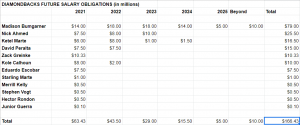
2020 salary terms may finally be sorted out. But what about what’s owed to players beyond that point? The near-term economic picture remains questionable at best. That’ll make teams all the more cautious with guaranteed future salaries.
Every organization has some amount of future cash committed to players, all of it done before the coronavirus pandemic swept the globe. There are several different ways to look at salaries; for instance, for purposes of calculating the luxury tax, the average annual value is the touchstone, with up-front bonuses spread over the life of the deal. For this exercise, we’ll focus on actual cash outlays that still have yet to be paid.
We’ll run through every team, with a big assist from the Cot’s Baseball Contracts database. Prior entries can be found here. Next up is the Diamondbacks:
*Reflects deferred salary in Madison Bumgarner contract
*Includes buyouts on club options over Ketel Marte, Starling Marte, Merrill Kelly, Stephen Vogt, Hector Rondon, and Junior Guerra
*Includes remaining signing bonus to be paid to Nick Ahmed
*Includes remaining salary obligation to Zack Greinke
*Does not include buyout of Mike Leake mutual option, which is owed by Mariners
(click to expand/view detail list)
Mike Leake Opts Out Of 2020 Season
Diamondbacks right-hander Mike Leake is planning to opt out of participating in the 2020 season, Steve Gilbert of MLB.com reports (via Twitter). Leake becomes the first known player to choose not to play amid public health concerns stemming from the COVID-19 pandemic, although others will surely follow suit.
D-backs general manager Mike Hazen has confirmed the decision, tweets Zach Buchanan of The Athletic. The details surrounding Leake’s decision aren’t known, nor need they be shared. As Hazen went on to tell reporters: “I think those conversations are personal in nature” (Twitter link via the Arizona Republic’s Nick Piecoro). Leake’s agent, Danny Horwits, offered the following statement (via ESPN’s Jeff Passan):
During this global pandemic, Mike and his family had many discussions about playing this season. They took countless factors into consideration, many of which are personal to him and his family. After thorough consideration, he has chosen to opt out of playing in 2020. This was not an easy decision for Mike. He wishes the best of luck and health for his Diamondback teammates this season and he’s looking forward to 2021.
Leake, 32, was in the final season of a five-year, $80MM contract originally signed with the Cardinals — although he’s since been traded to Seattle and then Arizona. He’d have earned a prorated $16MM salary this season — about $5.5MM — and had a $5MM buyout on an option for the 2021 season. MLB Network’s Jon Heyman tweets that Leake will not be paid in 2020, which suggests that his decision is not due to concerns about his own health but rather the health of close-proximity family and loved ones. Under the agreement reached between the league and union last week, only players who are deemed high-risk themselves are entitled to receive salary and service time after opting out.
Under the terms of Leake’s previous trades, the Cardinals were set to pay $4MM to the Mariners this season to cover a portion of Leake’s salary. The Mariners, meanwhile, were on the hook for as much of $9MM of Leake’s salary, which was to be paid to the D-backs in deferred installments. Those payments will now presumably be forgiven. As for the $5MM buyout on Leake’s 2021 option, that does not pertain to the 2020 season and should therefore still remain on the table. The Mariners are also responsible for that sum under the terms of last summer’s trade.
With Leake suddenly and unexpectedly out of the rotation picture in Arizona, the D-backs will likely rely on the quartet of Madison Bumgarner, Robbie Ray, Zac Gallen and Luke Weaver to lead the rotation. Merrill Kelly could be in line to retake the fifth spot, although he’ll face some competition from younger arms like Alex Young, Jon Duplantier and, if healthy, Corbin Martin. Arizona will also have a 40-man roster spot opened up with Leake no longer occupying a spot.
Diamondbacks Announce Initial Player Pool
The D-backs on Monday announced their initial player pool for the 2020 season. Player pools can contain up to 60 players, and only players in a team’s pool will be eligible to participate in summer training camp or regular/postseason games. Teams are free to change the makeup of the pools as they see fit, but once a team’s pool reaches 60 players, a player must be removed (released, traded, waived, etc.) in order to make a new addition. That player becomes ineligible to return to that same team in 2020.
Not all players within a team’s pool are ticketed for MLB playing time, of course. Most teams will include well-regarded but still far-off prospects as a means of getting them training reps with no intention of running them onto a major league diamond this season. A comprehensive review of 2020’s unique set of rules can be found here.
Here are the 60 players in the Diamondbacks’ initial pool (* indicates player not on 40-man roster)…
Right-Handed Pitchers
- Jeremy Beasley*
- Archie Bradley
- J.B. Bukauskas*
- Taylor Clarke
- Stefan Crichton
- Jon Duplantier
- Luis Frias*
- Zac Gallen
- Kevin Ginkel
- Josh Green*
- Junior Guerra
- Bryce Jarvis*
- Levi Kelly*
- Merrill Kelly
- Mike Leake
- Artie Lewicki*
- Yoan Lopez
- Corbin Martin
- Keury Mella*
- Joel Payamps
- Hector Rondon
- James Sherfy*
- Riley Smith
- Luke Weaver
- Taylor Widener
Left-Handed Pitchers
- Madison Bumgarner
- Andrew Chafin
- Matt Grace*
- Tommy Henry*
- Joe Mantiply*
- Robbie Ray
- Blake Walston*
- Alex Young
Catchers
Infielders
- Nick Ahmed
- Seth Beer*
- Kevin Cron
- Eduardo Escobar
- Jake Lamb
- Ketel Marte
- Wyatt Mathisen
- Geraldo Perdomo*
- Juniel Querecuto*
- Josh Rojas
- Pavin Smith*
- Ildemaro Vargas
- Christian Walker
- Andy Young
Outfielders