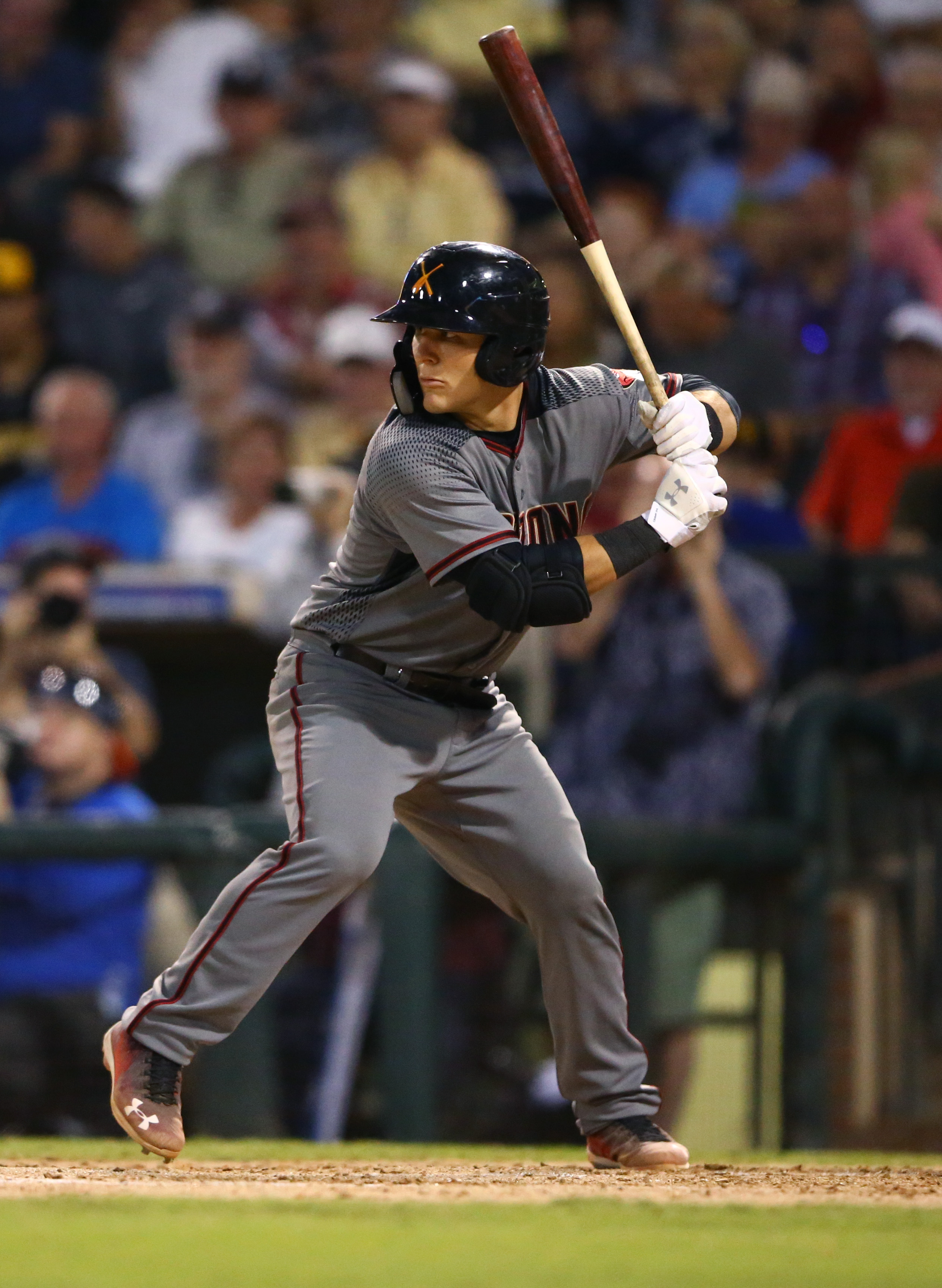
Which 15 Players Should The Diamondbacks Protect In An Expansion Draft?
In a few weeks, we’ll be running a two-team mock expansion draft here at MLBTR – just for the fun of it! Currently, we’re creating 15-player protected lists for each of the existing 30 teams. You can catch up on the rules for player eligibility here.
So far, we’ve covered the Rockies, Dodgers, Padres, Giants, Rangers, Mariners, Athletics, Angels, Astros, Twins, Royals, Tigers, Indians, White Sox, Rays, Yankees, Red Sox, Blue Jays and Orioles. The Diamondbacks are up next.
First, I’ll remove free agents Mike Leake, Jake Lamb, Andrew Chafin, and Robbie Ray from consideration. Hector Rondon and Stephen Vogt have club options for 2021, but we’ll take them out as well. In the case of Starling Marte, I’ll assume his $12.5MM club option is exercised, and that the D’Backs will protect him. In the case of Merrill Kelly, I’ll assume his $4.25MM club option gets picked up, but I’ll let you decide whether to use a protected spot on him.
I’ll lock in Madison Bumgarner due to his no-trade protection. I’ll also put Daulton Varsho on the list, as a Baseball America Top 100 prospect with a 2020 ETA. This will be the initial ten-player protected list:
Madison Bumgarner
Starling Marte
Ketel Marte
Daulton Varsho
Luke Weaver
Carson Kelly
Christian Walker
Zac Gallen
Nick Ahmed
Eduardo Escobar
That leaves five spots for the 20 players listed below. It’s worth considering that in this scenario we’re in November 2020, and the player’s remaining amount of control is a big factor.
Silvino Bracho
Archie Bradley
Kole Calhoun
Taylor Clarke
Stefan Crichton
Kevin Cron
Jon Duplantier
Kevin Ginkel
Junior Guerra
Merrill Kelly
Domingo Leyba
Tim Locastro
Yoan Lopez
Corbin Martin
Joel Payamps
David Peralta
Josh Rojas
Bo Takahashi
Ildemaro Vargas
Alex Young
With that, we turn it over to the MLBTR readership! In the poll below (direct link here), select exactly five players you think the Diamondbacks should protect in our upcoming mock expansion draft. Click here to view the results.
Wilmer Flores Changes Representation
Infielder Wilmer Flores has new representation. Flores, 28, will now be repped by Cesar Suarez of the Beverly Hills Sports Council, per MLB Network’s Jon Heyman. Flores’ change in representation will soon be reflected in MLBTR’s Agency Database. Flores had previously been repped by the McNamara Baseball Group.
Suarez is a former player himself, though he never reached the majors after signing with the Yankees as a 16-year-old, per his bio on the BHS Council’s website. He hails from Flores’ native Venezuela, as do other notable Suarez clients such as Rougned Odor and Salvador Perez. Heyman did not mention any specific impetus behind Flores’ decision to make a change at this time.
Flores, 28, is coming off a one-and-done year in Arizona. The utility infielder made the most of his time in the desert. After signing a one-year, $4.25MM guaranteed deal with the Diamondbacks, he appeared in 89 games, slashing a robust .314/.361/.487, good for a career-best 120 wRC+. Flores also missed more than a month of playing time after a foot contusion in late May pushed him to the injured list. Arizona declined a $6MM player option, making him a free agent for a $500K buyout instead.
When he was on the field, Flores performed. If you’re looking to poke holes in Flores’ 2019 output, a .332 BABIP is a good place to start, but Flores has long been a strong offensive contributor, so it’s not totally a smoke show. Still, career norms of a .268 BA and .277 BABIP point to some regression. Statcast credits Flores’ 2019 with a .329 xwOBA (league average is .318 xwOBA).
As for his new agent, there’s no immediate contractual work pending after Flores signed a two-year deal with the Giants this offseason. He made back the $6MM he was in line for in Arizona, only it’s spread out across two seasons. Flores will make $3MM in each of 2020 and 2021, while the Giants hold a $3.5MM option for 2022. If Flores can flourish in San Francisco, he should have the opportunity to net another major league contract either before his age-30 or age-31 season.
The Giants haven’t been all that active in free agency recently, so their signing of Flores was notable, especially since there’s not an obvious place to put the contact-oriented infielder. Veterans like Evan Longoria, Brandon Crawford, and Brandon Belt are entrenched around the infield on big-money deals that run concurrently to Flores’. There should be at-bats for Flores at second base, but he’s not alone there either, as Mauricio Dubon offers the Giants a higher ceiling with more team control as a pre-arb player, and Donovan Solano is coming off a mini-breakout of his own (.330/.360/.456 in 81 games last year). The presence of local hero Pablo Sandoval also muddies the waters for Flores – if Kung Pu Panda ends up making the team.
The potential for a Universal DH should give Flores some hope for grabbing a few extra PAs, but the Giants are actually pretty set on that front after bringing back the hugely popular Hunter Pence. Fans will be happy to see Pence’s name back on the lineup card, but even from a baseball standpoint, Pence is coming off a year when he unexpectedly put together an All-Star campaign at age-36. Pence finished the year hitting .297/.358/.552 with 18 home runs in 83 games as the Rangers’ DH. Like Flores, Pence also missed a fair amount of time due to injury. Given the ages of Longoria (34), Pence (37), Crawford (33), Belt (32), Sandoval (33) and even Solano (32), Flores is actually one of the young guys in the infield mix, despite his status as a 7-year MLB veteran. It’s not obvious where his playing time will come from, but there are many paths that lead to Flores seeing time as a regular infielder.
Latest On Teams’ Plans For Second Spring Training
While the league and the MLBPA have yet to reach a formal agreement on either player compensation or health/safety protocols for a rebooted 2020 season, teams are still preparing for a shortened restart of “Spring” Training — ideally beginning in mid-June. The goal is for a three-week training period to lead into an 82-game season that kicks off in early July. The latest on plans for a few NL clubs…
- The Mets will likely hold their version of Spring Training 2.0 at their spring facility in Port St. Lucie, Fla. rather than at Citi Field in New York, Tim Healey of Newsday reports. New York City remains the U.S. epicenter for the coronavirus, and beyond the pure health aspect of the decision, staging their training camp in Florida gives the Mets access to multiple fields. As Healey notes, the Mets completed a $57MM renovation project at Clover Field back in February, which has improved the overall quality of the facilities and equipment available to Mets players — several of whom are already in Florida.
- The Phillies are likely to remain in Philadelphia for their second wave of Spring Training, per Jim Salisbury of NBC Sports Philadelphia. The Phillies’ Urban Youth Academy, across the street from Citizen’s Bank Park, has two full-size fields that could be made available, and Salisbury notes that the Phils have ownership stake in their nearby Triple-A and Double-A affiliates, which could allow those parks to be used as well. Both affiliates are fewer than 70 miles away from Citizen’s Bank Park.
- The Diamondbacks have opened Chase Field for individual workouts, USA Today’s Bob Nightengale tweets. Unlike other clubs, the D-backs have the luxury of their home field and spring facility being a mere 20 miles apart. Nightengale notes that in addition to Chase Field opening up, some players are also reporting to the Salt River Fields spring facility in preparation for a second Spring Training.
Braves Have All The Pieces To Build A Solid DH
With the DH likely headed to the National League in 2020, the Braves may have a few more at-bats to spread around. As a team, the Braves finished 2019 with a 102 wRC+, the 4th-highest mark in the National League, though they managed to turn that production into 855 runs, fewer than only the Nationals and Dodgers. To repeat at those levels, Atlanta has the difficult task of replacing the production from Bringer of Rain Josh Donaldson, who joined the Twins after putting up 37 bombs, 96 runs, 94 RBIs, and an all-around stellar 6.0 rWAR season in 2019. A regular DH should help.
Atlanta boasts a good deal of depth to utilize in a potential designated hitter role. For starters, there’s the question of whether Johan Camargo becomes a four-down back at third base. Austin Riley may eventually take over the hot corner, but if he doesn’t, there are probably some DH at-bats to go his way. Riley was slated to spend some time at Triple-A, but if there is no Triple-A, the Braves may just as soon bring his light-tower power to the big-league level. Riley definitely struggled closing out his rookie year, but power (.471 SLG and .245 ISO) isn’t the problem. Riley needs to close the gap on his 5.4% BB% and 36.4 K%, but given his youth and potential, he’s probably the guy the Braves want to claim the DH spot (if he doesn’t claim third base outright).
If Riley doesn’t improve the other aspects of his game, then he’s essentially Adam Duvall, another candidate for DH at-bats. Duvall, 31, has a career .229 ISO and .461 SLG at the big league level, numbers that could land him in the middle of the order if it weren’t for other drawbacks to his game. In 130 plate appearances last season, Duvall put together a solid 121 wRC+ showing by hitting .267/.315/.567. That output was bolstered by an absurd .300 ISO. He also had some good luck, as his .306 BABIP was a fair bit higher than his career mark of .271. Duvall could certainly see some time at DH, especially if they want to save Riley for a more stable playing environment, but he has gone just 1 for 3 in posting a wRC+ over 100 when given more than 400 plate appearances. In a short season, however, Duvall has the type of short-burst approach that could perform.
The safer option is to use the DH to rest their four-man outfield of Ronald Acuna Jr., Ender Inciarte, Marcell Ozuna, and Nick Markakis. Acuna will be in there every day, but he can move around the outfield and would probably benefit from a DHing day every now and again. Ozuna and Markakis complement each other perfectly in some ways, with Ozuna the right-handed power bat and Markakis the lefty on-base option, and they can both handle themselves in the field. There’s no reason both shouldn’t be in the lineup, however, especially if Inciarte is healthy enough to spend the better part of most weeks manning centerfield. Inciarte, 29, played just 65 games last season, but he’s a true difference-maker with the glove when healthy (21 OAA in 2018, 20 OAA in 2017). Assuming health, all four of Acuna, Inciarte, Ozuna, and Markakis should find their names on the lineup card most days.
With Acuna taking his spot in right, Markakis might be the guy who gets the most at-bats as the ostensible extra bat. But when southpaws take the hill, the Braves can rest some combination of Markakis/Inciarte while getting Duvall or Riley some run. Both mashed lefties in 2019. Say they go with a straight left-right platoon: Markakis hit .298/.371/.446 vs. righties in 2019, and Duvall (small sample alert) hit .333/.386/.744 vs lefties. Even take Duvall’s career splits versus lefties (.240/.318/.473), and a leveraged platoon of Markakis and Duvall makes for a pretty potent designated hitter.
This post continues a recent series from MLBTR looking at designated hitters options for each team in the National League. Thus far we’ve covered the Cardinals, Reds, Dodgers, Diamondbacks, and Nationals, as well as the remaining free agent options.
Universal DH Could Open Door For 2019 Minor League Home Run King
The Diamondbacks weren’t a bad offensive club in 2019, but they were a middle-of-the-pack unit in the National League in terms of total runs (sixth overall with 813), home runs (ninth, 220) and wRC+ (seventh, 94). Like most contending clubs with a good bit of depth, those numbers should tick up if the league implements a universal DH in 2020, as seems increasingly likely.
For the Diamondbacks, the most established beneficiary on the roster is lefty swinging Jake Lamb. Shoulder injuries have torched the 29-year-old’s past two seasons, and the former everyday third baseman has since lost that spot to Eduardo Escobar as a result. With a DH added to the mix, Lamb could rotate between designated hitter and both infield corners, providing occasional breathers for Escobar and 2019 breakout performer Christian Walker — at least against right-handed pitching. Lamb has struggled mightily in his career against southpaws, though, so he’d likely need to be platooned.
Enter Kevin Cron.
The righty swinging younger brother of slugger C.J. Cron has never been considered among the D-backs’ top prospects, in part because of a lack of defensive value and the type of plodding speed you’d expect from a 6’5″, 250-pound first baseman. But Cron has consistently hammered minor league pitching, and never more so than in 2019, when he belted a minor-league-leading 39 home runs in just 84 games. (Yes — the Triple-A ball was also juiced.)
Cron logged a ridiculous .331/.449/.777 slash with a career-high 16.2 percent walk rate and a 20.4 percent strikeout rate with Triple-A Reno. He only received 78 plate appearances in the Majors, due in no small part to the breakout of Walker, who is also a stellar defender at first base. That said, Cron tacked on another six round-trippers in the big leagues, bringing his season total to 45 in just 460 plate appearances.
Lamb might get the first look at DH — he’s playing on a $5.525MM contract after all — but Cron should be in line for at least a platoon gig early in the season. Further injuries to Lamb or some struggles at the plate could open the door for a wider look. It’s not a given that Cron’s minor league dominance would carry over to the big leagues — he’s not even ranked in their top 30 prospects at Baseball America and sits just 26th at MLB.com — but when you homer in nearly 10 percent of your 400-plus plate appearances, it’s probably time for a legitimate chance.
Beyond Cron and Lamb, the D-backs have prospect Seth Beer working his way toward the Majors. He came over from Houston in the Zack Greinke swap and is a bat-first corner option himself, although he’s yet to appear in Triple-A. Versatile Swiss army knives like Josh Rojas and Andy Young can be plugged in all over the diamond, giving the Snakes increased opportunities to spell Ketel Marte, David Peralta, Kole Calhoun, etc. with a day at designated hitter as well.
The D-backs have the depth to take a mix-and-match approach to the DH spot, plus one veteran option looking for a bounceback … but the most interesting thread to follow will be whether 2019’s minor league home run king can capitalize on an opportunity he didn’t expect to have when Spring Training originally commenced.
Remembering A Disastrous World Series Performance
The worst bullpen meltdown of the 2001 World Series was not the one you think. You probably go right to Byung-Hyun Kim blowing saves in games four and five in Yankee Stadium, putting the Diamondbacks on the brink of elimination heading into game six. But that’s not it.
You might also think of Mariano Rivera blowing the save in game seven. Mark Grace singled, Rivera turned a sac bunt attempt into runners on first and second, Tony Womack eventually knocked home the tying run. Then Tim McCarver – without so much as a spoiler alert – laid out exactly what was about to happen like he’d seen it already, and Luis Gonzalez shoveled a ball over the drawn in infield to win the World Series. Just like that, the greatest closer of all time blew game seven of the World Series, ending a Yankee dynasty in its tracks.
But that’s not it either. I’m talking about Jay Witasick‘s beautifully disastrous performance in game six.
With the Yankees up three games to two in the 2001 World Series, the series shifted back to Arizona for a critical game six. The Yankees were just one win away from their fourth consecutive World Series championship, while the Diamondbacks, in their fourth season, hadn’t yet existed in a world in which the Yankees were not the champs. Kim’s consecutive blown saves put Arizona in this position, but in game six, it would be the Yankees bullpen that would implode. Though Jay Witasick’s meltdown didn’t come in as high a leverage situation as Kim’s (nor Rivera’s), it was something to behold.
Witasick entered Game 6 with runners on second and third with the Yankees trailing 5-0. It was still early. The game was in reach. Here’s how hitters fared against Witasick that inning:
- Single to LF
- Single to LF
- Single to LF
- Single to RF
- Tony Womack strikes out swinging (phew!)
- Single to CF
- Double to LF
- Single to CF
- Double to CF
- Reggie Sanders strikes out swinging (finally!)
In a game when the Yankees could have clinched a World Series victory, Joe Torre let Witasick stay in the game to surrender four consecutive hits – twice! – in one inning. By the time Reggie Sanders finally struck out, the Diamondbacks led 12-0. Relievers are often made to wear it the way Witasick did here, but a win in this game meant a World Series title. This wasn’t a normal game. This was the type of game when – normally – you never give up. Witasick’s 8 earned runs tied him with Grover “Pete” Alexander for the most runs ever given up in a World Series game. Alexander took 2 1/3 innings to give up that many in the 1928 World Series against the Yankees.
Witasick would give up two more hits the next inning (he started another inning!), giving him a final line that looks like this (parents, cover your children’s eyes): 1 ⅓ innings, 10 hits, 9 runs (8 earned), 4 strikeouts. Randy Choate came on and allowed Witasick’s stragglers to score, by which point the Diamondbacks led 15-0. Luis Gonzalez – their consensus best player – was pulled for rest in the bottom of that inning (the 4th inning!). Given the stakes of the game, it’s amazing that Torre allowed Witasick to get shelled the way he did.
I’ll give Torre this: games four and five of the 2001 World Series went into extra innings, and leading 3 games to 2 going into game six, the Yankees had some cause to pack it in by the time Andy Pettitte left the game without recording an out in the third inning. And it’s not as if Witasick was giving up home runs. These were mostly bleeders through the left side of the infield – but they weren’t totally cheap knocks either.
On the other hand, when Pettitte exited the game, it was still just a 5-0 deficit in the 3rd inning. Of course, Torre also had reason to doubt whether his offense could come back from a deficit that large. In the first five games of the series combined, the Yankees had scored a total of four runs in innings 1 through 8. Without a pair of clutch ninth-inning home runs from Tino Martinez and Scott Brosius, the Yankees came dangerously close to losing all 7 games of the series (which, of course, would have been impossible).
Still, Witasick’s ill-fated stint in the third and fourth inning of game 6 stands out as a woeful performance with the season on the line. Witasick put together a solid professional career, pitching for 7 teams over 12 years with a 4.64 ERA/4.69 FIP, and it’s hardly his fault that Torre decided to pack this one in by the third inning, but it’s worth a re-watch nonetheless.
10 MLB Teams Whose Business Initiatives Face Coronavirus Hurdles
Like most every person or business, all thirty MLB teams face tough questions during the time of COVID-19. Some are relatively similar for all ballclubs, but there are obviously quite a few unique issues — some more pressing than others.
Dealing with the implications of this pandemic is probably toughest for organizations that are in the midst of executing or planning major business initiatives. We’ll run down some of those here.
Angels: The team has been cooking up potentially massive plans to develop the area around Angel Stadium. Fortunately, nothing is really in process at the moment, but it stands to reason that the project could end up being reduced in scope and/or delayed.
Athletics: Oof. The A’s have done a ton of work to put a highly ambitious stadium plan in motion. Massive uncertainty of this type can’t help. It isn’t clear just yet how the effort will be impacted, but it seems reasonable to believe the organization is pondering some tough decisions.
Braves: Luckily for the Atlanta-area organization, the team’s new park and most of the surrounding development is already fully operational. But with the added earning capacity from retail operations in a ballpark village comes greater exposure to turmoil.
Cubs: Like the Braves, the Cubs have already done most of the work at and around their park, but were counting on big revenue to pay back what’s owed (and then some). Plus, the Cubbies have a new TV network to bring up to speed.
Diamondbacks: Vegas?! Vancouver?! Probably not, but the Snakes do want to find a new home somewhere in Arizona. That effort is sure to be dented. Plus, the team’s recent initiative to host non-baseball events at Chase Field will now go on hiatus.
Marlins: The new ownership group has had some good vibes going and hoped to convert some of the positivity into a healthy new TV deal. That critical negotiation will now take place in a brutal economic environment.
Mets: So … this is probably not an optimal moment to be selling your sports franchise. The Wilpon family is pressing ahead with an effort to strike a new deal after their prior one broke down (at the worst possible time).
Orioles: That bitter television rights fee dispute that just won’t stop … it’s not going to be easier to find a resolution with less cash coming through the door. It was already setting up to be a rough stretch for the Baltimore org, with past TV money due to the Nationals and more bills to come, even while going through brutally lean years on the playing field.
Rangers: The new park is now built. While taxpayers footed much of the bill, the club still has to pay back a $600MM loan. Suffice to say the Rangers (and municipal authorities) anticipated game day revenues of more than $0 in year one when they planned out the loan repayment method.
Rays: The club’s preferred Ybor City option flamed out and it is currently engaged in a somewhat confusing effort to split time between the Tampa Bay area and Montreal. Existing hurdles to that arrangement seem only to be taller in the age of the coronavirus.
Others: We may be missing some, but it seems most other organizations are engaged more in usual-course sorts of business initiatives rather than franchise-altering efforts. For instance, the Nats have an interest in that TV deal as well. The Red Sox have been working to redevelop areas around Fenway Park. The Blue Jays are dabbling in future plans. And the Dodgers have a new TV rights deal, though that came to fruition after the pandemic hit and may not be impacted any more than any other existing carriage arrangements.
Replacing A Strikeout Machine
The Diamondbacks and much-maligned former general manager Dave Stewart made a shrewd pickup six years ago when they acquired left-hander Robbie Ray from the Tigers in a three-team trade. Ray has been one of the most productive players on Arizona’s roster since then, but his time in the desert may be nearing an end. Regardless of whether a season takes place, the soon-to-be 29-year-old Ray may choose to test the free-agent market in the winter, when he’d rank near the top of the list of available starters.
[RELATED: Revisiting The Nats’ “Steal” Of A Deal]
The most appealing thing about Ray is that he fans hitters in droves, having struck out 11-plus batters per nine in four straight seasons. He ranked third in that category last year with 12.13 K/9, trailing only now-$324MM man Gerrit Cole and former teammate Max Scherzer. Problem is that Ray hasn’t kept runs off the board at elite rates like Cole and Scherzer have, nor has he been the innings-eating workhorse along their lines. Ray’s the owner of a lifetime 4.11 ERA/3.97 FIP and has never reached the 175-frame mark in a season.
Most recently, Ray pitched to a 4.34 ERA/4.29 FIP across 174 1/3 innings in 2019. That’s not ace-like production, but there’s nothing wrong with it at all, and the Diamondbacks might soon have to find a way to replace it. They’ve at least pondered it, as Ray has been the subject of countless trade rumors over the past couple seasons. No offer has gotten Arizona to bite thus far, though, and after a strong 85-win effort last year, the club doesn’t seem prepared to part with Ray in the near future. Rather, the Diamonbacks made a serious effort to improve their rotation in the offseason by signing ex-Giant Madison Bumgarner to a five-year, $85MM pact. The belief then was that there would be a season, and the hope was that Ray, Bumgarner, Luke Weaver, Zac Gallen and Mike Leake would form a tremendous starting five.
The potential is certainly there for the D-backs’ rotation to be a smash success in 2020. But it may well end up as Ray’s last season with the club. The same goes for Leake, who has an $18MM option or a $5MM buyout for 2021. A rotation devoid of Ray and Leake would still have a nice trio in Bumgarner, Weaver and Gallen, but what of the other two spots? Arizona just spent pretty big on Bumgarner, so maybe it would shop at the high end of the market again for someone like old friend Trevor Bauer, Jake Odorizzi, Marcus Stroman, Masahiro Tanaka, Mike Minor, James Paxton or Jose Quintana. Otherwise, at the mid- and lower-tier levels of free agency, there should be quite a few somewhat intriguing arms available. You also can’t discount the trade market, where Matthew Boyd, Jon Gray and Chris Archer are some of the hurlers who could soon be available.
As far as in-house options go, Arizona doesn’t appear to be loaded with immediate solutions. The Diamondbacks could keep Merrill Kelly for $4.25MM, but he may be a buyout candidate ($500K) after producing mediocre results in 2019. The team does have several other choices who have either pitched in the majors or are almost ready for MLB (Jon Duplantier, Taylor Clarke, Taylor Widener, J.B. Bukauskas and Corbin Martin are some examples), though nobody there has a proven track record of racking up outs at the game’s highest level.
If you’re the D-backs, one of the many reasons you’re hoping a season occurs is so what looks like a very good rotation can help you break a two-year playoff drought. But that rotation looks as if it will weaken soon, largely on account of Ray’s pending free agency.
Revisiting The Braves’ Fleecing Of The D-Backs In The Shelby Miller Trade
In late 2015, the Braves drummed up quite a bidding war for right-handed pitcher Shelby Miller, who became one of the biggest names on that winter’s trade market. As a controllable, 25-year-old starter who had spent the last year toiling away on a Braves team that lost 95 games, he garnered interest from as many as 20 teams: what’s not to like? This was a player who could boost a team’s playoff chances not only for the coming year, but for the foreseeable future as well—and he was attainable. Unfortunately for the team that won that bidding war, the Arizona Diamondbacks, it gave way to one of the more lopsided trades in recent memory.
In its entirety, the five-player deal sent Miller and relief prospect Gabe Speier to the Diamondbacks, who in turn gave up Ender Inciarte, Dansby Swanson, and Aaron Blair to the Braves. Just about six months earlier, the D-Backs made Swanson, a 21-year-old shortstop from Vanderbilt, the first overall pick in the 2015 draft. For that hefty price, Arizona got their man.
Miller was coming off a year in which he notched an unsightly 6-17 W-L record, but that mark was wildly misaligned with his 3.02 ERA, which fell just outside the top 10 in the NL. He did that while tossing 205 1/3 innings in his first (and only) year in Atlanta, which acquired him as the centerpiece of the trade that sent Jason Heyward to the Cardinals.
But the D-Backs’ valuation of Miller proved to be severely misguided. In his first year in Arizona, he would go 3-12 and was credited with just 0.6 fWAR. And while you need to look just a year in the past for evidence that W-L records can be misleading, Miller couldn’t hang his hat on a good ERA this time around: his 6.15 ERA in 20 starts was the worst among NL starters with at least 100 IP. Despite the impressive run prevention numbers from 2015, Miller’s price tag portrayed him as a front-line starter when he was probably more accurately described as a mid-rotation arm.
The move firmly declared Arizona GM Dave Stewart’s intent to contend in the immediate future. Acquiring Miller came on the heels of the Zack Greinke free-agent signing, which gave the D-Backs a formidable rotation of Greinke, Miller, Robbie Ray, and Patrick Corbin. Add that to an offense anchored by Paul Goldschmidt and A.J. Pollock, and it’s not hard to see how Arizona perceived a path to the postseason. However, they would win just 69 games in 2016 and essentially wound up as a re-imagination of the previous year’s Padres, a team that likewise went all in only to fall flat.
Even in the immediate aftermath of the deal, many viewed the deal as a vast overpay on the Diamondbacks’ part. But that negative public perception apparently didn’t bother the club, which was dead-set on vaulting itself into the playoff picture after winning 79 games the year before. It’s an admirable approach, no doubt, to try to capitalize on the coincidence of Paul Goldschmidt’s prime with the big-money signing of Greinke. But in this case, the price just didn’t match the prize. Of course, as we know now, the team would have to wait a year—and install a new front office regime—before they broke into the 2017 postseason as a Wild Card team.
At the time, Swanson was one of the first draftees (and first number one choice) to be traded under a new rule that allowed teams to deal drafted players after the World Series in the year of their selection. He is one of three first overall selections to have been traded before debuting with the team that drafted him. As MLBTR’s Steve Adams noted in his summation of the trade at the time, Swanson was the latest in a series of moves that illustrated the Arizona regime’s apparent devaluation of draft picks: by trading Swanson, signing Greinke (and therefore surrendering their 2016 top pick), and trading Touki Toussaint, the team had effectively missed out on three consecutive years of first-round selections.
Swanson was heralded as the shortstop of the future for Atlanta, which had just recently shipped Andrelton Simmons to the Angels. And although Swanson maybe hasn’t been the superstar that we expect from a No. 1 overall draft pick, he’s been a good MLB shortstop and showed us glimpses of another gear last year, when he had his best offensive season thanks to improved power output. If that upward trend is to be believed and he can provide even slightly above-average offensive numbers, Swanson can really solidify himself as a building block in Atlanta, thanks to his solid defense at a key position. Check out the growth in Swanson’s hard-hit rate and expected hitting stats from 2018 to 2019, courtesy of Baseball Savant.
Inciarte, meanwhile, wound up being a surprisingly important piece of the deal for the Braves. He won the Gold Glove Award for NL center fielders in each of his first three years in Atlanta, ultimately serving as a nice transitional piece between losing years in 2014-2017 and the contending teams of today. And while he’s seen his role with the Braves diminish over the last couple of years, he proved to be a pretty solid acquisition for a team that lacked quality Major League talent outside of Freddie Freeman. He was a fine guy to pencil into center field every day while the franchise cultivated a core of young players.
Neither Blair nor Speier wound up contributing much to the teams that acquired them: Speier made his MLB debut last year with the Royals, who got him in exchange for Jon Jay, and Blair hasn’t appeared in the Majors since 2017. He was a former first-round pick himself, but failed to put things together when he got his chance with the Braves in 2016.
All told, the combination of Inciarte, Swanson, and Blair has thus far produced 13.1 fWAR for the Braves, with more likely to come from Swanson and, to a lesser extent, Inciarte. For the Diamondbacks, Miller and Speier produced a meager 0.7 fWAR. Miller lasted just three years in Arizona, appearing in only 29 games and pitching 139 innings for the team.
Last year, he got a chance with the Rangers and toggled between the bullpen and the starting rotation, but the change of scenery didn’t seem to help his fortunes. He tossed 44 innings of 8.59-ERA ball, striking out just 30 batters. In January of this year, he earned himself a minor-league deal with the Brewers, and was expected to begin the season with the team’s Triple-A affiliate.
The D-backs Replaced Paul Goldschmidt With A Waiver Claim — And It Worked
It’s been three years since Christian Walker rode the waiver carousel. A 2012 fourth-round pick of the Orioles, Walker’s chance of being a regular with the Baltimore organization likely went up in flames the moment owner Peter Angelos green-lighted the seven-year, $161MM deal that brought Chris Davis back to the club after he’d reached free agency. The Orioles still had a designated hitter spot, but a year later in the 2016-17 offseason, the Orioles re-signed Mark Trumbo to a three-year deal that only further cut into Walker’s opportunities. In Spring Training 2017, Walker was cut loose when the O’s acquired Richard Bleier from the Yankees.
From there, it was a whirlwind month for Walker — and likely one with a fair bit of frustration. After being blocked in Baltimore by Davis and Trumbo, Walker was surely hoping for a clearer path to the Majors. Instead, he landed in the National League, with no DH… behind Freddie Freeman. The Braves claimed Walker four days after his DFA in Baltimore but tried to sneak him through waivers themselves not two weeks later. Walker was again left to hope for a path to the Majors. Upon landing in Cincinnati on another claim, he was, of course, looking straight up at an in-his-prime Joey Votto. Three weeks later, Walker hit waivers again when the Reds tried to outright him at the end of camp. This time, he landed directly behind Paul Goldschmidt in Arizona.
The D-backs finally succeeded in passing him through waivers, though they selected him back to the big leagues later that year. For two seasons, Walker obliterated Triple-A opposition, slashing a combined .305/.372/.586 (142 wRC+) with 50 home runs, 59 doubles and 13 triples. And yet, his Major League counterpart matched him blow for blow in the big leagues; Goldschmidt posted a ridiculous .294/.396/.547 (144 wRC+) with 69 home runs, 69 doubles and eight triples. By the time the 2018 season concluded, Walker was out of minor league options while Goldschmidt entered the final season of his contract.
A trade of Goldschmidt seemed plausible but hardly a sure thing entering the winter of 2018-19. There was little hope of the D-backs re-signing him with Zack Greinke still on the books. Goldschmidt had already signed one team-friendly extension in his career and wasn’t likely to do so a second time. The D-backs explored deals involving both Goldschmidt and Greinke that winter, ultimately lining up with the Cardinals on a return of Luke Weaver, Carson Kelly, Andy Young and a Competitive Balance draft pick (Round B).
Even at that point, though, Walker wasn’t a lock to step into Goldschmidt’s shoes. The D-backs had re-signed Eduardo Escobar to a three-year deal, crowding the third base mix and perhaps pushing Jake Lamb across the diamond to first base. Lamb’s 2018 season was ruined by a shoulder injury, but he hit 59 home runs from 2016-17, batting a combined .248/.345/.498 along the way. A platoon looked to be the likeliest outcome for the right-handed-hitting Walker and the lefty-swinging Lamb, and that’s indeed how the club operated — until Lamb landed on the injured list once again on April 5 with a quadriceps injury that would sideline him into late June.
Prior to the 2019 season, Walker hadn’t started consecutive games in the Majors since Sept. 2014. With Goldschmidt out the door and Lamb on the shelf, however, the everyday opportunity he’d sought in the nearly five years since making his MLB debut was sitting right in front of him, and he seized it. Walker appeared inn 71 games while Lamb was on the IL — starting 66 of them — and hit .258/.333/.461 with 11 homers, 17 doubles, a triple, four steals and elite defense at first base. Even with Lamb back in the fold and playing on a $4.825MM salary, Walker had earned the trust of the organization and earned himself an everyday role.
By season’s end, the then-28-year-old Walker had compiled a .259/.348/.476 slash and 29 home runs. While his hitter-friendly home park and the juiced ball that prompted home run totals throughout the league to explode rendered that production perhaps a bit lighter than some might expect (112 wRC+, 111 OPS+), Walker complemented his output at the plate with quality baserunning and with some of the best glovework of any first baseman in the Majors. Walker’s 11 Defensive Runs Saved and 9 Outs Above Average trailed only Oakland’s Matt Olson for the MLB lead at his position. Walker’s 3.0 bWAR, in fact, topped the 2.4 mark of the franchise icon he’d replaced.
It’ll be important to see how he carries himself at the plate in the event of a course correction with regard to the composition of the baseball, but there’s little reason to doubt his ability. Walker (fittingly) drew a base on balls in 11.1 percent of his plate appearances and was among the game’s very best in terms of hard-hit rate (94th percentile), average exit velocity (85th percentile), xwOBA (81st percentile) and percentage of barreled balls (90th percentile). And even if those numbers take a step back, his superb glovework and excellent baserunning (relative to his positional peers) help to give Walker a relatively high floor.
All of that should be music to the ears of the D-backs, whose patience in hanging onto Walker was rewarded not only with a potential everyday heir to the first base slot — but one that can be controlled all the way through the 2024 campaign. Heading into the 2020 season — assuming there is one — there should be little doubt that Walker has a firm grip on the starting job that’s eluded him for his entire career. As insane as it would have sounded when Walker was acquired in 2017 and as improbable as it might’ve seemed even last spring, the D-backs look like they’ve successfully replaced Goldschmidt with a waiver claim.