
Poll: What Should The Rangers Do With Joey Gallo?
In a piece today, Evan Grant of the Dallas Morning News calls upon the Rangers to commit to a path with young slugger Joey Gallo this winter. It’s a major question for Texas, with several possible strategies, so it seems worth posing the matter to MLBTR’s readers.
Though he’s still just 22 years of age, and continues to carry jaw-dropping power potential, Gallo wasn’t deemed worthy of a significant chance at major league action last year. He ultimately struck out 19 times and recorded just one hit in thirty MLB plate appearances scattered over 17 games. But Gallo continued to thrive at Triple-A, where he banged out 25 home runs and posted a .240/.367/.529 slash over 433 plate appearances.
The biggest question mark on Gallo remains the strikeouts. He walks quite a bit — 15.7% over his Triple-A season and 13.1% over his 153 MLB plate appearances — so it’s not as if he lacks for zone awareness. But Gallo has also struck out in just under half of his trips to the plate in his brief time in the majors while swinging through 22.5% of the pitches he offered at. (Khris Davis was worst among qualified MLB hitters last year with 16.6%.) And while Gallo trimmed his K rate a bit at the highest level of the minors in 2016, he faded after a promising start in that regard and still ended up going down on strikes 34.6% of the time.
While Texas can still option Gallo, the team faces the proposition of filling in two primary power spots in its lineup. Mitch Moreland is set to vacate first base via free agency, with Grant suggesting he won’t likely be pursued by the Rangers. And the team is also bidding adieu to DH candidate Carlos Beltran, who was acquired in the aftermath of Prince Fielder‘s injury-induced retirement. With other positions also in need of solutions, Texas probably can’t afford to spend big on two bats to step into these openings.
Grant suggests that Texas could look to bring in free agent first baseman Mike Napoli for a third go with the organization. The right swinger is capable of playing first and would complement the left-handed-hitting Gallo. Alternatively, the club could look elsewhere, possibly attempting to re-sign Beltran — a switch-hitter who has logged all of five career innings at first base. Either way, that kind of addition would leave the team reliant upon Gallo, unless he is paired with another righty bat in some kind of DH platoon.
There are several other possible routes to consider, it seems. With a rather robust group of slugging types available this winter, the Rangers could add two lesser-priced bats and try to cash Gallo in to address another need. As Grant writes, though, his difficulties in turning the corner may make it hard for the team to cash Gallo in for a starting pitcher good enough to punt on his upside. He might also be used in some kind of platoon role — with players like Ryan Rua and Jurickson Profar representing possible mates. And it’s certainly possible that Gallo could be sent back to Triple-A, but that would represent his third consecutive year at that level and would add to the payroll and roster pressures.
While the Rangers will get to watch Gallo play in Venezuelan winter ball action, and can to some extent delay final decisions until the spring, the organization largely knows the state of play and will need to chart a course for the winter market. What’s the best course of action?
What Should The Rangers Do With Joey Gallo?
-
Trade him for the best starting pitcher or center fielder they can get. 48% (3,867)
-
Give him the first base job and re-sign Beltran (or similar). 23% (1,817)
-
Give him the DH job and sign Napoli (or similar). 12% (918)
-
Send him down to Triple-A and hope he improves. 11% (838)
-
Use him in a platoon. 7% (540)
Total votes: 7,980
AL East Notes: Bautista, Encarnacion, Travis, Price, Red Sox Catchers
Let’s take a look at a few recent notes out of the AL East:
- Blue Jays outfielder Jose Bautista still seems likely to depart in free agency, Jon Heyman of Fan Rag writes. While Toronto figures to have some level of interest, it probably won’t outbid the market for a player who has been the organization’s biggest star. While it’s never worth putting too much stock in postseason results, it may not help that he has just four hits and six walks in his 35 plate appearances in this year’s playoff action — though Bautista did enjoy a productive stretch to end the regular season.
- Fellow star Blue Jays slugger Edwin Enarnacion still seems most likely to head to the Red Sox this winter, Heyman suggests. While Boston has given some signals that it may not go big for a free agent bat, the team does appear to represent a good fit for a player who raked for most of the year. Other potential landing spots, per Heyman, include the Yankees and Rangers. For what it’s worth, Encarnacion’s overall postseason results have been quite good: he’s slashing .323/.400/.645 with three home runs and four walks against just three strikeouts.
- Devon Travis wasn’t able to carry on for the Blue Jays in the ALCS and won’t play again in 2016 due to a knee injury. He has continued to put up good numbers when healthy, but a variety of ailments have clouded his long-term outlook. Heyman does say that Toronto expects him to be ready for a full spring next year, but notes “there’s concern about his ability to stay healthy” within the organization.
- Evan Drellich of the Boston Herald examines the case of Red Sox lefty David Price, who never quite seemed to gain his footing in Boston and has continued to come up short in the postseason. Unlike Dodgers’ ace Clayton Kershaw, who has excelled this year after several notable disappointments in the playoffs, Price is still awaiting his time for redemption. Two general managers who employed Price in the past — Andrew Friedman and Alex Anthopoulos — discussed his situation, both suggesting that he has the competitive fire and track record to suggest he’s still a good bet to perform when the stakes are highest.
- While the Red Sox have several options behind the plate in 2017, Brian MacPherson of the Providence Journal questions whether the overall quality is sufficient. Sandy Leon‘s hard-to-fathom breakout stalled late in the year, Christian Vazquez never found his groove at the plate, Blake Swihart was moved to the outfield at Triple-A before a season-ending ankle injury, and veteran Ryan Hanigan posted an injury-plagued, anemic offensive season. All said, adding depth wouldn’t make much sense, and it’s not clear that there’ll be an opportunity to find a top-quality backstop this winter. That could leave Boston with some tough questions — beginning with a call on Hanigan’s $3.75MM option (which comes with a $800K buyout). As MacPherson notes, too, both Leon and Vasquez lack remaining options. While Swihart does have one more option year remaining, his most recent usage suggests that the organization isn’t bullish on his ability to stick behind the dish.
Minor MLB Transactions: 10/18/16
Here are the latest minor moves, via Baseball America’s Matt Eddy unless otherwise noted:
- The Braves re-signed catcher Blake Lalli after recently outrighting him. Lalli, 33, received a brief MLB cameo for the first time in quite a while, but hasn’t spend much time in the majors and figures to remain in the upper minors next year. He carries a .265/.316/.376 batting line over parts of five seasons at Triple-A.
- Meanwhile, the Braves outrighted 26-year-old lefties Matt Marksberry and Andrew McKirahan as well as shortstop Daniel Castro. Marksberry has made 35 appearances over the last two seasons, posting a composite 5.06 ERA, though he was effective in 42 2/2 frames in the upper minors last year, carrying a 2.32 ERA with 8.2 K/9 against 3.6 BB/9. McKirahan spent the year recovering from Tommy John surgery. As for Castro, 23, the last two years have come with a fair amount of major league opportunities, but his bat hasn’t been up to the task. Over 239 total plate appearances, he has hit just .217/.250/.265.
- The Pirates re-signed righty Casey Sadler to a minor league deal. Sadler, 26, made a nice spot start in 2016 but spent most of the year working at Triple-A. He wasn’t able to repeat his quality earned run numbers from the prior two seasons in the upper minors, pitching to a 4.22 ERA with 5.3 K/9 and 2.8 BB/9 over 81 frames in 13 starts.
- Young Mexican third baseman/catcher Victor Ruiz is heading to the Reds from the Tijuana Toros, Cincinnati announced. Reds director of international scouting Tony Arias says that Ruiz has been on Cinci’s radar for some time, praising the youngster’s hitting ability, his “very good hands and a good throwing arm,” and also his “leadership and competitive qualities.”
Al Avila: “Changes Are Coming” To Tigers
Tigers GM Al Avila told team reporters in his end-of-year press conference today that the organization will be looking to shake up its approach to roster building this winter. While Avila was largely and understandably vague on specifics, he made clear that “changes are coming” to how Detroit does business, as Evan Woodberry of MLive.com reports on Twitter.
The central issue, Avila suggested, is to avoid the ongoing reliance on high-priced veterans, as Jason Beck of MLB.com reports (Twitter links). “We want to get younger,” he said. “We want to get leaner. We want to run the organization without having to go over our means. We want to stay competitive, but at the same time, this organization has been working way above its means for some time.”
The notion that the Detroit organization has been spending “above its means” is certainly notable. Unquestionably, the club — under the leadership of owner Mike Ilitch — has committed huge sums of money to acquire and retain numerous talented players at market prices. That includes not only large extensions for players like Justin Verlander and Miguel Cabrera, but also major free agent outlays for Prince Fielder (who was later traded for Ian Kinsler), Anibal Sanchez, Victor Martinez, and — most recently — Justin Upton and Jordan Zimmermann.
Many of those big contracts were handed out while the Tigers’ baseball operations were being run by Dave Dombrowski, who Avila replaced last summer. But he oversaw the signings of Upton and Zimmermann last offseason, along with acquisitions of veterans Mike Pelfrey, Francisco Rodriguez, Cameron Maybin, and Mark Lowe. And the front office reportedly talked down Ilitch from a budget-busting offer to slugger Chris Davis. While the club improved to an 86-75 record, it failed to make the postseason for the second consecutive season despite an Opening Day payroll of nearly $200MM.
Ultimately, Avila was not willing to label the team’s upcoming approach as a rebuilding effort, as Anthony Fenech of the Detroit Free Press reports (Twitter links). And he did not specifically chart a course for how the team will accomplish the stated aim of infusing youth and trimming costs. But he did suggest that some tweaks could be coming, and that they may require some changed expectations for a team that has fashioned itself a perennial contender. “It’s not going to be easy,” said Avila. “But it has to be done.”
The overall thrust of the comments appears to indicate that Detroit may look to reallocate resources as soon as the coming winter. Avila left the impression that the organization won’t be looking to add impact free agents, as Woodberry tweets. And the GM made clear that payroll won’t go up, as Fenech tweets. He also didn’t promise a decline, but seemingly suggested as much. “Usually it will be the opposite,” he said. It’s not immediately clear whether the Tigers could pursue trades of quality veterans in a bid to add younger, controllable talent, but that certainly seems to be a natural course to pursue given Avila’s statements.
Detroit may not pursue a dramatic tear-down, but the precise strategic direction remains to be seen. Avila did note that the Tigers will likely need to add a reserve catcher to pair with James McCann, suggesting his son — Alex Avila — could be considered for a return, as Fenech tweets. The organization has yet to decide on club options over Maybin ($9MM with a $1MM buyout) and Rodriguez ($6MM with a $2MM buyout), the veteran executive added and Fenech tweeted.
Hiroki Kuroda To Retire
Veteran right-hander Hiroki Kuroda has announced that he’ll retire at the end of the season, as Japan’s Kyodo News reports. The seven-year major league veteran has pitched in the Nippon Professional Baseball league for the last two seasons upon returning to his homeland.
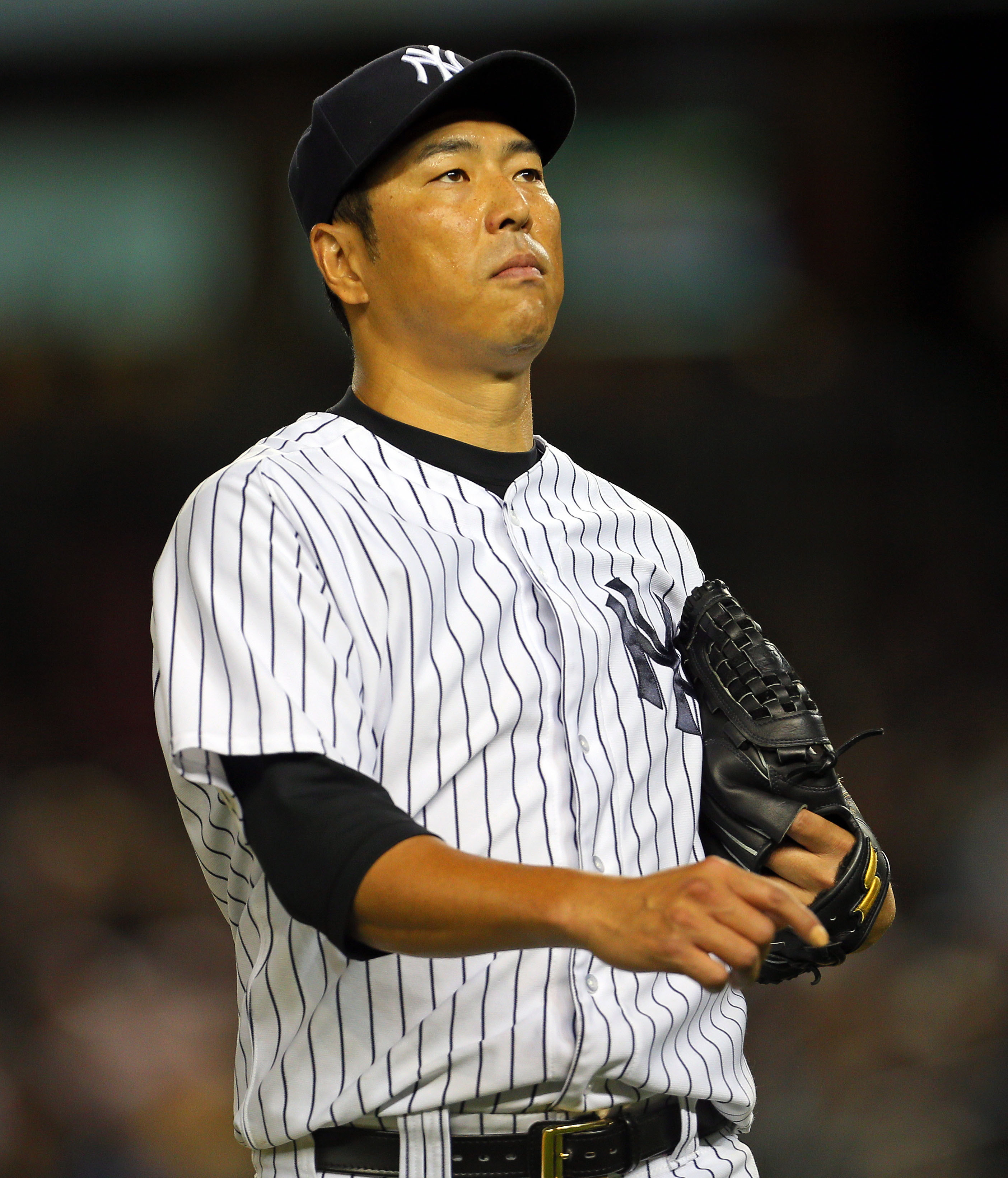
Kuroda, 41, is best known in these parts as a high-quality member of the Dodgers and then the Yankees. But in Japan, he is famed for his long run with the Hiroshima Carp — the organization he broke in with, excelled for, and returned to after his run in the majors (spurning the Padres’ reported efforts to keep him stateside).
Indeed, the Japanese star did not appear in the big leagues until his age-33 season. Of his twenty years of professional pitching, Kuroda spent 13 in the NPB — all for the Carp. All told, he provided that organization with over 2,000 innings of 3.55 ERA pitching. And he has been even better since his return, posting successive 2.55 and 3.09 ERA campaigns. He’ll hang up his spikes after the team’s run through the Japan Series comes to a close.
“The Japan Series will be the end. I’ve decided to hang it up,” Kuroda said. “I’ve been shown an excellent dream with an excellent team. And now I want to go out with a smile on my face, all of us celebrating a championship pouring beer on each other.”
In between his stints in Hiroshima, Kuroda excelled in the majors. He spurned several other suitors to join the Dodgers for the 2008 campaign, initially inking a three-year deal. From that point forward, Kuroda inked successive one-year pacts — first returning to Los Angeles, then switching coasts to join the Yankees on what turned out to be a trio of single-season deals (the final two of which came after he declined qualifying offers).
Through it all, Kuroda was a model of consistency. He only completed one campaign — his 2009 sophomore MLB season — with less than 31 starts. And he never completed a year with an earned run average of more than 3.76. Ultimately, Kuroda provided his two major league organizations with nearly identical production: 699 innings of 3.45 ERA pitching with 6.7 K/9 against 2.1 BB/9 for the Dodgers, and 620 frames of 3.44 ERA ball with 6.7 K/9 and 1.9 BB/9 for the Yanks. Even as his fastball velocity dwindled, Kuroda’s sinker/slider mix allowed him to steadily maintain his peripherals, and he ended with a 48.6% groundball rate and even 10.0% swinging strike rate in the majors.
In the aggregate, Kuroda earned just over $88MM as a major leaguer. And he is currently the highest-paid player in Japan. But it’s hard to dispute that he has delivered value at every stop along the way. MLBTR joins all those around the game in congratulating Kuroda on his outstanding two decades as a professional ballplayer, and in wishing him good fortune in his future endeavors.
Photo courtesy of USA Today Sports Images.
Rule 5 Roundup
We’re just a few months away from this winter’s Rule 5 draft, so it makes sense to take a look back and see how things shook out from the 2015 selections. Several organizations found useful players, even if the most recent class didn’t include an Odubel Herrera-esque breakout sensation. Some of the most recent draftees have probably locked up MLB jobs again for 2017, though others who stuck on a major league roster all year may head back to the minors for further development. (Once a player’s permanent control rights have been secured, his new organization is free to utilize optional assignments as usual for future years.)
Here’s a roundup of the 2015 draft class with the 2016 season in the books:
Keepers
- Tyler Goeddel, OF, kept by Phillies from Rays: The 23-year-old struggled with the aggressive move to the big leagues, carrying a .192/.258/.291 batting line in 234 trips to the plate, but showed enough for the rebuilding Phillies to hold onto him all year long.
- Luis Perdomo, RHP, kept by Padres (via Rockies) from Cardinals: It didn’t look good early for Perdomo, but he showed better after moving to the rotation and ended with a rather promising 4.85 ERA over twenty starts. Though he struggled to contain the long ball, and only struck out 6.4 per nine, Perdomo sported a nifty 59.0% groundball rate on the year.
- Joey Rickard, OF, kept by Orioles from Rays: After opening the year with a bang, Rickard faded to a .268/.319/.377 batting line on the year but held his roster spot in Baltimore. He ended the season on the DL with a thumb injury, though, and may end up at Triple-A for some added seasoning.
- Joe Biagini, RHP, kept by Blue Jays from Giants: The only Rule 5 pick to appear in the postseason, Biagini was a great find for Toronto. He ended with 67 2/3 innings of 3.06 ERA pitching, with 8.2 K/9 and 2.5 BB/9, and now looks like a potential fixture in the Jays’ relief corps.
- Matthew Bowman, RHP, kept by Cardinals from Mets: Bowman rounds out a trio of impressive relievers. He contributed 67 2/3 innings with a 3.46 ERA and 6.9 BB/9 against 2.7 BB/9 to go with a monster 61.7% groundball rate.
Retained By Other Means
- Deolis Guerra, RHP, re-signed by Angels (who selected him from Pirates) after being outrighted: Guerra was in an unusual spot since he had previously been outrighted off of the Bucs’ 40-man roster when he was selected, meaning he didn’t need to be offered back. Los Angeles removed him from the major league roster and then brought him back on a minor league deal, ultimately selecting his contract. Though he was later designated and outrighted by the Halos, Guerra again returned and largely thrived at the major league level, contributing 53 1/3 much-needed pen frames with a 3.21 ERA on the back of 6.1 K/9 against just 1.2 BB/9.
- Jabari Blash, OF, acquired by Padres (who acquired Rule 5 rights from Athletics) from Mariners: Blash’s intriguing tools weren’t quite ready for the majors, but San Diego struck a deal to hold onto him and was surely impressed with his showing at Triple-A. In his 229 plate appearances there, Blash swatted 11 home runs but — more importantly — carried a .415 OBP with a much-improved 66:41 K/BB ratio.
- Ji-Man Choi, 1B, outrighted by Angels after Orioles declined return: The 25-year-old scuffled in the bigs but was rather impressive at the highest level of the minors, where he walked nearly as often as he struck out and put up a .346/.434/.527 slash with five home runs in 227 plate appearances.
Returned
- Jake Cave, OF, returned from Reds to Yankees: After failing to crack Cinci’s roster out of camp, Cave impressed at Double-A but slowed at the highest level of the minors (.261/.323/.401 in 354 plate appearances) upon his return to the New York organization.
- Evan Rutckyj, LHP, returned from Braves to Yankees: Sent back late in camp, the 24-year-old struggled in limited action on the Yanks’ farm after missing most of the season with elbow issues.
- Josh Martin, RHP, returned from Padres to Indians: In his first attempt at Triple-A, Martin posted 66 frames of 3.55 ERA pitching with 8.2 K/9 against 3.1 BB/9.
- Daniel Stumpf, LHP, returned from Phillies to Royals: Slowed by a PED suspension, Stumpf was bombed in a brief MLB stint with the Phils but dominated at Double-A upon his return to K.C., posting a 2.11 ERA with 11.0 K/9 and 1.7 BB/9 in 21 1/3 innings.
- Chris O’Grady, LHP, returned from Reds to Angels: Sent back in late March, O’Grady compiled a 3.48 ERA over 95 2/3 innings in the upper minors, though he performed much better as a Double-A starter than he did as a Triple-A reliever.
- Zack Jones, RHP, returned from Brewers to Twins: The 25-year-old was out with a shoulder injury for most of the year, and ended up being sent back to Minnesota in late June, but has shown swing-and-miss stuff when healthy.
- Blake Smith, RHP, returned from Padres to White Sox: Smith ended up making a brief MLB debut upon his return to Chicago, but spend most of the year pitching well at Triple-A Charlotte, where he ran up a 3.53 ERA in 71 1/3 innings with 9.5 K/9 against 3.0 BB/9.
- Colin Walsh, INF, returned from Brewers to Athletics: After struggling badly in his major league stint with the Brewers, Walsh went to Oakland’s Triple-A affiliate and put up a .259/.384/.388 bating line over 245 plate appearances.
Twins Outright Tommy Milone, Four Others
11:33pm: Milone has elected free agency, Mike Berardino of the St. Paul Pioneer-Press reports on Twitter.
8:08pm: The Twins have announced five outright assignments as the team clears 40-man roster space entering the offseason. Southpaws Tommy Milone, Andrew Albers, and Pat Dean were all cut, as were infielder James Beresford and outfielder Logan Schafer.
None of the moves is terribly surprising. Though incoming Minnesota chief baseball officer Derek Falvey has yet to join the organization — he’s staying with the Indians as they continue their postseason run — the organization obviously already knew these five roster spots would be opened up to make way for new acquisitions and/or Rule 5 draft protection.
Milone, 29, was slated to earn a slight raise on his $4.5MM arbitration salary, with MLBTR and contributor Matt Swartz projecting a $4.9MM figure this winter. It never seemed particularly likely that the Twins would pick up that tab after Milone turned in 69 1/3 innings of 5.71 ERA ball on the year. He has provided some solid major league innings over the years, though, and could earn a shot at a swingman or even rotation role from another organization in the right circumstances (and at a lower price).
The 31-year-old Albers and 27-year-old Dean have not topped one hundred total major league frames in their careers, and neither have been particularly productive in their limited opportunities. Albers worked 17 frames this year for Minnesota, allowing five home runs and 27 base hits along with 11 earned runs. Dean ended his first MLB campaign with a 6.28 ERA on 6.7 K/9 against 3.1 BB/9 over 67 1/3 innings.
As for the position players, Beresford briefly cracked the big leagues for the first time in 2016 but has never really hit much in a decade-long minor league run. The 30-year-old Schafer has seen action in six seasons, but owns only a .214/.292/.318 career batting line in 720 plate appearances.
D-Backs Introduce Mike Hazen, Address Tony La Russa’s Role
The Diamondbacks introduced new general manager Mike Hazen today, as Nick Piecoro of the Arizona Republic reports. While there wasn’t much in the way of specifics on offer, the team’s top brass did talk through some general approaches and also addressed the still-undefined role of re-positioned executive Tony La Russa, Piecoro further reports.
Hazen enters the fold with a broad mandate as he takes the reins from the outgoing Dave Stewart. Though he was the last executive interviewed by the organization, things came together in a matter of days. “Clearly, in the case of Mike, everybody agrees he’s the right guy,” said president and CEO Derrick Hall. “So you have to let him do his job. That’s the goal.”
Hall and his boss, owner Ken Kendrick, expressed confidence in their new hire. Hall explained that Hazen will look to build a sustainable contender, with a “well-balanced” approach. The long-time Red Sox executive impressed with his breakdown of the organization, presenting a “vision” that the organization’s top leadership found compelling.
The incoming GM will take over final authority over the baseball decisionmaking for the organization, whereas Stewart had reported to La Russa. While the Hall of Fame skipper will stay in the organization — which was no sure thing after Stewart, VP DeJon Watson, and manager Chip Hale were all cut loose — he’ll do so in a diminished capacity.
La Russa was involved in the GM hiring process even after he was ordered to fire Stewart and was stripped of his title of chief baseball officer. But he’ll now work under the lesser title of chief baseball analyst and adviser, and will join Hazen in reporting to Hall, who says there’ll be “a dotted line” between the two men. “Mike needs to know everything that [La Russa is] doing and be comfortable with it,” Hall explained, adding that the relationship between La Russa and a new manager will also require “an understanding on both sides at what that role is.”
The precise nature of the relationship between Hazen and La Russa remains to be seen, but it seems that the former will attempt to embrace the latter’s experience. “I know that the game is moving in a particular direction with the buzzword of analytics,” Hazen explained. “(But) there’s no replacing the softer parts of the game, the knowledge of how to manage a human being. … “Those things I’m confident that Tony’s going to be able to help with and I look forward to hearing what he has to say on all those things.” La Russa struck a similar tone, saying: “I think there’s a real place in front offices for guys that have uniform experience, just so you can help balance the metrics (with) some of that baseball expertise that’s come along for 100 years.”
Indeed, though he has spent much of his time in a Boston organization that obviously values analytics, Hazen stressed his roots in scouting and player development. As for the team’s many upcoming offseason decisions, Hazen largely demurred. “I don’t have a defined view just yet,” he said. “It would be irresponsible for me at this point to sort of say exactly how we’re going to attack the roster.” That’s understandable enough, given that he hasn’t yet dug into his new job, and he did notethat offseason opportunities will have an impact on the organization’s direction. “We’ll have more concrete answers on that as we move through the offseason,” he said. “We’ll see what the landscape is in the marketplace.”
Mariners Announce Surgeries For Steve Cishek, Taijuan Walker, Tony Zych
The Mariners announced that three important members of the team’s pitching staff recently underwent surgery. Reliever Steve Cishek had his torn hip labrum repaired, starter Taijuan Walker had a bone fragment removed from his right ankle, and bullpen member Tony Zych underwent a shoulder biceps tendon transfer in his right arm.
It seems that Cishek’s may be the most concerning of the procedures. The club’s announcement suggests that he’ll need four to six months of rehab “before resuming full baseball activities,” which means that it would be quite optimistic to expect him to be ready for the start of the regular season. (Spring training will begin in about four months.)
Cishek suffered the tear during the season, but was able to return after a fairly brief absence. It’s not clear whether something else occurred, or if that was simply a temporary solution — with plans for an offseason surgery for a permanent fix. Cishek is owed $6MM next year, the second and final year of his contract, and had seemed primed to serve as a quality set-up man after providing 64 frames of 2.81 ERA pitching (with 10.7 K/9 against 3.0 BB/9) in 2016.
Walker, meanwhile, dealt with foot issues throughout the year and obviously felt it was an opportune moment to have that addressed. Seattle desperately needs him to fulfill the huge promise he has shown. The club says that Walker is expected to be ready to go with camp opens.
Finally, the prognosis is the same for Zych, though it’s hard to say his outlook is as promising. The 26-year-old has shown swing and miss stuff, but missed a great deal of the 2016 campaign and only ended up making a dozen major league appearances. His procedure may be somewhat less dramatic than it sounds, as the club stressed that it “did not involve the rotator cuff or capsule in the shoulder.” Certainly, a healthy Zych would go a long way toward making up for Cishek’s absence, however long that turns out to be.
Offseason Outlook: Philadelphia Phillies
MLBTR is publishing Offseason Outlooks for all 30 teams. Click here for the other entries in this series.
The Phillies faded badly after a solid start to the 2016 campaign, and ultimately dealt with some ups and downs from important organizational assets. But with an increasingly massive gulf between the team’s commitments and its spending capacity, the build back toward contention may begin to feature investments in the major league roster.
Guaranteed Contracts
- Matt Harrison, SP: $15MM through 2017 (includes $2MM buyout of $13.25MM club option for 2018)
Other Obligations
- Phillies retained $9.5MM of future obligations to Cole Hamels in trade sending him to Rangers; payout over unreported timeline
Arbitration Eligible Players (service time in parentheses; projections via MLB Trade Rumors)
- Jeanmar Gomez, RP (5.063) – $4.6MM
- Freddy Galvis, SS (4.021) – $4.4MM
- Cesar Hernandez, 2B (2.154) – $2.5MM
- Cody Asche, 3B/OF (3.022) – $1.3MM
- Non-tender candidates: Gomez, Asche
Contract Options
- Ryan Howard, 1B: $25MM club option ($10MM buyout)
- Charlie Morton, SP: $9.5MM mutual option ($1MM buyout)
Free Agents
Phillies Depth Chart; Phillies Payroll Information
With a big new TV contract backing a franchise that already has shown more capacity to spend than all but a few others, the Phillies have been a monster in waiting from the moment their veteran-laden roster took a downturn after the 2011 campaign — its last of five straight NL East title runs. But that was five seasons ago, and the rebuild has really only been undertaken in earnest over the last two years, leading president Andy MacPhail and GM Matt Klentak to continue preaching patience.
All told, despite essentially unrestrained spending capacity, the Phillies are unlikely to lock up too much future payroll space this winter. Klentak has consistently dampened any expectations of a free agent spending spree, and reports suggest instead that the club will look to the free agent and trade markets for some targeted additions — thus maintaining flexibility and keeping the books clear for future extensions and more promising open-market classes still to come.
That said, the Phils can’t be counted out for any free agents, and it’s reasonable to wonder whether the team will weigh a significant addition if it sees a chance at achieving good value and infusing some life into Citizens Bank Park. Certainly, there are a variety of roster spots that could stand to be improved.
The place to start, it seems, is the outfield, where only center is locked down. The remarkable Odubel Herrera has not only been the team’s best player in each of the last two years after being plucked in the Rule 5 draft, but improved significantly in plate discipline (nearly tripling his walks) and home run power (from eight to 15) in his second MLB campaign.
Otherwise, it’s open season. Though there are internal possibilities — now and in the near future — to account for, neither corner spot is spoken for. Cody Asche struggled and may well be a non-tender candidate. Aaron Altherr didn’t progress as hoped after missing a big chunk of the season. Rule 5 pick Tyler Goeddel will surely head to the minors for needed seasoning. The highly-rated Nick Williams scuffled at Triple-A, with 136 strikeouts against just 19 walks, so he’s probably headed back to Lehigh Valley. Good things happened at Double-A, where Dylan Cozens emerged with forty home runs and Andrew Pullin had a mini-breakout of his own, but neither player stands out as particularly likely to make the MLB roster out of camp. Roman Quinn did reach the majors after a solid showing at Reading, and could be a candidate for a roster spot, but he hasn’t shown much power and showed enough swing-and-miss in his brief MLB stint that more development may be in order.
That group, along with those deeper in the system, may come with enough promise that the Phillies won’t chase two multi-year outfield additions. But it seems reasonable to expect that the club will at least sign one established veteran to man a corner post for the next several years. There are a variety of options available, ranging from the probably-unrealistic Yoenis Cespedes to the steady Josh Reddick and relatively youthful left-handed hitters Michael Saunders and Colby Rasmus. We’ve heard some chatter connecting Ian Desmond to Philly, where presumably he’d play in left or even occupy a utility role at some point. Dangling a moderate guarantee with an opt-out to Carlos Gomez could be interesting. And if they like what they’ve seen, the Phillies could be in a nice position to take a shot on MLB-to-KBO success story Eric Thames (assuming he’d move back to the grass if he returns stateside). Odds are, the club will add at least two veterans, perhaps chasing a shorter-term deal with some upside on one player.
There’s far less work to be done in the infield, where most of the jobs are accounted for. Though he took a step back, Maikel Franco remains the future at third. Shortstop Freddy Galvis doesn’t get on base much, but put on a late-season power surge and showed plenty of glove to hold onto the everyday job. The expectation remains that he’s keeping the seat warm for top prospect J.P. Crawford, though Galvis’s strong finish and Crawford’s tepid batting line in his first run at Triple-A almost certainly makes that a mid-season debate. Looking at second, Cesar Hernandez somewhat quietly ended up having a big year, posting a .371 on-base percentage, fielding his position quite well, though he was gunned down in 13 of 30 stolen base attempts. The team will presumably either re-sign Andres Blanco, who has been surprisingly useful, or find another sturdy utility piece to fill things out.
There’s a bit more uncertainty at first and behind the plate, but that doesn’t mean there’s reason to expect any major action. With Ryan Howard set to follow Carlos Ruiz out the door, finally closing the book on the team’s stretch of excellence, the first base job seems set to go to Tommy Joseph — who battled through concussion issues that forced him out from the catching position. He swatted 21 home runs and posted a .257/.308/.505 batting line in 347 plate appearances, though he was much better with the platoon advantage and could end up being paired with a lefty slugger. Joseph’s emergence may push Darin Ruf off the roster.
In some regards, 28-year-old backstop Cameron Rupp was an even bigger surprise than Joseph. He posted league-average overall offensive numbers and whacked 16 long balls in his 419 trips to the plate, setting himself up as the primary receiver for 2017. A strike to bring back A.J. Ellis (who was acquired when Ruiz was traded) or add another one-year veteran wouldn’t be surprising. Regardless of where Joseph goes from here, the organization will want to see what it has sooner than later in top prospects Jorge Alfaro and Andrew Knapp, so a significant addition would be a surprise.
As for the pitching, it was two steps forward, one step back in many regards. Righty Aaron Nola is the chief example of that, as he showed immense promise — with 9.8 K/9 against 2.4 BB/9 and a 55.2% groundball rate — even if a low strand rate (60.6%) helped crater his earned run average (4.78 over 111 innings). The big question, though, is whether he can work back from a UCL sprain or whether he’ll end up succumbing to Tommy John surgery. Vince Velasquez also dealt with arm troubles and inconsistency, but was dominant at times and ended up with 131 innings of 4.12 ERA ball. Forming the third piece of what could be a nice core was fellow righty Jerad Eickhoff, who has exceeded expectations (both of prospect observers and of ERA estimators) with 248 1/3 innings of 3.44 ERA pitching since rising to the major league level in the middle of 2015.
How the Phils will account for the two or three remaining spots in the rotation remains to be seen. Charlie Morton figures to hit the open market after missing most of the year, unless he and the team see eye to eye on a mutual option or work something else out. Less-established starters Adam Morgan, Zach Eflin, and Jake Thompson all logged significant MLB innings, but none performed well enough to lock up a job (and Eflin will also be working back from surgery to both knees). Command artist Alec Asher was excellent in the upper minors before a PED suspension, and then got strong results in five major league starts upon his return, so he could factor in the club’s 2016 plans.
While there are options on hand, odds are the Phils will look to add at least one sturdy veteran. Jeremy Hellickson filled that role quite nicely after being acquired via trade, and it seems the team will be able to recoup a draft pick for its investment by issuing him a qualifying offer. Klentak will likely be looking to find at least one more solid rotation piece, whether by signing or trade. It seems reasonable to think that the team will again be willing to allocate a decent bit of money to that effort, so long as the contract doesn’t drag out too far into the future. Another strike similar to the trades for Hellickson and Morton would not surprise. There are some fairly costly pitchers with short-term control remaining (via arb or option) who could fit a generally similar profile, such as Drew Smyly, Hector Santiago, Jordan Lyles, Jaime Garcia, Derek Holland, Clay Buchholz, and even Tyson Ross — if he can show that he’s on an upward health trajectory, at least.
The bullpen, too, can be filled mostly from within, but the Phillies can also open up the late innings to outsiders who are interested in throwing high-leverage innings. Incumbent closer Jeanmar Gomez stumbled down the stretch, and could even draw non-tender consideration with his save tally inflating his earning power. But he was quite good for most of the year, seemingly wearing down in the course of another season of heavy usage. Hector Neris was the true eye-opener in 2016, and he’ll continue to play a significant role moving forward. Neris appears to be first in line for closing duties, though the club could dangle that opportunity in a bid to draw veteran free agents.
Filling things out will likely involve giving some chances to younger players while perhaps taking some shots on veterans — as the team did last year with David Hernandez, Andrew Bailey, and others. The Phils received interesting showings last year from live-armed young hurlers such as Edubray Ramos, Joely Rodriguez, and Severino Gonzalez, all of whom will factor at some point in 2017. Others — including Michael Mariot, Luis Garcia, and Phil Klein — could be kept on the 40-man for depth and given a chance to compete this spring. While Elvis Araujo and injury-addled Mario Hollands could compete for a chance to serve as a lefty option alongside Rodriguez, that’s certainly a plausible area for the club to target on the open market. All told, dropping a bit of cash on the bullpen would be an easy way to improve for the Phillies, but it would be exceedingly surprising were the club to play in the markets for the top available closers.
What’s not covered above, at least not directly, is the possibility of more creative action than we’ve seen of late. Klentak has thus far proceeded steadily — after all, most of the Phillies’ major veteran pieces were already gone when he took over — rather than engineering the kinds of bold swaps put together by the new-look Braves front office. But he also has far more financial might at his disposal, and already wielded it to add Hellickson, Morton, and Hernandez last winter. Whether it’s absorbing a big salary to facilitate the acquisition of a quality youngster, taking advantage of the team’s protected first-round pick to land a QO-bound free agent who slips through the cracks, or finding some other means of buying up talent, there figure to be many opportunities for Klentak to absorb this winter.