
Nexen Heroes Post Byung-ho Park
NOVEMBER 3: Nexen indeed posted Park yesterday, as expected, Jee-ho Yoo of Yonhap reports. As explained further below, bids are due this Friday.
By timing the move as they did, Nexen has moved Park up into the front of the free agent period. By comparison, the Kang posting and signing process took place in late December. While that strategy may carry some risk, as teams pursuing significant free agents may prefer not to be bound, it could reflect a hope or expectation that MLB teams will view Park as a major addition around whom their offseason plans could be structured.
OCTOBER 28: The Nexen Heroes have announced that they will post first baseman Byung-ho Park on Monday, November 2nd, as So-jung Park of the Yonhap News Agency reports (hat tip to Dan Kurtz of MyKBO.net).
The Korean star is a former teammate of Pirates infielder Jung-ho Kang. Both put up gaudy numbers in the hitter-friendly KBO, but Park has actually been a more consistently stratospheric offensive performer.
In each of the last three seasons, the 29-year-old has registered a 1.000+ OPS. And he’s continued to improve: last season, Park posted career-best numbers in each of the triple-slash categories (.343/.436/.714) and blasted 53 home runs in 622 plate appearances (one year after swatting 52 long balls). There will be questions asked of his strikeouts, though, as Park went down on strikes in about a quarter of his plate appearances in each of the last two seasons.
Park will now test his earning power through the traditional posting system that still governs the flow of players from the KBO to the majors. (A modified set of rules now applies to Japan’s NPB, where there is a $20MM cap on posting fees and the potential for multiple MLB clubs to negotiate with a player.) Major league organizations will participate in a blind bidding process in which the high bidder earns exclusive negotiating rights.
By posting Park on Monday, the bidding window will stay open until 5pm EST on Friday, November 6th. Then, Nexen says, the club will determine whether to take the top offer and announce its decision on Monday, November 9th. At that point, assuming the KBO club moves forward, the winning MLB team will have thirty days to reach agreement with Park (with the posting fee refunded if it cannot).
It’s always tough to predict the international market, but Kang’s huge year in Pittsburgh certainly seems likely to have elevated perceptions of Park’s ability to transition to the majors. (Travis Sawchik of the Pittsburgh Tribune explores that idea in more depth in an interesting piece.) To be fair, players like Eric Thames can look like Barry Bonds playing in Korea — he’s fresh off of a .381/.497/.790, 47 home run campaign — but that doesn’t mean the numbers are without any value. Acquired for just a $5MM posting fee and a four-year, $11MM contract, Kang proved an excellent value after moving to North America. While he obviously didn’t match his monster KBO stat line, he adapted quite well to the majors and put up an excellent .287/.355/.461 batting line.
Park will, of course, have quite a different market. Scouts will have opinions on how his bat will translate, and it will obviously matter that he appears to be limited to first base. But plenty of teams will be intrigued at the possibility of adding a reasonably youthful power hitter at a relatively affordable price. There will be several veteran first basemen available in free agency, but the only premier, younger talent on this year’s market is Chris Davis, who MLBTR’s Tim Dierkes predicts to land a six-year, $144MM contract.
Offseason Outlook: Atlanta Braves
After undergoing a fairly extensive tear-down last winter, the Braves will look to begin rebuilding toward a return to contention in 2017, when they are set to open a new park.
Guaranteed Contracts
- Freddie Freeman, 1B: $118.5MM through 2021
- Andrelton Simmons, SS: $53MM through 2020
- Nick Markakis, OF: $33MM through 2018
- Julio Teheran, SP: $29.6MM through 2019 (includes buyout of 2020 club option)
- Hector Olivera, 3B: $32.5MM through 2020
- Nick Swisher, OF: $15MM through 2016*
- Michael Bourn, OF: $14MM through 2016*
- Cameron Maybin, OF: $9MM through 2016 (includes buyout of 2017 club option)
- Dian Toscano, OF: $4MM through 2018 (includes buyout of 2019 club option)
- Jason Grilli, RP: $3.75MM through 2016 (includes buyout of 2017 club option)
*Indians will pay $10MM of the collective obligations to Swisher and Bourn in 2016
Arbitration Eligible Players (service time in parentheses; projections by MLB Trade Rumors)
- Mike Minor (4.138) – $5.6M
- Pedro Ciriaco (3.049) – $800K
- Shelby Miller (3.030) – $4.9MM
- Arodys Vizcaino (2.168) – $1.1MM
- Chris Withrow (2.132) – $600K
- Non-tender candidates: Ciriaco
Contract Options
- None
Free Agents
Things got ugly in the second half for the club, which all but collapsed down the stretch. In addition to the sales of a few last short-term veterans, the Braves’ summer featured a bad contract swap of Chris Johnson for Nick Swisher and Michael Bourn and — more importantly — the acquisition of Hector Olivera in a deal that sent lefty Alex Wood and prospect Jose Peraza to the Dodgers (among other pieces changing hands). That made for a less-than-ideal 2015 product, but that wasn’t really the point.
We may have been given a hint at the Braves’ endgame when the club parted with the controllable Wood for an unproven, somewhat older player in Olivera. Having spent the winter accumulating as many upper-level young arms as it could via trade, Atlanta gave one up for the chance at five fairly cheap years of Olivera. That move suggests that Atlanta already sees a light at the end of the tunnel of its quick rebuild. After all, Wood certainly could’ve brought back youthful prospects instead.
With a newly resurgent farm system and at least the nucleus of a core in place, the Braves are probably ready to begin adding at the major league level. But having parted with so much MLB-level talent in the last year or so, it’s unlikely that the organization really expects contention in 2016. Instead, the focus will be on 2017 and beyond.
So, what might the club look to do this winter under the leadership of newly-promoted GM John Coppolella and president of baseball operations John Hart? Let’s start with the possibility of further swaps, as it’s hard to rule anything out after Atlanta was willing to part with its long-term control over Evan Gattis and Craig Kimbrel last offseason.
It would take something awfully compelling for the Braves to consider moving Freddie Freeman or Andrelton Simmons, the pair of young infielders who figure to bridge the team’s most recent contender to its (hopeful) future outfit. Frankly, the possibility seems too remote to seriously consider as something that’s on the table.
Righty Julio Teheran, though, has generated more chatter. He’s taken a value hit after an uninspiring 2015, but he’s cheap, young (still 24), and durable (607 1/3 innings since the start of 2013). It’s hard to know how interested Atlanta is in parting with him, but the ask would surely be high in spite of his difficulties.
After all, while the Braves have compiled an impressive volume of young arms, few have established themselves in the big leagues. It would be risky to move on from Teheran, especially after having already sent out Wood. Shelby Miller had a strong season and looks like a great get from the Jason Heyward/Jordan Walden deal. (An extension with Miller could be pursued, at least to buy up his arb-eligible seasons.) The other key piece in that swap, Tyrell Jenkins, is one of several younger arms who’ll look to crack (or stay in) the big league staff in the coming years. Matt Wisler, Mike Foltynewicz, and Manny Banuelos are also recent trade additions in that general mold, and top prospect Lucas Sims is coming up behind that group. Further off are interesting names like Touki Toussaint, Kolby Allard, and Max Fried, among others.
Rounding out the 2016 rotation will involve a mix of depth pieces like Williams Perez and Ryan Weber and, perhaps, a veteran acquisition or two. The club has indicated it will tender a contract to lefty Mike Minor in hopes that he can reestablish himself after a tough run of injuries, but he’ll be hard to count on.
It’s possible to imagine Atlanta adding a mid or long-term arm on the free agent market, though it seems more likely that the club will look to bail out an undervalued asset than to beat the market for a top-end hurler. It wouldn’t be too hard to imagine this opportunistic front office pouncing if someone like Jeff Samardzija or Ian Kennedy find demand lacking, though I’d expect they will value the loss of a draft pick quite highly in weighing such decisions. While Atlanta’s #3 overall selection is protected, the team will probably like the idea of preserving an additional early draft slot (and the pool money that comes with it). Otherwise, there’s certainly some merit to the idea of utilizing the team’s unclaimed rotation spots to draw a pitcher (Doug Fister being the popular, but potentially too pricey, example) who could be looking for a one-year bounce-back deal. And Atlanta should be a popular destination for minor league free agents seeking a chance to prove themselves in the spring.
There’s even more uncertainty in the bullpen, where Arodys Vizcaino reemerged to have a nice year and take over as the closer. After him, though, the team’s most-used and most effective pen arms were traded (Jim Johnson, Luis Avilan) or hurt (Jason Grilli). The team still controls Grilli for two more years (the second via option) and could put him back in the ninth when he returns from injury, both to boost his trade stock and to tamp down Vizcaino’s arb platform. Rule 5 pick Daniel Winkler will need a roster spot to open the year in order for the team to earn his permanent rights, while another Rule 5 selection — Andrew McKirahan — could provide a left-handed option. Unfortunately, southpaw Paco Rodriguez — who was acquired from the Dodgers — is going to be out for the year after undergoing Tommy John surgery, but Chris Withrow — another Los Angeles import (separate trade) — could be ready and provides some interest. Veteran Peter Moylan could be brought back, and the club can also get some frames out of Brandon Cunniff, who logged the most relief innings last year of any returning pitcher in the organization.
There are a number of other names that could be in the mix, but none seem particularly worth mentioning. Atlanta took advantage of the fact that it had late-inning opportunities to offer last year when it signed Grilli and Johnson, and it could do so again. The club will also just be looking to get innings wherever it can. Last year’s roster ultimately included a veritable who’s who of once-quality pitchers who were looking for big league chances. But there’s also quite a realistic scenario where the Braves make a real investment in a reliever or two via free agency, as the team’s front office has hinted in recent weeks.
Moving back to the position player side of the equation, the infield seems largely set — potentially. Simmons, Freeman, and Olivera will take three spots. Third base prospect Rio Ruiz, who didn’t exactly master Double-A but spent the year there at 21 years of age, could eventually push Olivera off of the hot corner. That would open new questions and new possibilities, but there are some more immediate issues to be addressed.
Jace Peterson probably warrants another audition at second, though he’ll need to improve on a .239/.314/.335 batting effort. It’s possible — perhaps likely — that the team will look to supplement him with a veteran. The team signed Alberto Callaspo and Kelly Johnson as role-playing depth pieces last year, and figures to do something similar this winter. Top prospect Ozhaino Albies may ultimately be an appealing option up the middle, but he’s just 18 and is further off away than was the traded-away Jose Peraza.
Its certainly possible that the organization will consider adding a more significant infield piece this winter. That’s all the more true given reports that Olivera will spend some time in Puerto Rico playing the corner outfield. There are several free agents who might function as bridge players — Howie Kendrick and Daniel Murphy among them — and a variety of hypothetical trade candidates.
The club faces more questions behind the dish, where Christian Bethancourt remains an intriguing but frustrating player. He played only sporadically in the majors, endured a mid-season demotion (though he hit well at Triple-A), and drew questions about his mental approach. In a mid-season interview, Hart explained that he liked the young backstop’s tools, but felt that he was failing to grasp what it took to be a big league catcher. The issue was “not dedication,” said Hart. Instead: “It’s a level of preparedness you need for what [pitching coach] Roger [McDowell] expects and a championship organization expects, especially when dealing with young pitchers.” It’s possible that Atlanta will entertain change-of-scenery offers, though he seems more likely to get another chance. Last year’s primary backstop ended up being veteran A.J. Pierzynski. He remains a candidate to return, particularly after the club resisted the urge to trade him at the deadline, though he’ll test the market first. Otherwise, another elder statesman might be found. The Braves have been mentioned as a hypothetical suitor for Matt Wieters, who attended Georgia Tech, and he certainly could be the sort of (relative) buy-low that the organization would find intriguing. But it’s not yet clear whether Atlanta will be a leading contender for his services, especially since he’ll likely require a signing team to sacrifice a draft pick.
In the outfield, Nick Markakis — last year’s surprise free agent splurge — will handle right. Cameron Maybin figures to see the bulk of the action in center — barring a trade, at least. He was a nice comeback surprise after being included as part of the salary balancing in the Craig Kimbrel deal. Though his production tailed off late, he ended up with a .267/.327/.370 batting line to go with 23 steals and ten home runs. On the other hand, defensive metrics hated his glovework despite historical success.
While there would have to be interest if an appealing offer came in, the club is probably best off sticking with Maybin for the time being. He isn’t too expensive, his option conveys a bit of upside, and he could turn into an even more valuable mid-season trade chip. Maybin is likely just keeping the seat warm for Mallex Smith, who earned a mid-season promotion to Triple-A in his age-22 campaign. He still needs to conquer that level, and is far from a surefire prospect, but a summer promotion could be in order if he does and if there’s a need at the major league level.
Of course, the Braves do have another option in center: the veteran Bourn, who came over in the aforementioned trade along with Swisher. Bourn could help bridge the gap as well. Neither of those players produced last year, and may not last the year if they falter. (Both have options for 2017 that vest at 550 plate appearances, and it’s hard to imagine a scenario where that is allowed to take place.) But they’ll do for the meanwhile, and the organization has another fourth outfield type on hand in Adonis Garcia (though he’s not a good bet to repeat his production).
Given that array of outfield options, it’s easy to dream on the team wading into the free agent market. It would be foolish to rule out such an effort, though it’d also be rather shocking to see any nine-figure deals handed out. As with the rotation, it’s possible to imagine the Braves seeing what the market will yield. That could come in the form of a one-year, bounceback signing or a multi-year pact with a mid-level free agent who falls through the cracks.
Entering the winter, there’s an argument to be made that Atlanta should be increasingly aggressive in free agency (after having already shown just that trait on the trade market). After all, if the team hopes to be prepared for legitimate contention in 2017, this robust free agent market might present the right moment to strike.
Having demonstrated a willingness to spend on the mid-tier market last year, in signing Markakis, players his price range certainly seem in play. Costlier additions, though, may not be forthcoming. There’s some open current and future payroll, but not a lot: the club has just under $75MM in commitments for 2016 before accounting for arbitration, and that number drops into the $50MM to $60MM range over the four seasons to follow. Even with the promise of new stadium and TV revenue, it would be dangerous to tie up too much future payroll for an organization that has started a season with a payroll over $100MM only once (2014).
All told, the offseason promises more of the same creativity out of Atlanta, albeit with a nearer-term focus. And we can’t discount the possibility of a big surprise out of this creative front office duo.
Outrighted: Schafer, Hellweg, Jimenez, Moreno, Santos
Here are the day’s outright assignments:
- As teams continue paring back their 40-man rosters in anticipation of a busy offseason, the Brewers were the latest to announce a group of outrights. Righty Johnny Hellweg, lefty Cesar Jimenez, catcher Juan Centeno, first baseman Matt Clark, and outfielder Logan Schafer all lost their roster spots. Hellweg hasn’t seen the big leagues since his first-ever MLB action back in 2013, and he struggled badly with his control in the minors this year. Jimenez, a late-season waiver claimee, was projected to earn $1MM in arbitration. He’s had solid results, and greatly improved his K:BB ratio this year, but will presumably look for another opportunity elsewhere. Centeno has received only spot duty in the majors over the last three seasons and is mostly a light-hitting depth piece. Clark has been quite productive in the upper minors in recent seasons, but did not get another trip to the show after a brief stint in 2014. As for the 29-year-old Schafer, he has produced a meager .212/.286/.319 batting line in 646 career plate appearances in Milwaukee, most of them coming over the last three years.
- The Yankees announced that they’ve reinstated right-handers Sergio Santos and Diego Moreno from the 60-day disabled list and outrighted each. The veteran Santos has already elected free agency and will look to latch on with a new club this winter. The former White Sox/Blue Jays closer posted a 4.96 ERA with an 18-to-7 K/BB ratio in 16 1/3 innings between the Dodgers and Yankees this season. Moreno, meanwhile, acquired four years ago in the trade that initially sent A.J. Burnett to the Pirates, made his MLB debut in 2015 but yielded six runs in 10 1/3 innings. The 28-year-old has enough minor league service time to elect free agency as well.
Dae-ho Lee Becomes Free Agent, Seeks MLB Deal
First baseman Dae-ho Lee has declined his 2016 player option with the Fukuoka SoftBak Hawks, he announced (story via Jee-ho Yoo of Yonhap News). He added that he intends to pursue a contract with a major league organization.
The South Korean has played in Japan’s Nippon Professional Baseball league since 2012. He moved there after more than a decade in the Korean Baseball Organization.
Unlike many other international players covered here at MLBTR, Lee will be looking to make the jump at the (relatively) advanced age of 33. That isn’t an unprecedented number, but it obviously limits his earning capacity and will reduce the number of teams that have interest in guaranteeing him money.
Lee has shown plenty with his right-handed bat, though, swatting 31 home runs and posting a .282/.364/.524 slash last year in the highly competitive NPB. That was his best overall campaign, but he has been quite consistently productive in Japan’s top league and the KBO before that.
Notably, because he is a free agent, Lee won’t require a posting fee. That eliminates some complications from the process and ought to drop the overall asking price. Presumably, the veteran will be looking first and foremost for opportunity, and it’s easy to imagine a variety of teams rolling the dice if the price is right.
“All baseball players dream of playing in the majors, and I’d like to pursue that dream,” Lee explained in his press conference. “If I can give 100 percent, like I’ve done throughout my career, I don’t think it will be impossible.”
Shapiro, LaCava On Jays Offseason
The Blue Jays’ new front office leadership — president Mark Shapiro and interim GM Tony LaCava — held a press conference today in which they addressed a variety of important topics. Ben Nicholson-Smith of Sportsnet.ca reported on all the key aspects of the discussion. Among the most notable bits:
- Toronto will bring back manager John Gibbons. He was under contract for another year already, as his deal includes a clause that guarantees an added season if he’s not let go within the prior calendar year. It’s designed to prevent him from ever entering a season as a lame duck manager, and the Jays will apparently allow that provision to go into effect this season.
- While LaCava will take the reins of the baseball operations department for the time being, Shapiro said that he intends to conduct a full search for a new general manager. It’s not yet clear whether LaCava will be a candidate and what kind of timeline the club expects. Looking ahead, Shapiro indicated that he will operate at a high-level in collaboration with his general manager, but gave Nicholson-Smith the impression that he is and will continue to be well-versed in all of the organization’s baseball assets and decisions.
- Shapiro clearly rejected idea that he’d criticized Alex Anthopoulos for his deadline dealing in an internal meeting, as had been reported. He told the press that the summer moves were “great trades,” even if they required the organization to part with good young talent.
- The Jays payroll will give the team what it needs to continue in contention, Shapiro said, though he did not give details on the club’s actual spending appetite for the coming year. He did note that he’s not unaware that he’ll be working with more flexibility than he had with the Indians. As he put it, “if you have a larger payroll you have a greater tolerance for risk.” In that regard, Toronto will no longer abide by any strict rules against issuing contracts of more than five years in duration. “I don’t believe in absolutes,” Shapiro explained.
Reds Decline Options Over Badenhop, Schumaker; Outright LeCure
The Reds have made a series of moves to shape the club’s roster on the first day of the offseason, as the club announced. Cincinnati will decline its club options over righty Burke Badenhop and utilityman Skip Schumaker and has outrighted right-hander Sam LeCure.
Badenhop, 32, has long been a sturdy reliever. He joined the club on a one-year deal with an option that seemed likely to be exercised — it contained a $1.5MM buyout and $4MM value — but began and ended his season with rough stretches (at least in the earned run department). The first and last impressions didn’t help, but Badenhop also put up a 3.93 ERA that landed well above his recent years’ marks and did not impress ERA estimators along the way. Still, he ought to draw plenty of interest from teams looking for solid innings — especially if they are drawn to groundball producers.
The 35-year-old Schumaker had a two-year guarantee, but contributed just a .238/.297/.322 batting line over his 539 plate appearances over the last two years. That made it rather an easy decision to buy out his $2.5MM option for $500K. While Schumaker is valued for his defensive versatility, he’s rated well below replacement level for each of the past three seasons.
As for LeCure, who’s 31 years of age, 2015 was a major disappointment despite the fact that he carried a 3.15 ERA. That’s because he started the year in the minors and ultimately threw only twenty MLB frames. LeCure has continued to see his strikeout and swinging strike rates fall along with his velocity in recent seasons.
All told, it’s not exactly surprising to see Cincinnati parting with these kinds of veteran players, though it wouldn’t have cost much to retain them. The organization now has more youthful options in both the infield and the bullpen after its trade activity over the last year or so.
East Notes: Jennings, Olivera, Jays GM, Red Sox
As he departs the Marlins, Dan Jennings issued a statement thanking the team (via MLB.com’s Joe Frisaro). He indicated that the club called him yesterday to tell him he “was being relieved” from his general manager duties, calling that move “sad and regrettable” but expressing that he respected the decision and would look back on his time in Miami with fondness. Jennings is said to be receiving strong interest from other clubs around baseball now that he’s a free agent.
Here’s more form the east:
- Recent Braves acquisition Hector Olivera is expected to spend time at both third base and left field in the Puerto Rican winter league, MLB.com’s Mark Bowman reports. The organization hopes to add to Olivera’s defensive capabilities while getting an idea of “what their needs might be over the next few years,” says Bowman. Atlanta would surely prefer to feel comfortable putting Olivera in either spot, as it would open up ample flexibility in the club’s developmental and acquisition plans.
- It’s still a bit early to get a read on what the Blue Jays will do to replace Alex Anthopoulos in their general manager’s role, but Jon Morosi of FOX Sports reports that president Mark Shapiro does intend to hire a day-to-day GM while holding onto final decisionmaking authority. He will also be able to hire away at least one or two front office members from the Indians if he wishes, so long as the hirings are promotions. Morosi tosses out a few hypothetical matches. Brendan Kennedy of the Toronto Star did the same last night.
- Clubs around baseball are gearing up to talk trades with new Red Sox president of baseball operations Dave Dombrowski, writes Alex Speier of the Boston Globe. Dombrowski has shown a willingness both to promote young players aggressively and to ship them out in trades, and that makes for a fascinating pairing with the organization’s highly-regarded talent base.
Free Agent Profile: Jason Heyward
Jason Heyward hasn’t maintained the power output that many once predicted, but he’ll hit the market at a very young age while playing at quite a high level and should be paid accordingly.
Strengths/Pros
There’s a lot to like about Heyward‘s all-around game, as he rates as a positive in essentially every area. His tools are undeniable, and he’s turned them into tangible production in most regards.
Heyward‘s best single attribute might be his glove. Ultimate Zone and Defensive Runs Saved ledgers are filled with big numbers, as he’s consistently rated as an outstanding right fielder. Since he debuted in 2010, Heyward has easily paced all outfielders in accumulated UZR (Alex Gordon‘s 68.3 UZR is second to Heyward‘s 96.2). Though his arm is more solid/good than great, he excels in the range department and isn’t prone to mistakes. Given his age and remarkable consistency, this is about as bankable a skill as one could hope to find.
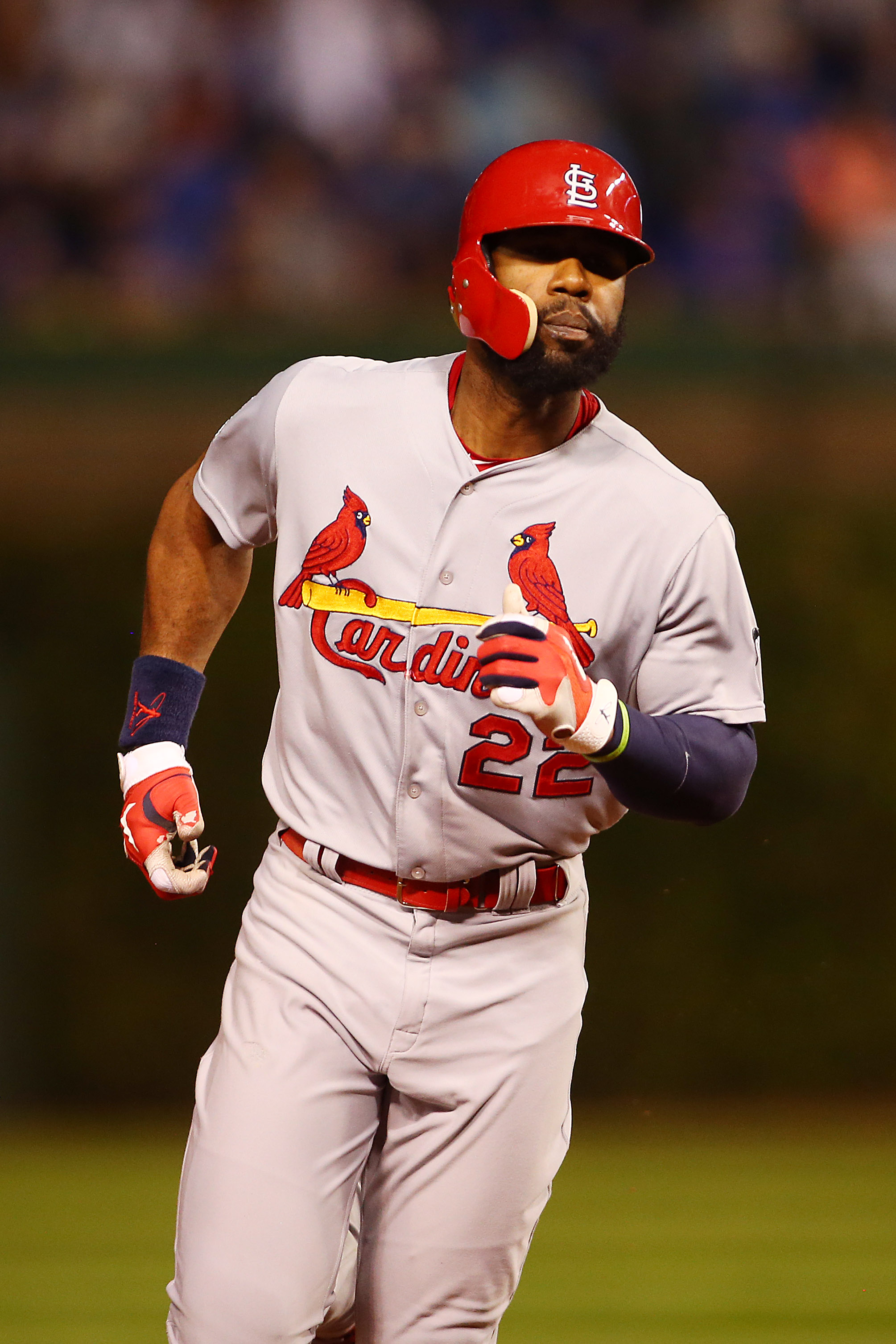
Another often-underappreciated source of value is the basepaths, and Heyward excels there, too. He’s a fairly consistent source of twenty stolen bases, and more importantly, draws excellent overall marks. Indeed, Heyward ranked fifth in all of baseball in 2015 in Fangraphs’ BsR metric (the baserunning component of fWAR) and sits in the top thirty since his rookie year.
Heyward isn’t quite as outstanding with the bat — if he was, we’d be looking at Mike Trout‘s theoretical free agent case — but he’s hardly a liability. He’s reached base at a solid .353 clip and walked at a strong 10.8% rate for his career. Though Heyward‘s power has not returned to its peak 2012 levels (27 home runs, .210 ISO, .479 SLG), he’s significantly cut back on the strikeouts since and now sits at about a 15% K rate, well below the league average.
Having only just turned 26, it’s not at all out of the question that Heyward could still tap into some pop, particularly since he’s shown the ability to do so at the major league level. His HR/FB rate did land at 12.0%, near his historical norm, after it fell to 6.5% in 2014.
It’s also worth noting that Heyward has also continued to improve in the plate discipline department over the years, showing that he’s continuing to hone his craft. His chase rate and overall swing percentage have dropped every year since 2012, and his contact numbers have risen: in his most recent campaign, he posted a 93.8% in-zone contact rate.
By measure of wRC+, Heyward has been 18% better than the league-average batter over his career and was slightly north of that in 2015, when he slashed .293/.359/.439. He’s been a consistently above-average performer at the plate, apart from a fairly mild sophomore slump, and also shown the ability to hit the ball to all fields. All said, there’s a lot to like about Heyward at the plate.
But the biggest reason that Heyward‘s free agent guarantee will likely place at or near the very top of the market is his age. Though he’s already racked up six full years of MLB service, Heyward won’t turn 27 until next August, making him a rare free agent who still could have much of his prime ahead of him. For some context, consider that Alex Gordon — another top free agent corner outfielder this year — had his breakout 2011 campaign in his age-27 season. Gordon, one of Heyward’s chief competitors this winter, is a full five years older.
The total package makes Heyward one of the game’s best overall players. He hasn’t put up a single huge season, really, but consistently registers excellent campaigns. Somewhat quietly, he’s accumulated more fWAR since 2010 than any outfielder not named Trout, McCutchen, or Bautista. (He sits 11th overall among position players.)
That’s due in part, also, to his solid record of durability. Heyward has averaged 139 games and 572 plate appearances per year — good, but not great — but has mostly missed time due to bad luck (e.g., appendectomy, broken jaw).
Weaknesses/Cons
There’s really no broad area in which Heyward fares particularly poorly, but there are certainly some rather significant factors that hold down his value.
The power conundrum certainly rates at the top of the list. As discussed above, it is a huge question for him. His established 27-homer upside remains tantalizing. Were he a reliable source of 25 home runs, his earning power would be astronomical. But, that’s not how things have shaken out in recent seasons. Heyward’s isolated power hasn’t exceeded .150 in either of the last two years, and he hasn’t popped more than 14 long balls since his 2012 campaign.
As a result, some teams looking at the idea of committing huge money over a lengthy term will certainly feel some uncertainty. If you believe that Heyward has settled in as a 12-to-15 annual home run level of power, then any fall-off in his speed and defense could leave him as an even less exciting player than he already is. Two fairly recent, seven-year free agent deals with non-power-hitting, average-OBP outfielders — Jacoby Ellsbury ($153MM) and Carl Crawford ($142MM) — have fallen flat.
We discussed Heyward’s increasing contact tendencies above, and that does have some benefits (e.g., his improving strikeout numbers). But the list of elite contact makers is also riddled with slap hitters, and there are some concerns in Heyward’s batted-ball profile. Last year, his groundball/flyball ratio was way out of whack when compared to career norms. After consistently hitting in the range of 45% groundballs against 35% flyballs annually, Heyward saw his groundball rate shoot up to 57.2% while his flies plummeted to 23.5%. That could be a one-year blip, but it’s not the most encouraging sign to see so many balls hitting the ground.
Likewise, Heyward has traditionally struggled against left-handed pitching. He increased his output to about league-average in 2015, but he’s running a .230/.309/.351 batting line for his career. When weighing a decade-long commitment (or thereabouts), it’d probably be preferable not to be wondering whether and how soon you’ll need to find a platoon mate.
Personal
Heyward was born in New Jersey but grew up in Georgia and excelled there as a high school ballplayer. He wears the number 22 to honor the memory of his former high school teammate, Andrew Wilmot.
As Peter Gammons explored in an interesting 2010 piece, Heyward is the product of a well-educated and thoughtful family. Even as his son participated in competitive youth baseball, Heyward’s dedicated father made sure the focus remained on having fun. Even as he was just entering the big leagues, Heyward drew rave reviews from teammates, coaches, and scouts for his hard work, and he’s only enhanced that reputation since.
“I love to play. I love to play hard,” Heyward himself explained. “I try to play the right way. I was brought up by parents who taught me to treat everyone with respect, to treat them the way I want to be treated.”
Market
Heyward is a special free agent because of his age and consistent level of production. That his annual earning power isn’t exceptional could keep more teams in the hunt than might otherwise be the case, and of course some will see an opportunity to buy up still-undervalued skills.
It’s hard to completely rule out any large market clubs, because other roster moves could always be made to free space for this kind of opportunity. Organizations such as the Angels, Tigers, Giants, and Mariners have the means and, quite possibly, the need for Heyward. The Cardinals don’t generally chase top-of-the-market free agents, but just had him for a year and gave Matt Holliday big money under similar circumstances. There’d be a nice fit with the White Sox, Orioles, Astros, Royals, and Padres, if they’re willing to spend beyond their typical levels. Meanwhile, big spenders such as the Yankees — but also, theoretically, including the Cubs, Dodgers, Rangers, and Nationals — could make room for Heyward if they feel the opportunity is just too good to pass up.
Expected Contract
There’s a range of possibilities here, as always, but I’m guessing Heyward will command a longer deal at a slightly lesser average annual value. Ellsbury’s deal came at just under $22MM in AAV, and even Crawford cracked $20MM annually (five years ago). It’s hard to put Heyward in the same production bracket as Robinson Cano (ten years, $240MM), and you could argue that he’s not as valuable a free agent as was Prince Fielder (nine years, $214MM), depending upon how one values defense and baserunning. But those signings show that super-length contracts at still-significant AAVs can be had.
It’s important to note, also, that Heyward looks like a prime candidate to negotiate an opt-out clause into his deal. Given his age, he’d probably see value in having the right to return to free agency after a reasonable stretch. (After all, as MLBTR’s Steve Adams points out, even five years from now Heyward will still be younger than Gordon is as he hits the market this winter.) And Heyward is represented by Excel Sports Management’s Casey Close, who has guided clients such as Zack Greinke and Masahiro Tanaka to opt-out arrangements.
My prediction: ten years, $200MM.
Photo courtesy of USA Today Sports Images.
Reds Outright Seven Players
Here are the day’s outright assignments:
- The Reds have announced that seven players were outrighted off the club’s 40-man roster (h/t to C. Trent Rosecrans of the Cincinnati Enquirer, on Twitter). On the chopping block were pitchers Nate Adcock, Collin Balester, David Holmberg, and Josh Smith, outfielders Brennan Boesch and Jason Bourgeois, and infielder/outfielder Kris Negron. Adcock, Balester, Boesch, and Bourgeois have all seen reasonably frequent MLB action but have bounced around quite a bit in recent years. Negron has appeared in each of the last three seasons in Cincinnati, compiling a .220/.296/.353 batting line over 270 plate appearances. Holmberg was acquired as part of the pre-2014, three-team deal that sent Heath Bell (from the Diamondbacks) and Ryan Hanigan to the Rays. He’s functioned as a depth starter, walking nearly as many batters as he’s retired via strikeout over his 58 1/3 MLB innings with Cincinnati. Smith made his MLB debut last year, allowing 25 earned runs in 32 2/3 innings of work, but found himself squeezed out by Cincinnati’s recent influx of young, upper-level pitches.
Latest On Dodgers’ Managerial Search
The Dodgers have parted ways with manager Don Mattingly in what appears to be a mutually agreeable divorce. That leaves the organization searching for a new skipper, marking an important hire for president of baseball operations Andrew Friedman. We’ll keep tabs on the hiring process right here:
- The Dodgers will interview Darin Erstad for the position, Ken Rosenthal of FOX Sports tweets. Erstad currently serves as the head coach at the University of Nebraska. While it would be unusual for a big league club to hire a skipper directly out of the college ranks, Erstad was a long-time major leaguer.
- Padres bench coach Dave Roberts, who was a finalist in the Mariners’ managerial search, will interview for the Dodgers, tweets ESPN’s Jerry Crasnick. Roberts, of course, had a 10-year playing career as an outfielder and stole one of the most famous bases in recent history in the 2004 ALCS. He’s been coaching for the Padres since 2011, beginning as a first-base coach.
- Ken Rosenthal of FOX Sports tweets that he’s spoken to a number of people in the past day who said they’d be stunned if anyone other than Kapler is named manager in Los Angeles.
Earlier Updates
- Mark Saxon of ESPN Los Angeles tweets that he’s hearing Mets bench coach Bob Geren will be in the mix for the Dodgers’ opening. Geren, 54, managed the Athletics from 2007-11, so Dodgers GM Farhan Zaidi is plenty familiar with him.
- Dodgers director of player development Gabe Kapler is a “serious frontrunner” for the job, tweets Buster Olney of ESPN.com, who acknowledges that the process is only just beginning. Joel Sherman of the New York Post reported earlier this morning (via Twitter) that Kapler was considered a candidate. While he only has minimal managerial experience in the low minors, Kapler is a highly respected former player who has long been viewed as a budding managerial prospect.
- Bill Shaikin of the Los Angeles Times lists some names to keep an eye on, with Kapler among them. Other strong possibilities to come under consideration by the Dodgers, per Shaikin, include former Rays and current Cubs bench coach Dave Martinez, former Padres skipper Bud Black, current Dodgers bench coach Tim Wallach, and recently-hired Dodgers third base coach Ron Roenicke.