
East Notes: Anthopoulos, Nats, Desmond, Montero, Cespedes, Gordon
Blue Jays ownership is to blame for the team’s surprising separation with former GM Alex Anthopoulos, argues Bruce Arthur of the Toronto Star. New president Mark Shapiro “said he strongly disagreed with some of the deadline choices that sent prospects out,” Arthur reports, and indications are that he took the job in part because he is interested in increasing his involvement in personnel decisions. (The club made several swaps, most notable shipping out young pitching talent to acquire David Price and Troy Tulowitzki.) Rogers Communications, the club’s ownership group, initially offered Anthopoulos only a one-year contract with an option, says Arthur, and though the offer ultimately was bumped to a five-year term, that seemingly set the stage for the departure of Anthopoulos. Meanwhile, the new free agent executive took a conciliatory tack on his way out, saying, “I just didn’t feel like this was the right fit for me going forward.”
Here’s more from Toronto and some other eastern division clubs:
- Writing for the National Post, Andrew Stoeten takes rather a different perspective on the Blue Jays‘ front office changes. He suggests that it’s a valid criticism that Anthopoulos gave up too much young talent over the summer, even if the immediate results were good. More broadly, there’s no reason in particular to think Anthopoulos is uniquely irreplaceable, Stoeten argues.
- Barry Svrluga of the Washington Post takes a look at an interesting offseason for the Nationals. As he explains, the club could probably just add some bullpen pieces and a left-handed-hitting, center field-capable fourth outfielder and call it a day. That wouldn’t be perfect, but it should be workable enough, and it may be what the team had hoped and expected to be looking at heading into 2015. But a terribly disappointing campaign changes the equation somewhat. Svrluga says that the organization has pegged a $175MM overall annual operations budget, a number which includes player salaries but would also include additional spending in other areas (he cites various front office upgrades, though presumably it might also involve international spending or other speculative investments). With various big-money players are coming off of the books, Svrluga argues at least some of their salaries ought to be reallocated to new acquisitions. Upgrading over Wilson Ramos at catcher should be considered, he argues, and the team must decide whether to trade Yunel Escobar (possibly for bullpen help) and how much trust to put in Michael Taylor.
- Outgoing Nationals shortstop Ian Desmond figures to draw strong interest from the Mets, people around the game are telling Jon Heyman of CBSSports.com (as part of a broader notes column). Heyman says he’s expecting a “robust” market for Desmond after a late-season return to form, and also notes the Mariners, Padres, White Sox, and Twins as plausible landing spots.
- It’s easy to forget about righty Rafael Montero given the success of the Mets‘ other arms, but Joel Sherman of the New York Post writes that the team hasn’t. New York expects Montero to be ready to go this spring after dealing with shoulder issues all year, and Sherman notes that he’ll at least represent a solid depth piece in the near-term if he can stay healthy. Of course, with Zack Wheeler also set to return next summer and Steven Matz now looking like he’ll command a rotation spot for years to come, Montero could ultimately factor as a trade chip.
- Sherman also takes a crack at assessing the in-season changes to the future free agent market of Mets outfielder Yoenis Cespedes. The Red Sox offered him a five-year deal at about $75MM when he was with the club, says Sherman, and might have considered going to the Hunter Pence range (5/$90MM). Now, says Sherman, Cespedes’s future valuation has swung wildly. Before his mid-season swap to New York, he says, Cespedes was generally expected to receive a deal that might not have reached $100MM. The outfielder pushed his ceiling to the six-year, $150MM range after a blistering couple of months, per Sherman, but now some executives feel a tepid few weeks could drop him shy of nine figures. For what it’s worth, my own take is that Cespedes’s earning capacity has probably not moved quite so violently; while it’s obviously shifted, I’d have pegged him at a higher mid-season expectation and still believe he’ll easily clear the $100MM barrier this offseason.
- The Red Sox could be a surprise contender to add outfielder Alex Gordon via free agency, Sherman writes. While Boston could move forward with its internal options in the outfield, rival executives see a scenario where the team tries to utilize the resurgent Jackie Bradley Jr. as a trade piece to add a pitcher while simultaneously locking up Gordon. Alex Speier of the Boston Globe analyzes the concept, explaining that Fenway Park has seemed uniquely capable of undermining otherwise strong defenders’ abilities in left field. As Sherman suggests, Gordon could be added with the idea of deploying him in right, and Speier does add that Castillo looked good in limited action in left, so there’s some hypothetical plausibility but also some tough questions to be answered before pursuing that strategy.
Daniel Norris Has Successful Surgery For Thyroid Cancer
OCTOBER 29: Norris has announced on Instagram that his surgery was successful and that he is considered cancer-free. That’s obviously outstanding news. Hopefully, the surgery has not only secured Norris’s long-term health, but also will allow him to resume his promising career in short order.
OCTOBER 19: Tigers lefty Daniel Norris announced today on Instagram that he has been diagnosed with cancer in his thyroid. He will undergo surgery soon to remove the malignant growth.
Needless to say, the news is shocking, particularly given that Norris is just 22 years of age. On the bright side, of course, many of the factors that made him a top pitching prospect — youth, physical strength, and mental toughness — will serve him well as he battles this new foe.
Also providing hope for a good prognosis is the fact that Norris played out the season despite receiving the diagnosis several months back. He indicates in his announcement that he got the news prior to his trade from the Blue Jays to the Tigers, but was advised that it was safe to hold off on having the procedure. Remarkably, Norris performed quite well in a late-season run of eight starts with Detroit.
MLBTR extends its very best wishes to Daniel, who was kind enough to join the MLBTR Podcast back in early August. Already an inspirational figure for his approach to life, he’ll no doubt continue to set an example as he tackles cancer.
Marlins Dismiss Dan Jennings
5:44pm: The Marlins have announced that Jennings has been relieved of his duties. Miami won’t hire a replacement, but will instead shift his former responsibilities over to Hill while also increasing Berger’s role.
Jackson also provides more detail on the split, writing that Jennings wanted to stay on as manager but was told he’d instead be offered a return to the GM role. The then-skipper and owner Jeffrey Loria had butted heads over how he was running the club, says Jackson, “including whether to play Marcell Ozuna.”
Per the report, Jennings was preparing to report back to the organization on October 19 when he was told instead to stay home. Club president David Samson advised Jennings that he’d first need to talk things over with Loria — a conversation which seemingly never occurred.
Samson issued the following statement in a team press release:
“We want to thank Dan for his dedication and loyal service to the Marlins organization over the last 13 years. This is the continuation of the restructuring of our baseball operations department and we look forward to moving in a unified direction to reach our goal of becoming a championship-caliber ballclub that our fans richly deserve.”
5:06pm: The Marlins have decided to “dismiss” now-former general manager and manager Dan Jennings, Barry Jackson of the Miami Herald reports on Twitter. Jennings, of course, was still under contract for three more seasons, meaning that Miami will likely remain on the hook for the $5.6MM left on his contract (though it could be offset when he’s hired elsewhere).
Jennings, 55, has been with the Miami organization since 2002. He served as the club’s general manager — working alongside president of baseball operations Michael Hill — from 2013 through the middle of 2015. After the team fired manager Mike Redmond in May, Jennings moved into the skipper’s seat in an eyebrow-raising move that didn’t pan out.
Though Jennings wasn’t able to turn around a disappointing club that he had a major hand in compiling, he is said to have managed to earn the trust of his players in spite of the odd situation. And while the Fish weren’t able to match their (arguably unreasonable) expectations, Jennings remains a highly-respected executive. Indeed, Bob Nightengale of USA Today notes on Twitter that Jennings has already drawn interest from other teams looking for assistant general managers.
While the move is somewhat surprising, given Jennings’s deep ties to the Miami organization and owner Jeffrey Loria, Nightengale adds that Jennings was hoping to be released from his obligations to pursue new opportunities. It appeared that his front office standing may have been marginalized while he was in the dugout, with the club having handed off some of his duties to VP and assistant GM Mike Berger. Club president David Samson said just weeks ago that Jennings was still the general manager, but it seemed even at that time that there was a lot to be worked out for the relationship to continue.
During his time in the GM chair, Jennings played a key role in a number of big moves. Most notably, perhaps, the club extended outfielders Giancarlo Stanton and Christian Yelich, with the former receiving a record $325MM guarantee.
MLBTR Chat Transcript: Ozuna, Storen, Carrasco, Schwarber
Click here to read a transcript of today’s chat with MLBTR’s Jeff Todd.
Explaining The Qualifying Offer System
The qualifying offer system has been around since the 2012-13 offseason, but it remains a complicated and sometimes misunderstood process. Teams will be making their decisions in short order, so it’s a good time for a quick refresher on how things work.
Here are the key components of the system:
- The value of the qualifying offer, which is determined annually by averaging the top 125 player salaries from the previous year, will be worth $15.8MM this offseason. All qualifying offers are for the same duration (one year) and the same amount (i.e., $15.8MM for 2015-16).
- Teams have until five days after the World Series to make qualifying offers. At that point the players have seven days to accept.
- Once a team makes a qualifying offer, the player has two choices: he can accept the one-year deal or decline in search of other offers. If he declines the offer and signs elsewhere, his new team will have to surrender a top draft pick (see more on this below).
- No player has ever taken a qualifying offer, but if one does, he cannot be traded (absent consent) until June 15 of the following season (i.e., 2016), as Steve Kinsella of Sports Talk Florida recently noted and MLBTR has confirmed. Even if a player grants such consent, only $50K in cash can be exchanged as part of the trade.
- Teams that sign free agents who turned down qualifying offers will surrender their first unprotected draft pick in the following year’s draft. The first ten selections in the draft are protected. This year, the Phillies, Reds, Braves, Rockies, Brewers, Athletics, Marlins, Padres, Tigers, and White Sox have protected choices. Those clubs would surrender their second-highest selections if they reach terms with a QO-declining free agent.
- Forfeited picks don’t go to other MLB teams (as they used to under the old Type A/B system). Instead, they disappear and the first round is condensed. In turn, teams that lose a player who declined a qualifying offer are awarded a compensatory pick at the end of the first round, before the competitive balance choices. Such compensation picks are awarded in the inverse order of record. As a result of these rules, the draft order is constantly fluctuating over the offseason. Click here for last year’s ultimate draft order to see how it can end up looking.
- When a team re-signs a player that has previously declined a qualifying offer from that team, no draft forfeiture or compensation takes place.
- Only players who have been with their clubs for the entire previous season are eligible for compensation. Thus, players traded mid-season — e.g., Johnny Cueto, Ben Zobrist, Yoenis Cespedes, and David Price — are not eligible to receive a qualifying offer.
- Qualifying offers operate independently of options. Hence, a player can receive a qualifying offer even if their option is declined (whether by team or player) or if they opt out of a deal. Hence, Zack Greinke is eligible for a qualifying offer if he opts out of his contract, as expected.
If you’re interested in learning more about the qualifying offer system’s function in practice, check out these prior posts from MLBTR: Avoiding The Qualifying Offer; Contextualizing The Qualifying Offer System; Assessing The Qualifying Offer System & Its Purposes. Also, MLBTR has run polls on some of the many players who appear to be debatable qualifying offer candidates this season. You can read more on their situations, and see the poll results, at the following links: Marco Estrada (Blue Jays); Matt Wieters (Orioles); Denard Span (Nationals); Daniel Murphy (Mets).
This post is adapted, in part, from this 2012 post from former MLBTR scribe Ben Nicholson-Smith.
Marlins In “Serious Talks” With Don Mattingly
The Marlins are in “serious talks” with Don Mattingly regarding the club’s open managerial position, Jon Heyman of CBSSports.com reports. Both sides expect to reach agreement, per the report.
All indications have been that the former Dodgers skipper was the focus of Miami’s managerial search. MLB.com’s Joe Frisaro said yesterday that an interview on Monday went well, with the sides seemingly set to talk about contract terms. And today’s report suggests that negotiations are progressing in earnest.
Marlins owner Jeffrey Loria, a noted Yankees afficionado, is said to be a huge fan of Mattingly. Miami put a hold on its nascent managerial search to see how things would shake out with Los Angeles, and move quickly on Mattingly after he agreed to part ways with the team.
Though he was unable to guide the Dodgers deep into the post-season, he was seemingly successful at managing the club’s big contracts and big personalities. Under Mattingly’s leadership, the club carried a .551 overall regular season winning percentage.
The Marlins present something of a different challenge, of course. There’s much less media attention and a much lower payroll, though keeping a dugout job for a Loria-owned team has not proven easy over the years. In recent years, the organization has churned through Ozzie Guillen, Mike Redmond, and past (and future?) GM Dan Jennings.
As Heyman notes, the Dodgers remain on the hook for the remaining $1.6MM owed Mattingly under his prior contract. A new deal with Miami would be expected to “easily top” that amount in annual value, per the report.
It’s worth bearing in mind that a deal may well not be announced until after the conclusion of the World Series, even if it’s reached before that point. Frisaro tweets that the club likely will indeed hold off on officially naming a new skipper until that point.
List Of 2016 Super Two Qualifiers
Presented below is the list of players who have qualified for Super Two status for arbitration purposes this year. (Service time in parentheses.) As MLBTR’s Tim Dierkes recently tweeted, the service time cutoff is 2.130. You can find arbitration salary projections for these players right here.
- Dan Jennings, White Sox (2.171)
- George Kontos, Giants (2.171)
- Justin Grimm, Cubs (2.170)
- Arodys Vizcaino, Braves (2.168)
- Avisail Garcia, White Sox (2.167)
- Jurickson Profar, Rangers (2.167)
- Jedd Gyorko, Padres (2.164)
- Juan Lagares, Mets (2.160)
- Didi Gregorius, Yankees (2.159)
- Erasmo Ramirez, Rays (2.158)
- Chris Archer, Rays (2.156)
- Nolan Arenado, Rockies (2.155)
- Will Smith, Brewers (2.155)
- Jean Machi, Red Sox (2.154)
- Seth Maness, Cardinals (2.154)
- Scott Van Slyke, Dodgers (2.151)
- David Lough, Orioles (2.149)
- Chris Hatcher, Dodgers (2.146)
- Evan Scribner, Athletics (2.142)
- Nick Tepesch, Rangers (2.136)
- Zach Putnam, White Sox (2.135)
- Chris Withrow, Braves (2.132)
- Kole Calhoun, Angels (2.130)
- Jeff Manship, Indians (2.130)
- Anthony Rendon, Nationals (2.130)
Click here to read more about how the Super Two concept works. Note that, as the link shows, the originally projected service time cutoff moved down as things played out over the course of the season. That brought some notable names into early arbitration qualification — namely, Calhoun and Rendon — which could have a big impact on their earning power in potential extension scenarios.
It’s also important to bear in mind that several of the players listed above have already agreed to long-term extensions: Gyorko, Lagares, and Archer. Notably, the size of the guarantee provided by Archer’s contract is dependent upon his Super Two status. By reaching it (as had been expected), he keeps a $25.5MM overall guarantee. That total would have been reduced to $20MM otherwise.
That contract structure reflects the importance of reaching Super Two status. Doing so not only bumps a player’s salary a year early, but sets a higher floor for future paydays.
Free Agent Profile: Jordan Zimmermann
Teams will have to decide whether Jordan Zimmermann is a top-of-the-staff stalwart or a steady mid-rotation arm.
Strengths/Pros
Zimmermann is often credited with a “bulldog” mentality because he so consistently attacks hitters in the zone. He conveys a sort of unemotional intensity on the hill that contributes to his well-earned reputation for steadiness and relentlessness. But he’s not just a big, lumbering arm; Zimmermann is also an excellent athlete who moves well off the mound and fields his position well.
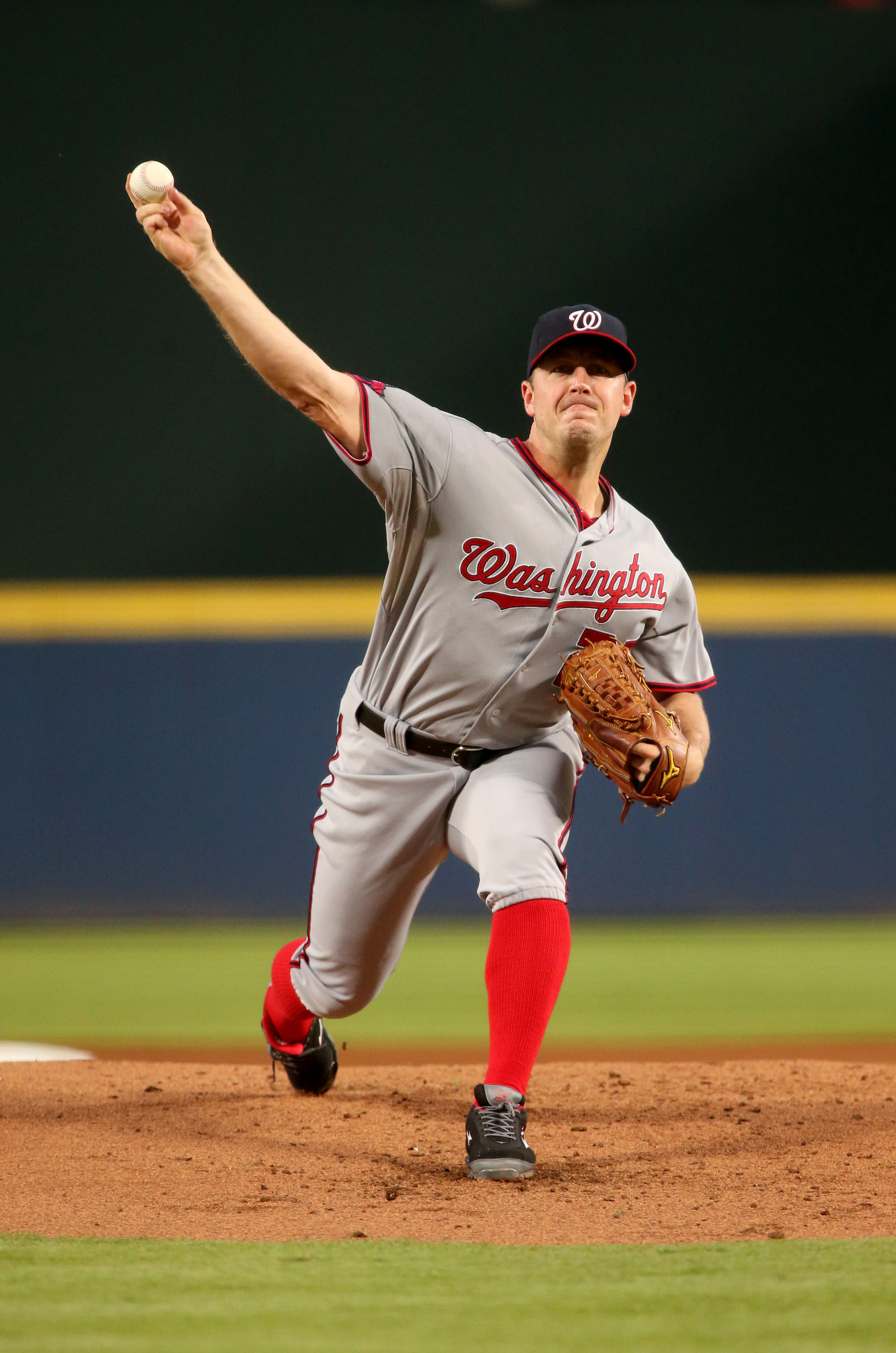
Age and innings go a long way in determining the length of free agent deals available to starting pitchers, and Zimmermann fares well in both regards. While he’s not the youngest arm on the market, he won’t turn thirty until May 23rd of next year.
Zimmermann has also been quite durable in recent years. He was shut down early in 2011, his first year back from Tommy John surgery, as the Nationals sought to build up his innings. In the four years since, Zimmermann has made at least 32 starts each season while compiling 810 1/3 total innings. Though he’s never put up gaudy single-season inning tallies, he is fifth in the game in total starts since the beginning of 2012 and ranks 12th in total frames over that span.
That’s a nice base to work from, but performance will obviously drive both years and value. Heading into this season, there was reason to believe that Zimmermann could reach (or even exceed) Jon Lester‘s six-year, $155MM deal with the Cubs. After all, he was coming off of two consecutive years in which he landed in the top ten in the National League Cy Young voting, building off of two very good seasons before that. His 2014 campaign, in particular, was outstanding: Zimmermann posted a 2.66 ERA with 8.2 K/9 against a league-low 1.3 BB/9.
While he has often described his approach as pitching to contact, Zimmermann has also shown the ability generate swings and misses (though, as explained below, that comes with some caveats). 2014 set a high-water mark for Zimmermann’s strikeouts, but he was able to return to that level over the latter half of last year, so it may be too early to write off his ability in that regard despite uninspiring overall numbers in 2015.
And focusing on the swings and misses tends to detract from the veteran’s single best skill: his impeccable control. Zimmermann has never permitted more than two free passes per nine innings over a full season. Since the start of 2011, only six starters with over 500 innings have bettered his walk rate.
Another area where Zimmermann has performed well is in limiting platoon splits. He’s been slightly better against righties historically, of course, but has handle opposite-handed hitters in equivalent manner in most regards. Lefties do draw walks at a higher rate (2.3 vs. 1.4 BB/9), but their overall production has not been markedly greater (.310 vs. .286 wOBA).
Weaknesses/Cons
There’s a lot to like, but 2015 represented a step back for the righty, and not just in the earned run department. Zimmermann’s 3.66 ERA was by far the highest full-season mark of his career, and his FIP (3.75), xFIP (3.82), and SIERA (3.83) marks all landed a fair sight over his career averages.
Of greatest concern to his outlook, perhaps, was the failure to maintain what had been a breakout season in the strikeout department. His 2014 swinging strikeout jump (from the mid-8 percent range to 10.3%) has basically dropped back to where it was before and now looks like an outlier. And that issue is compounded by the fact that Zimmermann doesn’t generate a ton of groundballs, having settled into the low-forty-percent range.
It is interesting to note that Zimmerman trended upwards in terms of strikeouts over the season’s second half, posting 8.3 K/9 over his final 90 innings of the year. But that was not accompanied by success, as it coincide with a large jump (from 0.64 to 1.60 HR/9) in home run proneness that almost entirely explains his earned run leap.
Bottom line: it’s not clear that Zimmermann can generate the whiffs you’d like to see while keeping the home runs in check. Doing both of those things drove his outstanding 2014, but he was running a HR/FB rate (6.4%) that was significantly below his career level (now 9.1%). This past year, while Zimmermann‘s batted ball results were in line with his track record, he allowed a career-high 1.07 HR/9 on a 10.9% HR/FB rate.
Zimmermann certainly has had success in the past despite middling K numbers, but he’s always outperformed ERA estimators. In particular, SIERA has never been a big fan — crediting him with just a 3.62 lifetime mark. He fares better by measure of FIP (3.40) and xFIP (3.57), but all those numbers paint him more as a steady mid-rotation arm than the somewhat higher-level arm that his 3.32 lifetime ERA might suggest.
As teams decide how to judge those numbers, they’ll also be looking at other recent indicators. The pitch value of his fastball (per Fangraphs) fell into the negative for the first time over a full season after consistently rating as a plus offering. Possibly reflecting some lost confidence, Zimmermann dropped his fastball use rate back into the low-60% range after it had risen to over 70% in 2014. He also continued to work higher in the zone with the pitch, continuing a trend from 2014. While that might have helped him restore the swings and misses, it came with too many long balls and marginal grounder rates.
So, what’s up with the heater? One possible root issue is an average velocity drop. The offering was still within one mile per hour of his top career speed, so it isn’t necessarily a huge red flag, but that velo loss — combined with the other issues and sagging production — isn’t particularly promising, either.
Another historical strength that came into some question last year is performance against left-handed bats. Zimmermann’s fastball-slider-curve mix is well-established and has long been effective, but he’s generally also sprinkled in the occasional change. He largely dropped that pitch last year. Whether or not that’s a contributing cause, Zimmermann allowed a .281/.338/.438 batting line to opposite-handed hitters. Those are his worst-ever full-season marks in each of the triple-slash stats.
Personal
Zimmermann is a native of Wisconsin and graduate of the University of Wisconsin-Stevens Point. ESPN.com’s Jerry Crasnick’s 2013 profile of Zimmermann paints him as something of a mid-western archetype. An outdoorsman in the offseason, he doesn’t put much of his personality on display publicly but is known to deliver “a wry sense of humor” in the clubhouse environment.
Jordan and his wife Mandy have two children, the second of whom was born just one day before he took the bump on July 12 of this year. It wasn’t his best outing, but Zimmermann wasn’t making any excuses. “Still have to go out there and throw the ball over the plate,” he said.
Market
As mentioned above, there was a time where the Lester deal looked plenty attainable for Zimmermann, who looked to be chasing David Price and Johnny Cueto in earning power. Now, the Relativity Client has clearly been bypassed by the older Zack Greinke and stands alongside Cueto as players whose value took a bit of a hit down the stretch. There’s competition, as well, from pitchers like Mike Leake, Jeff Samardzija, Wei-Yin Chen, and Japan’s Kenta Maeda.
Though he won’t reach the AAV achieved in the Lester deal or even the somewhat lighter pre-2012 Greinke pact ($147MM over six years), it still seems plausible that Zimmermann will get a sixth guaranteed year — possibly at a lower rate. There’s some wiggle room in his market, especially if some teams still prefer the suddenly questionable Cueto, but there ought to be a lot of clubs with interest, helping prop up his floor and creating the possibility of some upward movement.
There are any number of clubs that might pursue Zimmermann, some of whom won’t likely be after the two arms ahead of him. The fact that he’ll be bound by draft compensation will provide something of a limiting factor, but there ought to be a good number of suitors. Basically the entire AL East (Rays aside) could theoretically have interest, as might the Tigers, Astros, Cubs, Dodgers, and Giants. Somewhat less obvious teams like the Mariners, Angels, Twins, Marlins, Cardinals, and Diamondbacks could also make sense. And if Zimmermann’s market sags early, other opportunistic buyers might conceivably get involved. A return to the Nationals can’t be written off entirely, but that ship likely sailed when the sides were unable to match up on an extension.
Expected Contract
It might be on the higher side of his market, but given his durability and broad potential market, I think Zimmermann will get to six years — though he might have to sacrifice a bit of AAV to get there. I’ll predict a six-year, $126MM contract.
Front Office Notes: Jennings, Anthopoulos, Klentak, Cherington, Chavez
The Marlins‘ front office arrangement remains unresolved, according to Jon Morosi of FOX Sports. Dan Jennings isn’t listed on the team’s official website and hasn’t been working as the team’s general manager, per the report. It’s not yet clear where things are headed, but as Morosi notes, Jennings is under contract for the next three years in Miami.
Here’s more from the NL East:
- Meanwhile, the Blue Jays now face an increasingly interesting situation with their own general manager, Alex Anthopoulos, as Shi Davidi of Sportsnet.ca reports. The crux of the matter isn’t money, says Davidi, who writes that Anthopoulos “is believed to have a strong extension offer on the table.” Instead, it’s a matter of resolving the authority structure between Anthopoulos and new president Mark Shapiro. Per Davidi, working that out is the key; if that can’t be done, a departure is “a real possibility.”
- The Phillies finally installed a new baseball operations leader by hiring Matt Klentak, and the organization now seems largely set up to begin moving back toward contention in earnest. As MLB.com’s Todd Zolecki writes, the organization’s newly accessible leader, owner John Middleton, wants to make the team a consistent presence at the top of the standings. He acknowledged that the Phils “didn’t recognize early enough and act upon that recognition that the window had closed.” Now, the work to open a new window will start with a new philosophy. “The word that [president Andy MacPhail] has talked about and the word [Klentak] has talked about today is ‘discipline,'” Middleton said. “So I think you’re right. I think you have to have a goal and you have to have a road map to achieve it, and you have to be disciplined to know where you are on that road and therefore use that to dictate your decisions and what you do. That’s what I think is going to be the key to success. The other part of this is being objective about yourself and your performances.”
- Of course, the Phillies‘ front office decisionmaking process is an important matter in and of itself, even after the hiring, and CSNPhilly.com’s Jim Salisbury lays out where things stand in that regard. MacPhail said that he will vest substantial authority in Klentak, even though his job is also baseball-focused, and both men emphasized that they are looking for balance in all regards (including, notably, between analytics and scouting in player assessment). Klentak also noted that he sees a big opportunity in the club’s worst-in-baseball finish last year. “There’s a really strong foundation of players in this organization, some of whom are in the big leagues and some of whom are coming,” he said. “I think that, coupled with the first pick in the draft, the largest international bonus pool this year, the first priority in the waiver period, the first pick in the Rule 5 draft, etc., creates some inherent advantages at least in the short term that are incredible. And I think if we do our jobs right, we will turn this into a winner and it’s going to be fun for a long time.”
- Former Red Sox GM Ben Cherington has joined Columbia University’s Sports Management Program as an “executive in residence,” according to a press release. As Alex Speier of the Boston Globe writes, the move isn’t as surprising as it might seem at first glance.
- Joel Sherman of the New York Post reports that the Yankees tried to hire Cherington following his resignation from the division-rival Red Sox in August. “I reached out to him,” Cashman told Sherman. “I have a lot of respect for him, his integrity and how he did his job.” Sherman notes that Cherington could have conceivably become an assistant GM when Billy Eppler left to go become the Angels’ GM, but Eppler’s responsibilities go to top scout Tim Naehring, as has been previously reported. Cherington will eventually join a front office, but for the time being, his role at Columbia makes sense, as his wife and children were living in suburban New York even while he was Boston’s GM.
- In another interesting GM transition, former Phils GM Ruben Amaro Jr. has taken the unusual step of moving to the Red Sox as their first base coach, and Tim Britton of the Providence Journal delves into the reasoning for the move. As manager John Farrell noted, both men have some similarities in having moved from the front office to the field, though obviously the skipper made that move much earlier in his post-playing career. “I guess it’s unusual but for me, I’ve always had an itch to be back on the field,” Amaro said. “It’s always been something I’ve thought about quite a bit, and I was afforded a wonderful opportunity…. Had it not been the Red Sox, frankly I probably would not be doing this.”
- The Angels have added former big league third baseman Eric Chavez as a special assistant, Jon Heyman of CBS Sports reported earlier today in his latest notes column. Chavez had served in that capacity last year for the Yankees, working there with new Halos GM Billy Eppler. It sounds as if the 37-year-old will have wide-ranging job responsibilities, including working with the club’s younger players and performing various scouting-related functions.
Poll: Should Marco Estrada Get A Qualifying Offer?
Let’s be honest: this is not a question we expected to be asking at the start of the year, when Marco Estrada was settling into the Blue Jays pen as a swingman and long reliever. But he impressed early, provided a solid rotation presence much of the way, and had a notable impact in the post-season. That makes it worthwhile to wonder: is a qualifying offer in play?
We already know something about Estrada’s market valuation, because the Jays acquired him early last fall from the Brewers. The swap sent first baseman Adam Lind to Milwaukee. He, too, had a nice season after the deal, but at the time it wasn’t the most impactful deal. If anything, that trade suggested that Lind was the more valuable player, since he was the more expensive side of the 1-to-1 trade. Lind cost $7.5MM last year, plus a $500K buyout on a $8MM option that wasn’t certain to be exercised (but now likely will be). Estrada, meanwhile, ultimately agreed to a $3.9MM salary to avoid arbitration.
Nothing about that trade suggested that Estrada would be valued at anything close to the qualifying offer rate. Wwhen he came to Toronto, he was coming off of a four-year run in which he compiled 509 2/3 innings of 3.99 ERA pitching, with 8.4 K/9 against 2.3 BB/9. But that K rate had been in decline, and 2013 was his worst season in the earned run department.How have things changed since? MLBTR’s Mark Polishuk took a closer look in September, but in a nutshell, it’s hard to argue with Estrada’s 2015 results: he logged a 3.13 ERA over 181 frames. But his strikeouts plummeted to 6.5 per nine, while his walks ranged above his career average to 2.7 BB/9. And ERA estimators were not pleased with the new mix of peripherals: Estrada earned a 4.40 FIP, 4.93 xFIP, and 4.64 SIERA.
It’s worth noting, also, that Estrada enjoyed a .216 batting average on balls in play against him. He’s always controlled contact, as Tony Blengino of Fangraphs has explained, but that’s still a notably low mark. He has a notably excellent change, and doesn’t rely on velocity, so you might like his chances going forward. But Estrada has already turned 32 years of age, so that’s not on his side, either.
Then again, the post-season provided Estrada an opportunity to put his abilities on display before the entire league, and he didn’t disappoint. In 19 1/3 innings over three starts, he allowed just five earned runs while striking out 15 and issuing only one walk.
All said, there’s reason for some skepticism, but also reason to believe that some team will make Estrade a three-year offer at a healthy AAV. And given that possibility, he might be inclined to test the market for what will likely be his best chance at a multi-year deal. Meanwhile, a pitching-needy Toronto club might feel okay about taking the risk that Estrada will accept a $15.8MM, one-year qualifying offer. That wouldn’t exactly be crippling for a large-budget contender, even if he’s only a solid back-of-the-rotation piece.
It’ll be fascinating to see what happens with Estrada. For now, let’s see what MLBTR’s readers think: should the Jays make him a qualifying offer?
Should The Blue Jays Make Marco Estrada A Qualifying Offer?
-
Yes 63% (2,785)
-
No 37% (1,655)
Total votes: 4,440