
Free Agent Contract Trends: 2007-08 To Present
Earlier in the offseason, I broke down the current free agent market spending trends and put them in context with spending over the last several years. As I noted then, the market seemed all but certain to take a huge leap forward in terms of overall spending levels.
Indeed, it has done just that. According to MLBTR's Free Agent Tracker (after removing non-guaranteed deals and the few exercised options or extensions that are reflected), $1.88B has been committed through this year's market. With more spending still to come, the total free agent pot has already expanded by nearly 30 percent over last year.
That is both shocking and unsurprising, given the oft-noted TV money that has flowed into the game. But just how dramatic, really, are the increases? Utilizing ESPN.com's free agent tracker, Dave Cameron of Fangraphs wrote yesterday that free agent deals had jumped from an average annual value of $4.87MM in 2009-10 to a $9.65MM rate in the present signing season. He observed also that multi-year deals were sharply on the rise, with ESPN's figures reflecting that closer to half of free agents were getting more than one year in the last two seasons while that figure had hovered in the 30% range for the previous three years. Ultimately, Cameron wrote, the increase in AAV and years combined to raise the average total commitment in a free agent contract from $7MM in 2009-10 up to $20MM in 2013-14.
With all respect to Cameron, and the useful ESPN data, the information relied upon in that post is incomplete, and the resulting conclusions — while directionally accurate — are somewhat misleading in some respects. MLBTR owner Tim Dierkes asked me last year to compile historical data on free agent signings in support of an effort at developing a projection system, I started from the MLBTR transaction and extension trackers and built it out by mining Cot's on Contracts, Cot's data on non-active players from Baseball Prospectus player cards, and ESPN.com's free agency tracker. I then supplemented those results with internet searches, including undertaking the difficult task of attempting to determine service time at the time that extensions were signed. While there may be some missing pieces, and best estimates were necessary for certain service time markers, I feel fairly confident that this data set provides a sound basis for analysis.
Here are the results of that research, along with the spending tab to date on the present year. It should be noted, of course, that while an unusual number of prominent free agents remain unsigned at present, the total figures will likely drop by the time this offseason is concluded.
First, let's look at the overall figures for all guaranteed, MLB contracts handed out through free agency. (All dollar amounts in this table, and throughout the post, in millions.)
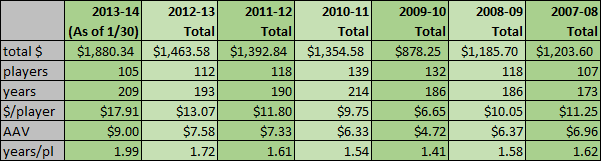
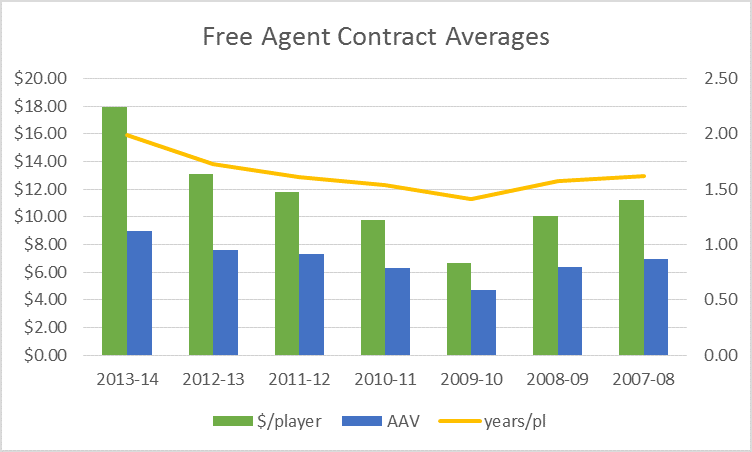
Clearly, though the trend that Cameron notes is still present, it is somewhat less dramatic than it first appeared. As it turns out, the ESPN tracker is missing a good number of deals, most of which are of smaller magnitude.
And, as we can see, the 2009-10 baseline is somewhat misleading. That year was, I believe, largely an outlier in terms of charting market development. There were internal factors at play: the market was headlined by Matt Holliday, John Lackey, Jason Bay, and Chone Figgins. Only Holliday landed a nine-figure deal, and only Lackey and Bay joined him with at least a $50MM guarantee. More importantly, though, the signing period took place in the midst of a massive, global economic downturn. That probably helped flood the player market with supply (notice the high number of players reached the market rather than being tendered arbitration or extended) and created obvious risk for teams in guaranteeing long-term money.
The curve is much less pronounced when using one of the prior years as a starting point. Comparing 2007-08 to 2012-13, we see that the average commitment per free agent contract has gone from $11.25MM to $13.07MM. That figure stands at $17.91MM for the ongoing 2013-14 period, though it will fall somewhat as the rest of a delayed market settles into place.
Moreover, while new local and national TV money is unquestionably having a dramatic impact, the hard-to-capture role of happenstance should not be ignored, either, in assessing the numbers. If, say, Robinson Cano had signed an extension with the Yankees and Masahiro Tanaka not been posted — both of which were certainly possible at various points — all of the roughly $400MM committed to those players would not have stayed on the market. Things might look much different had those two premium players not been available, or if the Yankees had chosen to stay under the luxury tax line.
Also critical to bear in mind is the fact that, as Cameron mentiones in the comments to his piece, many TV deals have only just been negotiated and will not reset again for decades. Those deals have raised the revenue streams of many teams and the league at large, but obviously none will increase annually at anything approaching the 30% free agent spending jump we've seen this year. (The Phillies' new deal, which I took a look at recently, is said to escalate at between 3-4% per year.)
Now, let's isolate things to multi-year deals only. Over the last seven signing seasons, here are how things look for free agent deals that guaranteed more than one year:
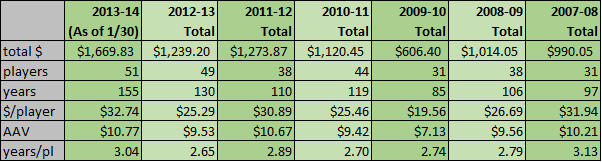
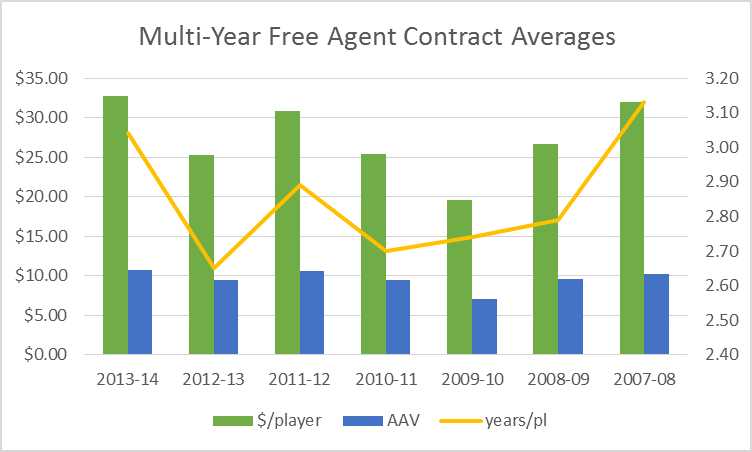
The 2009-10 blip is quite apparent. Again, look at the 2007-08 numbers and compare them across to the present year. The total commitment per player contract, AAV, and average number of years look about equal. When the current signing season ends, I suspect, its multi-year segment will fall below 2007-08 by those metrics.
Of course, that is somewhat misleading in and of itself. After all, with more money being given out than ever before, it must be going somewhere. In fact, as Cameron identifies, the key is in the number of multi-year deals that the market is awarding. Without question, the absolute number of multi-year deals has been sharply on the rise:

While we will have to wait and see where the numbers end up on the present year, it does look like a jump from ~30% to ~50% overstates things somewhat. Between last year and this, my guess is the number will settle in below 45%. Of course, that still represents quite a dramatic increase in the slice of the free agent market that is commanding multiple years.
So, what kinds of deals are the ones driving the growth? I charted out the contract lengths in my dataset to see:
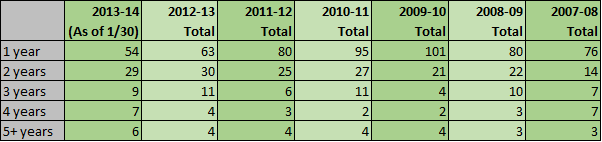
As those numbers suggest, there has been an apparent increase in two particular areas: two-year deals and contracts of four or more years. By percent of all free agent contracts:
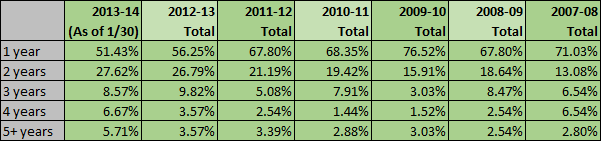
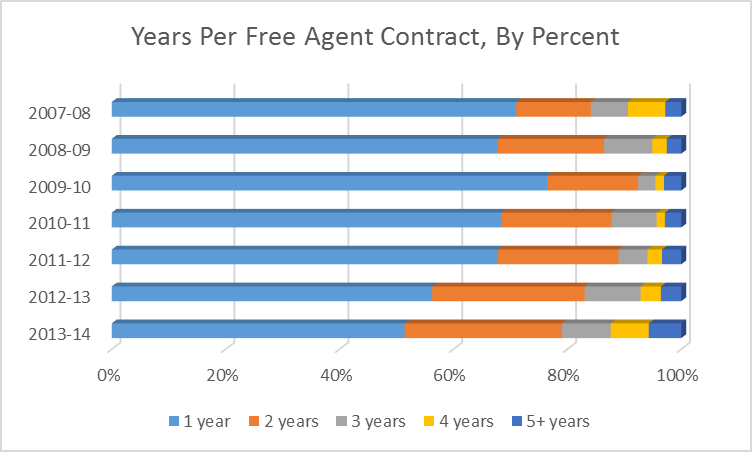
With no additional roster spots, there has been a corresponding drop in the number of one-year pacts. Most likely, strong competition for the best players, combined with increasing financial flexibility, has led to additional years being given all along the spectrum of the market. Interestingly, this shows that financial benefits have trickled down to non-star players, although MLB veterans capable of earning guaranteed money hardly represent the bottom of the baseball world.
The increasing number of two-year deals has held down the average length figures cited earlier. Unmistakably, however, the length of free agent guarantees have risen quite substantially in recent seasons.
East Notes: Blue Jays, Mets, Phillies, Orioles
Here are some notes from around the game's eastern divisions:
- Blue Jays GM Alex Anthopoulos hopes his club can benefit from the qualifying offer system given its array of draft picks, Ben Nicholson-Smith of Sportsnet.ca reports. With two protected first rounders, the Jays would stand to lose only a second-round choice by signing a free agent who comes burdened with draft pick compensation. "It's significant," said Anthopoulos. "I think if we had to give up a first round pick, it would changes thngs in a significant manner. I think that's where the draft pick compensation component is impacting some of these clubs." Though he said that "there's still value with the second round pick … and you still build that into an offer," Anthopoulos explained that "it's not close to the value of round one."
- Mets GM Sandy Alderson says he is "still looking for more players," reports ESPNNewYork.com's Adam Rubin, but emphasized that he likes the club as currently constituted. "I think we've spent the fifth-most of any team in Major League Baseball on free agents this offseason," said Alderson. "And we might do something else before Spring Training starts."
- Meanwhile, two New York starting pitching options — the recently signed John Lannan and Daisuke Matsuzaka — have opt-out provisions in their contracts, Rubin reports. Lannan has a June 14 date in his deal, while Matsuzaka has the standard Type XX(B) contract (for minor league free agents with six-plus years of service), which includes a June 1 opt-out.
- The Phillies should act on their reported interest in free agent starter A.J. Burnett, opines Todd Zolecki of MLB.com. With Roberto Hernandez a puzzling addition and international signee Miguel Alfredo Gonzalez still a "huge wild card," in Zolecki's view, the Phils should go hard for Burnett unless the club really does not believe it is a likely contender.
- We heard earlier today that the Orioles and Rays are also possible contender's for Burnett's services.
- The Orioles are interested in bringing back Jason Hammel, but probably are not his likely landing spot since they would not guarantee him a starting role, reports Dan Connolly of the Baltimore Sun. Baltimore executive VP Dan Duquette also acknowledged that "it would be nice" if the club could announce a significant addition at the team's fan event on Saturday, but of course emphasized that the event would not sway the decisionmaking.
- Baltimore announced a pair of international signings: 17-year-old Mexican Carlos Diaz and 16-year-old Dominican Jomar Reyes. As MLB.com's Brittany Ghiroli reports (Twitter links), both teenagers are expected to start out in the Gulf Coast League. Duquette said that multiple other clubs were involved, and labeled Diaz and Reyes as "potential everyday major league players that can hit in the middle of the lineup." The indicated said that the two received "substantial" bonuses, Connolly reports on Twitter.
Hanwha Eagles Sign Andrew Albers
JANUARY 30th: Albers has cleared unconditional release waivers, the Twins announced via press release. The procedural move allows Albers to sign as a free agent with Hanwha. Minnesota now has one empty spot on its 40-man roster.
JANUARY 29th, 8:49am: The Twins will receive roughly $500K in the exchange, a person with direct knowlegde of the situation tells Mike Berardino of the St. Paul Pioneer Press (Twitter link).
7:40am: The Eagles have officially announced the signing of Albers to a one-year, $700K deal in addition to a $100K signing bonus, according to a report from Korean news agency Yonhap (hat tip: MyKBO.net's Dan Kurtz).
As the Yonhap report notes, Albers is the first foreign player to sign in KBO following the league's removal of the $300K salary cap on foreign players earlier this month. KBO also increased its per-team limit on foreign players from two to three. Albers will be joined on the Eagles by former Red Sox supplemental-rounder Caleb Clay and Felix Pie.
JAN. 23: The Twins have agreed to transfer starter Andrew Albers to the Hanwha Eagles of the Korea Baseball Organization (KBO), reports MLBTR's Steve Adams (via Twitter). Albers has agreed to terms with his new club as well, making the deal complete.
MLBTR learned that a deal was in the works two days ago. The 28-year-old Albers, who is represented by Blake Corosky of True Gravity Sports Management, was a great story last year for the Twins. After being dug out of the independent Canadian-American Association after 2010, Albers became Minnesota's minor league pitcher of the year for 2013. He also saw his first big league action, posting a 4.05 ERA in 60 innings. Though he struck out only 3.8 K/9, Albers allowed only 1.1 BB/9 and generated a 43.5% ground-ball rate.
The move across the Pacific represents a nice opportunity for Albers, who faced an uphill battle at a big league rotation spot after the Twins' offseason addition of three free agent starters. With a salary reportedly set to land in the "high six figures," Albers stands to earn significantly more than he would have if he ended up in the minors. He also gets a chance to test the open market next year, as he will become a free agent after his season with Hanwha.
Orioles “All In” On Burnett, Rays Also Interested
The Orioles are "all in" on free agent starter A.J. Burnett, reports Peter Gammons of GammonsDaily.com (via Twitter). Also in the mix are the Rays, according to Gammons.
Burnett's reported decision to enter the open market promises to have a major impact on how the remaining free agent starting pitching situation plays out. In certain respects, Burnett is the most attractive remaining starter. (In particular, he was outstanding last year and figures to be had on a short-term deal.) As the newly reported interest of the Rays demonstrates, he could appeal to a variety of clubs, including those that had not been rumored to be players on the rest of the market.
But, as Gammons says, Burnett has only just begun the process of chosing a club. With pitchers and catchers reporting within a matter of weeks, and the starting pitching market still de-thawing from its Tanaka freeze, Burnett could potentially create further hold-up on the rest of the market. Teams like the Orioles, for instance, might conceivably hold off on other top options like Ubaldo Jimenez or Ervin Santana until Burnett has made his decision. And, as I noted previously, if Burnett lands with a club that had intended to add a starter, there could be less demand left for the other best open-market arms.
Olney On Kimbrel, Rumors, Morales, Ryan
In his latest ESPN Insider piece (subscription required and recommended), Buster Olney covered some interesting topics. Among them:
- It makes sense for the Braves to roll the dice on winning their upcoming arbitration hearing with closer Craig Kimbrel, says Olney, who notes that Kimbrel could otherwise earn more through arbitration than he might get on the open market. The stakes are high for both sides: Kimbrel's $9MM demand would set him up for perhaps a $14-15MM payday next year, while the Braves' $6.55MM counter could hold him to the $10-11MM range in 2015. That could make the difference between whether he is kept in Atlanta or is instead dealt to free up payroll space. And, as Olney notes, the return on Kimbrel in a trade might not be quite what fans would hope for if he is going to be paid like a starter.
- In spite of the MLB rules prohibiting team officials and agents from dispensing certain types of information regarding free agents, says Olney, a "tsunami of disinformation" has hit the rumor mill this offseason.
- Some MLB team executives have told Olney that Kendrys Morales may need to wait to sign until after the June 5-7 amateur draft if he hopes to beat the $14.1MM qualifying offer rate that he previously declined. By rule, a signing team would no longer be required to sacrifice draft pick compensation for Morales at that point. And, Olney notes, injuries and other happenings could increase demand.
- One major issue (among others) with this hypothetical strategy, I would suggest, is that Morales would only be able to earn a prorated portion of whatever 2014 salary he arrives at. For a player who was never really expected to land more than a two-year deal, giving up half-a-year of playing time might be more costly than just signing with the compensation attached.
- If Nolan Ryan joins the Astros organization, reports Olney, he will not be interested in serving as a figurehead and will want to have a voice in player personnel decisions.
Quick Hits: Prospects, Cruz, Yoon, Madson, Baker
MLB.com's Jim Callis has an interesting breakdown of the dollars committed to the game's top prospects. Over $228MM has already been committed by teams to the prospects listed among MLB.com's top 100. Meanwhile, ESPN.com's Keith Law has released his own prospect rankings (Insider links), naming the Astros' system as the game's best and tabbing Byron Buxton of the Twins as the best overall prospect. In his own top 101 prospects list, Jason Parks of Baseball Prospectus agrees with Buxton as the top choice, which certainly appears to be the consensus. And Baseball America has completed its listing of the ten best prospects by team.
Here are some more links from around the game:
- The Twins are keeping tabs on free agent outfielder Nelson Cruz, tweets Darren Wolfson of 1500 ESPN, but are a long shot to land him. Minnesota is probably only interested if Cruz drops his price fairly significantly, Wolfson adds, guessing that the club would probably only be involved at two years with an average annual value at or below the $10MM mark.
- Likewise, the Twins are waiting for the price to fall on South Korean hurler Suk-min Yoon, Wolfson reports (Twitter links). When Wolfson floated the number of two years and $10MM total to his source, he was told that cost was likely too steep for Minnesota.
- Free agent reliever Ryan Madson plans to hold a full public workout on February 7th, reports Jerry Crasnick of ESPN.com (Twitter links). The 33-year-old threw yesterday for an unknown club that is reportedly a leading candidate to land him, Crasnick adds.
- Starter Scott Baker chose the Mariners over offers from the Indians, Rangers, and Royals, reports Wolfson (via Twitter). The Twins never had interest in a reunion, Wolfson adds.
- Clayton Kershaw and the Dodgers were discussing a deal in the range of $200MM to $205MM over the summer, tweets Jon Heyman of CBSSports.com. By waiting until he wrapped up a Cy Young campaign, Kershaw was able to secure a deal with a $215MM guarantee.
David Ortiz Seeking One-Year Extension With Red Sox
WEDNESDAY: Ortiz said today that he is only looking to add an additional year to his deal, telling WEEI.com's Rob Bradford (writeup courtesy of WEEI.com's Alex Speier) that discussions had been productive and pleasant. Ortiz said that the club would "come back to me with their answer at some point," and that "everything is going well."
The club has indicated that it does want to get a deal done, according to the slugger. "[CEO and president Larry Lucchino] was telling me you are the priority for us, so we want to do whatever it takes to do the right thing," said Ortiz. "I believe in them. I hope this doesn't have to be something that gets to be a distraction. I hope that we get to where we want to be, where we need to be, before the season has started. I was expecting that before spring training started, to be honest with you … ." Be sure to check out the piece for more comments from Ortiz.
MONDAY: Red Sox designated hitter David Ortiz said yesterday that he wants to retire with the club, but indicated in a television interview with Steve Burton of Boston's CBS4 (quotes via Gordon Edes of ESPNBoston.com) that a new deal may be necessary for that to occur. When asked what would happen if the Sox were not willing to offer him multiple years, Ortiz responded: "Time to move on."
Of course, it is not clear just what kind of multi-year guarantee Ortiz has in mind. He has previously made clear that he wanted to avoid a lame duck contract season, which could mean that he simply hopes to tack another season onto the back of his present deal. Ortiz will earn $15MM in 2014 as part of the two-year contract he inked back in November of 2012.
Ortiz also said that he is happy with the Red Sox and has every intention of staying put. "As long as they keep offering me a job an I keep doing what I'm supposed to do and the relationship keeps building up," said Ortiz, "I'm going to be there. Hopefully, I won't have to go and wear another uniform."
But the 11-year Fenway resident also made clear that he will continue playing so long as he is performing, and certainly did not rule out the possibility of continuing his career with another club. When asked whether he could envision wearing another uniform, Ortiz responded: "I haven't seen it but if I have to, I've got no choice, I'm not going to quit. As long as I keep hitting the ball the way I have, I've got to keep on giving it a try."
At 38 years of age, Big Papi is still a force at the plate. Last year, in 600 regular season plate appearances, Ortiz posted a 309/.395/.564 triple-slash and 30 home runs. Then, he topped the year off with a ridiculous .688/.760/1.188 line in 25 World Series plate appearances, making him an easy choice for series MVP. Boston GM Ben Cherington recently indicated that the club has interest in working on a new deal and ultimately hopes to keep Ortiz in town until the end of his playing days.
Lance Berkman To Retire
Lance Berkman has confirmed that his playing career is over and that he will retire, reports MLB.com's Richard Justice (Twitter links). The 37-year-old had been expected to hang up his spikes.
Berkman has seen action in fifteen MLB seasons, posting an outstanding .943 OPS over his 7,814 big league plate appearances. He stands at 47th all-time with a 144 wRC+, nestled amongst a group of Hall-of-Fame caliber players. The switch-hitter swung well from the right side, but was devastating from the left. Over his career, Berkman put up a .304/.420/.575 triple-slash against righties, including 316 of his 366 total home runs.
Berkman ended his career with a disappointing 2013 run with the Rangers. He got on base at a .340 clip, but struggled to a career-low .359 slugging percentage over his 294 plate appearances. Hampered by injuries, including hip and knee issues, Berkman can retire comfortable in the knowledge that he was still an excellent player in his last full season of work. In 2011 with the Cardinals, Berkman was good for a .301/.412/.547 triple-slash with 31 home runs while still playing the outfield on a daily basis.
Berkman did most of his damage, of course, for an Astros team that was among the best in baseball during much of his peak. In the aggregate, Baseball-Reference pegs Berkman's career value at 52.8 WAR, while Fangraphs puts it at 55.8 WAR. The Big Puma earned a total of just over $124MM during his time in the bigs.
Bronson Arroyo Says He Has Yet To Receive An Offer
In spite of interest from twelve clubs, free agent starter Bronson Arroyo says that he has yet to receive an actual hard offer from a club, Jayson Stark of ESPN.com reports. "I am a guy who's performed for the last 10 years as consistently as anybody in the game," said Arroyo. "And for some reason, nobody's thrown me an offer yet."
Approaching his age-37 season, Arroyo is represented by Terry Bross. He has posted an earned run average of less than four runs per nine innings in four of his last five seasons, and has made at least 32 starts in every season since 2005. Last year, in 202 innings, Arroyo posted a 3.79 ERA and 5.5 K/9 against 1.5 BB/9.
The pitcher's statements are somewhat surprising in light of the widespread interest he has reportedly received. The veteran's name has been amongst the most-mentioned on MLBTR, in large part due to his outstanding record of durability.
Most recently, Arroyo was said to have fielded two-year offers from no fewer than four clubs, with the market slowly coming around to the idea of giving him a third. The widespread perception on Arroyo has been that he was simply waiting to find another guaranteed year.
Indeed, it is not clear whether Arroyo's claim — he said that he does not "even have an offer to turn down" – is impacted by his stance on what kinds of offers he would be open to receiving. Stark reports that Arroyo spent most of the offseason asking for three years with a guarantee exceeding $30MM. Though Stark does not name the current asking price on Arroyo, an executive predicts that he'll get around $10MM per year over a two-year term, with an option year on the end.
Of course, in his profile of Arroyo's free agent case, MLBTR's Tim Dierkes predicted that the veteran would land a two year deal at $12MM per season. As Dierkes argued back in September, a two year deal was likely the most that could be expected, given Arroyo's age.
Reds To Sign Ramon Santiago
The Reds have reached agreement on a minor league deal with infielder Ramon Santiago, reports CBSSports.com's Jon Heyman (Twitter links). Santiago gets a Spring Training invitation, and will earn $1.1MM if he breaks camp with the club.
The 34-year-old Santiago, who recently joined the Beverly Hills Sports Council, has been a regular utility cog with the Tigers for ten of the last twelve years. Since his one season of everyday playing time in 2003, Santiago has only once exceeded 300 plate appearances, but has received at least 150 in each of the last six campaigns. In 2013, Santiago stepped up to bat 234 times and registered a .224/.298/.288 triple-slash, continuing a downturn in his stat line that began the year before. Santiago still rates out well with his glove, however, and boasts generally solid defensive metrics up the middle and at third.
For the Reds, the switch-hitting Santiago should have a good chance at cracking the roster. Though the team has other infield backup options in the fold, such as Skip Schumaker, Jack Hannahan, and Chris Nelson, none of those players has spent significant time at shortstop. Santiago has played the majority of his big league games at the position, with most of his remaining appearances coming at the second base position.