
Joc Pederson’s Contract Allows Rangers To Override Opt-Out By Exercising 2027 Option
The Rangers’ two-year, $37MM deal with slugger Joc Pederson was agreed to late last month and announced shortly before the New Year, but it seems full details of the arrangement weren’t made clear at the time. It’s already known that Pederson’s deal contains a mutual option for 2027 and that he can opt out of his contract following the 2025 season. However, the Associated Press reports that the Rangers can override Pederson’s opt-out by exercising that mutual option a year in advance. The contract also contains a no-trade clause, per the AP.
Effectively, if Pederson signals his intent to opt out, the Rangers can veto his return to the open market by agreeing to commit another two years and $37MM. It could become an even pricier commitment for Texas, though, as Pederson’s contract contains escalators that would boost his 2026-27 salaries up to $21.5MM in the event that he wins a Silver Slugger or is named to the All-MLB team (first or second team) at season’s end. That’d mean committing two years and $43MM to Pederson in order to override the opt-out. Paired with his $5.5MM signing bonus and $13MM salary in 2025, Pederson’s contract can max out at a hefty $61.5MM over three years if he turns in a big enough season.
Pederson, 33 in April, has never won a Silver Slugger Award or earned All-MLB honors (dating back to the inception of the All-MLB teams in 2019). He certainly has enough pop in his bat to do so, but his long-running struggles against left-handed pitching have both weighed down his rate stats and likely kept him from accumulating the playing time to mash his way into consideration. Pederson is just a .210/.300/.330 hitter in his career against southpaws, compared to a .246/.349/.494 output against righties. The D-backs afforded him only 42 plate appearances against lefties last year (.219/.405/.344), but Pederson decimated righties with a .281/.392/.531 showing.
Even absent the escalators, the revelations of a no-trade clause and the team’s ability to override Pederson’s opt-out provision are plenty notable on their own. Texas, after all, was willing to commit a guaranteed two years and $37MM to Pederson this offseason. If he performs to expectations, they’ll essentially have the option to make that same commitment for his age-34 and age-35 seasons, which would lock the slugger in as a Ranger through 2027.
It’s also worth pointing out that there’s no scenario where Pederson can opt out and receive a qualifying offer from the team; Pederson already received (and accepted) a qualifying offer from the Giants following his All-Star 2022 season. Players can only receive one qualifying offer in their career. As such, if Pederson triggers his opt-out in November, the Rangers’ choices will be to extend him for another two years or to let him return to the open market with no compensation for his potential departure.
Rays Sign Drew Rasmussen To Extension
The Rays finalized a two-year extension with right-hander Drew Rasmussen on Tuesday afternoon. The Beverly Hills Sports Council client is guaranteed $8.5MM for what would have been his final two arbitration years. The deal includes a 2027 club option that has a base value of $8MM.
He will receive a $500K signing bonus, a $2MM salary next season, and a $5.5MM salary in 2026. The option comes with a $500K buyout. Various escalators could increase the option value by another $12MM. The price could increase anywhere between $1.5MM and $6MM based on Rasmussen’s health over the next two seasons. He could unlock another $6MM based on his start totals in 2026: $500,000 for eight starts, $750,000 for 12, $1MM each for 16 and 20, $1.25MM for 24 and $1.5MM for 28.
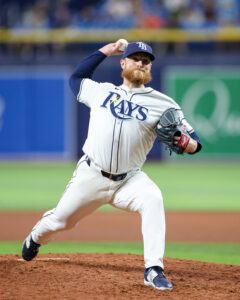
Ramussen, 29, missed the bulk of the 2023-24 seasons recovering from an internal brace procedure to repair the ulnar collateral ligament in his right elbow. That surgery tamped down his workload in both seasons as well as his expected price tag in arbitration. MLBTR contributor Matt Swartz projected a modest $2MM salary for the talented righty in the upcoming season. By virtue of his salary and that signing bonus, he’ll top that sum under this new multi-year arrangement while also sacrificing a year of free agency to lock in some immediate earnings.
It’s an understandable trade-off for Rasmussen, who didn’t get a full look in a big league rotation until his age-26 season (2022) and has since missed ample time due to injury. A sixth-round pick of the Brewers back in 2018, Rasmussen signed for just a $135K bonus and didn’t make his big league debut until 2020. In total, he’s earned under $4MM in his career thus far.
Rasmussen was traded from Milwaukee to Tampa Bay in the 2021 deal that sent Willy Adames to the Brewers. He was sharp down then stretch in a hybrid role for Tampa Bay but had a full-fledged breakout in 2022, That season, Rasmussen pitched a career-high 146 innings and turned in a 2.84 earned run average with a slightly below-average 21.4% strikeout rate against a terrific 5.3% walk rate. He kept the ball on the ground at a strong 46.6% clip. Rasmussen averaged 95.5 mph on his heater, deftly avoided hard contact and recorded a 12.1% swinging-strike rate that suggested more punchouts could be in the tank down the road.
That indeed looked to be the case early in 2023, too. Rasmussen notched an even better 2.62 ERA but saw his strikeout rate spike to 26.6%. He maintained plus command (6.2%) and also saw his ground-ball rate surge to 52.6% — an increase of six percentage points over the prior season. For a span of 36 starts from 2022-23, Rasmussen pitched like a genuine No. 1 or 2 starter — a clear playoff arm who could pitch near the front of any rotation.
Injuries, however, had other ideas for the talented righty. The Rays announced on July 8, 2023 that Rasmussen would require surgery. He wound up missing 13 months of action, returning to a big league mound on Aug. 7 of this past season. The Rays used him primarily as a reliever. He “started” four games but did so throwing only two innings apiece and working as an opener. The results, however, were excellent. In 28 2/3 frames, Rasmussen posted a 2.83 ERA, 30.2% strikeout rate, 5.2% walk rate and 53.3% grounder rate.
The plan now is for Rasmussen to return to the rotation. He’ll join Shane McClanahan (returning from Tommy John surgery), Ryan Pepiot, Taj Bradley, Shane Baz and Zack Littell in a very talented mix of arms. Each of McClanahan, Rasmussen and Baz could face some form of workload limitations, as Baz has yet to pitch a full season since returning from his own ligament surgery in 2022 — though he did pitch 118 2/3 innings combined between Triple-A and the majors in 2024.
For the Rays, there’s little to no impact on their 2025 budget. Rasmussen will only earn a nominal $500K more than his projected arbitration price, thanks to that signing bonus. They’ll also lock in the right-hander’s 2026 salary, gaining some cost certainty. It’s possible that Rasmussen could’ve outpaced that $5.5MM salary in arbitration with a big year, but likely not by much, given the low platform from which he’d be starting. The concession for locking in that ’26 salary is giving up a would-be free-agent season — his age-31 year. So long as he’s healthy, that option will pay him at least $8MM, though with good health there’s a good chance it’ll be a fair bit higher.
While it’s not quite to the same scale as the Rays’ extension with former ace Tyler Glasnow, there are some parallels here. Tampa Bay is putting down some guaranteed money on a talented but oft-injured righty. Glasnow’s $25MM salary in the final season of his own extension was guaranteed, whereas Rasmussen will have to remain healthy to push close to that number. Still, it’s a potentially weighty salary by the Rays’ standards, and one that could render Rasmussen a trade candidate down the road. The extension gives the Rays some extra control over a potential frontline arm but also a viable trade candidate down the road. It’s perhaps cynical to point out the manner in which an extension boosts a player’s trade value in the immediate aftermath of the agreement, but the Rays have a track record of operating in this manner.
For the time being, Rasmussen will head into the season as a locked-in member of a deep and talented rotation. The Rays haven’t done much to improve their middling lineup — though Danny Jansen provides a potential notable upgrade behind the plate. Rather, they’ll apparently hope for big strides from ballyhooed third baseman Junior Caminero and rebounds from Josh Lowe and Christopher Morel, both of whom experienced notable drops at the plate following very productive 2023 campaigns.
Marc Topkin of the Tampa Bay Times first reported that the Rays and Rasmussen were nearing a two-year, $8.5MM extension with an $8MM option for 2027. Topkin reported the presence of escalators in the option, which The Associated Press specified.
MLBTR Chat Transcript
Click here to read a transcript of Tuesday’s chat with MLBTR’s Steve Adams.
Pirates Interested In Alex Verdugo
It’s been a pretty quiet offseason for the Pirates, with their most prominent moves to date including the acquisition of first baseman Spencer Horwitz (in exchange for righty Luis Ortiz) and the re-signing of franchise icon Andrew McCutchen on another one-year, $5MM deal. The Bucs were said last month to be exploring the bullpen and corner outfield markets, and that appears to still be the case. Robert Murray of FanSided more specifically reports that Alex Verdugo is one name in whom the Pirates have interest.
Verdugo, 29 in May, is coming off a down season with the Yankees — his lone season in the Bronx. The former second-rounder and top prospect got out to a big start in his lone Yankees season, slashing .275/.362/.450 through his first 140 plate appearances. He tanked thereafter, posting just a .221/.270/.330 slash over his final 480 trips to the plate. Overall, he finished out the season with a .233/.291/.356 batting line — about 17% worse than league-average, by measure of wRC+.
Ugly as those results were, they stand as something of an anomaly in contrast with the rest of Verdugo’s career. While he’s never broken out into stardom, Verdugo was a solid regular in the outfield corners from 2019-23, batting a combined .283/.338/.432 in 2448 plate appearances with the Dodgers and Red Sox from 2019-23. That’s “only” about six percent better than league average, but he coupled that production with quality corner outfield grades (per both Defensive Runs Saved and, to a lesser extent, Outs Above Average). Verdugo has never been a big power bat — he’s reached a career-high 13 home runs in three different seasons, including 2024 — but rarely strikes out (career 15.1%). He’s tied for fifth in the majors in doubles dating back to 2020.
Verdugo’s lack of over-the-fence pop and his middling finish to the 2024 season combine to drag down his earning power in free agency. Given his lackluster ’24 showing and his age, he seems likely to take a one-year deal and return to the market next winter, hopefully on the heels of a steadier and more productive performance. He’d still only be entering his age-30 season, an age at which plenty of outfielders find lucrative multi-year deals.
Bucs fans may be exhausted with the notion of one-year deals for veteran rebound candidates, but that’s the free-agent reality in which the team typically operates under current ownership. Verdugo would fit the bill and fill a position of need. As it stands, Pittsburgh’s outfield projects to include Bryan Reynolds, shortstop-turned-center-fielder Oneil Cruz and perhaps Joshua Palacios, though in-house options like Jack Suwinski and Billy Cook could get consideration this spring as well. Verdugo would more prominently step into an everyday role alongside Reynolds and Cruz.
As things stand, the Pirates’ projected payroll is a paltry $79MM, per RosterResource. That’s about $8MM south of last year’s $87MM mark. Having filled their first base need inexpensively via the Horwitz acquisition, there ought to be additional (albeit modest) spending power to bring an outfielder of Verdugo’s caliber into the fold and perhaps still add a free agent reliever to the mix. Earlier in the offseason, the Phillies signed Max Kepler to a one-year deal worth a guaranteed $10MM. Verdugo is younger but has less power and defensive upside; a contract in that general range seems possible, but he doesn’t seem likely to command more than that.
Yankees Shopping Marcus Stroman
The Yankees’ eight-year deal for Max Fried gave them one of the deepest collection of major league starting pitching in the sport. Fried joined Gerrit Cole, Carlos Rodon, Luis Gil, Clarke Schmidt, Marcus Stroman and the since-traded Nestor Cortes in a long line of Yankee rotation options. While the trade of Cortes to the Brewers loosened that logjam (and significantly bolstered the bullpen, bringing Devin Williams in from Milwaukee), the Yankees still have six big league starters, most of whom are earning significant salaries. With that in mind, it’s not exactly surprising to see Bob Nightengale of USA Today report that New York is “actively trying to deal” Stroman.
Stroman’s name has already popped up in trade rumblings since the Fried signing. The Yankees pitched a Stroman-for-Nolan Arenado framework to the Cardinals, which was rebuffed by St. Louis. (Arenado has a no-trade clause, but the scenario was reportedly not even presented to the third baseman, as the Cardinals weren’t interested.) Given those efforts, it’s only natural that the Yankees have explored other possibilities as well.
Stroman, 34 in May, is entering the second season of a two-year, $37MM contract. He pitched decently during year one of the pact, logging a 4.31 ERA in 154 2/3 innings, but his strikeout rate (16.7%) and ground-ball rate (49.2%) were a far cry from his typical standards. Stroman punched out 21% of opponents from 2019-23 and kept the ball on the ground at a robust 53.2% clip over that same span. Similarly, the velocity on his sinker dipped quite a bit; from 2019-23, Stroman averaged 92 mph on the pitch (91.4 mph in ’23). In 2024, he averaged just 90 mph on that sinker.
Left-handed hitters, in particular, proved problematic for Stroman. They tagged him for a .296/.372/.474 batting line. He fanned just 14.3% of lefties, compared to 19% of fellow righties. With Stroman playing half his games at Yankee Stadium, lefties took full advantage of the short right-field porch. He surrendered 15 of his 19 home runs at Yankee Stadium in 2024 and pitched to a grisly 5.31 ERA at home. On the flipside, he sported a tidy 3.09 ERA on the road.
That road production and a generally successful track record should create at least some interest in Stroman elsewhere around the league, though perhaps not at the full freight of his $18.5MM salary this coming season. Trade discussions are surely complicated by the fact that the highly durable Stroman also has a vesting player option on his contract. With 140 innings pitched in 2025, he’d gain a player option for $18MM. Were that a club option, it wouldn’t be quite so problematic; that it’s a player option means that even if Stroman struggles or incurs a late-season injury, he’d be able to lock in that $18MM payday in 2026. Stroman has averaged 159 inning across the past five full seasons in which he’s pitched.
That player option, presumably, only creates more urgency for the Yankees to find a deal. They already have Cole, Fried and Rodon locked in for a combined $85MM in 2026 (including Fried’s slightly deferred signing bonus, which is paid half in 2025 and half in 2026). Schmidt will be in his third trip through arbitration as a Super Two player, while Gil will be in his first arb season in 2026. In total, it could mean a rotation earning a combined $100MM.
Stroman is arguably the sixth-best starter in that group of six at the moment, and paying him $18MM in 2025 and potentially again in 2026 understandably may not be a palatable course of action for the Yanks. That’s especially true when considering the team’s luxury tax status; they’re currently in the top penalty bracket for luxury status. Moving Stroman would trim more than $35MM in 2025 spending. The Yankees will be on the hook for 50-110% penalties on their luxury overages in 2026, depending on where the exact payroll ultimately lands. Again, that could mean a savings of $27-37MM, depending on if his player option comes into play.
While the player option surely gives other teams some pause, Stroman’s contract itself isn’t necessarily all that far underwater. The offseason has already seen 37-year-old Alex Cobb and 41-year-old Charlie Morton command $15MM one-year deals — Cobb’s coming after he made only three starts in 2024. Frankie Montas landed two years and $34MM with an opt-out upon signing with the Mets. The price for starting pitching has generally exceeded all expectations. Stroman at a year and $18MM, even with the conditional player option, isn’t necessarily egregious. Plus, if Stroman hits the 140 innings and pitches more like his 2021-23 self (3.45 ERA in 454 1/3 innings), he could well turn down the option and reenter free agency anyhow.
The Yankees aren’t likely to extract any kind of notable young talent in return for Stroman, but swapping him out for another veteran on a contract of some note or eating a portion of the contract and acquiring some longshot prospect help could still be feasible. There are still five weeks until pitchers and catchers report to spring training, and the market in recent offseasons has produced plenty of notable trades even after camps open. There should still be time for a deal to come together.
Tigers Sign Gleyber Torres
The Tigers announced Friday that they’ve signed free agent infielder Gleyber Torres to a one-year, $15MM contract. Torres, an Octagon client, is expected to be Detroit’s regular second baseman in the upcoming season. The Tigers, one of the rare teams to publicly disclose contract terms themselves, added that Torres’ contract has a one-time, $500K assignment bonus (in the event that he’s traded to another club).

Torres, who turned 28 earlier this month, has spent his entire big league career to date in Yankee pinstripes. The once-vaunted top prospect looked like a breakout star in 2019 when he socked 38 home runs in just 144 games, but Torres wound up settling in as a solid regular at second base rather than the superstar shortstop he appeared to be on the cusp of becoming in ’19. Since that stellar 2019 campaign — which came in MLB’s juiced-ball season — Torres has slashed .261/.332/.411. That’s about 9% better than average, by measure of wRC+ (which weights for home park and league run-scoring environment in a given season).
The 2024 season was shaping up to be a career-worst showing for Torres at the halfway point. Through his first 80 games, he turned in an anemic .215/.294/.333 slash (81 wRC+) with a 23.9% strikeout rate that was well north of the 19.3% mark he’d posted over the prior five seasons. Torres righted the ship in late June, however, and rebounding to the tune of a .298/.365/.421 slash with a much-improved 17.3% strikeout rate down the stretch.
It’s perhaps possible that Torres could’ve landed a multi-year deal at a lower rate, but given his age and track record, it’s not a shock to see him take a pure one-year pillow deal. MLBTR predicted back in November that he’d ink a two-year deal with an opt-out, as the priority for him always seemed likely to be getting back to the market next winter. The demand seemingly wasn’t there to push to that range, however, and Torres will head to Comerica Park as an eminently reasonable one-year roll of the proverbial dice. With a strong enough showing, he’ll have the added benefit of being a potential qualifying offer candidate for the Tigers next offseason.
Torres steps into a Detroit infield that’s lacking in any real certainty. Colt Keith, who hit .285/.330/.429 in 445 plate appearances after a terrible start to his rookie season, appears to be the only other infield lock. He played second base in 2024 but has experience at the hot corner as well. Evan Petzold of the Detroit Free Press writes, however, that the organization prefers not to play Keith at third due to some injury concern regarding his right shoulder. Keith has taken reps at first base, and while he’s yet to play there in a professional game, he could get further work there this spring in the event of a potential position shift.
Meanwhile, Javier Baez is signed for three more seasons at $24MM per year, but he’s played himself out of a starting role and will eventually be a release candidate if he can’t rebound to at least some extent (though the Tigers have suggested this winter that they still see a role for Baez in ’25). Former top pick Spencer Torkelson belted 32 homers in 2023 but flailed through an ugly 2024 campaign and has yet to establish himself as a viable big league regular. Trey Sweeney showed a big league-ready glove at shortstop but didn’t hit in 36 big league games during last year’s second-half debut. Top prospect Jace Jung drew heaps of walks (16%) in 94 plate appearances late last season but is probably ticketed for Triple-A work or (speculatively speaking) some exposure to left field. Matt Vierling could factor in at the hot corner as well, though he can play in the outfield, too.
The glut of infield options, even with many of them unproven, gives the Tigers some flexibility with regard to how they handle the rest of the offseason. Young players like Sweeney and particularly Jung would command considerable trade interest. Torkelson stands as a viable change-of-scenery candidate, especially if the Tigers indeed plan to give Keith a prominent role at first base. Torkelson could still factor into the first base/DH mix, but he’s hardly a lock to do so after hitting .221/.300/.392 through his first 361 big league games.
The Tigers have been connected to free agent third baseman Alex Bregman, though that’d be a considerably larger signing than they’ve made at any point under current president of baseball operations Scott Harris. Some of the link there is surely due to the presence of former Astros skipper A.J. Hinch in the Detroit dugout. Petzold reported earlier in the week that Bregman has become more of a priority for the Tigers as the offseason has worn on, but the addition of Torres clouds the infield mix a bit more. A fit could still come together, particularly if the Tigers are keen on moving someone like Jung in a deal for rotation help.
In terms of payroll, there’s no reason to think the Tigers can’t make another prominent addition after adding Torres. They entered the offseason with only Baez, Keith and Kenta Maeda on guaranteed deals for the upcoming season. Torres and fellow free agent pickup Alex Cobb have pushed the team to a projected a $109MM payroll, per RosterResource’s projections. That’s nowhere near the team’s franchise-record $200MM payroll from 2017. And while that level of spending came under the ownership of the late Mike Ilitch, even Ilitch’s son, Chris, has authorized payrolls as high as $135MM in recent seasons (2022).
Jon Heyman of the New York Post first reported that Torres had agreed to a deal with the Tigers. ESPN’s Jesse Rogers first reported the terms and that Torres was expected to be the Tigers’ starting second baseman.
A’s President Dave Kaval Announces Resignation
A’s president Dave Kaval announced Friday that he’s resigning from his role in order to “pursue new business opportunities in California.” His last day with the team will be Dec. 31. Kaval, former president of Major League Soccer’s San Jose Earthquakes, has been with the A’s since 2016. Board member Sandy Dean will serve as the A’s interim president while the club conducts a search for a new president early in 2025.
“We are grateful for Dave’s contributions and leadership over the past eight years,” owner John Fisher said in a statement within today’s press release. “He guided our organization through a period of significant transition, and we sincerely thank him for his unwavering commitment to the team. As we look ahead to the next chapter of our franchise, the team will continue to grow under new leadership, driving the organization toward success during our interim years in West Sacramento and at our new home in Las Vegas.”
Kaval joined the A’s in 2016, when former managing partner Lew Wolff sold his stake in the team to Fisher, who assumed an even broader role at the time. He’s been the public face of the A’s now-abandoned efforts to build a new stadium in Oakland. During Kaval’s tenure with the A’s, the team explored the possibility of new facilities at Howard Terminal, Jack London Square and even at the site of their now-former home, the Oakland-Alameda County Coliseum.
Kaval played an integral role in the construction of what’s now known as PayPal Stadium in San Jose, home to MLS’ Earthquakes (also owned by Fisher). At the time of his hiring, he pledged his enthusiasm for “[pursuing] a world-class ballpark in Oakland for the best fans in baseball.”
Clearly, that never panned out. Kaval and Fisher drew sharp criticism from A’s fans throughout the latter portion of his time with the team, as many questioned the sincerity of the team’s desires to remain in Oakland. The A’s announced in 2023 that they planned to relocate to Las Vegas and have since begun the process of relocating to a 33,000-seat stadium located on the Las Vegas strip at the site of the since-demolished Tropicana Casino. The A’s will play the next three seasons at West Sacramento’s Sutter Health Park — the home of the Giants’ Triple-A affiliate. They’re expected to move into their new permanent Las Vegas home in 2028.
Tigers Designate Bailey Horn For Assignment
The Tigers announced Friday that they’ve designated left-hander Bailey Horn for assignment. He’ll be the corresponding 40-man roster move for newly signed infielder Gleyber Torres, whose one-year, $15MM deal with the Tigers is now official.
Horn, 26, was claimed off waivers out of the Red Sox organization a month ago. He’ll now be traded to another club or claimed off waivers within the next week. He made his big league debut in Boston last season, pitching 18 innings and yielding 13 earned runs (6.50 ERA) on 22 hits and 10 walks with 13 strikeouts.
It wasn’t the best first impression in the majors, but Horn was sharper for Boston’s Triple-A club, rattling off 29 1/3 innings of 2.15 ERA ball with a 29.2% strikeout rate against a bloated 11.7% walk rate. Horn has missed bats in droves in the minors, fanning 29% of his career opponents, but he’s also walked nearly 13% of his opponents along the way. He’s a former fifth-round pick of the White Sox who’s been traded multiple times, most notably going from the Sox to the Cubs in exchange for Ryan Tepera back in 2021.
Horn’s ability to miss bats, coupled with a heater that averages 95 mph and a pair of minor league option years still remaining, could prompt another team to take a look.
D-backs Among Teams With Interest In Kirby Yates
The D-backs have been in the market for a high-leverage reliever throughout the offseason, and they’re among the clubs with interest in right-hander Kirby Yates, per Nick Piecoro of the Arizona Republic. The Snakes have checked out several options on the trade market but balked at the asking price for Devin Williams — since traded to the Yankees — and their interest in Cardinals stopper Ryan Helsley might be moot if St. Louis ultimately opts to hold him.
Arizona GM Mike Hazen has left no doubt about his team’s desire to add a closing option this offseason. “I still feel like a back-end bullpen guy to help out with [Justin Martinez] and with [A.J. Puk] and those guys, I still see that,” Hazen said in a radio appearance back in early November. “I thought when [Paul Sewald] was closing, we had the best version of who we were, frankly. … But, we know [Martinez and Puk] can close, too, so we’ll see.
Yates, 38 in March, is fresh off a dominant rebound campaign with the Rangers, for whom he saved 33 games while pitching to a 1.17 ERA over the life of 61 2/3 innings. Yates earned his second career All-Star nod, fanned 35.9% of the opponents he faced, and issued walks at a 9.6% clip (higher than average but generally offset by the gaudy strikeout rate).
The 2024 season was Yates’ second consecutive year with 60-plus innings pitched, but injuries have hindered the righty at various points in his career. He threw only 11 1/3 big league innings from 2020-22; he was limited to six appearances in 2020 thanks to an elbow injury — one that wound up requiring Tommy John surgery a year later in 2021 (his second TJS operation). That procedure wiped out his entire 2021 season and the majority of his 2022 campaign.
When healthy, Yates has been a lights-out late-inning option in recent years. He’s the epitome of a late bloomer, as he didn’t truly solidify himself as a quality big league reliever until his age-30 season and didn’t break out in full until his age-31 campaign with the Padres, in 2018. Since that breakout, Yates boasts a scintillating 2.21 ERA with 93 saves, 30 holds, a 35.5% strikeout rate and a 10% walk rate.
Yates would (clearly) fit the Diamondbacks’ desire for a bona fide stopper at the end of the bullpen. The question is whether he’ll fit into the budget. After last year’s brilliant showing, he’s in position to command an eight-figure salary, perhaps even over a multi-year deal if a team isn’t scared off by offering two years to a 38-year-old who’s twice required UCL surgery.
Hazen said in the aforementioned radio appearance that he expected payroll to be in the general vicinity of 2025’s $173MM mark. RosterResource currently projects a $160MM payroll for the Diamondbacks. Yates could command the bulk or perhaps even the entirety of the remaining budget, though it’s always possible that other trades will impact the payroll. The D-backs have received trade interest in their young outfielders and in their starting rotation. The club surely still hopes to shed at least a portion of the $22.5MM owed to Jordan Montgomery.
A multi-year deal for Yates would be nearly unprecedented for a reliever this old. As shown in MLBTR’s Contract Tracker, the only free agent relievers in the past decade to sign multi-year deals beginning in their age-38 season are Jason Grilli and Darren O’Day, both of whom signed for a total of $8MM or less. The only real comp for a pitcher of this age commanding a multi-year deal at a premium rate is Daniel Bard‘s two-year, $19MM extension with the Rockies back in July 2022 — a deal that obviously did not pan out.
Exploring A Potential Pablo Lopez Trade
It's been a quiet offseason for the Twins as the front office faces payroll constraints for a second straight offseason. Minnesota's signing of Carlos Correa and extension for Pablo Lopez in the 2022-23 offseason -- among other moves -- pushed the club's payroll up into the $150-160MM range. Both deals came just months after owner Jim Pohlad took a step back as his nephew, Joe Pohlad, took on a far more prominent role. That ownership shuffle, coupled with the long-term nature of those deals, made it look like there'd be a lasting bump in payroll.
Clearly, that hasn't been the case. Amid uncertainty regarding the team's television broadcast rights, ownership slashed payroll back down to the $130MM range for the 2024 season. The Twins largely sat out the 2023-24 offseason, with their largest moves coming via the trade market (dealing Jorge Polanco to Seattle) and in the bargain aisle of free agency (a $5.25MM deal for Carlos Santana being their most expensive). At the end of the 2024 season, Joe Pohlad announced his intent to explore a potential sale of the team.
That's led to even more uncertainty and inflexibility with the budget this offseason, as evidenced by the Twins' complete lack of activity. RosterResource projects the Twins' payroll at about $142MM. Ownership would like that back into the $130MM range again. It's expected that at some point they'll trade righty Chris Paddack, whose $7.5MM salary looks quite affordable when juxtaposed with the aggressive market for starters this winter. They'll shop Christian Vazquez but would need to eat some of his $10MM salary. A trade of their excellent utilityman, Willi Castro, could also be explored.
Speculation regarding the possibility of larger-scale deals was inevitable, but president of baseball operations Derek Falvey said early in the offseason that the team views Correa, Lopez and Byron Buxton as "key" players to the team's 2025 outlook. Falvey has emphasized that the Twins are intent on contending in 2025, even as it looks like he'll be forced to find ways to trim player payroll before making a single addition.
A Correa trade always seemed far-fetched. He's owed $128MM over the next four years and has a full no-trade clause. Buxton also has full no-trade protection. However, the recent report from ESPN's Jeff Passan that the Twins have at least listened to offers on Lopez presents a far more compelling thought exercise. Lopez's contract is teeming with surplus value in a way that isn't true -- or isn't as true, anyway -- of the Twins' other most expensive players.
Trading Lopez would ignite swift backlash from an already frustrated and put-off fanbase. At the same time, the huge return and the potential avenues for restructuring the team in the wake of such a surprising deal are compelling enough that it's understandable if the Twins perform due diligence to at least see what the market might bear.
Let's dive into an admittedly very hypothetical look at why a Lopez trade could actually appeal to the Twins, who could be involved, and how the Twins could proceed (and possibly improve) in the aftermath.

Unlock Subscriber-Exclusive Articles Like This One With a Trade Rumors Front Office Subscription
- Access weekly subscriber-only articles by Tim Dierkes, Steve Adams, and Anthony Franco.
- Join exclusive weekly live chats with Anthony.
- Remove ads and support our writers.
- Access GM-caliber tools like our MLB Contract Tracker