
Rangers Notes: McCutchen, Pederson, Higashioka
Andrew McCutchen has hit the ground running in his attempt to make the Rangers’ Opening Day roster, as the veteran has a blistering .583/.706/.833 slash line over 17 Cactus League plate appearances. Nothing is yet guaranteed for Cutch since he is in camp on a minor league contract, yet the 39-year-old is using the rather awkward end of his tenure with the Pirates as some extra incentive.
“I haven’t been in this position, in a place where there are a lot of doubts from other people in quite a long time. I’m motivated in a different way,” McCutchen told the Dallas Morning News’ Evan Grant. “I remember getting invitations to spring training when I was 20-21 years old, knowing I wasn’t going to make the team, but had the approach that I wanted to showcase that I can do this here, no matter the age. This is kind of the same thing, only the ages are different. I want to show people that I can continue to play this game at a very high level.”
McCutchen’s second stint in Pittsburgh began with two above-average offensive seasons, but he hit a more modest .239/.333/.367 over 551 PA in 2025, translating to a 95 wRC+ and the first sub-replacement (-0.1 fWAR) performance of his 17-year Major League career. Hitting in a pitcher-friendly venue like PNC Park has never been easy for batters, though McCutchen observed that “we had some of the same ballpark effect the Rangers had last year, that the ball wasn’t really flying to left field. You weren’t getting rewarded as often and I was trying to find ways to improve the numbers. How can I get hits? How can I get on base? How can I work counts? I put my body into positions that weren’t ideal.”
“I needed to get back to basics and get myself in the most optimal position for 39 that I could get. And, honestly, I feel like I’m in a better spot than I have been in a number of years.”
Despite the subpar production, there was still an expectation that McCutchen would again re-sign with the Pirates, as there seemed to be an unofficial agreement in place that the veteran would end his career in a Pittsburgh uniform. As McCutchen puts it, “I was pretty vocal about doing that, and wanted that. The other side also was pretty vocal about wanting to do that too, but they wanted to do it a little sooner.”
The apparent lack of response or even communication on the Pirates’ part led to McCutchen going public with his frustrations on social media in late January. The Bucs then signed Marcell Ozuna in early February, and Ozuna’s usage in the DH role more or less closed the door on the chances of McCutchen remaining in Pittsburgh.
Should McCutchen break camp with the Rangers, he might get a bit more outfield time than he did with the Pirates, but he’d likely still be primarily used as the right-handed side of a DH platoon with Joc Pederson. Of course, this assumes that Pederson will hit well enough to hold his own spot in the lineup, which is no guarantee since the veteran slugger is also trying to bounce back from a disappointing year.
After signing a two-year, $37MM free agent deal with Texas last winter, Pederson hit only .181/.285/.328 over 306 PA. He was off to an ice-cold start even before he missed two months due to a hand fracture, and he hit only marginally better after his return from the injured list in late July.
Pederson told MLB.com’s Kennedi Landry that “the mentals of not playing good for so long” contributed to his inability to get out of his funk. “Even the whole second half of when I came back, things started to trend in the right direction, but still I was not where I wanted to be….We have so many goals, so everything is going to be tailored around that, how to contribute to a winning team, how to be an above-average productive player.”
An offseason of work with Rangers hitting coach Justin Viele can hopefully get Pederson back on track, though the numbers haven’t yet been there for Pederson in Spring Training. The $18.5MM salary owed to Pederson in 2027 gives the Rangers incentive to give him plenty of time to find himself at the plate, though another extended slump might lead to some hard questions about Pederson’s playing time (or even a spot on the roster). Another DH candidate like McCutchen could emerge, or Texas might want to give multiple players a shot at DH at-bats to help keep people fresh.
In some injury news from the team’s camp, catcher Kyle Higashioka is expected to return to game action tomorrow, manager Skip Schumaker told Evan Grant and other reporters. Back stiffness has kept Higashioka sidelined from games since March 5, though he returned to catching and batting work against live pitching. Assuming no setbacks once he gets back on the field, Higashioka should have enough time to ramp up and be ready for Opening Day.
Higashioka and the newly-signed Danny Jansen will share the Rangers’ catching duties this season. Another free agent signing from the 2024-25 offseason, the first season of Higashioka’s two-year, $13.5MM contract resulted in a .241/.291/.403 slash line and 11 homers over 327 PA (93 wRC+).
Joc Pederson Exercises Player Option
Joc Pederson has officially exercised his $18.5MM player option for the 2026 season, according to a report from The Associated Press. The deal contains a matching mutual option for 2027. This was the only option decision for the Rangers this offseason.
It was also one of the easiest option calls of the winter. Pederson’s first season in Arlington was terrible. He signed as a near full-time designated hitter who was supposed to tee off on right-handed pitching. He instead hit .181/.285/.328 with nine home runs over 306 trips to the plate. He started the year slowly, fractured his right hand when he was hit by a pitch in May, and was only marginally better in the second half. Pederson had a strong August but otherwise struggled throughout the year.
He obviously wouldn’t have come close to an $18.5MM salary on the open market. That made it a no-brainer to stick around for what he hopes to be a rebound season. Pederson mashed at a .275/.393/.515 clip with the Diamondbacks two seasons ago. The Rangers probably don’t have much choice but to run it back with him as their primary DH. They’d be unable to offload more than a couple million dollars in a trade.
Texas is likely to reshape the offense via trades or non-tenders of the likes of Adolis García, Jonah Heim and Josh Jung. They’d have a tougher time finding a taker for the underwater Pederson and Marcus Semien deals. It’d be surprising if they trade Corey Seager, whose contract would be prohibitive for all but a handful of teams and who remains one of the team’s two or three best hitters.
Rangers Release Kevin Pillar
TODAY: The Rangers announced that Pillar has been released after clearing waivers.
MAY 25: The Rangers announced a trio of moves, including the previously reported news of outfield prospect Alejandro Osuna joining the active roster and DH Joc Pederson being placed on the 10-day injured list due to a right hand fracture. To create space on the 40-man roster for Osuna’s contract selection, Texas designated outfielder Kevin Pillar for assignment.
Pillar signed a minor league contract with the Rangers this past winter, and some injuries to other outfielders opened the door for Pillar to make the Opening Day roster. Playing mostly in center field with some addition time in both corner outfield slots, Pillar’s contributions have been almost entirely on the defensive side, as he has batted only .209/.209/.265 over 43 plate appearances. He also missed a little over two weeks of action due to a bad back that required a stint on the 10-day IL.
Sam Haggerty‘s emergence as the new everyday center fielder and the Rangers’ decision to call up Osuna left Pillar as the odd man out, even with Texas still missing some notable names on the injured list. Evan Carter has been on the IL for a week due to a Grade 2 strain of his right quad, but despite that more severe variety of strain, Carter may be on track for a relatively quick return. Rangers manager Bruce Bochy told reporters (including Shawn McFarland of the Dallas Morning News) yesterday that Carter may be able to start a minor league rehab assignment by next weekend, as Carter is already doing running drills and has been cleared for live batting practice.
Pillar has now played for 10 different teams over the course of his 1234 career games and 13 seasons in the big leagues. One of the game’s top defensive center fielders back during his heyday with the Blue Jays, Pillar has carved out a lengthy career as a part-time or fourth outfielder, despite a lack of production at the plate (i.e. a .255/.293/.405 career slash line).
Because Pillar has been previously outrighted in his career, he has the right to elect free agency if he clears waivers and the Rangers try to outright him to Triple-A. It could be that Pillar will accept such an assignment and bide his time waiting for his next chance on the Texas roster, or he might explore his options to see if another club can offer a clearer path to big league playing time. It also isn’t out of the question that Pillar may consider hanging up his cleats for good, as the 36-year-old strongly considered retiring last season before deciding to return for the 2025 campaign.
Joc Pederson Suffers Right Hand Fracture
The Rangers were dealt a major injury blow today when DH Joc Pederson was hit by a pitch in this evening’s loss to the White Sox. Pederson initially stayed in the game but was later lifted for a pinch-hitter. Manager Bruce Bochy revealed to reporters (including Shawn McFarland of the Dallas Morning News) that Pederson suffered a fracture in his right hand when he was struck by the pitch. Pederson told reporters, including McFarland, that he expects a recovery timeline of six weeks for the injury.
It’s a blow to a Rangers club that has already struggled to stay healthy this year. Pederson will now join Corey Seager and Evan Carter on the shelf from the club’s lineup, in addition to injuries suffered by reliever Chris Martin and starters Kumar Rocker, Jon Gray, and Cody Bradford. Those injuries have contributed to Texas’s struggles this year, as they’ve posted a lackluster 25-28 record that’s left them three games out of a Wild Card spot and five games out of the AL West. With Josh Smith covering for Seager at shortstop and Sam Haggerty holding down center field in place of Carter, the Rangers will likely be forced to get creative with replacing Pederson.
One option could be first baseman Blaine Crim, who failed to record a hit in a five-game cup of coffee earlier this year but sports a .301/.369/.558 slash line in Triple-A this year. Another could be outfielder Dustin Harris, who has a 104 wRC+ in 45 trips to the plate at the big league level and is the club’s only left-handed hitter already on the 40-man roster at Triple-A. Harris could be a particularly attractive option if the Rangers would like to continuing starting backup catcher Kyle Higashioka at DH against left-handed pitchers, a role which the club is already carrying third catcher Tucker Barnhart in order to accommodate on a more regular basis.
Turning back to Pederson, it must be acknowledged that for however much losing his offensive prowess from the lineup may sting on paper he hasn’t delivered much production in his first season with the organization. Signed to a two-year, $37MM guarantee over the winter, Pederson has hit a paltry .132/.266/.240 (51 wRC+) in 144 plate appearances to this point in the season. That’s hardly production a club will miss from their lineup, but it’s unfortunate timing nonetheless giving that Pederson had just begun to look more like his normal self at the plate: he’s hitting .220/.429/.444 with four extra-base hits and an eye-popping 26.5% walk rate over his last 16 games.
The Rangers can only hope that he’ll be able to pick back up right where he left off when he returns to action later this summer. A six week timetable would leave him poised to return in early July, shortly before the All-Star break. Rough as his start to the 2025 campaign was, it goes without saying that Pederson can be a dynamic addition to virtually any lineup when healthy; while he almost exclusively plays against right-handed pitching, the slugger slashed an excellent .262/.365/.485 with a wRC+ of 135 and 61 homers in 387 games over his last three seasons. That’s the 16th-best wRC+ among all hitters with at least 1000 plate appearances in that span, sandwiched between Vladimir Guerrero Jr. and Jose Ramirez on the leaderboard. If Pederson can offer that sort of production to the Rangers in the second half, it should be easy for fans to forget his first-half struggles and injury woes so long as Texas hasn’t already fallen out of the playoff conversation before he returns.
Player Option/Opt-Out Update: April Edition
The increasing popularity of opt-outs/player options as a means to close the gap in free agent signings and extensions has changed the face of free agency entirely. Not long ago, opt-outs were perks reserved for the game’s truly elite stars — a benefit to help differentiate nine-figure offers and secure the game’s top stars.
In 2025, they’re downright commonplace. Opt-out laden short-term deals have become a common alternative to the more conventional one-year pillow contract that a player in search of a rebound campaign might pursue. They’ll also provide a soft landing for a veteran whose market didn’t materialize as expected, even coming off a productive season. Some teams simply use them as a means of sweetening the pot even when negotiating with mid- and lower-tier free agents. The Royals gave opt-outs/player options to both Chris Stratton and Hunter Renfroe two offseasons ago. The Reds did the same with Emilio Pagan and Nick Martinez. Tucker Barnhart, Trey Mancini and Ross Stripling are just a few of the other recent examples of solid but non-star veterans to land such clauses in their free agent contracts.
At their core, opt-out provisions aren’t particularly different from club options that have been widely accepted as commonplace for decades. Teams guarantee a certain number of dollars over a certain number of years, and if the player continues performing at a high enough level, they’ll exercise a club option that’s typically locked in at a below-market price. If not, the player will be bought out and sent back to free agency. Player options and opt-outs are merely the inverse; the player/agent negotiate a certain length and annual value but reserve the right to opt back into the market if the player continues to perform at a high level. It’s two sides of the same coin, one favoring the team and the other favoring the player.
There are 16 players around the league this year who’ll have the right to opt into free agency at season’s end, depending on their performance. (Conversely, there are 27 players with club options.) We’ll periodically take a look at this group over the course of the season, as their performances will have a major impact on the 2025-26 market. For more context, you can check out our full list of 2025-26 MLB free agents as well as the first installment of our recent 2025-26 MLB Free Agent Power Rankings, wherein we rank the top 10 free agents in terms of earning power. Darragh McDonald, Anthony Franco and I recently discussed the decision process behind those rankings in the latest episode of the MLB Trade Rumors Podcast.
Onto this year’s group!
Pete Alonso, 1B, Mets | One year, $24MM remaining
Alonso looked like a good bet to opt out from the moment he agreed to terms on his front-loaded two-year, $54MM contract. That he’s been one of the best hitters on the planet in the season’s first three weeks only improves that likelihood. The 30-year-old slugger is slashing a comical .365/.474/.730 with five homers, eight doubles and more walks (12) than strikeouts (10) through his first 78 turns at the plate. Alonso is chasing pitches off the plate at a career-low 19.1% rate and is sporting the best contact rate of his career at 82.8%. He’s doing all of that with career-best marks in average exit velocity (96.3 mph), barrel rate (24.1%) and hard-hit rate (61.1%). Alonso has been an absolute monster, and the fact that he can’t receive a qualifying offer — players can only receive one in their career, and he rejected one last November — is a cherry on top of his dominant output.
Cody Bellinger, OF/1B, Yankees | One year, $25MM remaining (Bellinger receives $5MM buyout if he opts out)
Bellinger posted All-Star numbers with the 2023 Cubs, signed back for three years with a pair of opt-outs and hit well in 2024 — just not to his 2023 standard. Traded to the Yankees this past offseason, many thought he was primed for a rebound because of the favorable dimensions at Yankee Stadium. It hasn’t played out that way. Through his first 62 plate appearances, Bellinger looks more like the lost version of himself from 2021-22 than the strong performer we saw in ’23-’24. He’s hitting .185/.242/.296 with what would be career-worst strikeout and swinging-strike rates of 29% and 15.2%, respectively. When he’s made contact, it’s been loud (90.8 mph average exit velocity, 53.5% hard-hit rate) — and there’s still plenty of time to turn things around. It’s not the start he or the Yankees hoped for, however.
Shane Bieber, RHP, Guardians | One year, $16MM remaining (Bieber receives $4MM buyout if he opts out)
Bieber has yet to pitch this season as he rehabs from last year’s Tommy John surgery. Cleveland has yet to place him on the 60-day injured list, which could offer some optimism regarding his timetable for a return, but he’s not on a minor league rehab assignment yet. At last check, he was targeting a return around the All-Star break.
Alex Bregman, 3B, Red Sox | Two years, $80MM remaining (Bregman can opt out again after 2026)
Bregman has started his Boston tenure on a tear, hitting .321/.365/.564 with four big flies in 85 plate appearances. He’s been 62% better than average, by measure of wRC+, but there are still some of the same red flags he displayed early in the 2024 season. During his peak, Bregman was one of the sport’s toughest strikeouts and showed outstanding plate discipline. From 2018-23, he walked in 13.8% of his plate appearances against a puny 12.3% strikeout rate. Bregman’s walk rate fell off a cliff last season, and it hasn’t recovered so far in 2024. He’s drawn only four free passes (4.7%). More concerning, he’s fanned 18 times, leading to what would be a career-worst 21.2% strikeout rate. Bregman’s chase rate is down, and he’s still making elite contact within the strike zone, but he’s making contact on a career-low 56.5% of his swings on balls off the plate. If he keeps hitting like this, it probably won’t matter, but it’s something to watch as the season continues.
Edwin Diaz, RHP, Mets | Two years, $37MM remaining (Diaz can opt out again after 2026)
Diaz had a nice return from a 2023 season lost to a knee injury in 2024, pitching to a 3.52 ERA with a 38.9% strikeout rate against a 9.3% walk rate. It wasn’t quite his usual level of dominance, but most relievers would happily take a 39% punchout rate in a “down” season. Things aren’t going as well in 2025. Diaz’s four-seamer is sitting at a career-low 96.4 mph, per Statcast. That’s down 1.1 mph from last year’s mark and 2.5 mph from his 99.1 mph peak in 2022. If he were still overpowering opponents, it wouldn’t matter much, but Diaz has been tagged for five runs on six hits and five walks in 6 2/3 frames. That’s a 16% walk rate, and he’s already tossed four wild pitches — more than he did in 53 2/3 innings a year ago. The caveat with everyone on this list is that we’re all of 11-12% through the season, but the early trendlines aren’t good for Diaz.
Jack Flaherty, RHP, Tigers | One year, $10MM remaining (increases to $20MM once Flaherty makes 15 starts)
Flaherty’s heater is down nearly a mile per hour, and his walk rate is up from 5.9% to 10.3% … but that’s in a span of 21 1/3 innings. He’s still getting strikeouts at a plus level (28.7%), and the bottom-line results are good: 2.53 ERA. Flaherty seems healthy, which will be a big factor for him — both in terms of boosting his stock ahead of a potential return to free agency and in boosting his 2026 salary if he winds up forgoing the opt-out opportunity. If he can deliver a third straight season of 27-plus starts and a second straight year with a plus strikeout rate and low-3.00s (or even mid-3.00s) ERA, the market will likely reward him with the long-term deal that eluded him this past winter. Flaherty doesn’t turn 30 until October. He’ll have a chance at a deal ranging from four to six years in length if he comes close to replicating his 2024 performance. One potential downside: he was traded last summer and thus ineligible to receive a qualifying offer. If the Tigers contend all season, as expected, they’ll be able to make Flaherty a QO if he opts out.
Lourdes Gurriel Jr., OF, D-backs | One year, $18MM remaining
Though he’s one of the most consistent hitters in the sport, Gurriel is out to a woeful start in 2025. His D-backs are red-hot, but their current win streak comes in spite of an anemic .145/.176/.304 start from their everyday left fielder. Gurriel has some of the best contact skills in MLB, fanning in only 17.3% of his plate appearances and making contact on just shy of 90% of his swings in the zone dating back to 2022. He’s punched out in what would be a career-low 13.5% of his plate appearances this year, but he’s staring down a .121 average on balls in play. He should be due for a course correction, but it’s worth noting that he’s hitting more fly-balls and fewer line-drives than ever, which is going to naturally suppress his BABIP a bit (although certainly not to this extent). Gurriel is owed $13MM in 2026 and has a $5MM buyout on a $14MM club option for 2027. He’d need to be confident he could top not just $18MM but probably that he’d top two years and $27MM; the hefty nature of that buyout makes him a net $9MM decision for the D-backs in 2027, which seems like a price they’ll be willing to pay.
Ha-Seong Kim, SS, Rays | One year, $16MM remaining
Kim is still finishing up the rehab from last October’s shoulder surgery. He’s expected back mid-to-late May, which would give him about four months to prove he’s back to form. A healthy Kim would’ve been a coveted free agent who could’ve commanded four or more years in free agency. A plus defender at three positions and a plus runner with enough power to pop 10 to 20 homers annually, Kim will be in high demand next offseason if the shoulder injury doesn’t prove a major drain on his offensive capabilities.
Seth Lugo, RHP, Royals | One year, $15MM remaining
Lugo’s rise from reliever to starter to Cy Young finalist has been remarkable. He’s gotten decent results in 2025, with a 3.86 ERA in his first 23 1/3 innings, but his strikeout and walk rates are nowhere near last year’s marks. After fanning 21.7% of his opponents against a pristine 5.7% mark last year, the 35-year-old Lugo currently sports respective rates of 17% and 9.6%. His velocity is below par (92.2 mph average fastball) but right in line with last year’s levels. A year and $15MM should be the floor for a healthy Lugo, even if he doesn’t repeat his brilliant 2024 season. That’s the same mark that older starters like Charlie Morton, Justin Verlander, Alex Cobb and Max Scherzer (well, $15.5MM) received this past offseason. The Royals could tag him with a qualifying offer if he opts out, which would give him a tougher call on a one-year deal that should be worth more than $21MM. That said, if Lugo comes anywhere close to last year’s results, he’d turn that down in pursuit of a multi-year deal.
A.J. Minter, LHP, Mets | One year, $11MM remaining
Minter’s 94.3 mph average fastball is a career-low, but it’s only narrowly shy of his 2024 mark (94.5 mph). It’s feasible that as he further distances himself from last year’s hip surgery, that number could tick up, too. He’s pitched 8 1/3 innings, allowed a pair of runs on five hits and a walk, and punched out a dozen hitters. That’s a whopping 38.7% strikeout rate. So far, Minter is missing more bats within the strike zone than ever before; opponents have an awful 73% contact rate on his pitches in the zone (compared to the 85% league average). Minter landed two years and $22MM with an opt-out when he was coming off hip surgery. He should be able to top a year and $11MM so long as he’s healthy and pitches to his typical levels. So far, so good.
Frankie Montas, RHP, Mets | One year, $17MM remaining
Montas has yet to pitch in 2025 after suffering a lat strain during spring training. He’s yet to begin a minor league rehab stint but, like Bieber, also has not been placed on the 60-day injured list yet. The size of the Mets’ commitment to Montas this winter registered as a bit of a surprise even when he was thought to be healthy. He’ll need a strong few months to walk away from $17MM guaranteed.
Tyler O’Neill, OF, Orioles | Two years, $33MM remaining
The biggest question with O’Neill is whether he can stay healthy enough to position himself for an opt-out. He’s mashing with a .265/.339/.490 slash and two homers through 56 plate appearances. (One of those big flies extended his ludicrous MLB record of six straight Opening Days with a long ball.) He’s also missed the past couple games due to neck discomfort. O’Neill has never played in more than 138 games in a season, and he’s only twice reached 100 games in a year. (He did play 50 of 60 games in the shortened 2020 season.) O’Neill’s 21.4% strikeout rate would be a career-low, but his actual contact rate and swinging-strike rate aren’t career-best marks. It’s hard to see him sustaining that career-low strikeout rate as a result, but O’Neill’s power is substantial enough that he can be a productive hitter even running strikeout rates approaching/exceeding 30%.
Joc Pederson, DH/OF, Rangers | One year, $18.5MM remaining (Rangers can counter opt-out by exercising 2027 club option for $18.5MM)
Signed to help the Rangers remedy their 2024 ineptitude against fastballs, Pederson has instead turned in a career-worst performance against heaters (and every other offering). It’s only 16 games, but Pederson has collected just one hit against fastballs in 2025 — a single. It’s an alarming development for a hitter who carries a lifetime .244 average and .521 slugging percentage against four-seamers. Pederson has compiled an unfathomable .060/.161/.080 slash in 57 plate appearances. He’s still making a fair bit of hard contact, but most of it is resulting in grounders. His 55.6% ground-ball rate and 2.8% (!) line-drive rates are career-worst marks. There’s no earthly way he can continue to struggle this much, but he’ll need quite the turnaround for that opt-out provision to come into play.
Wandy Peralta, LHP, Padres | Two years, $8.9MM remaining (Peralta can opt out again after 2026)
Peralta posted a career-worst 13.6% strikeout rate in year one of his four-year pact with San Diego in 2024. He passed on his first opt-out opportunity, and understandably so. It’s early, but the veteran lefty has more than doubled last year’s awful 8.3% swinging-strike rate, which now sits at 16.8% through 8 1/3 innings. Peralta is generating chases on an eye-popping 40% of his pitches off the plate, and his opponents’ 44.4% contact rate on those swings is the second-best mark of his career. He’s all but shelved his four-seamer, is barely using his slider, and is leaning hard into a sinker/changeup combo. He won’t sustain a 1.08 ERA, of course, but if he keeps piling up grounders and whiffs, he’ll have a good case to opt out, even at age 34.
Trevor Story, SS, Red Sox | Two years, $55MM remaining
It’s hard to believe we’re already in year four of Story’s six-year deal with Boston — in part because we simply haven’t seen him in a Red Sox uniform all that often. The former Rockies All-Star played in only one-third of the team’s games through the first three years of the contract. Injuries have decimated Story in recent years, and he produced a middling .232/.296/.397 line when healthy enough to play from 2022-24. He’s out to a much better start in 2025, playing in 20 games (already just six shy of last year’s total) and recording a .299/.325/.442 line with three homers. A 3.8% walk rate, 30% strikeout rate and .400 BABIP through 80 plate appearances don’t bode especially well, but to his credit, Story is torching the ball; he’s averaging 90.3 mph off the bat and has even better marks in barrel rate (11.3%) and hard-hit rate (54.7%). It’s hard to see him turning down the two years and $55MM after he’s been injured so much in Boston, but he’s enjoying a fine start to the year.
Robert Suarez, RHP, Padres | Two years, $16MM remaining
Suarez’s name popped up late in the offseason rumor mill, but he was always going to be a tough trade candidate because of this two-year player option. If he performed well, he’d opt out, and if he struggled and/or got hurt, the acquiring team would be saddled with two unwanted years. Such is the nature of trading anyone with a player option/opt-out. Suarez stayed put, and the Padres have to be thrilled. He’s 8-for-8 in save opportunities, hasn’t allowed a run in nine innings, and is boasting a 31.3% strikeout rate against a 6.3% walk rate. That strikeout rate is supported by a huge 16% swinging-strike rate. Suarez looks unhittable right now, just as he has in the past when at his best. There’s a lot of season left, and things can go south in a hurry for relievers in particular, but a player couldn’t ask for a better start to a platform season.
Joc Pederson Taking First Base Reps In Rangers Camp
The Rangers intend to get Joc Pederson work at first base this spring, manager Bruce Bochy said (link via Evan Grant of the Dallas Morning News). While the Rangers still plan to use him primarily as a designated hitter, they could get him occasional first base work over the course of the season.
Pederson was a full-time DH with the Diamondbacks last season. He’s never been a good defender, but that was the first time in which a team kept him off the field entirely. Pederson had played regularly in the outfield before that. He broke in as a center fielder with the Dodgers but had moved more or less to a corner role by 2019.
Bochy downplayed the chance of using Pederson in the outfield at Globe Life Field. “I would imagine he could go out there, but I think the focus is more at first base right now, to help out a little bit. I don’t envision needing more depth in the outfield,” the veteran skipper told Grant and other reporters. “He hasn’t been over there very much, so I imagine he’s got a little rust on him. But he’s taken some ground balls already and we’ll make a call later. We think it’s going to work.”
Pederson has played 154 major league innings at first base. He made a pair of late-game appearances there for the Giants two seasons ago. His only 19 career starts as a first baseman came with Los Angeles back in 2019. He committed six errors in 149 innings, leading to very poor defensive metrics in that tiny sample. It’s an unfamiliar position, but it’s not uncommon for corner outfielders to log occasional first base action.
Texas should have a strong defensive outfield. They’re lined up with Wyatt Langford, Evan Carter and Adolis García as their starting trio. Leody Taveras is on hand as a quality fourth outfielder who can step into everyday center field work if Carter has any kind of recurrence of last year’s injury issues.
First base is a little less established. The Rangers traded Nathaniel Lowe to Washington for reliever Robert Garcia. That came on the heels of acquiring corner infielder Jake Burger from Miami. He’s lined up for the majority of playing time at first base. Burger doesn’t have great on-base skills but brings a lot of right-handed pop. He has respectively hit 34 and 29 homers over the past two years. While he divided his playing time equally between the corner infield spots for the Fish, he’s unlikely to play much third base on a team that has Josh Jung and Josh Smith.
Pederson will work primarily as a designated hitter against right-handed pitching. Burger has had neutral platoon splits for his career. He’ll play frequently against righties, but there’s little harm in testing if Pederson can adequately step in on occasion. That’d also give Bochy some flexibility to get García or Langford off their feet at times, potentially drawing Taveras into the lineup on days when Texas wants a stronger defensive outfield.
MLBTR Podcast: Brent Rooker’s Extension, Gavin Lux, And Catching Up On The Holiday Transactions
The latest episode of the MLB Trade Rumors Podcast is now live on Spotify, Apple Podcasts, and wherever you get your podcasts! Make sure you subscribe as well! You can also use the player at this link to listen, if you don’t use Spotify or Apple for podcasts.
This week, host Darragh McDonald is joined by Tim Dierkes of MLB Trade Rumors to discuss…
- The Athletics and Brent Rooker agreeing to a five-year extension (1:40)
- The Dodgers signing Hyeseong Kim and trading Gavin Lux to the Reds (6:40)
- The Diamondbacks signing Corbin Burnes (14:45)
- Do the Blue Jays have unique challenges in signing free agents to come to another country? (16:30)
- Will Burnes opt out in two years and will the Diamondbacks trade a starter now? (21:05)
- The Yankees acquiring Cody Bellinger from the Cubs and signing Paul Goldschmidt (26:35)
- The Astros signing Christian Walker (34:40)
- The Mets signing Sean Manaea and Griffin Canning (39:15)
- The Red Sox signing Walker Buehler and Patrick Sandoval (43:35)
- The Phillies acquiring Jesús Luzardo and signing Max Kepler (50:35)
- The Orioles signing Charlie Morton (55:35)
- The Guardians trading Josh Naylor to the Diamondbacks and signing Carlos Santana (58:30)
- The Rangers trading Nathaniel Lowe to the Nationals and signing Joc Pederson (1:01:25)
- The Nationals get Lowe as well as signing Josh Bell, Michael Soroka and Trevor Williams (1:05:30)
- The Tigers signing Gleyber Torres and shuffling their infield around (1:08:25)
Check out our past episodes!
- Kyle Tucker To The Cubs, And Trades For Devin Williams And Jeffrey Springs – listen here
- Winter Meetings Recap – listen here
- Blake Snell, Dodger Fatigue, And The Simmering Hot Stove – listen here
The podcast intro and outro song “So Long” is provided courtesy of the band Showoff. Check out their Facebook page here!
Joc Pederson’s Contract Allows Rangers To Override Opt-Out By Exercising 2027 Option
The Rangers’ two-year, $37MM deal with slugger Joc Pederson was agreed to late last month and announced shortly before the New Year, but it seems full details of the arrangement weren’t made clear at the time. It’s already known that Pederson’s deal contains a mutual option for 2027 and that he can opt out of his contract following the 2025 season. However, the Associated Press reports that the Rangers can override Pederson’s opt-out by exercising that mutual option a year in advance. The contract also contains a no-trade clause, per the AP.
Effectively, if Pederson signals his intent to opt out, the Rangers can veto his return to the open market by agreeing to commit another two years and $37MM. It could become an even pricier commitment for Texas, though, as Pederson’s contract contains escalators that would boost his 2026-27 salaries up to $21.5MM in the event that he wins a Silver Slugger or is named to the All-MLB team (first or second team) at season’s end. That’d mean committing two years and $43MM to Pederson in order to override the opt-out. Paired with his $5.5MM signing bonus and $13MM salary in 2025, Pederson’s contract can max out at a hefty $61.5MM over three years if he turns in a big enough season.
Pederson, 33 in April, has never won a Silver Slugger Award or earned All-MLB honors (dating back to the inception of the All-MLB teams in 2019). He certainly has enough pop in his bat to do so, but his long-running struggles against left-handed pitching have both weighed down his rate stats and likely kept him from accumulating the playing time to mash his way into consideration. Pederson is just a .210/.300/.330 hitter in his career against southpaws, compared to a .246/.349/.494 output against righties. The D-backs afforded him only 42 plate appearances against lefties last year (.219/.405/.344), but Pederson decimated righties with a .281/.392/.531 showing.
Even absent the escalators, the revelations of a no-trade clause and the team’s ability to override Pederson’s opt-out provision are plenty notable on their own. Texas, after all, was willing to commit a guaranteed two years and $37MM to Pederson this offseason. If he performs to expectations, they’ll essentially have the option to make that same commitment for his age-34 and age-35 seasons, which would lock the slugger in as a Ranger through 2027.
It’s also worth pointing out that there’s no scenario where Pederson can opt out and receive a qualifying offer from the team; Pederson already received (and accepted) a qualifying offer from the Giants following his All-Star 2022 season. Players can only receive one qualifying offer in their career. As such, if Pederson triggers his opt-out in November, the Rangers’ choices will be to extend him for another two years or to let him return to the open market with no compensation for his potential departure.
Rangers Sign Joc Pederson
The Rangers have officially announced the signing of designated hitter Joc Pederson to a two-year deal with a mutual option for 2027. Pederson, a client of Excel Sports Management, can opt out of the contract after next season. He’s reportedly guaranteed $37MM.
Pederson, 32, has now signed his fifth consecutive contract that allows him to re-enter free agency after just one year. The slugger first reached free agency during the 2020-21 offseason and signed a one-year deal with the Cubs. He followed that up with a one-year deal with the Giants before accepting the Qualifying Offer from the club the following offseason, and most recently signed yet another one-year pact with the Diamondbacks last winter. His newest deal offers a bit more security, however, given that it comes with a player option for a second season.
The constant trips through free agency haven’t stopped Pederson from being one of the most productive lefty bats in the majors in recent years. Since making his second career All-Star appearance in 2022 as a member of the Giants, Pederson has slashed a fantastic .262/.365/.485 with a 135 wRC+. That figure leaves him with the 16th-highest wRC+ in baseball among qualified hitters over the past three seasons, and he’s sandwiched comfortably between Vladimir Guerrero Jr. and Jose Ramirez on that leaderboard.
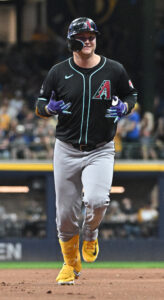
Given that he’s provided superstar-caliber offense on the cheap to multiple teams in recent years, it may seem somewhat surprising for Pederson to wind up with yet another relatively short-term deal that guarantees him less than $20MM per year. That discrepancy is primarily due to Pederson’s extremely limited profile. While he’s a phenomenal hitter who rakes against right-handed pitching, his profile features a massive platoon split and he’s typically been at his best throughout his career when he sits against same-handed pitching as much as possible. He’s a career .210/.300/.330 (78 wRC+) hitter against left-handed pitching and even in the past three seasons has floated a pedestrian 104 wRC+ against southpaws.
Perhaps that on its own wouldn’t be enough to stop Pederson from getting a hefty contract in free agency, but he’s also a poor defender in the outfield who didn’t put on a glove a single time during his year in Arizona after starting just 23 games in the outfield in San Francisco the prior year. His last season as a regular on defense in 2022 saw Pederson struggle to a -11 Outs Above Average figure that landed him near the bottom of the league’s leaderboards. Even with prodigious hitting talent, Pederson’s earning power has been consistently limited on the open market due to relatively minimal upside available in signing a platoon bat who’s increasingly restricted to DH-only duties. With that context, Pederson actually did quite well in landing the deal he got from the Rangers; his $37MM guarantee significantly outpaces the two-year, $24MM pact MLBTR predicted he would land when placing him as the #24 free agent on our Top 50 MLB Free Agents list at the outset of the winter.
For the Rangers, the addition of Pederson offers some much-needed thump to a lineup that finished just 22nd in the majors with a 95 wRC+ last year. That includes utterly abysmal production at DH, where Texas managed just a 65 wRC+ that was second-worst in baseball ahead of only the Reds. The addition of Pederson not only adds another big lefty bat to the Rangers lineup to complement his former Dodgers teammate Corey Seager but also makes up for the loss of Nathaniel Lowe, who the club traded to the Nationals just last night. The additions of Pederson, Kyle Higashioka, and Jake Burger to the club’s lineup in conjunction with better health from youngsters Josh Jung and Evan Carter should give the Rangers a much stronger offense up and down the batting order while allowing the club to lean less heavily on utility man Josh Smith, who was one of the team’s top offensive contributors in the first half but faded to hit just .215/.265/.300 after the All-Star break.
With Pederson now in the fold, RosterResource projects the Rangers for a payroll of just under $217MM for 2025, and that figure jumps up to just over $229MM for luxury tax purposes. That leaves around $11MM left for the club to work with before the first luxury tax threshold, which it was reported earlier this winter that the club hopes to duck under next year. While the rotation was addressed by bringing back Nathan Eovaldi and the lineup appears to be in good shape at the moment, the club still appears to be a piece or two short in the bullpen even after adding Hoby Milner, Jacob Webb, and Robert Garcia. It’s possible the Rangers could look to follow the example they laid out in the deal that sent Lowe to D.C. in exchange for Garcia and deal a potential trade candidate like Leody Taveras, Dane Dunning, or Jon Gray in a deal that bolsters their relief corps while also freeing up payroll space that could help them land a proven closer such as Kirby Yates or David Robertson, both of whom pitched well for the Rangers in 2024 but elected free agency last month.
Now that Pederson is headed to Texas, a handful of other suitors will need to look elsewhere. The incumbent Diamondbacks reportedly had interest in a reunion with Pederson earlier this month, though it’s possible that the club’s recent trade for Josh Naylor eliminated that need and leaves them in position instead to look for some right-handed thump to replace outgoing first baseman Christian Walker. Meanwhile, the Blue Jays were connected to both Pederson and Naylor in the rumor mill and at this point could be further motivated to land a notable bat such as Anthony Santander or Teoscar Hernandez now that many of the club’s lower-level targets have come off the board.
Evan Grant of the Dallas Morning News was first to report the Rangers and Pederson were discussing a contract. The Athletic’s Ken Rosenthal was first with the agreement. ESPN’s Buster Olney reported the two-year, $37MM guarantee and the opt-out.
Mets Notes: Pederson, Alonso, Third Base, Rotation
The Mets have already added one of the best left-handed hitters in the game this offseason, signing Juan Soto to a 15-year, $765MM deal. However, Jon Heyman of the New York Post suggests they were recently in on another big lefty bat: Joc Pederson. That was, of course, before Pederson agreed to a two-year, $37MM deal with the Rangers early on Monday morning.
Presumably, the Mets were interested in Pederson as a designated hitter. Coming off an excellent 2024 campaign, he would have made a strong replacement for J.D. Martinez. Like Pederson, Martinez became a free agent at the end of the season. If the Mets are still in the market for a DH after losing out on Pederson, their options are somewhat limited. Martinez might be the best true DH left in free agency. They could, of course, pursue an outfielder like Anthony Santander or Teoscar Hernández, but those two are looking for significantly more money than Pederson, and, presumably, they would prefer to continue playing the outfield.
However, if it’s really just another big bat the Mets are looking for, the best solution could also be the most straightforward: re-signing first baseman Pete Alonso. Bob Nightengale of USA Today reported on Sunday that the Mets are still “pushing hard” to re-sign their homegrown slugger. If that’s true, it’s difficult to imagine Alonso ending up anywhere else. Teams like the Yankees and Astros have already filled their holes at first base. And when the Mets set their sights on a target, they’re not easy to outbid.
Nightengale also notes that the Mets “like their internal options” at third base – in other words, he implies they aren’t likely suitors for star third baseman Alex Bregman. However, it’s not clear if that is at all contingent on the team re-signing Alonso. If Alonso is back in Queens next season, Mark Vientos is the obvious candidate to play third base. Vientos was one of the team’s best hitters in 2024, while also providing capable defense at the hot corner. Yet, if Alonso signs elsewhere, Vientos is likely to move across the diamond and take over at first. Simply put, there is a massive difference between Vientos and the next-best option at third base, which seems to be former top prospect and unproven big leaguer Brett Baty. The other internal options include Ronny Mauricio, who spent the entire 2024 season on the IL, and Luisangel Acuña, a second baseman/shortstop who has never played third base professionally. It’s hard to believe the Mets would feel confident going into the season without a more reliable player at third base.
It’s easier to accept the notion that the Mets are done adding to their rotation, which Will Sammon of The Athletic suggests is the case. After agreeing to a three-year, $75MM deal with Sean Manaea, the Mets have now signed three notable free agent starters: Manaea, Frankie Montas, and Clay Holmes. Those three will join Kodai Senga and David Peterson in the rotation, with Paul Blackburn, Griffin Canning, and Tylor Megill offering additional depth. Top prospect Brandon Sproat is another arm who could start for the Mets at some point in 2025.
With Senga and Manaea occupying the top two spots in the rotation, the Mets don’t have a bona fide ace like Zack Wheeler of the Phillies or Chris Sale of the Braves. However, their starting pitching depth looks like it’s going to be an asset. They would surely find room for Roki Sasaki if the NPB superstar chooses to sign in Queens, but otherwise, the Mets seem to have all the starters they can carry to begin the 2025 campaign.