
The Opener: Cardinals, Rays, Veteran Depth Options
Here are three things we’ll be keeping an eye on around baseball today…
1. Cardinals, Cardinals, Cardinals:
There’s no shortage of intrigue around the Cardinals right now — albeit not for reasons the St. Louis faithful would prefer. Lars Nootbaar and Tommy Edman both left last night’s game after injuring themselves on foul balls — Edman fouling one into his leg and Nootbaar fouling one into his groin. The latter was taken to a “non-emergency medical facility” for further exams, per Derrick Goold of the St. Louis Post-Dispatch. The Cards will have updates on both today, but with that pair ailing and Nolan Gorman now having missed three games due to ongoing back discomfort, the Cards could be shorthanded and forced into some kind of roster move.
Elsewhere on the roster, tonight will be a crucial night for struggling franchise icon Adam Wainwright, who has limped to an 8.78 ERA in 66 2/3 innings during what will be the final season of his big league career. Wainwright is two wins away from becoming just the 122nd player to ever reach 200 wins … but he’s allowed 38 runs in 23 innings since his last victory, exactly two months ago to the day. Wainwright tells Benjamin Hochman of the Post-Dispatch that he has no plans to quit and plans to see the season through. Manager Oli Marmol acknowledged Wainwright’s struggles, telling Hochman that in the event of another non-competitive outing, “we’ll sit down and we’ll have another honest conversation as to what does this really looks like moving forward and what’s best.”
2. Kittredge set to return to Rays:
When the Rays next take the field on Friday, they’ll likely do so with right-hander Andrew Kittredge in their bullpen for the first time since June 8, 2022. Kittredge, who underwent Tommy John surgery last summer, has wrapped up his rehab process and is expected to be activated from the 60-day injured list prior to tomorrow’s game, Marc Topkin of the Tampa Bay Times writes. Righty Hector Perez, who was selected to the big league roster yesterday and subsequently allowed four of the five batters he faced to reach base, seems to be a likely corresponding move.
Getting Kittredge back is nothing short of a boon to a Tampa Bay pitching staff that has been ravaged by injuries. While he’s not going to step into the rotation to help offset the crushing losses of Shane McClanahan, Drew Rasmussen and Jeffrey Springs, Kittredge was a quietly elite bullpen option from 2020-22 before his injury. In his past 99 2/3 big league frames, he’s notched a 2.17 ERA with a 24.2% strikeout rate, 4.9% walk rate and 51.9% ground-ball rate.
3. More veterans hit the market:
As August has worn on, we’ve seen several notable names jettisoned from Major League rosters by way of DFA. With no trades of Major League players allowed, any player designated for assignment at this point can only be placed on outright or release waivers, instantly making him available to all 29 other teams. Yesterday’s DFAs of Ryan Thompson (Rays) and Luke Weaver (Reds) add another pair of potential depth options for teams, joining earlier DFA casualties like Mychal Givens and the since-released Carson Kelly and Chasen Shreve. (Givens, as of this morning, had not yet passed through waivers but will likely clear, given his $5MM salary and injury-plagued season.) Both Thompson and Weaver are affordable enough — earning $1MM and $2MM this season, respectively — that it’s not completely out of the question that a team would claim them, though that appears unlikely in the latter’s case, given the extent of his struggles. Even if Givens, Thompson and Weaver all become free agents, they’ll stand out as immediate depth options for teams dealing with injuries in the bullpen or (in Weaver’s case) the rotation.
There are also a handful of notable veterans who’ve been released from minor league deals recently, including catcher Kevin Plawecki, lefty Fernando Abad, right-hander Dan Altavilla and designated hitter/outfielder Franmil Reyes. Royals righty Nick Wittgren, meanwhile, is likely to elect free agency today.
Marcus Stroman Diagnosed With Rib Cartilage Fracture
Cubs right-hander Marcus Stroman was supposed to make his return from a hip injury today, but the 32-year-old righty experienced some soreness in his rib cage that caused the Cubs to delay his return. They’ve received unwelcome news after Stroman underwent testing, announcing to reporters that he’s now been diagnosed with a right rib cartilage fracture (Twitter link via Maddie Lee of the Chicago Sun-Times). There’s no timetable for his return at this point.
Although the next steps and the timeline for Stroman’s return are uncertain at this point, it’s unquestionably bad news for the Cubs. Stroman’s made 23 starts this year, allowing 3.85 earned runs per nine innings. He was even better earlier in the year, as he had an ERA of just 2.28 through June 20. With the Cubs floundering in the standings at that time, he was often floated as a potential candidate for a deadline trade.
But he then allowed 30 earned runs in his next 30 innings before landing on the injured list in early August due to right hip inflammation. That dip in Stroman’s health and performance coincided with the club getting hot and surging up in the standings. They ultimately held onto trade chips like Stroman and Cody Bellinger, as well as adding new players such as Jeimer Candelario. They are currently 61-58 and just a game out of a Wild Card spot.
They have been getting by without Stroman for a couple of weeks and will have to continue to do so. Four spots in the rotation have been taken by Justin Steele, Kyle Hendricks, Javier Assad and Jameson Taillon of late. With Stroman’s expected return this week, Drew Smyly was moved to the bullpen, tossing an inning of relief against the Blue Jays on the weekend. It seems he might get another shot at a starting gig, with manager David Ross telling reporters such as Sahadev Sharma of The Athletic that Smyly will likely get back in the mix.
Smyly’s season has been fairly similar to Stroman’s, as he had a 3.38 ERA through his start on June 19 but allowed 35 earned runs in his next 35 innings before getting bumped to the ‘pem, inflating his ERA for the year to 5.01. Hayden Wesneski could be another option but he has a 5.51 ERA as a starter this year. They have other options on the 40-man such as Ben Brown or Caleb Kilian, but the former hasn’t made his major league debut and is walking 14.3% of Triple-A hitters this year while the latter has a 12.42 ERA in his limited big league work.
For the time being, it seems there are some moving parts here, with Stroman’s health and Smyly’s performance being two key factors to watch in the weeks to come. For Stroman personally, he’s facing an opt-out decision in the months to come, as he can walk away from the final season of his three-year deal and leave $21MM on the table.
Not too long ago, it seemed like a slam dunk that he would return to the open market, though that’s less certain now. He would likely still be able to top that figure on another deal even with this injury-marred second half, but it’s obviously a lesser platform than if he had stayed healthy and effective into October.
Cody Bellinger’s Resurgent Season
For much of the 2023 season, it’s looked as though the number of impact bats on the upcoming free agent market would be — well… minimal. Shohei Ohtani looms large over both the starting pitching and position player markets, and there’s no real consolation prize for the teams that miss out on him. Matt Chapman has been the top-ranked non-Ohtani position player on the prior installments of MLBTR’s Free Agent Power Rankings — a new version of which will be coming out in the coming weeks — but after a blistering start to the season he’s now been a roughly average hitter for the past three-plus months. He’ll still get himself a hefty contract, thanks to the composite above-average offense and plus defense, but he no longer looks like the second-best name among position players this winter.
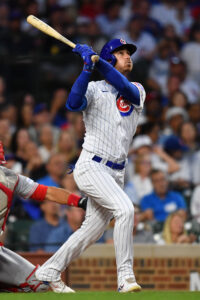
That distinction likely falls on Cody Bellinger, whose one-year deal with has proven to be a jackpot for both him and the Cubs. The $17.5MM that Chicago guaranteed to Bellinger now looks like an unmitigated bargain by today’s market standards, and Bellinger is in prime position to trounce that this winter, provided he can remain healthy.
That’s far from a given for a player who had shoulder surgery in Nov. 2020 and has been on the injured list four times since — including a month-long absence due to a knee injury earlier this year. But, Bellinger played in all but 10 of the Dodgers’ 384 games from 2018-20 and appeared in 144 games as recently as last season. Outside of that offseason shoulder procedure, most of his injuries have been relatively minor in nature.
What hasn’t been minor is the manner in which Bellinger has rebounded at the plate this season. Bellinger debuted as a 21-year-old back in 2017 and almost immediately established himself as an MVP-caliber talent. From 2017-19, he slashed .278/.368/.559, originally playing plus defense at first base before moving to the outfield in 2019 without missing a beat. Bellinger won NL Rookie of the Year in ’17 and was crowned the league’s MVP two years later — while also winning a Gold Glove in the outfield and a Silver Slugger.
As virtually any fan knows by now, the sky seemed like the limit but clearly was not. Bellinger was an above-average but far from elite hitter during the truncated 2020 season, batting .239/.333/.455 in 243 plate appearances. That good-not-great production continued into the postseason (.212/.316/.455, four home runs), but the bigger story of Bellinger’s playoffs was the aforementioned shoulder. The then-reigning NL MVP clubbed a pivotal home run in Game 7 of the NLCS against the Braves but regrettably dislocated the shoulder while celebrating that blast with teammate Enrique Hernandez. Bellinger went 3-for-22 in the World Series — one of those three hits being another homer — and required surgery a month later.
The next two seasons were a mess. Not only were Bellinger’s days as an MVP candidate a distant memory — it was a legitimately fair question whether he was even a viable big leaguer for much of the 2021-22 seasons. In that time, Bellinger tallied exactly 900 plate appearances and turned in an awful .193/.256/.355 slash line. He still played terrific defense, particularly in 2022, and he popped 19 home runs with 14 stolen bases during the 2022 season. The Dodgers still non-tendered Bellinger, and the Cubs outbid the field with that $17.5MM guarantee — a pricey roll of the dice on a player who’d been 31% worse than league average at the plate in the two prior seasons (by measure of wRC+).
Just as Bellinger’s days as an elite hitter quickly faded from memory in 2021-22, the struggles he endured during those two years now feel like they’re squarely in the rearview mirror. Bellinger had a brief slump when he was first activated from the injured list in mid-June, but he’s been on fire for most of the summer since his return. In 371 trips to the plate entering play Wednesday, the two-time All-Star is hitting .325/.377/.551. He’s belted 18 home runs to go along with 19 doubles, a triple and 17 steals (in 20 tries). He’s posted average or better marks in center field this season and even looked sharp in a brief return to first base (176 innings).
Perhaps most encouraging is the fact that Bellinger’s hit tool seems to be back to peak levels. Strikeouts were an issue in his rookie season (26.6%), but Bellinger pared that number all the way down to 16.4% during his MVP year in 2019. Following his surgery, Bellinger’s strikeout rate ballooned back to 27.1% in 2021-22. He also saw a massive spike in his chase rate on pitches off the plate (26.8% in 2019; 34.8% in 2021-22), while his overall contact rate dropped from 78.1% to 74.6%.
This year, Bellinger has punched out in just 15.4% of his plate appearances — the lowest mark of his career by a full percentage point. He’s enjoying career-best contact rates both on pitches in the strike zone (86.3%) and on pitches he chases off the plate (73.8%), leading to a career-high 81.4% overall contact rate.
While the improved contact skills and increased selectivity are unequivocally positive signs, there are some red flags that make Bellinger’s rebound appear a bit more tenuous. When he was at his best, Bellinger was a hard-contact machine, barreling the ball at an elite rate and ranking among the league leaders in batted balls at 95 mph or greater. In 2023, however, Bellinger’s 87.2 mph average exit velocity is nearly four miles per hour slower than his 91.1 mph average from 2019. This year’s 31.2% hard-hit rate is nowhere near his peak 45.6%, and his 6.4% rate of barreled balls (as defined by Statcast) sits at about half his best 12.6%.
That’s not to say Bellinger is a bad hitter or is likely to regress to his dismal 2021-22 levels of performance. His massive gains in contact and subsequent dip in strikeouts lend plenty of legitimacy to his rebound. The greater question is to what extent he can sustain this level of production with a quality-of-contact profile that’s actually below the league averages (89.1 mph exit velocity, 8.1% barrel rate, 39.3% hard-hit rate).
Statcast’s “expected” metrics are far from an exact science, but Bellinger still sits on the second-largest gap of all qualified hitters in terms of his actual batting average (.325) and expected batting average (.271). The gap between his .551 slugging percentage and expected .447 slugging percentage is the fifth-largest in baseball. Some fans may scoff at the mention of “expected” metrics, but they’ll surely factor into teams’ valuation of Bellinger over the winter (though most clubs have their own proprietary versions of such metrics which might differ from Statcast to varying extents). That said, even those expected ratios paint Bellinger as a clearly above-average hitter — roughly in line with what teammates Dansby Swanson and Ian Happ have produced this season. And, given Bellinger’s past displays of plus power, there’s quite a bit more upside in his bat than either of those comparisons.
As with any free agent, there are more factors to consider than Bellinger’s bat alone. He’s played first base and center field at above-average levels this season and is obviously an option in either outfield corner as well. Couple that versatility with the fact that he can hit lefties and righties at above-average rates — he’s hitting lefties better in ’23 but has been better against righties in his career — and Bellinger allows any manager some flexibility when writing out a lineup card. This year’s average sprint speed of 28.3 ft/sec is down a bit from his peak 28.9 ft/sec from 2017-19, but it’s still well above the league average (77th percentile). Bellinger uses that speed quite efficiently, too; he’s been successful in 82.2% of his career stolen-base attempts and 85% in 2023.
Perhaps most of all in Bellinger’s case, market scarcity will work in his favor. As previously mentioned, beyond Ohtani, there aren’t many hitters of note to pursue this winter. Chapman’s bat has cooled since his blistering start. Teoscar Hernandez entered the year positioned as one of the top free agents on the market but has batted just .250/.297/.423 — the worst full-season performance of his career. Jorge Soler and J.D. Martinez are having strong rebound seasons but are DH-only options. Jeimer Candelario is enjoying a rebound campaign of his own but has nowhere near Bellinger’s track record.
In terms of competition at his position, Bellinger will be going up against oft-injured defensive standouts Kevin Kiermaier and Harrison Bader. Both players are clear alternatives for teams seeking an everyday center fielder, though that’s due more to world-class defense than their offensive aptitude. Neither is as complete a player as Bellinger has been, and Bader has been on the IL three times this year while Kiermaier hasn’t reached 500 plate appearances in a season since 2015 (his only year ever reaching that level).
Perhaps most important of all will be age. Bellinger just turned 28 last month. He won’t turn 29 until next year’s All-Star break. Any team signing Bellinger would be paying up for more of his peak than the usual free agent has to market. Even an eight-year contract would run through Bellinger’s age-35 season. Given his age and the extent of his bounceback this year, it seems likely that he and agent Scott Boras will seek at least one opt-out opportunity in any long-term deal. He’ll surely reject a qualifying offer at season’s end, and while that won’t do his free agency any favors, the QO typically hasn’t been too great an encumbrance on the market’s very top-tier free agents.
No one is going to unseat Ohtani as the most coveted free agent of the upcoming class, but Bellinger increasingly looks like he could be viewed as the next-best position player on the market. His bet on himself has paid off in spades, and as long as he doesn’t completely collapse in the final six-plus weeks of the season, I imagine he’ll hit the market looking to top recent deals signed by George Springer (six years, $150MM), Brandon Nimmo (eight years, $162MM) and Kris Bryant (seven years, $182MM). Whether someone actually approaches or even exceeds $200MM for a player who struggled so substantially from 2021-22 and has a somewhat spotty batted-ball profile in his rebound season remains to be seen. But the mere fact that it’s even worth considering speaks to the magnitude of his rebound campaign at Wrigley.
Mets Designate Edwin Uceta For Assignment
The Mets announced Wednesday that right-hander Edwin Uceta has been designated for assignment in order to open a spot on the 40-man roster for fellow righty Dennis Santana, whose contract has been selected from Triple-A Syracuse. Right-hander Jose Butto was optioned to Syracuse in a corresponding 26-man roster move.
Uceta, 25, was a waiver claim out of the Pirates organization back in April. He’s missed substantial time this season after undergoing surgery to address a torn meniscus in his left knee — a June procedure that sidelined him for eight weeks. The Mets only recently reinstated him from the 60-day injured list. He’s pitched three shutout frames at the big league level this season and another 7 2/3 innings of one-run ball in the minors. That said, Uceta has also walked six hitters against just two strikeouts in the minors, and he issued a pair of free passes while facing a total of 11 big league hitters earlier this season.
Command has been an issue for Uceta throughout the upper minors (13.4% walk rate in 83 1/3 Triple-A innings) and in the Majors (11.9%). Broadly speaking, he’s shown good ability to spin his four-seamer and to miss bats in the upper minors, but he hasn’t yet found much success above the Double-A level. Uceta has a 4.64 ERA in 83 1/3 innings at the Triple-A level and a 5.80 mark in 40 1/3 frames between the Dodgers, D-backs and Mets in the big leagues.
The 27-year-old Santana has had better, albeit still below-average results in the Majors, working to a 5.18 ERA in 147 2/3 innings between the Dodgers, Rangers and Mets. He tossed 8 2/3 innings for the Mets earlier this season, yielding six runs in that time before being designated for assignment and passed through outright waivers. Since heading to Triple-A, he’s logged 33 innings with a 4.91 ERA, 27% strikeout rate and 13.2% walk rate. Command has been an issue for Santana as well, but he throws harder than Uceta and keeps the ball on the ground far more often.
The Mets have only gotten 6 2/3 innings out of their starters over the past two games, so swapping out Butto for Santana — at the expense of Uceta’s 40-man spot — will give manager Buck Showalter a fresh arm in the event of another short start in the next couple games. Uceta will be placed on waivers or released within the next week. He’s never been outrighted in the past and doesn’t have three years of service time, so if he goes unclaimed the Mets can retain him via outright assignment.
Rangers Release Kevin Plawecki
The Rangers have released veteran catcher Kevin Plawecki from their Triple-A affiliate, per the transaction log at MiLB.com. He’ll head back to the market and perhaps latch on with a new organization seeking catching depth in advance of the Sept. 1 deadline for postseason eligibility.
Texas originally acquired Plawecki, 32, from the Padres in exchange for cash on July 28. It was a logical depth addition at the time, as Jonah Heim had just hit the injured list with a wrist strain that might have required surgery. Heim has since returned from the injured list, however, and Texas further bolstered its catching depth just days after adding Plawecki. Defensive standout Austin Hedges was acquired from the Pirates and was already on the 40-man roster. With Heim healthy enough to play and Hedges joining him and Mitch Garver as catching options on the big league roster (plus prospect Sam Huff in Triple-A), there’s no clear path to the big leagues for Plawecki.
Plawecki only appeared in 10 games with Triple-A Round Rock but hit well, batting .294/.400/.325 in 40 trips to the plate. He’s also spent time with the Triple-A affiliates for the Nats and Padres in 2023, batting a combined .272/.349/.389 in 269 trips to the plate. He’s yet to appear in the Majors this season after logging at least 24 games in each of the past eight big league seasons.
Selected by the Mets with the 35th overall pick in the 2012 draft, Plawecki is a career .235/.313/.341 hitter in 1426 plate appearances. He’s operated mostly as a backup in the big leagues, never topping 277 plate appearances in a given season. Plawecki has never excelled at controlling the running game (career 19% caught-stealing rate) but has drawn above-average marks for his framing and pitch blocking, per Statcast.
Athletics’ JJ Bleday Diagnosed With ACL Sprain
The A’s placed outfielder JJ Bleday on the 10-day injured list with a left knee sprain last night, and manager Mark Kotsay further specified to reporters that an MRI revealed a sprain in Bleday’s anterior cruciate ligament (Twitter link via Martin Gallegos of MLB.com). A return this season is not certain.
On the one hand, the fact that Bleday isn’t headed straight for surgery, as is common with ACL injuries, is a relative silver lining. Any sprain involves some degree of stretching and/or tearing in the ligament, by definition. In that sense, it’s perhaps fortunate that Bleday escaped a more dire injury. On the other hand, even a lower-grade sprain that can be treated without resorting to surgery is still an injury of note, as evidenced by the team’s uncertainty about a return in the next six-plus weeks.
Bleday, 25, was the fourth overall pick in the 2019 draft, going to the Marlins after a strong college career at Vanderbilt. The A’s acquired him in an offseason swap of former top-10 picks that had yet to fully live up to their draft and prospect pedigree, sending lefty A.J. Puk to Miami in return. Bleday came to Oakland with six full years of team control remaining, whereas Puk already had two years of MLB service and was on the cusp of reaching arbitration.
A consensus top-10 talent in that year’s draft class — ranking within the top five on multiple pre-draft rankings — Bleday demolished NCAA pitching with a .347/.465/.701 batting line and 27 home runs in 347 plate appearances during his final season with the Commodores. Outside of a 2021 stint in the Arizona Fall League, however, he’d never come close to that type of production in the professional ranks. Bleday hit .257/.311/.379 in High-A following the draft, didn’t play in 2020 due to the canceled minor league season, and posted a .212/.323/.373 slash in Double-A back in 2021.
Bleday began drawing walks at a massive 16.3% clip and showing off his plus raw power with Miami’s Triple-A affiliate in 2022, but he did so while hitting .228 with a concerning 27% strikeout rate. Last season’s big league debut saw him post just a .167/.277/.309 slash, and the Marlins flipped him to Oakland in hopes of strengthening their bullpen.
Bleday’s first season with the A’s has been a bit more encouraging than his rocky debut with the Fish. This year’s .316/.429/.643 line in 119 Triple-A plate appearances is easily his best minor league production to date, and he more importantly dropped his Triple-A strikeout rate from 27% all the way down to 12.6%. The improved approach carried over to the Majors, to an extent. Bleday lopped five percentage points off his big league strikeout rate (23.2%) while narrowly improving his walk rate from 12.6% to 13.4%. He also upped his power output, his average exit velocity and his hard-hit rate. That said, his .203/.313/.373 slash still falls well shy of what the A’s had hoped to acquire when trading for him.
Even though he hasn’t exactly established himself as a clear big leaguer yet, Bleday should have ample opportunity to do so in 2024. Oakland already parted ways with Ramon Laureano, designating him for assignment and watching Cleveland claim him on waivers. Tony Kemp has logged the most time of any A’s player in left field this year, but he’ll be a free agent at season’s end. Seth Brown has seen plenty of action between both outfield corners, but he’ll be a trade or non-tender candidate in the offseason after an ugly first half — he’s hitting well since the All-Star break — and with an arbitration raise looming. Brent Rooker has faded since his hot start to the season (.200/.272/349 since mid-May) and has spent more time at DH than in the outfield corners this year anyhow.
Given Bleday’s Triple-A performance this season and the improvements in his approach at the plate and power production, it stands to reason that he’ll be in the mix for a corner outfield job next spring. He’ll also have two minor league option years remaining beyond the current campaign, so the A’s can easily get him more work in Triple-A if he doesn’t grab a starting job out of the gate next year.
The Opener: Bichette, Anderson, Dodgers
Here are three things around the baseball world we’ll be tracking today…
1. Bichette return looming?
Blue Jays shortstop Bo Bichette was slated to begin a minor league rehab assignment with Triple-A Buffalo last night, slotting in as the designated hitter, but that contest was rained out. TSN’s Scott Mitchell tweets that the plan had been for Bichette to DH on Tuesday and play shortstop Wednesday, with a Friday return in Cincinnati possible. The Jays are off tomorrow, while their Triple-A club now has games scheduled both today and tomorrow. Bichette could still DH today, play shortstop tomorrow, and technically return as soon as Friday. The Jays will evaluate Bichette following today’s DH appearance but still hope to get him into a game at shortstop before reinstating him, per Mitchell. The 25-year-old Bichette is enjoying an excellent season at the plate, hitting .321/.352/.494 with 17 home runs, but he’s been out since July 31 due to patellar tendinitis in his right knee.
2. Anderson’s suspension appeal:
White Sox shortstop Tim Anderson is facing a six-game suspension following the benches-clearing brawl that began when Anderson and Guardians third baseman Jose Ramirez got into a fist fight following the latter’s slide into second base. Jim Bowden of The Athletic tweets that Anderson’s appeal is scheduled for tomorrow, barring a settlement at some point today. Within the next day then, we should know whether Anderson will serve that full six-game ban or perhaps a reduced punishment. The two-time All-Star and 2019 AL batting champion is having the worst season of his career at the plate (.240/.285/.286), although in 103 plate appearances since the All-Star break he’s posted a .290/.359/.355 batting line.
3. Dodgers going for 10 in a row:
Earlier this season, it looked as though the Dodgers might be dethroned in the NL West, but their recent play has once again made them a commanding favorite to win their 10th division title 11 years. They’ll send Clayton Kershaw to the mound tonight against the Brewers as they seek their 10th straight victory — the longest active win streak in Major League Baseball at the moment. Kershaw, 35, will be making just his second start since returning from a six-week stay on the injured list. He’s been his usual dominant self when healthy, pitching to a 2.51 ERA with a 27.5% strikeout rate and 6% walk rate in 100 1/3 innings this season. Kershaw currently ranks fourth among active pitchers in strikeouts with 2916 in his career. He trails only Max Scherzer (3340), Justin Verlander (3290) and Zack Greinke (2955) in that regard. Depending on how long Greinke’s recent placement on the IL lasts, Kershaw could move into third place on that esteemed ranking by season’s end.
Dodgers Select Gus Varland
August 15: The Dodgers have now officially selected Varland to the roster. The corresponding move is outfielder Jake Marisnick getting transferred to the 60-day injured list. He’s been on the 10-day IL since July 19 due to a left hamstring strain, which will seemingly keep him out of action until at least mid-September.
August 14: The Dodgers are planning to select the contract of right-hander Gus Varland from Triple-A Oklahoma City, reports Jack Harris of the Los Angeles Times (via Twitter). They’ll need to make a corresponding roster move.
It’ll be the Dodger debut for Varland, but not the right-hander’s big league debut. That came earlier this season with the Brewers, who selected Varland from the Dodgers in last December’s Rule 5 Draft. Varland made Milwaukee’s Opening Day roster after a huge spring showing and, through his first eight innings, held opponents to a pair of earned runs — albeit on nine hits with as many walks (five) as strikeouts. In what proved to be his last appearance with the Brewers, Varland was rocked for nine runs in just two-third of an inning against the Cardinals on May 15. Milwaukee designated him for assignment the next day.
Varland cleared waivers, was returned to the Dodgers organization, and has been excellent in Triple-A since. The 26-year-old has pitched 33 1/3 innings, working to a pristine 2.16 earned run average with a 29.3% strikeout rate, a 6% walk rate, a 42.4% grounder rate and just 0.54 HR/9. It’s strong production on the whole, but Varland has been even better after a shaky start in his return to the Dodgers organization; since June 9, the right-hander has a 1.42 ERA in 25 1/3 innings.
The promotion for Varland comes on the heels of right-hander Joe Kelly‘s placement on the 15-day injured list. Kelly, acquired from the White Sox alongside Lance Lynn, has tossed 3 2/3 shutout innings since being acquired. His IL placement was relative to Aug. 10. Kelly is the ninth right-handed reliever on the Dodgers’ injured list at the moment, joining Yency Almonte, Tyler Cyr, J.P. Feyereisen, Daniel Hudson, Shelby Miller, Jimmy Nelson, Alex Reyes and Blake Treinen. Los Angeles didn’t have another healthy right-handed reliever on the 40-man roster — barring a short-term move to relief for Gavin Stone, Emmet Sheehan or Ryan Pepiot, all of whom are in Triple-A at the moment — so they’ll give Varland his first look and hope he can continue the pace he’s set since returning from the Brewers.
MLBTR Chat Transcript
Click here to read a transcript of Tuesday’s chat with MLBTR’s Steve Adams.
Rangers Sign Josh Harrison To Minor League Contract
The Rangers have signed veteran utilityman Josh Harrison to a minor league contract, per an announcement from his agents at MSM Sports. He’ll head to Triple-A Round Rock and primarily work as a third baseman and second baseman there.
Harrison, a veteran of 13 big league seasons, opened the year in Philadelphia but was designated for assignment and released earlier this month after batting .204/.263/.291 in 114 plate appearances. It was a rough showing, to be sure, but it also came in a relatively small sample. In the three seasons prior, Harrison combined for a .270/.332/.390 batting line over the life of 1074 plate appearances between the Nats, A’s and White Sox. That 2020-22 production falls neatly in line with Harrison’s career .270/.316/.396 batting line in 4347 trips to the plate.
Now 36 years old, Harrison is a two-time All-Star who’s well versed at a number of spots on the diamond. Second base has been his most frequent position (5081 big league innings), but he’s also spent ample time at third base (2331 innings), in right field (493 innings), in left field (487 innings) and at shortstop (265 innings) in addition to brief cameos at first base and in center field. Defensive metrics have generally viewed his glovework at second base and the hot corner quite favorably.
Harrison isn’t likely to suddenly recapture his peak form — he hit .315/.347/.390 back in 2014 — but he’s a capable, versatile defender who still makes contact at an above-average rate. The Rangers recently lost Rookie of the Year candidate Josh Jung to thumb surgery that puts the remainder his season in jeopardy, and while fellow youngster Ezequiel Duran gives them a quality substitute, Harrison can provide additional depth in the event of further injuries on the big league roster.
The Phillies are on the hook for what’s left of Harrison’s $2MM salary anyhow, so the Rangers would only owe him the prorated league minimum for any time spent on the big league roster. If the Rangers want to add a veteran for the final month of the season, they can select Harrison to the big league roster on Sept. 1, when rosters expand from 26 to 28 players. Because he’s joining the organization before Sept. 1, he’d be postseason-eligible as well — if he performs well enough in his new environs to warrant such consideration.