
Latest On Royals’ Outfield Outlook
Yesterday’s acquisition of Drew Waters gives the Royals a potential near-term option to evaluate in the outfield, and general manager J.J. Picollo spoke highly of Waters’ future when chatting with the Kansas City beat in the wake of the trade (link via Lynn Worthy of the Kansas City Star). Picollo called Waters a “plus defender” and a “true center fielder,” praising the switch-hitter’s speed and overall upside — even with Waters “still refining some skills” at the plate.
That’s a rather favorable characterization of a player who’s whiffed in 27.1% of his plate appearances during his third season at the Triple-A level, although to Waters’ credit, that strikeout rate is down considerably from his 36.1% mark in Triple-A in 2019 and from last year’s 30.9% pace. Struggles in the upper minors notwithstanding, Waters is still just 23 years old, has long been graded as a plus runner and potential asset in the outfield grass, and isn’t too far removed from a monster 2019 showing in Double-A. There’s plenty of reason to be optimistic about Waters as a player, even if his prospect star has dimmed in recent years.
The broader-reaching question for Royals fans — and for fans of teams seeking outfield upgrades around the league — is just what this trade will mean for the Royals’ outfield moving forward. The Waters acquisition isn’t likely to have much of a bearing on Andrew Benintendi‘s future; as a productive and affordable free-agent-to-be on a last-place team, Benintendi was one of the likeliest trade candidates in all of baseball with or without Waters around. (We ranked him No. 2 on last week’s Top 50 trade candidate list.)
As MLBTR’s Darragh McDonald explored last month, however, Benintendi isn’t the only trade candidate in the Royals’ outfield. Center fielder Michael A. Taylor is having the finest season of his big league career, and he’s playing on an affordable two-year, $9MM contract. That makes it tempting for the Royals to keep him around into 2023, but Taylor’s greatest asset is his glove in center, and Picollo made clear the Royals view Waters as a plus option in center as well. There’s plenty of room for both Waters and Taylor to slot into the same outfield — especially assuming an eventual Benintendi deal — but it’s still of some note that the Royals would seemingly feel confident that Waters could step into Taylor’s shoes in the event of a trade, at least from a defensive standpoint.
Taylor has indeed drawn interest from other clubs, with MLB.com’s Jon Morosi tweeting last night that the Yankees are among those who’ve considered him in their search for outfield upgrades. Taylor, hitting .264/.340/.385 and once again playing Gold Glove-caliber defense in center, would immediately become the best defensive outfielder on the Yankees’ roster (or on the roster of the majority of MLB teams). New York has been playing Aaron Judge in center field more than ever before, but Taylor could conceivably push Judge back to right field if and when the Yankees inevitably move on from Joey Gallo.
The Yankees are also known to be interested in Benintendi, and Kristie Ackert of the New York Daily News reported Sunday evening that the two sides have had “ongoing” talks regarding Benintendi for the past couple weeks. The asking price is believed to be high at present, Ackert adds. While the Yankees have now been linked to a pair of Kansas City outfielders, the Royals will surely receive interest in both Benintendi and Taylor from other clubs, just as New York will explore outfield options with other teams.
Further trades from the Royals aren’t necessarily a given. Picollo suggested that the team does not “feel the extreme need that we have to move any players,” though it’d be surprising if Benintendi, at the very least, didn’t change hands over the next three weeks. However, even if the Royals stand completely pat the rest of the way, Waters should get an earnest look in the big leagues before long, particularly with Kyle Isbel struggling and Edward Olivares only playing a limited role this year.
Matt Moore’s Bullpen Rebound
To call Matt Moore‘s career a roller coaster would be to undersell the peaks and valleys that have proliferated his time in professional baseball. An eighth-round pick by the Rays back in 2007, Moore skyrocketed through the minors (relative to most high school arms), debuting in a September playoff push in 2011. The second start of Moore’s career was a scoreless, seven-inning ALDS gem against the same club for which he now pitches back in that 2011 season. In the 2011-12 offseason, MLB.com and Baseball Prospectus ranked Moore as the game’s No. 1 prospect — ahead of a pair of outfield prospects by the name of Mike Trout and Bryce Harper. Baseball America ranked him second — behind Harper and ahead of Trout.
Early in his career, Moore largely delivered on those lofty prospect rankings. He wasn’t an immediate Cy Young favorite but nevertheless pitched to a 3.53 ERA over the course of his first 347 big league innings. Moore struck out 22.8% of his opponents during that span — a below-average mark in today’s game but well above the league-average of 19.4% from 2011-13. Moore made the All-Star team in 2013, pitched to a 3.29 ERA over 27 starts, and grabbed a few down-ballot Cy Young votes, finishing ninth.
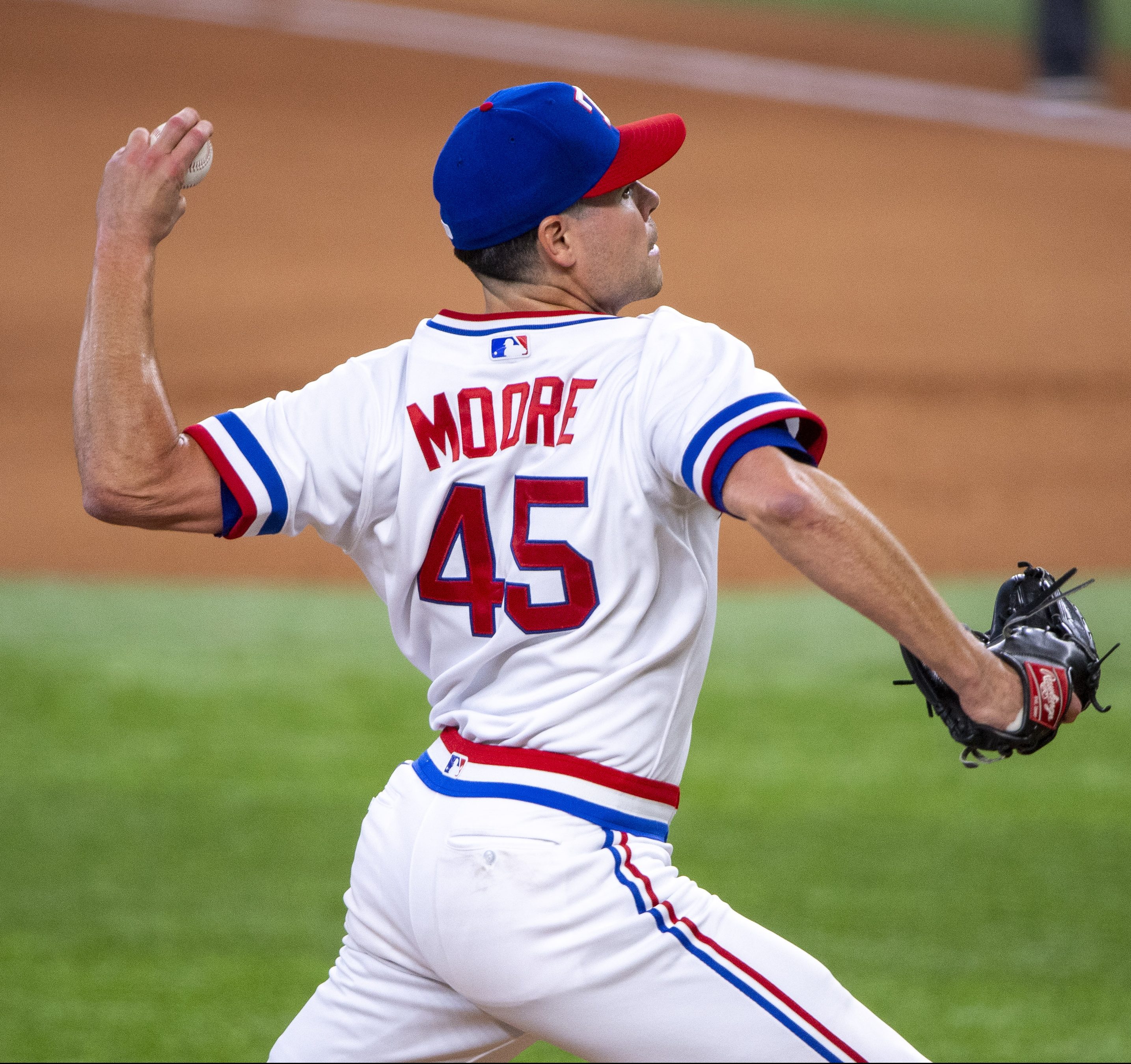
Tommy John surgery early in the 2014 season, however, would wipe out the majority of Moore’s 2014-15 campaigns. He made just two starts in 2014 before hitting the injured list due to ligament damage in his pitching elbow, and Moore was limited to 12 mostly ugly starts upon returning in 2015. His fastball, which averaged 96 mph in his electric rookie showing, averaged 92.7 mph over those dozen appearances.
Moore briefly looked to be back on track in 2016. Traded from Tampa Bay to San Francisco in July, he posted an identical 4.08 ERA with both teams en route to 198 1/3 innings. At the very least, he looked like a league-average starter, but Moore unraveled with the Giants in 2017 (5.52 ERA in 31 starts) and posted an ERA just under 7.00 in 102 innings with the 2018 Rangers. He made just two starts for the 2019 Tigers before sustaining a season-ending knee injury while fielding a ground-ball. Moore parlayed a strong 2020 showing with Japan’s SoftBank Hawks into a big league deal with the Phillies heading into the 2021 season, but he logged a 6.29 ERA in 73 innings last season in Philly.
Unsurprisingly, given that tumultuous run from 2017-21, Moore settled on a minor league deal this past winter — returning for a second stint with the Rangers. So far, it’s proven to be one of the best minor league fliers any team took over the winter.
This marks the first time in Moore’s career that he’s been used exclusively as a reliever, and the results been excellent. He’s sporting a 1.88 ERA with a strong 26.6% strikeout rate, a career-best 54.9% ground-ball rate and a 94.4 mph average fastball velocity that represents his highest level since his pre-Tommy John days in 2012.
Moore is throwing that heater at a career-low 42.3% mark so far in 2022. As we’ve seen so often with pitchers — particularly when they move to short-relief stints — he’s found success by ramping up the usage of his secondary offerings. Moore’s curveball is actually his primary pitch so far in 2022, as he’s thrown the pitch at a 44.3% clip that is far and away the highest of his career. He’s mixing in his changeup (13.5%), giving him a third pitch that helps keep righties at bay. (Just three of his 86 changeups this year have been thrown to lefties.) Gone is the cutter he threw at a 9% clip from 2014-21. The sinker he featured briefly from 2012-16 has also been scrapped. All three of Moore’s current pitches have been positives, per FanGraphs’ run values.
Moore’s Statcast profile is quite favorable, too, lending some further weight to his bullpen breakout. He’s in the 73rd percentile of big league pitchers in terms of whiff rate and the 79th when it comes to inducing chases off the plate. Moore ranks in the 85th percentile or better in fastball spin rate, barrel rate, hard-hit rate and in each of his “expected” ERA, opponents’ batting average, slugging percentage and wOBA. Put more simply: Moore is missing bats, and when he does allow contact, it’s generally weak.
It’s not all roses, of course. There’s no denying that Moore has still yielded far too many free passes in 2022 (13.9% walk rate), and while he’s begun to slightly scale back the rate at which he issues those walks, no one’s going to claim that he has above-average (or even average) command right now. Moore also hasn’t allowed a home run this season. That’s obviously a good thing — but it’s also a trend that no pitcher is likely to sustain over the course of a full season. Even if the bulk of contact against a pitcher is weak, hitters are generally going to barrel up a mistake and make them pay on occasion.
Few relievers check all the boxes though, and generally those that can sustain plus strikeout rates with plus command and ground-ball tendencies while also limiting hard contact and home runs are among the highest-paid pitchers in the game. Those types of relievers are rarely available at the trade deadline. Moore, however, should be available — and he has the strikeout, ground-ball and weak contact tendencies that teams tend to covet, even if they’re accompanied by at-times spotty command.
Beyond the impressive showing in his first foray into full-time relief work, the southpaw is also eminently affordable. Moore’s minor league deal over the winter came with a $2.5MM base salary. He’ll be a free agent at season’s end, so he’s a pure rental, but he’d only cost his new club about $1.17MM through season’s end as of this writing. That number, of course, will continue to tick downward as the Aug. 2 deadline approaches.
The Rangers find themselves within striking distance of the newly created third Wild Card spot in the American League, and their offseason blockbuster signings of Corey Seager and Marcus Semien were a clear indication that they’re aiming for a return to relevance in the AL West. But teams in this era of baseball are rarely strict buyers or sellers at the deadline. It’s certainly possible for the Rangers to continue exploring deals that might net them controllable big leaguers while also shipping short-term assets like Moore to more clear-cut postseason contenders to stockpile a bit more future value.
If Moore can net a decent prospect — and given how he’s pitched, there’s reason to think he should — trading him while still pursuing controllable, MLB-ready help in the outfield and starting rotation would represent a sensible means of toeing the buyer/seller line for a Rangers club that isn’t quite a surefire contender yet.
Royals Acquire Drew Waters From Braves For Draft Pick
The Royals have made their second deal of the past week, acquiring former top outfield prospect Drew Waters, minor league righty Andrew Hoffmann and minor league corner infielder CJ Alexander from the Braves in exchange for their Competitive Balance draft pick (No. 35 overall). Both teams have announced the trade.
The 15 selections in the two Competitive Balance rounds — Round A ranges from Nos.33-39, Round B from picks 67-74 — are the only picks eligible to be traded each year’s draft and can only be traded once (meaning the Braves cannot subsequently flip the pick to another team). The No. 35 pick that Atlanta is receiving comes with a slot value of $2,202,100, all of which will be added to the Braves’ league-allotted bonus pool of $8,022,200. That’ll bump the Braves from the 19th-largest draft pool to the 10th-largest (barring any additional trades).
The added pick and financial might will give the Braves some extra means of replenishing the farm after surrendering four prospects to acquire Matt Olson this offseason (to say nothing of the handful of trades made at each of the past few deadlines). Between those deals, low draft selections the past few years (due to strong regular-season performances) and the international free-agent penalties incurred by the former front office regime, the once-vaunted Braves farm system has taken a hit.
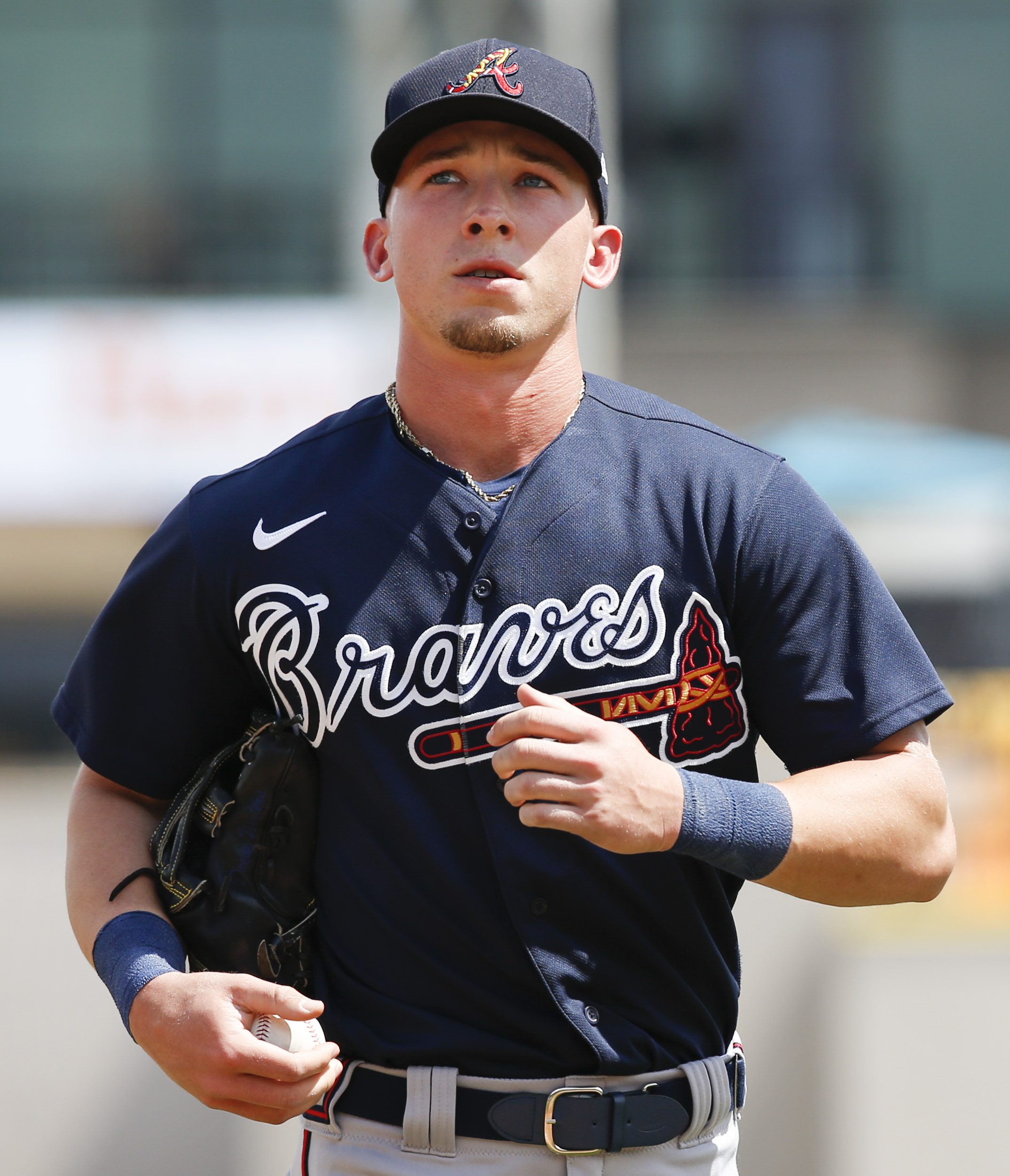
Waters, 23, ranked among the sport’s top-100 prospects from 2019-21 but has seen his stock fall precipitously in recent seasons as he’s struggled against Triple-A pitching. Waters is currently in his third season with Triple-A Gwinnett, but his .246/.305/.393 batting line isn’t an improvement over the pedestrian output he’s recorded there in both 2019 and 2021. Overall, in 788 plate appearances at the Triple-A level, Waters is a .246/.324/.383 hitter. Those struggles are reflected in the fact that the former second-round pick, who was once seen as a key building block for the Braves organization, is now instead part of a three-player package that will net Atlanta a draft pick that’s just six places higher than Waters was selected a half-decade ago.
With Ronald Acuna Jr. and Michael Harris II set to hold down two-thirds of the Atlanta outfield for the future — plus veterans Eddie Rosario, Marcell Ozuna and Guillermo Heredia all signed or controlled beyond the current season, there wasn’t much immediate room for Waters to make an impact on the big league outfield anyhow. Braves fans might be disheartened when thinking about what Waters might’ve fetched in a trade had he been moved a year or two ago, but the team did manage to net some value for the former Futures Game participant.
From the Royals’ vantage point, the long-term outfield picture is far less certain, so there’s good reason to take a chance on getting Waters back on track. Kansas City has been working to put a winning product on the field for the past couple seasons, and while the results haven’t been there yet, Waters provides more immediate potential to help the team than whomever would have been tabbed with that No. 35 overall pick. Waters posted a huge .319/.366/.481 batting line in a pitcher-friendly Double-A setting back in 2019, when he was one of the youngest players in the league. Baseball America and MLB.com both ranked him within the sport’s top 40 overall prospects in consecutive offseasons.
With Andrew Benintendi all but certain to be traded and center fielder Michael A. Taylor a candidate to go as well — he’s signed affordably through 2023 — the Royals will soon have some outfield vacancies. If veteran Whit Merrifield is finally moved at this year’s deadline, that’d represent another subtraction from the outfield corps.
The organizational hope has been that 25-year-old Kyle Isbel can claim a long-term spot in the outfield mix, but he’s currently hitting just .216/.248/.328. Twenty-six-year-old Edward Olivares has performed well in a much more limited role. Generally speaking, though, the Royals are thin on outfield prospects. College pitching has been a focus of their drafts during their recent rebuild, and while they have standout young options at shortstop/third base (Bobby Witt Jr.), catcher (MJ Melendez) and first base/designated hitter (Vinnie Pasquantino, Nick Pratto), there’s no ballyhooed outfielder knocking down the door to the Majors for the Royals at the moment. Waters, clearly, is something of a project, but he’ll give the Royals an immediate option to join that young core if he can indeed benefit from a change of scenery.
Also heading to the Royals are Hoffmann, a 22-year-old righty selected in the 12th round of last summer’s draft, and Alexander, a 25-year-old who’s shown power, speed and concerning on-base struggles while playing against younger competition in Double-A.
Hoffmann ranked 16th among Braves prospects at FanGraphs and 23rd at MLB.com, where scouting reports on the 6’5″ righty peg him as a high-probability back-of-the-rotation piece — a rather notable step forward for a player just a year removed from being selected so late in the draft. So far in 2022, Hoffmann has posted terrific numbers in Class-A, making 15 starts with a 2.36 ERA, 28.4% strikeout rate, 6.6% walk rate and 46.3% ground-ball rate. Hoffmann’s fastball sits in the 91-93 mph range — below-average by today’s standards — and he relies heavily on above-average command to help mitigate the lack of a power primary offering.
Alexander, meanwhile, isn’t as highly regarded — as one would expect for a player who is in his third trip through Double-A despite the fact that he’ll turn 26 this month. A 20th-round pick in 2018, Alexander has dramatically reduced his strikeout rate in 2022, as it’s currently at 21.8% after sitting at 32% in 2019-21. He’s slugged 15 homers and gone 13-for-15 in stolen base attempts through 289 plate appearances this year, but Alexander has also walked at a meager 4.8% rate. Overall, his .258/.294/.465 isn’t particularly exciting, but he gives Kansas City yet another lefty corner infield bat, as he’s capable of playing first base as well.
ESPN’s Jeff Passan first reported the trade (Twitter links).
Pirates Outright Austin Brice
July 11: Brice has cleared waivers and been assigned to Triple-A Indianapolis, per Justice delos Santos of MLB.com. It’s unclear if Brice has accepted the assignment or elected free agency.
July 6: The Pirates have designated right-hander Austin Brice for assignment and optioned lefty Cam Vieaux to Triple-A Indianapolis, per a team announcement. That pair of moves creates space for right-hander Yerry De Los Santos to return from the Covid-related injured list and for newly acquired southpaw Manny Banuelos to be added to the active roster.
Brice spent a couple weeks in the majors, having been selected to the roster in late June. Signed to a minor league deal over the winter, the 30-year-old earned a brief look with a strong showing in Indianapolis. Across 26 2/3 innings, Brice posted a solid 3.04 ERA while striking out a lofty 27.2% of opposing hitters and inducing grounders on more than half the batted balls he allowed. Since adding him to the MLB staff, Pittsburgh has deployed him on only two occasions for low-leverage relief work.
While a limited look, that did mark Brice’s seventh consecutive year stepping onto a major league mound. He’s also played for the Marlins (a pair of separate stints), Reds and Red Sox. He’s typically racked up grounders at a solid clip and sports a fastball in the mid-90s, but he’s generally had issues keeping runs off the board at the highest level. Brice has allowed fewer than four earned runs per nine innings just once in a season, and he owns a 5.16 ERA through 165 2/3 career MLB innings.
The Pirates will presumably try to send Brice through waivers over the coming days. His quality Triple-A numbers may earn him a look from another team, but he is out of minor league option years. That means any team that claims him would have to keep him on their active roster or designate him for assignment themselves. Brice cleared outright waivers twice last season with Boston, meaning he’ll have the right to refuse an assignment back to Indianapolis in favor of minor league free agency if he goes unclaimed again.
Royals Designate Foster Griffin For Assignment
The Royals announced Monday that lefty Foster Griffin has been designated for assignment. His spot on the active roster will go to lefty Daniel Lynch, who has been reinstated from the injured list. Griffin’s spot on the 40-man roster will go to newly acquired outfield prospect Drew Waters, as the Royals announced that Waters has been selected to the 40-man roster and optioned to Triple-A Omaha.
Kansas City has also recalled lefty Angel Zerpa from Double-A Northwest Arkansas and appointed him as the 27th man for today’s doubleheader. Minor league right-hander Andrew Hoffmann and third baseman CJ Alexander, also acquired from the Braves in the Waters trade, were assigned to Double-A as well.
Griffin, 26, was the No. 28 selection of the 2014 draft but has only appeared in two big league seasons with the Royals with a total of six MLB frames pitched. For years, Griffin was generally ranked among the Royals’ more promising farmhands, although his year-to-year rankings fluctuated greatly. At his best, he looked the part of a potential third or fourth starter, staying healthy and soaking up innings in the upper minors even as his performance endured some wild swings from one season to the next.
However, Griffin suffered a torn ulnar collateral ligament in his pitching elbow early in the 2020 season, and the subsequent Tommy John surgery wiped out the remainder of that season and all of the 2021 campaign. The Royals removed him from the 40-man roster at one point but re-signed him to a minor league deal and selected him to the MLB roster earlier this season.
Now working exclusively as a reliever, Griffin has been excellent in Triple-A, where he sports a 1.93 ERA and a 32-to-6 K/BB. Griffin has punched out 29.4% of his Triple-A opponents against just a 5.5% walk rate — all while showing off a huge 55.9% ground-ball rate. Between his first-round pedigree, the impressive bullpen showing in Triple-A and the fact that Griffin has all three minor league option years remaining, it’s possible that another team will have interest — be it via waivers or a small trade. There’s no sugarcoating the seven runs (six earned) Griffin yielded in just 4 1/3 MLB innings this season, but he’s averaging 93.9 mph on his heater, and teams are always on the lookout for left-handed bullpen help.
The Royals will have a week to trade Griffin, attempt to pass him through outright waivers or release him.
Braves Select Robinson Cano, Designate Phil Gosselin
The Braves announced that they’ve selected the contract of veteran second baseman Robinson Cano, just hours after acquiring him from the Padres in exchange for cash. Fellow infield veteran Phil Gosselin was designated for assignment to open a spot on the 40-man and 26-man rosters. Atlanta also reinstated Adam Duvall from the paternity list and optioned first baseman Mike Ford to Triple-A Gwinnett.
Cano, 39, was suspended for the entire 2021 season after the second positive PED test of his 17-year Major League career. Once a perennial All-Star and MVP candidate who looked like a surefire Hall of Famer (prior to the multiple PED bans), Cano is in the penultimate season of a ten-year, $240MM contract signed with the Mariners prior to the 2014 season. He’s been released by both the Mets and the Padres this season thanks to an awful .149/.182/.189 batting line through 77 trips to the plate, but Cano did post a strong .333/.375/.479 slash in 104 Triple-A plate appearances for the Padres’ top affiliate this year.
Now back in the NL East, Cano will help his former division rival try to overtake his former club in a potential revenge series this weekend. For the time being, he’ll give Atlanta a platoon partner at second base for the righty-swinging Orlando Arcia — though it stands to reason that if Cano’s form resembles his output with the Padres and Mets from earlier in the year, the leash will be quite short. The Braves are biding their time until Ozzie Albies can return from a fractured foot, but he’s likely still more than a month out.
Gosselin, 33, had a nice run in Triple-A Gwinnett this season but hasn’t hit much in a tiny sample of 24 big league plate appearances (.261/.292/.261). He’s spent parts of ten seasons in the Majors, so teams generally know what they’re getting with him at this point. Gosselin will generally hit for a passable batting average but doesn’t walk or hit for power. He’s capable of playing just about anywhere on the diamond and is a solid defender at multiple infield positions, making him a nice veteran to have on hand as a depth option. The Braves will have a week to trade Gosselin, release him or try to pass him through outright waivers. Even if he goes unclaimed on waivers, he can reject an outright assignment in favor of free agency.
Pirates Have Rejected Recent Offers For Reynolds, Bednar
The trade market hasn’t gotten rolling in full just yet, with many teams focused on the draft and some borderline clubs waiting to see how the current roster performs for a bit longer before adding or subtracting from the mix. At 14 games under .500 with a -129 run differential and a 10-game deficit even in the Wild Card hunt, the Pirates aren’t going to be under any delusions about contending in the current season. That doesn’t mean they’ll tear the entire roster down, however, and Rob Biertempfel of The Athletic reports that Pittsburgh has already rejected “tempting” offers for both center fielder Bryan Reynolds and closer David Bednar.
Reynolds and Bednar are the team’s highest-profile players (and thus likely to be the most frequently speculated-upon by fans and pundits over the next three weeks), but it’s long seemed unlikely that either would be moved. Reynolds is on a two-year deal covering the 2022-23 seasons and is then arbitration-eligible for another year before he’ll become a free agent after the 2025 season. The Pirates have turned away interest in him for more than a year now. Bednar, meanwhile, has a whopping four seasons of club control remaining beyond the current year — and being a Pittsburgh native certainly makes him a bit more marketable to the fan base. Although Reynolds and Bednar have already been the focus of some talks with other clubs, Biertempfel suggests that a deal involving either player remains unlikely. (USA Today’s Bob Nightengale reported over the weekend that the Bucs have told teams that Bednar, in particular, will not be traded this year.)
Both players have performed well in 2022, and both could be key pieces when the Pirates take more aggressive strides to emerge from this rebuilding effort. The 27-year-old Reynolds had a dismal start to the season, slashing an uncharacteristic .202/.301/.345 in 136 plate appearances through May 16. In 208 plate appearances since that time, he’s hitting .299/.370/.543 with 11 homers, eight doubles and a pair of triples — right in line with the production you’d expect based on his output from 2019-21. A potential injury further diminishes the chances that Reynolds could be moved, though the team has yet to formally provide an update on his status today.
Bednar, meanwhile, has emerged as one of the NL’s best relievers since coming over from the Padres in the Joe Musgrove trade. In 101 2/3 innings with the Bucs since Opening Day 2021, the 27-year-old has a 2.39 ERA with a 33% strikeout rate, a 7.8% walk rate, 18 saves and 17 holds. His 15.7% swinging-strike rate in that time is tied for 11th among 146 qualified relievers in that time.
Various reports over the past year have illustrated just how high Pittsburgh’s asking price on Reynolds has been. The Miami Herald reported in March that the Pirates asked the Marlins for a package headlined by recent first-rounders Kahlil Watson and Max Meyer over the winter (in addition to other piece). The Seattle Times reported last October that the Pirates’ asking price from the Mariners last July began with Julio Rodriguez.
Requests of that nature are the reason that Reynolds and Bednar occupied the final two spots on MLBTR’s Top 50 trade candidate rankings last week, as opposed to more prominent listing that would be commensurate with their talent and potential impact. It’s always possible that a team absolutely overwhelms the Pittsburgh front office, but the far likelier outcome is that the Bucs move some veterans with minimal team control remaining (e.g. Jose Quintana, Ben Gamel).
Yankees Outright Ryan Weber
TODAY: The Yankees outrighted Weber to Triple-A
JULY 6: The Yankees announced Wednesday that right-hander Ryan Weber has been designated for assignment. His spot on the roster will go to righty Miguel Castro, who’s been reinstated from the paternity list.
Weber, 31, appeared in just one game in his latest Yankees stint, tossing a scoreless inning of relief on just 11 pitches. He’s totaled 4 2/3 innings of one-run ball with the Yankees this season, spending the remainder of the season with their Triple-A affiliate in Scranton. This is the second time Weber has been designated for assignment this season. He cleared waivers, elected free agency and quickly re-signed with the Yankees the first time around. It wouldn’t be a surprise at all to see the same sequence play out once again, as it’s fairly common for journeyman pitchers of Weber’s nature. (See also: Drew Hutchison in Detroit this season)
The Yankees are the seventh Major League team for which Weber has pitched since debuting with the Braves back in 2015. He’s logged big league time each season since that debut but has never appeared in more than 14 games and has maxed out at 43 Major League innings in any given season. Through 171 2/3 innings as a Major Leaguer, Weber has a 5.19 ERA with a well below-average 14.8% strikeout rate but an excellent 5.3% walk rate and a strong 52.9% grounder rate.
The Yankees will have a week to trade Weber, attempt to pass him through waivers or release him.
2022 Top 50 Trade Candidates
We’re less than a month from the August 2 trade deadline, and the outlook for a good portion of the league has rounded into focus. MLBTR has compiled its initial list of the top 50 deadline trade candidates, a list that’ll be updated at least once as July nears its end.
As always, this list is loosely ordered in terms of both likelihood of being traded and value to an acquiring club. Rental players are inherently going to carry less long-term value but are generally likelier to be moved by virtue of their impending free agency. Some controllable stars at the back of the list would be marquee acquisitions if made available, but they’re far less likely to change teams than anyone in the top 15. There’s an inherent subjectivity in striking that balance, of course.
It’s worth pointing out that while many teams can be clearly bucketed into “buyer” or “seller” already, some club’s directions remain subject to how they play over the next few weeks. At the start of last July, teams like the Nationals and Cubs were close enough to contention they weren’t obvious sellers. After a month of poor play, both teams moved plenty of high-profile players.
The Giants, Mariners, Marlins, Angels, and Rangers are among those who find themselves in that middle ground as of today. San Francisco, as an example, has slumped of late and enters play Friday just a game above .500. They’re nevertheless only two out in the Wild Card standings and are coming off a 107-win season, so it’s likely the front office will try to give this core an opportunity to iron things out. Should they continue to scuffle over the next three weeks, they may be more defined sellers. Seattle, Miami, the Angels and Texas could all find themselves in position to deal away impending free agents while holding onto or perhaps even adding controllable players to help them compete in 2023 and beyond.
Onto the list (with all stats not including tonight’s action):
1. Willson Contreras, C, Cubs:
Long one of the game’s top catchers, Contreras has elevated his offensive output to new heights so far in 2022. Sporting career-bests in walk rate (11.3%), strikeout rate (20.7%) and hard-hit rate (50.8%), Contreras is slashing a robust .274/.392/.498 with 13 home runs, 17 doubles and a triple. By measure of wRC+, he’s been 50% better than a league-average hitter and one of the 15 best qualified hitters in all of MLB. Contreras hasn’t been considered an elite defensive catcher in his career, and his defensive ratings so far in 2022 are down from their typically closer-to-average standards. He’s at -5 Defensive Runs Saved with a 23% caught-stealing rate (just below the 25% average) and sub-par framing marks.
Contreras himself has voiced a desire to remain in Chicago, but the Cubs have explored extension parameters in the past with no deal coming to fruition. Now this close to the open market, Contreras feels all but certain to change teams between now and Aug. 2, which will formally turn the page on the 2016 championship core. Trades of frontline catchers during a season are rare — learning a new pitching staff on the fly, midseason, is no small task — so the Contreras trade doesn’t have much recent precedent.
Contractual details: $9.6MM salary, free agent at season’s end
2. Andrew Benintendi, OF, Royals:
The Royals, buried at 20 games under .500 in a relatively weak division, have been working to move past their rebuild for two years. Benintendi’s very presence on the roster is proof of that, as he was one of several win-now moves made by the Kansas City front office in recent years. The big-picture goal hasn’t worked out, but Benintendi’s acquisition has been generally successful. The former first-rounder and top prospect plateaued with the Red Sox in 2019 and cratered in 2020, but he had a solid 2021 season and is in the midst of an excellent campaign at the plate. In 336 plate appearances, Benintendi is hitting .316/.387/.404 — about 29% better than league average, by measure of wRC+. His .363 average on balls in play screams for some regression, but a career-low 13.7% strikeout rate and resurgent 10.4% walk rate are both positives in his favor.
While Benintendi is best-suited for left field work, he can handle center field if needed. His left-handed bat would be a welcome addition to several contenders (e.g. Blue Jays, Yankees), and the Royals are slam-dunk sellers who’ve already shipped out one veteran (Carlos Santana). Expect Benintendi to be one of several others they move.
Contractual details: $8.5MM salary, free agent at season’s end
3. Josh Bell, 1B/DH, Nationals:
A longtime top prospect whose projected power didn’t really manifest in his first few big league seasons, Bell enjoyed what looked to be a breakout with the Pirates in 2019 when he belted 37 long balls and at last tapped into that home-run pop. Looking more closely at that season, however, Bell limped to the finish with a poor second half, and a terrible 2020 showing led to questions about whether his first-half surge with Pittsburgh in 2019 was a mirage during the juiced-ball season.
That looked like it might be the case when Bell stumbled out of the gates in 2021 following an offseason trade to the Nats, but he absolutely mashed from May onward and hasn’t stopped so far in 2022. Bell is hitting .311/.393/.502 this season. Dating back to May 1 of the previous year, the switch-hitter has a .292/.376/.501 slash in 856 plate appearances. He’s ripped 37 homers, 39 doubles and three triples in that time. Bell has walked at an 11.4% clip in that time, fanned at just a 15.2% pace and has hit well from both sides of the plate. Even though the playoffs were out of the question for the Nats before the season even began, the decision not to trade Bell in the offseason could be prudent, as he might have further raised his stock in the first three months of play.
Contractual details: $10MM salary, free agent at season’s end
4. Luis Castillo, RHP, Reds:
With several of the other obvious rotation trade candidates –including Castillo’s own teammate — suddenly dealing with health issues, Castillo increasingly looks like the crown jewel of not just the starting pitching market but perhaps the entire trade market. He was slowed in Spring Training by a shoulder issue and missed the first month of the season while effectively going through a Spring Training-esque buildup, but Castillo has returned looking like his typically excellent self. Through 11 starts, he’s sitting on a 3.09 ERA (3.23 FIP, 3.67 SIERA) with a 24.7% strikeout rate, an 8.2% walk rate and a 48.3% ground-ball rate. His fastball velocity and strikeout rate were down a bit early in the year as he finished building up at the MLB level, but since May 31, Castillo is averaging 97.2 mph on his heater with a 26.2% strikeout rate.
Dating back to Opening Day 2019, Castillo has a 3.55 ERA in 512 1/3 innings and is averaging just shy of six innings per start. He throws hard, misses bats, issues walks at an average rate and possesses well above-average ground-ball tendencies. This is a playoff-caliber starter who’d be an immediate upgrade to any rotation in Major League Baseball. The Reds have balked at trading him in the past, but the demand this time around could be so great that they can’t resist. Castillo’s trade value is at its apex, and that coalesces with an arbitration salary that’ll soar past $10MM for a Reds team that has been working to cut payroll since 2020.
Contractual details: $7.35MM salary, arb-eligible through 2023 season
5. Frankie Montas, RHP, Athletics:
Up until this week, a spirited debate could be had about whether Castillo or Montas was the true prize of the starting pitching market. Some may still prefer Montas on talent alone, but he’s missing his next start due to shoulder inflammation that required a cortisone injection. The A’s haven’t placed him on the injured list yet, and it’s still possible that he could bounce back from the cortisone shot, pitch well for his next five or so starts and render this shoulder issue a mere blip on the radar. Time will tell, but the current ailment has at least clouded Montas’ outlook a bit.
Given how the rest of their offseason went, it was a surprise that the A’s didn’t trade Montas on the heels of an outstanding 2021 season in which he pitched to a 3.37 ERA with a 26.6% strikeout rate, 7.3% walk rate and 42.8% grounder rate in 187 innings. He’s been as good — arguably better — so far in 2022. Montas has an 80-game PED suspension as a black mark on his track record, but that was back in 2019 and he’s been outstanding since without ever failing a test. Since 2019, he has 497 2/3 innings of 3.51 ERA ball with comparable velocity and strikeout/walk rates to those of Castillo. If Montas is healthy, expect him to be moved. The cost-cutting A’s aren’t going to extend him and won’t get as much for one season of him in an offseason trade as they would for one-and-a-half seasons prior to the deadline.
Contractual details: $5MM salary, arb-eligible through 2023 season
6. Tyler Mahle, RHP, Reds:
Like Castillo and Montas, Mahle is controlled cheaply for another season and a half. Unlike them, he got out to a dismal start to the 2022 season, yielding 20 earned runs through his first 25 2/3 innings. Since May 8, Mahle has mirrored his quietly strong 2020-21 form, however, notching a 3.51 ERA, 27.6% strikeout rate and 8% walk rate in his past 11 starts. He still has a ways to go to bring his season ERA back to expected levels — he’s currently at 4.48 — but Mahle owns a 3.94 ERA with impressive strikeout rates and only slightly below-average command through 320 innings since Opening Day 2020.
It’s not an extensive track record, but today’s front offices will care far more about what they project Mahle to do through the end of the 2023 season than about what he did earlier in his career. And while this is a pretty rudimentary split, it’s still noteworthy that Mahle has a 4.90 ERA and 1.71 HR/9 at home over the past three seasons, compared to a 2.93 ERA and 0.52 HR/9 on the road away from his bandbox of a home park.
Unfortunately for Mahle and the Reds, he landed on the injured list this week due to what’s being characterized as a minor shoulder strain. He’s the only injured player included on this list, and that’s because Mahle has already said he’ll return right after the All-Star break. That will give him multiple starts to prove his shoulder’s health, and if he can do so, Mahle could find himself packing up his locker just like his teammate, Castillo.
Contractual details: $5.2MM salary, arb-eligible through 2023 season
7. Jose Quintana, LHP, Pirates:
An unsurprisingly popular name in early trade chatter, the 33-year-old Quintana looks an awful lot like the 26-year-old version of himself in what’s proving to be a renaissance season. The former White Sox/Cubs hurler has pitched 81 innings of 3.33 ERA ball with above-average command, solid ground-ball tendencies and an only slightly below-average strikeout rate. Quintana is averaging just over five innings per start, but there are plenty of pitching-hungry contenders who’d love to bank on five to six solid innings every fifth day, rather than wondering which depth arm they’ll bring up from Triple-A or how they’ll navigate yet another bullpen game.
The Pirates signed Quintana with just this in mind, and his $2MM salary is affordable for any team that wants him. The lefty’s 2020-21 seasons were forgettable, to put thing things nicely, but this is as good as Quintana has looked since 2016.
Contractual details: $2MM salary, free agent at season’s end
8. David Robertson, RHP, Cubs:
Virtually every contender in baseball will be looking to upgrade its bullpen, and it’s hard to imagine there’s a single such club that wouldn’t want to bring Robertson into the fold. The injury bug finally caught up with the previously ultra-durable Robertson in 2019 after he signed a two-year deal with the Phillies. Robertson made 60 or more appearances and pitched at least 60 innings in each of the nine prior seasons, but forearm and elbow troubles eventually led to Tommy John surgery. Last year’s return — first in the Olympics with Team USA and then with the Rays — was solid but unexciting.
The Cubs took a one-year flier on Robertson and have to be thrilled to have done so. The average 93.5 mph velocity on Robertson’s cutter is the highest it’s been since 2011, and he’s saved a dozen games while pitching to a 1.89 ERA through 33 1/3 innings. Robertson’s 11.1% walk rate is too high, but he’s fanned a third of his opponents this season and is sporting a 50.7% ground-ball rate — second-best of his lengthy career. He’s been lights-out this season, and Robertson has more experience in postseason play and high-pressure situations than pretty much any reliever on the market.
Contractual details: $3.5MM salary (plus another $750K of incentives remaining to be unlocked), free agent at season’s end
9. Michael Fulmer, RHP, Tigers:
Very arguably the 1b to Robertson’s 1a among this summer’s class of bullpen rentals, Fulmer is in his first full season as a reliever and has dominated in his new role. The 2016 AL Rookie of the Year’s career has been repeatedly set back by injuries, including Tommy John surgery and an ulnar nerve transposition procedure, but he’s been healthy and brilliant in 2022. Through 31 innings, Fulmer carries a 2.03 ERA with a 25% walk rate against an admittedly bloated 12.1% walk rate. He’s slowly improved his walk rate over the course of the season after a shaky start, though, just as he’s seen his velocity continue to increase (93.6 mph average through May 25; 94.6 mph since).
Fulmer, somewhat remarkably, has given up just one “barreled” ball this season (as defined by Statcast), and he’s in the 87th percentile or better in each of Statcast’s hard-hit rate, expected batting average, expected slugging percentage, expected ERA and expected wOBA. He’s been operating as a setup man to Gregory Soto this season but would be a closing option on several contenders.
Contractual details: $4.95MM salary, free agent at season’s end
10. Andrew Chafin, LHP, Tigers:
When the Tigers signed Chafin to a two-year contract this winter — the second season of which is a player option — it was with the intent of building a strong bullpen for a hopefully competitive club. With an entire rotation on the injured list and unexpected struggles at the plate from several key members of the lineup, however, Detroit has only narrowly managed to avoid the AL Central cellar. Chafin’s performance surely isn’t to blame.
Though he missed three weeks with a groin strain back in April, Chafin has been outstanding out of AJ Hinch’s bullpen. In 24 2/3 innings, he has a 2.55 ERA with a career-best 30.6% strikeout rate against a better-than-average 7.1% walk rate. His 53.4% ground-ball rate is his best since 2017. He’s been every bit as good against righties as he has against lefties. The player option effectively makes Chafin a rental, because unless he gets injured, he’s going to decline that guaranteed year and return to the market in search of another multi-year deal — which he should absolutely find. For now, he’s the best lefty reliever on the trade market (again).
Contractual details: $5.5MM salary, $6.5MM player option for 2023
11. Trey Mancini, 1B/OF, Orioles:
Mancini’s return from Stage 3 colon cancer was a feel-good story of triumph that resonated not just with O’s fans but with all baseball fans. And while the slugger had a bit of a pedestrian showing in last year’s return from that life-threatening diagnosis, he’s in better form this year, hitting .288/.355/.426. The power isn’t what was in 2019 (hey there, juiced ball!), but Mancini is a well above-average hitter whose right-handed bat would boost any lineup, be it at first base, designated hitter or in the outfield corners. (Defensively, he’s best-suited for first base.)
The Orioles are going to take a PR hit when they trade him, and the move won’t be well-received in the clubhouse. But Baltimore has shown no willingness to spend any long-term money during the rebuild, and Mancini is a free agent in a few months. (Technically, he has a mutual option, but those are almost never exercised by both parties.) The return will probably underwhelm fans, as we’re talking about a rental of a defensively-limited player, but the O’s should still get a bit of help for the farm system whenever they find a trade partner.
Contractual details: $7.5MM salary, $10MM mutual option ($250K buyout) for 2023
12. Martin Perez, LHP, Rangers:
Just as everyone predicted, Perez ranks second among American League pitchers in wins above replacement as the All-Star break draws nea– wait, what?
Perez’s second stint with the Rangers has been a revelation. He’s boasting career-bests in strikeout rate (19.8%, still below the league average) and walk rate (6.1%, well better than average). His 52.6% grounder rate is his best since 2016. Perez is wildly unlikely to keep suppressing homers at this rate — in the past decade, there are only four instances of a starter (min. 100 innings) with a lower HR/FB than his current 4.4% — but Perez nevertheless looks better than ever. There’s been speculation that Texas could try to extend him.
Contractual details: $4MM salary, free agent at season’s end
13. Brandon Drury, INF/OF, Reds:
Drury might go down as the best minor league signing of the season. The journeyman infielder/outfielder has been Cincinnati’s best hitter, slashing .270/.331/.524 with 17 long balls — already a career-high — through 293 plate appearances. He’s played all four infield positions this year (albeit just four innings at shortstop) and has plenty of prior experience in the outfield corners. Drury is barreling more balls than ever, isn’t benefiting from a fluky BABIP and is walking at what would be a full-season career-high of 7.2% (admittedly, still below average). The power isn’t only a product of Great American Ball Park, either; he’s homered nine times at home and eight on the road. What contender couldn’t use a bat like this — be it as a starter or a heavily used utilityman?
Contractual details: $900K salary, free agent at season’s end
14. Matt Moore, LHP, Rangers:
The former top prospect in baseball hasn’t had the career anyone envisioned for him at the time, but Moore has found a home in the Texas bullpen. After floundering for several seasons as a starter following Tommy John surgery, he’s embraced a full-time relief role with a 1.98 ERA, 27% strikeout rate and 52.9% grounder rate in 36 1/3 frames. He’s walking way too many hitters (13.8%), but he’s had better command over the past month or so.
Contractual details: $2.5MM salary, free agent at season’s end
15. Mychal Givens, RHP, Cubs:
The Cubs may not be good overall, but their short-term veterans will hold plenty of appeal to other teams — and Givens is no exception. The 32-year-old is doing what he does every year… which is to say he’s posting a strong ERA (3.24) with plenty of strikeouts (29.2%) and far too many walks (11.1%). Givens’ average fastball has dipped from 95 mph in 2021 to 93.8 mph in 2022, which could be a slight concern, but he’s pitching to his track record. A cheap, experienced setup man ought to land with a contender before too long, once the Cubs begin shopping their trade chips in earnest.
Contractual details: $3.5MM salary, 2023 mutual option ($1.5MM buyout)
16. David Peralta, OF, D-backs:
Speaking of track records, Peralta has bounced back from the lone below-average season of his career at the plate (2021) to post a .250/.318/.470 line with 11 homers in 258 plate appearances this season. The left-handed-hitting Peralta has huge platoon splits throughout his career, and that’s again the case in 2022 (.121/.256/.212 in 39 PAs against lefties). On the flipside, Peralta hits right-handers quite well and ranks as a solid defender in either outfield corner. The D-backs seem willing to trade some outfielders, and there’s a wave of young talent breathing down Peralta’s neck.
Contractual details: $7.5MM salary, free agent at season’s end
17. Chad Kuhl, RHP, Rockies:
The signing of Kuhl couldn’t have gone much better for the Rockies so far, as the longtime Pirates righty has pitched to a 3.83 ERA in 82 1/3 frames. That’s already the second-highest innings total of the oft-injured Kuhl’s career, though, and his typically unexciting K-BB% is once again rather lackluster (16.9% strikeout rate, 8.6% walk rate). That said, this is Kuhl’s lowest walk rate since his rookie effort in 2016, and the righty is also limiting homers at the best rate of his career. Were it not for the Rockies’ history of bizarre deadline decisions, Kuhl would probably rank higher. However, the Rockies regularly delude themselves into thinking they’re a couple breaks from contending and have regularly eschewed trading productive veterans even in otherwise lost seasons (see: Jon Gray and Trevor Story just last year). The Rox might just hold onto Kuhl, and I wouldn’t be shocked if they looked into an extension.
Contractual details: $3MM salary, free agent at season’s end
18. Jordan Lyles, RHP, Orioles:
Lyles surprisingly received the largest contract given out by the Orioles under GM Mike Elias, although the fact that said contract contained just a $7MM guarantee speaks to the aggressive nature of Baltimore’s tanking during the current rebuild. Lyles was signed to eat innings and has done that capably, pitching 92 frames with a 4.70 ERA. His ability to soak up those innings might be more valuable to the Orioles than to a contending club, but Lyles has been moved at the deadline multiple times in the past.
Contractual details: $5.5MM salary, $11MM club option for 2023 ($1MM buyout)
19. Miguel Andujar, INF/OF, Yankees:
Andujar, the American League Rookie of the Year runner-up in 2018, missed nearly all of 2019 due to shoulder surgery and has been an afterthought in the Yankees organization since. He keeps hitting in Triple-A — .316/.362/.485 in 185 PAs this year — and the Yankees keep finding reasons to keep him in Scranton. Andujar has diversified his defensive skill set, spending time in left field and at first base, but it doesn’t seem like he’ll get a real chance with the Yankees anytime soon. He reportedly asked for a trade following a recent demotion.
Contractual details: $1.3MM salary, arb-eligible through at least 2024 (possibly 2025, depending on how much time he spends in Triple-A)
20. Dominic Smith, 1B/OF, Mets:
Smith was one of the NL’s best hitters in 2019-20 when he slashed .299/.366/.571 with 21 homers in 396 PAs. He cratered in 2021 with a .244/.304/.363 showing, though Smith revealed this spring that he played through a small tear in his shoulder last year. The 27-year-old was the odd man out following a busy offseason of acquisitions, remaining on the roster despite no real path to even semi-regular at-bats. He received 101 PAs in just under two months, hit .186/.287/.256 in that time, and was optioned to Triple-A in late May. Smith hit .266/.347/.438 in 15 games with Syracuse and is hitting .333/.333/.556 in 27 PAs since being recalled. The logjam still exists, and upon being asked in the past, Smith has candidly said he’d prefer to play everyday, even if it meant a trade.
Contractual status: $3.95MM salary, arb-eligible through 2024
21. Noah Syndergaard, RHP, Angels:
Although the 29-year-old Syndergaard hasn’t at all resembled the flamethrowing strikeout machine was early in his career — this year’s average fastball velocity of 94.6 mph is down a whopping five miles from its 99.6 mph peak in 2017 — he’s still been a solid member of the Anaheim rotation. Through 13 starts, “Thor” has logged 70 1/3 innings of 3.84 ERA ball with a career-low 18.8% strikeout rate but a 5.5% walk rate that is in line with his outstanding career levels. The salary is rather steep for this version of Syndergaard, but if the Angels can’t turn things around, he could still help a contender’s rotation — and the Angels could enhance their return by covering some of the bill.
Contractual status: $21MM salary, free agent at season’s end
22: Daniel Bard, RHP, Rockies:
Three years into one of the most improbable comebacks in recent memory, the 37-year-old Bard looks better than he has since 2010. Rather incredibly averaging a career-high 98.3 mph on his heater, Bard has punched out 29.5% of his opponents and saved 16 games while notching a 2.35 ERA through 30 2/3 innings. His 12.4% walk rate is far too high, but Bard is also sporting a career-best 55.6% grounder rate, helping him to both mitigate some damage from those free passes and keep the ball in the yard. Even with some regression to be expected — Bard’s .229 BABIP and 82.3% left-on-base rate are both unlikely to be sustained — he still looks like a solid late-inning power arm.
Contractual status: $4.4MM salary, free agent at season’s end
23. Ian Happ, OF, Cubs:
A career that has been punctuated by inconsistency and lofty strikeout totals has begun to take a turn for the better. Happ has always been productive at the plate even in spite of penchant for punchouts, thanks largely to well above-average power and high walk rates. In 2022, however, he’s begun to move away from the three-true-outcome mold, lowering his strikeout rate to a 20.7% mark that sits nearly nine percentage points shy of last year’s 29.2% mark (and even further below the 30.8% rate he took into the 2022 season). Happ is still hitting for some power (eight homers, .175 ISO), and his .279/.377/.454 batting line is 31% better than league average, per wRC+.
A switch-hitter, Happ has been far better from the left side of the plate but is above-average even from his “weaker” side. He can play an above-average left field, handle center or second base if needed, and is batting .282/.371/.506 dating back to Aug. 1, 2021 (552 PAs). The Cubs don’t need to trade Happ, but his value is at its peak.
Contractual status: $6.85MM salary, arb-eligible through 2023
24. Whit Merrifield, 2B/OF, Royals:
Merrifield’s name has been in trade rumors forever, and while GM-turned-president-of-baseball-ops Dayton Moore has expressly stated in the past that Merrifield is off limits, Kansas City is reportedly more open to a deal in 2022 than at any point in the past. Of course, Merrifield’s peak value looks to have passed. While he’s controlled into next season, the two-time AL hits leader and three-time AL stolen base leader is hitting just .236/.288/.322 in 365 PAs this season. Merrifield’s track record is exceptional, but this is the worst season of his career thus far. His exit velocity, hard-hit rate, strikeout rate and walk rate are still in line with his halcyon days, but Merrifield is hitting fewer line drives and more harmless flies than ever before.
Contractual details: $7MM salary, $2.75MM in 2023 (plus $4MM of bonuses/escalators), $18MM mutual option for 2024 ($500K buyout)
25. Nelson Cruz, DH, Nationals:
Cruz has been the gold standard for designated hitters for upwards of a decade, but the 41-year-old slugger is finally showing his age a bit in 2022. He’s posted a .288/.364/.445 slash in 215 plate appearances since a miserable start to the season, but Cruz’s overall .239/.321/.365 is noticeably below average. He’s still hitting the snot out of the ball, evidenced by a 90.9 mph average exit velocity and 48.1% hard-hit rate, but way too many of those well-struck balls are on the ground; Cruz’s 50.5% ground-ball rate is far and away the worst of his career. If he can get back to elevating the ball, his bat could be a game-changer, but that’s an expensive gamble.
Contractual details: $12MM salary, $16MM mutual option ($3MM buyout)
26. Steve Cishek, RHP, Nationals:
At 36 years of age, the veteran sidearmer isn’t going to wow teams with his upside. That said, Cishek has long been a dependable middle reliever or setup man who can miss bats and overwhelm righty opponents (career .210/.280/.306 batting line). He’s affordable for any team, and this year’s 24.2% strikeout rate is his best since 2018. Cishek’s 4.60 ERA isn’t pretty, but if his uncharacteristic 16.1% homer-to-flyball ratio regresses toward his career levels (8%), he’s a solid bullpen arm.
Contractual details: $1.75MM salary, free agent at season’s end
27. Alex Colome, RHP, Rockies:
The 33-year-old’s strikeout rate (15.7%) is at an all-time low, but his 53.9% grounder rate is a career-high. Colome was never going to repeat the 2.27 ERA he notched in two seasons with the ChiSox, when his BABIP was a minuscule .211. That said, he throws fairly hard, keeps the ball on the ground and issues walks at a below-average clip. He’s miscast as a high-leverage reliever, but Colome is a decent middle-relief arm.
Contractual details: $4.15MM salary, free agent at season’s end
28. Tyler Naquin, OF, Reds:
A former first-rounder who never developed as the organization hoped in Cleveland, Naquin was non-tendered and signed with the cross-state Reds, only to enjoy some of his finest big league work to date. He can’t hit lefties at all, but Naquin’s lefty bat has produced a .281/.341/.511 batting line against lefties since Opening Day 2021. He’s a fine corner outfielder who can handle center in a pinch, and teams looking for lefty sticks in the outfield should be intrigued by Naquin’s platoon production.
Contractual details: $4.025MM salary, free agent at season’s end
29. Tommy Pham OF, Reds:
Pham started the season 1-for-26 — such a brutal funk that the most common question asked in weekly chats for a couple weeks was, “When will the Reds release Tommy Pham?” In 275 plate appearances since, Pham is hitting .271/.353/.450 with 11 homers and 10 doubles. Not only is Pham not getting cut — he could net the Reds a prospect from a team needing corner outfield help.
Contractual details: $6MM salary, $6MM mutual option for 2023 ($1.5MM buyout)
30. Donovan Solano, INF, Reds:
Let the run of Reds rentals continue! The 34-year-old Solano has barely played this season, but he hit .308/.354/.435 in 775 plate appearances with the Giants from 2019-21. The trade market is perilously thin on infield options, and “Donnie Barrels” gives infield-needy teams a veteran hitter who’s had something of a breakout at the dish since Opening Day 2019.
Contractual details: $4.5MM salary, free agent at season’s end
31. Ramon Laureano, OF, Athletics:
There aren’t many center fielders who could hit the trade market, but Laureano is an exception. With the A’s tearing down and rebuilding at a time when Laureano’s salary is climbing in arbitration, he’s an intriguing, controllable option who provides value both at the plate and with the glove. Laureano does have a recent PED suspension on his track record, which may give teams some pause. Then again, he’s hitting .246/.341/.406 (122 wRC+) with six homers and eight steals since returning earlier this year. An added wrinkle to that PED suspension is that Laureano missed enough time that he won’t be able to accrue the service time he needs to cross from three to four years in 2022. In other words, it pushed his free agency back by a full year, meaning Laureano is still controllable for three years after the current season. As such, the price will be steep — but a career .261/.336/.457 hitter in center would fit a lot of clubs nicely.
Contractual details: $2MM salary, arb-eligible through 2025
32. Jorge Lopez, RHP, Orioles:
MLBTR wrote about Lopez at length last week, and he subsequently had three poor outings (sorry, Jorge!). That’s unlikely to tarnish his trade value much, though, as Lopez is still brandishing a scintillating sinker and dominant curveball that have led to a plus strikeout rate and elite ground-ball rate as he’s emerged as Baltimore’s closer. The former second-round pick and top prospect is finally tapping into that potential, and his post-hype Baltimore breakout could give GM Mike Elias one of the most coveted bullpen arms on the market.
Contractual details: $1.5MM salary, arb-eligible through 2024
33. Joe Mantiply, LHP, D-backs:
Thrice drafted as an amateur — never higher than the 27th round — Mantiply bounced around the league on a series of waiver claims and minor league deals before eventually landing in Arizona and establishing himself as a quality reliever. He’s pitched 72 2/3 innings of 2.72 ERA ball dating back to 2021, and he’s currently boasting a ludicrous 34-to-1 K/BB ratio so far in the 2022 season. Mantiply doesn’t throw hard, but he keeps the ball on the ground and has some of the best command you’ll find in a reliever. He’s a late bloomer at 31 years of age, and with four seasons of control remaining beyond the current campaign, the Snakes don’t need to move him. There aren’t many lefties on the market though, and there’s a “found money” element to catching lightning in a bottle like this that might tempt GM Mike Hazen.
Contractual details: Pre-arbitration, controllable through 2026
34. Joe Jimenez, RHP, Tigers:
Long regarded a possible closer-in-waiting, Jimenez has had an inconsistent career arc in Detroit. He’s always thrown hard and missed bats, but issues with walks and home runs often led to ugly ERA totals. He’s gotten things under control this season, however, posting a career-best 3.16 ERA through 31 1/3 innings. Jimenez has struck out 32% of opponents, has a personal-low walk rate (5.6%) and he’s affordable enough to appeal to virtually any contender. With an additional season of control beyond this year, the Tigers don’t have to make a move on Jimenez. His trade value will never be higher than it is this summer, and his career volatility could lead GM Al Avila and his staff to seize the opportunity.
Contractual details: $1.79MM salary, arb-eligible through 2023
35. Lou Trivino, RHP, Athletics:
Many fans will look at Trivino’s ghastly 6.94 ERA this season and rule him out as a viable trade candidate. It’s certainly an eyesore, and the A’s would probably recoup less for him this summer than they could’ve last offseason as a result. There’s enough promising in his underlying numbers that some clubs would still take a shot on his rounding into form.
Trivino has a career-best 29.7% strikeout rate. He’s inducing grounders and whiffs at slightly above-average clips. Trivino has given up plenty of hard contact this season, but he’ll certainly not continue to watch nearly half the balls in play against him drop for hits. He has a generally solid track record, particularly against right-handed batters. He’s worked in late-game situations for the past few years, including a run as Oakland’s closer. The A’s certainly aren’t going to take him off the table given their competitive window. There’s a good chance he still goes this summer, ugly ERA notwithstanding.
Contractual details: $3MM salary, arb-eligible through 2024
36. Anthony Bass, RHP, Marlins:
Bass isn’t the most exciting reliever around, but he’s been a generally effective middle innings arm over more than a decade in the big leagues. He’s a reliable strike-thrower and has had a capable two-year run in Miami. He’s given the Marlins 33 2/3 innings of 1.60 ERA ball this season, and while he’s unlikely to continue pitching at that level, he’d be a well-rounded veteran bullpen presence. Miami’s recent solid run has pulled them back to within four games of a Wild Card spot, but short-term veterans like Bass could come available if the club scuffles over the next few weeks.
Contractual details: $3MM salary, $3MM club option for 2023
37. Blake Snell, LHP, Padres:
The Padres would only move Snell as a means of creatively freeing some payroll room for additions elsewhere on the roster. They’re right up against the base luxury tax threshold and loath to exceed it, but they’re expected to gauge the market for outfield help. Moving Snell, who’s playing on a $13.1MM salary but has a more meaningful $10MM CBT hit for the Friars, could clear some breathing space to take on salary in a subsequent trade.
Snell won’t have huge surplus value after an up-and-down year and a half in San Diego. He struggled mightily early in his Padres tenure, then looked the ace the club believed they were acquiring in the second half. After starting this season on the injured list, he’s had erratic control and posted an ERA above 5.00, but few starting pitchers throw as hard or miss as many bats. There could be a buy-low opportunity for another team if the Padres are comfortable enough with their rotation depth to part with Snell.
Contractual details: $13.1MM salary, under contract for $16.6MM in 2023
38. Mike Clevinger, RHP, Padres:
If the Padres are reluctant to part with Snell, who’s under contract for next season, they could view Clevinger as an alternative. He’s one of four potential impending free agents in the rotation. Making just $8MM with a $5.75MM CBT hit this season, Clevinger wouldn’t clear as much room against the tax. Yet that affordability should also make it easier to find a taker for him than it’d be to move Snell, and San Diego has plenty of starting pitching for the stretch run. Clevinger missed all of last season recovering from Tommy John surgery, but he’s returned with a 3.34 ERA and slightly above-average strikeout and walk numbers through his first nine starts of the year.
Contractual details: $8MM salary, free agent at season’s end
39. Joey Gallo, OF, Yankees:
One of the Yankees’ big ticket acquisitions last summer, Gallo’s 12 months in the Bronx has been a disappointment. He has a .162/.294/.369 line in 462 plate appearances since the trade, striking out in just under 40% of his trips. He’s a quality defensive corner outfielder and baserunner, and his huge power potential allows him to carry a lineup when he’s on. All that said, there’s no sugarcoating how lost he’s looked at the plate for virtually the entirety of his time in pinstripes.
The Yankees would certainly be selling low were they to move Gallo at the deadline. They won’t fetch a strong prospect return, and moving him for little more than salary relief would smart after they sent five prospects to land him last summer. He’s not performed anywhere near the level the club had envisioned, though, and they’ve already begun to explore the market for possible outfield upgrades. It may just be time for a change of scenery.
Contractual details: $10.275MM salary, free agent at season’s end
40. Michael A. Taylor, OF, Royals:
MLBTR’s Darragh McDonald recently covered Taylor’s trade candidacy at length. A Gold Glove caliber center fielder, Taylor’s hitting at a career-best .265/.345/.388 level while cutting back on strikeouts that have some long given him trouble. In what could be a very sparse market for true center fielders, there’s decent appeal for contenders looking for help at the position. Taylor is under contact for $4.5MM next season, so the Royals don’t have to deal him. With no hope of competing this season, this will be their best chance to recoup a decent prospect return though.
Contractual details: $4.5MM salary, under contract for $4.5MM in 2023
41. Sean Murphy, C, Athletics:
As with Laureano, the price to get the A’s to pull the trigger on Murphy will be hefty. A franchise catcher controllable for three and a half seasons, he could certainly stick around in the Bay Area. He’s headed into his first season of arbitration eligibility at the end of the year, and Oakland’s acquisition of top catching prospect Shea Langeliers in the Matt Olson trade could increase their willingness to deal Murphy.
If he’s available, the 27-year-old would find plenty of demand. His .225/.294/.397 line doesn’t look like much at first glance, but it’s better than the .223/.292/.363 league mark for catchers. The greater appeal is what Murphy offers behind the plate. Owner of an elite arm and consistently strong pitch framing numbers, he’s easily a plus defender.
Contractual details: Pre-arbitration, controllable through 2025
42. Anthony Santander, OF, Orioles:
Santander is having a nice first half, drawing walks at a career-best rate en route to a .239/.323/.425 line. A switch-hitter with power from both sides of the plate, he’s a sensible target for clubs looking to add some offense to the corner outfield. Santander’s .261/.315/.575 showing during the shortened 2020 season looks like an outlier. The O’s aren’t likely to see him as an untouchable member of the long-term core, but he’s an above-average hitter controllable for the next two and a half seasons.
Contractual details: $3.15MM salary, arbitration-eligible through 2024
43. Brad Keller, RHP, Royals:
Keller’s a generally low-variance back-end starter. The Royals nabbed him in the Rule 5 draft a few years ago, and they’ve been rewarded with durability and capable if not overwhelming innings. Keller doesn’t miss many bats, but he throws a fair number of strikes and racks up ground-balls. After an outlier 5.39 ERA last season, he’s bounced back with a 4.37 mark through 16 starts. Like Merrifield and Taylor, he’s controllable through 2023 but could move if Kansas City considers a more drastic roster shakeup.
Contractual details: $4.825MM salary, arbitration-eligible through 2023
44. Madison Bumgarner, LHP, D-backs:
The D-Backs would surely love the opportunity to get out from the final two and a half seasons of Bumgarner’s contract. The five-year, $85MM investment was a significant gamble for the low-payroll club, one that hasn’t paid off. Bumgarner saw his velocity and strikeout numbers tumble through his first two seasons in the desert, but he’s seen his fastball climb back to the levels he reached late during his time with the Giants.
Bumgarner throws plenty of strikes and earned a reputation as a postseason warrior in leading San Francisco to a title in 2014. That mystique paired with a modest bounceback (3.74 ERA through 17 starts) could lead a contender to kick the tires on bringing him in. Would anyone be willing to take enough of the remaining salary to make it worthwhile for Arizona?
Contractual details: $23MM salary, under contract for $23MM in 2023 and $14MM in 2024 (deal includes deferrals)
45. Pablo Lopez, RHP, Marlins:
Lopez would draw plenty of interest if the Marlins made him available. Controllable for two and a half seasons and only 26 years old, he’d quite likely bring back the strongest return package of any pitcher dealt this summer. Lopez has a 2.97 ERA across 16 starts and has posted top-of-the-rotation production since a 2020 breakout. Miami was reportedly reticent to deal the righty even when they were fairly far back in the standings a few weeks ago. It’s even harder to see them doing so now that they’ve pulled back within four games of a Wild Card spot.
Contractual details: $2.45MM salary, arbitration-eligible through 2024
46. Paul Blackburn, RHP, Athletics:
Blackburn has given the A’s 16 starts of 2.90 ERA this year, a surprising breakout campaign. He’s not a strikeout artist, but he’s long had plus control and ground-ball numbers and he’s working with career-best velocity (91.8 MPH on average) on his sinker this season. He won’t reach arbitration-eligibility until after the season and can hang around for three more years. The A’s won’t be in any rush to move him, but perhaps his breakout first half positions them to sell high on a pitcher who cleared waivers a season ago.
Contractual details: pre-arbitration, controllable through 2025
47. Austin Hays, OF, Orioles:
A former top prospect, Hays has been a solid everyday left fielder for a few seasons. He’s taken his game up a notch this year, hitting .264/.322/.448 and a personal-best hard contact rate. Set to reach arbitration for the first time next winter and controllable for three and a half seasons, there’s no urgency for the Orioles to force a deal. They’ll likely listen to offers as a matter of due diligence, but Hays is the kind of player they’re hoping to build around as they finally move towards the end of their rebuild.
Contractual details pre-arbitration, controllable through 2025
48. Cedric Mullins, OF, Orioles:
It’s an almost identical situation for Hays’ outfield mate. Mullins wasn’t a top prospect but broke through emphatically in 2021, eclipsing 30 homers and steals apiece while earning some down-ballot MVP votes. He’s not playing at that level this season, but he has slightly above-average offensive marks and is regarded by most public metrics as a plus defensive center fielder. He’d bring back a massive return, but with three and a half seasons of remaining control himself, it’s unlikely the Orioles make a move.
Contractual details pre-arbitration, controllable through 2025
49. Bryan Reynolds, OF, Pirates:
Reynolds is roughly the Pirates’ equivalent of Mullins. Reynolds is the superior hitter but probably not the same caliber of defender. Nevertheless, he’s likewise a franchise center fielder who cemented himself as a star last year and has three-plus seasons of remaining control. Pittsburgh, like Baltimore, is slowly moving away from a rebuild and has set a mammoth asking price on Reynolds in the past. That’s unlikely to change this summer, and while he’ll again draw plenty of calls from contenders, it’s hard to see a deal coming together.
Contractual details: $6.75MM salaries from 2022-23, arbitration-eligible through 2025
50. David Bednar, RP, Pirates:
Bednar comes with an even longer window of club control than Reynolds, as he can be kept around through 2026. The big right-hander has broken out as Pittsburgh’s closer since being acquired over the 2020-21 offseason. He owns a 2.26 ERA while holding opponents to a .187/.255/.321 line in just shy of 100 frames over the past year and a half. He’s already 27 and relief pitching’s volatile enough the Bucs would probably listen to offers, but it’d take a massive haul to inspire them to pull the trigger on a deal.
Contractual details: pre-arbitration, controllable through 2026
Underwater Contracts for Potential Salary Dumps:
- Eric Hosmer, 1B, Padres: $20.625MM salary in 2022, $13.625MM salaries from 2023-25
- Wil Myers, OF, Padres: $22.5MM salary in 2022, $20MM club option ($1MM buyout) for 2023
- Jason Heyward, Cubs: $22MM salary in 2022-23
Others of Note
Tigers: Robbie Grossman, Jonathan Schoop, Tucker Barnhart, Michael Pineda
Royals: Hunter Dozier, Arodys Vizcaino, Zack Greinke
Athletics: Tony Kemp, Jed Lowrie, Elvis Andrus, Stephen Piscotty, Stephen Vogt
Angels: Michael Lorenzen*, Kurt Suzuki, Matt Duffy
Rays: Matt Wisler
Twins: Miguel Sano
Rangers: Garrett Richards, Charlie Culberson, Kole Calhoun, Brad Miller
Yankees: Aaron Hicks, Aroldis Chapman
D-backs: Christian Walker, Jordan Luplow, Mark Melancon, Noe Ramirez, Caleb Smith, Ian Kennedy*, Zach Davies*
Braves: Adam Duvall
Cubs: Andrelton Simmons, Marcus Stroman*, Kyle Hendricks*, Daniel Norris, Drew Smyly*, Wade Miley*
Padres: Dinelson Lamet
Reds: Kyle Farmer
Nationals: Cesar Hernandez, Tanner Rainey, Sean Doolittle*, Victor Robles
Marlins: Elieser Hernandez, Jesus Aguilar, Garrett Cooper, Dylan Floro, Brian Anderson, Billy Hamilton
Pirates: Ben Gamel, Chris Stratton, Jake Marisnick, Daniel Vogelbach
Giants: Carlos Rodon, Joc Pederson, Wilmer Flores, Dominic Leone, Evan Longoria*, Curt Casali, Matthew Boyd*
Rockies: Jose Iglesias, Jhoulys Chacin, Carlos Estevez
* Currently on injured list
Outrights: Minaya, Bracho
We’ll start the morning off with a pair of outright assignments from around the league…
- Twins righty Juan Minaya went unclaimed on outright waivers and has accepted an assignment to Triple-A St. Paul, tweets Dan Hayes of The Athletic. The 31-year-old Minaya has spent the past couple seasons in the Twins organization and was a solid member of their bullpen in 2021, pitching to a 2.48 ERA in 40 innings. A 12% walk rate and sky-high 83.5% left-on-base rate always made it unlikely that Minaya would sustain that level of output, however, and he’s struggled both in Triple-A and the Majors this year. Minaya carries a 5.91 ERA in 21 1/3 Triple-A frames this year and a 5.59 mark in 9 2/3 big league innings, though in his most recent Major League stint he did toss 3 1/3 shutout innings with four strikeouts and no walks. Minaya could have opted for free agency but seems comfortable in the Twins organization, as he’s now accepted multiple outrights there this season and returned on a minor league deal after being outrighted at the end of the 2021 season.
- Right-hander Silvino Bracho went unclaimed on outright waivers and has been assigned to Triple-A Gwinnett, the Braves announced. The 29-year-old righty, who opened the season with the Red Sox’ Triple-A affiliate, has had an eventful week and a half. Selected to Boston’s big league roster on June 28, Bracho was designated for assignment two days later — before he ever appeared in a game. The Braves acquired him for cash that same night, and he tossed a shutout frame for Atlanta the very next day — just his second inning of big league work since 2018. Bracho was again designated for assignment just three days later, however, and as a player with more than three years of MLB service, he’ll now have the ability to reject this outright assignment if he wishes. Bracho saw frequent use in the D-backs’ bullpen from 2015-18 but also battled myriad injuries along the way and has made only two MLB appearances since. He’s had a nice season in Triple-A so far, logging a 3.16 ERA and a 36-to-4 K/BB ratio in 31 1/3 innings with the WooSox.