
Mariners To Sign Sergio Romo
The Mariners have agreed to a deal with free-agent righty Sergio Romo, tweets Jesse Sanchez of MLB.com. It’s a big league deal that comes with a $2MM base salary, tweets Joel Sherman of the New York Post. The deal is pending a physical. Romo is represented by Meister Sports Management.
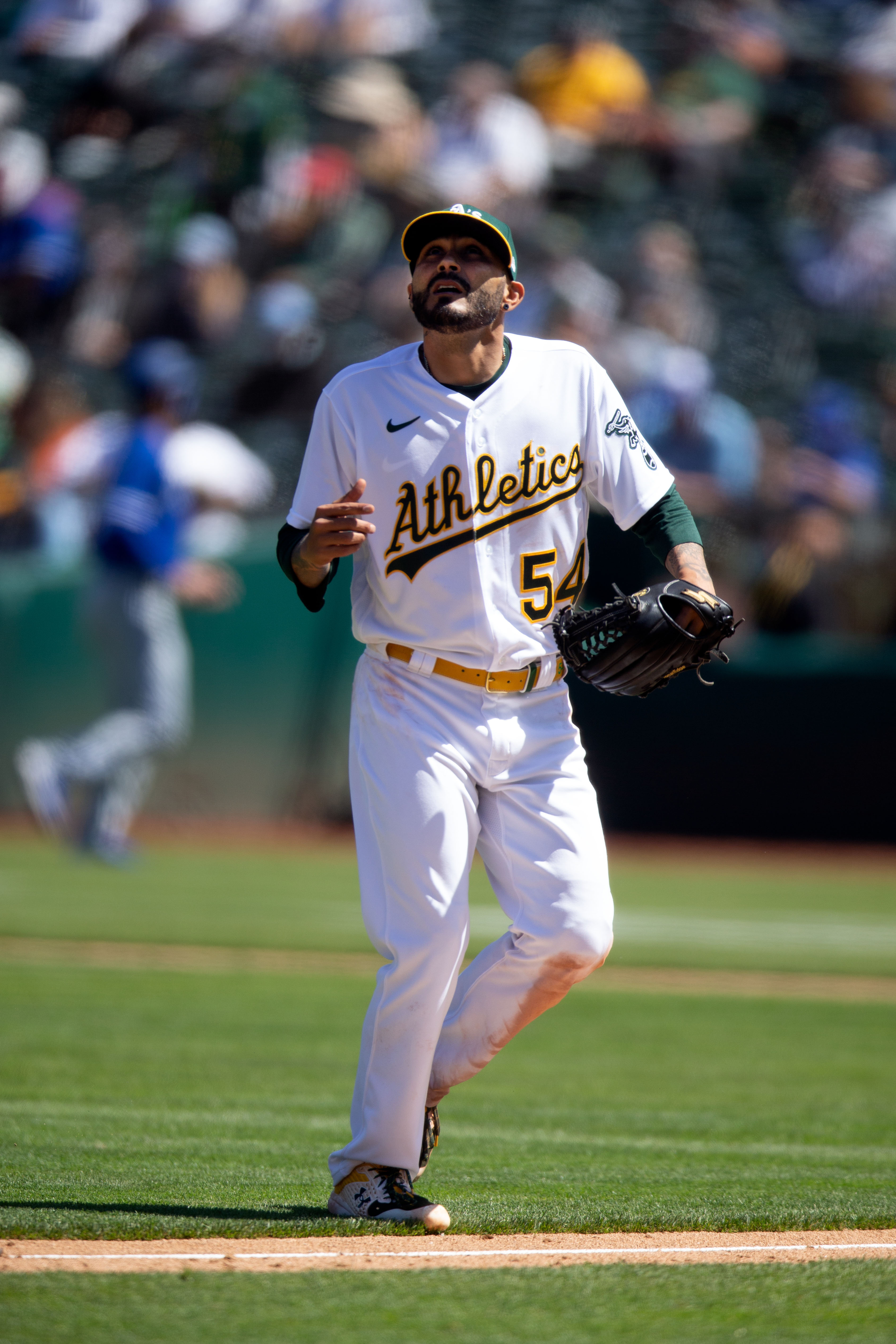
The 39-year-old Romo spent the 2021 campaign with the division-rival A’s, where he posted a 4.67 ERA with a 23.2% strikeout rate against an 8.1% walk rate. It marked a downturn both in terms of ERA and strikeout rate for the 14-year big league veteran, but Romo continued to be among the game’s best in terms of limiting hard contact. His 84.9 mph average exit velocity ranked in the 98th percentile of big league pitchers, and Romo’s 23.3% opponents’ hard-hit rate was the best in the Majors.
A soft-tossing, sidearming slider specialist, Romo has long flummoxed right-handed opponents and kept lefties in check more effectively than most sidearm righties. He wasn’t quite as dominant against either in ’21 as he has been in prior seasons, but neither managed much to do much damage against him overall. Right-handed opponents posted a .240/.290/.420 batting line, while lefties hit .235/.330/.376 — both good for a .305 wOBA.
Romo’s spike in ERA this past season was due, at least in part, to an uncharacteristic dip in strand rate; after leaving 77% of runners on base throughout his career (and 78% in 2020 with Minnesota), Romo saw that rate drop to 69.3%. He also put himself at a disadvantage by throwing a first-pitch strike at just a 59.8% clip — the third-lowest mark of his career. If Romo can get ahead more frequently and maintain his outstanding levels of weak contact, that problematic strand rate will quite likely regress toward his career levels.
The Seattle bullpen was already strong, following a breakout from Paul Sewald and a resurgence from fellow righty Drew Steckenrider. The Mariners will also get both Ken Giles and Andres Munoz back from Tommy John surgery, giving them a pair of power arms capable of reaching triple-digit readings on the radar gun. Righty Diego Castillo was closing games in Tampa Bay before being acquired at last year’s trade deadline, and the club was surely encouraged by the progress made from starter-turned-reliever Erik Swanson.
That said, the Mariners also lost a key arm in recent days when right-hander Casey Sadler underwent a shoulder procedure that will cost him the entire 2022 season. Sadler, 31, posted a comical 0.67 ERA in 40 1/3 innings last year, and while he would never have been expected to replicate that level of dominance, he was surely viewed as a vital member of manager Scott Servais’ bullpen. Romo gives the M’s a veteran replacement for Sadler — one who’ll provide quite a different look than some of his new power-armed teammates. Going from Romo’s 85-86 mph “fastball” to triple-digit heaters from Giles or Munoz in the late stages of a game won’t be an easy transition for opponents.
With Romo on board, the Mariners’ projected payroll ticks up to about $106MM — its highest point since 2019 but still miles shy of the franchise-record $158MM. It’s still possible they’ll boost that total a bit further with another free-agent pickup — though the market has been largely picked over by now — or via a trade acquisition, though much of the team’s heavy lifting appears complete this winter. The M’s were known to be eyeing an experienced option to round out the rotation and have yet to make such an addition, however, and there’s always some room for even further bullpen depth to be added — particularly with expanded 28-man rosters to begin the season.
Red Sox Designate Jeisson Rosario For Assignment
The Red Sox announced this morning that they’ve designated outfield Jeisson Rosario for assignment in order to open a spot on the roster for Trevor Story, whose six-year contract is now official.
Rosario, 22, was acquired from the Padres in 2020 alongside infield prospect Hudson Potts in the trade that sent Mitch Moreland to San Diego. Both Rosario and Potts have now been designated for assignment on consecutive days, though, as Potts lost his 40-man spot yesterday when Boston claimed righty Kyle Tyler off waivers from the Angels.
The fleet-footed Rosario has yet to make his big league debut or even reach the Triple-A level. He spent the 2021 campaign with the Sox’ Double-A affiliate, where he posted a .232/.335/.307 batting line with three home runs, 15 doubles, a triple and a strong 12.3% walk rate against a troubling 27.9% strikeout rate. Scouting reports tout his speed, glovework in center and ability to draw walks, but Rosario is lacking in power and has notable concerns about his hit tool. He’ll be traded or placed on outright waivers within the next week.
Luis Castillo Behind Schedule, Justin Dunn Out “Months” With Shoulder Injury
The Reds could be without top starter Luis Castillo when Opening Day rolls around, as manager David Bell told reporters Tuesday that Castillo was briefly shut down due to some shoulder soreness (Twitter link via Bobby Nightengale of the Cincinnati Enquirer). Castillo is healthy now and has resumed throwing, per Bell, but he’s behind schedule in his buildup for the season. There was more concerning news on righty Justin Dunn, acquired in last week’s Jesse Winker trade, as Bell revealed that he’ll miss at least a couple of months due to ongoing shoulder troubles. Nightengale further notes that the Reds were aware of Dunn’s injury status when acquiring him.
The good news for Reds fans is that there’s no indication Castillo is being plagued by a serious injury. It’s possible he’d only miss the first turn or two through the rotation, so long as there are no further setbacks as he builds back up.
For much of the offseason, Castillo stood out as one of the more logical trade candidates on the market. General manager Nick Krall began the offseason speaking of a need to align the Reds’ payroll to its resources, and the first few moves continued a cost-cutting sequence that dated back to last offseason. The Reds placed Wade Miley and his eminently reasonable $10MM salary on waivers and traded catcher Tucker Barnhart to the Tigers. In the days coming out of the lockout, Cincinnati dealt Sonny Gray to the Reds and traded both Jesse Winker and Eugenio Suarez to the Mariners.
Since shedding the remainder of the Suarez deal, however, the Reds have begun to make some more modest additions to the payroll. They picked up about $7MM of salary obligations in the trade that sent Amir Garrett to Kansas City in exchange for Mike Minor, and the Reds have also given out small big league deals to infielder Donovan Solano and reliever Hunter Strickland. Krall has since publicly stated that he does not expect to trade either Castillo or right-hander Tyler Mahle, who was a popular trade target of pitching-needy teams himself.
Castillo, 29, got out to a rocky start in 2021 when he posted an ugly 7.22 ERA through his first 11 appearances. His return to form was swift and emphatic, however, as Castillo closed out the year with a brilliant stretch of 22 starts that saw him work to a 2.73 ERA with a 26% strikeout rate and 9.4% walk rate. Over the past three seasons, he’s given the Reds 448 1/3 innings of 3.61 ERA ball with a 27% strikeout rate, a 9.3% walk rate and an outstanding 56.8% grounder rates. He’s controllable through the 2023 campaign, and it stands to reason that if the Reds don’t contend this year, Castillo’s name will again surface on the summer trade market. It’s a similar story with Mahle, who’s also controlled through 2023.
As for Dunn, the news of a months-long absence due to a shoulder problem that dates back to June 2021, when the right-hander last pitched, is surely a source of frustration. The 26-year-old Dunn pitched 50 1/3 innings of 3.75 ERA ball with Seattle last year but did so with a below-average 22.8% strikeout rate, a bloated 11.3% walk rate and a low 33.8% grounder rate. He last took the ball on June 17.
Dunn is a former first-round pick and well-regarded prospect, having been drafted 19th overall by the Mets in 2016 and traded to the Mariners alongside Jarred Kelenic in the deal that sent Robinson Cano and Edwin Diaz to New York. He can still be controlled all the way through the 2025 season, but it now seems that by the time he’s ready to go for the Reds, he’ll have missed upwards of a year due to shoulder troubles.
The injury news on Dunn squarely takes him out of the running for the fifth spot in the rotation, and with Castillo ailing to a much lesser degree, there’s some uncertainty regarding who’ll round out the starting staff. If Castillo isn’t ready to go, Opening Day would likely fall to Mahle. He’d be followed by Minor and Vladimir Gutierrez, with right-hander Tony Santillan and perhaps lefty Reiver Sanmartin serving as early options as well. The Reds figure to get a look at several top pitching prospects in 2022 — Hunter Greene, Nick Lodolo and Brandon Williamson among them — but it’s unclear whether they’d consider dipping into their farm for an early-season stopgap.
MLBTR Chat Transcript
Click here to read a transcript of today’s chat with MLBTR’s Steve Adams.
Red Sox Claim Kyle Tyler, Designate Hudson Potts
The Red Sox announced Tuesday that they’ve claimed right-hander Kyle Tyler off waivers from the Angels and, in a corresponding move, designated outfielder infielder Hudson Potts for assignment.
Tyler, 25, was the Halos’ 20th-round draft selection back in 2018 and made his big league debut in 2021 when he tossed 12 1/3 innings out of the bullpen. The Oklahoma product held opponents to four runs (2.92 ERA) on eight hits and six walks with six strikeouts. Tyler’s strikeout/walk rates in the big leagues obviously weren’t much to write home about, and he sat at just 91.1 mph with his fastball during that limited time.
That said, Tyler also enjoyed a solid season in the minors, logging a 3.66 ERA with a 25.3% strikeout rate and 6.8% walk rate in 86 frames between Double-A and Triple-A — mostly working as a starting pitcher. The right-hander has all three minor league option years remaining, so he gives the Sox some additional pitching depth at a time when big names like Chris Sale and James Paxton are on the injured list.
Potts, 23, is a former first-round pick and well-regarded prospect whose development simply hasn’t progressed as hoped. Selected by the Padres with the No. 24 overall pick in 2016 and traded to Boston in 2020’s Mitch Moreland swap, Potts spent the 2021 season with Boston’s Double-A affiliate. It was his second stint at the Double-A level, but Potts still managed only a .217/.264/.399 batting line with a sky-high 32.8% strikeout rate.
Potts has previously drawn praise for his substantial raw power, but he hasn’t made contact enough to take advantage of that pop since a solid 2018 showing in A-ball. The Red Sox will have a week to trade Potts or place him on outright waivers, at which point any of the other 29 clubs could place a claim.
Giants, Darin Ruf Agree To Two-Year Deal
The Giants have agreed to a two-year, $6.25MM deal with first baseman/outfielder Darin Ruf, tweets ESPN’s Jeff Passan. The contract contains a club option for a third season, which would be Ruf’s first potential free-agent year.
Ruf, represented by Vanguard Sports, was projected by MLBTR contributor Matt Swartz to earn $2.6MM via arbitration. He’d have been due another raise via arbitration in 2023 before reaching free agency in the 2023-24 offseason. Joel Sherman of the New York Post tweets that Ruf will earn $3MM this season and next, adding that the 2024 option is valued at $3.5MM and comes with a $250K buyout.
Originally signed by the Giants on the heels of a strong run in the Korea Baseball Organization, Ruf has emerged as a key weapon against left-handed pitching. The former Phillies slugger has decimated southpaws, hitting at a .275/.390/.579 clip with 13 home runs, 11 doubles and a triple in 205 plate appearances. The resulting 157 wRC+, which indicates that Ruf has been 57% better than a league-average hitter against southpaws, ranks 12th among 168 qualified hitters.
That’s not to say Ruf has had a difficult time with right-handers or needs to be deployed strictly as a platoon player, to be clear. He’s no slouch against same-handed opponents either, as evidenced by a robust .270/.372/.461 slash in 207 plate appearances against them. It’s not the same level of dominance he’s had over southpaws, but Ruf’s production has been strong enough that manager Gabe Kapler ought to feel good plugging him into the lineup on just about any given day. And, with the advent of the National League designated hitter, Ruf figures to get more opportunities than in the past.
It’s a highly affordable deal for the Giants — one reflective of Ruf’s atypical career arc. Ruf didn’t see his first prolonged MLB action until his age-26 season, back in 2013, and he didn’t even reach arbitration eligibility until last year — his age-34 campaign. Ruf is already 35 and will turn 36 by late July, meaning he wouldn’t have accrued the necessary six years of service time to reach free agency until after he’d already turned 37. He earned a few million overseas while slashing .313/.404/.564 across three seasons with the Samsung Lions, but given the late-blooming nature of his breakout, it’s not a surprise to see him giving up a free-agent year at a relatively modest rate. This new two-year deal effectively doubles Ruf’s career earnings, which surely makes it a particularly satisfying deal to sign at 35 years of age.
Blue Jays, Matt Chapman Agree To Two-Year Deal
The Blue Jays and newly acquired third baseman Matt Chapman avoided arbitration by agreeing to a two-year, $25MM contract, ESPN’s Jeff Passan reports. The deal will buy out Chapman’s final two arbitration seasons but does not extend Toronto’s club control over the two-time Platinum Glover. Chapman, a client of the Boras Corporation, will receive a $1MM signing bonus and consecutive salaries of $12MM on the deal, tweets MLB Network’s Jon Heyman.
MLBTR contributor Matt Swartz had projected Chapman to earn $9.5MM this coming season, and he would’ve earned one more raise in 2023 before reaching free agency in the 2023-24 offseason. Taking into account that $9.5MM projection, Chapman’s $25MM guarantee effectively puts a $14.5MM price on that third-time arbitration salary, which seems well within the realm of plausible outcomes.
The new contract doesn’t change much in terms of Chapman’s outlook, though it gives him some financial security in the event of a major injury or further downturn at the plate. The Jays, meanwhile, get some payroll certainty not only for this season but also in 2023 — and they also avoid a need to dedicate any time or resources to arbitration talks with Chapman next winter.
Acquired last week in a trade that sent prospects Gunnar Hoglund, Kevin Smith, Zach Logue and Kirby Snead to Oakland, Chapman heads to Toronto in search of a return to his 2018-19 MVP-caliber form at the plate. A hip injury in 2020 cut the season short for Chapman and ultimately required surgery. He returned to play a mostly full slate of 151 games in 2021, but while Chapman belted 27 home runs and played his usual brand of premium defense at the hot corner, his overall production at the plate dropped as his strikeout rate rose. It’s certainly possible that the 2019 All-Star simply wasn’t at 100% last season, and he’ll now set out to prove that was the case without needing to spend much time dwelling on his contractual status.
Chapman’s new $12MM salary bumps the Blue Jays’ projected payroll up to about $170MM, per Roster Resource’s Jason Martinez, and it gives them about $190MM worth of luxury-tax obligations. That’ll establish a new franchise-record mark in terms of actual payroll, though the Jays are still about $40MM shy of the new $230MM luxury-tax threshold.
Dodgers Sign Kevin Pillar To Minor League Deal
The Dodgers have signed veteran outfielder Kevin Pillar to a minor league contract, per a club announcement. Pillar, a client of All Bases Covered Sports Management, will head to Major League Spring Training and vie for a roster spot. He’d earn a $2.5MM base salary upon making the club, tweets MLB Network’s Jon Heyman.
Pillar, 33, is a veteran of nine big league seasons who’ll hope to work his way into the outfield mix in Los Angeles. He spent the 2021 season with the Mets, batting .231/.277/.415 with 15 home runs, 11 doubles, a pair of triples and four stolen bases (in seven tries) through 347 trips to the plate. That was the fifth team in the past three seasons for Pillar, who’s begun to bounce around the league a bit after a lengthier run in Toronto to begin his career.
A former 32nd-round pick of the Blue Jays (2011), Pillar debuted just two years after being drafted. He saw sparing action in 2013-14 before settling in as a fixture in center field with the Jays from 2015-18. Pillar was Toronto’s primary center fielder for that span of four years, batting a combined .263/.301/.401 while regularly showing off his penchant for highlight-reel diving grabs.
For the bulk of his career, Pillar had the power, speed and certainly the defensive chops to offset a perennially low walk rate that tamped down his on-base percentage each year. From 2015-17, in particular, Pillar was a defensive juggernaut, racking up a ridiculous 52 Defensive Runs Saved with a 24.3 Ultimate Zone Rating. Pillar was snubbed in Gold Glove voting more than once in that stretch, and by 2018, the reckless abandon with which he played the outfield perhaps began to take its toll. His defensive metrics in center quickly went south in 2018, and by 2019 the Jays had designated him for assignment.
Pillar has since spent time in San Francisco, Colorado, Boston and Queens. Over the past three seasons, he’s batted .256/.293/.433 (90 wRC+) with 42 home runs and 23 steals. He’s been better against left-handed pitching in that time, as one would expect for a right-handed hitter, posting a .279/307/.499 batting line. Pillar’s average sprint speed has dipped a bit in recent years, though, and Statcast suggests that his initial jump on fly-balls has also slowed as he’s progressed into his 30s. He’s still posted solid defensive marks in the corners, however.
On the whole, Pillar isn’t the dynamic highlight-reel machine that he was during his peak with the Jays, but he’s a decent bat against left-handed pitching who has some pop against righties and can play all three outfield spots (even if he’s below average in center at this point). That’s a nice bench player for a contending club, but the Dodgers have a crowded outfield mix as it it. Beyond the starting trio of Mookie Betts, Cody Bellinger and AJ Pollock, L.A. also has versatile superutility man Chris Taylor and infielder/outfielder Matt Beaty as outfield options. Top infield prospect Gavin Lux has begun to see time in the outfield as well, and the Dodgers also invited outfielders Stefen Romero and Jason Martin to spring training after signing them to minor league deals.
Twins Designate Ralph Garza Jr. For Assignment
The Twins announced Tuesday that they’ve designated right-hander Ralph Garza Jr. for assignment. His spot on the 40-man roster will go to shortstop Carlos Correa, whose three-year, $105.3MM contract with Minnesota has now been formally announced by the team.
Garza, 28 next month, will cede his spot on the 40-man roster to his former Astros teammate. The 6’2″, 220-pound right-hander was drafted by the Astros in the 26th round back in 2015 and made his Major League debut with the ‘Stros in 2021 before joining the Twins via an August waiver claim. He tallied 30 1/3 innings between the two clubs and pitched to a solid 3.56 ERA, albeit it with strikeout, walk and ground-ball rates (22.8%, 11% and 37.3%, respectively) that all checked in worse than those of the league-average reliever.
Garza throws both a sinker and a four-seamer and works with a pair of different arm angles that offer some deception to opponents. He sports a career 3.82 ERA in parts of four seasons in Triple-A, where he’s whiffed 25.9% of his opponents against an 11.3% walk rate. A pure reliever, Garza has a pair of minor league option years remaining, so it’s possible another club will be intrigued by his blend of four pitches, his respectable upper-minors track record and the flexibility of those option years. The Twins will have a week to trade him or place him on outright waivers, at which point any of the other 29 clubs could place a claim.
Twins Sign Carlos Correa
March 22: The Twins announced that Correa has officially signed his contract. He’ll be introduced at a press conference tomorrow morning.
March 19: Correa’s deal includes a limited no-trade clause this season, which becomes a full no-trade clause in 2023 and 2024 if he chooses to opt in to those contract years, per Bob Nightengale of USA TODAY (via Twitter). Without knowing the full details of the limited no-trade clause, it’s still a relatively impactful development. If the Twins fall out of contention this season, they’ll have a sizable trade chip on their hands in Correa.
March 18: In a stunning move, the Twins have agreed to sign the market’s top free agent, shortstop Carlos Correa, reports Mark Berman of Houston’s FOX 26 (Twitter link). Rather than the massive long-term deal that Correa has been seeking, he’ll instead sign a three-year, $105.3MM contract with opt-out clauses after the contract’s first and second seasons. ESPN’s Jeff Passan adds that the contract pays an evenly distributed $35.1MM annually. Correa is represented by the Boras Corporation.
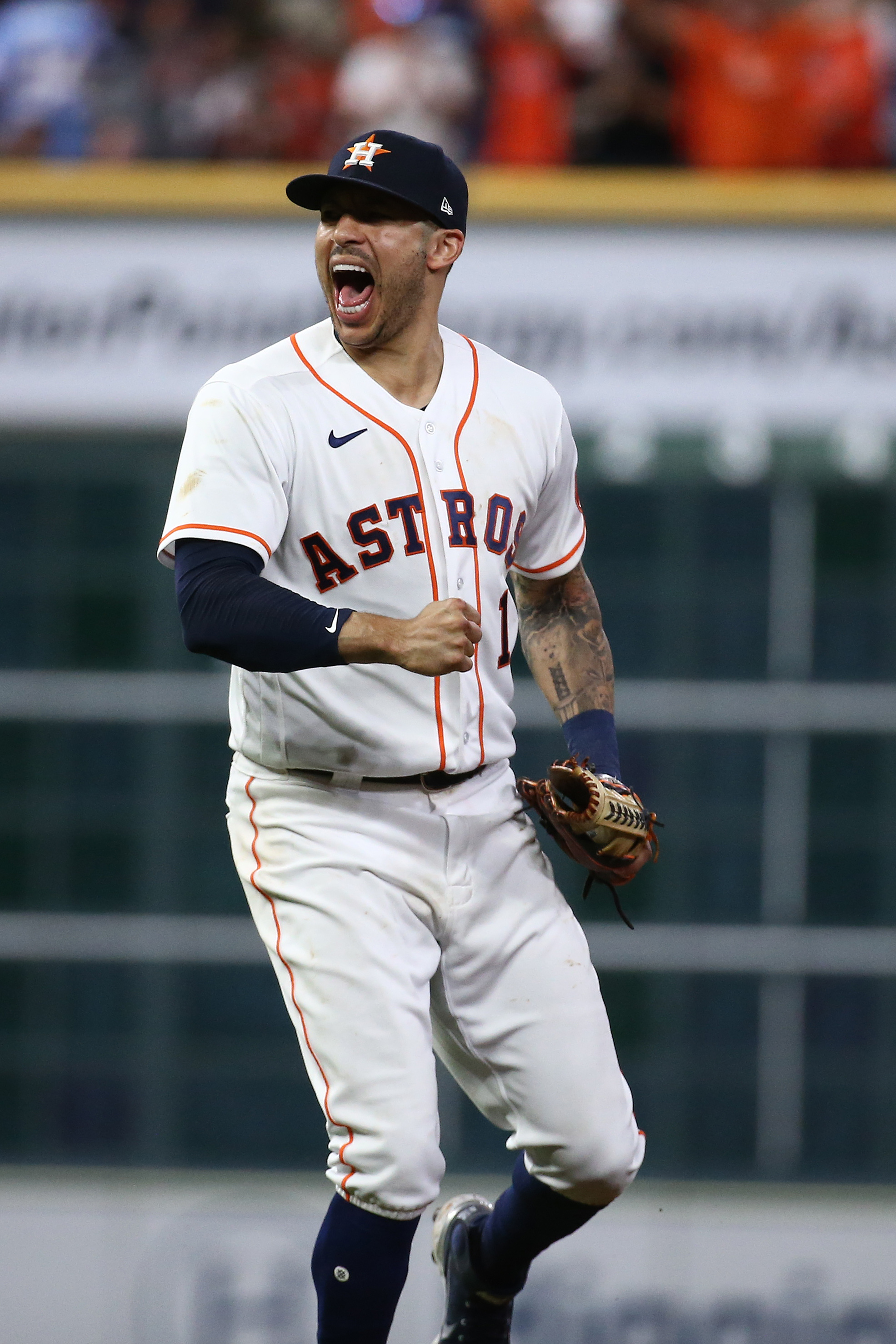
The Twins are giving Correa the second-highest average annual value of any position player in MLB history, trailing only the $36MM AAV on Mike Trout‘s decade-long, $360MM contract extension with the Angels and narrowly topping the $35MM AAV on Anthony Rendon‘s seven-year deal with the Angels. The move also means the No. 1 and No. 2 picks from the 2012 draft, Correa and Byron Buxton, will now be teammates for at least the 2022 season.
Upon shedding the remainder of Josh Donaldson‘s contract in a trade with the Yankees, Minnesota was immediately linked to free-agent shortstop Trevor Story. Instead, the more than $40MM saved in that Donaldson deal will be reallocated to Correa, whose $105.3MM guarantee trails only Joe Mauer for the largest in Twins franchise history. Correa rejected a qualifying offer from the Astros at season’s end, meaning the Twins, a revenue-sharing recipient, will forfeit their third-highest selection in this year’s draft in order to sign him. That’ll be their pick in Competitive Balance Round B, which should fall in the mid-60s. The Astros, meanwhile, will gain a compensatory selection at the end of Competitive Balance Round B, which typically falls in the early 70s.
The opt-outs in the deal provide Correa with the ultimate insurance net; if he remains healthy in 2022 and produces anywhere near his 2021 or 2019 levels, he’ll surely reenter the market in search of something along the lines of the 10-year deal he originally sought. If he suffers an injury of note or experiences an unexpected downturn at the plate, he’ll have another $35.1MM salary waiting for him in 2023 with the same opt-out opportunity in the 2023-24 offseason.
The 27-year-old Correa, a career .277/.356/.481 hitter who slashed .279/.366/.485 with a career-high 26 homers in 640 plate appearances this past season, will serve as a focal point in a Twins lineup that is also anchored by Buxton and second baseman Jorge Polanco. He’s been an average or better hitter every season of his big league career, with the exception of the shortened 2020 campaign, and has connected on 20 or more home runs in five of his six full-length seasons at the MLB level. Correa has walked at a 10.8% clip and struck out in 20.5% of his plate appearances since debuting as a 20-year-old rookie, including career-best marks of 11.7% and 18.1%, respectively, this past season.
As with any longtime Astro, Correa comes with a relatively tainted reputation stemming from Houston’s 2017 sign-stealing scandal, but George Springer proved last winter that the market will still pay premium rates for those players, provided they remained productive in subsequent years. Correa only serves as further evidence of that reality. And, just as Springer was embraced by Toronto fans, Correa surely will be well-received in Minnesota so long as he produces in a Twins uniform.
Like Buxton, Correa has had some durability issues, only twice reaching 500 plate appearances in his career. However, he played in 148 games this past season and in 58 of 60 games during the shortened 2020 season. Correa had a brief stay on the Covid-19 list over the summer in 2021, but he hasn’t been on the injured list since sustaining a broken rib in June 2019. The other notable injury he’s had in his career, a torn thumb ligament, came in 2017 and hasn’t had noticeably lingering effects.
Correa only further deepens a Minnesota lineup that is deep in talent but also lacking in consistency. Each of Miguel Sano, Max Kepler and Gary Sanchez have 30-homer seasons in their past but have ebbed and flowed through roller-coaster performances at the plate in recent years. Third baseman Gio Urshela, acquired alongside Sanchez in the Donaldson deal, will also look for a rebound to his 2019-20 levels (.310/.358/.523) after playing through health troubles in 2021.
Meanwhile, former top prospects Alex Kirilloff and Trevor Larnach have considerable offensive ceilings but played through injuries in their first full looks in 2021. Kirilloff, in particular, played through a torn wrist tendon before undergoing season-ending surgery. Top prospect Jose Miranda, who posted video-game numbers between Double-A and Triple-A this past season (.344/.401/.572), is expected to debut in 2022 and could see time at third base and/or designated hitter.
All of that is to say, the makings of a formidable lineup are present in Minnesota, though they’ll need a few things to break right. From the defensive side of things, Correa gives the Twins a pair of Platinum Glove winners, joining Buxton in that regard. With quality defenders like Kepler, Urshela and young catcher Ryan Jeffers also occupying key spots on the diamond, the Twins should have a strong defensive team overall. The Twins already ranked 12th in the Majors both in Defensive Runs Saved and Outs Above Average in 2021, and Correa should boost both marks.
The larger questions center around the team’s patchwork starting rotation, however. After shipping Jose Berrios to the Blue Jays prior to the 2021 trade deadline and watching fellow righty Kenta Maeda fall to Tommy John surgery not long after, the Twins entered the winter in need of at least three veteran starters to pair with youngsters Joe Ryan and Bailey Ober. They’ve yet to reach that goal. Acquiring Sonny Gray from the Reds gave them one notable upgrade, and rolling the dice on a Dylan Bundy rebound prior to the lockout was a sensible enough move in a vacuum. However, the Twins idled for the early portion of the offseason and are now faced with a rotation that is still lacking and a free-agent market that has been largely picked over.
The Twins have been tied to Athletics starters Sean Manaea and Frankie Montas, but failing that, president of baseball operations Derek Falvey and general manager Thad Levine will need to seek some creative and under-the-radar options — particularly now that they’ve gone all-in on the 2022 season with this Correa deal. Minnesota has a number of pitching prospects on the precipice of the big leagues, but Correa is a clear win-now move that necessitates additional fortification in both the rotation and the bullpen.
It’s not clear just how much latitude Falvey and Levine will have to further boost a payroll that now, with Correa’s addition, is at a projected $128.5MM — within a few million dollars of franchise-record territory. The front office has repeatedly spoken of ownership support to boost payroll as needed in the past, however, and the shocking addition of Correa seems to support the notion that there’s more room to take the team’s spending levels to new heights, at least for the next few seasons.
Correa’s deal is fascinating on a number of levels, not the least of which being that it’s the first time in recent memory where the market’s consensus No. 1 free agent pivoted to a short-term deal with a potentially early reentry to the market. Entering the offseason, the common consensus was that the Yankees and Correa’s new division rivals, the Tigers, would be the primary bidders for his services. The Yankees not only opted to sit out the market for top-end shortstops entirely (despite a clear need), but in essence paved the way for the Twins to make this deal when they took on the remainder of Donaldson’s contract. The Tigers, meanwhile, offered Correa a reported 10-year, $275MM deal with three opt-out clauses — although presumably not so early in the contract as the offer on which Correa ultimately landed.
Risk-averse detractors will opine that Correa should’ve pounced on the larger guarantee, but with a big season Correa will again enter the market in search of a $300MM+ deal and having already banked $35.1MM in 2022. If he reaches even $240MM on a multi-year deal next winter, in advance of his age-28 season, or a $205MM+ deal after a 2023 opt-out, he’d come out ahead on the entire gambit.
Even in the event that Correa unexpectedly plays all three seasons in Minnesota on this deal, he’d return to the open market in advance of his age-30 season and needing to clear what could very well be an attainable $170MM to top that reported Detroit offer. It’s obviously possible that Correa struggles, gets injured or never reaches that same earning ceiling, but he’s known as a supremely confident player — a mentality that is underscored by taking a deal of this nature.
The incumbent Astros offered Correa five years at a total of $160MM prior to the lockout and, earlier in the week, were said to be prepping a new offer for their longtime star. It’s not yet clear what Houston ultimately put forth, but their initial offer didn’t include any opt-out provisions. If the new offer followed suit in that regard, it’s possible that Correa simply felt that in order to accept a shorter-term deal than the 10-year pact he initially sought, he’d need the opportunity to take another bite at the free-agent apple sooner than later.
Correa’s future trips to the market hinge on how the 2022 and perhaps the 2023 seasons play out, but regardless of when he returns to free agency, he’ll do so with a few advantages. Firstly, he won’t be one of five high-end shortstops on the market, as was the case this year. The combination of Correa, Story, Corey Seager, Marcus Semien and Javier Baez is regarded as perhaps the greatest collection of free-agent shortstops in history. The talented nature of that group always created the possibility for a game of musical chairs that left one without the contract he sought, but few would have expected Correa to take a short-term deal.
Were Correa to return to the market next winter, he’d do so alongside Trea Turner, Dansby Swanson and perhaps Xander Bogaerts, who can opt out of his contract’s final three years and $60MM. However, Bogaerts’ defensive shortcomings have been increasingly placed under the microscope in recent years, and Swanson has never performed at Correa’s level either offensively or defensively. Turner and Correa certainly have the potential to be seen as 1-A and 1-B on next year’s market, but age is on Correa’s side; he’s more than a year younger than Turner. Furthermore, because Correa received a qualifying offer this winter, he’s now permanently ineligible to receive a second one. The qualifying offer system may yet be done away with entirely — that’s dependent on negotiations surrounding an international draft — but Correa is forever free from draft-pick compensation, regardless.
The other element of the contract to consider is the agency component of it. Correa turned heads by hiring Hollywood talent agency William Morris Endeavor to represent him in Sept. 2019. WME represented him up until midway through this offseason’s MLB lockout, but Correa hired the Boras Corporation to represent him on Jan. 18. There’s little sense speculating on the motivation behind the switch, but the change in representation meant that Correa’s former agents could have staked a claim to the commission from his eventual contract. Whenever Correa returns to the market, be it post-2022, post-2023 or post-2024, his new representation will command the entirety of the commission.
From a pure baseball perspective, the contract is a win both for Correa and for the Twins. Correa can lay claim to a nominal salary record — largest annual value for an infielder — and receive a massive yearly salary while retaining the ability to return to free agency in advance of either his age-28, age-29 or age-30 season.
The Twins, meanwhile, score the largest upgrade available to them on the market, catapulting them back into the conversation in the American League Central. They won’t be considered favorites without securing some additional pitching help, but Correa nevertheless provides radical improvement on both sides of the ball. The magnitude of the pitching upgrades the Twins have up their sleeve will determine their fate in 2022, but if their shocking deal with Correa is any indicator, they’re far from done improving this roster.