
Cardinals Sign Zach McAllister To Minor League Deal
The Cardinals have agreed to a minor league deal with righty Zach McAllister, the team announced this morning. He’ll report to Major League Spring Training and provide some depth in the rotation and bullpen.
Three full seasons have passed since McAllister last pitched in the Majors. He spent some time with the Phillies organization in 2021 but logged just 10 2/3 innings in the minors. The 34-year-old was a mainstay on the Cleveland pitching staff from 2012-17, first spending some time in the rotation before solidifying himself as a quality reliever. From 2015-17, McAllister posted a 2.99 ERA with a 26.1% strikeout rate against an 8.6% walk rate — often pitching more than an inning at a time.
Now 34 year old, McAllister will give St. Louis some depth both in the rotation and in the bullpen. The Cards’ rotation is largely set, with Jack Flaherty, Adam Wainwright, Steven Matz, Dakota Hudson and Miles Mikolas the likeliest quintet to start games. Righty Drew VerHagen, signed to a two-year deal after a strong run in Japan, could also vie for some rotation work but may begin in the bullpen. In-house options like Jake Woodford and Johan Oviedo add further depth to the rotation, as does non-roster invitee Aaron Brooks. McAllister has a ways to go before he pushes his way into consideration for a big league roster spot, but he’ll give the Cards some experience depth to stash in Triple-A Memphis even if he doesn’t make the club out of camp.
Red Sox Reportedly Showing Interest In Freddie Freeman
The Freddie Freeman bidding has a new entrant, as MLB Network’s Jon Heyman tweets that the Red Sox have joined the fray. They’ll join a field that has already included the Yankees, Blue Jays, Dodgers and, somewhat surprisingly, the Rays. Tampa Bay reportedly made an offer to Freeman prior to the lockout, and Marc Topkin of the Tampa Bay Times reported last night that the Rays remain interested. However, he suggests their interest is limited to a shorter-term deal — presumably at what would be a massive annual rate. That doesn’t appear too likely, of course, given the interest from larger-market clubs with deep pockets. As of yesterday afternoon, reports indicated that the Yankees were “pessimistic” about their chances of signing Freeman, while other clubs viewed the Blue Jays as a serious threat.
A Freeman signing would give the BoSox an elite heart-of-the-order grouping, as he’d join Xander Bogaerts, Rafael Devers and J.D. Martinez in composing the team’s two-through-five hitters. Adding Freeman to the fold would likely mean supplanting 26-year-old Bobby Dalbec at first base, though even with his big finish to the 2021 season, Dalbec isn’t going to serve as a roadblock to a superstar of Freeman’s caliber. Dalbec struggled through a dismal first half before slashing .269/.344/.611 in his final 195 plate appearances, although he did so in spite of a 31.3% strikeout rate and still finished the year with an overall batting line of .240/.298/.494.
The larger question for the Red Sox is likely a matter of payroll — more specifically, the luxury tax. Last week’s newly ratified collective bargaining agreement bumped the tier-one threshold for penalization from $210MM to $230MM, but the Sox are already at about $209MM of luxury obligations (via Roster Resource’s Jason Martinez). Adding Freeman to the mix would send Boston soaring past that mark. The Sox have paid the tax in the past, but more recently ownership has been staunchly against doing so. Freeman is the type of player for whom many clubs might consider an exception, but it’s not yet clear whether Boston would feel that way or whether any Freeman interest is contingent on moving other salary.
If the Sox are indeed willing to pay the tax, it’d likely only be a one-year dip into those waters. Boston’s luxury obligations will plummet following the season, dropping from the current $209MM level all the way to $75MM. That doesn’t even include the possibility of Bogaerts opting out of his six-year, $120MM contract — which seems quite likely and would further shave another $20MM from that luxury ledger. The Red Sox have Martinez, Nathan Eovaldi, Jackie Bradley Jr., Christian Vazquez, Enrique Hernandez, Michael Wacha, Rich Hill, Matt Strahm and Kevin Plawecki all coming off the books following the 2022 season.
Again, that doesn’t make it any kind of lock that they’ll be comfortable putting forth a multi-year deal of six years in the $30MM annual value range, which is generally believed to be where Freeman’s asking price currently lies. But there’s a clear on-paper fit and the long-term payroll flexibility to make it work, as MLBTR’s Anthony Franco noted when picking the Sox to sign Freeman back in November.
Wherever Freeman lands, it’s become quite clear that he’s set to move on from the only organization he’s ever known. The Braves acquired Matt Olson in a trade with the Athletics yesterday — a move that president of baseball operations Alex Anthopoulos called the toughest transaction of his lengthy executive career while fighting back tears (video link via Bally Sports). Anthopoulos noted multiple times that he couldn’t “get into specifics” as to why the deal was so difficult to make, though the implication was clear.
Zac Gallen Questionable For Opening Day Due To Shoulder Issue
Diamondbacks right-hander Zac Gallen‘s Opening Day status is in doubt due to right shoulder discomfort, manager Torey Lovullo tells reporters (Twitter thread via Nick Piecoro of the Arizona Republic). Gallen originally felt discomfort during the lockout, when he was unable to consult with team physicians, and underwent an MRI on his own. He was diagnosed with bursitis and is still dealing with some of the effects of that issue. He’ll throw off the mound within the next few days, at which point the Snakes will have a better sense of his timeline.
There’s little denying the talent of the 26-year-old Gallen, but this will mark the second straight season that he’s been limited by an arm injury of note. Gallen missed the first few weeks of the 2021 season with a hairline fracture in his forearm — an injury sustained while taking batting practice. He later spent more than a month on the injured list due to a small tear in the ulnar collateral ligament of his right elbow — a far more ominous injury. Gallen returned and avoided arm troubles for the remainder of the season, but he did miss a couple weeks in July owing to a hamstring strain.
All told, that trio of injuries limited Gallen to 23 starts and a total of 121 1/3 innings. That still marked a career-high at the MLB level, as he was a midseason call-up in 2019 and didn’t have the opportunity to pitch a full workload of 30-plus starts during the pandemic-shortened 2020 campaign.
When he’s been on the mound, Gallen has been strong. In 273 1/3 Major League innings, he carries a 3.46 ERA with a 27.6% strikeout rate, a 9.6% walk rate and a 42.8% ground-ball rate. Gallen worked to a sub-3.00 ERA in each of his first two seasons in the big leagues, and his 2.75 mark through 72 innings in 2020 was enough to land him some down-ballot Cy Young votes, as evidenced by his ninth-place finish. Arizona controls Gallen through the 2025 season, and he won’t be eligible for arbitration until next winter.
Were Gallen to miss time early in the season, the D-backs would likely rely on Madison Bumgarner, Merrill Kelly and Luke Weaver in the top three spots. Non-roster invitee Dan Straily seems likely to crack the roster, and the D-backs have a host of options in the fifth spot, including Tyler Gilbert, Corbin Martin, Humberto Mejia and Humberto Castellanos, among others.
Athletics Trade Matt Olson To Braves
The Freddie Freeman era in Atlanta appears all but over. The Braves announced Monday that they’ve acquired All-Star first baseman Matt Olson from the Athletics in exchange for a hefty package of minor league talent: center fielder Cristian Pache, catcher Shea Langeliers and right-handers Ryan Cusick and Joey Estes. While some Atlanta fans may hold out hope that the implementation of the universal designated hitter leaves open the possibility for both Olson and Freeman to coexist on the same roster, Braves president of baseball operations Alex Anthopoulos implied otherwise when discussing the trade with reporters. Anthopoulos held back tears today, calling the Olson trade the hardest transaction he’s ever had to make — a clear allusion to the team’s plans for Freeman (or lack thereof).
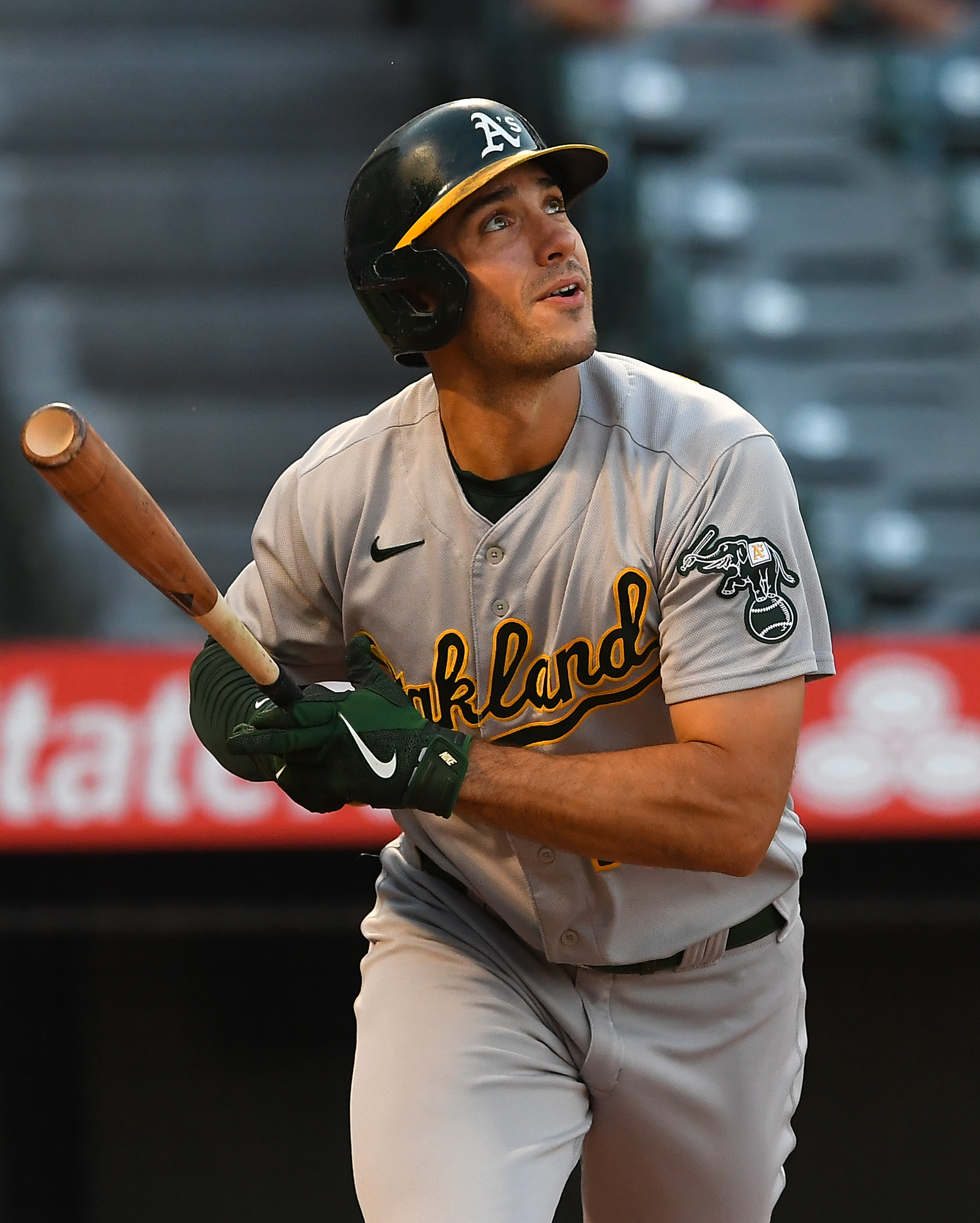
As is the case with Anthopoulos, the acquisition of Olson will be a bittersweet one for many Braves fans. While Olson is an elite first baseman with Atlanta roots, it’s long been difficult to fathom Freeman, the 2020 National League MVP, ultimately moving on and signing with a new team. Freeman was a homegrown star in every sense of the word, going from No. 78 overall draft pick in 2007 to a five-time All-Star, league MVP and World Series champion. He’s spent the past 12 seasons in Atlanta, thanks in large part to an eight-year, $135MM contract extension that kept him in Braves gear long beyond his arbitration years. Freeman has become synonymous with the Braves, but it now appears all but certain that this is a changing of the guard.
As far as replacements for Freeman go, it’s tough to dream up a better option than the Atlanta-born Olson, however. Set to turn 28 later this month, Olson is a two-time Gold Glover at first base who just wrapped up a career year that netted him his first All-Star nod. Over the past three years, Olson has cemented himself as one of the premier power threats in the game, swatting 89 home runs and 65 doubles while playing his home games in the cavernous Oakland Coliseum. This past season, Olson shed the “strikeout-prone” label when he cut his strikeout rate from 27.5% in 2019-20 all the way down to 16.8%. He did so while maintaining an excellent 13.1% walk rate and turning in the finest overall season of his career: .271/.371/.540 with a career-high 39 home runs.
Of course, Olson is far more than your prototypical bat-first, slugging first baseman. He’s a two-time Gold Glove winner who happens to lead all Major League first basemen with 34 Defensive Runs Saved dating back to 2017 (despite playing in just 59 games that year). Olson’s 22.8 Ultimate Zone Rating is also tops among first basemen in that span, and his 15 Outs Above Average (per Statcast) rank sixth in that same span. There’s an argument to be made that bittersweet as the change might be for Braves fans, Freeman is being replaced by the most well-rounded, prime-aged first baseman in the game.
The Braves will control Olson for at least the next two seasons, as he’s currently sitting on four-plus years of Major League service time. MLBTR contributor Matt Swartz projects a $12MM salary for Olson this coming season, and he’ll be due one more raise on that sum before qualifying as a free agent after the 2023 season. Of course, the Braves could well look to sign Olson to a long-term deal that would keep him with his hometown club far longer than those remaining two years of control. Atlanta reportedly balked at going six or more years on a potential Freeman extension, but Olson is four and a half years younger than Freeman, which could alleviate concerns about an eventual decline in the late stages of a long-term deal.
Just as it’s difficult for the Braves’ faithful to process the change, Athletics fans are surely reeling from the news as well. While periodic sell-offs of this nature have become second nature for Oakland diehards, the current core is one of the more talented and recognizable groups in recent memory. Olson was a fan favorite and beloved player at the Coliseum, but his departure begins to pave the way for what the A’s hope will be its next core group.
Pache and Langeliers are the true headliners here, though all four prospects ranked among the top 15 or so in the Braves’ farm. Pache, 23, has seen his stock dip a bit since being ranked as baseball’s No. 7 prospect (per Baseball America) in the 2020-21 offseason. That’s due both to a poor showing at the plate in the big leagues and a fairly pedestrian output in Triple-A Gwinnett. Pache received just 68 big league plate appearances in ’21 and batted .111/.152/.206, though it’s tough to glean much of anything from such a small sample. His work in Triple-A was more encouraging but not on par with his strong 2019 campaign in Double-A; in 353 trips to the plate with Gwinnett this past season, Pache batted .265/.330/.414.
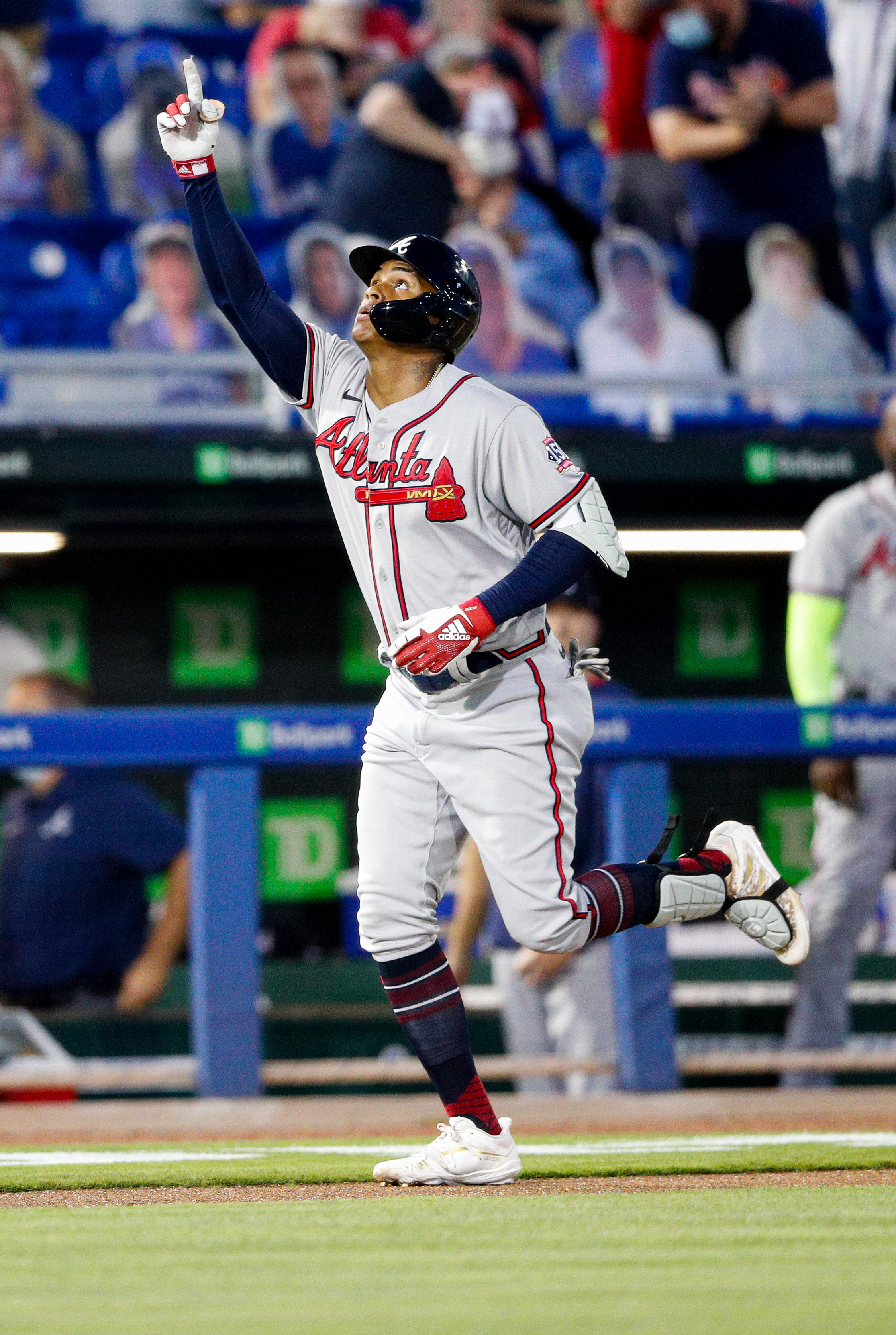
Offense has never been projected to be Pache’s primary selling point, however. That’s not to say he couldn’t develop into a solid big leaguer at the plate, of course, but much of his prospect allure has come from the fact that he’s a plus runner who received 80 grades for his defensive upside in the outfield. Considering the huge space he’ll now have to patrol at the Coliseum, that’s a particularly valuable skill to have. And, if Pache can turn in something close to his lifetime .280/.330./406 slash from the minor leagues, he ought to be able to solidify himself as a highly valuable big leaguer before long. Pache is still near universally regarded among the sport’s top 100 prospects.
Turning to the 24-year-old Langeliers, he’ll give the A’s another potential high-end catcher before long. Sean Murphy is the incumbent option there and had a fine season in ’21, but Langeliers was the No. 9 overall pick in 2019 and is fresh off a .256/.339/.494 showing between Double-A and a brief stop in Triple-A. Baseball America ranked Langeliers 54th among all prospects, calling him an excellent defender with a “cannon” arm and above-average power. That he reached Triple-A already in 2021, albeit only for five games, speaks to his proximity to the Majors. Langeliers also ranks as baseball’s No. 70 prospect at FanGraphs and No. 80 at The Athletic.
With Langeliers now perhaps the future behind the plate, Oakland will at least have the ability to more comfortably listen to offers on Murphy if they see fit. Murphy is controlled another four seasons and just won a Gold Glove while popping 17 home runs, but he’ll reach arbitration next year — around the time Langeliers is likely to be ready for an everyday audition at the big league level.
As for Cusick and Estes, both are well regarded in their own regard, even if they haven’t received the type of national attention that Pache and Langeliers have. Cusick was Atlanta’s first-round pick just last summer, joining the organization after posting huge strikeout totals during his sophomore and junior seasons at Wake Forest (37% overall). The 6’6″, 235-pound righty sits in the upper 90s with a heater that has touched 102 mph.
Command was an issue for Cusick in college, but in 16 1/3 innings with Low-A Augusta last season, Cusick punched out more than half of the 67 hitters he faced while issuing just four walks. It remains to be seen whether he can sustain those gains, but there’s huge potential if he can indeed refine his command. If not, a triple-digit fastball and this type of bat-missing ability will surely play up as a potential late-inning reliever. He was generally regarded among the system’s 10 best overall prospects.
As for the 20-year-old Estes, he was the Braves’ 16th-round selection in 2019 but has quickly elevated his profile. Drafted out Paraclete High School in Lancaster, Calif., Estes had a nondescript pro debut that lasted 10 innings in ’19, didn’t pitch due to the canceled 2020 minor league season and then broke out with a monster year as Cusick’s teammate in Low-A Augusta. Through 20 starts, a total of 99 innings, Estes notched a 2.91 ERA with a 32.1% strikeout rate and a 7.3% walk rate. He was an extreme fly-ball pitcher in 2021 (33.2% grounder rate), but that’s not a huge concern for the A’s, given their spacious home environs. Estes’ success came despite being nearly three years younger than the average competition he faced. While he and Cusick are both at least one, if not two full seasons away from making a big league impact, they both add some considerable upside to an Oakland system that was generally regarded among the thinnest in the sport.
“This is the cycle for the A’s,” Forst said back in early November when addressing reports of a likely payroll reduction. “We have to listen and be open to whatever comes out of this. This is our lot in Oakland until it’s not.” Those foreboding words have already manifested in the trade of two popular and productive A’s stars, and there’s little sense expecting that Oakland will put a foot on the brakes now. They’ve secured four new pitching prospects and a pair of ballyhooed close-to-the-Majors position players already (Pache, Langeliers), and things are likely just getting started.
As for the Braves, the acquisition of Olson will turn the page on perhaps the team’s most iconic player since Hall of Famer Chipper Jones. The 2020 MVP crowning for Freeman was a high note in his career, but the team’s storybook World Series run, with Freeman at the heart of the charge, will make an even more fitting end to this chapter in the team’s history. Olson will have major shoes to fill at Truist Park, but so long as he carries on at something near the .254/.348/.515 pace he’s tallied over his past 564 Major League games, the Braves will be in good hands.
ESPN’s Jeff Passan first reported that trade and all five players involved (Twitter thread).
Marlins Notes: Payroll, Castellanos, Center Field, Sixto
When the Marlins parted ways with Derek Jeter on March 1, reports in the immediate aftermath suggested that a rift had grown between Jeter and owner Bruce Sherman — in part due to a change in payroll expectation. Sherman, the team’s principal owner, pushed back on that notion in meeting with reporters today, plainly stating that the Marlins have money left to spend and plan to do just that (Twitter link via SportsGrid’s Craig Mish). That’s a subjective statement, of course, but it’ll be telling to see to what extent the Marlins are willing to further bolster the payroll.
Specifically, Jeter’s push to sign Nick Castellanos was reported to be a source of consternation. MLB Network’s Jon Heyman reported last week that he’d been willing to offer at least five years to bring the Miami native into the fold, but it’s less clear that Castellanos remains a priority post-lockout. Longtime Marlins beat writer Joe Frisaro reports that the Fish remain interested in Castellanos but characterizes them as a “long shot” to win the bidding for his services (Twitter link).
Castellanos would add a much-needed bat to the mix, and Sherman indeed told reporters in his media session: “We need bats” (link via Mish). However, even with the advent of the universal designated hitter, Castellanos is a little bit of an imperfect fit from a roster construction standpoint. Miami already has several corner options, including Avisail Garcia, Jesus Sanchez, Garrett Cooper and Bryan De La Cruz. However, the Marlins don’t have a true everyday center fielder, and general manager Kim Ng said this morning that finding such an option is a priority (Twitter link, with video, via MLB.com’s Christina De Nicola).
Ng acknowledged that Garcia is an option in center field and that they discussed the possibility of him playing center while in the process of negotiating his four-year contract. However, there’s little doubt that Garcia is best suited for corner-outfield work, which is generally the case with all of the Marlins’ in-house options. The free-agent market is rather light on options at the moment, which helps to explain why Miami has repeatedly pursued a trade for Pittsburgh’s Bryan Reynolds. (Reynolds himself is best in a corner but also better defensively in center than Miami’s current options.) Presumably, they’re exploring additional options to roam center field.
Miami’s deep stock of pitching talent positions them nicely to pull of a trade for an outfielder, but their depth has taken at least something of a hit in recent months. Righty Zach Thompson went to the Pirates as part of the package to acquire catcher Jacob Stallings, and lefty Jake Eder underwent Tommy John surgery late in the 2021 season. It was also reported recently that righty Sixto Sanchez was behind schedule in his recovery from shoulder surgery, and Ng confirmed as much today (via Mish). Sanchez is currently shut down entirely and does not have a timetable to resume throwing. A recent MRI came back clean, Ng noted, but Sanchez had experienced discomfort when ramping up for the season.
Even still, the Marlins have Sandy Alcantara, Trevor Rogers, Pablo Lopez and Elieser Hernandez penciled into rotation spots, and there ought to be a spirited competition for the fifth starter’s job. Jesus Luzardo, Edward Cabrera, Braxton Garrett, Cody Poteet, Nick Neidert, Paul Campbell and Daniel Castano all started games in Miami last year. Ng said today that Cabrera will be late reporting to camp due to visa issues, which could put him a bit behind some of the others in terms of competing for that spot. Luzardo is the on-paper favorite for it, but a lot can change over the course of Spring Training. Injuries and performance can alter the picture, and it’s still possible that the Marlins include Hernandez in a deal to land an outfielder.
Giants To Sign Carlos Rodon
March 14: Rodon’s opt-out clause is contingent on him pitching at least 110 innings this season, tweets Mark Feinsand of MLB.com. If Rodon does not throw at least 110 innings in 2022, he will not be able to opt out of the contract’s second season.
March 11, 3:21pm: Rodon will earn $21.5MM in 2022 and $22.5MM in 2023, tweets USA Today’s Bob Nightengale.
3:07pm: The Giants have reached a two-year, $44MM deal with left-hander Carlos Rodon, reports ESPN’s Jeff Passan. Rodon, a client of the Boras Corporation, can opt out of the contract after the first year of the deal. Susan Slusser of the San Francisco Chronicle reported shortly beforehand that Rodon was “very much in play” for the Giants.
The 29-year-old Rodon is arguably the top starter on the market at this point after a breakout 2021 season. The former No. 3 overall pick returned from a series of injury-marred seasons to turn in the finest performance of his career, dominating the American League for much of the season. Through late July, Rodon was one of the favorites for the Cy Young Award, having pitched to a sparkling 2.14 ERA with a sensational 36.6% strikeout rate against a 6.8% walk rate.
Rodon overwhelmed the Astros on July 18, pitching seven innings of scoreless, one-hit ball and racking up 10 punchouts. That, however, would be the last time the southpaw pitched more than five innings in an outing. Rodon lasted just four frames and allowed four runs in each of his next two starts. He rebounded to dominate a stripped-down Cubs team that had traded away most of its lineup, tossing five shutout innings with 11 strikeouts on Aug. 7.
Rodon then hit the injured list with shoulder fatigue, returned on Aug. 26, and went on to make only five starts over the regular season’s final 39 days. He reached 80 pitches in just one of those five appearances, and his fastball sat at a greatly diminished 93.2 mph in that time. Rodon was still effective in that time (2.35 ERA in 23 innings), but his strikeout rate was down to 27.2% — still strong, but not quite elite.
Heading into the postseason, Rodon’s status was a question mark, though he was ultimately included on the ALDS roster and deemed good to go for a Game 4 appearance. Rodon came back out slinging his fastball in the upper 90s, but he lasted just 2 2/3 innings in a game that would eventually result in Chicago being bounced from the playoffs.
On the whole, Rodon finished out the regular season with a 2.37 ERA, a 34.6% strikeout rate and a 6.7% walk rate in 132 2/3 innings. He ranked among the league leaders in terms of swinging-strike rate, opponents’ chase and overall strikeout rate. Statcast generally felt that Rodon’s breakout ERA was legitimate, pegging him for an “expected” 2.68 ERA in addition to a .189 expected opponents’ batting average and .316 expected slugging percentage.
As if the late-season shoulder woes weren’t troublesome enough, though, further questions surrounding Rodon’s health emerged after the White Sox opted against issuing him an $18.4MM qualifying offer. The fact that the team that knew Rodon best wasn’t comfortable with a one-year deal even after a season of that caliber cast serious doubt on the status of his shoulder. Earlier this morning, however, SNY’s Andy Martino tweeted that the medicals on Rodon were “actually very good,” citing multiple teams who’d looked into the southpaw. Clearly the Giants agree to an extent, as they saw fit to promise Rodon more than double what he’d have received upon signing a qualifying offer. Because Rodon did not receive the QO, the Giants won’t have to surrender any draft picks to sign him — and the White Sox won’t receive any compensation for his departure.
Rodon’s contract may have two guaranteed years, but it’s essentially a more modern version of the oft-seen one-year “pillow” contract. If he remains healthy and pitches well, Rodon will be a lock to opt out of the contract in search of a nine-figure guarantee heading into what would be his age-30 season in 2023. (And, depending on whether MLB and the MLBPA agree to an international draft by July 25, he may not have to face a qualifying offer next winter.) If not, he’ll still have the safety net of a weighty salary for the 2023 season — after which he’d have another bite at the free-agent apple.
The signing isn’t without its risk for the Giants. Beyond Rodon’s late-season shoulder troubles, the left-hander had simply never performed anywhere near this level prior to the 2021 season. This is the type of performance that both the White Sox and their fanbase hoped for when Rodon was drafted No. 3 overall and immediately ranked as one of the sport’s best pitching prospects. However, Rodon was more of a third or fourth starter for the bulk of his career in Chicago, pitching to a 4.01 ERA through 494 1/3 innings from 2015-18. Along the way, he dealt with a litany of injury troubles, ranging from minor issues like a wrist strain to more severe problems in his shoulder (which required surgery in September of 2017) and in his elbow (which required Tommy John surgery in May of 2019).
Red flags aside, this type of short-term, high-annual value structure is one with which Giants president of baseball operations Farhan Zaidi is quite comfortable. Zaidi, the former Dodgers general manager, pursued arrangements of this type often in Los Angeles, and since moving to the Giants he’s had a clear preference to avoid long-term contracts — even if it means paying a higher annual premium. Under Zaidi, the Giants haven’t given out a contact of more than three years in length to any free agent, and it was reported early in the offseason that the team was disinclined to pursue players expected to command nine-figure deals.
Notably, Rodon’s $22MM annual rate of pay is a match with that of now-former Giants righty Kevin Gausman in Toronto, but Gausman commanded a five-year pact. Gausman has a greater track record of durability, of course, but Rodon certainly has the ability to match or even exceed Gausman’s production, provided he can remain on the mound.
Rodon becomes the fourth and presumably final rotation addition for the Giants this winter. Four of San Francisco’s five starters — Gausman, Anthony DeSclafani, Alex Wood and Johnny Cueto — reached free agency at season’s end, leaving only budding ace Logan Webb as a lock for the ’22 rotation. The Giants have since re-signed both DeSclafani (three years, $36MM) and Wood (two years, $25MM) while also adding veteran righty Alex Cobb (two years, $20MM).
Some additional depth could always be brought in behind that quintet, as there’s little in the way of experience behind them. Out-of-options right-hander Tyler Beede is likely ticketed for a long relief role and is the sixth man up on the depth chart, but the other names on the Giants’ 40-man roster (e.g. Sammy Long, Sean Hjelle, Kervin Castro) are either light on experience or haven’t pitched in the Majors at all. San Francisco has Corey Oswalt in camp on a minor league deal, but the front office hasn’t exactly loaded up on depth options to cover rotation innings in the event of an injury. Given that each of Rodon, Wood and Cobb have extremely lengthy injury histories, some additional veteran stability would be prudent.
That said, with Webb and Rodon now forming a formidable one-two punch and a trio of strong mid-rotation options behind them, the Giants have the potential for one of the better staffs in the National League. The Giants still have work to do and seem likely to find some punch to add to the lineup in the coming days/weeks, but the rotation is in good shape and, unlike last season’s unit, can potentially remain in place for at least one year beyond the upcoming campaign.
Twins Showing Interest In Trevor Story
12:15pm: Story has already turned down at least one nine-figure offer from a team that wanted him to change positions, tweets MLB Network’s Jon Heyman. Story’s strong preference has been to remain at shortstop — a desire that the Twins can clearly accommodate if they’re comfortable with Story’s price tag.
12:30am: The Twins have completed a whirlwind series of trades over the past 36 hours, shipping out Mitch Garver, Josh Donaldson, Isiah Kiner-Falefa (briefly acquired for Garver) and prospect Chase Petty (their top pick from last summer’s draft) while acquiring Sonny Gray, Gio Urshela, Gary Sanchez and a pair of pitching prospects. It’s a dizzying gambit, but it’s quite likely that Minnesota is only getting started. That frenzy cleared roughly $41MM from the Twins’ books, and their 2022 payroll is at a projected $94MM presently — about $40MM shy of their franchise-record.
One area the Twins could look to spend some of the money saved in that Donaldson swap is back at shortstop, where they briefly filled a need via the acquisition of Kiner-Falefa before sending him to the Yankees in tonight’s Donaldson blockbuster. To that end, Dan Hayes of The Athletic reports that the Twins have been in touch with the representatives for free-agent shortstop Trevor Story.
That Kiner-Falefa’s time with the Twins proved to be only a day was surely music to the ears of Story’s agents. The Yankees had made clear that they planned to eschew a big-name signing at shortstop, instead preferring a more short-term bridge to top prospects Anthony Volpe and Oswald Peraza. The trade of Kiner-Falefa not only gives the Twins a potential opening at shortstop — though it should be noted that Urshela can handle that position if needed — but also freed up some additional money to spend.
Looking past the $94MM projected on their 2022 books, the Twins only have about $39.5MM in guarantees on the 2023 ledger. They’ll quite likely pick up the $12MM option on the newly acquired Gray, but even still, that leaves ample room for another weighty salary — particularly since Minnesota will have a fairly light arbitration class in 2023. By the time 2024 rolls around, the Twins have less than $20MM in guaranteed money on the books. Again, that number will jump due to arbitration and, more notably, the $10MM and $10.5MM options they hold on Max Kepler and Jorge Polanco. Even with those contracts, a Story-sized salary could easily be accommodated.
The 29-year-old Story had something of a disappointing season overall, as an elbow issue impacted him at the plate and dragged down his throwing ability in the field. That said, Story’s .251/.329/.471 slash and 24 home runs in 595 plate appearances were still solid, and he has a track record of strong production on both sides of the ball. Dating back to 2018, he’s a .281/.348/.532 hitter with 107 home runs and 85 steals in 2166 plate appearances. Hitters who call Coors Field their home tend to have pronounced splits that draw the ire of skeptics, but Story has been about 17% better than league average with the bat since ’18 even after weighting for his home park (117 wRC+).
Defensively, Story’s 2021 was something of a mixed bag. Both Defensive Runs Saved (+9) and Ultimate Zone Rating (+3.6) felt he was characteristically strong with the glove, but Statcast’s Outs Above Average pegged him at a career worst mark of minus-7. Outside of that one OAA mark, though, Story has a sterling defensive reputation and the gaudy metrics to match. He ranks seventh in all of Major League Baseball, regardless of position, with 69 Defensive Runs Saved dating back to 2016. His 15.4 UZR in that time isn’t quite so dominant but still ranks 41st among all big leaguers, and OAA feels he’s been a strong defender outside of 2021 (+18 dating back to 2016).
As previously alluded to, Minnesota needn’t necessarily feel obligated to make a big splash at shortstop. Urshela can man the position at a satisfactory level, and they have minor leaguer Jose Miranda, who exploded into top-100 prospect territory with a massive .344/.401/.572 showing between Double-A and Triple-A in 2021. Miranda is knocking on the door to the big leagues as it is, and his best position is widely considered to be third base. That said, there’d be little harm in getting him a further look in the Majors, and the depth afforded by having each of Urshela, Story, Polanco, Miranda and Luis Arraez would be enviable.
Whether Story ultimately lands in Minnesota, the Twins will apparently be involved in the bidding to an extent. The largest free-agent contract the Twins have ever given out was Donaldson’s four-year, $92MM contract, and Story could well topple that mark this winter, wherever he signs. With Donaldson off the books, Byron Buxton signed to a seven-year/$100MM contract and a generally clean payroll slate after the ’23 season, Minnesota can afford to make a splash on just about any free agent that’s left on the market. That doesn’t make them any kind of lock to ultimately sign Story or another big-ticket free agent, but the Twins are making things interesting after laying largely dormant prior to the lockout.
Twins, A’s Have Discussed Sean Manaea, Frankie Montas
Continuing on with the frenetic pace they’ve set in recent days, the Twins have been discussing trade possibilities with the Athletics, tweets MLB.com’s Jon Morosi. Minnesota and Oakland have discussed scenarios that would send lefty Sean Manaea or right-hander Frankie Montas to the Twins.
The Twins and A’s were logical trade partners coming out of the lockout, given Minnesota’s dire need for rotation help and the fact that Oakland had at least three starters expected to be available: Manaea, Montas and the since-traded Chris Bassitt (who was dealt to the Mets this weekend). The Twins have already upgraded their starting staff by plucking Sonny Gray from the Reds in Sunday afternoon trade, but there are still clear holes to fill in a rotation that presently includes Gray, Dylan Bundy and youngsters Bailey Ober and Joe Ryan.
Either Manaea or Montas would further deepen a rapidly changing Twins roster. The former figures to be more attainable and have a lower price tag than the latter, as Manaea will be a free agent at season’s end. Montas, meanwhile, is controlled through the 2023 season via arbitration.
A former No. 34 overall draft pick, the 30-year-old Manaea has come roaring back from 2018 shoulder surgery to reestablish himself as a quality big league starter. Since returning late in the 2019 season, Manaea has tossed 263 innings of 3.73 ERA ball with an above-average 24.8% strikeout rate and a fantastic 5.2% walk rate. Manaea made 11 starts during the Covid-shortened 2020 season and took the ball 32 times last year while racking up 179 1/3 innings, so the shoulder issues that derailed his 2018-19 seasons look to be in the past. He’s projected by MLBTR contributor Matt Swartz to earn $10.2MM this coming season.
Montas, who’ll turn 29 in a week, just wrapped a career year with the A’s. The 2021 season was the first time in Montas’ big league career that he crossed the 100-inning threshold, but he nearly jumped all the way to 200 frames, racking up 187 innings of 3.37 ERA ball to go along with a 26.6% strikeout rate and 7.3% walk rate. Montas averaged 96.6 mph on his heater and posted huge marks in swinging-strike rate (13.7%) and opponents’ chase rate (35.9%). He’s projected to earn $5.2MM in arbitration this year.
It should be noted that Montas did miss significant time in 2019 after being hit with an 80-game PED suspension, and he struggled considerably in his return to the mound in 2020 (5.60 ERA in 53 innings/11 starts). That said, Montas has consistently posted strong strikeout and walk rates in his big league career and would, as is the case with the recently acquired Gray, give the Twins a key rotation piece for at least the next two seasons. Accordingly, the cost to acquire him figures to be higher than the cost to acquire Manaea.
Twins president of baseball operations Derek Falvey has said in the hours since completing last night’s Josh Donaldson deal with the Yankees that Minnesota has many irons in the fire, and talks with the A’s figure to just be one of many possibilities they’re exploring. Minnesota has, in the past few days, traded Mitch Garver to Texas in a deal to acquire Isiah Kiner-Falefa; traded pitching prospect Chase Petty to the Reds to acquire Gray; and traded Kiner-Falefa, Donaldson and catcher Ben Rortvedt to the Yankees in a deal that netted Gary Sanchez, Gio Urshela and upwards of $40MM in salary relief. They’ve since been rumored to have interest in free agent shortstop Trevor Story. That, paired with the acquisition of Gray and talks with Oakland, show that even amid a dramatic roster reshaping, Minnesota is aiming to contend in the AL Central for the 2022 season.
Guardians Among Teams Exploring Matt Olson Trade
Matt Olson is among the highest-profile trade targets on the market at the moment, and although the teams most often linked to him have been the Yankees, Rangers and Braves (presumably as a fallback if Freddie Freeman signs elsewhere), Ken Rosenthal of The Athletic tweets that the Guardians are also “in the mix” for the Athletics’ All-Star first baseman. Cleveland is currently exploring upgrades of varying quality at first base, in the outfield and in the bullpen, Rosenthal adds.
Armed with one of the deepest farm systems in the sport, the Guardians could easily put together a compelling package to pry Olson from Oakland. Cleveland is particularly deep in terms of controllable middle infield prospects, with shortstops Brayan Rocchio, Jose Tena, Tyler Freeman and Gabriel Arias all climbing the ranks behind presumptive big league double-play tandem Amed Rosario and Andres Gimenez.
It’s possible that Gimenez himself could be of interest to the A’s or another trade partner; the 23-year-old switch-hitter struggled in 210 plate appearances with Cleveland last season but had a big showing in Triple-A and isn’t far removed from being regarded as one of the sport’s most promising prospects himself. He’s also controllable via arbitration through at least the 2026 season. Of course, Cleveland is deep in prospects at other positions as well. Outfielders George Valera and Steven Kwan, righty Daniel Espino and third baseman/outfielder Nolan Jones have all garnered attention on prospect rankings.
As for the fit regarding Olson, it’s a pretty straightforward one. No team in baseball got less production from its first basemen than Cleveland did in ’21. Bobby Bradley, Yu Chang, Jake Bauers, Owen Miller, Josh Naylor and even Harold Ramirez (two plate appearances) and Roberto Perez (one plate appearance) all saw time in the lineup at first base but combined for a disastrous .207/.275/.389 batting line. Olson, meanwhile, hit a career-best .271/.371/.540 while blasting 39 home runs and playing his typical brand of Gold Glove caliber defense.
The question for the Guardians is whether they’d be able to retain Olson beyond the 2023 season, when he’s currently scheduled to become a free agent. MLBTR contributor Matt Swartz projects Olson to earn $12MM in arbitration this coming season, and he’d be owed one more raise for that ’23 campaign. If Olson replicates this past season’s production, he’d surely command more than $30MM in total over the next two seasons.
That’s a steep price for a Guardians club that is also looking at two more years of control over franchise cornerstone Jose Ramirez. A perennial MVP candidate, Ramirez has seen his own name bandied about the rumor mill, though he’s seemed like a long-shot, at best, to be moved this offseason. On the one hand, pairing up Ramirez and Olson would give the Guardians a dynamic heart-of-the-order pairing around which to build for the next two years.
It’d be a surprise to see the typically low-payroll Guardians extend both (or even one) to the type of nine-figure deal either could command, but a 2022-23 core of Olson, Ramirez, Shane Bieber, Aaron Civale and Franmil Reyes would give Cleveland plenty of high-quality talent at the heart of the roster. And, if things did truly go south and push the front office to consider a sell-off, both Olson and Ramirez would remain among the most sought-after players available whenever they hit the market.
Giants Sign Jakob Junis, Designate Hunter Harvey
The Giants have signed right-hander Jakob Junis to a one-year, Major League contract, per the team. Alex Pavlovic of NBC Sports Bay Area reports that Junis, a Wasserman client, will be guaranteed $1.75MM on the deal. Right-hander Hunter Harvey has been designated for assignment in order to clear a 40-man roster spot, tweets Susan Slusser of the San Francisco Chronicle.
Junis, 29, has spent his entire professional career in the Royals organization prior to this deal. A former 29th-round pick, he made his big league debut with Kansas City back in 2017 and, for his first two seasons at least, looked like he might hold down a spot in their rotation for the foreseeable future. Over those two seasons, Junis was a valuable source of solid, if unspectacular innings, pitching to a combined 4.35 ERA with a 20.7% strikeout rate and a strong 5.7% walk rate over the life of 275 1/3 frames.
The 2019 season marked the beginning of a downturn for Junis, however, and he has yet to recover. Junis made 31 starts for Kansas City in ’19 and soaked up 175 1/3 innings but was tagged for an untenable 5.24 ERA on the season. He’s posted an even higher ERA in each of the past two seasons and, on the whole, owns a 5.36 mark over his past 240 big league innings.
That said, Junis has maintained plus levels of command even amid his downturn and picked up strikeouts at a slightly above-average rate last season. He doesn’t throw particularly hard (91.1 mph average fastball in ’21) but has ample experience both in the rotation and in the bullpen at the MLB level. He also has a minor league option remaining and, because he was cut loose by the Royals during his arbitration years, he can be controlled through the 2023 season if he rebounds in San Francisco and finds his footing.
The Giants, of course, have developed quite the reputation for restoring the careers of pitchers, and Junis is badly in need of just such a bounceback. He won’t have a rotation spot to begin the season — not with Logan Webb, Carlos Rodon, Anthony DeSclafani, Alex Wood and Alex Cobb all on board — but he can give the Giants a multi-inning/long-relief option and serve as a sixth starter. Given the injury histories of Rodon, Wood, Cobb and DeSclafani, having some experience depth like Junis carries extra importance.