
David Peralta To Undergo Shoulder Surgery
Diamondbacks outfielder David Peralta will undergo shoulder surgery and miss the remainder of the 2019 season, manager Torey Lovullo announced in an appearance on 98.7 FM Arizona Sports today (Twitter link via 98.7’s John Gambadoro). Specifics on the procedure, including a timeline, have yet to come to light.
Peralta, 32, has thrice been placed on the 10-day injured list due to inflammation in his right AC joint this season — the most recent placement coming on Saturday. The ongoing discomfort, it seems, has reached a point where continued rest and rehab won’t suffice.
Shoulder troubles limited Peralta to just 99 games this season and may have contributed to the downturn in offensive performance he experienced this year. While he still turned in an above-average .275/.343/.461 batting line (104 OPS+), that output falls shy of 2018’s robust .293/.353/.516 performance (127 OPS+).
Peralta’s name came up a bit prior to the July 31 trade deadline, but it was never clear that the team was all that focused on moving Peralta, who is controlled through the 2020 season via arbitration. Peralta earned $7MM this year on the heels of that solid showing, and he’ll be eligible for one more raise this winter before qualifying for free agency in the 2020-21 offseason. Any trade involving Peralta this winter would obviously constitute selling low, and the D-backs’ outfield situation is teeming with uncertainty. Jarrod Dyson and Adam Jones will be free agents at season’s end, while Steven Souza is recovering from a catastrophic knee injury (torn ACL, torn LCL, partially torn PCL, torn capsule).
Giants Release Scooter Gennett, Select Tyler Rogers
The Giants announced a flurry of roster moves on Tuesday, most notably requesting unconditional release waivers on second baseman Scooter Gennett. San Francisco also promoted infield prospect Mauricio Dubon (as had been previously reported), selected the contract of right-hander Tyler Rogers (the twin brother of Minnesota closer Taylor Rogers) and recalled outfielder Joey Rickard. Furthermore, Abiatal Avelino was optioned to Triple-A, while righty Trevor Gott was placed on the 10-day injured list due to a right elbow strain.
Gennett, 29, enjoyed a pair of excellent breakout seasons with the Reds in 2017-18, hitting a combined .303/.351/.508 with 50 homers in 1135 plate appearances, but his 2019 campaign has been a forgettable one. Gennett began the season on the injured list due to a severe groin strain and, after an absence of nearly three months, struggled to regain his footing in Cincinnati.
A deadline trade sending him to the Giants in exchange for a player to be named later didn’t prove to be a spark, either. In 139 plate appearances, he’s posted an ugly .226/.245/.323 batting line with an enormous spike in strikeout rate (19.6 percent in 2018; 29.5 percent in 2019) and a significant dip in walk rate (6.6 percent in ’18; 1.4 percent in ’19). With Gennett and the recently released Joe Panik out of the picture, Dubon (covered at greater length earlier today) will quite likely be in line for regular work at second base.
While another club could technically claim Gennett off release waivers, there’s almost no way to fathom that outcome. Gennett’s two excellent seasons in Cincinnati bolstered his salary to $9.75MM, and he’s owed the balance of that sum — about $1.78MM — between now and season’s end. Any claiming team would be on the hook for that amount. By contrast, signing Gennett after he clears would only cost Gennett the prorated league minimum — about $95K as of this Thursday (when he’d formally clear waivers).
Turning to the 28-year-old Rogers, this’ll be the first call to the big leagues for the former 10th-rounder. While he’s watched his twin brother rise to prominence as one of the game’s top lefty relievers, he’s been biding his time in Triple-A for parts of four seasons. In that time, the right-handed Rogers has worked to a 3.27 ERA with 6.8 K/9, 3.6 BB/9 and a whopping ground-ball rate north of 64 percent.
The sidearming Rogers features a funky delivery that has at times made him unhittable by opposing righties. While he’s not in the midst of his best season — what pitcher in the supercharged offensive environments in Triple-A is? — he held righties to a putrid .161/.239/.238 line through 159 plate appearances in 2018. For a Giants team that figures to have some extensive bullpen turnover moving forward, it’s worth getting a look at an intriguing righty who could be a piece in future seasons.
MLBTR Chat Transcript
Click here to read a transcript of Tuesday’s chat with MLBTR’s Steve Adams.
Mets Place Ruben Tejada On Release Waivers
The Mets have requested unconditional release waivers on infielder Ruben Tejada, tweets Jon Heyman of the MLB Network. He’ll be a free agent in 48 hours if he clears.
Tejada, 29, returned to the Mets earlier this month — his first appearance with his original MLB organization since the 2015 postseason. He went hitless in nine plate appearances but has enjoyed a strong season in Triple-A Syracuse, where he’s posted a .330/.408/.476 batting line through 304 plate appearances. The majority of Tejada’s time in Triple-A this season was spent at third base, but he’s also logged innings at second base and shortstop.
Tejada, who bounced from St. Louis to San Francisco to Baltimore between Mets stints, is familiar with all three positions and has played each extensively in the Majors (shortstop in particular). He’s a career .250/.324/.317 batter in 2396 plate appearances as a big leaguer.
Giants To Promote Mauricio Dubon
The Giants are set to get their first look at middle-infield prospect Mauricio Dubon, per Robert Murray of The Athletic (Twitter link). The Giants will promote the 25-year-old, whom they acquired in the deadline deal that sent Drew Pomeranz and Ray Black to the Brewers, prior to tonight’s game. Dubon is on the 40-man roster, so San Francisco will only be required to make a 25-man roster move to accommodate his promotion.
Dubon currently ranks fifth among Giants farmhands at Baseball America, seventh over at Fangraphs and eighth at MLB.com. He’s hitting a combined .302/.345/.477 in 539 plate appearances on the season, including a .323/.391/.485 line (116 wRC+) in 112 plate appearances since being traded over to his new organization. Dubon has long posted low strikeout rates in the minors, but he’s taken that trend to a new level in Triple-A Sacramento, where he’s walked more often (10 times) than he’s struck out (nine).
Originally a Red Sox draft pick in 2013, Dubon went to Milwaukee alongside Travis Shaw in the much-maligned (by Boston fans, that is) Tyler Thornburg swap. However, while he looked to be on the cusp of MLB readiness early in 2018, a torn ACL in May wiped out the remainder of last season for him. Upon returning to the field in 2019, Dubon was suddenly looking up at Keston Hiura and Mike Moustakas in the Brewers’ big league infield, clouding his path to the Majors to an extent. While the Brewers could’ve given him a look at shortstop with Orlando Arcia struggling immensely in 2019, the decision was instead made to utilize him as a means of adding some help to the relief corps.
With his new organization, Dubon is blocked at shortstop by Brandon Crawford (and his no-trade clause), who is signed through the 2021 season. However, while Dubon has played primarily shortstop in 2019, he has ample experience at second base and could immediately step into a regular role there as he auditions for 2020 at-bats. The Giants recently cut ties with Joe Panik, creating a clear opening for Dubon to slot into the lineup.
Dubon is generally regarded as a hit-over-power prospect, but his home run output has increased in Triple-A this season (though it’s worth noting the important caveat that home runs have skyrocketed throughout all of Triple-A upon switching over to the same ball used in MLB). While there may be questions about his ability to hit for power in the long run, particularly in the cavernous Oracle Park, Dubon typically receives average or better ratings for his hit tool, arm strength, speed and defensive abilities. Paired with a keen eye at the plate and solid upper-minors production, that skill set should earn him a legitimate opportunity at regular playing time with the Giants as they look to transition to a younger core under new front-office management headed by president of baseball operations Farhan Zaidi.
By promoting Dubon now, the Giants will put him on track to become eligible for arbitration upon completion of the 2022 season and to reach free agency in the 2025-26 offseason. Future shuttling between the Majors and Triple-A could of course impact that timeline (and Dubon does have an option remaining beyond the current season). As things currently stand, he wouldn’t be a candidate for Super Two status, meaning he’d be arb-eligible the standard three times before hitting the open market.
Does MLB’s Options Structure Need To Change?
Giants right-hander Jeff Samardzija recently crossed the 10-year threshold in terms of Major League service time and took the occasion to voice concerns about the difficulty today’s younger players will have in reaching that same milestone (link via Henry Schulman of the San Francisco Chronicle). More specifically, Samardzija wondered aloud how any young player can be expected to reach 10 years of big league service when modern front offices utilize the final spots on the MLB roster as a carousel of various relievers and bench players in an effort to keep their rosters fresh.
“These guys are being productive for our team but at the same time only getting 70 to 80 service days a season,” said Samardzija. “It’s going to take them till they’re 34, 35 or more to get six years, and then 40 to get 10 years. … We need to make sure one option can’t be 10 callups or call-downs where we can use them as swing guys who don’t accumulate any time.”
Samardzija’s precise wording is perhaps a bit embellished, but the sentiment is indeed reflective of today’s baseball climate. Players are optioned back and forth between the Majors and minors at a higher clip than ever before. The shift from a 15-day to a 10-day injured list — one that, notably, will be reversed for pitchers beginning in 2020 — in particular, has emboldened front offices to use brief trips to the IL as a means of resting pitchers and getting fresh arms into their bullpens or rotations when the need (often) arises. Rather than carrying a largely set seven- or eight-man bullpen, many clubs have only four to six set relievers and round out the final bullpen spots with a parade of changing faces.
As the league’s option structure is currently constructed, there’s nothing wrong with doing any of that. Maintaining that level of agility on a club’s roster is now generally viewed as a sound baseball practice, and with good reason. It’s easier to manage workloads in the minor leagues, and a constant churn at the back of the bullpen prevents clubs from having to trot the same pitcher out to the mound on three or even four consecutive days.
At the same time, the increased prevalence of optioning players in this fashion will eventually only increase the number of big leaguers who exhaust their minor league options, and that eventuality will the have the opposite effect of reducing teams’ roster flexibility. And for the players, of course, it does indeed become more difficult to garner substantial service time. The Yankees have sent left-hander Nestor Cortes Jr. back to Triple-A on seven different occasions this season. The Twins have done the same with Kohl Stewart. That’s a far better fate than merely sitting in the minors and not accruing any MLB time, but it’s also easy to see why players would argue that it’s a frustrating and suboptimal process that could be tweaked.
As things currently stand, players receive three option years (and, in rare cases stemming from significant minor league injuries, sometimes a fourth). Any player on the 40-man roster who is sent down to the minors and spends more than 20 days there is considered to have used an option year. He can be shuttled to and from the minors as often as the team deems fit that season all under the umbrella of that single option year.
As Schulman notes in the Samardzija interview, this very infrastructure is among the myriad topics being discussed as the league and the players’ union are in the early stages of collective bargaining negotiations. The current CBA runs through the 2021 season, so it’s unlikely that there’ll be any immediate changes to such a core component of roster construction, but the rising number of issues the players are bringing to the table in labor talks does seem like a portent for change in some respects. Surely, only a fraction of those issues will result in meaningful change, and the minor league option infrastructure is but one piece of the much broader topic of service time.
(Poll link for app users)
Does MLB need to change its minor league option system?
-
Yes, the frequent roster turnover has gotten to be too much, and we need something better, 66% (2,919)
-
The current system works just fine. The MLBPA should focus on other priorities. 34% (1,497)
Total votes: 4,416
Mets Sign Nick Rumbelow
The Mets signed right-handed reliever Nick Rumbelow out of the independent Atlantic League this week, per an announcement from his now-former team: the Sugar Land Skeeters. He’ll head to New York’s Triple-A affiliate in Syracuse and give the club some additional depth in the ‘pen.
Rumbelow, 28 early next month, was released by the Mariners earlier this season on the heels of a disastrous performance at the Triple-A level. The former Yankees prospect pitched to an 8.17 ERA with a 22-to-15 K/BB ratio and two hit batters in 25 2/3 innings of work before being cut loose. However, whatever difficulties he had locating the ball in Tacoma have been largely remedied in his brief stop on the indie circuit. In 22 1/3 Atlantic League innings, Rumbelow posted a tiny 0.81 ERA with a brilliant 31-to-3 K/BB ratio.
Rumbelow also struggled in 17 2/3 MLB innings with the Mariners in 2018, but his numbers in Sugar Land are more in line with the sharp results he posted in Triple-A last year (17 2/3 innings, 2.04 ERA, 25 strikeouts, eight walks) and with the Yankees in 2017 (29 innings, 0.62 ERA, 30 strikeouts, eight walks). The righty’s career has been slowed by injuries, most notably including Tommy John surgery that effectively wiped out his entire 2016 season.
The Mets have been turning over the bullpen a bit with their recent signing of Brad Brach and the return of Paul Sewald (as Tim Peterson was designated for assignment for a second time this season). Right-hander Robert Gsellman, meanwhile, appears unlikely to return to the Mets in 2019 after reportedly being diagnosed with a partial lat tear. There’s no guarantee Rumbelow will get a look at the big league level, but rosters are set to expand next weekend.
Rockies Claim Wes Parsons
The Rockies announced that they’ve claimed right-handed reliever Wes Parsons off waivers from the Braves, who had designated him for assignment over the weekend. In order to make room on the 40-man roster, the Rox moved Scott Oberg from the 10-day IL to the 60-day IL, definitively ending his season. Oberg went on the IL over the weekend due to a blood clot.
With an immediate need for fresh arms and a longer-term interest in finding cost-efficient relief pitching, it’s no surprise that the Rox made a strike here. Parsons hasn’t quite reached his 27th birthday, has options remaining, and is still a long way from arbitration. It’s possible he’ll be given a chance to pitch his way into the team’s plans for 2020.
If he’s to take advantage of the opportunity, Parsons will need to improve upon his initial showing in Atlanta. He carried a 3.52 ERA through 15 1/3 MLB innings this year, but didn’t get there in style. With 13 walks to go with a dozen strikeouts, along with a lowly 6.9% swinging-strike rate, it was clear that Parsons wasn’t fooling MLB hitters.
That said, there’s still reason to hope for better. Parsons has a history of quality results in the upper minors; this year, at Triple-A, he worked to a 2.86 ERA with 8.6 K/9 and 3.3 BB/9 along with a 56.8% groundball rate. No doubt the Rox are particularly intrigued by the fact that Parsons has typically induced quite a few worm burners and limited the long ball as a minor-leaguer.
MLBTR Chat Transcript
Click here to read a transcript of today’s chat with MLBTR’s Steve Adams.
Athletics To Promote A.J. Puk
The Athletics will promote left-hander A.J. Puk from Triple-A Las Vegas prior to tomorrow’s game, Martin Gallegos of MLB.com reports (via Twitter). Puk, the No. 6 overall pick in the 2016 draft, will need to have his contract formally selected. Oakland has an opening on its 40-man roster to accommodate him.
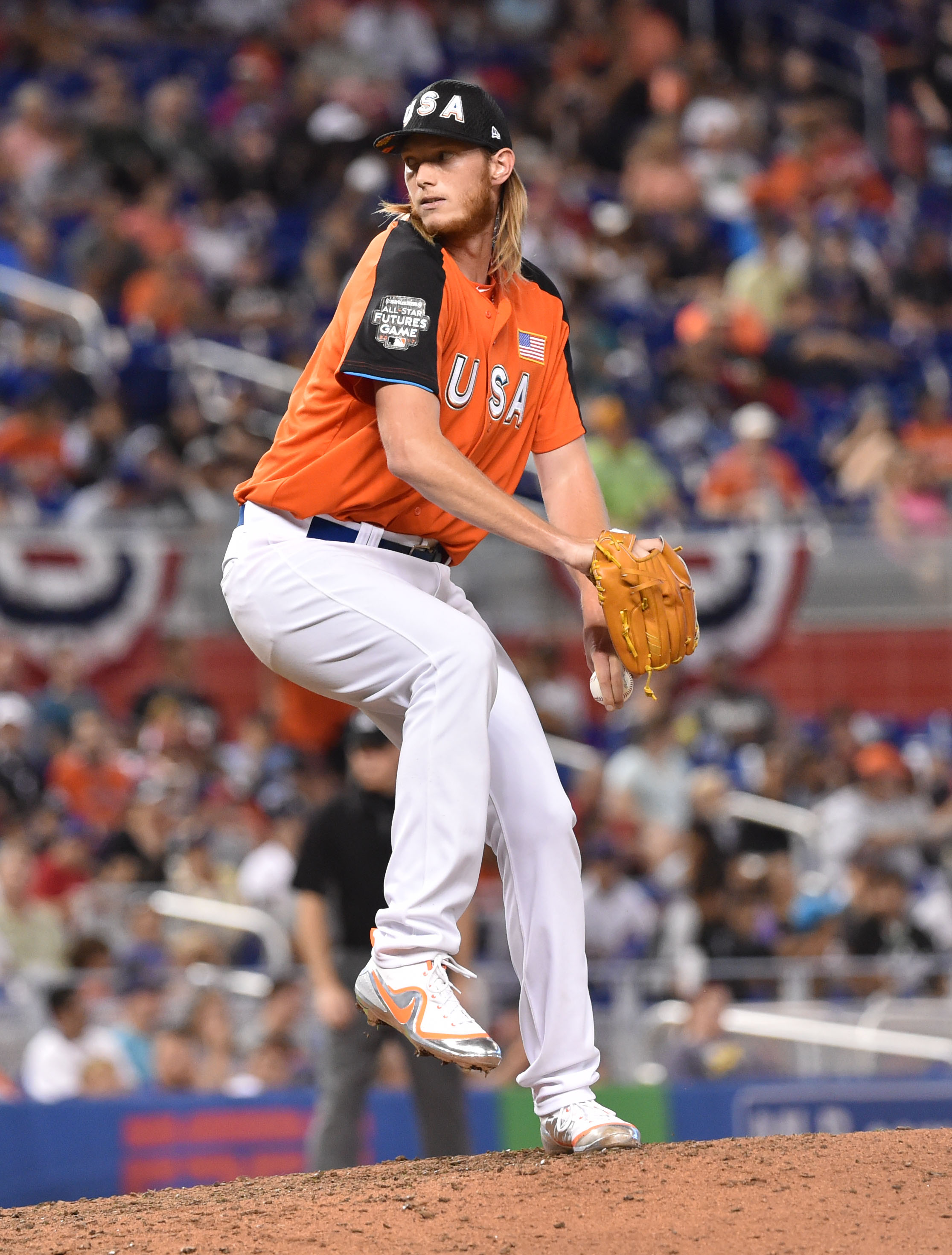
Puk, 24, is considered by virtually every major prospect outlet to be among the game’s top 50 prospects. He’s viewed as a potential key piece to the Athletics’ rotation down the road, but he’s been working primarily in relief this season as he works back from 2018 Tommy John surgery. The towering 6’7″ southpaw has a lackluster 4.97 ERA in 25 1/3 minor league innings this season, but he’s also punched out 38 hitters against 10 walks in that time.
Fangraphs currently rates Puk as baseball’s No. 21 prospect, putting a 65 grade on his fastball, a 60 on his slider and giving him the potential for two more average or better offerings in his changeup and curveball. MLB.com lists Puk 43rd among MLB prospects and dropped a 70 grade on his heater with a 65 on his slider. Puk, who paced all minor league starters with 13.2 K/9 in his last full season back in 2017, is touted as a potential No. 2 starter at the Major League level. He’ll likely get the opportunity to make good on those bullish forecasts in 2020, alongside the likes of Sean Manaea, Frankie Montas and perhaps fellow ballyhooed left-hander Jesus Luzardo, but for now he’ll step into Bob Melvin’s bullpen and look to help shut things down in the late innings.
Oakland has three left-handers in the ‘pen at the moment, with Jake Diekman, Wei-Chung Wang and Ryan Buchter all giving Melvin southpaw options. All three of those southpaws have had issues with commanding the strike zone, though, and none can match Puk’s overall ceiling as a game-changing relief weapon. Taking a broader look, Oakland has seen closer Blake Treinen follow up a dominant 2018 campaign with a dismal 2019 showing. Fellow righty Lou Trivino has taken similar steps backward, leaving the A’s with a bullpen that’s been weaker than they anticipated.
By promoting Puk now, the A’s will be positioning themselves to control him through 2025 season, although future optional assignments to the minors could yet impact that timeline. If he’s in the big leagues from Tuesday through season’s end, he’ll accrue 41 days of big league service, though, meaning in order to push his path to free agency back until the 2026-27 offseason, the A’s would need to keep him in Triple-A for nearly two months next season. In other words, this appears quite likely to be a chance for Puk to cement himself as a big leaguer and leave the minor leagues behind. If he is indeed in the Majors for good, he wouldn’t be eligible for arbitration until after the 2022 season.