
Tigers, Assistant GM David Chadd Part Ways
The Tigers and assistant GM David Chadd have mutually agreed to part ways, Chris McCosky of the Detroit News was among those to report. According to McCosky, the sides discussed the possibility of Chadd remaining in the organization in a different role, but that did not end up coming to fruition.
Chadd, who had two years left on his contract, had previously served as scouting director, and as assistant GM was former GM Al Avila’s second in command prior to Avila’s firing in August. This change comes on the heels of the Tigers hiring Scott Harris to be their president of baseball operations in September. Harris had previously been GM for the Giants under Farhan Zaidi and an assistant GM under Theo Epstein with the Cubs.
In parting ways with a longtime Avila associate like Chadd, the Tigers make room in the front office for Harris to make his own hires to staff Detroit’s baseball operations department. In addition to Chadd’s assistant GM role, Harris is expected to look for a GM to serve as his own second in command this offseason.
Additionally, the Tigers decided not to renew the contract of senior director of medical services Kevin Rand, as Evan Petzold of the Detroit Free-Press first reported. Head athletic trainer Doug Teter is replacing Rand (although his official title has yet to be determined), while strength and conditioning coordinator Steve Chase will not be back with the club, per Petzold.
Harris and anyone else who joins the Tigers front office will have their work cutout for them this offseason. Despite being frequently cited as a possible sleeper team entering the 2022 season and making a splash in free agency by signing Eduardo Rodriguez and Javier Baez, Detroit had a brutal 66-96 record this year, finishing fourth in a weak AL Central, just one game ahead of the fifth place Royals.
Offseason Chat Transcript: Colorado Rockies
MLBTR is holding live chats specific to each of the 30 teams as the offseason nears. In conjunction with the recent offseason outlook for the Rockies, Anthony Franco hosted a Rockies-specific chat. Click here to view the chat transcript.
The Orioles Struck Waiver Gold Last November
The last time left-hander Cionel Perez was tagged on a post at MLBTR was 11 months ago, when the Orioles announced they’d claimed him off waivers from the Reds. Ditto righty Bryan Baker, whom the Orioles claimed from the Blue Jays two weeks prior. They were the definition of innocuous offseason moves at the time: a last-place team claiming a pair of little-known relievers who’d been waived by non-playoff clubs performing garden-variety 40-man roster maintenance. The moves were met with the expected cynicism associated with waiver claims of this ilk.
At the time, it wasn’t wholly clear whether either would even survive the offseason on Baltimore’s 40-man roster. Perez was out of minor league options, so he’d have to win a big league spot during Spring Training or else be subjected to waivers a second time. It’s not at all uncommon for fringe 40-man players in that spot to eventually be designated for assignment when a team signs a free agent, acquires an established player via trade, or claims someone else on waivers.
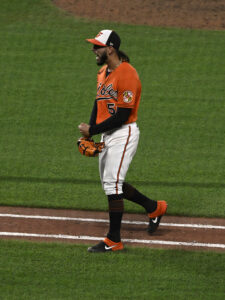
Fortunately for the O’s, both Perez and Baker indeed survived the winter on their 40-man roster. Perez fired six shutout innings with just three hits and two walks against seven strikeouts during the truncated Spring Training. Baker tossed four innings of one-run ball. Both found their way onto the Opening Day roster. Prior to this year, Perez had pitched to a 6.04 ERA in 50 2/3 MLB innings, including a 6.38 mark in 2021. Baker had one MLB inning to his name.
Before long, Perez found himself building a strong start to his 2022 season, however, solidifying his hold on a place in Brandon Hyde’s bullpen. He opened the year with 9 2/3 shutout frames, and while an 8-to-4 K/BB ratio along the way was a bit less impressive, he followed that strong first month with seven more innings of one-run ball and an 8-to-2 K/BB ratio. By the time the Orioles’ game on June 1 drew to a close, Perez had pitched 16 2/3 innings with a 0.55 ERA, a 25.8% strikeout rate, a 10.6% walk rate and a 51.2% ground-ball rate.
Along the way, Perez increasingly began to incorporate a new pitch into his repertoire: a power sinker that averaged a hearty 96.6 mph. He’d never thrown a sinker in a Major League game before, and Perez used the offering sporadically through the season’s first three months, only flashing it 9.6% of the time. In mid-July, however, Perez committed to the pitch more decisively, and from July 16 through season’s end he used that new sinker at a 22.4% clip. His four-seamer, which he’d previously thrown 52.4% of the time, saw its usage rate dip to 36.9%.
Perez posted a sparkling ERA both pre-sinker and post-sinker, but the secondary numbers suggest that Perez’s success with the sinker was more sustainable than without. Once he leaned more heavily into the new pitch, he fanned 25.2% of his opponents, walked 9.0% of them, induced grounders at a 52.8% rate and yielded an 88.2 mph average exit velocity. Prior, those rates were 22%, 8.9%, 50% and 89.6 mph. The gains weren’t Earth-shattering, but Perez’s results were better once he gained more comfort with his new pitch. Seventy percent of the sinkers that were put into play against Perez were grounders.
Good as Perez was in 2022, there’s likely some regression in store. His .284 average on balls in play isn’t especially fortunate, but few pitchers can sustain marks as low as Perez’s 0.31 HR/9 and 4.3% homer-to-flyball ratio. He’s also unlikely to continue stranding 87.4% of his runners moving forward — a rate that ranked ninth in MLB (min. 50 innings) behind a collection of some of the game’s most proficient strikeout artists. Still, there’s not much about his 2022 season that portends a complete implosion next year.
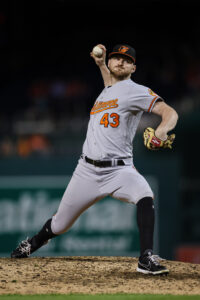
Baker took the opposite route of Perez, getting hit hard and hit often early in his first extended look at the MLB level. Through June 19, he’d been tagged for a grisly 5.60 ERA in 27 1/3 innings of bullpen work. The O’s opted to stick with him rather than option him to Triple-A, however, and they’re likely quite glad they did.
Baker threw his changeup less than 10% of the time in those first two-plus months but more than doubled his usage to 21.4% from late June through season’s end. Meanwhile, he continued to up his fastball velocity, averaging 97.3 mph over the final few months after sitting just 95.2 mph through his first 27 1/3 innings. From June 24 through season’s end, Baker posted a 2.13 ERA, 29.6% strikeout rate and 8.9% walk rate.
It’s an open question whether he can sustain the velocity gains he picked up during the season, but his changeup was a devastating out pitch for him down the stretch. Baker finished off 48 plate appearances with a changeup in 2022, surrendering only two hits (both singles) and racking up 25 strikeouts in the process. Statcast credits him with a hearty 37.7% whiff rate on the pitch and gives his opponents credit for an expected wOBA of just .123. Hitters averaged just 83.1 mph off the bat when they put Baker’s changeup in play — with 55% of those batted balls taking the form of grounders.
Neither Perez nor Baker will draw the fanfare of up-and-coming Baltimore stars like Adley Rutschman and Gunnar Henderson, but that doesn’t mean they can’t fill key roles as the team looks to continue its emergence from an arduous rebuild. Perez is controllable for another four seasons, and Baker can be controlled for five more years. There’s some obvious volatility when it comes to year-over-year performance with relievers, so perhaps Perez and/or Baker will come crashing back to Earth at some point. For now, however, the O’s have what looks like a pair of setup men they acquired for free — a quality lefty/righty combo that’ll help to form a bridge to fellow out-of-the-blue breakout Felix Bautista.
Keep in mind that this is the same Orioles team that traded another waiver wire All-Star, Jorge Lopez, prior to the Aug. 2 trade deadline. Building quality bullpens has proven to be an Achilles heel for countless front offices, but at least for the 2022 season, the O’s made it look downright easy. Their ability to continue doing so could well be as important to turning the tide as the arrival of many of the system’s vaunted top prospects.
The Guardians Have Some Middle Infield Decisions To Make
Two months ago, I wrote about Andres Gimenez‘s 2022 breakout and how it was a critical factor in propelling the Guardians toward what would eventually be their first division title since 2018. Gimenez finished strong following that Aug. 30 writing, going on to bat .282/.387/.385 in his final 137 plate appearances.
For the season on the whole, Gimenez batted .297/.371/.466 with 17 home runs, 26 doubles, three triples and 20 steals — pairing that all-around offensive value with some of the game’s best defense at second base. Even if you expect some regression based on this year’s .353 average on balls in play — Statcast pegged him with an “expected” .257 batting average, based on the quality and frequency of his contact — Gimenez still looks like a strong defensive infielder with quality on-base percentages, some power and plenty of speed.
The excellence of Gimenez’s season goes a long way toward justifying the organization’s trade of Francisco Lindor, at least from a pure roster standpoint. Lindor was terrific in his second season with the Mets, but Guardians ownership was never going to give Lindor the type of contract he received in Queens, and Gimenez showed that he can be a building block himself. With four years of club control remaining, he could be — or at least should be — an offseason extension candidate.
Of course, Gimenez alone was not the sole return for Lindor. Also acquired in that swap was another longtime top infield prospect of the Mets: Amed Rosario (plus outfielder Isaiah Greene and right-hander Josh Wolf). Soon to turn 27, Rosario perhaps hasn’t lived up to the sky-high expectations set when he was ranked among the top five to ten prospects in all of baseball, but he’s settled in as a solid option for the Guardians at shortstop. He hit .283/.312/.403 in 670 plate appearances this season, bringing his collective output in two seasons with Cleveland to .282/.316/.406. By most metrics, this was also his best defensive season (though Statcast disagreed, grading him at seven outs below average).
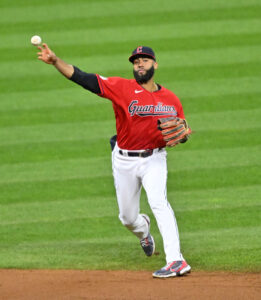
Unlike Gimenez, however, Rosario’s contract status isn’t quite so favorable. Despite his youth, Rosario debuted with the Mets way back in 2017 and spent three full seasons as a regular with them. As such, he came to the Guardians with “only” three seasons of club control remaining. He’s now coming up on the third and final of those three seasons.
Rosario not only has just one season of club control remaining — he has one relatively expensive season of control remaining. MLBTR contributor Matt Swartz projects a $9MM salary for Rosario next year in his final season before free agency. For a solid everyday shortstop with at least an average bat, that’s a reasonable price to pay. Rosario hit 11 home runs, stole 20 bases, knocked 26 doubles and paced the Majors with nine triples. Baseball-Reference’s version of wins above replacement (which uses Defensive Runs Saved as the primary defensive component) pegged him at 4.1 WAR. FanGraphs’ version (which uses Ultimate Zone Rating and Statcast’s OAA) pegged him at 2.3 WAR. Any way you slice it, Rosario looks like a good value at that rough price point.
Then again, that’s simply looking at the situation in a vacuum — which few front offices have the luxury of doing. That $9MM figure would’ve represented about 13% of the Guardians’ Opening Day payroll from the 2022 season. Cleveland only has a combined $18MM in guarantees on next year’s books, but their arbitration class could tack another $37MM or so onto the ledger. Add in another 15 pre-arbitration players at or around next year’s $720K league minimum, and the Guardians are right back to the $68-69MM mark at which they opened this past season — before making a single addition.
Granted, the strength of Cleveland’s young players is a large reason they defied expectations and won the AL Central in 2022, and it’s justifiable to suggest that they could effectively run out nearly the same group again in 2023 and be competitive. Doing so, however, would rely on replicating this year’s uncanny level of health; the Guardians had by far the fewest IL days of any team in baseball. There’s also the simple fact that even with a roster good enough to take the division, the Guards fell in the ALDS. The very fact that they had a postseason run at all could provide some extra revenues and boost payroll in 2023, but the extent to which that might be true isn’t clear at this juncture.
Beyond the payroll implications is the simple fact that Cleveland is rife with middle-infield options and could look to fill Rosario’s role internally while reallocating that salary to other areas of need. Gimenez rose through the minors as a shortstop and has thrived there in limited Major League work, posting six Defensive Runs Saved, five Outs Above Average and a 2.3 Ultimate Zone Rating in just 452 innings. There’s good reason to believe that he could slide to the other side of the bag and not only handle the position but even improve Cleveland’s infield defense.
Looking beyond Gimenez and Rosario, Tyler Freeman and Gabriel Arias both made their MLB debuts in 2022 and have been considered among the organization’s best prospects for the past couple seasons. Neither hit much in the Majors, and Arias struggled in Triple-A as well, but both are young and at least on the cusp of MLB readiness. Freeman, who fanned in just 9.3% of his Triple-A plate appearances, seems to fit a brand of Cleveland baseball that particularly emphasizes bat-to-ball skills.
Elsewhere in the minors, the Guardians have touted 21-year-old Brayan Rocchio, though he has just 33 games in Triple-A under his belt and struggled at the plate as one of the younger players in that league. Jose Tena gives Cleveland yet another 21-year-old middle infield option who’s already reached Triple-A; he’s not as highly touted as Rocchio but did bat .267/.306/.419 between Double-A and Triple-A in 2022.
Depending on which of the in-house middle infield prospects forces his way onto the big league roster first, Cleveland could deploy Gimenez at either middle infield spot. Freeman, for instance, has played plenty of shortstop but is generally regarded as a future second baseman. Rocchio and Arias, meanwhile, have drawn plus grades for his glovework at shortstop in scouting reports — as did Gimenez during his prospect days. The logjam of talented, young, up-the-middle defenders is hardly a true “problem” for the Guardians, though, and Gimenez’s ability at either spot gives the team the luxury of letting the situation play itself out in Spring Training and early next season.
Suffice it to say, there are plenty of options for Cleveland in the middle infield if they look to move Rosario and spend the roughly $9MM or so he’d command in another manner, be it in the outfield, behind the plate or to deepen an already excellent pitching staff. The question facing the front office this winter is whether it’s prudent to spend more than 10% of the 2023 budget on Rosario when the organization is flush with talented middle-infield options who could play a key big league role for the league minimum.
There’s certainly an alternative scenario where they keep Rosario and trade some middle-infield talent to bolster another position on the roster, so Rosario shouldn’t necessarily be viewed as a sheer lock to be traded. That said, history tells us the Cleveland organization will be plenty comfortable listening to offers on him this offseason. And, given the number of teams that are on the lookout for middle infield help every offseason — and the number of teams for which that projected $9MM salary wouldn’t be nearly so cumbersome — it’s easy enough to connect the dots and see that a trade is at the very least quite plausible.
Marlins Down To Four Managerial Finalists
11:30am: Heyman tweets that the Marlins have narrowed the group down to four and expect to make a decision soon. Heyman tweets that the Marlins have narrowed the group down to four and expect to make a decision soon. Raul Ibanez was interviewed early in the process but is not among the four, Heyman adds.
Craig Mish of SportsGrid and the Miami Herald reports that former Mets skipper Luis Rojas, who’s currently the Yankees’ third base coach, also secured a second interview, suggesting that he’s the fourth (and apparently last) finalist in the mix for the job.
9:37am: The Marlins are continuing to narrow the field in their search for manager Don Mattingly’s successor and have deemed a handful of names to be finalists in their search. Per Marc Topkin of the Tampa Bay Times, Rays bench coach Matt Quatraro and Astros bench coach Joe Espada are among a “small field” of finalists in Miami. Jon Heyman of the New York Post adds Cardinals bench coach Skip Schumaker to the list of finalists.
Both Quatraro and Espada were considered finalists in last offseason’s Mets managerial search, before the team ultimately hired a more experienced option in the form of veteran Buck Showalter. The Marlins, it seems, are taking a different approach; the entire group of known candidates to have interviewed in Miami would be first-time managers at the big league level. Quatraro and Espada have both interviewed with at least five teams for managerial vacancies in recent years.
Schumaker, meanwhile, is a fast-rising name in the coaching ranks himself. The former big league utilityman was playing in the Majors as recently as 2015 and landed his first Major League coaching gig when the Padres named him first base coach in the 2017-18 offseason. San Diego eventually elevated him to the unusual title of “associate manager,” before the Cardinals, for whom he played eight Major League seasons, tabbed him as their new bench coach a year ago. Along the way, Schumaker has also interviewed for managerial vacancies with the Mets and Red Sox.
Other names known to have interviewed thus far include Royals bench coach Pedro Grifol and Phillies third base coach Dusty Wathan. Braves bench coach Walt Weiss reportedly declined an opportunity to interview, though the fact that there was even interest suggests that the Marlins aren’t dead-set on hiring a rookie skipper. Weiss spent four seasons as the Rockies’ manager from 2013-16.
Poll: Who’s Going To Win The World Series?
Baseball’s new expanded playoff format has resulted in a unique David vs. Goliath matchup in the World Series. In the first year of a sixth playoff team, the Phillies immediately became the first sixth seed to reach the Fall Classic, scoring upsets over the Cardinals, Braves, and Padres along the way to claim the National League pennant. In the American League, the top-seeded Astros held serve and swept both the Mariners and Yankees for a perfect 7-0 record in these playoffs.
Ironically, the Phillies and Astros met in their final series of the regular season, and Philadelphia didn’t actually clinch its ticket to the postseason until a 3-0 win over Houston on October 3. 2022 was almost like two seasons in one for the Phillies, as the team held a 22-29 record when Joe Girardi was fired on June 3, yet the change to interim manager (and now full-time manager) Rob Thomson immediately provided a spark. The Phils went 65-46 the rest of the way to earn their first postseason berth since 2011.
The roll has continued through October, with the Phillies knocking out three higher-seeded opponents due to a mix of strong pitching and timely hitting. While several Philadelphia players have had heroic moments, the 2022 postseason is increasingly looking like Bryce Harper‘s moment, as the slugger is batting .419/.444/.907 with five home runs during the playoffs. Trailing the Padres 3-2 in the eighth inning of today’s Game 5, Harper crushed a two-run homer that put Philadelphia ahead for good in the 4-3 clinching victory, and unsurprisingly captured NLCS MVP honors.
Harper and the rest of the Phillies lineup will be challenged, however, by Houston’s dominant pitching staff. The Astros have a collective 1.88 ERA over 72 postseason innings, with more strikeouts (89) than hits (46) and walks (21) combined. The “weak link,” so to speak, is Justin Verlander with a 6.30 ERA over 10 innings, as Verlander was hit hard by the Mariners in Game 1 of the ALDS — however, the future Hall-of-Famer rebounded with a dominant six-inning performance against New York in Game 1 of the ALCS.
Considering how Jose Altuve and Kyle Tucker have been struggling at the plate throughout October, the scariest part of Houston’s 7-0 record is that the team is arguably not even firing on all cylinders. The Astros cruised to a 106-56 mark during the regular season and is now back in the World Series for the second consecutive year, and the fourth time in six years. The only Series triumph came in 2017, and since that title is forever shrouded in controversy by the sign-stealing scandal, winning another championship might be the only way for the Astros to escape that cloud and earn more recognition as a mini-dynasty.
Houston is 1-3 in previous trips to the World Series, while the Phillies are 2-5 with their last championship coming in 2008. This isn’t the first postseason meeting between the two franchises — back when the Astros were a National League team, Philadelphia and Houston met in the 1980 NLCS. In what was when a five-game maximum, the Phillies needed all five games to barely outlast the Astros in a series regarded as a classic. The Phils went on to win their first-ever World Series crown that same year, and Philly fans can only hope that karma repeats itself in this latest matchup against the Astros.
Who’s your pick to win?
(poll link for app users)
Who Wins The World Series?
-
Houston Astros 62% (17,383)
-
Philadelphia Phillies 38% (10,506)
Total votes: 27,889
Nestor Cortes Leaves ALCS Game 4 Due To Groin Injury
Yankees starter Nestor Cortes was removed from Game 4 of the ALCS after two-plus innings of work due to what the team described as a left groin injury. Cortes allowed only a single and a walk in his first two frames, but walked his first two batters of the third inning and then allowed a three-run homer to Astros shortstop Jeremy Pena. Cortes was replaced by Wandy Peralta after the Pena home run.
Manager Aaron Boone and a team trainer briefly visited Cortes on the mound after the initial walk, but elected to leave the southpaw in the game. Later, during an in-game interview with TBS reporter Lauren Shehadi, Boone said that Cortes had been dealing with a groin problem throughout the postseason. Cortes made two starts against the Guardians in the ALDS, with a solid 2.70 ERA over 10 innings of work. The Yankees won the second of Cortes’ outings, the series-clinching Game 5.
Cortes missed a little over two weeks on the 15-day injured list with a left groin strain in late August and early September, so it would seem like this current injury may have been a recurrence of that original problem. Further roster maneuvers may soon be a moot point for the Yankees since they trail the Astros by a 3-0 deficit in the ALCS, though if they force a Game 5 and have to replace Cortes on the roster, the left-hander wouldn’t be eligible to participate in the World Series if New York did launch a miracle comeback.
Quick Hits: Reds, Wheeler, Morel, Rays Ballpark
The Reds had a longstanding interest in Zack Wheeler as both a trade target and then when the righty entered free agency in the 2019-20 offseason. Bobby Nightengale of the Cincinnati Enquirer recently revisited that free agent pursuit, which ended when the Phillies signed Wheeler to a five-year, $118MM contract. According to Nightengale, the Reds were also willing to spend beyond $100MM to sign Wheeler, but they may have been undone by geography more than just dollars. Wheeler prioritized staying on the East Coast and closer to his wife’s home state of New Jersey, giving the Phils the edge over both the Reds and the White Sox (who reportedly offered more than $118MM).
Needless to say, signing Wheeler would’ve changed the entire trajectory of recent Reds history, not to mention the Phillies’ last three seasons and their current berth in the 2022 World Series. As Nightengale notes, the Reds went on to sign Nick Castellanos (for $64MM over four years) and Shogo Akiyama ($21MM over three years) after Wheeler left the market, and it isn’t known if either of those deals could’ve or would’ve still happened if Cincinnati had made its big investment in Wheeler’s contract.
More from around the baseball world…
- Christopher Morel had a solid rookie season, hitting .235/.308/.433 with 16 home runs over 425 plate appearances for the Cubs. Beyond his contributions at the plate, Morel also started games as a second baseman, third baseman, shortstop, center fielder, and left fielder. ‘There’s not many guys in the big leagues that can do what he does, the consistency he’s shown at times in each position,’’ Cubs assistant coach Jonathan Mota told Maddie Lee of the Chicago-Sun Times. A super-utility role would make Morel a valuable commodity on the roster, and both Morel and the Cubs seem committed to continuing his prep work at multiple positions going forward.
- Tampa-area businessman Darryl Shaw recently bought 25 acres of waterfront land in the Ybor City neighborhood, and as John Romano of the Tampa Bay Times explains, Shaw tried in the past to work with the Rays in other ventures in the Ybor area. Shaw’s new land purchase might therefore revive the idea of a new Rays ballpark in downtown Tampa, though Romano notes that this could be a long shot for a variety of reasons, including a lack of committed civic funding and the Rays’ increased interest in a new park (and accompanying “baseball village” infrastructure) built on the grounds of Tropicana Field in St. Petersburg. Any number of proposals involving Tampa, St. Pete, and even Montreal have been floated over the years as the Rays look for a new home, and it remains to be seen if any answer can be found before the club’s lease at the Trop expires after the 2027 season. Rays team president Matt Silverman said that “city and county officials on both sides of the bay seem to appreciate the value of baseball and are focused on finding a solution. The discussions are going on simultaneously in a parallel, non-competitive, non-adversarial way. Everyone understands time is of the essence.”
How The Phillies Built Their NL Championship Team
After reaching the postseason in 2011, the Phillies didn’t even post another winning record until their modest 82-80 effort in 2021. Between the dismantling of their 2008 championship core, a rebuild, and then a few stalled attempts at returning to contention, it has often been a frustrating (phrustrating?) decade for Philadelphia baseball fans…until, suddenly, it wasn’t. The Phillies went 87-75 this season to claim the final NL wild card berth, and then upset the Cardinals, Braves, and Padres in a magical playoff run that has resulted in the franchise’s eighth National League pennant.
Given this recent history, the Phillies’ emergence can be seen as both unexpected and overdue. President of baseball operations Dave Dombrowski (who has taken his fourth different organization to the World Series) deserves a great deal of credit for putting the Phillies over the top, though the roots of Philadelphia’s roster also extend back to former general managers Matt Klentak and Ruben Amaro Jr.
While the 2022 team received contributions from several players who have since been traded, released, sent to the minors, or simply not selected for the postseason rosters, let’s take a look at the collection of players who have fueled this run back to the World Series…
Homegrown, international signings: Seranthony Dominguez (2011), Ranger Suarez (2012)
For casual fans who may be only getting to know Dominguez and Suarez this postseason, it may be surprising to learn that they are longtime organizational mainstays. Both were signed at age 16 for a modest $25K bonus, and their development into key arms is yet another example of why MLB teams continue to scout and invest in the international market.
Dominguez made his MLB debut in 2018, but after pitching well out of the bullpen in his first two seasons, he missed almost all of the 2020-21 campaigns due to Tommy John surgery. Returning to action this year, Dominguez didn’t miss a beat in posting a 3.00 ERA over 51 innings, emerging as the team’s top choice for high-leverage situations in both the regular season and playoffs.
Suarez also debuted in 2018, and his early promise as a swingman also hit a health-related roadblock when he missed most of the 2020 season recovering from COVID-19. The Phillies continued to use Suarez both out of the rotation and in the pen in 2021 before converting him into full-time rotation work this year, with solid results. The southpaw posted a 3.65 ERA over 155 1/3 innings and 29 starts, and he has continued to thrive in the postseason with a 2.16 ERA over 8 1/3 frames.
Homegrown, amateur draft: Aaron Nola (2014 draft, first round, seventh overall pick), Rhys Hoskins (2014, 5-142), Bailey Falter (2015, 5-144), Dalton Guthrie (2017, 6-173), Nick Maton (2017, 7-203), Connor Brogdon (2017, 10-293), Alec Bohm (2018, 1-3), Matt Vierling (2018, 5-137), Bryson Stott (2019, 1-14)
The lack of a consistent minor league pipeline has been a sore spot for the Phillies over the last decade, as while Nola and Hoskins were standouts, several other highly-touted prospects either didn’t have success in the majors or didn’t even make the big leagues whatsoever. Homegrown prospects don’t necessarily need to be stars, but it certainly helps when a team can fill roster holes from within, which is why the contributions of Brogdon, Vierling, Falter, Guthrie, and Maton have all raise the roster’s talent floor. Falter and Brogdon in particular became regulars in the rotation and bullpen, while Vierling received a lot of playing time before the Phillies finally acquired Brandon Marsh to address their center field need.
Nola and Hoskins continue to be productive, while Bohm and Stott have now broken out as first-round picks making an impact. Bohm bounced back from a rough 2021 to become the Phillies’ regular at third base, and Stott also looks to be an infielder of the future after becoming the everyday shortstop. While it remains to be seen if either player will remain at those positions down the road, that isn’t an issue for the 2022 squad.
Free agent signings: Bryce Harper, Zack Wheeler, Kyle Schwarber, Nick Castellanos, Brad Hand, Andrew Bellatti, Corey Knebel (injured)
John Middleton became the managing partner of the Phillies’ ownership group in 2015, and after waiting out a few rebuilding years, Middleton was ready to “maybe even be a little bit stupid about” increasing the payroll. The heavier spending really started with the signings of Jake Arrieta and Carlos Santana during the 2017-18 offseason, but things really kicked into high gear when Harper was inked to a 13-year, $330MM free agent deal in February 2019. Essentially from the moment the contract was signed, there was speculation whether or not Harper was really worth such a massive investment, and yet it’s safe to say that those doubts have been silenced. Harper’s first four seasons in Philly have included a .282/.394/.546 slash line, 101 homers, the 2021 NL MVP Award, and a scorching run through the postseason (including NLCS MVP honors).
Klentak oversaw the Harper signing, as well as Wheeler’s addition on a five-year, $118MM contract the next offseason. Dombrowski has been no stranger to big contracts over his front office career, and when he took over in the front office following the 2020 season, the Phils continued to hand out the dollars — this past winter, it was $100MM over five years for Castellanos, and $79MM over four years for Schwarber.
It isn’t always a strategy that works, and the Phillies themselves have enough high-profile free agent misses to act as evidence that a team can’t simply buy their way to success. And yet with an ownership group willing to exceed the luxury tax, this spending has worked out because Harper, Wheeler, and Schwarber have more than held up their ends of the deal. Even Castellanos has contributed some key hits in the playoffs, after struggling during much of the regular season. Beyond these big-ticket contracts, the Phils also scored on smaller deals with relief pitchers, as Hand, Bellatti (signed to a minor league deal), and Knebel were all effective. Knebel unfortunately hasn’t been a part of Philadelphia’s October run, as a torn shoulder capsule ended his season in August.
Trades: J.T. Realmuto, Jean Segura, Brandon Marsh, Noah Syndergaard, Kyle Gibson, David Robertson, Zach Eflin, Edmundo Sosa, Garrett Stubbs, Jose Alvarado, Nick Nelson
The Phillies’ aggressiveness also manifested itself on the trade market, headlined by the blockbuster deal with the Marlins that brought Realmuto to Philadelphia in 2019. With Realmuto re-signing with the Phils in free agency on a five-year, $115.5MM deal, he is now locked up through the 2025 season, turning the trade even into more of a win for the Phillies.
Since Segura was acquired back in December 2018, fans may have forgotten just what a fascinating deal it was that brought him from the Mariners. Segura filled a hole for a team that was ready to win immediately, and as it turned out, Seattle also picked up a cornerstone infielder in J.P. Crawford (as well as Santana’s contract). Segura is entering the last year of his contract and it remains to be seen if he’ll return in 2023, yet his contributions in Philadelphia will always be appreciated. Segura provided above-average offense while acting as an everyday shortstop and second baseman in his four seasons, plus a little time at third base.
With the Phillies battling for a wild card berth for much of the season, the trade deadline was a key moment for adding reinforcements for the stretch run. In landing Marsh and Syndergaard (in separate trades) from the Angels, Sosa from the Cardinals, and Robertson from the Cubs, Dombrowski went 4-for-4 in upgrades, as the quartet each provided important contributions. Marsh may be the biggest acquisition of the lot, as the former top-100 prospect now looks like the answer to the Phillies’ longstanding hole in center field.
Gibson was the big get at the 2021 deadline, as Gibson, Ian Kennedy, and prospect Hans Crouse were acquired from the Rangers for a three-player package. Unfortunately, this swap didn’t really work out, as Gibson has delivered only a 5.06 ERA over 236 2/3 innings in a Phillies uniform over the last two seasons. Still, Gibson has at least eaten some innings, and is now available on the postseason roster as a long relief option.
Eflin was part of two major trades within a two-day span back in December 2014, first dealt from the Padres to the Dodgers as part of the five-player swap that sent Matt Kemp to San Diego and Yasmani Grandal to Los Angeles. The Dodgers then flipped Eflin (and lefty Tom Windle) to the Phillies for Philadelphia icon Jimmy Rollins, putting some extra pressure on Eflin before he ever stepped onto a mound in the City of Brotherly Love. Eflin has been a mostly consistent and even underrated back-of-the-rotation arm over his seven seasons with the Phils. Due to another bout of knee problems that led to a 60-day IL stint during the season, Eflin has been used as a reliever rather than as a starter during the playoffs, pitching in six of the Phils’ 11 games.
It’s easy to be overlooked as Realmuto’s backup catcher, but after Stubbs was acquired from the Astros last November, he won that backup role and ended up appearing in 46 games in the regular season. Already known as a solid defensive catcher, Stubbs showed some offensive ability for the first time in his four MLB seasons, hitting an impressive .264/.350/.462 over 121 plate appearances.
Several relievers have already been mentioned in this post, and the Phillies’ bullpen was still something of a question mark even this season, though the relief corps has done its job in getting the team to the brink of a championship. Alvardo was acquired from the Rays in December 2020 following two injury-plagued seasons, and the southpaw’s 3.71 ERA over 106 2/3 IP has been a tightrope walk, defined by a lot of strikeouts (32K%) and a lot of free passes (15.3% walk rate). Nelson has also been shaky, posting a 4.85 ERA and an NL-leading 13 wild pitches in 68 2/3 frames since being acquired from the Yankees in a four-player trade last November.
Offseason Chat Transcript: Washington Nationals
In conjunction with our recent Offseason Outlook post on the Nationals, we held a reader live chat devoted to Nats-related topics. Click here to read the transcript.