
Brandon Crawford Announces Retirement
Giants legend and long-time shortstop Brandon Crawford has announced his retirement in a post on his personal Instagram account today. The Giants announced (X link from Justice delos Santos of The Mercury News) that Crawford will be celebrated at the club’s upcoming game on April 26, when they will be hosting the Rangers, managed by Crawford’s former skipper Bruce Bochy.
“Growing up in the Bay Area and going to games at Candlestick,” Crawford says, “I always dreamed of playing for the San Francisco Giants. Being drafted by my hometown team and spending most of my career with them far surpassed any dream I had as a kid. I definitely pretended to win a World Series in my backyard – but winning two? That was beyond my wildest dreams.” He goes on to express gratitude to that organization as well as the Cardinals, his family members, coaches, teammates, fans and many others who he crossed paths with.
As Crawford himself mentioned, he could hardly have asked for more of the platonic childhood baseball dream. In 2008, he was drafted by the club he grew up cheering for, with the Giants selecting him in the fourth round out of UCLA. In 2010, the Giants won the World Series, their first title since the club moved from New York to San Francisco. However, Crawford was still a minor leaguer at that time.
He was able to make his major league debut in late May of 2011, and he did so in memorable fashion. In his first game in the show, he hit a grand slam in the seventh inning, his first major league hit (YouTube link from MLB). That gave the club a 5-3 lead over the Brewers and they held on to win 5-4. Despite that notable start, the first season wasn’t great overall. He hit just .204/.288/.296 and only got into 66 games. The Giants finished 86-76 and missed the playoffs.
In 2012, Crawford took a firmer hold of the shortstop job in San Francisco, getting into 143 games. His offense still wasn’t especially impressive but it was better than the year prior and his defense was well regarded. The club went 94-68, winning the National West and advancing to the postseason. Crawford hit just .217/.321/.283 in the playoffs but the Giants went on to defeat the Reds, Cardinals and Tigers, earning their second title in three years.
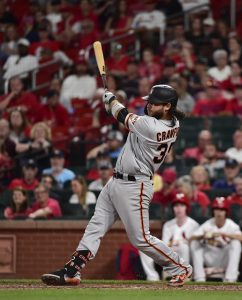
The following year, Crawford’s performance held fairly steady. His offense was again a bit below league average but with strong shortstop defense. However, the Giants slid to 76-86, well out of contention. They came back in 2014, with an 88-74 record that was enough to snag a Wild Card spot. At that time, there were just two such spots per league and those clubs faced off in a one-game, winner-take-all matchup. The Giants cruised through that game with an 8-0 victory, then defeated the Nationals, Cardinals and Royals to secure yet another title. The Giants had three trophies in five years and Crawford had two rings with his hometown club before his 28th birthday.
Crawford had his best offensive season to date in 2015, as he hit 21 homers with a .256/.321/.462 slash line. He made his first All-Star Game and collected both a Silver Slugger and his first Gold Glove award. While the team’s performance fell off, Crawford emerged as a legitimate star. The Giants recognized as much and signed him to a six-year, $75MM extension.
It was more of the same in 2016. Crawford hit .275/.342/.430 while continuing to play elite shortstop defense. He won his second straight Gold Glove and found his name on MVP ballots for the first time. Crawford’s offense dropped over the next few years, but he continued to play excellent defense. He earned a third straight Gold Glove in ’17 and another All-Star appearance in ’18.
While Crawford appeared to be on the downswing of his career toward the end of the 2010s, he hit surprisingly well in the shortened ’20 season. It would’ve been easy to write that off as a small sample blip if Crawford didn’t follow that up with a monster year. At age 34, Crawford set a career mark with 24 homers while hitting .298/.373/.522 in 138 games. He earned another Gold Glove and All-Star nod and finished fourth in NL MVP balloting as the Giants reeled off 107 wins to secure their first division title in a decade.
San Francisco re-signed their longtime shortstop to a two-year, $32MM extension on the heels of that resurgent showing. Neither Crawford nor the team managed to sustain their ’21 form, though, and that deal didn’t wind up working as the club hoped. San Francisco let Crawford walk once he hit free agency last winter. He signed a one-year contract with the Cardinals but was limited to 29 games as a veteran backup to rookie Masyn Winn in St. Louis.
Crawford finishes his career with more than 1400 hits and a .249/.318/.395 batting line over more than 6300 plate appearances. He hit 147 homers and drove in 748 runs. Crawford’s production was even more impressive on the other side of the ball. He was one of the preeminent defensive shortstops of his era and earned four Gold Glove nods. Crawford made three All-Star teams, appeared on MVP ballots twice, and won the aforementioned two titles with his hometown club. Baseball Reference valued his career around 29 wins above replacement over parts of 14 seasons. B-Ref calculated his career earnings around $114MM. MLBTR salutes Crawford on an excellent career and sends our best wishes in his post-playing days.
Image courtesy of USA Today Sports.
Ty France Open To Playing Catcher
Ty France hit free agency at the start of the offseason when the Reds outrighted him off their 40-man roster. Mark Feinsand of MLB.com tweets that the former Mariner is open to catching opportunities as he fields interest from other teams. Feinsand adds that France has already received at least one guaranteed contract offer, though it’s not clear how many teams (if any) view him as a realistic option for work behind the plate.
France has never played catcher in an MLB or minor league game. He’s not wholly unfamiliar with the position though. As a member of the Padres early in his career, France took catching reps at the team’s alternate training site during the 2020 canceled minor league season. He was reportedly viewed as a potential emergency catcher in both San Diego and Seattle, though neither team ever got into a situation where they were compelled to use him.
At 30 years old with no in-game catching experience, France is probably no more than a third catcher or emergency option. It’d be a huge task for him to acclimate to the receiving and game-calling nuances for even semi-regular work at the position. Still, there’s little harm for France in expressing a willingness to entertain catching if a team offered him the opportunity.
France’s lack of defensive value is the biggest knock against him. While he has a bit of experience at both second and third base, he doesn’t have the quickness to play either position regularly. France played almost exclusively first base in 2024. He received poor defensive marks there as well. Defensive Runs Saved graded him seven runs below average, while Statcast estimated he was nine runs below par.
For a couple years, France offset that minimal defensive profile with a big performance at the plate. He combined for a robust .284/.354/.441 slash between the 2020 deadline deal that sent him to Seattle and the end of the ’22 season. His production dipped to a .250/.337/.366 line in 2023. The decline continued this year, as France got out to a .223/.312/.350 start before the Mariners designated him for assignment. A move to hitter-friendly Great American Ball Park didn’t spark his bat. France hit .251/.292/.391 in 52 games for the Reds.
FanGraphs and Baseball Reference each graded France’s 2024 performance below replacement level. That made it an obvious call for Cincinnati to decline to tender him an arbitration contract that likely would’ve topped $8MM. It wasn’t out of the question that France would be limited to minor league offers, but Feinsand’s report indicates there’s at least one team willing to give him an Opening Day job. That’d very likely be on a low base salary, potentially with incentives based on his games or plate appearances.
Marlins To Hire Daniel Moskos As Pitching Coach
The Marlins intend to hire Daniel Moskos as pitching coach, as first revealed by Kyle Sielaff and Stephen Strom of the team’s radio network (X link). It’ll be the first lead pitching coach job for the 38-year-old.
Selected fourth overall by the Pirates in the 2007 draft, Moskos reached the majors for 31 relief appearances four years later. That was the extent of his big league playing experience. The Clemson product pitched in the upper minors and in Mexico through 2018 before moving into the coaching ranks. He worked in the Yankees’ system for a couple seasons before joining the Cubs as an assistant pitching coach over the 2021-22 offseason.
Moskos has spent the past three seasons on staff in Chicago. He worked under David Ross and kept that position for Craig Counsell’s first year on the North Side. Tommy Hottovy has held the top pitching coach role in Chicago for the last six seasons.
Miami has begun to build out the staff under first-year manager Clayton McCullough. The Marlins have reportedly tabbed Seattle field coordinator Carson Vitale as bench coach and are naming Giants’ assistant hitting coach Pedro Guerrero as their top hitting instructor.
Diamondbacks Re-Sign Jose Castillo To Minor League Deal
The D-Backs are bringing back lefty reliever José Castillo on a minor league deal, reports Daniel Álvarez-Montes of El Extrabase (X link). Castillo, a client of OL Baseball Group, will get a non-roster invite to MLB camp.
Castillo sticks in the organization for a second season. He spent last year with the Snakes’ top affiliate in Reno. He missed the first half of the year to injury and was limited to 21 appearances. He tossed 20 2/3 innings of 4.35 ERA ball in a very tough park for pitchers. Castillo fanned a decent 24.4% of opponents against an 8.1% walk rate. His fastball averaged 94.3 MPH, a tick below the level he showed with the Padres in 2023.
That generally solid performance wasn’t enough to get a big league look with the Snakes a year ago. Still, Castillo sufficiently impressed the front office to get another non-roster invite. While he didn’t reach the majors last year, he pitched in parts of four seasons with San Diego. The Venezuelan-born southpaw has a 4.24 ERA in 40 1/3 big league innings.
A.J. Puk, Joe Mantiply and Kyle Nelson are the three lefty relievers on Arizona’s 40-man roster. Tommy Henry and Blake Walston could work in long relief or as rotation depth. Puk will pitch in high leverage spots, while the soft-tossing Mantiply has been a steady contributor in the middle innings. Nelson missed almost all of last season after undergoing surgery to treat thoracic outlet syndrome, so he could find himself on the roster bubble in Spring Training. Andrew Saalfrank will be an option midway through the season. He’ll remain on the restricted list into June after being issued a one-year suspension for betting on MLB games while he was in the low minors.
Casey Sadler Announces Retirement
Right-hander Casey Sadler announced his retirement from baseball today on X. In his statement, he thanks many people, including baseball fans, young players, his parents, his coaches and his agent.
Sadler, now 34, was selected by the Pirates in the 25th round of the 2010 draft out of Western Oklahoma State College. He worked his way up the minor league ladder, mostly as a starter, getting some brief big league looks in 2014 and 2015. Unfortunately, he required Tommy John surgery in October of 2015 and had to miss the entire 2016 season. In 2017 and 2018, he was back on the hill and pitching in relief a bit more but mostly in the minors, only getting into two big league games in 2018.
He was no longer on Pittsburgh’s roster at the end of 2018 and was able to become a free agent. He ended up having a bit of a breakout in 2019, split between the Rays and Dodgers. He signed a minor league deal with Tampa for that year and eventually tossed 19 1/3 innings for them, with a 1.86 earned run average. He was designated for assignment and flipped to the Dodgers in July, then posting a 2.33 ERA in 27 innings for his new club after the swap. He finished the year with a combined 46 1/3 innings with a 2.14 ERA. His 16% strikeout rate was subpar but he limited walks to a 6.7% clip and got grounders on 51.8% of balls in play.
In 2020, he wasn’t able to build off that performance in the pandemic-shortened season. He was flipped to the Cubs and later to the Mariners, finishing the year with a 5.12 ERA in 19 1/3 innings. His strikeout rate jumped to 24.4% but he also gave free passes to 14% of opponents.
But an even better breakout than 2019 followed in 2021. He tossed 40 1/3 innings for the Mariners that year with a miniscule ERA of 0.67. He had a 25.5% strikeout rate, 6.9% walk rate and 62.9% ground ball rate. He moved up the bullpen pecking order, eventually earning 15 holds that year.
Unfortunately, he was never able to build on that incredible campaign. He and the M’s avoided arbitration by agreeing to a $1.025MM salary for 2022 but Sadler required season-ending surgery in March, before the campaign even began. He spent the entire season on the injured list and was outrighted off the roster in November. He re-signed with the Mariners on a minor league deal for 2023 but spent much of that year on the minor league injured list and struggled when on the mound.
Per Sadler’s retirement announcement, he recently thought he would require another Tommy John surgery but then found out the problem was mental. His wife had started a pitching lesson business, which she asked him to get involved in. Sadler says that working with the younger pitchers gave him a renewed sense of purpose and improved his mental health, but also reduced his own desire to play.
Injuries prevented him from being on the big stage for long, but he performed exceptionally well when under the lights. Sadler retires with 101 major league games under his belt and a 2.86 ERA in that time. He struck out 104 opponents, recording one save, 22 holds and six wins. We at MLBTR congratulate him on a fine career and wish him the best in all his future endeavors.
Blue Jays, Michael Stefanic Agree To Minor League Deal
Infielder Michael Stefanic and the Blue Jays are in agreement on a minor league deal. Stefanic’s agent Nate Heisler of Klutch Sports relayed the news on X while Stefanic himself took to Instagram to thank the Angels, their fans and his former colleagues for his time with that club, in addition to expressing his excitement about his new opportunity.
Stefanic, 29 in February, was an undrafted free agent back in 2018. The Angels signed him at that time and he started to garner attention as a minor leaguer due to his plate discipline and multi-positional abilities, though a clear lack of power. In 2021, he took 554 trips to the plate in the minors, walking in 9.4% of them while only striking out 13.9% of the time.
His home run total spiked to 17 that year, even though he had only hit three over the 2018 and 2019 seasons combined. Perhaps that was due to him getting up to the hitter-friendly Pacific Coast League but his .336/.408/.493 line that year still translated to a 132 wRC+, indicating he was 32% better than league average.
Baseball America ranked him the #22 prospect in the Angels’ system going into 2022 and he went on to make his major league debut that year. He has been sent to the plate 264 times over the past three big league seasons, walking in 8.7% of those while striking out just 15.2% of the time. But he hasn’t yet hit a home run, leading to a fairly empty slash line of .232/.317/.275 and 72 wRC+. He has continued to hit in the minors, however, with a combined line of .349/.444/.456 and 133 wRC+ over the past three years.
That wasn’t enough to get him much run at the major league level and he exhausted his final option year in 2024. The Angels passed him through waivers and outrighted him last month, but Toronto will give him a non-roster gig. Stefanic has also played every position on the diamond except for center field and catcher in his professional career, perhaps giving him a shot at carving at a utility or bench role.
The Jays have plenty of uncertainty in their position player group at present. First baseman Vladimir Guerrero Jr. and shortstop Bo Bichette are both a year away from free agency. Right fielder George Springer is now 35 years old and has just two years left on his deal. Second base, third base and left field are fairly open. Players like Spencer Horwitz, Ernie Clement, Will Wagner, Nathan Lukes, Leo Jiménez, Davis Schneider, Jonatan Clase, Orelvis Martínez, Addison Barger, Joey Loperfido and Steward Berroa are all on the 40-man roster but Clement and Schneider are the only ones of thar group with more than 112 games of MLB experience.
If Stefanic can earn his way onto the roster, he is out of options but he has just a bit more than a year of service time, meaning he can be cheaply retained beyond 2025 if he has a roster spot at season’s end.
KBO’s LG Twins Sign Yonny Chirinos
The LG Twins of the Korea Baseball Organization have signed right-hander Yonny Chirinos, per Dan Kurtz of MyKBO.net and Jiheon Pae (X link). It had previously been reported by XSportsNews reporter Kim Geun-han and relayed by Kurtz (X link). The righty will earn $1MM in 2025, in the form of a $200K signing bonus and $800K salary.
Chirinos, 31, once seemed like a potential rotation building block for the Rays. Over the 2018 and 2019 seasons, he tossed 223 innings, allowing 3.71 earned runs per nine. He struck out 21% of batters faced, walked just 5.9% of opponents and kept the ball on the ground at a 43.5% clip.
But elbow troubles became the story for a few years and he hasn’t been able to get back on track since. He only made three major league appearances in 2020, requiring Tommy John surgery in August of that year. He missed the entire 2021 campaign while recovering. While trying to get back from that procedure, he was further delayed by an elbow fracture. He wasn’t activated off the IL until September of 2022, over two years after going under the knife, making two appearances at the end of that season.
He’s been back on the mound for the past two years but hasn’t been able to get back to his previous level of performance. He has a 5.63 ERA in 115 innings over the two most recent big league seasons, with his strikeout rate at just 15.3% in that time. He had to settle for a minor league deal with the Marlins going into 2024 and was only on their roster for about a month from the middle of June to the middle of July.
Had Chirinos stayed in North America, he surely would have been limited to another minor league deal somewhere. Even if he made it back onto a major league roster in 2025, he likely would have been limited to a salary somewhere around the $760K league minimum.
By heading overseas, he has unlocked a bit more money and presumably a bit more job security. If he can make the most of his opportunity with the Twins, perhaps he can take another crack at North American ball down the line.
Angels Sign Yusei Kikuchi
The Angeles officially announced the signing of Yusei Kikuchi to a three-year deal on Wednesday afternoon. Kikuchi, a client of the Boras Corporation, is guaranteed $63MM. He’ll make even $21MM salaries over the contract.
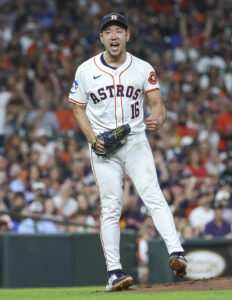
Kikuchi, 33, spent nine seasons pitching for NPB’s Seibu Lions before he was posted for major league clubs prior to his age-28 campaign during the 2018-19 offseason. The lefty landed with the Mariners on a complex contract that guaranteed the southpaw $56MM over four years, with the fourth year being a $13MM player option that the Mariners could preempt by picking up a four-year club option worth $66MM.
Complicated as that contract was, however, Kikuchi’s time in Seattle was both disappointing and straightforward. The lefty struggled over his first two seasons in the majors, posting a lackluster 5.39 ERA and 5.17 FIP between the 2019 and ’20 seasons.
He managed to turn things around a bit in 2021, however, with a 4.41 ERA (96 ERA+) and a 4.61 FIP. While those numbers hardly jump off the page, Kikuchi was an All-Star in 2021 and looked dominant at times, with a 2.33 ERA and a 27.5% strikeout rate in an 11-start stretch from late April to early July. Kikuchi took a gamble and entered free agency despite his uneven season. That decision wound up paying off, as he would eventually sign with the Blue Jays on a three-year, $36MM contract. His time in Toronto started off much like his stay in Seattle, as he struggled badly in 2022 to the tune of a 5.19 ERA and 5.62 FIP in 100 2/3 innings of work split between the bullpen and rotation.
The lefty finally figured things out at the age of 32 last season, however, and showed off the consistent, mid-rotation production both the Mariners and Jays had dreamed on when signing him. In 32 starts for Toronto in 2023, Kikuchi pitched to a solid 3.86 ERA with a 25.9% strikeout rate against a 6.9% walk rate. That solid campaign seemed to tee the lefty up for another steady season in 2024, though he once again faced a number of ups and downs. Kikuchi’s time in Toronto this year saw him drastically underperform his underlying metrics, as he pitched to a lackluster 4.75 ERA despite his 26.2% strikeout rate and 6% walk rate both being improvements over the previous season. Despite that ugly ERA, the lefty had a 3.66 FIP, 3.51 SIERA, and 3.43 xFIP during his 22 starts with the Blue Jays this year.
Those exciting peripherals surely helped convince the Astros to package youngsters Jake Bloss, Joey Loperfido, and Will Wagner in a trade with the Jays that brought Kikuchi to Houston for the stretch run. That was a hefty price to pay for a rental, but the lefty made good on his price tag with ten dazzling starts for the Astros following the trade deadline. He racked up 60 innings of 2.70 ERA ball, struck out a whopping 31.8% of opponents while walking just 5.9%, and improved his overall season numbers to a league average 4.05 ERA with a 3.46 FIP that was good for the 16th-best mark among all qualified big leaguers this year, sandwiched comfortably between top free agent starters Max Fried (3.33) and Jack Flaherty (3.48).
Now, the Angels are betting on those excellent peripherals just as their division rivals in Houston did over the summer. Amidst a busy November where they’ve already struck early to land Jorge Soler, Travis d’Arnaud, Kevin Newman, and Kyle Hendricks via trade and free agency, the club has now gone out of its typical comfort zone to sign Kikuchi to the largest guarantee the Angels have given a free agent starter since right-hander C.J. Wilson‘s five-year, $77.5MM deal in 2011. Kikuchi is just the second starter the club has signed to a multi-year pact since then, joining future rotation-mate Tyler Anderson. Kikuchi, Anderson, and Hendricks figure to create a veteran nucleus for Anaheim’s starting staff next year that could help to take pressure of younger arms such as Reid Detmers, Chase Silseth, and Jack Kochanowicz.
While Kikuchi’s up-and-down performance may cause his new deal to raise some eyebrows, the pact is right in line with the $60MM over three years that MLBTR predicted for the lefty on our annual Top 50 MLB free agents list. Kikuchi ranked 12th overall and 6th among starters on that list, placing him firmly behind top-of-the-class arms like Corbin Burnes, Blake Snell, and Fried but in a similar conversation as fellow southpaw Sean Manaea among the better mid-tier options on the market. Notably, Kikuchi was unencumbered by a Qualifying Offer after being rendered ineligible by the midseason trade that shipped him to Houston. That surely made him more attractive to an Angels club that has relied heavily on the draft in recent years while fast-tracking players such as Nolan Schanuel, Zach Neto, and Ben Joyce to the majors.
Prior to signing with Anaheim this morning, Kikuchi had been connected to the Cubs in free agency as the club seemingly plans to focus on the mid-tier of the starting pitching market this winter with a preference towards hurlers not encumbered by a QO. The Braves and Rangers are among the other teams rumored to be shopping in a similar tier of the market, and any team that missed out on Kikuchi should still have a few options at their disposal this winter. Flaherty, Nathan Eovaldi, Matthew Boyd, and Andrew Heaney are among the pitchers remaining unencumbered by the QO expected to land multi-year deals, and interesting one-year options such as Walker Buehler and Max Scherzer also remain on the table.
Jon Heyman of The New York Post first reported the terms.
Orioles Interested In Nathan Eovaldi
The Orioles and Atlanta are two of the clubs that are interested in free agent right-hander Nathan Eovaldi, per Jon Morosi of MLB Network (X link). The interest from Atlanta was previously reported.
Eovaldi, 35 in February, is a plausible fit for many clubs in the league. Given his age and injury history, he won’t be able to secure a long-term commitment. But since he’s been a consistently strong performer in recent years, he should still be in demand. MLBTR predicted him for a $44MM guarantee on a two-year deal as part of the annual Top 50 Free Agents post. Perhaps he could get a third year, but he’s not really out of any club’s price range.
Whoever signs Eovaldi will be getting a player with a checkered health history, as he’s undergone two Tommy John surgeries in his career. Many players with that distinction have struggled to continue performing at a high level but Eovaldi has been quite steady of late.
He missed the 2017 season while recovering from that second surgery, was good in 2018 but wobbled a bit in 2019. But he’s made 115 starts over the past five years with a 3.75 earned run average. He didn’t finish any of those seasons with an ERA higher than 3.87. His strikeout rate finished between 22.4% and 26.1% in those campaigns, his walk rate between 3.5% and 8.1%, and his grounder rate between 42% and 51%. Overall, it’s been 654 2/3 innings with a 24% strikeout rate, 5.6% walk rate and 46.9% ground ball rate.
That kind of performance would upgrade just about any rotation in baseball, so they each should have some level of interest, especially given the cap on Eovaldi’s earning power. The Rangers have interest in bringing him back but he’s also been connected to Atlanta, the Red Sox and now the Orioles. It seems fair to assume that several other clubs are also interested, even in the absence of explicit public reporting.
Baltimore is certainly a logical fit, given their rotation situation. Their 2024 ace Corbin Burnes is now a free agent. Kyle Bradish and Tyler Wells are each going to miss at least part of the 2025 season as they recover from UCL surgeries. Trade deadline acquisition Trevor Rogers struggled after being acquired and was quickly demoted to the minor leagues.
The current rotation nucleus consists of Zach Eflin, Grayson Rodriguez and Dean Kremer. Rogers could jump in there if he gets back on track next year. Albert Suárez just wrapped up a solid year in a swing role, but since he’s a 35-year-old journeyman, the O’s would probably prefer to add some arms and bump him back into that sixth or seventh starter slot. Chayce McDermott and Cade Povich made their major league debuts in 2024 but without fully cementing themselves as viable big leaguers.
In short, the club could certainly do with an upgrade or two. The big question for the O’s is what kind of approach they will take this winter. It’s been almost seven years since the Orioles have given out a multi-year deal to a free agent, as shown on MLBTR’s Contract Tracker. The last time they did so was a four-year deal for Alex Cobb back in March of 2018. After that, the club went into a lengthy rebuilding process and then was up for sale. David Rubenstein bought the club from the Angelos family, though that sale wasn’t complete until the spring of 2024.
That makes the O’s hard to predict this winter, as it will be the first offseason of the Rubenstein era. There are some signs that greater spending will be possible. The club took on some notable money at the deadline by acquiring Eflin and Seranthony Domínguez. Eflin is making $18MM in 2025 while Dominguez had an $8MM club option that the O’s eventually picked up. A couple of weeks ago, general manager Mike Elias said that “the whole spectrum” of pitching upgrades were being considered. He went on to thank ownership for making all possibilities viable but also cautioned that the O’s wouldn’t be spending money just for the sake of it.
Reading the tea leaves, it seems fair to expect something more aggressive than they’ve done in recent years, though that could come in many forms. Burnes is still available and is lined up to secure a deal well into nine-figure territory. He and Blake Snell were the top two names available but Snell has reportedly agreed to a five-year deal with the Dodgers, a guarantee of $182MM but with deferreals dropping the net present value into the $160-165MM range. Max Fried is also likely to end up with nine digits and Jack Flaherty has a chance to do so as well. The middle market has seen Yusei Kikuchi and Nick Martinez come off the board but it still features Eovaldi, Nick Pivetta, Sean Manaea, Luis Severino and others.
RosterResource projects the Orioles for a modest $99MM payroll, with literally nothing on the books for 2026 and beyond. That payroll is already a bit higher than last year’s $93MM Opening Day figure from Cot’s Baseball Contracts, but as mentioned, it’s possible that the new ownership group is willing to push things further. It also wouldn’t be unprecedented for the franchise, as Cot’s had them as high as $164MM in 2017, before their fortunes fell and they spiralled into their aforementioned fallow period.
Free Agent Prediction Contest Leaderboard Now Available
Our free agent prediction contest leaderboard is now available! Three of MLBTR’s top 50 free agents have signed: Nick Martinez, Yusei Kikuchi, and Blake Snell. Over 4,300 people entered the contest, and six have jumped out to an early lead by guessing all three pitchers’ destinations correctly.
If you’re looking for the leaderboard later, it can be found under the Tools menu for desktop users and under the Flame menu for mobile web users.