
Butterfly Effects & The Jason Heyward Signing
‘Twas the winter of 2015-16. Jason Heyward wasn’t the best-available player in a well-stocked free agent class. But he was a high-quality performer and still tantalizingly young (26). While hardly a traditional corner outfield star due to his middling power, Heyward was well-established as a quality hitter and superlative defender and baserunner.
The debate raged long before the offseason arrived: how much can you really pay for a player like this? All agreed he was good. But the traditionalists howled at the notion of a right fielder who hadn’t even hit forty home runs over the prior three seasons landing a premium contract. The analytically minded countered that, well, runs are runs regardless of how they’re added or prevented. Heyward was a 6.9 rWAR / 5.6 fWAR performer in 2015. With exceptional glovework and a steady OBP, Heyward seemed to be a high-floor player who might have some ceiling as well.
[RELATED: Jason Heyward & Chris Davis Have Two Of The Worst Free Agent Contracts … In Different Ways]
We predicted that Heyward would earn $200MM over a full decade — second-most in a rather well-stocked free agent class. That didn’t quite happen, but the real deal was actually more favorable to Heyward than the one we had guessed. He landed $184MM over an eight-year term and also got two opt-out opportunities (which was worth something at the time the deal was struck, even if they weren’t exercised). The deal delivered a nice $23MM AAV over quite a lengthy term.
Now that we’re all reacquainted with the contract as it turned out … let’s try to remind ourselves of the state of play in the market when it was struck. At the time of the pact, there were hints that the Cubs may not have been the high bidder. The Nationals supposedly had the top offer on the table, though we may presume it’d have been deferred. The incumbent Cardinals were also known to be in pursuit. And the Angels and Giants were still involved in rumors right up until the end.
So … what would things have looked like if Heyward had landed elsewhere?
Nationals
Whoa … would the Nats have hoisted the commisioner’s trophy last fall had they signed Heyward? That’s obviously not something that can be assessed fairly given the innumerable butterfly effects potentially at play. But the counter-factual does actually present a pretty similar situation to what actually happened in 2019. In right field, the Nationals got solid but hardly otherworldly work out of Adam Eaton — another left-handed hitter whose skillset is rather similar to that of Heyward.
More interesting to consider is the fact that the Nats probably wouldn’t ever have dealt for Eaton had they already acquired Heyward. Eaton landed in D.C. after the team missed on its effort to acquire Chris Sale for the White Sox. The swap cost the Nationals pitchers Lucas Giolito (reimagine 2019 with him on the staff), Reynaldo Lopez, and Dane Dunning. Of course, Eaton has been much more affordable than Heyward this whole time. Who knows if the Nats would’ve inked Patrick Corbin last winter had Heyward been on the books.
Ultimately, the Washington organization has deep enough pockets that it would’ve been just fine with an underperforming $23MM salary on the books — not unlike the Cubs. At the same time, also not unlike the Cubs, the Nats have been focused on getting and staying just under the luxury tax line, so this deal would’ve been a constant nuisance that would’ve interfered with any number of lower-cost veteran signings and acquisitions over the past several seasons.
Cardinals
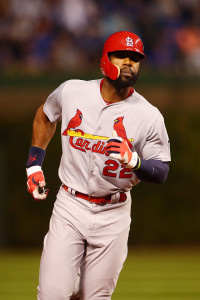
Much like the Nats, the Cards eventually made a big deal for a somewhat similar player. One winter after missing on Heyward (despite reportedly offering as much or more as the arch-rival Cubbies), the Redbirds reversed the talent flow by inking former Chicago center fielder Dexter Fowler. The switch-hitting Fowler wasn’t nearly as expensive as Heyward, but his own five-year, $82.5MM deal has worked out about as poorly. The Fowler contract probably wouldn’t have been signed had Heyward been around, but this is probably to the Cardinals’ benefit since the Heyward deal features a bigger and longer hit. Perhaps the Cubs would’ve ended up retaining Fowler had they missed on Heyward. You could argue over the details, but it’s probably not far from a wash.
Of course, the Cards went without either of those players in that 2016 campaign … which helped open the door to the memorable shooting star of Jeremy Hazelbaker. It’s tough to say whether there were significant long-term effects on the way the Cards’ outfield picture developed. Going without Heyward in 2016 opened more playing time for outfielders Randal Grichuk, Stephen Piscotty and, to a lesser extent, a pre-breakout Tommy Pham. Perhaps one or more would’ve been shipped out of town earlier had Heyward been retained. Maybe Pham’s breakout would’ve occurred elsewhere, thus eliminating his successive trades (to the Rays and then to the Padres), though it’s impossible to say that with any degree of confidence.
Angels
We don’t know whether the Halos were really strong pursuers of Heyward, but it’s worth considering what might’ve been. The club ended up foregoing any big free agent splashes that winter. (It had already acquired Andrelton Simmons.) Adding Heyward surely wouldn’t have forestalled the string of four-straight losing seasons, given the way he has played. But it might’ve prevented the Angels from eventually trading for and then extending Justin Upton. And it certainly could’ve gummed up this winter’s signing of Anthony Rendon.
Giants
Likewise, it’s not entirely clear that the Giants were heavily involved in bidding up Heyward’s price, but the team clearly had some real interest. The San Francisco org splashed a lot of regrettable cash that winter regardless. It had already inked Jeff Samardzija and ended up signing Johnny Cueto after Heyward landed with the Cubs. The Giants did find a rather direct alternative to Heyward, inking Denard Span to a three-year, $31MM pact. That didn’t quite go as hoped but was hardly a significant disaster. Suffice to say that having Heyward on the books would’ve further complicated an already difficult stretch for the organization.
Cubs
Ah, yes. The Cubs. Lauded at the time by some for landing Heyward for less than others would’ve paid — really, the deal was probably right at the market rate, give or take — the Cubbies have obviously not benefited from the signing.
Remember how we started this post? The debate over paying out a non-slugging right fielder. Consider these contemporaneous comments. On the one hand …

On the other …

To some degree, neither turned out to be right. And the lack of power was largely beside the point. Heyward did top twenty long balls in 2019, but he was still an average-or-worse hitter for the fourth-straight year. It was certainly his best offensive season for the Cubs … but also the team’s own worst effort in this four-year span. No, the Cubbies haven’t exactly dominated the National League over the span of this deal, but they did capture that elusive crown in 2016.
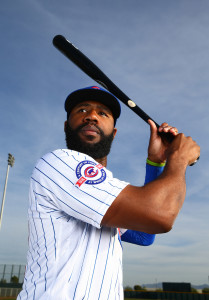
So does the World Series justify it? Eh … this isn’t as clean an analysis as the Gleyber Torres-for-Aroldis Chapman “you do what it takes!” situation. Heyward was terrible in 2016 and even worse in the postseason, when he contributed just five hits and a walk over fifty plate appearances.
There’s no two ways about it: the deal hasn’t worked out at all as hoped. Heyward has by all accounts worked hard and been a total class act, as ever. And he has trended back up with the bat, which is somewhat promising with regard to the final three seasons of the deal. But the net return to the Cubs — 7.1 rWAR and 6.0 fWAR — has not remotely justified the outlay.
Anybody that has watched the Chicago organization operate these past two winters can see the effects of this contractual miss. The Cubs have decided not to move past the luxury tax line, so every dollar going to Heyward has been another buck that couldn’t be allocated elsewhere. Of course, the Heyward whiff isn’t the only one that has stung in recent years, as MLBTR’s Tim Dierkes recently examined. And it’s worth emphasizing the he’s still just 30 years of age and still capable of contributing. It’s not outside the realm of possibility that he could even morph back into a quality regular. All things considered, this contract certainly didn’t single-handedly obstruct the Cubs’ dynasty-that-wasn’t … but it certainly played a leading role.
Photos courtesy of USA Today Sports Images.
10 NL West Pitchers Looking For Bounce-Back Seasons
MLBTR’s preseason series ends with National League West pitchers looking to bounce back in 2020. These 10 talented hurlers are hoping to get off the mat after difficult seasons…
Alex Wood, LHP, Dodgers:
The 29-year-old Wood is back in Los Angeles, where he experienced a great deal of success in 2015-18, after a Murphy’s Law season spent in Cincinnati. A back injury limited Wood to 35 2/3 innings of 5.80 ERA/6.38 FIP pitching last year after Cincinnati acquired him from Los Angeles expecting high-end production. Not unreasonable on the Reds’ part, as Wood had combined for a 3.29 ERA/3.36 FIP with 8.27 K/9, 2.57 BB/9 and a 49.5 percent groundball rate in 803 1/3 innings as a Brave and Dodger from 2013-18. The Dodgers brought him back on a low-risk guarantee ($4MM) in the offseason. They may strike gold if Wood can stay healthy.
Blake Treinen, RHP, Dodgers:
Like his new teammate Wood, Treinen was excellent in the recent past before falling off a cliff last season. Just two years ago, Treinen – then an Athletic – turned in one of the greatest seasons a reliever has ever had. But last year went awry for Treinen, who dealt with multiple injuries and logged subpar numbers. Treinen wound up with a 4.91 ERA/5.14 FIP and 9.05 K/9, 5.68 BB/9 and a 42.8 percent grounder rate over 58 2/3 innings. He lost his job as the A’s closer along the way, and they non-tendered him after the season. The hard-throwing Treinen landed on his feet, though, with a $10MM guarantee from the Dodgers.
Kyle Freeland, LHP, Rockies:
The soft-tossing Freeland was an NL Cy Young candidate back in 2018, so no one could have expected such a miserable showing in 2019. As it turned out, though, Freeland struggled so mightily that the Rockies optioned him to Triple-A at one point in the season. In the majors, he ended up with a brutal 6.73 ERA/5.99 FIP (compared to 2.85/3.67 the prior year) and 6.81 K/9 against 3.36 BB/9 across 104 1/3 innings, averaging fewer than five frames per start along the way. The 26-year-old’s severe drop-off was among the reasons the Rockies went from playoff team in 2018 to bottom-feeding club last season.
Wade Davis, RHP, Rockies:
Speaking of stunning declines from members of Colorado’s pitching staff … Davis continued his descent in 2019. In the second season of a three-year, $52MM contract, the once-untouchable Davis recorded an abysmal 8.65 ERA/5.56 FIP and walked more than six batters per nine over 42 2/3 innings. Davis also rated as one of Statcast’s worst pitchers, finishing toward the bottom of the league in average exit velocity, expected weighted on-base average and strikeout percentage, among other categories.
Johnny Cueto, RHP, Giants:
Even though he only pitched 16 innings last season, it’s tough not to include Cueto on this list. The former ace is hoping for his first full season in a while, as injuries (including Tommy John surgery in 2018) held him to a mere 216 1/3 innings over the previous three years. During his halcyon days, Cueto – now 34 – used to throw around that many innings in a single season. The Giants still owe Cueto $47MM through 2021, so a rebound effort would be all the more welcome for them.
Kevin Gausman, RHP, Giants:
Gausman, whom the Giants added for $9MM in free agency, is in line to join Cueto in their rotation. The hope for the club is that he’ll fare much better than he did in 2019 – a disappointing season for a pitcher who has been consistently respectable. Gausman performed so poorly as a Brave that they placed him on outright waivers in August, but he did turn his season around as a strikeout-heavy reliever in Cincinnati. However, despite 10.03 K/9 against 2.81 BB/9, Gausman could only muster a 5.72 ERA (granted, with a much more encouraging 3.98 FIP) in 102 1/3 frames divided between the two teams.
Dereck Rodriguez, RHP, Giants:
Rodriguez came out of nowhere to serve as one of the most effective rookies in the sport two years, but the dreaded sophomore slump took him down last season. The 27-year-old split 2019 between the Giants’ rotation and bullpen, registering a woeful 5.64 ERA/5.69 FIP (he was at 2.81/3.74 in 2018) in 99 innings. Rodriguez underwhelmed in the strikeout/walk department along the way, putting up 6.45 K/9 with 3.27 BB/9, and lost about a mile per hour on his low-90s fastball. Whether he’ll work more as a starter or reliever is in question heading into the new season, whenever it begins.
Tony Watson, LHP, Giants:
The normally reliable Watson wasn’t quite himself in 2019, in which he tallied career worsts in ERA (4.17), FIP (4.81) and home runs per nine (1.5) through 54 innings. Watson walked just two per nine, and there were no dips in his velocity (93.5 mph) or swinging-strike percentage (12.7), yet he still slumped to the second-lowest K/9 (6.83) of his career. Surprisingly, same-handed hitters – whom he has usually contained – did the most damage against Watson, teeing off on him for a .391 wOBA. In other words, Watson turned the average lefty into Anthony Rizzo. The Giants are banking on a better showing from Watson in 2020, though, as they re-signed him for a $3MM guarantee during the winter.
Trevor Cahill, RHP, Giants:
Cahill is the fifth member of this Giants-heavy list, but this will be his first year with the club. He spent last year with the Angels, who signed him for $9MM after he revived his career with the Athletics as a starter during the previous season. However, Cahill couldn’t carry that renaissance into 2019; he instead spent the majority of the season in the bullpen and logged an ugly 5.98 ERA/6.13 FIP. Compared to 2018, Cahill struck out one fewer batter per nine (7.12 overall) and saw his groundball rate drop by almost 8 percent (45.9). He also yielded a whopping 2.2 homers per nine – up from a paltry .65 the prior season. Now, it remains to be seen whether Cahill will even crack the roster in San Francisco, which signed him to a minor league contract. If he does, it may be as a reliever.
Garrett Richards, RHP, Padres:
Richards has been quite valuable when he has taken the mound. The problem is that appearances from the oft-injured ex-Angel have been rare in recent seasons. He hasn’t even touched the 80-inning mark in a season since 2015, when he amassed a career-high 207 1/3. Richards totaled just 8 2/3 frames last season after returning from the Tommy John surgery he underwent in July 2018. Of course, the Padres knew they’d get little from Richards in 2019 upon signing him to a two-year, $15.5MM pact. They’re hoping the investment pays dividends this season.
Giants Sign Prospect Javier Alexander Francisco
The Giants have signed shortstop Javier Alexander Francisco, a prospect from the Dominican Republic, as @GiantsProspects first reported (Twitter link; hat tip to John Shea of the San Francisco Chronicle). The value of the bonus is unknown at this time.
Shea notes that the 16-year-old has been working with former big leaguer Fernando Tatis Sr., who compares Francisco to his son, Padres star shortstop Fernando Tatis Jr. This comparison seems at least somewhat suspect, given the timing of this agreement. Many well-regarded international prospects have handshake deals worked out in advanced of their eligibility and then sign on the dotted line as soon as the signing period begins each year on July 2. Tatis Jr., for instance, signed with the White Sox on July 2, 2015, receiving a bonus of $700K. If Francisco is indeed at that skill level, he could have theoretically received a larger bonus by waiting another few months until teams would have their bonus pools reset to their full amounts.
Regardless of how Francisco develops personally, this move is consistent with a larger push in the Giants organization to focus on improving their farm system. Since Farhan Zaidi became the president of baseball operations in November of 2018, there has been a greater emphasis on upgrading the talent pipeline that flows into the major league club. Baseball America recently ranked the Giants farm system as the 14th best in the majors, after it checked in at 28th going into the 2019 season.
6 NL West Hitters Looking For Bounce-Back Years
Our preseason series focusing on notable hitters and pitchers hoping to rebound from less-than-ideal 2019 outings wraps up in the National League West. We’ll start with six hitters who enjoyed productive 2018 campaigns before falling short last season…
Manny Machado, 3B, Padres:
By no means did the 27-year-old Machado perform poorly in 2019, his first season as a Padre. He just didn’t offer the type of production the team likely expected when it signed him to a then-record free-agent contract worth $300MM over 10 years. Whereas the four-time All-Star thrived with the Orioles and Dodgers the year before he joined the Friars, he has been more good than great in San Diego so far. Across 661 trips to the plate last season, Machado batted .256/.334/.462 – enough for a 108 wRC+ (he was at 131 in 2018). He did mash 32 home runs and finish in the majors’ 87th percentile in average exit velocity, but Machado struck out in nearly 5 percent more plate appearances compared to 2018. Furthermore, according to Statcast, Machado’s hard-hit percentage fell by just over 4 percent.
Jurickson Profar, 2B, Padres:
The former can’t-miss prospect finally looked to be turning a corner at the major league level in 2018, his last year with the Rangers. Unfortunately, though, Profar’s output tanked in his lone season with the Athletics in 2019. The 27-year-old switch-hitter could only muster a .218/.301/.410 line (89 wRC+) and 1.3 fWAR in 518 PA, and Statcast rated him near the bottom of the league in several important metrics. As a second baseman, Profar garnered all negative reviews (minus-15 Defensive Runs Saved, minus-3 Outs Above Average, minus-1 Ultimate Zone Rating). Still, the Padres are taking a chance on a bounce-back year for Profar, whom they acquired in a winter trade. The move reunited him with ex-Rangers executive and current Padres general manager A.J. Preller.
David Peralta, OF, Diamondbacks:
Peralta had a terrific year in 2018, smacking 31 home runs and accounting for 3.9 fWAR, but a nagging right shoulder injury prevented him from a proper encore last season. The 32-year-old wound up with just 12 homers in 423 plate appearances, in which he registered an overall line barely above average (.275/.343/.461 – good for a 107 wRC+), saw his isolated power number fall by 37 points and his expected weighted on-base average plummet by 49 points. Nevertheless, the Diamondbacks are giving Peralta the benefit of the doubt, evidenced by the two-year, $22MM extension they handed him in January.
Brandon Crawford, SS, Giants:
Crawford entered last year with six straight seasons of at least 2.0 fWAR, but he dropped to 0.4 in that category in 2019. Crawford hit just .228/.304/.350 (74 wRC+) in 560 PA, and even his well-regarded defense declined. For the first time in his career, the 33-year-old graded negatively in both DRS (minus-4) and UZR (minus-0.4). Not reassuring for the Giants, who still owe Crawford $30MM through 2021.
Enrique Hernandez, UTIL, Dodgers:
The versatile Hernandez was quite effective in 2018, during which he posted 3.2 fWAR, but that number checked in at a far less impressive 1.2 last season. The problem? A massive decline in offensive production. Hernandez’s wRC+ (88) represented a 30-point fall, while his OPS (.715; .237/.304/.411) lost 91 points. It didn’t help that Hernandez endured a 4-plus percent increase in strikeouts and a 3 percent decrease in walks.
Daniel Murphy, 1B, Rockies:
Count Murphy as another recent free-agent signing gone awry for the Rockies, who inked him to a two-year, $24MM contract in December 2019. Year 1, perhaps the weakest offensive season of his career, couldn’t have gone much worse for Murphy. The 34-year-old ‘s .279/.328/.452 line doesn’t look terrible on paper, but when adjusted for ballpark, it only amounted to a wRC+ of 86. Murphy also had a miserable season in terms of Statcast output and recorded a negative fWAR (minus-0.2) for the first time ever.
Yasiel Puig Rumors: Marlins, Giants
Free agency is not at the forefront of baseball fans’ minds right now, but there’s still at least one rather talented player without a job. That’s 29-year-old outfielder Yasiel Puig, who – despite a mostly solid career of production – has encountered a tepid market since last season ended. Puig did reportedly turn down a one-year, $10MM offer from a National League team in recent months, but it’s unclear which club presented that proposal to Puig. The belief, however, is that the Marlins made him an offer at some point, Jon Heyman of MLB Network said on the latest edition of the Big Time Baseball Podcast.
While the Marlins may have tried to sign Puig during the winter, it appears they’re out on him now after adding fellow veteran OFer Corey Dickerson on a two-year, $17.5MM contract back in December. Nevertheless, all hope isn’t necessarily lost for Puig, whom some teams are still considering, Heyman says. The Giants are among the clubs on the list, reports Heyman, who expects Puig to sign somewhere this month (Heyman stated that before the coronavirus forced MLB to temporarily shut down operations Thursday, so it could affect Puig’s chances).
This is not the first time there has been a Puig-Giants connection since last season concluded. As of February, though, negotiations between the two sides had reportedly died down after the Giants brought back old pal Hunter Pence. He’s now set to team with Mike Yastrzemski and Alex Dickerson as the Giants’ top corner outfield choices, though those two can’t match Puig in overall track record, nor do they hit from the same side (Puig’s a righty, while Yastrzemski and Dickerson are lefties). Pence, also a righty, outhit Puig last year, but he may be more of a reserve now that he’s back in the DH-less National League.
Should an agreement between Puig and the Giants eventually come together, he’d reunite with president of baseball operations Farhan Zaidi and new manager Gabe Kapler. Both Zaidi and Kapler were Dodgers employees during part of Puig’s run in Los Angeles from 2013-18. Puig was largely a productive (albeit polarizing) Dodger, though his output at the plate dropped off last year between the Reds and Indians, which is one reason he remains without a team as we approach the middle of March.
NL West Notes: Buster, Pagan, Padres, Barfield
“I don’t see myself playing for any other team. Not that going to another team would diminish what you did. But personally, as a fan, I like to see guys stay with the same team. So no, I wouldn’t want to play anywhere else,” longtime Giants catcher Buster Posey told The Athletic’s Andrew Baggarly (subscription required) about his baseball future. Posey has two guaranteed years remaining on his contract, plus San Francisco has a $22MM club option ($3MM buyout) for the 2022 season that is e exercised — 2022 will be Posey’s age-35 season and his production has declined over the last two years as Posey has dealt with hip surgery and the subsequent recovery process. That said, Posey was able to engage in a full offseason workout regiment this winter and was on a hitting tear during Spring Training, so there’s certainly some optimism that he could at least approach his old form.
With at least two years to go before any sort of decision needs to be made, it remains to be seen if Posey could seek out a contract with a new team, retire at the end of his current pact, or perhaps re-sign with the Giants. This latter option could see Posey in a backup catcher/veteran mentor role at that stage of his career, particularly since San Francisco has one of the game’s best prospect (Joey Bart) in line as their catcher of the future. Interestingly, a move to first base for Posey doesn’t seem be an option at the moment, as the Giants aren’t planning to use Posey as a first baseman this season, to the point that Posey hasn’t been taking any grounders at first this spring.
More from the NL West…
- The Padres agreed to terms with 24 pre-arbitration players on contracts for the 2020 season, though Emilio Pagan‘s deal was renewed after the newly-acquired reliever didn’t come to terms with the team, Jeff Sanders of the San Diego Union-Tribune writes. Pagan will earn $591K in 2020 before becoming reaching arbitration eligibility next winter. Pagan becomes the latest notable player to have his contract renewed, a process Jeff Todd explored in a recent MLBTR YouTube video entry.
- As part of a reader mailbag piece, MLB.com’s AJ Cassavell looked at how the Padres could manage their 26-man roster, such as the increasing possibility that the team will carry only four outfielders. Cassavell figures that Wil Myers, Trent Grisham, and Tommy Pham have the starting jobs spoken for, while Franchy Cordero, Josh Naylor, and Abraham Almonte are competing for the fourth outfielder role. This would leave room for San Diego to use its 26th roster spot on a utility player. For added outfield depth, the likes of Greg Garcia, Francisco Mejia, or Jurickson Profar could all handle such a fill-in role if necessary. That wouldn’t necessarily be how the Padres would like to optimize Profar, since the club was already intent on using him at primarily at second base, though since Cassavell notes that the Padres’ second base competition could stretch into the season, Profar will need somewhere to find playing time if Brian Dozier or Garcia earn more looks at the keystone.
- Josh Barfield was promoted to the role of farm director for the Diamondbacks this offseason, as The Athletic’s Zach Buchanan (subscription required) looks at how the former big league infielder has quickly climbed the ladder during his five-plus years in Arizona’s front office. Hired as a scout by former D’Backs general manager Dave Stewart in the 2014-15 offseason, Barfield has moved from assistant director of pro scouting to assistant farm director to his current position. Barfield’s rising star hasn’t gone unnoticed around baseball, as current GM Mike Hazen told Buchanan that other teams have tried to hire Barfield away. A future position as a “manager or GM might not be far behind” for the 37-year-old Barfield, Buchanan writes.
Coronavirus Response Will Require MLB Schedule Changes
1:30pm: The Athletics and Giants have issued statements regarding the coronavirus. An exhibition game between the two that was scheduled to take place at Oracle Park on March 24 has been canceled, the Giants announced. The two clubs are looking into alternate settings.
Meanwhile, the A’s, who are scheduled to open the season at home with a four-game series against the Twins, announced that they will “adhere to any government directives and work with Major League Baseball on all alternative arrangements.” It seems overwhelmingly likely that the series will be played in a different setting than expected — be it a new location or an empty stadium.
12:25pm: As the coronavirus continues to sweep across the globe, it is increasingly apparent that staging Major League Baseball games in the manner anticipated will simply not occur. Already today we have seen several major developments in the response to the deadly disease.
This story is far bigger than sports. But sports have an essential role to play, both in forestalling transmissions that can occur in large gatherings and in signaling the need for community-level precautions.
Today, the World Health Organization formally designated the coronavirus a pandemic. WHO director general Tedros Adhanom Ghebreyesus said that nations “can turn the tide,” but warned not only of “the alarming levels of spread and severity” but also “the alarming levels of inaction” around the globe.
Dr. Anthony Fauci, the director of the National Institute of Allergy and Infections Diseases, addressed the matter in relation to basketball. The Ivy League has canceled its conference tournament but others remain on schedule along with the NCAA tourney. And while the NBA has begun preparing for disruption, it hasn’t yet acted.
Fauci says the outbreak is “going to get worse” and left no doubt he sees a need to curtail large-scale gatherings, at minimum in areas in which community spread has been detected. “We would recommend that there not be large crowds,” he said. “If that means not having any people in the audience when the NBA plays, so be it.”
American municipalities are increasingly acting upon the evident need to slow the spread of the coronavirus to limit the strain on health systems to the extent possible. Some of those decisions could directly force MLB to change its plans. To this point the league has instituted various minor changes to regular Spring Training rules — media accessibility, fan interaction, non-essential personnel being kept from traveling or appearing in the clubhouse — but has not limited Spring Training contests or changed its schedule for the upcoming regular season.
The league has indicated an awareness of the gravity of the situation and acknowledged the “fluidity” inherent to it. As the dangers become all the more evident, one might hope that the urgency of the matter will lead the league to taking a proactive, leadership position.
With Seattle serving as one epicenter of the outbreak in the United States, it is now all but certain that the Mariners won’t play there as planned to begin the season. The team now expects its first two home series to be prohibited by decree of the governor, Joel Sherman of the New York Post reports on Twitter.
It’s quite likely this is the tip of the iceberg, in Seattle and elsewhere. We’ve seen concepts floated of moving games scheduled for Seattle to Arizona, but that’s premised on the highly questionable premise that it’ll be safe to stage such massive gatherings anywhere within the next several weeks.
Other municipalities are also moving in a similar direction, with more sure to follow as evidence of the virus’s spread increases. San Francisco has banned gatherings of over one thousand people for at least the next two weeks, Connor Letourneau of the San Francisco Chronicle tweets. Washington, DC has recommended cancellations of gatherings of one thousand or more people. That was the same guidance issued yesterday by San Francisco; the city boosted it to an outright prohibition after the NBA’s Warriors held a home game.
Whatever the annoyances or disappointments, they’re designed to avoid the awful situations we’ve already seen unfold in China, Italy, and other places. Experts have explained the critical importance of “social distancing” measures to prevent the rapid spread of the disease, which is far more deadly and damaging when overburdened health systems struggle to provide adequate treatment.
West Notes: Mariners, Giants, Dodgers
A few items from the game’s West divisions:
- The Mariners are scheduled to start their season at home March 26 against the Rangers, but it’s possible that series (and perhaps some ensuing sets) will take place outside of Seattle. With the coronavirus outbreak taking a toll on Seattle, the Mariners might temporarily play regular-season home games at their spring training facility in Arizona, Evan Drellich of The Athletic reports (subscription link). That scenario could become more likely on Wednesday, when Washington Gov. Jay Inslee is expected to restrict all gatherings of 250-plus people in Seattle and other areas in the state, according to the Seattle Times. It’s unknown how long that restriction will last, but with just over two weeks left until the M’s season starts, there seems to be a growing likelihood that they’ll host their opener away from T-Mobile Park.
- Giants president of baseball operations Farhan Zaidi shed some light Tuesday on the team’s spring roster battles, as John Shea of the San Francisco Chronicle relays. Tyler Beede was a strong contender for the fifth spot in the club’s rotation, but now that he’s dealing with a flexor strain, the competition is down to Logan Webb, Dereck Rodriguez, Trevor Cahill and Trevor Oaks. Any of them could take the ball April 7 – the first time the Giants will need a No. 5 starter. Meanwhile, there could be a rotating bunch of players in center field, Shea writes. That may affect the picture at the keystone; among the Giants’ current second base options (Mauricio Dubon, Yolmer Sanchez and Donovan Solano), “Dubon is best suited to go out to the outfield,” Zaidi observes. Dubon’s versatility could lead to a season-opening roster spot for Sanchez, a 2019 Gold Glove winner whom the Giants signed to a minor league contract in the offseason.
- He wasn’t considered a legitimate prospect at this point a year ago, but now the Dodgers are of the belief that minor league utility player Zach McKinstry will turn into a contributor at the MLB level this season, Jorge Castillo of the Los Angeles Times writes. A 33rd-round pick in 2016, McKinstry put himself on the map in 2019 with excellent production at the Double-A and Triple-A levels, leading the Dodgers to add the 24-year-old to their 40-man roster in November. The multi-positional McKinstry has continued to impress team brass this spring, notes Castillo, who adds that he could become the Dodgers’ latest Chris Taylor or Enrique Hernandez type. “He can play anywhere on the diamond, he’s an intelligent player,” manager Dave Roberts told Castillo. “He conducts really good at-bats. He’s a guy that I wouldn’t be surprised if we saw him sometime this year.”
Giants Claim Jose Siri
The Giants have claimed outfielder Jose Siri off waivers from the Mariners, per an announcement from both clubs. San Francisco has placed injured catcher Aramis Garcia on the 60-day injured list to open a spot on the 40-man roster.
It’s the second waiver claim of the offseason for the 24-year-old Siri, who two years ago was ranked as one of the top prospects in the Reds organization. Back in 2017, Siri hit .293/.341/.530 slash with 24 homers and 46 steals in the Class-A Midwest League as a 22-year-old, earning him a spot on the back of FanGraphs’ Top 100 prospect list.
Unfortunately, over the past two seasons, Siri has struggled immensely. His on-base percentage across three minor league levels has checked in south of .300, and his 2019 campaign produced only a .237/.300/.357 slash between Double-A and Triple-A. Thus far in Spring Training, Siri has two hits (including a homer) and seven strikeouts in a dozen plate appearances.
Siri has a minor league option remaining, so he can be used as an up-and-down depth piece in San Francisco if the Giants see fit. It’s also possible that the Giants could try to pass Siri through waivers themselves in hopes of retaining him without committing a roster spot to him (not an uncommon tactic for president of baseball operations Farhan Zaidi).
Matt Carasiti To Undergo Tommy John Surgery
Giants right-hander Matt Carasiti will undergo Tommy John surgery tomorrow, The Athletic’s Andrew Baggarly tweets. Carasiti injured his elbow on Thursday, during his most recent Spring Training outing.
After signing a minors contract with San Francisco in January, Carasiti came to camp hoping to win a job in the Giants’ bullpen, and posted a 5.40 ERA with seven strikeouts and three walks over five spring innings. That will unfortunately be his last mound action for at least a year, as Carasiti now faces a 12-14 month recovery period.
The 28-year-old righty has 25 1/3 Major League innings on his resume, spread out over two seasons — 15 2/3 frames with the Rockies in 2016 and then 9 2/3 IP with the Mariners last year. In between those two stints, Carasiti pitched in the Cubs’ farm system and also spent a season in Japan with the Tokyo Yakult Swallows. Originally a sixth-round pick for the Rockies in the 2012 draft, Carasiti has a 4.26 ERA, 8.0 K/9, and 2.35 K/BB rate over 432 2/3 career minor league innings.