
Options In MLB Contracts: Primary Option Types
Having already recently examined overall trends in the inclusion of options in contracts, we’ll now take a look at the different types of options. The four most common types of options are: (a) club options, (b) vesting/club options, (c) mutual options, and (d) player options or opt-outs. There are many variations of these approaches that crop up in individual contracts, including player options or voiding rights that vest upon conditions (including trades) as well as variable guarantees.
For looking at aggregated numbers, it makes sense to focus on those contract terms most commonly utilized. (All data refers to the six signing seasons between 2007-08 and 2012-13.) Player options and opt-outs are fairly scarce, highly individualized, and often intermingled with other complicated contract provisions. Accordingly, we’ll leave those for another day. (In the meantime, see here for some recent examples of opt-out clauses.)
Club Options
By far the most common brand of option is the simple club option. The proposition is straightforward: after the last guaranteed year of a contract, the club can elect to keep control over the player for one (or more) seasons. If not, usually the team must pay a lesser buyout sum if it declines the option.
Risks And Benefits
There are several salient features of club options that make them highly beneficial to teams. First, they allow the team to defer the buyout portion of the guaranteed total salary to a later season. Second, they afford the team one or more seasons of control without guaranteeing the player’s salary. And third, unlike retaining rights to tender a contract through arbitration, club option years come with a specified price tag.
On the other side of the ledger, club options can benefit players somewhat, particularly if the buyout makes up a sizeable portion of option price. After all, the effective decision for a team with a club option is whether or not to pay the difference between the option price and the guaranteed buyout. (For example, an $11MM option with a $4MM buyout becomes a $7MM decision for the club.) Hence, if a player’s value falls somewhere between the full value of the option and the value of the option less the buyout, the team may ultimately overpay (on an annual basis, at least) to retain the player.
Likewise, the fact that the team will — at the point an option comes due for decision — have the chance to retain the player on a one-year commitment (or, in the case of multi-year options, retain rights over future seasons) can create incentives in favor of overpaying for a single season. On the other hand, of course, those factors also tend to prevent the player from achieving a new, multi-year deal on the open market.
Recent Usage
We already know from the first part of this series that extensions are more likely to contain option clauses than are free agent deals. It is further apparent, moreover, that the club options obtained through extension tend to come at more favorable prices. Among club options that have matured (i.e., have come up for a yay or nay), and were not otherwise disposed of (such as through a voiding clause or retirement), it appears that free agent club options were significantly less likely to be favorably acted upon than extension club options:


In the case of extensions, a second extension served in several cases to act, in effect, as a favorable exercise of what originated as an option year. (In some cases, the option is formally exercised in the course of reaching an extension; though it can be unclear, I have attempted to categorize such situations as an affirmative exercise rather than putting them in the “extended” category.) Adding those situations to those where the option was exercised outright, we see that it is about 50% more likely (~48% vs. ~30%) that a club option will be exercised if it comes from an extension rather than a contract signed with an open-market player.
This phenomenon is likely a reflection both of the differences in bargaining power and the fact that extended players are often (but certainly not always) at a younger point on the aging curve. Combined, it seems apparent that the option years of extended players are more likely to be good values at the time they come due for decision.
In turn, these observations inform how we assess the value of club options for new contracts. Club options are exercised somewhat less than one third of the time in the case of a free agent. And they are roughly 50-50 propositions when agreed upon via extension.
Click below to read about vesting/club options and mutual options.




Free Agent Contract Trends: 2007-08 To Present
Earlier in the offseason, I broke down the current free agent market spending trends and put them in context with spending over the last several years. As I noted then, the market seemed all but certain to take a huge leap forward in terms of overall spending levels.
Indeed, it has done just that. According to MLBTR's Free Agent Tracker (after removing non-guaranteed deals and the few exercised options or extensions that are reflected), $1.88B has been committed through this year's market. With more spending still to come, the total free agent pot has already expanded by nearly 30 percent over last year.
That is both shocking and unsurprising, given the oft-noted TV money that has flowed into the game. But just how dramatic, really, are the increases? Utilizing ESPN.com's free agent tracker, Dave Cameron of Fangraphs wrote yesterday that free agent deals had jumped from an average annual value of $4.87MM in 2009-10 to a $9.65MM rate in the present signing season. He observed also that multi-year deals were sharply on the rise, with ESPN's figures reflecting that closer to half of free agents were getting more than one year in the last two seasons while that figure had hovered in the 30% range for the previous three years. Ultimately, Cameron wrote, the increase in AAV and years combined to raise the average total commitment in a free agent contract from $7MM in 2009-10 up to $20MM in 2013-14.
With all respect to Cameron, and the useful ESPN data, the information relied upon in that post is incomplete, and the resulting conclusions — while directionally accurate — are somewhat misleading in some respects. MLBTR owner Tim Dierkes asked me last year to compile historical data on free agent signings in support of an effort at developing a projection system, I started from the MLBTR transaction and extension trackers and built it out by mining Cot's on Contracts, Cot's data on non-active players from Baseball Prospectus player cards, and ESPN.com's free agency tracker. I then supplemented those results with internet searches, including undertaking the difficult task of attempting to determine service time at the time that extensions were signed. While there may be some missing pieces, and best estimates were necessary for certain service time markers, I feel fairly confident that this data set provides a sound basis for analysis.
Here are the results of that research, along with the spending tab to date on the present year. It should be noted, of course, that while an unusual number of prominent free agents remain unsigned at present, the total figures will likely drop by the time this offseason is concluded.
First, let's look at the overall figures for all guaranteed, MLB contracts handed out through free agency. (All dollar amounts in this table, and throughout the post, in millions.)
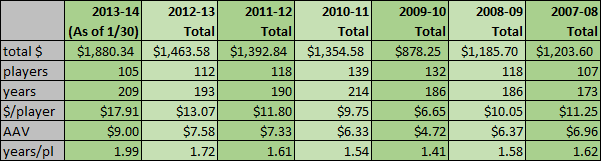
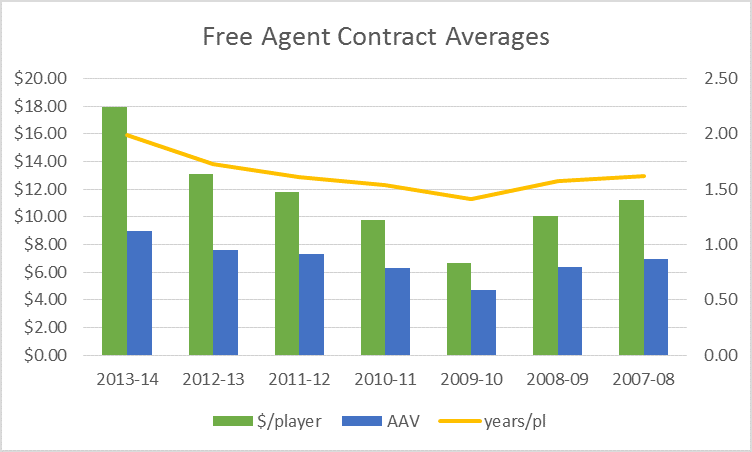
Clearly, though the trend that Cameron notes is still present, it is somewhat less dramatic than it first appeared. As it turns out, the ESPN tracker is missing a good number of deals, most of which are of smaller magnitude.
And, as we can see, the 2009-10 baseline is somewhat misleading. That year was, I believe, largely an outlier in terms of charting market development. There were internal factors at play: the market was headlined by Matt Holliday, John Lackey, Jason Bay, and Chone Figgins. Only Holliday landed a nine-figure deal, and only Lackey and Bay joined him with at least a $50MM guarantee. More importantly, though, the signing period took place in the midst of a massive, global economic downturn. That probably helped flood the player market with supply (notice the high number of players reached the market rather than being tendered arbitration or extended) and created obvious risk for teams in guaranteeing long-term money.
The curve is much less pronounced when using one of the prior years as a starting point. Comparing 2007-08 to 2012-13, we see that the average commitment per free agent contract has gone from $11.25MM to $13.07MM. That figure stands at $17.91MM for the ongoing 2013-14 period, though it will fall somewhat as the rest of a delayed market settles into place.
Moreover, while new local and national TV money is unquestionably having a dramatic impact, the hard-to-capture role of happenstance should not be ignored, either, in assessing the numbers. If, say, Robinson Cano had signed an extension with the Yankees and Masahiro Tanaka not been posted — both of which were certainly possible at various points — all of the roughly $400MM committed to those players would not have stayed on the market. Things might look much different had those two premium players not been available, or if the Yankees had chosen to stay under the luxury tax line.
Also critical to bear in mind is the fact that, as Cameron mentiones in the comments to his piece, many TV deals have only just been negotiated and will not reset again for decades. Those deals have raised the revenue streams of many teams and the league at large, but obviously none will increase annually at anything approaching the 30% free agent spending jump we've seen this year. (The Phillies' new deal, which I took a look at recently, is said to escalate at between 3-4% per year.)
Now, let's isolate things to multi-year deals only. Over the last seven signing seasons, here are how things look for free agent deals that guaranteed more than one year:
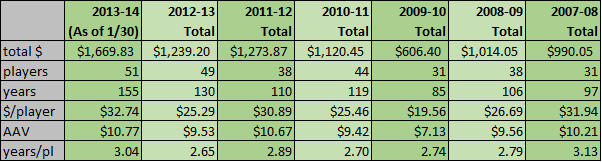
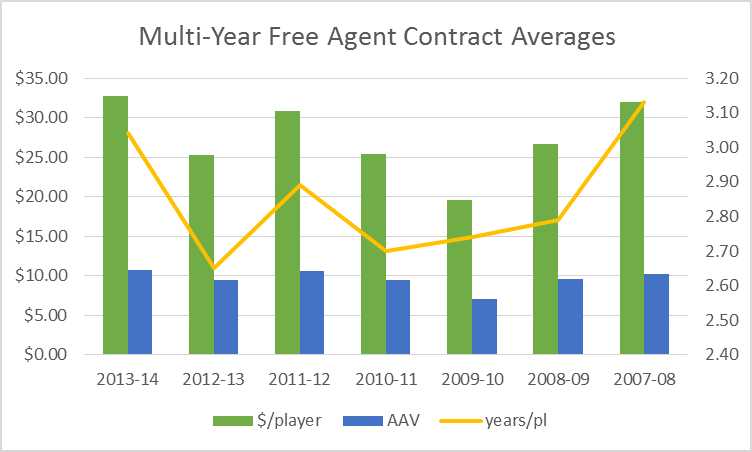
The 2009-10 blip is quite apparent. Again, look at the 2007-08 numbers and compare them across to the present year. The total commitment per player contract, AAV, and average number of years look about equal. When the current signing season ends, I suspect, its multi-year segment will fall below 2007-08 by those metrics.
Of course, that is somewhat misleading in and of itself. After all, with more money being given out than ever before, it must be going somewhere. In fact, as Cameron identifies, the key is in the number of multi-year deals that the market is awarding. Without question, the absolute number of multi-year deals has been sharply on the rise:

While we will have to wait and see where the numbers end up on the present year, it does look like a jump from ~30% to ~50% overstates things somewhat. Between last year and this, my guess is the number will settle in below 45%. Of course, that still represents quite a dramatic increase in the slice of the free agent market that is commanding multiple years.
So, what kinds of deals are the ones driving the growth? I charted out the contract lengths in my dataset to see:
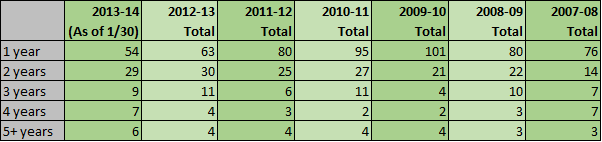
As those numbers suggest, there has been an apparent increase in two particular areas: two-year deals and contracts of four or more years. By percent of all free agent contracts:
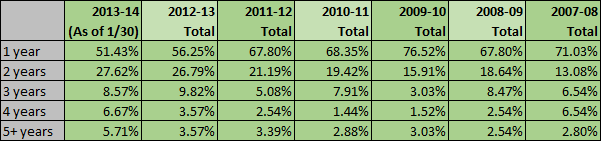
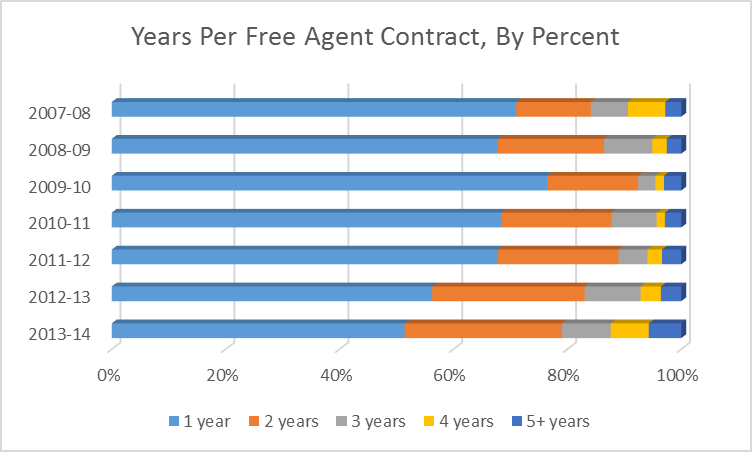
With no additional roster spots, there has been a corresponding drop in the number of one-year pacts. Most likely, strong competition for the best players, combined with increasing financial flexibility, has led to additional years being given all along the spectrum of the market. Interestingly, this shows that financial benefits have trickled down to non-star players, although MLB veterans capable of earning guaranteed money hardly represent the bottom of the baseball world.
The increasing number of two-year deals has held down the average length figures cited earlier. Unmistakably, however, the length of free agent guarantees have risen quite substantially in recent seasons.
Mets Tried To Land Balfour
2:24pm: A club official says that the team did not beat the Rays' offer on Balfour, Mike Puma of the New York Post reports (Twitter links.) Though the Mets had "dialogue" with Balfour, the source said, only a "real creative" contract would have been possible for the club.
The Mets made an equivalent offer to that of the Rays, tweets Adam Rubin of ESPNNewYork.com.
2:17pm: The Mets offered Grant Balfour a larger deal than the two-year, $12MM pact he signed with the Rays, reports Ken Rosenthal of FOX Sports (Twitter links). The closer instead chose Tampa because of its proximity to his Clearwater, Florida home, says Rosenthal, and may also have considered the impact of Florida's lack of state income taxes.
The news is most interesting for what it says about a Mets organization that has already guaranteed nearly $90MM in free agent signings. With Bobby Parnell expecting to resume his duties as closer to start the year, and the club seemingly already controlling enough pieces for the pen, the interest in Balfour rates as a surprise. That is especially so given that Balfour is already 36, and the Mets will play the coming year without ace Matt Harvey to help lead a renaissance. If nothing else, it would appear that the Mets still have money to spend on the market, if any other players carry sufficient appeal for GM Sandy Alderson.
Commenting Policy
MLBTR is increasing efforts to enforce our commenting policy. The goal is to raise the level of discourse in the comments, part of which involves eliminating inappropriate language and insults.
Comments of this nature are not allowed:
- Attacks or insults towards other commenters, the post author, journalists, teams, players, or agents.
- Inappropriate language, including swearing and related censor bypass attempts, lewdness, insults, and crude terms for body parts, bodily functions, and physical acts. Overall, we don’t want any language that a parent would not want their kid to see.
- Juvenile comments or extensive use of text message-type spelling.
- Comments written mostly or entirely in capital letters.
- Spam-type links or self-promotion. Please submit to our weekly Baseball Blogs Weigh In feature if you have a website or blog. Currently, permissible links in the comments are limited to MLB.com, Cot’s Baseball Contracts, FanGraphs, Baseball-Reference, Baseball Prospectus, Baseball America, and MLB Trade Rumors. Comments linking to other sites will be deleted.
- Comments about how you're sick of this topic or it's not newsworthy.
- Anything else we deem bad for business may be removed.
Also keep in mind the following general guidelines:
- No inappropriate avatars or images are allowed.
- Comments should be kept to approximately 200 words or less.
- Corrections for errors made in our posts are welcome and appreciated. We ask that you be cordial in doing so.
If you see comments that violate our policy, please flag them and/or contact us. Bans may be handed out liberally by our moderators, without second chances or warnings. Remaining civil is not that difficult, though, and most commenters have no problems doing so as well as helping rein each other in. We at MLBTR are grateful for long-time commenters and readers, though this policy applies equally regardless of tenure. This policy is always available at the bottom of the site, and will be re-posted monthly.
Arbitration Roundup, Part II: Notable Deals And Cases
With the day's arbitration activities complete, the filterable MLBTR Arbitration Tracker now has a full set of information for your perusal. The settlement amount is available for every player that has reached agreement already. And the team and player arbitration demands exchanged earlier today (and the resulting midpoint) are available for all 38 players that have yet to ink a new deal. (As always, you will want to reference the projections from the arbitration model of MLBTR contributor Matt Swartz.)
Let's take a quick look back, and then a quick look forward:
Notable Deals
The most interesting signings of the day included:
- Starter Max Scherzer of the Tigers landed far and away the biggest one-year jump of a 5+ service year hurler.
- Orioles first baseman Chris Davis, who received a record raise for a second-time eligible player.
- Outfielders Brett Gardner of the Yankees (link) and Giancarlo Stanton of the Marlins (link) both got substantially more money than was projected by Swartz.
- The Nationals signed interesting two-year deals with extension candidates Jordan Zimmermann (link) and Ian Desmond (link) that guaranteed their remaining arbitration years without extending team control.
- Dillon Gee of the Mets became the first player to sign after exchanging figures, when he and the club apparently realized that they were too close to warrant a fight.
Notable Cases
As we move ahead, here are the situations most worth watching:
- The Braves say they will go to hearings with star players Craig Kimbrel ($9MM vs. $6.55MM), Jason Heyward ($5.5MM vs. $5.2MM), and Freddie Freeman ($5.75MM vs. $4.5MM).
- Homer Bailey and the Reds are nearly $3MM apart in terms of arbitration positions ($11.6MM vs. $8.7MM), but seemingly plan to use their time before the hearing to talk long-term extension.
- Some of the other sizeable gaps between player and team filings, in absolute terms, are Justin Masterson and the Indians ($3.75MM), Doug Fister and the Nationals ($2.75MM), Mark Trumbo and the Diamondbacks ($2.45MM), and Matt Wieters and the Orioles ($2.25MM).
- More significantly, in some respects, are the differences in position in relative terms. These cases feature the greatest relative gulf (percent by which player demand is higher than team offer): Logan Morrison and the Mariners (127.3%), Daniel Descalso and the Cardinals (77.42%), Brandon Belt and the Giants (75.6%), Ben Revere and the Phillies (75.0%), and Trumbo and the D-Backs (72.1%). Among these situations, all of the player figures were further away from Swartz's projections than were the teams'. Belt and Revere — both Super Two players — were furthest away from the projected salary. The gap in exchanged figures can have a huge impact on the bargaining positions of lower-salaried players in post-exchange negotiations: they stand to lose much more by failing in a hearing, and their teams are better able to take on the risk of taking them to a hearing.
- Amongst cases with over $4.5MM player demands, these have the largest percentage differences: Trumbo and the D-Backs (72.1%), A.J. Ellis and the Dodgers (53.3%), Fister and the Nationals (47.8%), Masterson and the Indians (46.6%), David Freese and the Angels (46.3%), Kenley Jansen and the Dodgers (44.3%), Tyler Clippard and the Nationals (42.7%), Alex Avila and the Tigers (42.7%), and Jeff Samardzija and the Cubs (40.9%).
- The two seemingly unnecessary disputes are between Andrew Cashner and the Padres (5.49%) and Heyward and the Braves (5.77%). And yet, both cases could end up in a hearing.
MLB Owners Approve Expanded Replay In 2014
Expanded instant replay is officially coming to Major League Baseball for the 2014 season. MLB owners unanimously approved the new replay system today at the quarterly owners meetings, writes Paul Hagen of MLB.com, and the new system has also been approved by the MLBPA and the World Umpires Association.
Managers will be allowed to challenge no more than two plays per game, with a second challenge only being earned if the manager wins his initial challenge. Initiation of these challenges will be made verbally to that day's crew chief. The umpiring crew will also be allowed to initiate a review on any qualified play from the seventh inning on, even if a manager has already used his challenge(s). Roughly 90 percent of plays in a game will be eligible for challenge, including: ground-rule doubles, fan interference, stadium boundary calls, force plays (with the exception of a fielder touching second base on a double play), tag plays, fair/foul calls in the outfield, trap calls in the outfield, hit by pitch calls, timing plays (whether a runner scores before a third out is recorded), touching a base, passing runners and record-keeping (e.g. ball and strike counts, outs, substitutions).
Home run calls will continue to be reviewable upon the crew chief's discretion. Managers can request that the umpiring crew review a home run call but cannot directly challenge a home run ruling.
Challeneged plays will be reviewed by an umpiring crew at the Replay Command Center at MLB Advanced Media headquarters in New York. Ballparks will be equipped with an easily accessible communication center near home plate. Additionally, teams will be allowed to have a club employee monitor video outside of the dugout and communicate with the manager about whether or not to initiate a challenge. Teams will now also be allowed to show replays of close plays on the stadium video boards, even for plays that aren't reviewed.
Hagen's piece is an excellent rundown of the entire replay system which contains considerable detail on the new system and is well worth the read for those wanting to familiarize themselves with the full scope of replay expansion.
In a press release, MLBPA executive director Tony Clark stated: "The Players look forward to the expanded use of replay this season, and they will monitor closely its effects on the game before negotiating over its use in future seasons."
146 Players File For Salary Arbitration
The Major League Baseball Players Association has issued a press release announcing that 146 players have officially filed for salary arbitration. Among them are many outstanding players (and some fascinating arbitration cases), including Clayton Kershaw, Craig Kimbrel, Chris Davis, Max Scherzer, David Price, and Giancarlo Stanton.
Let's take a quick look at what this means, and how MLBTR will guide you through the arbitration happenings soon to come:
Upcoming Arbitration Period
Today's deadline is largely a formality. Teams were required to make decisions on tendering arbitration by December 2nd, and players file as a matter of course when arbitration is offered.
But with the announcement, the clock is now ticking down to Friday at noon central, when players and teams will formally exchange and submit salary figures. As a result, we can expect a flurry of new deals to avoid arbitration between now and then.
Though a hearing can still be avoided after the Friday's exchange, several teams tie their bargaining position to the deadline. As MLBTR's Tim Dierkes has explained, so-called "file and trial" teams refuse to negotiate after the exchange deadline in any case, taking the stance that they will go to a hearing if agreement has not been reached. The Blue Jays, Braves, Marlins, Rays, and White Sox are the clubs that maintain such a policy. Meanwhile, at least four other clubs — the Brewers, Pirates, Nationals, and Indians — take the file and trial approach in some circumstances, and have shown a particular willingness to go to a hearing.
On a league-wide basis, of course, hearings are an increasing rarity. For the first time ever, there were none last year. Hearings will be scheduled over the period of February 1st through 21st this year.
How To Keep Tabs On Arbitration Situations
With so many players' situations still to be resolved, how can you keep track? MLBTR has you covered as the flow of arbitration settlements increases:
- First, you'll want to take a look back at the arbitration projections of MLBTR contributor Matt Swartz. Swartz has also provided some excellent arbitration breakdown pieces, in which he takes a closer look at the cases of certain key players.
- Second, as always, be sure to keep a close eye on MLBTR's pages, whether by the classic means of regular browser refreshing or — if you prefer — through a more modern mechanism. Remember, news will always appear on the site first.
- Third, MLBTR's Arbitration Tracker will carry the latest updates while maintaining all arbitration information in one spot. Our writing team will do its best to keep the tracker fresh troughout the coming days and weeks.
Of course, the Arb Tracker also allows you to filter amongst the players within it based upon such factors as team, service time, settled amount, and (eventually) player and team submission amounts.
Looking at the tracker now, 34 players have already reached agreement on a contract for 2014. Among them, only Seth Smith, Stephen Strasburg, and Brad Ziegler have broken the $3MM barrier, so most of the big spending is still to come.
Indians reliever Josh Outman just became the first of the 146 players who technically filed today to reach an agreement with his club. Click here to take a look at the other filing players whose cases are still outstanding.
MLBTR Apps, Features, Functions
An explanation of the many ways to enjoy MLB Trade Rumors:
- Be sure to pick up the MLBTR apps for the latest news and rumors, for iPads, iPhones, and Android devices.
- If you want only the hard news in the form of transactions, our transactions page is the ticket. You can also get only the transactions via Twitter or RSS.
- To return to the main page at any time, just click on the title or the Home button on the navigation bar below the title.
- The navigation bar will cover many of your needs. Use the About dropdown to learn about this site or any of its writers.
- The Contact button takes you to a page where you can write an email message to the MLBTR writers. If you have a link to a rumor we've missed, please send it in through the Contact page! Also use the Contact page to inquire about advertising on MLBTR.
- The Archives dropdown shows you 15 months worth. If you need to go back further, click on Site Map at the very bottom of the page. Site Map also lists out every MLBTR post category, including players, teams, and features.
- The Tools dropdown takes you to a number of different places. The MLBTR Widget allows website owners to easily add a constantly updated box with all of MLBTR's headlines to their sites.
- Also under the tools tab is our Transaction Tracker, which enables you to search about anything and everything to do with baseball trades, signings and extensions.
- Our DFA Tracker helps you monitor the many players who are designated for assignment throughout the year.
- We also have an Extension Tracker, with details on all contracts that include at least one arbitration year.
- MLBTR's Agency Database lets you know which agencies represent which players. It's searchable by team, agency or player, so be sure to check it out.
- Follow Teams is a very useful dropdown. Hover over it to see all 30 teams. Click on the team name to bring up a page of every post containing information about that team, with the latest on top. These are the same pages you'll find if you go to the Rumors By Team section on the sidebar and select A's Rumors, Angels Rumors, etc.
- Also under the Follow Teams dropdown, you'll find RSS and Twitter buttons. Those links allow you to follow a single team's rumors via RSS or Twitter. Did you know we have a separate Twitter account for each of the 30 teams? For example you can follow @mlbtrtigers, where you would get the latest Tigers updates.
- You can also follow Tim Dierkes on Twitter for more MLBTR content.
- On the far right of the Navigation bar, you'll see buttons for Twitter, Facebook, and RSS. MLBTR has over 301,000 Twitter followers, over 79,000 Facebook fans, and over 61,000 RSS subscribers. Sign up for these and you'll be the first to receive all of our posts.
- Be sure to check out your favorite team's MLBTR page on Facebook so you can receive and comment on the latest rumors.
- On to the sidebar. It begins with a list of our Top Stories, which our writers update any time major hard news occurs. Go here for a quick update on the most important stories. Below that is the site's Search Box, where you can type in any player's name and get the latest on him.
- MLBTR Features has all kinds of goodies, including our free agent lists. Many of the MLBTR Features are constantly updated by our writers, so be assured that our free agent lists are always fresh.
- Below Features you've got headlines for all the Recent Posts, in case you'd rather not scroll to see all the headlines. Then there's a box for our Mailing List, where you can sign up to receive a daily email containing MLBTR's posts. Use this option if you don't need the news as soon as possible.
- Next we have Featured Posts, where you'll find original work from MLBTR writers we consider noteworthy.
- If the main site doesn't load perfectly on your cell phone, try the more mobile-friendly mlbtraderumors.mobi. It's a simple page that shows you just the headlines and lets you click through to what you want to read.
- MLBTR is available on the Kindle as well.
Greg Maddux, Tom Glavine, Frank Thomas Elected To Hall Of Fame
The Baseball Writers Association of America has elected Greg Maddux, Tom Glavine and Frank Thomas to the Hall of Fame.
Maddux, often referred to as "The Professor," won 355 games with a 3.16 ERA in 5,008 1/3 career innings. He averaged 6.1 K/9 (3,371 career strikeouts) and 1.8 BB/9 (999 career walks) over that time and captured four consecutive NL Cy Young Awards from 1992-95. He also fired 109 complete games, including 35 shutouts, and picked up 18 Gold Glove Awards as well. Baseball-Reference valued his career at 104.6 WAR, while Fangraphs had him at 113.9.
His longtime teammate, Glavine, won two NL Cy Young Awards (and had three other Top 3 finishes) en route to a career 3.54 ERA. Glavine won 305 games, striking out 2607 batters (5.3 K/9) against 1500 walks (3.1 BB/9) in 4,413 1/3 career innings. He completed 56 of his 682 career starts and totaled 25 shutouts along the way. Baseball-Reference pegs him at 74 WAR, while Fangraphs values his career at 64.3 WAR.
Thomas was one of the game's most feared power hitters for the majority of his 19-year career. "The Big Hurt" owns a lifetime .301/.419/.555 batting line with 521 homers and 1,704 RBIs. He won the American League MVP in 1993-94 and had four other Top 4 finishes in that voting. Thomas' OPS+ of 156 is tied with the great Willie Mays for the 19th-highest in Major League history, placing him one point ahead of Hank Aaron. In terms of WAR, Baseball-Reference has Thomas at 73.6 compared to Fangraphs' 72.4.
Falling painfully shy of enshrinement is Astros great Craig Biggio, who received 74.8 percent of the vote, meaning he was two votes shy of being elected. That should bode well for his future chances, and one would imagine that he is a lock for election in the coming years.
Also of note is Jack Morris, whose 61.5% vote count did not get him elected in his 15th and final time on the BBWAA ballot. Opinions have varied widely on Morris, whose 10-inning shutout in Game 7 of the 1991 World Series against the Braves is considered one of the greatest postseason performances in history. He will now have to wait until at least 2016 for another chance at the Hall of Fame, when the Veteran's Committee can vote on his fate.
Maddux's 97.2 percent vote count is overwhelming, but also means that he was left off of an incredible 16 ballots. It was thought that he could pass Tom Seaver for the greatest total ever, but Tom Terrific's mark of 98.8 percent still remains the top in Hall of Fame voting history. Mike Piazza (62.2 percent), Jeff Bagwell (54.3 percent) and Tim Raines (46.1 percent) were among the other top vote-getters. Click here for the full results, and congratulations from the MLBTR team to Maddux, Glavine and Thomas on the well-deserved elections.
Extension Candidates
From November 2012 through May 2013, 27 players with less than six years of Major League service signed contract extensions. 23 of these deals were signed after January 15th, and it's safe to say extension season will begin this year a little before the January 17th figure exchange date for arbitration eligible players.
Here's the breakdown by service time from the last extension period:
- 1-2: 2
- 2-3, not Super Two: 2
- 2-3, Super Two: 4
- 3-4 years: 4
- 4-5 years: 8
- 5-6 years: 7
It was a pretty even distribution – four players who were not yet arbitration eligible were extended (all in March or later), while at the other end of the spectrum, seven players were headed into their contract years and signed extensions instead. Here's a look at each team's speculative extension candidates. The date of the team's last multiyear deal for a player with less than six years of service is in parentheses.
- Angels (2-5-13): Mike Trout
- Astros (7-13-13): Jason Castro
- Athletics (4-11-11): Jed Lowrie, Brandon Moss, Jim Johnson, Luke Gregerson, Craig Gentry, John Jaso, Josh Donaldson, A.J. Griffin, Jarrod Parker
- Blue Jays (3-27-13): Colby Rasmus, Brett Cecil
- Braves (1-4-11): Freddie Freeman, Jason Heyward, Craig Kimbrel, Kris Medlen, Mike Minor, Chris Johnson, Andrelton Simmons, Julio Teheran
- Brewers (3-13-13): Jean Segura
- Cardinals (3-8-13): Matt Carpenter, Trevor Rosenthal, Shelby Miller, Michael Wacha, Lance Lynn
- Cubs (5-13-13): Jeff Samardzija, Travis Wood, Nate Schierholtz, Welington Castillo
- Diamondbacks (12-20-13): Mark Trumbo, Gerardo Parra, Pat Corbin, Wade Miley, A.J. Pollock
- Dodgers (2-7-12): Clayton Kershaw, Kenley Jansen
- Giants (3-29-13): Brandon Belt, Pablo Sandoval
- Indians (2-7-13): Justin Masterson, Jason Kipnis, Corey Kluber
- Mariners (1-5-11): Kyle Seager
- Marlins (12-19-10): Giancarlo Stanton, Steve Cishek, Jose Fernandez
- Mets (4-4-12): Dillon Gee, Daniel Murphy, Bobby Parnell
- Nationals (1-18-13): Jordan Zimmermann, Ian Desmond, Doug Fister, Stephen Strasburg, Tyler Clippard, Wilson Ramos, Bryce Harper
- Orioles (2-9-13): Chris Davis, Tommy Hunter, Matt Wieters, Manny Machado, Chris Tillman
- Padres (9-5-12): Andrew Cashner, Chase Headley, Ian Kennedy, Everth Cabrera, Tyson Ross, Eric Stults, Jedd Gyorko
- Phillies (2-19-12): Kyle Kendrick, Ben Revere, Domonic Brown
- Pirates (12-11-13): Neil Walker, Pedro Alvarez, Mark Melancon, Gerrit Cole, Starling Marte
- Rangers (11-7-13): Jurickson Profar
- Rays (12-3-13): David Price, Jeremy Hellickson, Alex Cobb, Chris Archer, Wil Myers, Desmond Jennings
- Red Sox (1-19-13): Junichi Tazawa, Xander Bogaerts
- Reds (2-12-13): Homer Bailey, Aroldis Chapman, Mike Leake, Todd Frazier
- Rockies (2-11-13): Nolan Arenado, Wilin Rosario, Tyler Chatwood, Rex Brothers
- Royals (3-30-12): Greg Holland, Eric Hosmer, Luke Hochevar, Lorenzo Cain
- Tigers (1-12-11): Max Scherzer, Rick Porcello, Austin Jackson
- Twins (12-6-12): No likely candidates
- White Sox (3-7-13): Jose Quintana
- Yankees (2-1-08): Ivan Nova, David Robertson, Brett Gardner
With over 100 extension candidates listed, obviously I have taken an inclusive approach. In each case, it makes sense to evaluate the history of the team, GM, and agent. For example, the Yankees generally don't do multiyear deals with their players before they reach free agency, though their contract six years ago with Robinson Cano was a huge win. And while agent Scott Boras typically encourages his clients to explore free agency, he was open to precedent-setting early deals for Elvis Andrus and Carlos Gonzalez (and was perhaps ordered to broker the team-friendly contract for Carlos Gomez).
I encourage you to explore the possibilities with extension candidates using the myriad of tools available at MLB Trade Rumors, including our extension tracker and arbitration tracker.