
MLBPA Confirms Tony Clark As Executive Director
Unsurprisingly, the Major League Baseball Player's Association has "overwhelmingly confirmed" the appointment of Tony Clark to the position of executive director, the organization announced via press release. Clark was named by the MLBPA Executive Board to the post back in December.
The longtime big leaguer took over at the helm for the deceased Michael Weiner, after having been appointed as Weiner's deputy last summer. "I am honored to receive the support of the general membership in conforming my appointment as executive director," Clark stated in the release. "I look forward to working on behalf of the fraternity of all Players, and to building on Michael's vision and the proud traditions and accomplished history of the Player's Association."
Ranking Agencies By 2013 WAR
Which agency's players have the most MLB talent? One way of answering that question is to rank the agencies by 2013 wins above replacement (from FanGraphs). Here are the results for total 2013 WAR. Please note that players with negative WAR were omitted, and cutoffs of 50 plate appearances for hitters and 20 innings for pitchers were used to remove smaller sample cases.
- Boras Corporation: 132.9
- Relativity Baseball: 107.4
- Excel Sports Management: 72.0
- CAA Sports: 70.8
- ACES: 68.9
- Wasserman Media Group: 62.6
- Octagon: 44.8
- The Legacy Agency: 43.6
- MVP Sports Group: 41.8
- Jet Sports Management: 25.5
- Beverly Hills Sports Council: 23.5
- Frontline: 22.8
- TWC Sports: 21.2
- LSW Baseball: 20.3
- Kinzer Management Group: 19.7
Let's take a look at WAR per big league player, filtering to agencies with at least ten players. WAR per player:
- Boras Corporation: 2.42
- Excel Sports Management: 2.18
- Relativity Baseball: 2.03
- Wasserman Media Group: 2.02
- Jet Sports Management: 1.96
- Frontline: 1.90
- Kinzer Management Group: 1.79
- MVP Sports Group: 1.74
- Octagon: 1.72
- LSW Baseball: 1.69
- CAA Sports: 1.54
- ACES: 1.47
- The Legacy Agency: 1.36
- All Bases Covered: 1.28
- Beverly Hills Sports Council: 1.12
In some cases WAR per player is deceiving, because a large agency like Boras gets dinged for having small 2013 contributions from players like Xander Bogaerts or Jake Arrieta. So, here's a listing of the number of four-win players by agency:
- Boras Corporation: 11 (Carlos Gomez, Chris Davis, Max Scherzer, Matt Harvey, Jacoby Ellsbury, Shin-Soo Choo, Adrian Beltre, Carlos Gonzalez, Jayson Werth, Matt Holliday, Jose Fernandez)
- Relativity Baseball: 5 (Miguel Cabrera, Paul Goldschmidt, Justin Verlander, Andrelton Simmons, Gerardo Parra)
- ACES, Excel Sports Management, Wasserman Media Group: tied at 4
MVP Sports Group and Octagon had three each.
A look at three-win players by agency:
- Boras Corporation: 20
- Relativity Baseball: 14
- Excel Sports Management: 11
- Wasserman Media Group: 8
- CAA Sports: 7
- ACES: 6
- Octagon: 5
- Jet Sports Management, Kinzer Management Group, MVP Sports Group: tied at 3
Comparing these numbers to 2012, the Boras Corporation increased its total WAR by over 27% and came out on top in every category. The agency continues to represent the most and best MLB talent. The top ten from last year remains mostly the same, though Relativity (formerly SFX) is on the rise with star power and depth. Jet Sports Management is a new entrant in the top ten, led by Chris Sale, new addition Mike Minor, Kyle Seager, and Brian McCann.
MLBTR's agency database was used for this post; please email me at mlbtrdatabase@gmail.com with any corrections or omissions. Also, feel free to drop me a line if you'd just like to see your agency's entire list of players used for this post.
2013-14 Free Agent Spending By Team To Date
While some prominent names remain available, the free agent market is relatively settled at this point. (Click here to see who is left.) It would be surprising to see more than a few additional guaranteed MLB deals.
Given that, it seems like a good time to break down what each club has spent. You'll notice also that this provides some update on the total spending figures that I most recently calculated in late January. The total spend has now surpassed $2B. Unlike that post, I'll keep it simple and just give you the numbers today.
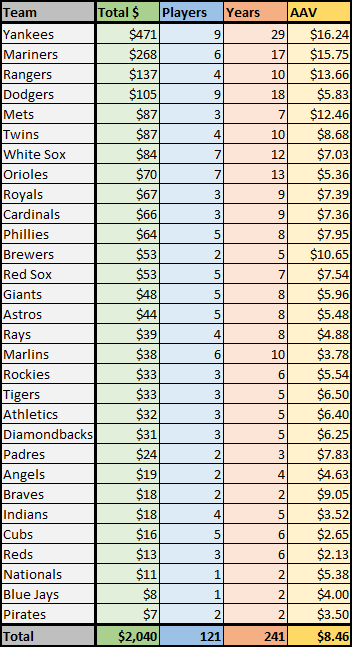
And in chart form (click image for full size):

2013-14 Article XX(B) Free Agents
As has been previously discussed on MLBTR, the MLB collective bargaining agreement contains a provision that allows certain free agents who are signed to minor league contracts to receive a $100K retention bonus if they do not receive a binding promise to be added to the team's 25-man roster (or the Major League disabled list) five days prior to the season. If the team decides to pay the retention bonus, the player also receives a June 1st opt-out clause. Contracts can permissibly include terms that are more favorable to the player, such as greater retention bonuses and/or earlier opt-out clauses.
For the current season, MLBTR's Tim Dierkes tweets, decisions must be made by March 17th for the Diamondbacks and Dodgers, and by March 25th for the rest of the league. (Of course, at present, neither of the clubs opening play in Australia has signed an XX(B) free agent.) Last year, numerous XX(B) free agents received either a roster guarantee or a bonus from teams hoping to maintain control over the player.
There are many different ways to become a free agent, but only those players who reach free agency through Article XX(B) and certain international free agents are eligible for this added protection. There are two types of players who can qualify in this manner at the end of a season. (In either case, of course, the player must not already be a free agent; i.e., he must be on a club's 40-man roster upon the conclusion of the World Series.) First are those players who have accrued at least six years of Major League service time and are not under contract for the following season. Second are those players with expiring contracts who signed with an MLB club after turning 23 and after playing five seasons in one of the major international leagues. (In the below list, Kawasaki and Wada are examples.) In either case, the XX(B) free agenty must sign his minor league deal ten or more days prior to Opening Day to qualify for the added contractual protections.
Here is a list of this year's crop of Article XX(B) free agents who have signed minor league deals and thus come within the ambit of the rule, as of today. (Several other players likely to land minor league deals could also qualify — including names like Kevin Gregg and Juan Pierre — if they sign in time.)
Angels: John McDonald, Carlos Pena, Yorvit Torrealba, Chad Tracy
Astros: Cesar Izturis
Blue Jays: Munenori Kawasaki
Braves: Freddy Garcia
Brewers: Zach Duke, Lyle Overbay, Mark Reynolds
Cubs: Tsuyoshi Wada
Giants: Kameron Loe
Indians: David Aardsma, Aaron Harang
Mariners: Scott Baker, Endy Chavez, Humberto Quintero
Marlins: Reed Johnson
Mets: Kyle Farnsworth, Daisuke Matsuzaka
Nationals: Luis Ayala, Mike Gonzalez, Chris Snyder
Orioles: Alexi Casilla, Johan Santana, Delmon Young
Philies: Ronny Cedeno
Rays: Erik Bedard
Red Sox: Rich Hill
Reds: Jeff Francis, Ramon Santiago
Rockies: Nick Masset
Twins: Matt Guerrier, Jason Kubel
MLB Implements New Home Plate Collision Rule
Major League Baseball and the Major League Baseball Players Association announced today that they have agreed to implement an experimental rule that is designed to eliminate "most egregious collisions at home plate." The official language of the rule, per the press release, is as follows:
- "A runner attempting to score may not deviate from his direct pathway to the plate in order to initiate contact with the catcher (or other player covering home plate). If, in the judgment of the Umpire, a runner attempting to score initiates contact with the catcher (or other player covering home plate) in such a manner, the Umpire shall declare the runner out (even if the player covering home plate loses possession of the ball).
- Unless the catcher is in possession of the ball, the catcher cannot block the pathway of the runner as he is attempting to score. If, in the judgment of the Umpire, the catcher, without possession of the ball, blocks the pathway of the runner, the Umpire shall call or signal the runner safe."
The rule, numbered Rule 7.13, does not bar players from colliding with a catcher if the ball is already clearly in the catcher's possession by the time the runner reaches home plate. Factors in determining whether or not a runner violated the rule will be whether or not he made an effort to touch home plate, lowered his shoulders or pushed through the catcher leading with his hands, elbows or arms. Runners who slide and catchers who leave a path for the runner to get to the plate will not be found in violation of the rule.
MLB and the MLBPA will form a committee of players and managers to review the rule as the season progresses, with an eye on full-time implementation for the 2015 season. Rule 7.13 plays will be reviewable under expanded instant replay.
O’s Considering Comp Free Agents
The Orioles are willing to forfeit the 17th overall pick in 2014 and its associated bonus pool money to sign a compensation free agent, FOX Sports' Ken Rosenthal writes in his latest column. It would appear that the O's aren't done sorting through external rotation options after adding Suk-Min Yoon earlier this week.
While Baltimore has been connected with pitchers such as Ervin Santana and Ubaldo Jimenez in recent weeks, new quotes from baseball operations chief Dan Duquette suggest stronger interest than what's been previously reported. "We do have a little bit better talent base in our organization. Our scouts have done a decent job recruiting internationally as well as domestically," Duquette comments. "With the maturity of our team, we have to take a look at it."
That last quote likely refers to the Orioles' current window for contention, which looks to narrow considerably after the 2015 season, when first baseman Chris Davis and catcher Matt Wieters are scheduled to hit free agency. Augmenting the rotation with a pitcher such as Santana or Jimenez would appear to be the most likely avenue of upgrade, as Orioles starters posted an ERA of 4.57 in 2013, good for 12th in the AL. It's currently not known whether the O's prefer Santana or Jimenez, but payroll flexibility isn't an issue, Rosenthal writes.
Rosenthal's article outlines another intriguing possibility: that the Orioles ink two compensation free agents. Adding Santana or Jimenez and a hitter — say, Kendrys Morales — would cause Baltimore to lose the 55th selection in the draft in addition to its first rounder, and such a move is "probably a long shot," Duquette says. However, losing one pick "makes the second one easier, frankly," he adds.
Visit HoopsRumors.com For The Latest NBA News
The NBA trade deadline is just one week away and there figures to be a dizzying amount of trade talk leading up to it. Fortunately, you can keep up with it all by visiting our sister site, HoopsRumors.com. There, you'll be kept abreast of every credible trade rumor in the NBA with the kind of up-to-the-second news updates and in-depth analysis that you've come to know and love from MLBTR.
Are you just a casual hoops fan? Let's get you up to speed. The Knicks continue to target the Raptors' Kyle Lowry while dangling Iman Shumpert to other clubs. The Celtics seem willing to part with just about anyone on the roster not named Rajon Rondo and forward Brandon Bass is getting serious interest from multiple clubs. Meanwhile, the Warriors are looking for bench help and they're getting a great deal of calls on Harrison Barnes. The Bucks are turning away calls on Larry Sanders and the Knicks reportedly won't move free-agent-to-be Carmelo Anthony, but as we've learned over the years, anything can happen.
With Feb. 20th quickly closing in, there's no better time to check out HoopsRumors.com and follow us on Twitter, @HoopsRumors.
The New Posting System And What It Means For MLB
Thursday will mark the 19th anniversary of Hideo Nomo signing with the Dodgers to become the first impact Japanese-born major leaguer to make the jump to Major League Baseball. Meanwhile, we're just weeks removed from the latest Japanese sensation, Masahiro Tanaka, signing a much more lucrative deal with the Yankees. When I spoke with former Dodgers GM Fred Claire, the man who brought Nomo to Los Angeles, earlier this offseason about the parallels between the two processes, he rightfully said that there were hardly any, save for their position and nationality. Tanaka's transition involved about a year of will they/won't they chatter about whether the Rakuten Golden Eagles would post the star pitcher and thirty days of intense talks between clubs and agent Casey Close. Nomo, meanwhile, broke free from the Kintetsu Buffaloes by simply "retiring" from Nippon Professional Baseball. Yankees GM Brian Cashman surely wishes things were still that simple.
After watching Nomo flee with ease and, years later, seeing Hideki Irabu and Alfonso Soriano join MLB without any compensation coming NPB teams' way, NPB finally put their foot down in 1998. NPB reached agreement with commissioner Bud Selig on a new system that would compensate Japanese clubs for allowing players – who have to wait nine years before reaching free agency – out of their contracts to make the jump. The system, devised by Orix BlueWave GM Shigeyoshi Ino, called for MLB teams to take part in a silent auction where they offered up a dollar amount to the Japanese team to win exclusive negotiating rights with the posted player. If the winning team and player reached agreement on a deal within the 30-day window, the NPB team would get their posting fee. If a deal was not reached, the Japanese club got nothing and the player was returned to his NPB club. It was a system that gave NPB clubs checks that ranged from the reasonable to the sizable to the titanic. The first player posted, Alejandro Quezada, earned the Hiroshima Toyo Carp a $400K check courtesy of the Reds. Ichiro Suzuki, the second posted player, went to the Mariners after Seattle gave the Orix BlueWave a little more than $13MM. Nearly eight years later, the Red Sox paid the Seibu Lions $51.1MM for the privilege to give Daisuke Matsuzaka a six-year, $52MM contract. There was a bilateral opt-out clause on the MLB-NPB agreement on a year-to-year basis, but it survived nearly a decade-and-a-half. NPB had about as much incentive to tear up the contract as a lottery winner would have to light their ticket on fire. It's surprising, however, that MLB allowed the system to continue as constructed for as long as they did.
With nearly all of baseball drooling over Tanaka in 2013, MLB finally forced NPB to come back to the table with NPB to hammer out a more favorable agreement. The new system caps the maximum posting fee at $20MM and, unlike the previous system, allows the player to negotiate with any team that is willing to pay the fee. On the surface, it would seem that this overhaul was a major victory for Selig & Co. since Dice-K and Darvish's fee was more than double that amount and Tanaka surely would have tripled it. However, as this year's Tanaka sweepstakes showed, the overall cost to the winning club may not change very much at all. Star pitcher Yu Darvish cost the Rangers $111.7MM overall between his $60MM contract and $51.7MM posting fee. Tanaka's posting fee was roughly $32MM less but cost the Yankees $175MM in total with $155MM going to the 25-year-old. Ultimately, what did MLB gain from the new system? I spoke with Major League executives and agents to try to bring some clarity to the latest iteration of the posting system.
Introducing ProFootballRumors.com
We are proud to announce our new NFL rumors site, Pro Football Rumors! Luke Adams and his team of NFL fanatics are covering rumors, transactions, and the draft 365 days a year with the style, timeliness, and analysis you've come to love on MLBTR and Hoops Rumors. The team has been quietly covering all the latest for the past several days, so there is plenty of reading material.
NFL free agency starts in March and we'll have the latest on big names like Jimmy Graham, Greg Hardy, and Eric Decker. We'll also keep you on top of the latest on Johnny Manziel, Teddy Bridgewater, and Jadeveon Clowney in advance of the May draft. If you like what you see at Pro Football Rumors, please bookmark the site, follow us on Twitter @PFRumors, and like our Facebook page.

Former NBA Star McGrady Eyeing Baseball Career
Seven-time NBA All-Star Tracy McGrady is aiming to pitch in professional baseball, FOX 26 reports. Still a relatively young 34, McGrady has been training with Diamondbacks pro scout Scipio Spinks and will look to catch on with the independent league Sugar Land Skeeters for the 2014 season.
Spinks says McGrady is currently throwing in the 85-86 MPH range, disputing earlier reports that the former NBA scoring champion had surpassed 90 MPH. However, he adds that McGrady's slider, which took him "five minutes" to learn, is a "true slider" with "good break on it." McGrady can also command the baseball to both sides of the plate with ease, he comments, and may reach the 90s with practice. "If the season starts tomorrow Tracy McGrady will be able to pitch on that Skeeters team," Spinks says. McGrady is training at Constellation Field, the Skeeters' home park.
Roger Clemens has also given instruction to McGrady, the Houston Chronicle's Jose de Jesus Ortiz reports. Clemens, currently a special assistant with the Astros, says McGrady "[isn't] there yet" and needs the opportunity to throw to live hitters.