
Michael Morse has provided notice that he is still a force at the plate, but his defensive limitations remain a major factor in his market. He made good on the one-year, $6MM deal he signed with the Giants, but what kind of contract will he achieve in his second successive turn at free agency?
Strengths/Pros
You could probably write this section fairly in just one word: bat. Over 482 plate appearances with the Giants, Morse put up a strong .279/.336/.475 slash with 16 home runs. That line does not quite reach the monster figures he tallied in 2011 with the Nationals — .303/.360/.550 with 31 long balls – but nevertheless indicates that his down season in 2013 can be chalked up in large part to a nagging wrist injury that required offseason surgery.
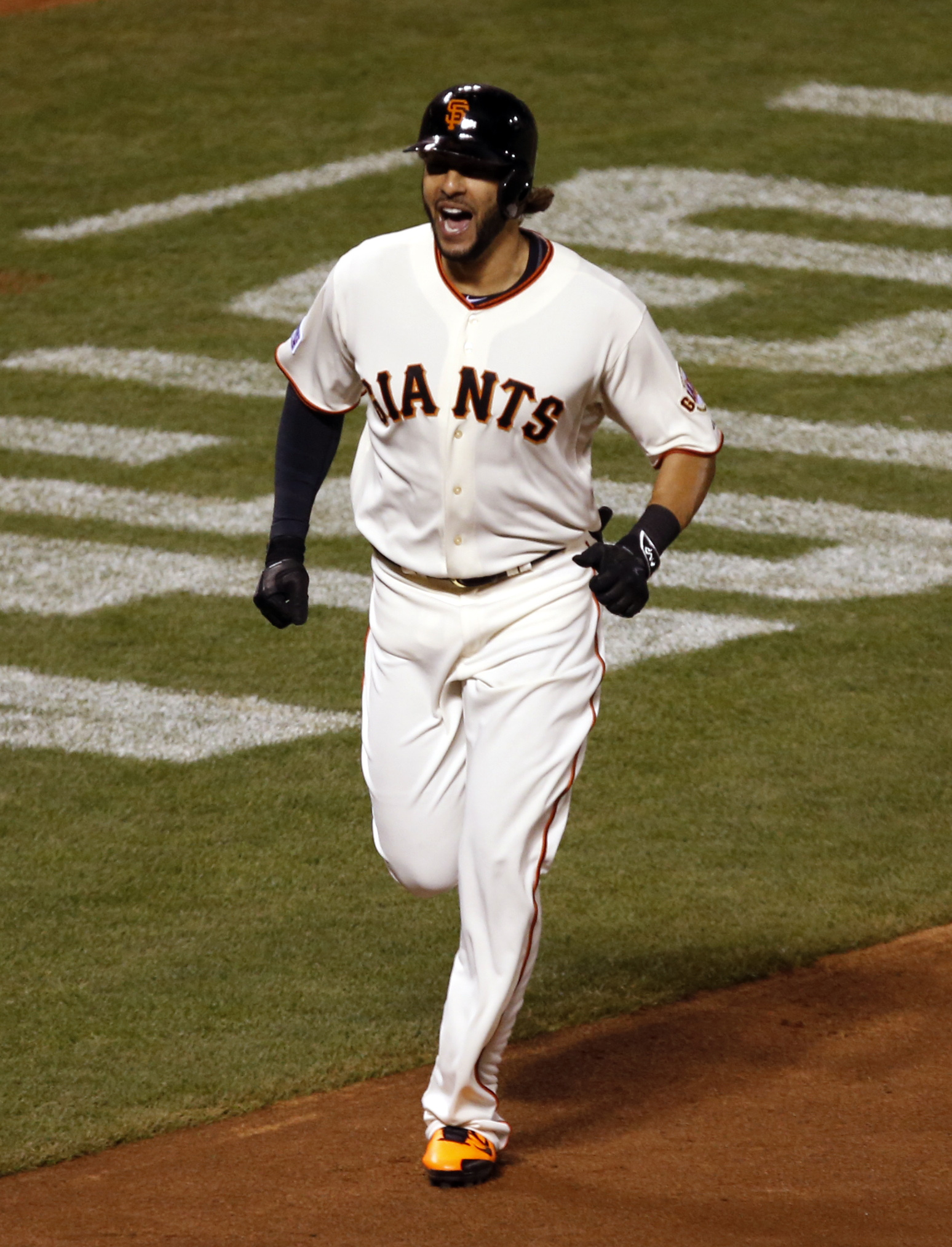
Notably, the right-handed-hitting Morse is productive against both righties (121 career wRC+) and lefties (121 career wRC+). Though he may never again be a truly elite power hitter, he has bumped his ISO back to just under the .200 level and could well improve on his career-low 15.1% HR/FB rate with a move to a ballpark that better suits his notable pop to the opposite field gap.
In truth, there is not much to dislike about Morse’s bat. Detractors could point to a slightly rising strikeout rate, but there is no spike that is way out of line with his career numbers. And Morse has had plenty of success with the same general mix of Ks and free passes. Likewise, his numbers in 2014 should arguably be downgraded due to the fact that he carried a sizeable .348 BABIP. (Notably, Morse’s rough 2013 season was driven in part by a .254 average on pitches he put in play.) But despite his lack of speed, Morse has put up three seasons of .330-or-better BABIP figures because, well, he hits the ball really hard. With all of his batted ball, pitch recognition, and contact numbers lining up cleanly with his career norms, Morse seems a good bet to continue to produce at a solidly above-average rate with the bat.
All said, Morse would be quite valuable even in a pure DH role, especially since he does not need a left-handed-hitting platoon mate. But that may still sell short his value somewhat. While Morse is widely acknowledged to be a very poor defensive outfielder (more on that below), he has somewhat surprisingly seen relatively little action at first in his career. Over 1,259 2/3 career innings at that spot, he has rated out as a slightly below-average defender. While that may not seem at first glance to be much of a feather in his cap, that decent performance in sporadic playing time provides hope that Morse could be a more reliable option if he were to open the spring with a first baseman’s mitt and use it steadily over a season. And it bears recalling that Morse started out his career as a shortstop, and even saw 450 big league innings there in his rookie season with the Mariners. Though he’ll never be graceful, it seems plausible to think that Morse could take on a full-time job at first.
Weaknesses/Cons
A hot start, mid-season swoon, and late-year rally is generally not the worst way to hit your walk year. But for Morse, that year all but ended when August flipped to September. Sidelined with a strained oblique, Morse saw just two plate appearances in the season’s final month. And as of this writing, Morse has taken just four trips to the dish during the Giants’ postseason run, though the most recent produced a memorable home run.
That slightly unfortunate, essentially minor injury could probably be forgotten in large part were it not for Morse’s lengthy docket of maladies. The towering slugger has missed significant time over each of the last three seasons – to say nothing of several earlier DL stints – for various aches, pains, and strains. In the aggregate, since that 2011 full-season breakout, Morse has averaged 107 games and 416 plate appearances a year. In particular, acquiring teams that intend to utilize him in the outfield will need to account for the distinct possibility that a full year of production may not result.
Of course, whether to use Morse as a regular outfield option at all is open to question. Among players with at least 1,000 innings in the outfield over the last three years, Morse ranks fifth from the bottom in total negative defensive value by measure of both UZR and Defensive Runs Saved. And the eye test tends to support these findings.
Baserunning, likewise, is a clear negative for Morse, who was one of the league’s worst runners this year and probably will be for the rest of his career. He will turn 33 just before the start of the 2015 campaign, though that is still a fair sight younger than several other first base/DH options set to hit the market.
Personal
Morse, who was married in 2012, currently lives within walking distance of AT&T Park, according to this profile from Ann Killion of the San Francisco Chronicle. He grew up in Florida, ultimately being drafted by the White Sox out of high school, but also spent time in Jamaica as a child.
Bearing a nom de guerre of “the Beast,” Morse is one of the most colorful players in the game. Whether performing his “Samurai Cobra Snake” routine before entering the box, spinning “Take On Me” before his third plate appearance of a game, or re-enacting a ghost swing before trotting out a grand slam after a review, Morse is undeniably an entertaining presence at the ballpark.
Market
While the Giants signed him as an outfielder, Morse’s time there in a regular capacity probably should and will come to an end. Though National League teams in need of a first baseman could make a slight roll of the dice on Morse’s defense, the most obvious landing spot remains with an American League club. Lacking platoon splits, he would be an attractive option to share time at first with a more platoon-oriented hitter while taking the rest of his hacks from the DH spot.
Clubs like the Rangers, Mariners, and White Sox seem to be possibilities, and the Royals may be in the market for a Billy Butler replacement. Were Victor Martinez to find a new team, it is possible to imagine the Tigers giving Morse a look to share first base and DH duties with Miguel Cabrera. And several N.L. teams – the Padres, Brewers, Marlins, and possibly the Pirates come to mind – could see merit in installing Morse at first. Should consideration be given to using him in the outfield, it is conceivable that the Giants, Reds, and Mets could get involved. Depending on how the Phillies proceed with their situations at first, third, and the corner outfield, Morse could theoretically land there as well.
As for comps, recent contracts given to Marlon Byrd (2/$16MM), Adam LaRoche (2/$25MM plus loss of a draft pick), and perhaps Mike Napoli (2/$32MM plus sacrifice of potential draft compensation) seem the most relevant points of reference. Byrd’s age and near-past disappearance from relevance certainly had a major impact on his market, though he is a more able defender than Morse. And Napoli’s strong work at the plate and in the field, combined with an age, seem to make his number out of reach. As for LaRoche, it is hard to ignore the fact that he was coming off of a 33-home run year and was generally well-regarded as a defensive first baseman (whatever the metrics may say).
Ultimately, even without the qualifying offer penalty, Morse seems likely to land shy of LaRoche’s deal. That is especially so given the fact that he faces relatively steep competition from bat-first players such as LaRoche (now again a likely free agent), Michael Cuddyer, Billy Butler, and (on the high side) Nelson Cruz and Victor Martinez.
Expected Contract
Morse’s representatives at ACES will probably ask for three years, but there is sufficient market competition that I see a shorter pact as the likelier outcome. Though a qualifying offer is unlikely to weigh down his value, Morse has his limitations as a player. Ultimately, I predict that he will land a two-year, $22MM contract.
Photo courtesy of USA Today Sports Images.
I love Michael Morse as a ballplayer. He’s fun, he’s passionate and as evidenced in last night’s NLCS Game 5, he can come through when you really need him to. And while I’d miss him if he weren’t on the Giants next year, an NL club really isn’t the place for him unless he can play first base and the Giants already have a fantastic first baseman. But who knows. Sabes usually does figure out a way to keep the band together.
Back to Baltimore, Chicago Wite Sox, Detroit, Minnesota, KC, Seattle, Texas, Rays. If it’s 2/22 I have a hard time see in the NL fit Mlwaukee perhaps?
Couldn’t see Minnesota, they need to improve their OF defense and have DH locked up.
He’s got about as much chance to return to Baltimore as Jeremy Guthrie does. Blow Hard Buck never used him. He’d be better off going anywhere else….except maybe back to Seattle again.
Th pirates sure could use his bat could platoon him with alverez. A possable combined 50+hr from 1st.
Meh, I don’t know at that price. He is really a dh, and him playing the field means he has topped 1.0 fWAR once. I wouldn’t pay that, but who knows. He is behind v-mart and cruz. Butler’s option is only $12.5MM which is overpaid, but it would be better than signing Morse at this price.
I still think it’s odd he’s not yet had a chance to be a first baseman. He doesn’t move well, obviously, but he played short and I think he’d have a good chance of being average at first if he just focused that all spring and season.
For an AL team that might also use him as a full-time DH, it’s reasonable to plug him at first with the idea to move him to the hitting-only role if it doesn’t work out.
Mikey Mo is a fun player and can really smoke the ball. His defense leaves a lot to be desired so DH might be his role.
Solid hitter with definite pop, but as has been said, offers little defensively and will likely be a full time DH in the not too distant future.
I see him perhaps fitting more an American League club now, sharing DH and 1B duties, and for me 2/22 is perhaps a little generous, i see Morse picking up around 2/18 somewhere, befitting his status as a mid level bat in an albeit thin free agent market for offense.
Why are the Astros not a fit?
Because Chris Carter will be their full time DH again in 2015 after hitting 37 HR’s in 2014.
one of carter or morse could play at 1B
Singleton
A PEDs guy coming off the 2nd best year of his career in SF at age 32. Must be some sort of fountain of youth out in the bay area LOL. Guy came up a shortstop just nine years ago and now people wonder if he can even play left field. If I’m an opposing GM i’m ‘suspicious’ and not interested.
Come on, that was just so long ago. And there has been nothing since. This eye test thing is unfair and unrealistic; this isn’t the age of steroids.
It amazes me how many people believe that PED’s directly make you good at baseball.
Do people believe that? I think people who understand how PEDs work know that the real value is in the strength training and recovery.
It makes you throw the ball harder and stronger swinging the bat so you can use a bigger stick and get to the outside pitch better. It also helps with the initial pop of the bat. It can even make you stronger so a hitter can get to a hard heater inside that he would not have been quick enough to get to without the PED.
It is silly to think PEDs would not make a man a better baseball player because that is exactly what they do!!!
Teams can make their own evaluations, and use what they know and we don’t to do so. But it would be very irresponsible for me to use this site as a launching pad for speculation about ongoing PED use.
Yep, this post should not have turned into the witch hunt that I took it to
No worries. I understand why people raise the questions, I just ultimately feel it is worth putting the other side out there.
Actually, their primary use is to jack you up so you can work out like a mad man
Well, some in the public still tie things back to the oversized steroid era. But yeah, you are right about the current value: overcoming minor injuries, improving strength and reflexes on the margins (which can be the difference between players who never quite make it and those who do).
All that, though, speaks in favor of withholding judgment — particularly when it is grounded on the idea that this really big, strong guy just looks too big and strong.
It’s not the age of steroids. It’s the age of advanced PEDs that work quickly and flush out of your system. We could pretend that a proven cheater isn’t 32 coming off the 2nd best year of his career with a team that has employed more cheaters than any other, but why ignore reality?
The guy’s only played 5 seasons in the majors, only one of which could be considered a full season. He might be cheating, but you’re not going to prove it that way, especially since there were good reasons (wrist injury) he wasn’t as good last season.
Morse is a very good big league hitter, and has been since he was with the Nationals. He had injuries that clearly explain his down year last year (and, to a lesser extent, the year before). Is he a ~130+ OPS+/wRC+ guy going forward? Not sure, but I think he can be exptected to be well above average, based on his established hit and power tools.
I just am not going to go around convicting people based on how I think their bodies look, etc.
My conviction lies in the results, not his size. I just dont think the results are a coincidence. He’s a big league caliber talent though, I wont/ didn’t mean to take that away from him.
My hesitancy to judge holds there, too. I think he’s got enough of a track record of hitting that this year’s production was not some kind of fluke where you go, “what is this guy on?” (Though even if it was, I wouldn’t suggest it.)
Baseball is too fickle a game. Look at Steve Pearce: he was actually a well-regarded prospect way back when. Is it so crazy to think he found something, or just put it together for one glorious season? There are plenty of guys in the olden days who had one shining moment, too, it’s really not a new phenomenon.
Things I learned today: Michael Morse, Matt Lawton, Ryan Franklin, and Rafael Betancourt were once suspended ten days for PED usage. I really don’t know how I never knew this, lol. Nobody talks about Morse and the latter two being tied to PEDs.
Foggy at this point, but wasn’t the PED from a rehab?
Not shown on this bio is his failed drug test record while in the minor leagues, club officials and players will remember this fact when he hits the open market again. He is a good hitter on pitches down the middle as evidence from that jack last night on a weak slide piece right down the middle
That was a different era. I am all about preventing PEDs (mostly for reasons of fairness on the field and player health), but there’s no reason I can see to drag that out now. Youthful indiscretion is not an uncommon phenomenon, and at some point you have to move on.
I can understand after seeing your comments why you would not include the failed drug tests. However do not make the mistake of thinking that management and players for that matter will not take exception. I know for a fact from my conversations with the big leaguers that I know that they view one time cheaters as a disgrace to the game. Clean players want the guys who have used PED’s to have one year or lifetime bans after the first offense.
My initial post was harsh, he can hit but I think he is a far less player than Maon Byrd and should get a contract less than his 2/$16
I don’t assume that there is literally no impact. There could be some teams that would downgrade him or have no real interest, with that as a factor. My point is just that it is too speculative to reach back on something like that at this point (for my post, anyway).
As for the Byrd comp, remember we have another year of good production from Marlon to hang our hats on. At the time, it was a one-year, very late-career breakout. He definitely is the most flexible player given his defensive standing, but Morse’s bat is legit. Could he fall shy of 2/$16? Guess it’s possible, but that’s dependent upon the impossible-to-foresee factors of the baseball player market.
2/$22 is just my best guess, b/c I think there will be enough interest to drive him there.
Agreed.
The Rangers are a good fit
One of my favorite players as a National. The personal stuff is right on. I just don’t think he can stay healthy to be full time player. Maybe as a DH. His best role is the role he is on right now with the Giants. Would be a great bench player on a return to Washington.
Yeah I enjoyed him in DC, too, as I lived there during his stint. You could say that I formed some opinions after watching him in the NLDS: flabbergasted at the defense and amazed by that incredible “Take On Me” moment in Game 5.
But I don’t see a fit now. With Zimmerman moving off third, and Souza ready for MLB action, I don’t see a need to spend for a RH bat of his type right now.
I think Morse is going to be overrated much like Kendrys Morales was. Neither can really play the field reliably, and their hit tool is a bit overrated. They’ve got power, but that’s about it. 22 MM isn’t much of an overpay, and I agree someone will give him that, but I personally wouldn’t go past Byrd’s 16 MM.
Quite a home run yesterday….
Back up plan for those who thought they would getting VMART or maybe Cruz.
Tigers could afford Morse AND overpay for Andrew Miller AND get a #4 starting pitcher for the same price tag as just VMART. Worth it?
In overall dollars, you might match what VMart would cost depending on the number 4 starter. But that’s 25-30 tied up for next year in players who won’t have the impact that VMart will.
1. I am talking about total cost, not AAV.
2. VMART is going to get 4 years, unless he feels guilty about being injured for a full year and gives the Tigers a hometown discount of HIGH AAV, but only 3 years.
3. I expect Miller to sign with the Red Sox as their closer and expect the Tigers will not be able to afford him… UNLESS VMART does not sign with the Tigers.
Players don’t ever feel guilty about that stuff enough to do that kind of stuff. There’s no reason to even bring it up unless he had said something about it.
Miller as Sox closer is certainly interesting. All depends on Koji. I personally don’t really want him back that badly.
As others have said, we Nats fans really do love the guy. There is no room for him in DC, but I wish him nothing but success.
Nats resigned LaRoche no draft pick loss
Mets could use him I would put morse in rf move grandy to lf sign cuddyer for insurance for rf and 1b I would make a trade to get Reyes back maybe murph,gee,tejada and den deckker Toronto can use an Of with melky leaving and a serviceable sp in gee plus murph and tejada