
Teams will have to decide whether Jordan Zimmermann is a top-of-the-staff stalwart or a steady mid-rotation arm.
Strengths/Pros
Zimmermann is often credited with a “bulldog” mentality because he so consistently attacks hitters in the zone. He conveys a sort of unemotional intensity on the hill that contributes to his well-earned reputation for steadiness and relentlessness. But he’s not just a big, lumbering arm; Zimmermann is also an excellent athlete who moves well off the mound and fields his position well.
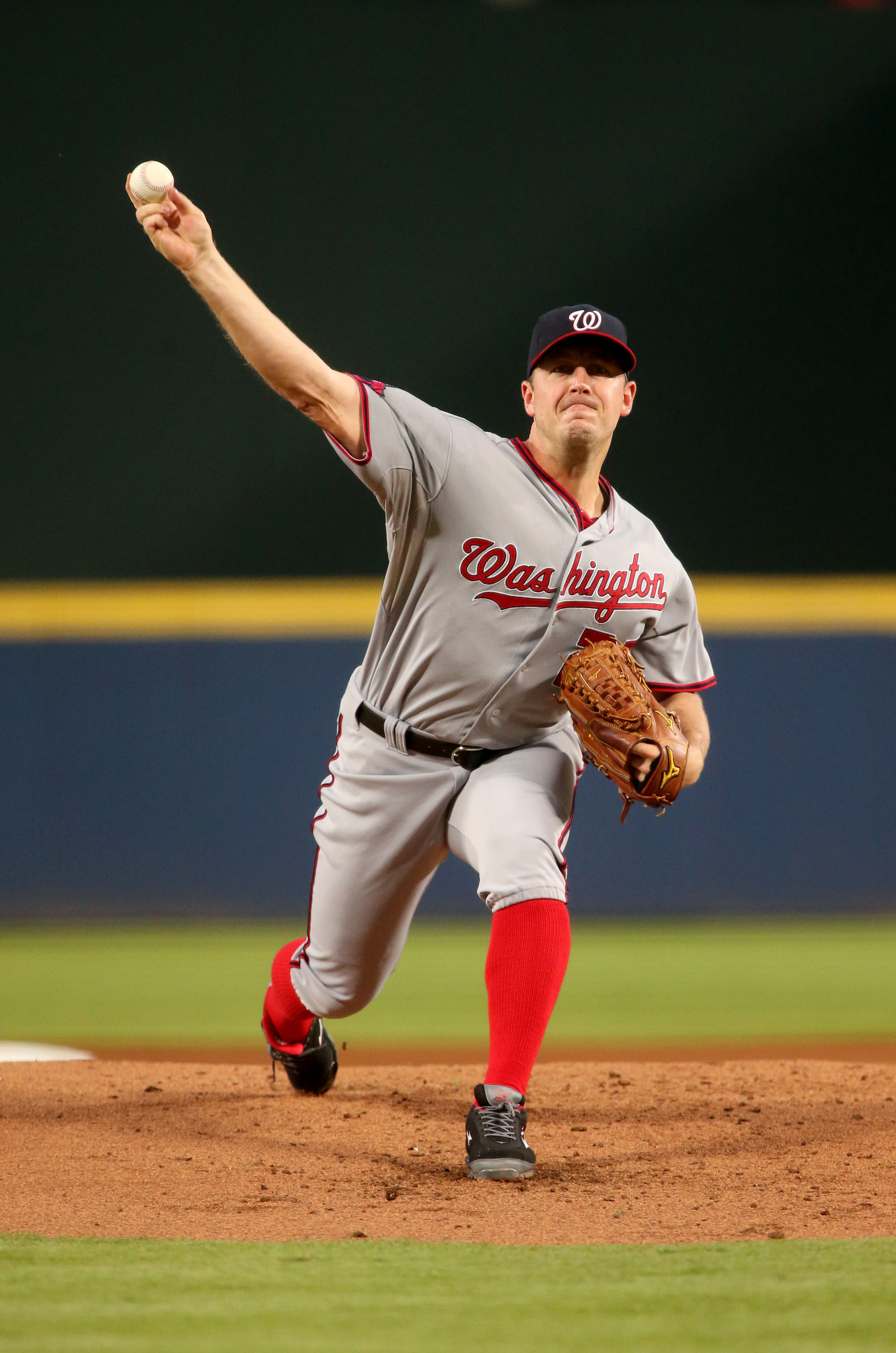
Age and innings go a long way in determining the length of free agent deals available to starting pitchers, and Zimmermann fares well in both regards. While he’s not the youngest arm on the market, he won’t turn thirty until May 23rd of next year.
Zimmermann has also been quite durable in recent years. He was shut down early in 2011, his first year back from Tommy John surgery, as the Nationals sought to build up his innings. In the four years since, Zimmermann has made at least 32 starts each season while compiling 810 1/3 total innings. Though he’s never put up gaudy single-season inning tallies, he is fifth in the game in total starts since the beginning of 2012 and ranks 12th in total frames over that span.
That’s a nice base to work from, but performance will obviously drive both years and value. Heading into this season, there was reason to believe that Zimmermann could reach (or even exceed) Jon Lester‘s six-year, $155MM deal with the Cubs. After all, he was coming off of two consecutive years in which he landed in the top ten in the National League Cy Young voting, building off of two very good seasons before that. His 2014 campaign, in particular, was outstanding: Zimmermann posted a 2.66 ERA with 8.2 K/9 against a league-low 1.3 BB/9.
While he has often described his approach as pitching to contact, Zimmermann has also shown the ability generate swings and misses (though, as explained below, that comes with some caveats). 2014 set a high-water mark for Zimmermann’s strikeouts, but he was able to return to that level over the latter half of last year, so it may be too early to write off his ability in that regard despite uninspiring overall numbers in 2015.
And focusing on the swings and misses tends to detract from the veteran’s single best skill: his impeccable control. Zimmermann has never permitted more than two free passes per nine innings over a full season. Since the start of 2011, only six starters with over 500 innings have bettered his walk rate.
Another area where Zimmermann has performed well is in limiting platoon splits. He’s been slightly better against righties historically, of course, but has handle opposite-handed hitters in equivalent manner in most regards. Lefties do draw walks at a higher rate (2.3 vs. 1.4 BB/9), but their overall production has not been markedly greater (.310 vs. .286 wOBA).
Weaknesses/Cons
There’s a lot to like, but 2015 represented a step back for the righty, and not just in the earned run department. Zimmermann’s 3.66 ERA was by far the highest full-season mark of his career, and his FIP (3.75), xFIP (3.82), and SIERA (3.83) marks all landed a fair sight over his career averages.
Of greatest concern to his outlook, perhaps, was the failure to maintain what had been a breakout season in the strikeout department. His 2014 swinging strikeout jump (from the mid-8 percent range to 10.3%) has basically dropped back to where it was before and now looks like an outlier. And that issue is compounded by the fact that Zimmermann doesn’t generate a ton of groundballs, having settled into the low-forty-percent range.
It is interesting to note that Zimmerman trended upwards in terms of strikeouts over the season’s second half, posting 8.3 K/9 over his final 90 innings of the year. But that was not accompanied by success, as it coincide with a large jump (from 0.64 to 1.60 HR/9) in home run proneness that almost entirely explains his earned run leap.
Bottom line: it’s not clear that Zimmermann can generate the whiffs you’d like to see while keeping the home runs in check. Doing both of those things drove his outstanding 2014, but he was running a HR/FB rate (6.4%) that was significantly below his career level (now 9.1%). This past year, while Zimmermann‘s batted ball results were in line with his track record, he allowed a career-high 1.07 HR/9 on a 10.9% HR/FB rate.
Zimmermann certainly has had success in the past despite middling K numbers, but he’s always outperformed ERA estimators. In particular, SIERA has never been a big fan — crediting him with just a 3.62 lifetime mark. He fares better by measure of FIP (3.40) and xFIP (3.57), but all those numbers paint him more as a steady mid-rotation arm than the somewhat higher-level arm that his 3.32 lifetime ERA might suggest.
As teams decide how to judge those numbers, they’ll also be looking at other recent indicators. The pitch value of his fastball (per Fangraphs) fell into the negative for the first time over a full season after consistently rating as a plus offering. Possibly reflecting some lost confidence, Zimmermann dropped his fastball use rate back into the low-60% range after it had risen to over 70% in 2014. He also continued to work higher in the zone with the pitch, continuing a trend from 2014. While that might have helped him restore the swings and misses, it came with too many long balls and marginal grounder rates.
So, what’s up with the heater? One possible root issue is an average velocity drop. The offering was still within one mile per hour of his top career speed, so it isn’t necessarily a huge red flag, but that velo loss — combined with the other issues and sagging production — isn’t particularly promising, either.
Another historical strength that came into some question last year is performance against left-handed bats. Zimmermann’s fastball-slider-curve mix is well-established and has long been effective, but he’s generally also sprinkled in the occasional change. He largely dropped that pitch last year. Whether or not that’s a contributing cause, Zimmermann allowed a .281/.338/.438 batting line to opposite-handed hitters. Those are his worst-ever full-season marks in each of the triple-slash stats.
Personal
Zimmermann is a native of Wisconsin and graduate of the University of Wisconsin-Stevens Point. ESPN.com’s Jerry Crasnick’s 2013 profile of Zimmermann paints him as something of a mid-western archetype. An outdoorsman in the offseason, he doesn’t put much of his personality on display publicly but is known to deliver “a wry sense of humor” in the clubhouse environment.
Jordan and his wife Mandy have two children, the second of whom was born just one day before he took the bump on July 12 of this year. It wasn’t his best outing, but Zimmermann wasn’t making any excuses. “Still have to go out there and throw the ball over the plate,” he said.
Market
As mentioned above, there was a time where the Lester deal looked plenty attainable for Zimmermann, who looked to be chasing David Price and Johnny Cueto in earning power. Now, the Relativity Client has clearly been bypassed by the older Zack Greinke and stands alongside Cueto as players whose value took a bit of a hit down the stretch. There’s competition, as well, from pitchers like Mike Leake, Jeff Samardzija, Wei-Yin Chen, and Japan’s Kenta Maeda.
Though he won’t reach the AAV achieved in the Lester deal or even the somewhat lighter pre-2012 Greinke pact ($147MM over six years), it still seems plausible that Zimmermann will get a sixth guaranteed year — possibly at a lower rate. There’s some wiggle room in his market, especially if some teams still prefer the suddenly questionable Cueto, but there ought to be a lot of clubs with interest, helping prop up his floor and creating the possibility of some upward movement.
There are any number of clubs that might pursue Zimmermann, some of whom won’t likely be after the two arms ahead of him. The fact that he’ll be bound by draft compensation will provide something of a limiting factor, but there ought to be a good number of suitors. Basically the entire AL East (Rays aside) could theoretically have interest, as might the Tigers, Astros, Cubs, Dodgers, and Giants. Somewhat less obvious teams like the Mariners, Angels, Twins, Marlins, Cardinals, and Diamondbacks could also make sense. And if Zimmermann’s market sags early, other opportunistic buyers might conceivably get involved. A return to the Nationals can’t be written off entirely, but that ship likely sailed when the sides were unable to match up on an extension.
Expected Contract
It might be on the higher side of his market, but given his durability and broad potential market, I think Zimmermann will get to six years — though he might have to sacrifice a bit of AAV to get there. I’ll predict a six-year, $126MM contract.
I’d love to see the Red Sox pick him up at that price.
I’d try to cut off that 6th year and do something like 5/120.
Isn’t one Porcello enough?
How are the two even close to the same? Zimmerman is pretty much a lock for a 3.00ish ERA, 7-9 K/9, sub 2.0 BB/9, and solid all around numbers. Porcello has had just two seasons under 4.00 ERA (rookie year was 3.96), has two seasons of K/9 over 7.0, and the rest under 6.0, with most being under 5.0. He does have decent control usually hanging around 2.0-2.5 on BB/9. But he also has broken 200 IP once, and hasn’t gone above 190 in any other seasons. So I don’t see the comp in any way, shape or form.
I’m pretty sure he was referring to the $. May be mistaken.
Why do you think he got such a large contract?
I made the mistake of bring up Porcello yesterday. Very sore subject.
Porcello would be welcome back in Detroit… if most of his salary were picked up.
I think the Red Sox will see Zimmerman as a lower cost alternative to Price and Cueto. Going with Red Sox for 5/100, I think the QO, a down 2015 and a deep free agent starting pitching class will limit his market.
If he gets 5/100 he should fire his agent, unless its Milwaukee and he’s taking a massive hometown discount. Even then, he’s a lock for a minimum 6/120 deal. I can see him going much higher too.
I think Buchholz will bounce back and Porcello should also. And Erod looks like a real winner plus a number of other guys like Hill, Miley etc…Do they need to spend for a #1?
It’s not the number one priority. Honestly if they don’t get at least three quality arms for the bullpen there’s no point in getting a number one starter. But they still need someone to front the rotation. Someone like Kelly or ERod growing into that job isn’t beyond the realm of the possible, it’s just not something that can be counted on.
Key in the article is “bulldog mentality” that makes him valuable to any team. I don’t think he’s a SP a top team can look to as the #1 for any length of time, think back to what made John Lackey valuable when he 1st became a FA and Boston signed him, not to lead the rotation, but to sit behind then Beckett and lester. not that lackey wasn’t better really than Becket, but one can get the point. Serious inning type guys who will also dominate more often than not, though not Ace like qualities.
Not saying wouldn’t like to have Zimmerman, as would, just not at a cost of more than 100-125m spread over 5-6y. A team that can afford the payroll and needs an ace should probably look forward and not rely on just Zimmerman, unless they maybe have another pitcher of at least this quality already, or acquire another.
“Bulldog mentality” doesn’t mean anything, stats do, and over his last 971 innings he’s had a 3.30 FIP – those kinds of pitchers simply do not grow on trees. He’s borderline elite, so while he probably won’t get the $200+M Price will get, he’s certainly going to fall around 150-180, in my opinion.
95% sure not getting 150-180. He’s in the 100-130 market. He doesn’t miss bats, has had TJS, and has pitched his entire career in the weak hitting NLE. He’s also in a market flooded with pitching, there are 3 pitchers they are clearly better than him (Price, Cueto, Greinke) and 5 who are slightly worse but should be much cheaper (Kazmir, Maeda, Shark, Leake, Chen)
To me a ‘bulldog’ mentality is a guy like Mad Max. I’ve watched Zimm alot and don’t see that. I see a very good #2 that like Chen will get top dollar.
Agreed, will add that having guys like Zimmermann and Scherzer around has made watching gio and stras just so, so tough.
I think Zimmerman would be wise to sign early. The pitching market is deep and the teams who miss out on Greinke/Cueto/Price may not necessarily care to commit 100+ million to Zimmerman.
It’s deep this year, but its as shallow as can be next year, unless you like CJ Wilson. Strasburg is the only borderline elite SP. Teams know this and will spend accordingly this offseason.
Zimmerman is not getting 150 easily just because pitching is shallow next year, especially after an underwhelming season.
Being next years FA market for starting pitchers consists of Strasburg and a whole lot of “meh”, I can see Zimmermann getting between 150-180 quite easily,on a 6-7 year deal. He’s not elite, but money and performance are only very loosely connected, he’s going to be subject to a lot of teams in a war for him, and whoever wins will be getting a solid 2-3 guy who should put up 3-5 excellent seasons for his new club.
I think people are really underestimating how much free agents will get. There are a lot of pitchers on the market, but there are more teams that need pitchers than there pitchers in free agency. And the Dodgers wouldn’t wince at signing Greinke and another starter to contracts worth over $250 million.
Yes next year after Strasburg and Cashner it gets pretty shallow but 2018 has the potential to be as deep or deeper than this year’s class.Teams that miss out on this year will have a shot at Arrieta, Cobb, Ross and Lynn. Plus, guys like Pineda, Eovaldi, Parker, Smyly, Duffy, and Alvarez all have the potential to break out in the next couple of years and become TOR arms. Also, Tanaka has an opt out and could be in this class as well..
So, I find it unlikely that a team would handcuff themselves to a $150+ million contract just because 2017 isn’t very deep. Especially when that contract would more than likely effect their spending in 2018. I am not saying Zimmerman definitely won’t get that kind of money. A team like the Red Sox or Dodgers could fall in love with him and give him that kind of money. But a team like Philly (unlikely I know) who could be ready to contend again in 2017 isn’t going to cough up that kind of cash just because the 2017 free agent class is weak.
Zimmermann’s lack of strikeouts and ground balls concern me. I personally view him as a very high-end third starter, but after his poor year this year, relatively speaking, I’m not sure any team will view him as TOR arm. I would agree with Jeff at about 6/125-130.
A high end #3 on one team might be a high #2 on another. It’s easy to pick the aces, after that it’s all relative depending on strength of staff, NL or AL, and a strong or weak defense. A good example is Chen for my team in ’15 he was their #1. He will get 100 easily for 5. Guys insist on arguing that but with the Cubs for instance he could be a great pick-up. I always remember Maddon talking about how tough he was and getting high praise. Chen will be the best FA lefty after Price and Boras will get him paid well as he should be. Very unfortunate to lose him but we’ll survive.
It is unfortunate the O’s won’t be able to keep him. I would like to see him go to the Mariners. They need a solid dependable innings eater with good upside.
I feel like he is going to sign in Toronto.
Honestly, I’d rather the Dodgers land Zimmerman over Price or Cueto, and then either go all in in a bidding war with the Cards for Jason Heyward, or the Royals for Alex Gordon, and try to land some tier three pitcher a la Gallardo or Leake on a short-term deal to bridge the gap over to our young guns in the farm system. Getting Zimmerman as apposed to someone like Greinke would allow us to go all in to grab either Heyward or Gordon and fortify our outfield and lineup even more and probably still add another reliable arm. I dunno, it all depends on how much money the front office is given to work with, which, with recent history, seems like a lot.
They have too many outfielders already. Plus, they already have Kershaw, Wood, Ryu, and McCarthy, already under contract for the rotation next year. Urias isnt far away and Lee deserves a long look. Arroyo has a $4.5m buyout on a $11m option and they are going to chase Greinke hard.I could see them chasing Zimmerman if they miss out on Greinke but with all of the 2nd tier guys they already have under contract the only 2nd tier option I can see them getting would be exercising the option on Arroyo seeing as he will only cost an additional $6.5 m after the buyout. If he is healthy he will be a very solid #5. I think the #5 spot is Lee’s to lose though.
Tigers make sense to me. Instead of getting two lesser FA pitchers for the same combined AAV, get Zimmerman as more sure thing with high upside and then count on VanMan Norris or Fulmer to pan out (high chance that one of the two do). You can always adjust mid-season if they both do not.
First let’s hope and pray Dan Norris get’s through his bout with thyroid cancer.
Washington will miss him. 🙁
You still have a good Zimmerman left.
Reminds me a little of Rick Reuschel. very solid, not sure he’s a dominant ace-type. on the right deal, a very good investment. But too long, and you don’t get the peaks and pay for the regression.
Really right on target Mike. Very good comparison to Rick.
I think he may surprise some people with where he signs like the Dodgers, White sox, or Blue Jays. Most people keep saying Red Sox, Cubs, or Tigers but those are the obvious choices and as we all know obvious never happens
Trust me on this…Jordan Zimmermann is not signing with the White Sox. They have never spent that kind of money on any free agent, let alone a starting pitcher. They already have a true ace in Chris Sale who is making a fraction of the dollars that Zimmermann will command as well as a solid #3 pitcher in Jose Quintana who, like Sale, was also locked up long term with a team friendly contract extension before becoming arbitration eligible.
The White Sox are less likely to sign any top tier FA this off-season after their ‘spree’ last winter and far more likely to upgrade through trades or just hope that many of the under-performers from last season live up to to their contracts and that some of their younger perceived core begin to fulfill organizational expectations.
The club may look at bringing in a cheaper short term option like former ace Mark Beuhrle to help bolster their rotation in 2016 until some of their high end prospects like Carson Fulmer, Frankie Montas, Spencer Adams or Tyler Danish are ready fro prime time roles as MLB starting pitchers. Unless they opt to trade a pitcher like Quintana this off-season to solve a core need at third base or catcher or can somehow manage to dump John Danks in the final year of his ill-advised 5yrs/$65M contract extension, their likely 2016 rotation will consist of Sale, Quintana, Carlos Rodon, Danks and Erik Johnson.
Supply and demand are going to push all these pitching contracts down. Price and Greinke will still get paid, but I’d mostly take the under for everyone else this off-season.
Every case is different. I agree that Zimm won’t get 150-180 like people are saying. But most of the so called two’s and three’s will get paid very well. Going from the AL to the NL for some of these guys in particular should create a few more surprises like Jake with the Cubs. That’s why I see Chen and some other AL guys doing real well in the NL. NL to AL is obviously more difficult to adjust to.
I hope the Astros consider him but not at that salary.
Anybody even mentioning the Jays in this conversation?
If he chooses to pitch in the AL east that’s the place to go.
I included them in the post. He has a very wide possible market.
Many of Jordan Zimmermann’s metrics resemble those of another impending free agent starting pitcher…Jeff Samardzija.
Zimmermann is 16 months younger and the more accomplished starting pitcher in regards to W-L and ERA, but also has a history of injury and more mileage on his arm. Zimmermann also has benefited from starting for a far better team in Washington than what Samardzija pitched for in Chicago during the Cubs rebuild and White Sox re-tool over the past 4 seasons.
Because of his production, Zimmermann will command the higher contract but Samardzija just may turn out to be the better value if he can hook up with a real postseason contender long term and not have to be relied upon as his new team’s ace starting pitcher. In my opinion both profile as #2 or #3 starters but Zimmermann may be asked to head up his next clubs rotation with his expected contract while Samardzija is less likely to be signed for that role with his new team. ‘Shark’ put up good numbers following his mid-season trade to a contending Oakland club in 2014. He wasn’t asked to be the team’s ace and he also benefited from starting his home games in a pitcher friendly ballpark. A combination like that with his new FA contract just might make him the more valuable pitcher for his next club.
Post-all star break, the Red Sox led MLB in BA….but middle of league in ERA. A few more wins and they’re in the playoffs. I think Zimmermann could be a nice fit in Boston and has an even keel attitude with no off-field baggage. He would be worth the investment. I don’t get the same vibe on Cueto or Leake….and Price is going to be…well, too Pricey!