
Outfielder Dairon Blanco Leaves Cuba To Pursue MLB Career
Cuban outfielder Dairon Blanco has left his home nation to pursue a major league career, Ben Badler of Baseball America reports. The 23-year-old falls within international signing restrictions, which will function to shape and limit his market.
Blanco’s primary calling card is speed, with Badler calling him an 80-grade runner. He’s a major threat on the bases who’s also capable of playing in center, though the report suggests he could use some polish in the outfield.
That’s also the case with regard to his bat. Blanco owns a .303/.369/.409 slash in 916 plate appearances over four seasons in Cuba’s Serie Nacional, with 52 steals to go with a fairly promising 118:81 K/BB ratio. Though the high batting average, low strikeout rate, and wheels suggest that Blanco could be a useful contact hitter, Badler says that he hasn’t exhibited “natural hitting rhythm and actions” even though he’s generally succeeded against Cuba’s uneven pitching talent.
All told, Blanco looks to have an intriguing skillset but also a long way to go to the majors. He’ll also still have some time to wait before signing in the first place, as Badler notes that there’s essentially no chance he will be able to receive clearance before this year’s July 2nd signing period wraps up in mid-June. Still, Blanco could factor into the subsequent signing period, when he’ll join a growing list of Cuban players at different stages of their development in what promises to be a fascinating market.
Prospect Notes: International, Draft, Phillies
MLB.com has released its list of the top thirty international prospects, and it’s headed by infielder Kevin Maitan — a much-hyped Venezuelan youngster who is said to be set to sign with the Braves. Most of the remaining names on the list are also attached to major league clubs, but #2 man Vladimir Gutierrez is an exception. The 20-year-old righty is still a wild card, with many teams said to be intrigued. Thirteenth-ranked outfielder Randy Arozarena is also still up for grabs, it seems. Check out the list to see who could be destined for your club, and be sure to read the accompanying piece from Jesse Sanchez breaking down the market.
Here’s more prospect chatter:
- ESPN.com’s Keith Law has some updates on upcoming draft-eligible prospects that are worth a look if you have an Insider subscription. California product Matt Manning impressed Law with his curve, with the ESPN analyst labeling him the best high school righty in this year’s draft. There are updates on several other players to watch as June approaches.
- Speaking of the Rule 4 draft, Frankie Pilierie of D1baseball.com has posted a first-round mock (subscription required). He’s got University of Florida lefty A.J. Puk going 1-1 to the Phillies, which seems to be an opinion gaining some steam among analysts. He notes, though, that the club is still watching Jason Groome and Corey Ray — the latter of whom recently sat down with MLBTR contributor Chuck Wasserstrom for an interesting interview.
- MLB.com’s Jonathan Mayo answers some fan inquiries about the draft, starting with one on Puk. He explains that the southpaw may well not be the best talent available, but represents a plausible top asset given his relative polish. Of course, the club may have numerous other names still in the running, Mayo notes. He goes on to address several other topics of interest regarding pre-MLB talent.
- If you’re hankering for more prospect chatter, be sure to check out the recent MLBTR podcast featuring Ben Badler of Baseball America, which focused especially on some interesting international names to watch. BA also has released its top fifty draft list for subscribers, with plenty of analysis to go with it, and it’s well worth a read.
MLB Releases 2016-17 International Bonus Pools
Major League Baseball has released the bonus pools that will apply to the 2016-17 international market, as Baseball America’s Ben Badler provides and as are reflected in the table below (mobile link). We had a post on the draft slots for the coming year earlier this morning; both spending allocations represent increases that were reported back in February by BA’s Hudson Belinsky (which we covered here, including year-over-year changes by clubs as things stood at the time).
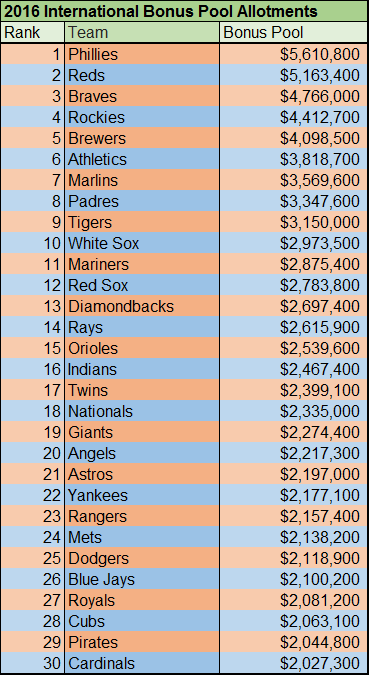
Teams have proven much more willing to blow past these international signing caps than those applicable to the amateur draft. But there are still significant penalties for doing so. As MLBTR’s Steve Adams has explained, these are the rules that come with the pools:
Penalties for the international bonus pool are as follows (international bonus pools only apply to players who are under the age of 23 and have fewer than three years of professional experience):
- All overages are taxed at 100 percent.
- Exceed bonus pool by 5 to 10 percent: Team is not allowed to sign a player for more than $500K in the following international signing period.
- Exceed by 10 to 15 percent: Team is not allowed to sign a player for more than $300K in the following international signing period.
- Exceed by more than 15 percent: Team is not allowed to sign a player for more than $300K in the following two international signing periods.
Of course, many organizations will not be in position to utilize their full allotments and will be looking to trade slots after incurring those penalties in prior years. As Badler has previously explained, the Dodgers, Giants, Cubs, and Royals are serving two-year $300K+ signing bans beginning in 2016-17. The Blue Jays will face a one-year limitation period for the coming market. Meanwhile, the Diamondbacks, Angels, Rays, Red Sox and Yankees are set to finish out their own pair of signing seasons on the sidelines, but will be able to re-enter the market fully for 2017-18.
Those and other organizations could look to achieve value from their allocations by trade, rather than by utilizing them for signings. Rival clubs will be looking to offset taxes or avoid penalties by padding their totals. Acquiring more spending money can only be accomplished by trading for specific signing slots — which are all provided at Badler’s above-linked post. Of course, teams can’t just take on as much as they wish; instead, they can only increase their original allotment by half its initial value.
By virtue of finishing with the worst record in the game last year, the Phillies not only pick up the top overall pick in the coming draft but also receive the largest international spending allocation. The Reds have the second most cash to spend, but their situation is still dependent upon whether and when the team formalizes a reported deal with infielder Alfredo Rodriguez. It seems likely that his $6MM bonus won’t hit the books until the new period starts on July 2nd, thus avoiding a broader spending ban for a coming year in which the club has significant capacity to add international talent.
With rules governing Cuban amateurs set to undergo significant change, there could be an interesting crop of new talent to accompany the typical July 2 wave from other parts of the world. That has also led to some timing issues in reaching agreements, as is the case with Rodriguez and also interesting Cuban youngster Lazaro Armenteros, who reportedly could be headed to the Padres — but only after the new signing period opens. Along with San Diego, the Braves and Nationals are among the clubs expected to blow past their pools and take on maximum penalties. Likewise, the Brewers, Cardinals, Phillies, and Rangers are also believed to be lining up big international outlays, and the Twins have also been mentioned as a possible big spender. These are among the teams that could be looking at summer swaps to add to the spending allocations listed in the table.
Latest U.S. Rule Change On Cuba May Pave Way For Free Agents
As the United States continues to unroll policy changes with regard to interactions between American and Cuban businesses and citizens, the latest move could have profound implications for the way that the island’s famed baseball players make their way to MLB. As Ben Strauss of the New York Times explains, the new rules — which start today — it will be permissible for major league teams (like any other employer) to hire Cuban citizens.
Under the existing scheme, Cuban players have been forced to endure a lengthy and often dangerous process not only to make it out of Cuba, but to become eligible to sign as free agents. While there are still many logistical and policy-related matters to be worked through before there is any kind of efficient exchange of talent between Cuba and the majors, yesterday’s announcement seems to remove a significant barrier from the process.
Indeed, the biggest immediate effect may be on Cubans who have already left the island and are currently waiting to reach free agency — which has previously required the establishment of residence in a third country in circumstances ripe for exploitation. In theory, those players — among them, Cuban legend Yulieski Gurriel, his brother Lourdes Gurriel, and veteran second baseman Jose Miguel Fernandez — can legally sign right now, so long as they are otherwise able to gain legal entry and work authorization, as would any other international player.
It’s likely, of course, that clubs will await some confirmation before proceeding; if nothing else, pursuant to baseball’s own rules, those players will still need to be declared free agents. Dan Halem, MLB’s chief legal officer, tells Strauss that the league is still studying the rules, and there could be a need for administrative changes before the flow of talent opens. Regardless of precisely how long it takes for the impact of the rule change to be felt, it holds out the promise of eliminating some of the worst byproducts of the convoluted prior system.
Standing alone, though, the new rules do not eliminate the incentive for defection for those ballplayers that remain in Cuba — though, presumably, they’d be able to defect directly to the United States or at least do so much more quickly. Working out a process for players still in Cuba, of course, will require more negotiation and the participation by the Cuban government. But with goodwill exchanges between MLB and Cuba seemingly proceeding nicely, it isn’t hard to imagine the parties in interest finding a way forward.
2016 Draft & International Pool Changes By Team
Baseball America’s Hudson Belinsky reports that draft and international spending pools will rise by about 4.6 percent in total for the 2016 Rule 4 Draft in June and the 2016-17 international signing period, which kicks off on July 2. Belinsky provides total draft and international pools for all 30 clubs, with the Reds ranking first in terms of draft bonus pool at $13.923MM and the Phillies laying claim to the top international pool by virtue of finishing with the league’s worst record in 2015.
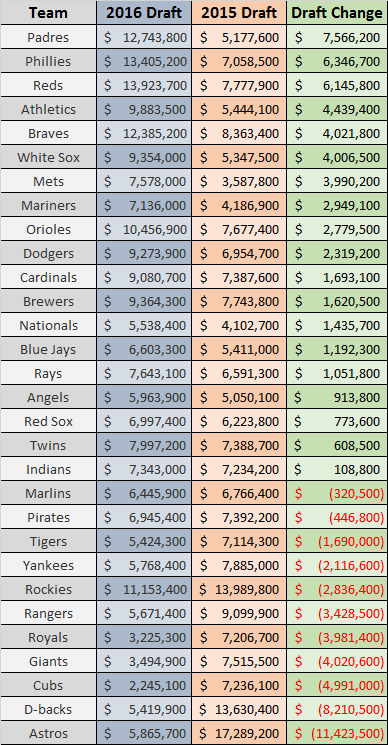
For MLBTR purposes, I’ve compiled quick references highlighting the year-to-year changes in each club’s draft and international spending pools, although it’s important to stress that the draft pools are still highly subject to change; Ian Desmond, Dexter Fowler and Yovani Gallardo all remain unsigned and will all require a club to forfeit its top unprotected pick upon signing, while the Nationals, Cubs and Rangers will all receive comp picks in exchange for those losses (Links to draft changes table and to international changes table for mobile app users).
Notably, that means that the Orioles’ current projection of a $10.457MM bonus pool is likely due for a precipitous decline, as the team has been rumored to be nearing a deal with Gallardo for nearly a week. While the exact value of the No. 14 overall pick that Baltimore would surrender isn’t known, last year’s 14th overall selection carried a value of $2,842,400. A 4.6 percent increase in that figure — the number referenced by Belinsky — would result in a slot value of $2,973,150. That figure would completely negate Baltimore’s $2.78MM pool increase, and the O’s could stand to incur further draft losses if they complete a deal with Gallardo and go on to pursue Fowler, as has been rumored. Baltimore’s second pick, No. 29 overall, would rise to 28th overall in the event that a deal with Gallardo is completed. Again, based on last year’s $1.975MM value for that slot and a 4.6 percent increase, the Orioles would stand to lose $2.066MM in draft money, bringing their total loss in the event of those rumored signings to $5.039MM — roughly 48 percent of their overall pool.
While the Reds have the largest draft pool overall, it’s the Padres who saw the largest increase in their draft spending potential, as the team received compensatory picks for the departures of both Ian Kennedy and Justin Upton in addition to winning the first pick in Competitive Balance Round B, which sits at No. 71 overall. As Belinsky points out, that gives San Diego six picks in the top 85 of the upcoming draft (so long as the club does not sign one of the aforementioned free agents, which indeed appears unlikely).
Conversely, no team has seen as swift of a fall in its draft spending potential as the Astros, who went from an enormous bonus pool of more than $17MM to a more standard pool of $5.866MM. (Last year, Houston picked second, fifth and 37th overall in the draft, thus creating the record-setting bonus pool.) The D-backs lost more than $8MM in pool money due to the fact that they dropped from the No. 1 overall pick to the No. 16 pick and subsequently forfeited the pick anyway to add Zack Greinke.
The Cubs punted a pair of picks to sign Jason Heyward and John Lackey, though they’ll see a notable bump back up the rankings when they receive a comp pick after Fowler signs (that comp pick between the first and second rounds will be eliminated due to the Heyward/Lackey signings, but Chicago’s second-round pick will then be restored, adding about $920K to its pool). Similarly, the Nats and Rangers will each see their draft allotments jump north of $7MM once Desmond and Gallardo sign.
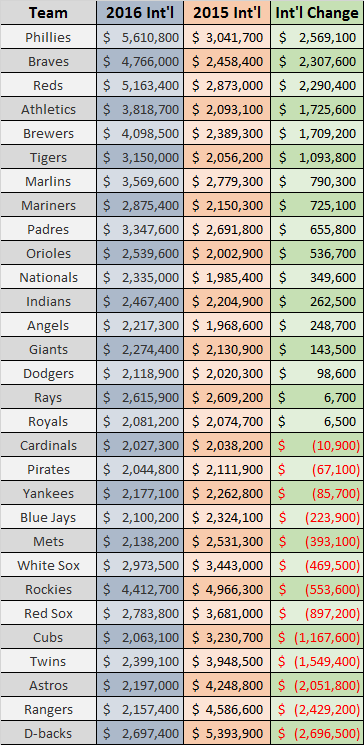
Meanwhile, the Phillies enjoy the largest increase in baseball on the international side of the equation, although the size of their pool could be rendered moot if the team exceeds its cap by a wide enough margin. Philadelphia is reportedly planning to be aggressive, and if the team plans to incur significant penalties, then the only real gain from the top pool is a bit of a break on luxury taxation. As such, if the Phils plan to shatter the pool anyhow, they could actually trade away slots. Counter-intuitive as it may seem, if they’re incurring maximum penalty anyhow, the slots would hold more valuable to a team that isn’t planning to do incur penalties, and the only loss for the Phillies would be more money.
The fact that the Reds are set to receive the third-largest increase again brings to light the team’s curious ties to Cuban shortstop Alfredo Rodriguez in January. Reds president of baseball operations Walt Jocketty denied that a deal was in place at the time that news of a $6MM signing bonus from Cincinnati to Rodriguez broke, and the team has yet to announce a deal. However, if Cincinnati does indeed come to terms with Rodriguez for that sum, it would prevent the team from signing a player for more than $300K in either the 2016-17 signing period or the 2017-18 signing period, thus mitigating the advantage of their notable pool increase. Instead, the Reds would likely trade away their international bonus slots this summer, and while that money can indeed be a deal-sweetener when talking with other clubs, international slots on their own haven’t been traded for much in the way of high-profile prospect capital. Straight-up swaps for international money have previously involved players such as Aaron Kurcz and Garrett Fulenchek. While some of the players in these deals could prove to be solid pieces in the long run, giving $6MM to Rodriguez would mean that the Reds elected to exceed their pool well after the top talent on this year’s international class had signed. Beyond that, they’d be doing it so by signing a limited number of players — highlighted by a defensively gifted but light-hitting shortstop — instead of taking a bulk approach and acquiring multiple prospects in next year’s class.
Looking to other clubs that have incurred maximum penalties, the Royals, Dodgers and Giants are all in roughly the spot in which they entered the 2015-16 period, but those slots will be used as trade fodder this summer after their significant international expenditures over the past seven and a half months. The Yankees, Rays, D-backs, Angels and Red Sox all look like reasonable candidates to trade away the majority of their international slots this coming signing period as well due to the fact that each team incurred maximum penalties in the 2014-15 signing period.
International Notes: Gurriel Bros., July 2 Spending
Cuban star Yulieski Gurriel, who reportedly defected recently with younger brother Lourdes Gurriel, may have an easier path to free agency than had been expected. Jorge Ebro of El Nuevo Herald reports that both brothers have moved across the border from the Dominican Republic to Haiti, which is a popular launching point for Cuban players seeking to make it to the majors. (Spanish language link.) Importantly, per the report, the 31-year-old infielder has already established Panamanian residency, which might well provide a faster route to the open market since some hurdles would already be cleared. Ebro provides other interesting details on the situation of the famed elder Gurriel brother, who is apparently looking to take his last chance at playing in the majors in his prime. Though he’ll soon turn 32, Gurriel is considered a prime talent and will create an interesting market situation — remember, quality infielders such as Ian Desmond, David Freese, and Juan Uribe remain unsigned — if and when he is deemed eligible to sign. The younger Lourdes, meanwhile, still appears likely to wait until October to ink an agreement, when he’ll be old enough to fall ouside of international signing restrictions.
Here are some more notes on the international market:
- The Brewers, Cardinals, Phillies, and Rangers are expected to have an active year in the coming July 2 market, MLB.com’s Jesse Sanchez reports, though it’s not yet clear to what extent any of those teams will be willing to go past their pool allocation. We’ve already heard that the Braves, Nationals, and Padres are expected to make significant moves this summer, likely incurring maximum penalties for exceeding their international spending limits. With numerous big spenders on the sidelines after blowing past their own caps in prior years, there’s some opportunity for other clubs to step in and seek to sign their own slate of talented youngsters out of Latin America.
- Sanchez goes on to discuss the market more generally, explaining that expectations are the non-Cuban market will produce a few significant bonuses (around $3MM to $4MM) with several other players receiving seven-figure paydays as well. He further notes that there figures to be quite a bit of competition as teams capped at $300K bonuses look to add lower-bonus names. The Angels, Diamondbacks, Rays, Red Sox, and Yankees are halfway through their two-year restricted periods, while the Blue Jays, Cubs, Dodgers, Giants, and Royals are set to join them for the coming signing period.
- There’s a notable showcase event being held today in Santo Domingo that will feature many of the players being targeted by the aforementioned teams, as Sanchez further reports. 59 prospects from seven nations will be there, including top Venezuelan youngster Kevin Maitan (who is favored to sign with the Braves). Other intriguing players are on hand, per Sanchez, including Mexican outfielder Tirso Ornelas, Panamanian righty Edisson Gonzalez, and Dominican outfielder Jeisson Rosario.
Braves, Nationals, Padres Expected To Exceed 2016-17 International Pools
The Braves, Nationals, and Padres are all expected to bust their international spending allocations for the upcoming July 2 period, Ben Badler of Baseball America reports. With many other clubs serving the first or second year of their own bans on doling out $300K+ bonuses to pool-eligible players, and other organizations not heavily invested internationally, it appears these three clubs are prepared to enter the void.
As Badler explains, the teams don’t yet know exactly how much cash they’ll have to spread, but the general spending capacity won’t come as a surprise since it’s based on prior year’s record. Teams can also acquire individual spending allotments from other clubs via trade, and with many organizations unable to spend all of their slots, there should be plenty available. But a club can only increase its total allocation by 50%, so even adding in some new capacity presumably won’t keep the teams from avoiding the penalties.
The disincentive for going over the pool, of course, is a 100% tax on overages above 10% as well as up to a two-year timeout (after a 15% excess) on future bonuses of over $300K. But it’s long been expected that changes could be coming to the international amateur market — as commissioner Rob Manfred just addressed yesterday — and it’s certainly possible (but hardly certain) that budget-busting organizations won’t end up being handicapped under a new system.
Atlanta, especially, is expected to attack the market, per Badler. He says that the rebuilding organization is lining up a series of signings that could equal or exceed the Yankees’ spree from 2014-15. Their biggest targets are top-shelf infield prospect Kevin Maitan and fellow Venezuelan standout Abrahan Gutierrez, a catcher.
Meanwhile, the Nats are looking to build on their success at low-budget international signings with some real cash at their disposal. A pair of middle infielders — Dominican Yasel Antuna and Venezuelan Jose Sanchez — are near the top of their list.
Likewise, the Padres have not only been laying the groundwork for a series of deals with Dominican and Venezuelan players in the $1MM range, but are eyeing a major strike on the burgeoning market for young Cuban talent. Badler says that the San Diego organization is attempting to convince several players who may soon become free agents to wait for the new signing period to ink their deals.
Cuban Phenom Lazaro Armenteros To Hold Jan. Showcase
Cuban phenom Lazaro Armenteros could be the next big thing, as Bob Nightengale of USA Today writes. In fact, the 16-year-old could be the best amateur player to sign in 2016.
Armenteros, who has been given the soccer-type one-name moniker of Lazarito, possesses “a rare combination of dazzling speed, raw power and outfield arm strength” and profiles as a very strong corner outfielder. One veteran international scout who marveled at his mix of speed and power even said that he has something that is reminiscent of Willie Mays and Bo Jackson. Two more scouting directors confirmed to Nightengale that Armenteros has superstar potential.
Lazarito is so good that he already has a Japanese team willing to pay him $15MM to play in Nippon Professional Baseball, Nightengale hears. Still, his main focus is signing with an MLB team. On January 8th, Armenteros will show his stuff in a showcase for MLB teams in San Cristóbal. In the meantime, MLB is expected to rule by the end of January whether he’s eligible to sign now, or must wait until the next signing period that begins July 2.
Armenteros attempted to defect Cuba multiple times, as MLB.com’s Jesse Sanchez wrote back in September. He first tried to fly into Ecuador, only to be sent back on a return flight. He then traveled to Russia with the hopes of being able to fly from Moscow to Haiti, but he was once again sent away. However, Lazarito made a savvy move and purchased a ticket to Haiti during a layover in Germany. After spending some time in Haiti, the 16-year-old athlete made his way over to the Dominican Republic, where he works out six days a week in a remote beach town.
In the midst of all that craziness, Armenteros missed the May 15 cutoff date to officially register for the international signing period. Now, MLB must decide whether to grant him an exemption. There is precedent for that, so it is certainly possible that he will be given the green light.
Adding to the mystery is the fact that Armenteros has not been seen playing organized baseball since the summer of 2014. Thanks to sanctions from the Cuban government, the Jan. 8 showcase will be his first time in front of MLB scouts in about 18 months. Agent Charles Hairston says that 150 to 200 scouts will be on hand for the audition, even though they’re not supposed to be there.
“Technically, it’s illegal for teams to see him now,” Hairston says, “but every team I’ve talked to has confirmed they will be there. Everyone is very much aware of him.”
Outfield Prospect Jorge Ona Leaves Cuba
Jorge Ona, a 19-year-old outfielder from Cuba, has left the island to chase an MLB contract, Baseball America’s Ben Badler reports. Despite not much playing time in Cuba’s Serie Nacional, Ona still ranked sixth on Baseball America’s list of the top 20 prospects still in Cuba (as of April) due to strong performances for the Cuba junior national leagues and in international tournaments.
Ona is a 6’2″, 192-pound right-handed hitter with “a quick, compact swing from the right side, plus raw power and a strong arm in right field.” In a longer scouting report within that top-20 prospects piece (open to BA subscribers), Badler noted that Ona showed good athleticism in as a fielder and “showed a good approach [at the plate] for his age,” though “gauging plate discipline and pitch recognition can be difficult in a brief look.” Badler projected Ona would be a first-round draft pick if he were eligible for the North American draft.
Ona’s lack of Serie Nacional experience and his age will make him subject to international draft pools, and since he was born after Sept. 1, 1995, he would have had to have registered by last May 15 to be eligible for the current international prospect class. Ona therefore won’t be eligible to be signed until July 2, 2016, and since he’ll surely command more than a $300K bonus, that will eliminate a number of teams from his market. The Angels, Blue Jays, Cubs, Diamondbacks, Dodgers, Giants, Rays, Red Sox and Yankees are all prohibited from spending more than $300K on any one player in the 2016-17 international signing period due to exceeding their spending pools in either of the last two signing periods.
Pitcher Ronald Bolanos Leaves Cuba
Cuban hurler Ronald Bolanos, a 19-year-old righty, has left the island nation and has his sights set on joining a MLB organization, Baseball America’s Ben Badler reports. Bolanos has also spent time in the outfield, but looks like a better prospect on the hill.
According to Badler, Bolanos fell just outside the top-twenty Cuban prospect list that he just compiled. He works in the 88 to 93 mph range with his fastball, and has a promising slider as well. The youngster lacks polish and has mostly worked in a relief capacity, but remains a fairly interesting arm.
As Badler explains, Bolanos is young and inexperienced enough that he’ll ultimately be subject to international signing bonus limits. He’s a ways away from the market: in addition to all the regular barriers he’ll have to clear, Bolanos will not be eligible to register until the signing period that begins on July 2, 2016.