
MLBTR is publishing Offseason Outlooks for all 30 teams. Click here for the other entries in this series.
After a season that was destroyed by injuries, the Angels will attempt to assemble a healthier, more competitive team for 2017.
Guaranteed Contracts
- Albert Pujols, 1B: $140MM through 2021
- Mike Trout, OF: $119MM through 2020
- Andrelton Simmons, SS: $47MM through 2020
- Ricky Nolasco, SP: $13MM through 2017 (includes $1M buyout on 2018 option; Twins to pay $4MM)
- Huston Street, RP: $10MM through 2017 (includes $1M buyout on 2018 option)
- Cliff Pennington, IF: $2.25MM through 2017
Arbitration Eligible Players (service time in parentheses; projections via MLB Trade Rumors)
- Garrett Richards (4.148) – $7.0MM
- Shane Robinson (4.124) – $600K
- Kole Calhoun (3.130) – $6.9MM
- Matt Shoemaker (2.156) – $3.8MM
- Cory Rasmus (2.155) – $700K
- Brett Oberholtzer (2.127) – $1.0MM
- Non-tender candidates: Robinson, Rasmus, Oberholtzer
Contract Options
- Yunel Escobar, IF: $7MM or $1M buyout
Free Agents
You’ve heard the Angels’ sob story by now. They suffered a rash of injuries early in 2016 that effectively ruined their season, forcing them to lean on questionable starters like Tim Lincecum in a desperate effort to find someone, anyone, who could take the ball every fifth day. They have Albert Pujols signed to a toxic contract. And they have a thin collection of prospects that, before the season, ESPN’s Keith Law (Insider-only) described as “by far the worst system I’ve ever seen.” Woe be the Angels, woe be Mike Trout, and woe be GM Billy Eppler, who took the job last October.
Or so it would appear. Without a doubt, the Angels have problems. But their situation is more complex than their 74-88 2016 season and terrible farm system make it seem. The worst might be over, and the team can take big steps this winter toward a much-needed reboot.
The Angels’ poor 2016 performance was due in large part to a pitching staff that, by advanced metrics like xFIP and SIERA, ranked with the Reds as one of the league’s worst. That staff should be much better next season. Garrett Richards, who pitched just 34 2/3 innings in 2016, appears to be healthy after opting for stem cell treatments rather than surgery to rehab his torn UCL. It’s far from certain dodging Tommy John will work out for him, or that he’ll return to his earlier form, but the news so far is promising. Tyler Skaggs, too, could pitch a full season after missing all of 2015 and most of 2016 due to arm trouble. The 2017 Angels already appear to have more healthy rotation talent than the 2016 team did, and that’s before even making a move.
Then there are Jered Weaver and C.J. Wilson, who made a combined $40MM in 2016. Neither helped the team — Weaver spent the season on a futile quest to prevent opposing hitters from smashing 83-MPH fastballs to smithereens (although he deserves some credit for soaking up 178 innings despite his velocity troubles), and Wilson was hurt. They’ll both be free agents, and their departures will give the Angels considerable payroll flexibility, as they’ll only have about $125MM in payroll commitments for 2017 (including their arbitration-eligible players) compared to $165MM last season. In the recent past, they’ve limited payroll in an effort to stay beneath the luxury-tax threshold; it’s not entirely clear where the threshold will be next year, but it is clear the Angels will be comfortably beneath it before they begin shopping.
This is, unfortunately, not a good offseason to go hunting for pitching help, which the Angels will still need even if we make the tenuous assumption that Richards and Skaggs will be fully healthy. Those two could join Matt Shoemaker and Ricky Nolasco in the Angels’ 2017 rotation, but the team still needs a starter, or maybe two. The best starters the organization has who haven’t yet been mentioned here are Andrew Heaney and Nick Tropeano, who are both likely to miss the 2017 season after having Tommy John surgery. And the team’s farm system seems unlikely to produce much in the way of starting pitching help, or to give it much currency to acquire a starter on the trade market. The Angels do have lefty Nate Smith at Triple-A, and perhaps Brett Oberholtzer could be an option if he misses Super Two. Alex Meyer is another possibility. But the Angels don’t have much in the way of depth.
That could mean they enter a free agent market headed by Rich Hill, Ivan Nova and Jeremy Hellickson. Alternately, as Jeff Fletcher of the Orange County Register recently suggested, they could use their available funds to take on a bad contract. They’ll have to get creative to make trades, but there should be a variety of pitch available with salaries high enough to limit the prospect cost they’ll take to acquire — someone like Jaime Garcia or Clay Buchholz, who both have 2017 team options, could make sense, or perhaps the Angels could pursue a young veteran like Tom Koehler or Drew Smyly.
The Angels’ position players were productive in 2016, as any group of hitters led by Mike Trout will tend to be. Trout, Kole Calhoun and Andrelton Simmons give the Angels a formidable core, and the team also seems somewhat settled at third base (where they’ll almost certainly exercise the option of the productive Yunel Escobar, although perhaps it’s at least faintly possible they could move Escobar to second and try to acquire a third baseman instead) and 1B/DH (where they have C.J. Cron and Pujols’ immovable contract).
That leaves catcher, second base and one outfield spot. Luckily for the Angels, the markets at those positions are more robust than the starting pitching market. Available catchers include Matt Wieters, Jason Castro and the injured Wilson Ramos. There’s also the chance the Angels could again gamble on Geovany Soto, who missed most of 2016 due to various injuries but was productive when he played. Soto might be an especially good fit for the Angels in that he would likely only require a one-year deal, helping the Angels balance their desire to be competitive in 2017 with the likelihood that they won’t contend until future seasons. Whoever the Angels end up with, he’ll likely pair with Jett Bandy, who struggled to get on base but otherwise had a reasonably productive rookie season in 2016.
The second base market is headlined by Neil Walker and Chase Utley, with only Walker requiring what figures to be a significant long-term commitment. It’s surely a long shot, but signing both Utley and either Sean Rodriguez or Steve Pearce would be an interesting outside-the-box move. Rodriguez and Pearce are both right-handed batters who hit well and could be good complements to the lefty-swinging Utley, while also potentially helping the Angels’ outfield situation.
The top prize in the outfield will be Yoenis Cespedes, making the relatively safe assumption that he’ll opt out of his deal with the Mets. The Angels weren’t among the top contenders for Cespedes last offseason because of luxury-tax concerns, but that could be different this winter. Jose Bautista, Ian Desmond and Carlos Gomez are also available. A left-handed hitter like Michael Saunders, Josh Reddick, Brandon Moss, Colby Rasmus or Jon Jay, or a switch-hitter like Angel Pagan, could work, since the Angels currently have a righty-heavy lineup. (The list of current Angels righties also includes former top Mets prospect Jefry Marte, who hit well down the stretch last season and could get playing time in the outfield as needed.) Former Angels slugger Mark Trumbo will be available after a 47-homer season, but the Angels would do well to avoid him at the price they’re likely to have to pay, since he’s poor defensively and they don’t have space at DH.
The bullpen’s 3.77 ERA in 2016 was merely respectable, and its 4.45 xFIP and 4.15 SIERA indicate that Angels relievers were weaker than their ERAs suggested. Closer Huston Street figures to be healthy after a terrible 2016 season in which he posted a 6.45 ERA in 22 1/3 innings and missed time to oblique and knee problems. It remains to be seen whether he can return to form, given his poor 2016 performance and his velocity, which has declined since 2009 and now rests at around 88 MPH. Cam Bedrosian likewise ended the season on the DL due to a blood clot, but his future appears brighter than Street’s — he had a brilliant 2016 season and figures to be healthy for Spring Training.
The 2017 bullpen should also feature some combination of Jose Alvarez, J.C. Ramirez and Mike Morin, all of whom soaked up innings at least somewhat effectively last season. And, depending on who remains on their 40-man roster once the offseason is through, the Angels will also have a variety of even lower-wattage options to sort through, like Blake Parker, Deolis Guerra, Kirby Yates, Meyer, and lefties Cody Ege, Ashur Tolliver and Greg Mahle.
Parker, Yates, Ege and Tolliver are all recent waiver claims, and the waiver claim has lately been the Angels’ most-used tool to compensate for their lack of farm system depth. The team could continue to tread down that narrow avenue and others like the Rule 5 Draft, which is where they originally got Guerra. It might even work, at least to a degree — Parker, in particular, seems likely to be at least somewhat productive in the big leagues, based on his recent minor league numbers. Still, the Angels will probably want to grab at least one experienced reliever on a big-league deal this offseason, particularly given the uncertainty regarding Street. They might also want to re-sign Andrew Bailey, who pitched well in 12 appearances with the team.
The Angels have many holes. Even if they spend relatively heavily, they aren’t likely to adequately fill them all, and it will be awhile before Eppler and his front office can produce enough homegrown talent for the team to start filling talent gaps with farm-raised players. For now, they’ll have to spend money, and be creative where spending on free agents won’t work. (The Angels do currently have the last protected pick in the 2017 draft, and therefore won’t risk losing a farm-system-nourishing first-round pick if they pursue free agents who have been extended qualifying offers.)
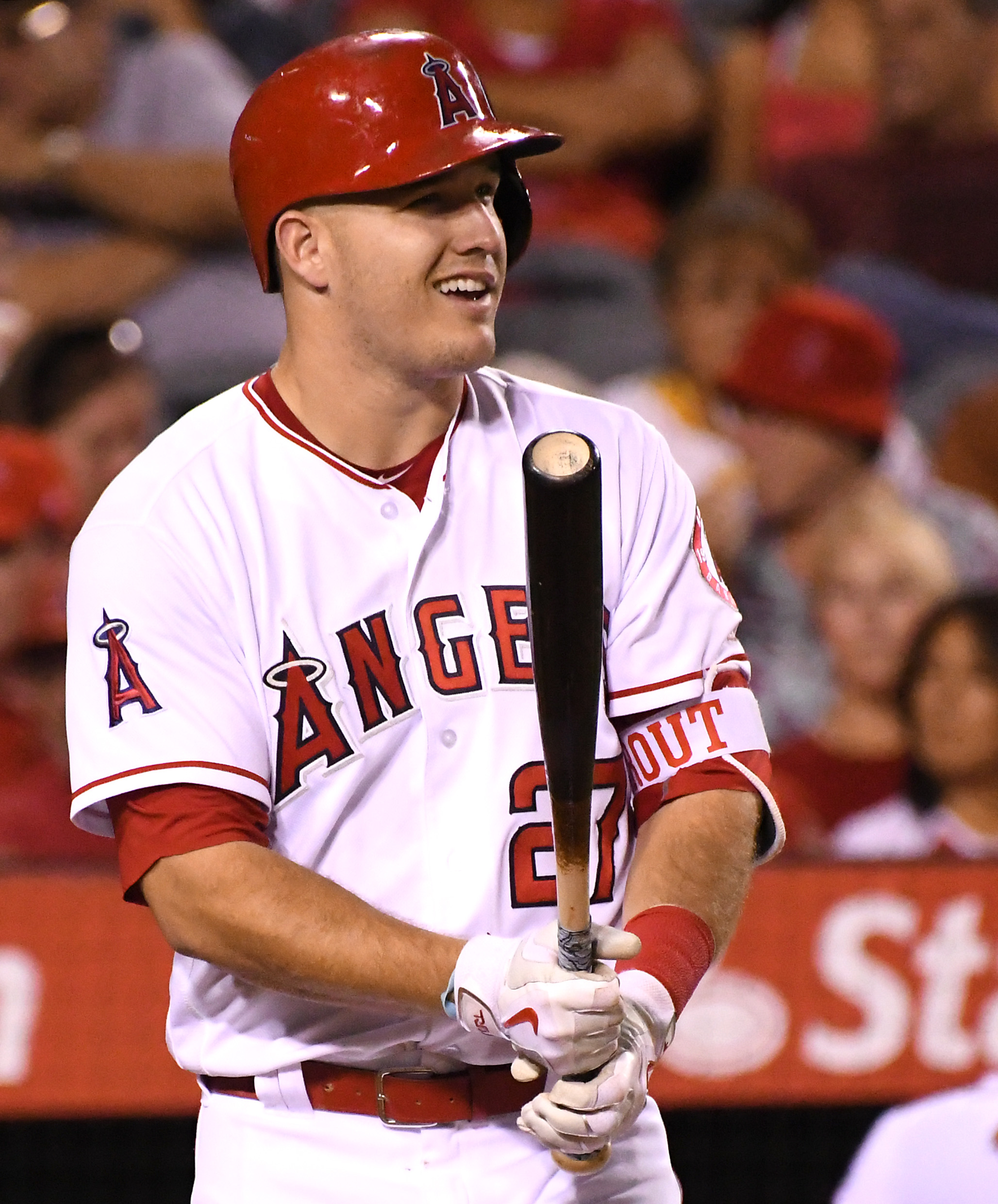 The good news is that they have Trout, a player so terrific that the Angels can be competitive if the rest of their players are even adequate. A player who routinely produces nine-win seasons can hide a lot of problems. The 2017 Angels aren’t going to be perfect, but Trout alone gives them a solid chance at being decent, and some smart free-agent signings could make them even a bit better than that.
After the Angels’ rash of injuries last year, there was plenty of outside discussion about the team potentially trading Trout. But the speculation went nowhere, and understandably so. It would be extremely difficult for the Angels to get fair value for Trout, for one thing. Also, he only recently turned 25, and he’ll be under team control for four more seasons. That should be enough time for Eppler to improve the Angels’ talent base. If the team’s big-league core hasn’t significantly improved in a couple years, the Angels can easily wait to trade Trout then, as long as he stays healthy.
In the meantime, the situation in Anaheim isn’t as dire as last season made it look. The team’s farm system is an ongoing problem, and it gives the organization a low floor — injuries ruined the Angels’ 2016 season, and that could happen again next year or in 2018, because the organization currently doesn’t have the depth to compensate for them. That’s a serious concern, given that it isn’t automatic that Richards will be ready to pitch and pitch well. But with Trout, Calhoun, Simmons, Richards, Shoemaker and Bedrosian aboard, there’s plenty of talent. And with money to spend, it wouldn’t be a surprise if Eppler were able to cobble together another contending team before too long.
Photo courtesy of USA Today Sports Images.
Poor Mike Trout.
poorer freddie!
The Braves, at the very least, had some exciting moments last season, and they also own one of the deepest farm systems in all of baseball…
Not to mention the new stadium, a strong second half showing, and a young core of extremely talented starting pitchers and pen guys coming up soon as reinforcements…
Then, you have Freddie, Inciarte, Flowers, Swanson, Albies, and Kemp who all had very productive seasons last year…
I would definitely argue that Freeman is in a better position with his team than Trout…
For Trout, he hardly has any help around him, and other than maybe a free agent addition, no one is coming over to help him in the near future, nor anytime soon…
all angels need is pitching depth. besides they are only 2 years removed from 98 win season.
And 5 years away from contention at this rate.
Bravesfan88
I thought this article was about the Angels…..???
A new stadium isn’t going to win them anything and all that talent in the minors hasn’t won a single game for them on the major league level.
I would appreciate sticking to the topic on comments…..the Anaheim Angels.
All they need is pitching depth…??
The only thing that doesn’t need to be fixed with the Angels is Mike Trout.
Rank in OPS by Position in 2016:
C – 22nd
1B – 21st
2B – 28th
SS – 22nd
3B – 19th
RF – 15th
LF – 30th
Bullpen ERA: 18th
Starter ERA: 20th
Blown Saves: 21
They have no ace. Every starter they had looked like a 4th or 5th starter at best.
If you take out Trout and Pujols they had 96 home runs as a team. If you take out Trout they had 43 stolen bases as a team.
And to top it all off, they have probably the worst farm system in baseball.
And a second baseman, an outfielder who knows how to catch a ball decently and hits higher than his weight, and a catcher. You know, just a “few” things there 😉
Mike Trout is anything but POOR! LOL We normally have different teams in the world series and playoffs every year. Who would have believed the Yankees would miss the playoffs for the second straight year! Redsox when from first to worst and back to first in their division again.
What makes baseball so great is the inability to predict from year to year as to who will end up in the World Series! The Angels had a down year no doubt but a tweak here and there and they will be back contending sooner than you think! Who would have believed Cleveland would be the American League Champions before the season started?
Dont they still owe Josh Hamilton a pile of money in 2017?
26 Million in 2017
I think Wilmoth missed the fact that the Angels owe Hamilton $24.1 million for next season. If he did include it in his calculations, he did not mention it in the article.
It’s included.
Any chance Angels deal Simmons? Cards would love to have him and slide Diaz over to 2b. Garcia and prospect? Or what would it take to get him? Then they could package Wong, Adams and Rosie or similar for cf like Blackmon, sign gurriell for future 3b.
Yadi c
Carp 1b
Diaz 2b
Simmons ss
Gyorko 3b (until gurriell comes up)
Grichuk lf
Blackmon cf
Piscotty rf
Martinez, Reyes, waino, Lynn, leake sp
Defense is shored up, offense stays good, pitching good with no holes
There will be teams that outbid the Cards for Gurriel. Plus you can essentially stamp and deliver him to the Astros. Especially considering Houston has 30 mill in guaranteed contracts for 2017. All in all Diaz is fine at short. Early this year his defensive struggles occurred because of the speed of the game. Simmons is going to cost a lot and Garcia has no value to the Angels. The Cardinals don’t have the prospects for both Simmons and Blackmon. The cards would have to part with Reyes to obtain Blackmon. All in all it’s one or the other and in an offensive anemic market, controllable offensive player are going to ridiculous prices. Prices I don’t believe Mo will be inclined to pay. So if they are looking for a piece or two it’s more likely they’ll pursue a fowler or lower tier in Jackson on the FA market. On the trade market you are looking at the second tier trade prospects in which Mo doesn’t have to give up the farm to obtain.
The problem with the trade you propose is they are Cardinal centric. They in no way touch upon the needs of the Rockies. The Rockies have no use for a Wong and or an Adams. Rosenthal might hold some appeal but after his struggles he is in no way a headliner, more like an extra piece. When discussing trades involving Blackmon the Rockies start with Reyes . So Reyes and Roesnthal probably sparks they’re interest.
Fat chance. Mainly because Simmons was the highlighted move last offseason. But also because we desperately need him. With his offensive numbers up from previous years I think it’d take at 2 major league ready players and a prospect. Or somewhere around there
Yeah they gave up a huge package for him last offseason. It’d have to surpass that especially since Simmons is cheap and a great SS.
Add the fact that he just had quite possibly his best offensive season. A year after having his previous best offensive season. Which means he may get even better offensively next season. Which means, look out!
martinez, wacha and oh will do!
The problem is nobody wants any of those guys.
– The Cardinals are debating whether to even pick up Garcia’s option next season, so he has very little value.
– Wong, who has trouble staying healthy, is a career .248/.307/.390 hitter, coming off his worst season yet, and is owed $24.25 million over the next four years.
– Rosenthal had surgery on his shoulder last season and was a completely different pitcher when he returned
– Adams can never stay healthy, and when he is, he’s not good. Past two seasons he’s hit .246/.298/.436 – as a first baseman. That’s a bad line for a catcher. And he’s an awful defender.
So I’m mind blown at how some Cardinal fans seem to think that combination can get them:
Andrelton Simmons – a 26 year old shortstop coming off the best offensive season of his career. He has accumulated more WAR since 2013 than any other shortstop in baseball, and he’s locked up through 2020.
Charlie Blackmon – a CF who hit .324/.381/.552 with 29 home runs, 82 RBI’s, and 17 stolen bases last year. He’s hit .285+ with double digit home runs in three straight seasons. Last year he stole 43 bases and the year before he stole 28. And his stats away are just as good as his line at home. Not to mention the fact that the Rockies have no motivation to move him.
So if you want Charlie Blackmon and Andrelton Simmons, it’d look more like this:
Harrison Bader, Jack Flaherty, Luke Weaver, Marco Gonzales, Kolten Wong for Andrelton Simmons
Alex Reyes, Michael Wacha, Trevor Rosenthal, Randal Grichuk for Charlie Blackmon (it’s probably more than what he’s worth – but like I said, the Rockies have no motivation to move him)
If the Angels once again dive into the free agent market and spend big on an aging veteran, they are likely the stupidest team in baseball. Adding any player that requires draft pick compensation is foolish, and giving big dollars to players like Cespedes is even worse. They’re not going to be good or win a title the way the team is currently structured, no matter what they do this offseason. They should just suck it up and deal that they’re going to be bad for a few years, and that they’ll very likely lose Trout at some point. It’s reality.
They won’t lose their first round pick because it’s protected. But I’d be unhappy if we overspent again
If you notice I didn’t mention which round of a pick they’d lose. Yes, their first round pick is protected, but their second is not. If they sign a QO free agent they will lose their second rounder, which is foolish when your farm system is as bad as the Angels’ is.
What’s the difference when anyone drafted after the first round has about a 10-15% chance of ever making it to the big leagues?
It’s an important high pick. Please don’t be stupid
Suggesting a second round draft pick is negligible is ridiculous.
Just in the past decade, some second rounders include Nolan Arenado, Freddie Freeman, Giancarlo Stanton, Chris Tillman, Jordan Zimmermann, Charlie Blackmon, Jason Kipnis, Brad Miller, Billy Hamilton, Tyson Ross, Steve Matz, and Steven Wright.
And of all teams, the Angels should be the least likely to take compensation picks for granted. Ask them if they regret not signing Mark Teixeira back in 2008.
Things are going to get worse for this team before they get better
read cards?
I think he does…the deck marked “common sense”.
Agreed. I’ve heard that Socisa is very disliked too. I’m very surprised that he is still managing that team.
he is disliked? by whom? the players? players love him. gm and the manager respect each other and work closely together..
Players do not love him at all. Or Pujols. Both have bad attitudes and Alby walks around cussing in Spanish and mean muggin.
Sure…
That’s completely inaccurate. I have two writers at the Angels fan site I run that have had clubhouse access. Players love playing for Scioscia. The one who wasn’t well like was Jerry Dipoto.
Do you have an actual analysis of this?
Yes, I got go hunting with a few players
The Angels are screwed if they don’t make a move I think when you look back at the Albert Pujols signing it really screwed their payroll up to this point so Simmons needs to go and get some decent prospects outta him and there is a few more guys that have some value that they could trade, if they don’t do that it’s going to come to a point aventually where there values go down and then guess who leaves Mike Trout so they better do something now or in the near future we might be seeing Mike Trout as a Yankee
dream on!
I disagree , The Hamilton contract put them in a hole
The Pujols contract did not screw their payroll. They were right at the luxury tax this season and if you delete his contract they still have $165 million in AAV left after that. Remove Hamilton and you still have $140 million. The Royals and Pirates would still do so much with that. And that’s always my point. If those teams can do so much with such small payrolls then why automatically think the Angels can’t do anything with the rest of their payroll. They already proved they can bring just two years removed from a 98 win season.
They could pull a Red Sox and require any team taking Trout to also take Nearly all of Pujols contract off their hands in a similar vein to how the Dodgers bailed Boston out in 2012. And the Angels could still get some decent prospects out of it as well.
that could be tough in that a team would either need to be looking for a 1b + OF or a DH+OF in order to accommodate that trade
It would just have to be a team looking for Trout and have the available funds to pay both him and Pujols. Pujols is the liability that comes with having Trout in your lineup.
That’s assuming Pujols is willing to waive his no trade clause.
Yes it is, but if he is going to a contender I am sure he would agree to it. He has no chance of getting another ring if he stays with the Angels for the rest of his career.
you too read cars?
What is a contender in Major League Baseball exactly? Is it a club that looks like your fantasy team? Is it a squad that emerges in June and stays healthy and productive enough to get hot at the right time? I’ll say the latter. There is no dynasty happening right now. The second WC has allowed a lot more teams into the pennant race. You can be a .500 ballclub now and have a shot with just one winning streak. So how do you define contender anymore in this game? Teams rise and fall every season in this game. And again we’re seeing more ballclubs going for a championship that haven’t won anything in years, decades even. So what is a contender?
It could be any given team in any given season. Albert should stay right where he is. The Angels will be fine. They just need to wait for their window to open up like everyone else.
Right on!
Exactly. Thank you.
I don’t know that it could happen but it’s a very good idea and reference in the Sox rebuild.
It appears to me after reading this article and other post season articles on the Angels, the best course of action would be to: 1) hope that the starting pitching recovers from last season; 2) provide some backup for Bandy at catcher, probably on a 1 year deal; 3) run fairly hard after Ian Desmond, as a solution at either 2nd base or left field (this would require sacrificing our 2nd draft choice); 4) pick up an outfielder of the Josh Reddick level (hopefully without having to burn another draft position) and 5) rework the bullpen. At least at this point, I would consider Jefry Marte to be backup in either the outfield or infield. Pennington, of course, will be the other backup infielder.
Teams may go after Desmond this winter, he could be another Zobrist and add to his value.
Don’t step too far out on that limb.
Desmond was bad in the outfield, I watched every night. He was solid at the dish and could really drive the ball the other way. He didn’t seem to swing and miss as much as I remember. He was great for TX but not good at all in CF.
The Angels needed 16 more wins to at least take a WC spot. And they only got 5 starts from Richards, 1 from Heaney, and 13 from Tropeano. And of course there’s the injuries that plagued Smith and Street. Smith was then dealt when he got healthy and Street had season ending surgery.
So the question is this:
Could those 5 pitchers have accumulated a 16 WAR on top what little they had collectively due to their injuries?
Realistically, I would guess a 5 WAR from a healthy Garrett Richards. Then go from there. All 5 would have to average about a 3.2 WAR. I’m thinking they’d probably have to get about 12 of those wins from Richards, Heaney, and Tropeano.
Also, the 2016 Angels offense had a 25 WAR. The 2014 Angels that led the majors in runs had a 27 WAR. Meanwhile the 2016 Angels pitching staff had a WAR of only 5. So I think they should go all out on pitching. Focus about 90% of their energy this offseason on pitching and plug any position player holes with affordable options.
It’s hard to say if they can find enough pitching this offseason to bounce back. But it’s worth a try with all the money coming off the books.
Another question is:
Should they trade Calhoun and/or Cron for pitching the way they dealt Trumbo for Santiago and Skaggs in 2014?
They could also try to supplant the rotation by obtaining someone else’s biggish shorter term contracts (just one example McCarthy or Kaz or #4/5) without giving up much of anything. Doing something like that would not require them prospects and could lengthen their staff. Realistically they could go many ways, but it’ll probably involve mixing and matching. Normally I’d guess a franchise at this cross roads would tear it all down, but having Trout probably prevents them.
I won’t say there’s no way, but I would personally be shocked if the Angels come close to taking a playoff spot next season.
I think a WAR of 5.0 for Richards is much more optimistic than realistic.
The highest he’s ever posted was a 4.4 in his stellar 2014 campaign. Last season he made 32 starts, and had a 1.8 WAR. 2014 should be looked at as an outlier rather than an expectation at this point. I’d say a 2.0 WAR from a healthy Richards is more realistic.
And even if you were able to get those 16 wins, you’re assuming that every single player on the roster will be healthy and productive all season long.
I also think you’re understating the offensive problems a little bit, too. I think there are holes everywhere in that lineup except for short, center, right, and DH. You can get by with Cron, but with a .278/.325/.467 line at first, especially when you’re playing below average defense, there’s still a lot to be desired.
1, angels don’t need any extra catchers. they have bandy, perez and graterol in the majors.
2, jefry marte was playing better as he was getting more at-bats. his avg and obp could be higher, though.
3,2b would be, more than likely, filled with what they have in-house.
4, most angels fans are satisfied with pujols’ performance. he’s not what he was when he was in the previous team but he is providing decent number of home runs and rbi’s.
besides, signing him brought in extra $1 billion from fox.
5, even though nolasco carries hefty price tag for how he pitched in twins he surprisingly pitched much better as an angel in ’16.
Pujols production is good, but given the effect his contract has on the team makes him and his contract look bad.
What effect is that exactly? You take his contract off the books and you still get an enormous payroll. Those big contracts are a poor excuse.
Pujols salary in 2016 was $25 million. His offensive WAR was +1.9. His contract represented 15% of the whole Angel payroll, yet he contributed less than 2 runs above replacement. The Angels claim they cannot invest additional in free agents, Pujols contract (as well as that of Hamilton) are the major reasons why. We are paying for his glory years in St. Louis and not for the player we currently have under contract. I blame ownership for putting us in that position, but we are still stuck with the problem.
Since the Angels were right under the luxury tax at season’s end, if you take off Albert’s AAV on his contract, you’re still left with a $165 million dollar payroll. Big contracts are a poor excuse. Especially when low payroll teams have been able to maneuver around their constraints lately to build contending teams.
You are 100% correct RLAAngels. If “IF” the MLB had contracts like the NFL, Alberts play his contract would have got him cut by now. Unfortunately the Halos are stuck with the albatross contract, and have to make the best of it.
What a dilemma. Trout will be gone long before this is a playoff team again.
They have to get rid of Pujols but the only way is to package Trout and ship them to NY. NY will want to send Ellsbury with whoever the Angels want which would cancel out dumping Pujols in the first place.
Of course the Angels may just decide its better to have another player in the Hall of Fame with their cap on than build for the future.
Angels win the lottery by drafting Trout, but lose 10 lotteries in signing Pujols.
This Albert Pujols contract as being horrible needs to stop! Half way through other than the year he was injured he has averaged 33 hrs and 98 runs batted in! Last season he hit 272 with 31 hrs and 109 rbi’s which was third in the league. The fact is when Albert is healthy he performs period. We are talking about a player who when it is all said and done will be in the top 3 in home runs lifetime and a for sure first ballet Hall of Famer! Everyone talks about Trout’s first 5 years but if you look at Pujols first five they were even better! Big Pappy played through age 40 at a high level and there is no reason why Albert can’t do the same!
Albert still only had a 1.9 oWAR last year. His defensive WAR was worse, but obviously affected by his continued plantar fasciitis. He is pretty much relegated to DH. Unfortunately (and I say this with sadness), his plantar fasciitis has gotten the best of him, which is killing his WAR. We are paying the legacy rewards for his glory years with St. Louis. This is not Albert’s fault, as he should be rewarded for those years, but the Angels should not have to bear the burden. On the other hand, no one forced the Angels to give Albert the contract.
He his 268 with 31 homers and 119 rbi’s in 152 games. Other than Big Papy who had a career year his numbers are more than respectable. He is a clubhouse leader, represents the organization well and is Mike Trout’s mentor. Ya the foot problems are effecting his ability to play in the field and hit to some extent but his contract only has 5 years remaining. Hamilton’s 125 million for 4 years was the disaster so 240 million for 10 years isn’t as horrible as everyone makes it out to be! David Price just signed a 7 year deal for 200 million and his era was almost 5 runs per game in year 1 of the 7 year deal..
Is “ERA was almost 5 runs” is a new way of saying “3.99”?
And we don’t know everything about intangibles, but as far as performance Albert’s contract is not a good one. ,
His numbers are more than respectable for an average player, not somebody making $26 million. And not only was it a $240 million contract, but it was backloaded, so he’s set to make $28 million/year the next five seasons. Plus he’s got a personal services contract after, so the Angels will still be paying him $1 million a year, every year from 2022-2031.
A few additional notes on his performance:
– he may hit home runs, but he hasn’t hit doubles as much (just 22 last year and 19 this year), so his slugging is at all-time lows
– he doesn’t walk anymore – he owns a .318 OBP the past three seasons
– he has no value other than his bat, as he’s strictly a DH at this point and he doesn’t do much on the base paths
– there’s still FIVE years left on his contract, and he’s sure as heck not getting any better. Josh Hamilton’s entire contract was five years.
There’s no way you actually believe Pujols will be worth anywhere near the 5 year, $150 million contract he has left.
Well put. Some of these Angel fans are so in bed with Pujols…. That they don’t get his play his contract = WAY over paid. Without a doubt, the worst contact in the MLB.
Sign Neil Walker or Justin Turner. Sign Josh Reddick (wont cost a pick) and bring back Soto and build a stronger bullpen. Signing Jeremy Hellickson would be a nice addition too for the rotation. IMO the additions of Walker,Turner and Hellickson are better then any 2nd/3rd round pick players will ever be so it is worth losing a pick for those guys. I’d take a flyer on Jacob Turner too if Hellickson gets the QO. Signing Jacob would be a low risk/high reward and allows the Angels to sign Walker or Turner along with a big name closer. Jansen would be my pick although Melancon would be great too. I wouldn’t even touch Chapman. oh yea, bring back the WEAV! not more than 5M though.
My priority would be
1.Starter
2. Reddick
3.Pen
4.2nd base upgrade
5.Bring back Weav
Sign Darwin Barney to fill the hole at 2nd? Does that work or am I way off? It seems like he turned his career around this year and was very productive I could see the Angles signing him and not costing them big bucks either. Does this make any sense?