
MLBTR is publishing Offseason Outlooks for all 30 teams. Click here for the other entries in this series.
“We want to run the organization without having to go over our means. We want to stay competitive, but at the same time, this organization has been working way above its means for some time.” ~ Tigers GM Al Avila, Oct. 18, 2016
Guaranteed Contracts
- Miguel Cabrera, 1B: $180MM through 2023 (including $8MM buyout of 2024 club option)
- Justin Upton, LF: $110.625MM through 2021 (may opt out of contract after 2017 season)
- Jordan Zimmermann, RHP: $92MM through 2020
- Justin Verlander, RHP: $84MM through 2019 (plus 2020 vesting option)
- Victor Martinez, DH: $36MM through 2018
- Anibal Sanchez, RHP: $21MM through 2017 (including $5MM buyout of 2018 club option)
- Ian Kinsler, 2B: $16MM through 2017 (including $5MM buyout of 2018 club option)
- J.D. Martinez, RF: $11.75MM through 2017
- Mike Pelfrey, RHP: $8MM through 2017
- Francisco Rodriguez, RHP: $6MM through 2017
- Mark Lowe, RHP: $5.5MM through 2017
Arbitration Eligible Players (service time in parentheses; projected salaries via MLBTR contributor Matt Swartz)
- Andrew Romine (4.049) – $1.2MM
- Jose Iglesias (4.036) – $3.2MM
- Justin Wilson (4.035) – $2.7MM
- Alex Wilson (3.038) – $1.2MM
- Bruce Rondon (3.037) – $900K
- Nick Castellanos (3.029) – $2.8MM
- Non-tender candidates: Romine
Free Agents
Other Financial Commitments
- Prince Fielder: $6MM paid to Rangers annually through 2020
Tigers Depth Chart; Tigers Payroll Information
The comment from Avila that opened this outlook was one of many headline-grabbing quotes he delivered last month, as the second-year GM’s words were the first significant indication that Tigers owner Mike Ilitch may not continue his free-spending ways. Avila was charged with spending aggressively to assemble a contender last year in his first winter atop Detroit’s baseball ops hierarchy — business as usual in the Detroit front office — and responded by shelling out more than $270MM to sign Justin Upton, Jordan Zimmermann, Mike Pelfrey, Mark Lowe and Jarrod Saltalamacchia while also swinging trades for bullpen help in the form of Francisco Rodriguez and Justin Wilson.
The results, clearly, were not encouraging. Though the Tigers finished with 86 wins and were in contention for much of the year, each of the free agents signed to a multi-year deal flopped in year one of their contract. Zimmermann suffered injuries and faded after a brilliant start, while Upton looked lost at the plate until a strong six-week finish. Pelfrey’s contract was baffling from the get-go, and Lowe was unable to recreate the terrific 2015 campaign he authored with the Mariners and Blue Jays. The trade results were more promising, at least. K-Rod proved still capable of handling a late-inning role, and Wilson posted terrific peripherals that suggest his 4.14 ERA will improve in 2017 and beyond (10.0 K/9, 2.6 BB/9, 54.9 percent ground-ball rate, 3.02 SIERA).
The disappointing performance of last winter’s additions, though, didn’t simply cause the Tigers to miss out on the 2016 postseason. Rather, they further clogged what was already a dreadful long-term payroll outlook and seemingly served as the tipping point to curb some of the team’s offseason aggressiveness. That’s not to suggest that a full tear-down is in the offing. Franchise cornerstones like Miguel Cabrera and Justin Verlander — both of whom have full no-trade protection via 10-and-5 rights anyhow — seem unlikely to move. Zimmermann, too, has full no-trade rights early in the five-year deal he inked last November. Upton, meanwhile, can block trades to 20 teams and would be difficult to unload. The Tigers would probably love to deal Sanchez, Pelfrey and Lowe, but it seems unlikely that any team would line up to take on those onerous financial commitments. If they’re to be moved, the Tigers will have to chip in some cash or take on a similarly unwanted deal.
Where, then, do they turn to accomplish Avila’s stated goals of getting younger and trimming some of the payroll? Detroit wasted such little time in beginning the process that this outlook required a last-minute update before publishing. Avila’s first move of the offseason came less than 24 hours after the completion of the World Series, as he traded Cameron Maybin and his $9MM club option to the Angels in exchange for young right-hander Victor Alcantara. The move sheds Maybin’s $9MM salary next year and also prevented the Tigers from needing to pay a $1MM buyout. Beyond that, Detroit added a hard-throwing prospect to its minor league ranks. The return on Maybin wasn’t especially strong, but he’s a one-year rental coming off an injury-shortened season, and it didn’t appear to be a huge secret that the Tigers preferred to deal their center fielder.
Rodriguez’s $6MM option was probably an easier call, as it came with a $2MM buyout, thus it a net $4MM decision for the team. Detroit exercised the option shortly after trading Maybin, so Rodriguez looks to be in the fold for the time being, although there’s still a chance that the Tigers could field offers for him later this winter. The game’s emphasis on relief pitching is trending up, after all, and while no one is going to mistake K-Rod for the powerhouse reliever he was during his peak with the Angels, he’s still a very serviceable late-inning arm on a reasonable one-year deal. Moving K-Rod to a club that can’t afford to pursue one of the top free-agent closers or to a team looking to use him to set up for a top-flight closer could net another interesting young piece.
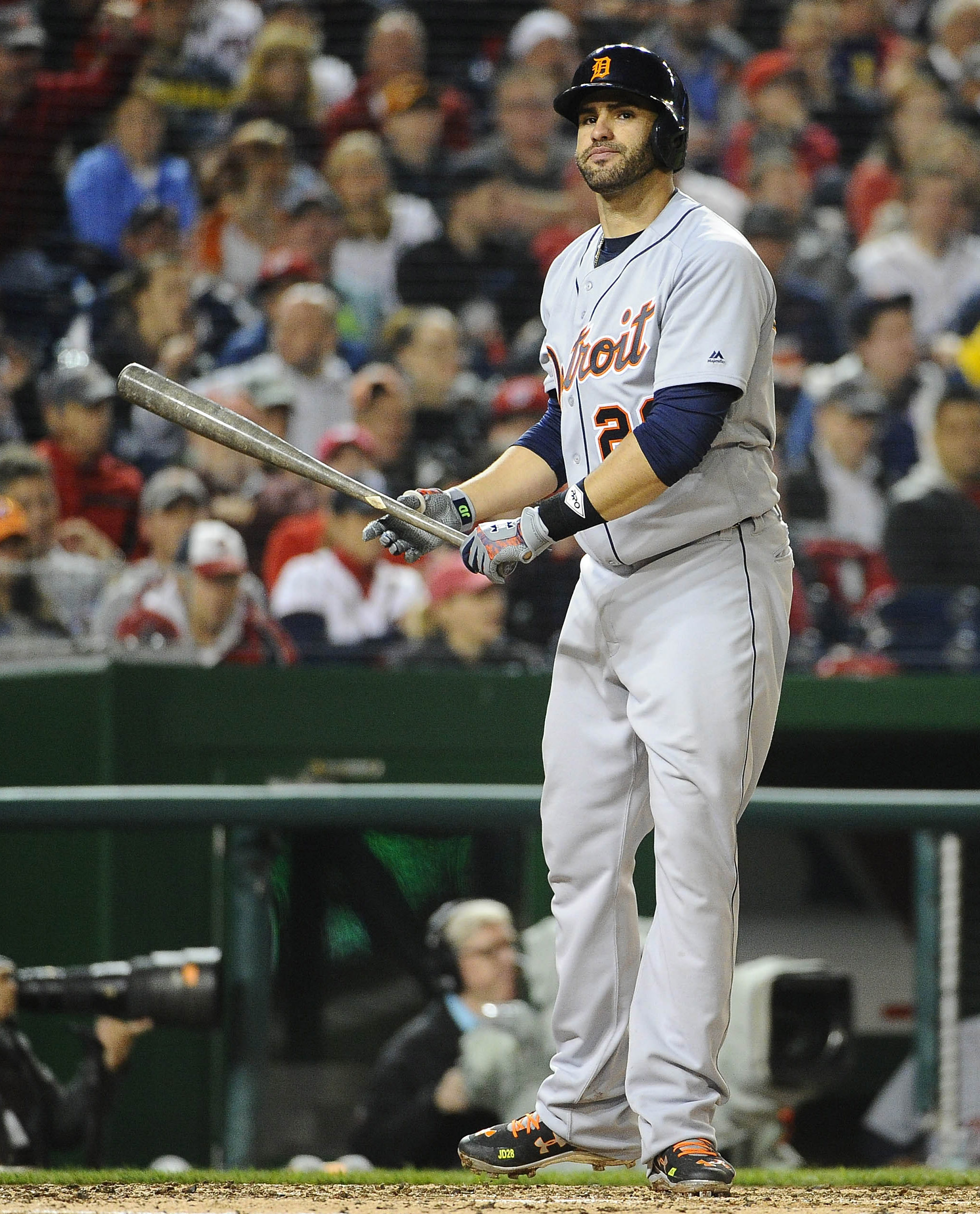
Beyond Rodriguez, right fielder J.D. Martinez (pictured) is perhaps the most palatable veteran for the Tigers to shop this winter. While the loss of an elite bat will unequivocally sting, Martinez is likely headed for a $100MM+ contract next winter, and extension talks with him aren’t likely to come with any kind of notable discount just one year removed from such a tantalizing payday.
MLBTR’s Mark Polishuk recently looked at Martinez’s extension candidacy and suggested that something in the vein of $120MM-140MM over five to six years would be a realistic price (depending on the inclusion of an opt-out clause). That indeed seems like a fair prognostication for a player who just turned 29 and has laid waste to opposing pitchers with a .299/.357/.540 slash line and 83 home runs in 401 games since coming to Detroit. Avila candidly said he doesn’t foresee a long-term deal happening with Martinez, making him a natural trade candidate. Though Martinez comes with just one more year of control (and some defensive question marks), his imposing bat and reasonable price tag could net a package fronted by at least one premium young prospect while also trimming some money off the payroll. The Mets (if Yoenis Cespedes signs elsewhere), Giants, Blue Jays, Orioles, Rangers, Mariners, Angels and Dodgers all seem like plausible landing spots (to varying degrees).
Kinsler, too, figures to have widespread trade appeal, though as a similarly excellent player with two years of club control remaining ($11MM 2017 salary, $10MM 2018 option), the asking price could be greater and the urgency to deal him lesser. Certainly it’s fair to assume Avila and his staff would entertain offers on Kinsler, but contending teams in need of a definitive second base upgrade aren’t as plentiful as those looking for corner outfield sluggers. The Dodgers, Mets (if Neil Walker departs) and possibly the Angels stand out as win-now clubs that could look to upgrade at second base.
Victor Martinez represents another highly productive veteran controlled for two more seasons, but the $36MM he’s owed for his age-38 and age-39 seasons is probably excessive, and his market would be limited to AL-only teams with open DH slots. That’s not to say a deal couldn’t be worked out — the Dave-Dombrowski-led Red Sox do have a new opening at DH, for instance — but trading V-Mart looks decidedly more cumbersome than parting with the other middle-of-the-order Martinez on the roster.
With all the talk of selling pieces and trimming payroll, though, it’s easy to forget that the Tigers won 86 games this season and could be firmly in the thick of things in the AL Central next year with better health from some of their veterans. A rebound from Zimmermann, for instance, would give the team a strong quartet of Verlander, Zimmermann, American League Rookie of the Year candidate Michael Fulmer and Daniel Norris on which to lean in the rotation. Meanwhile, the strides made by Nick Castellanos at third base give the team another intriguing bat to pair with Cabrera and a hopefully resurgent Upton in the middle of the order. Jose Iglesias is an elite defender, so much so that his glove largely offset the decline in his offense this year. A rebound with the bat shouldn’t be ruled out for Iglesias, as his K/BB numbers remained identical in 2016 while his BABIP fell off (in part due to an increase in fly balls). With some combination of Kinsler and/or either Martinez likely to return in 2017 as well, the makings of a strong lineup are present.
And in the bullpen, Rodriguez could again anchor an improved relief corps if he’s not dealt. Even if the Tigers do part ways with the game’s active saves leader, there’s still hope. Wilson’s peripherals, as mentioned above, were outstanding. Young Bruce Rondon took a huge step forward with a 2.97 ERA on the season and a 1.52 ERA over his final 25 games. Joe Jimenez, one of the top bullpen prospects in baseball, logged a 1.51 ERA and 13.1 K/9 across three minor league levels and should be a factor at some point in the first half of the 2017 season. Alex Wilson quietly recorded his third straight season with a sub-3.00 ERA and his second in which he reached 70 innings.
Detroit could look to supplement that core group, though paying top dollar early in the offseason (as it has in some instances in the past) doesn’t seem likely. Instead, help could come in the form of controllable relief arms via trades. (Alcantara, conceivably, could occupy a relief role later this year.) Alternatively, the Tigers could look to opportunistically wait out the free-agent market and snatch up a quality setup arm on a modest one- or two-year deal late in the winter. The relief market somewhat resembles a game of musical chairs each winter, and inevitably there’s a name or two that’s left standing without a big contract when the music stops.
Center field, too, presents an opportunity to make a value play, though Avila suggested immediately after the Maybin trade that his team’s center field job will be a “wide-open competition.” That could give out-of-options outfielders Anthony Gose and Tyler Collins a shot at cracking the roster, and young JaCoby Jones will certainly get a look as well. Jones could use more time to improve on his offense and familiarize himself with center field (most of his experience is in the infield), though, and Collins hit poorly in both Triple-A and in the Majors in 2016. Gose, meanwhile, was suspended by the team this summer for arguing with Toledo manager Lloyd McClendon, who is now the Tigers’ Major League hitting coach and also posted a .521 OPS in Triple-A. If Detroit does take to the open market to look for a more affordable option than Maybin, then names like Peter Bourjos, Michael Bourn and even old friend Austin Jackson are among the options.
As for other possible spots where a low-cost addition might make sense, the utility infield and backup catcher roles need to be addressed. It’s possible that Romine is tendered a contract and reprises the role he’s filled in Detroit since 2014, but his bat has never developed. Dixon Machado represents a mildly cheaper (by about $700K) in-house alternative, and the team could also look to re-sign Erick Aybar to fill the role or pursue Ruben Tejada, as either could be an offensive upgrade. James McCann still hasn’t hit much in Detroit, but all accounts seem to indicate that the Tigers think he’s their man behind the plate in the long run. He figures to get at least another year to prove them right, so a backup option like Geovany Soto, Drew Butera or even old friend Alex Avila (GM Al Avila’s son) could fit.
A new corner outfielder could make sense in the event of a J.D. Martinez trade, especially now that Maybin is gone. In addition to the aforementioned Gose and Collins, the Tigers have another out-of-options outfielder in Steven Moya that could compete for everyday at-bats in right field. Moya ripped 25 homers between Triple-A and the Majors last season in just 526 combined plate appearances, so his power is certainly intriguing even if it comes with a questionable OBP and some defensive uncertainty. Affordable value plays on the free-agent market could include Colby Rasmus (who is coming off a pair of surgeries and a down season) or former big leaguer Eric Thames, who has dominated the Korea Baseball Organization over the past three seasons.
And if the team is truly interested in forming a sustainable core that doesn’t force it to play “above its means,” perhaps there’s the possibility of an extension for a younger star this winter. Fulmer is the most appealing youngster to lock up, but he’s still three years from arbitration eligibility, so there’s little in the sense of urgency. At the same time, his distance from significant earnings make it easier to sign him at a lower cost. Castellanos, too, could be an extension candidate if the team believes his 2016 strides at the plate and in the field to be legitimate improvement instead of a short-term blip on the radar. And even Rondon, who a year ago was sent home due to the Tigers’ discontent with his “effort level,” could be the recipient of a modest multi-year deal that would prevent his arbitration price from soaring in the event that he eventually inherits the ninth inning.
The potential spending standstill has been a long time coming and one that we’ve speculated about here at MLBTR on multiple occasions. Eventually, the Tigers’ hyper-aggressive outlays were going to create long-term payroll difficulties, and that’s very much the case right now. Detroit already projects to have a $195.7MM payroll in 2017, a $138.1MM payroll in 2018 and $111.1MM in 2019. Even as far out as 2020, the team is guaranteeing a fairly stunning $83.1MM to just three players (or $105.1MM to four players if Verlander’s 2020 option vests).
Though a change in approach finally seems to be at hand, the Tigers don’t need to wave the white flag. While the extent to which they continue to shed payroll (i.e. trade productive veterans) will of course be a significant factor in determining next year’s postseason hopes, there’s enough talent on the roster to withstand some financial housekeeping and still find success.
Photo courtesy of USA Today Sports Images.
The window for Detroit is closing. Relief pitching is the name of the game today and Detroit does not have an answer as they keep trying to patch the pen together with has-beens.
Justin Wilson, Bruce Rondon, Alex Wilson, and Joe Jimenez sound like a solid core to me.
If they add a top-notch closer, it would have the makings of one of the best bullpens in the game. Heck, the Cubs won it all with a bullpen that their manager lost almost all confidence in by the time the world series came around.
I feel that Romine will be retained, he can basically play all 9 positions well and he’s not that much of a liability with the bat
Only in the spirit of “no major leaguer is truly much of a liability with the bat” is this true. Of 376 big leaguers with 175+ PA last year, Romine was 66th worst, which places him squarely in the bottom quintile of that list of hitters.
Of course, a utility players’ main usefulness is in putting a warm body on the field to plug in a hole at this moment, so having a great bat there is a luxury. He does have a plus glove, too, so we can always use that at the end of the bench.
What kind of package would the tigers ask for from mets, angels, etc for kinsler?
From the Mets, the Tigers will probably ask for Matz, but it’s very unlikely that the Mets would be willing to deal him. Maybe a package around Nimmo and Lugo would be enough. I don’t think the Angels have anything that the Tigers would be interested in prospect-wise.
Yeah, I would find it difficult to believe that the Angels have something in their organization that would net them Kinsler (of course not including any hypothetical around Trout). Kinsler has two more seasons left on this contract before he becomes a free agent heading into 2019.
While I do expect the Tigers to cut some payroll, I don’t see them doing a total teardown by any means. I’d expect that any deal they make for their star contributors will need to have at least some decent components that would contribute at the major league level in 2017.
All of the Mets’ main starters are untouchable. With all of them healthy they stand the best chance against the Cubs as WS favorites. Mets don’t need to make such a trade.
I wouldn’t expect the Tiger to look for starting pitching, unless they trade away starting pitching. They currently have 7 starters returning from last year, if all remain healthy. What they are lacking is depth in position players, and they would need a replacement for whoever they are trading. Other than Machado, if they move Iglesias, they really don’t have ready replacements at any position. As they currently have an opening in CF after moving Maybin, if the Mets want Kinsler, the Tigers would likely want an IF or a CF back. I don’t think they match up well with the Mets.
Mets would have to give something along wheeler More
From the Mets, you aren’t going to get deGrom, Harvey or Metz for Kinsler. Don’t think the surprising rookie duo of Lugo or Gsellman are enough. Doesn’t seem like the Mets are interested in moving prospects Dom Smith or Ahmed Rosario but most of their other minor leaguers should be in play. If the Mets find a solution at catcher, then they could offer d’Arnaud in return who’s value is hard to gauge right now. My best guess on a Mets offer would be d’Arnaud, Gsellman and Brandon Nimmo.
In the event the Mets lose Cespedes, I think J.D.. Martinez could make a lot of sense for them and I think the Mets would try and center a deal around Zack Wheeler.
Zach wheeler doesn’t make sense. I’d expect the tigers to for someone younger with more control.
If the Mets were to lose Cespedes, then it can simply exercise Jay Bruce’s option and hope that he will hit similar to what he did in Cincinnati rather than his output with the Mets.
If the Mets are interested in Kinsler, it will not be able to pry him loose with a pitcher who hasn’t pitched in 2 years. Since Syndergaard, deGrom, and Matz are off limits, it will need to offer Harvey for Detroit to be interested.
The Tigers already have Boyd, Sanchez and Pelfrey for their 5th starter options. Harvey is good, but not what they need. Detroit wants young and cheap. Harvey is about to get expensive, and I believe, only has 3 years left. Kinsler has 2, and his salary is declining. Not much of a gain for Detroit. I see a third team being necessary to make something happen.
Window is closed for the time being if the Tigers are serious about reducing payroll. Almost no way to stay competitive and shed salaries, especially if their goal is to get down below the new luxury tax threshold, whatever that is. They are not going to get immediate value in any trades they make, the payoff will be down the line, especially if JD Martinez and Ian Kinsler are traded.
That’s a little bit dramatic. If Tigers management handles the realignment efficiently and this isn’t a complete teardown, and they stop slotting in probables based purely on financial commitments (Sanchez, Lowe, Pelfrey, etc) the Tigers can absolutely contend in a Central that will also regress in the coming months.
Even with the inept coaching staff, full seasons from Fulmer, Norris, and Boyd should more than solidify the rotation. Maybin is grossly overrated, and you can replace JD Martinez a la another Granderson type trade (JD for Aaron Judge+ for example?).
The loss of Kinsler, however, would be a massive hole in their ability to contend. While neither JD or Maybin were 2WAR players in 2016, Kinsler has been a 6+ WAR second baseman for two seasons now. Even with an expected regression, that’s a lot to replace in a single trade.
Agreed. Detroit can survive without J.D., but it can ill afford to lose Kinsler. If Avila is serious about trimming payroll to more manageable numbers, then he can trade J.D. and KRod. Even VMart if Boston is willing to trade a good prospect for him. But Kinsler should stay, imo.
Fulmer, Norris, Verlander, Zimmermann is the start of a pretty solid rotation They need to figure out what to do with Pelfrey and Sanchez the offense should be fine when Castellanos comes back the Bullpen could still use an arm or two as well. I dont think the Tigers need any major moves, they just need to not go 4-14 against the Indians. Just being .500 would have brought them within 3 games of the Indians for the division crown and probably gained a WC spot. They need to tweak the team for sure but they are not as far away from Cleveland as everyone is making them out to be. I think Jones is going to offer a very dynamic player to them they have some good arms in the system who are progressing slowly but progressing none the less.
If the Tigers had gone 9-9 with the Indians they would have won the division as the Indians would have 5 more losses as well (and end up with just 89 wins).