
MLBTR is publishing Offseason Outlooks for all 30 teams. Click here to read the other entries in this series.
The Marlins could hold the key to the offseasons of many other organizations, as new ownership (led by CEO Derek Jeter) will reassess the team’s direction after a disappointing 2017 campaign.
Guaranteed Contracts
- Giancarlo Stanton, OF: $295MM through 2027 (including buyout on 2028 option; contract includes opt-out after 2020)
- Wei-Yin Chen, SP: $52MM through 2020 (technically structured as player option)
- Christian Yelich, OF: $44.5MM through 2021 (including buyout on 2022 option)
- Dee Gordon, 2B: $38MM through 2020 (including buyout on 2021 option)
- Martin Prado, 3B: $28.5MM through 2019
- Edinson Volquez, SP: $13MM through 2018
- Brad Ziegler, RP: $9MM through 2018
- Junichi Tazawa, RP: $7MM through 2018
Contract Options
- Ichiro Suzuki, OF: $2MM club option
Arbitration-Eligible Players (service time in parentheses; projections via MLBTR contributor Matt Swartz)
- Marcell Ozuna (4.124) – $10.9MM
- Derek Dietrich (3.151) – $3.2MM
- Dan Straily (3.126) – $4.6MM
- Justin Bour (3.064) – $3.5MM
- Miguel Rojas (3.043) – $1.1MM
- J.T. Realmuto (3.038) – $4.2MM
Free Agents
[Marlins Depth Chart; Marlins Payroll Information]
Jeter seems to be tweaking, rather than overhauling, the team’s baseball operations department, which will still be led by Michael Hill. But with new decisionmakers at the top of the food chain and key new execs installed downstream (in particular, Gary Denbo), the Marlins seem ripe for at least a partial roster overhaul.
Financial pressures will surely weigh in. Though incoming ownership is surely hoping that an improved business and baseball approach can turn the club into an annually profitable undertaking, that won’t be the case right off the bat. There are continued whispers that the purchase price was high and that the ownership group isn’t quite as firm, financially speaking, as might have been hoped.
Whatever the precise cause, rumor has it that Jeter and his charges will be looking to significantly reduce the team’s payroll this winter, perhaps as far south as $90MM. That’s hardly unfamiliar territory; indeed, the organization has only twice cracked nine figures and has otherwise never gone over $75MM in Opening Day payroll. But after several investments drove last year’s franchise-record $115MM+ slate of salaries, it’s a big drop. Since the existing guarantees and projected arbitration payouts would alone push the team into the $130MM range, the reported target likely portends some major trades.
Much of the speculation thus far has focused on slugger Giancarlo Stanton — for good reason. He nearly reached 60 long balls last year, will just 28 years of age over the offseason, and is going to begin earning annual salaries in excess of $25MM in 2018. While the overall contractual guarantee remains daunting, perhaps it’s an approximately market rate of annual pay for a player of Stanton’s abilities. His appeal is unlikely to be higher than it is now, after he raised his national profile with his dinger barrage and turned in a productive and healthy overall season.
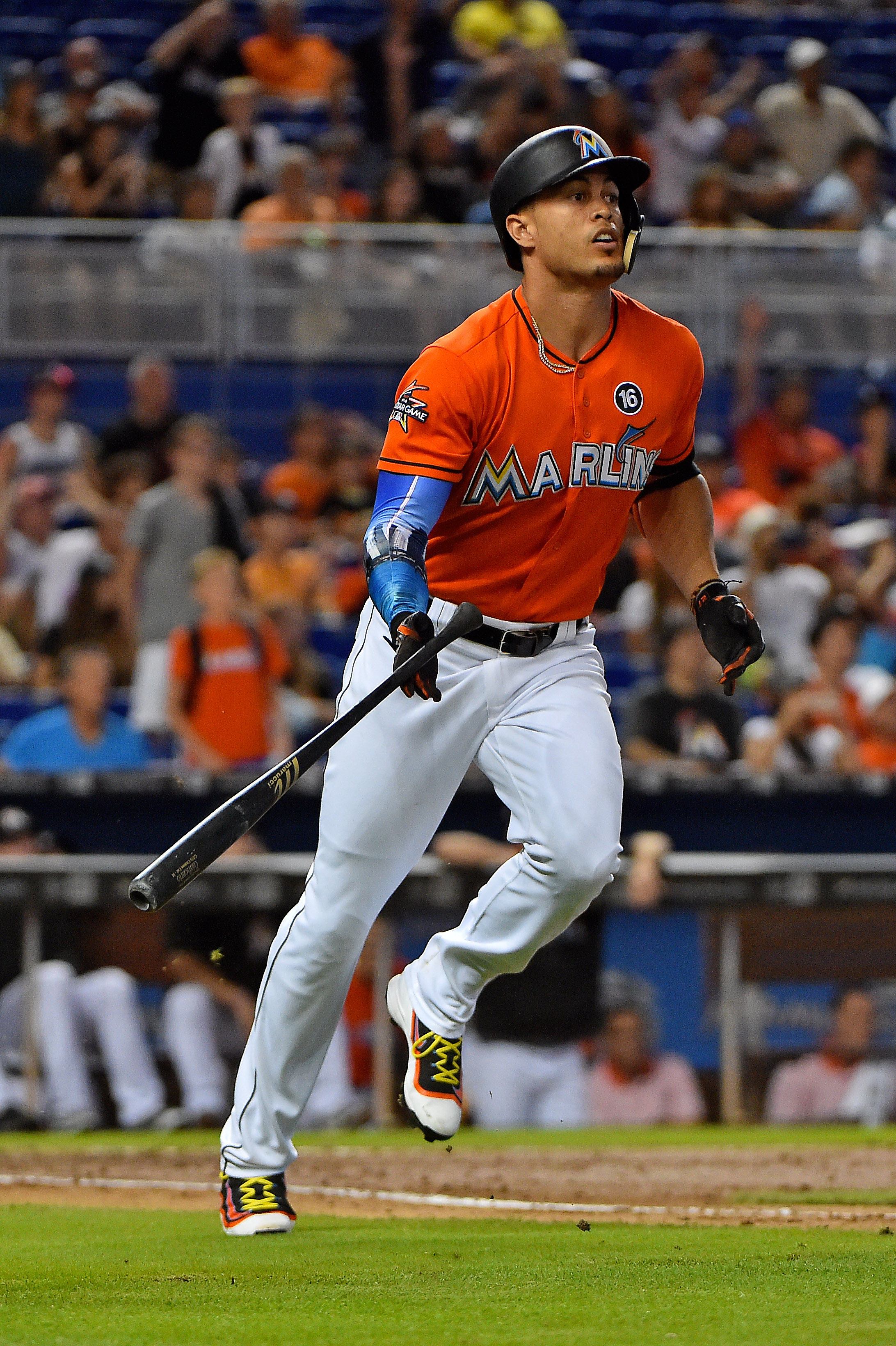
Though Stanton is an obvious trade candidate, his contract is hardly a straightforward asset to deal. From a PR standpoint, it’s hard to move a player of such prominence, though perhaps the ownership change also represents an opportune moment to turn a new leaf. Stanton enjoys full no-trade protection, but he has indicated he would rather not hang out in Miami for a rebuild. The post-2020 opt-out may perhaps give some other teams some pause if asked to give up significant young assets (quite apart from the lofty total contract price). Sufficient future payroll capacity will be an obvious prerequisite to acquiring Stanton. As of yet, the market situation is mostly undeveloped, but there’s been (in some cases speculative) mention of teams like the Phillies, Giants, and Red Sox as potential suitors.
There are any number of fascinating scenarios that could be dreamed up regarding Stanton, depending upon the precise motivations of the teams involved. Will the new Miami leadership be willing to keep some of the money (or take on an underperforming veteran in the swap) to increase the prospect return? Or is the primary goal to realign the balance sheets? And might other veteran Marlins players even potentially enter trade talks as the various teams seek to structure mutually beneficial scenarios?
There are plenty of other conceivable trade candidates on Miami’s roster, especially on the position-player side. In all likelihood, the offseason changes will be driven more by trade interest from rivals than by any specific needs the Marlins wish to address. It’s possible that the club will move Stanton but mostly otherwise keep together its relatively affordable and youthful core. But it’s equally conceivable — and perhaps advisable — that the organization will rip the band-aid off all at once.
Other teams are no doubt eyeing swaths of Miami’s roster as players to consider pursuing over the offseason. Outfielders Christian Yelich and Marcell Ozuna will hold even more appeal than Stanton to many organizations, given Yelich’s eminently affordable contract and Ozuna’s reasonably priced projected salary. There are loads of sluggers that can be had for cheap, but first baseman Justin Bour still stands out as an ascendant and affordable hitter. Derek Dietrich could be a useful platoon piece for other clubs given the solid pop he brings along with defensive capacity (albeit not mastery) at the 3-4-5 spots in the infield as well as the corner outfield.
Miami’s best trade asset, though, could actually be catcher J.T. Realmuto. That’s due in large part to scarcity at the position; reliable everyday backstops are one of the game’s rarest assets. Realmuto, 26, is an above-average hitter and baserunner who comes with three more seasons of affordable control. He throws and blocks well. And while he once rated as a poor framer, there’s now a notable (and quite unusual) split: Stat Corner views him as a wreck at winning strikes, while Baseball Prospectus now sees Realmuto as an ace pitch sweetener.
Those players all carry excess value against their contractual commitments. In a wholesale sell-off scenario, the Fish could recoup serious young talent. Other players hold out more promise of freeing payroll space. Dee Gordon should draw some interest, though there are quite a few other second basemen available and his contract looks to be in range of his hypothetical open-market value. And though Martin Prado won’t be a hotly pursued commodity — he is coming off of an injury-plagued 2017 and turns 34 at the end of October — some clubs would surely take on some of his salary. The better bet, in Prado’s case, might be to hope that an early-season turnaround boosts his value at the trade deadline.
Any acquisitions on the position-player side will be dependent upon what happens with the long list of players just discussed. The Marlins could end up adding young MLB talent in trades. Or they could end up with some pretty distinct holes to be filled by seeking lower-priced veterans in free agency. Third baseman Brian Anderson is perhaps the best candidate to join JT Riddle as a new semi-regular. Otherwise, there isn’t much in the way of quality young talent pressing for MLB time from the upper minors, as most of the Marlins’ best prospects are pitchers and/or lower-level position players.
To the extent the Marlins really try to compete in 2018, the chief needs would be found in the pitching staff. And the team will need enough arms to make it through the season regardless, so odds are that it will at least pursue lower-cost and minor-league free agent candidates.
In the rotation, that could mean adding at least two or three arms. Another opening could be made if the Marlins decide to move righty Dan Straily. He turned in another solid season and offers surplus value to teams that want quality innings at a below-market rate. Straily’s projected $4.6MM salary would represent only represent a small fraction of the sum the Marlins reportedly hope to shed, but he could net some upper-level talent that could conceivably step onto the big league roster in the not-too-distant future. Affordable arms are always in demand, and Straily reportedly drew a fair bit of interest prior to the non-waiver deadline.
While the club would love to find a taker for its remaining obligations to lefty Wei-Yin Chen, that’s hard to imagine after he missed most of the season with a partial UCL tear that did not require surgery. Rather, he’ll be run out there if he’s healthy in hopes that he’ll give innings and perhaps regain his form. His ability to do so is no sure thing, though, as skipper Don Mattingly has questioned whether Chen will be able to pitch at all next season. It’s perhaps still theoretically possible that Edinson Volquez will make it back from Tommy John surgery late in 2018, but the Marlins can’t count on anything from him and aren’t likely to shed his $13MM commitment.
Otherwise, Jose Urena outperformed his peripherals but surely deserves a starting job. And the team’s aggressive promotion of Dillon Peters suggests a belief that he’s ready to shoulder a big load at the game’s highest level. He has typically shown excellent control, so he’ll no doubt pare back his 5.5 BB/9 debut walk rate, and there’s obvious promise in his 63.3% groundball rate. The team can also give more opportunities to southpaws Adam Conley, Justin Nicolino, Chris O’Grady and Jarlin Garcia (who may yet move from the ‘pen back to the rotation) or dip further into the system, where Trevor Richards is one of the more interesting, near-term possibilities. Clearly, though, there’s cause for the front office to pursue some bounceback arms and perhaps make a selection in the Rule 5 Draft to pair with righty Odrisamer Despaigne as depth options.
The situation is rather similar in the bullpen, where there’s one interesting young potential trade candidate (Kyle Barraclough), two expensive veterans that did not quite live up to their salaries (Brad Ziegler and Junichi Tazawa), and a slate of inexperienced youngsters. The team could get something of interest back for Barraclough, who has four more years of team control and has averaged 12.1 K/9 with a sub-3.00 ERA in 163 big league innings. It’s also feasible that Miami could generate some interest in Ziegler following a strong finish to the season (especially if the Fish pay down some of his $9MM price tag), but that’d only mean opening yet more jobs at the MLB level. Regardless of what happens with the existing players, there’s an evident need to add plausible major-league arms, as Drew Steckenrider represents the only other young, controllable lock for a bullpen slot.
All things considered, the Marlins’ pitching staff is among the worst-positioned in baseball for near-term success. While there are some high-upside arms filtering northward, none seem likely to arrive soon, and recent top 10 overall picks Tyler Kolek (No. 2 in 2014) and Braxton Garrett (No. 7 in 2016) have both had Tommy John surgery. The organization has felt the pain of mortgaging the future already; for instance, while Straily worked out about as well as could have been hoped, he cost the team young flamethrower Luis Castillo, who has an exceedingly bright future and has already turned in 89 1/3 quality MLB innings for the Reds.
Fielding a competitive team would mean upgrading the pitching, which in turn would require some combination of: 1) weakening the position-player mix through trade; 2) spending more money; 3) parting with prospect capital; and 4) hitting on buy-low targets. With the Marlins looking to shave payroll and set the stage for a sustainable future, there’s little in the way of opportunity — let alone justification — for trying again to win with this basic roster mix.
Instead, it’s almost surely time for the organization to part with some of its best players in service of a new plan. How far they’ll go (along with how they’ll backfill) remains anyone’s guess — and also represents perhaps the most wide-reaching variable in the development of the overall player market this winter.
Photo courtesy of USA Today Sports Images.
Tyler Kolek was drafted in 2014
Thanks.
If I am the Rockies, I am offering McMahon, Hampson, Pint and Wall for Stanton. Imagine the kind of damage he would do in Colorado.
Colorado takes on Stanton’s contract, but ships the marlins Desmond along with McMahon, Hampson, Pint, and Wall- two top 100 prospects
Id do this as well, and not resign cargo back lmao
As a Marlin fan, I would be really happy with this return for our organization. I’d be willing to throw in 40 million or so to facilitate this type of return as well if necessary.
Not a bad deal at all but switch out Rodgers for Hampson and its a no brainer
that’s not that bad of a deal to be honest
I think Stanton would do good in a Mets uniform. Highly unlikely but possible
Do well*
* Do goodly
If you go by 90% of these posts every MLB team is in on Stanton and Ohtani…
thegreatcerealfamine, every team was in on Ohtani before any of these posts!
Brevity is the soul of wit..
At least “every team’s Fans” are certainly “in on Stanton”……..
Most every team will make a phone call, hoping for the deal of a lifetime. Not happening. Marlins aren’t “giving him away” regardless of financial constraints
“Someone Will Pay”……..(a quote from Field Of Dreams…well, almost)
“If You Sign Him, People Will Come”……(another one)
Rockies, Brewers, Red Sox, Cardinals, Phillies…….and I believe The Dodgers will all be working to find a deal (that Stanton will accept).
Bold Guess: Dodgers trade Puig, Mitchell White, and D.J. Peters (Stanton look-alike – size wise) for Stanton……Miami pays $45 Million to the Dodgers “IF” Stanton doesn’t Opt-Out after 2020. If he exercises that opt-out, no salary relief (Dodgers get Stanton for 3/$77)
The perception is that the Dodgers are a team that just spends and spends, but that isn’t the way they’ve been doing it under Andrew Friedman. The largest deal Friedman has given out is $84 million for Jansen and the largest he’s given a free agent is $48 million for McCarthy.
Bringing in a huge contract like Stanton has would be a complete change of course and could possibly disrupt team chemistry. They’re emphasizing young players like Seager, Bellinger, and Urias. I don’t see them committing to Stanton.
Urias is going to be a bust. He had major shoulder surgery.
I suggest that for a few reasons…..
1. Stanton has a Full No-Trade Clause, and is a So. Cal. Guy……..
2. I’m hoping that A-Gon retires, freeing up 21.5 Million for ’18 (86% of Stanton’s Salary). Trading Puig Frees up another $7.5 Mil. That’s $29 Mil saved, so their payroll is actually $4 Mil less after the trade.
3. Puig has always been on shaky ground in LA. Moving to Miami fits him well because of the large Cuban contingency there. (i live just north of there)
Stanton might prefer the Dodgers but the Dodgers have to want a trade and the Marlins have to be getting something they’d want in a deal.
Why would A-Gon retire? He wants to play and he got injured playing. While a few players have retired while owed money none of them were injured. Prince Fielder didn’t retire. David Wright hasn’t retired. The Dodgers are on the hook for his $21.5 million for 2018 and that won’t change.
Yes, trading Puig and having A-Gon retire would mean not adding payroll that doesn’t change that Ned Coletti isn’t running the team any more. Andrew Friedman hasn’t brought in any expensive players from the outside. He’d rather spread his money over a lot of players.
Puig might like Miami but he’s the exact kind of player the Marlins are getting rid of. He’ll make $9 million next year, That’s the kind of salary the Marlins are trying to shed. He also is a free agent after 2019. If the Marlins are doing a rebuild they need players with 4-5 years of team control, not 2. If the Dodgers trade for Stanton the Marlins will want players like Walker Buehler and Alex Verdugo, not Puig.
A-Gon made a statement that he would retire if he wasn’t able to play regularly. His back issues are getting considerably worse. He’s going to end up just like Wright (Whom I believe should retire, and release the Mets from his Awful Contract)…….
You can change out the players any way that you like……It was just a suggestion. But if your take on Friedman is correct, then it won’t happen anyway. Wasn’t Friedman there when they were talking to the Brewers about Braun??? He’s a $20 Mil/yr player (3/58 M left ’18-20)….and he’s No Where Near the Player that Stanton is over the next 3 years. With salaries escalating so damn fast……I think most fans will be shocked at how many teams try to get Stanton.
that’s because every team is on Ohtani
“Off-season Outlook: Miami Marlins.” AKA… “This whole organization from top to bottom is absolutely screwed.”
The funny thing is that, at least as the lineup is concerned, Marlins are actually quite good. That is a lot of quality players, even if they are expensive. They could retool just a bit and be competitive, especially considering the messed up status of most NL East teams. I really wonder how serious Jeter et al are about tearing down completely and rebuilding from bottom up.
Their pitching staff is terrible, worse than it was coming into this year. It’s a shame they couldn’t succeed with the pieces they had, but they really should tear it down
It is bad but Urena and Straily are keepers and Peters killed it in the minors. If they can turn one or more of their outfielders into young pitching they could build for the future.
Straily sure, but Urena had a 5.20 FIP this year and has a career ERA and FIP near 5.00, so I’m skeptical. I like Peters and think he can be a solid back-end guy, but when the starting rotation is Dan Straily and a bunch of back-end starters, I just don’t see how that team can be considered a legitimate contender
Urena just needs to fix his pitch selection to do better (and getting more groundballs always seems to help.) Adding a starting pitcher from the KBO like Merrill Kelly And or Eric Hacker would help. Not letting Odrisamer touch the 25 man roster is essential to any success.
Urena showed flashes of Brilliance this past summer. At times, he was dominant, but he tried to be too cute with his approach sometimes, and the pitch counts rose quickly. He’s still a little raw, but made huge strides over ’16. Another jump up like that, and he’ll be better than Straily.
RIP José Fernandez
I hope Jeter and company can figure out how to reduce the payroll without jettisoning Stanton out of Miami. I think that would leave a bad taste in the mouth of fans during the first year of the teams new ownership with Stanton coming of an historic year.. Attendance be damned!!!
Honestly, it’s best for Miami to trade Stanton for young talent plus salary relief. The organization badly needs both moving forward to have any chance of winning.
The Marlins have fans?
Can you produce any evidence to support such an assertion?
There’s plenty of Fans in So Florida. They don’t necessarily “go to the stadium” for several reasons.
1. It’s a 75 minute drive from my house
2. Parking Options Suck at the stadium
3. The stadium was built in a “not-so-great-neighborhood”……
4. Most every game is televised. Not sure what the Blackout Boundary is but I’m about 70 miles away, and I can watch every game on TV.
Had they built the stadium in Delray Beach……Many More Fans Would Attend. More room for parking, easier approach/escape……more centralized location
Define “not so great” neighborhood without racial or social class implications.
High Crime Area
But I must ask……..What if the deterrent involved an issue that WAS related to race or social class? What if it was a neighborhood that if “a person of the wrong color/nationality/economic ability” walked down the sidewalk, they got hassled? (or worse) What if it was an area that was overrun with gang wars? Those places DO exist……..and the fact that “it’s a delicate subject for some”…..doesn’t negate the fact that “They Exist”.
Truth!
He’s obviously baiting you. Evidently it makes him feel better to try and fit the superior social mold…so self indulgent
Who gives me a negative for hoping the Marlins can keep Stanton? Haha.
Boston please. They can afford taking on entire contract to not havta give away there best prospects. Only other team I see willing to take the contract is la. Most teams wanna get under the luxury tax only Boston or lad will risk it imo.
I wasn’t aware Boston wanted to go over the Luxury tax threshold.
The Phillies could take on the entire contract and still have a 2018 payroll under $60 million. So it’s likely they can absorb it.
Stanton has a FULL No-Trade Clause.
Wants no part of a rebuild
Wants to go where he can WIN a CHAMPIONSHIP SOON.
Philly has the money, but “Not The Opportunity”…….
I was replying to his contention that only Boston and LA could absorb Stanton’s contract.
Stanton’s choices might be limited because before he gets to exercise his no trade clause the Marlins need to want to trade him. The Marlins will trade Stanton to a team that’ll absorb most/all of Stanton’s contract and give them the most in return. Few teams will be absorb the contract and some that can don’t have much young talent or aren’t willing to part with it. I doubt Jeter is going to compromise much on the former and won’t take scraps in return.
Stanton could be faced with the choice of going to the Phillies or staying with the Marlins. The Phillies are done with the rebuild and plan on spending hundreds of millions of dollars over the next few years. That may sell Stanton on them. They certainly are a better destination than the Giants, a team that won’t be good again for years.
I agree that Philly has the money available, and that they will contend soon (2-3 years?). Citizen’s Bank Park is also an extreme hitter’s Park…..so he may hit 50+ every year for several years to come.
But your comment still implies that “It’s Jeter’s Choice”…..and it’s NOT. The package is irrelevant to Stanton. He can dictate which team he plays for, which in turn, dictates what Jeter can get in return. Something has to give.
In addition, both The Marlins and The Phillies NEED PITCHING. What do the Phillies have to trade away in that dept?
It wouldn’t surprise me if Stanton asked that Gordon be traded with him (they are buddies)…….Would you trade C. Hernandez, Jake Thompson, Mickey Moniak, and Zack Eflin for Stanton & Gordon?
Jeter has a full no trade clause too. Nothing has to give. If Stanton says that he’ll only approve a trade only to teams that won’t take his full salary or won’t give up much in prospects then he keeps Stanton. People seem to think Jeter has to deal Stanton, but he doesn’t. Jeter’s goals are to reduce payroll and get more talent, not dump Stanton. Stanton is his marquee player. Keeping him would make many fans happier. Stanton hasn’t demanded to be traded. He’s only responded to trade rumors.
Sure, I’d do that deal if I were the Phillies but I don’t think the Marlins would. It’s not terrible for the Marlins. Hernandez is the only arbitration eligible player and he’s cheap and has three years of control. He might be a good player for the top of a deal but not for the Marlins. If you substitute Franklyn Kilome or Adonis Medina for Hernandez the deal might interest the Marlins. You might also need to upgrade one of the other pitchers to Nick Pivetta or Tom Eschelman.
I do not disagree with most of that.
Why wouldn’t The Marlins want Hernandez?
Would Love to have either Pivetta or Lively instead of Eflin.
Almost impossible to Keep Stanton and get payroll down to $90 Mil (Jeter’s Words).
The Marlins are only a few decent SP’s from being a contending team….. (RIP Jose F.)……too bad they sold to Jeter’s group. Jorge Mas is a Billionaire……maybe he would have turned them into the Dodgers…..LOL
Offseason outlook: Trade Stanton, Ozuna, Yelich and Gordon to Giants for two mid level prospects and a bag of expired peanuts to shed salary. Oh no? Well one can dream.
Send the Marlins Pence and Span while you’re at it
OUCH!!!!!
Stanton and Straily for Kyle Lewis, Ben Gamel, Max Povse and Mariners take on most of the contract. That’s probably way off, but I have no clue what it takes to get Stanton.
24, as fun as it would be to see Stanton in Seattle, I would be shocked if Dipoto were to absorb a contract like that, even if the Marlins picked up 100m on the tab.
The Marlins objective is to cut payroll so they aren’t going to take a deal that leaves them paying Stanton. If they pick up any money it’ll be in the last 5 years of the deal. That’s the time when Stanton might not be worth it and the Marlins wouldn’t be on the hook for anything if Stanton opts out.
The Mariners are at $153 million for 2018 without picking up any options. They likely aren’t in the market for a $25 million player.
When teams send money with a player on a multi-year deal, it usually comes in annual installments. That could be delayed, or back loaded (before the opt out), but Miami would almost certainly have to bring it down immediately if they wanted a return.
That said, I can’t see enough salary eaten for a deal with Seattle happen, which was my point.
I think Dombrowski empties the cupboards and gets Stanton.
Ozuna for Schwarber.
If you’re going to make a proposal the Marlins won’t take why not just say Tommy Lastella for Ozuna? You don’t get Ozuna without giving up Carl Edwards Jr and you’ll likely need to add a few more pitchers.
LMAO. What!?
Jeter needs to get rid of everybody and do a complete rebuild. Get rid of all the high contracts and mid contracts and do like the Astros have done.
But eat money to get top 100 prospects too.
The best idea would be add a bunch of bullpen pieces on minor-league deals and trade them for a low-level, but impressive pitching prospect that could be a good starting pitcher in the MLB. Like Chris Paddack for example.
They need to do what The White Sox did. Ok team, but not good enough to compete, and easier just to rebuild. If they trade Stanton, Gordon, Ozuna, Yelich, they could really stack their farm system. Each could rake in some very good prospects, with high potential. Not only would it help them in the next 3-4 years, but also help their budget.
3 of the 4 could…
Out of the 4, which one do you think wouldn’t bring in a decent prospect bundle?
Gordon’s not a great value. He’s got a pricey contract and there aren’t a lot of teams that need a 2B. Gordon was a 3.1 WAR player last year and is owed $39 million over 3 years. Cesar Hernandez was a 3.1 WAR player and will likely get around $20-$23 million over the same period. Gordon might not bring back a lot.
Stanton’s trade value is a question mark. His contract is so large that the return might not be great if the other team is paying all of it.