
Latest On Oakland’s Proposal To Keep A’s Through 2025-27 Seasons
TODAY: After today’s meetings, the Athletics released a statement to media saying “We appreciate Oakland’s engagement and also we are far apart on the terms needed to agree on an extension.” Oakland mayor Sheng Thao also issued a statement, saying “Oakland made a fair and reasonable offer to the A’s. We await their response and look forward to continuing discussions as necessary.” John Shea and Scott Ostler of the San Francisco Chronicle note that the city and Alameda County “are not unified in their negotiations for the lease extension with the team,” though Alameda County supervisor David Haubert described today’s talks as “a productive meeting.”
The A’s will turn from this meeting to another set of meetings Wednesday with Ranadive and Sacramento officials, as per another report from John Shea.
MARCH 31: Officials from the Athletics and from the city of Oakland are set to meet Tuesday to further explore the possibility that the A’s could remain at the Coliseum through the 2027 season, as the team is looking for somewhere to play until their planned new ballpark in Las Vegas is ready for Opening Day 2028. Some major details of the city’s latest proposal are already known, as ESPN’s Tim Keown and KGO-TV San Francisco report that Oakland is offering a five-year lease at the Coliseum covering the 2025-29 seasons, with an opt-out clause after 2027 so the team can depart if its new Vegas stadium is indeed ready on time.
The price tag for the new lease is $97MM, which the city demands that the A’s pay in full whether they stay for a three-year or five-year team. This stands out as the largest hurdle to an agreement between the two sides, as Keown notes that two other provisions “are not expected to be contentious” — the A’s would have to sell their 50% share in the Coliseum and surrounding land, and the team would also have to pay to convert the Coliseum’s surface into a soccer-ready state for the United Soccer League’s Oakland Roots SC franchise.
“The city is putting forward a very reasonable deal,” Oakland chief of staff Leigh Hanson said. “We don’t think there’s a poison pill in this deal. We feel this is an accomplishable goal, and we are going forward understanding we have a short window to execute.”
Oakland’s offer also removes two previous demands from the city, covering the idea of Oakland retaining the Athletics name and team colors, or that Major League Baseball would guarantee Oakland a new team in the next round of expansion. The new offer instead asks that the league commit to one of three options — either a vote on Oakland’s retention of the A’s name and colors, or helping work out a sale of the Athletics to an Oakland-based ownership group, or “a one-year exclusive right to solicit ownership of a future expansion team,” as Keown puts it.
The $97MM figure is “the shortfall the city says [A’s owner John] Fisher walked away from on the multibillion-dollar Howard Terminal project” Keown writes, referring to the long-discussed plan to build a new ballpark for the A’s in Oakland’s Howard Terminal area. Those plans fell through, of course, when Fisher instead pivoted for a new city entirely with the move to Las Vegas.
Needless to say, there is a large gap between the city’s ask of $97MM and what the A’s are offering, which is $17MM over the course of a two-year lease covering the 2025 and 2026 seasons. The 2027 season isn’t included since the team is “contending they have options,” which likely implies a one-year move to another city or perhaps to the Athletics’ Triple-A affiliate’s current ballpark in Las Vegas. Staying in Oakland through 2026 would give the club more time to fully plan out their temporary pre-Vegas landing spot, whereas there’s a ticking clock now given that the Athletics’ current lease at the Coliseum expires after the current season.
This urgency might give the city some leverage in negotiations, though the A’s have reportedly explored other locations like Salt Lake City and Sacramento as possible homes for the 2025-27 span. Sacramento was considered the favorite alternate spot besides a lease extension in Oakland, and John Shea and Scott Ostler of the San Francisco Chronicle wrote on Friday that multiple league sources feel the Athletics will ultimately end up in Sacramento for a variety of reasons.
The Athletics’ TV contract with NBC Sports California has loomed as a major factor in the situation, as the deal (which pays the A’s upwards of $67MM per season) requires the team to actually be located in the Bay Area. Shea and Ostler write that the A’s are also in talks with NBC Sports California about a revised contract, and speculate that “if the A’s could cut a new deal for, say, half that amount, they might grab it. They’d be losing tens of millions per year, but they’d still be making tens of millions, and could make up any shortfall in other ways.”
Ultimately it might come down to how the math works out between the $97MM figure proposed by the city, and what the A’s could get from a renegotiated contract with NBC Sports California. Just staying in Oakland would naturally make the TV situation a moot point, and the A’s organization would also avoid the logistical complications of playing in a minor league ballpark and temporarily moving its entire infrastructure to Sacramento, while also prepping for another move to Las Vegas in the near future.
However, Shea and Ostler feel Fisher might not be bothered by these complications, and could prefer to leave Oakland behind entirely while also keeping his 50% share of the Coliseum. The city and Alameda County’s desire for full control over the Coliseum gives Fisher some leverage, since “the danger to Oakland here is that [Fisher] has no plan” for his share of the ballpark, Shea and Ostler write, and Fisher “is simply intending to squat on that site and wait for a big-profit sale sometime down the road.” That said, Fisher could also view selling his share of the Coliseum as a method of cutting ties with Oakland, generating some short-term money, and avoiding some ongoing and pending legal challenges facing Alameda County’s half-sale of the Coliseum’s ownership.
Sacramento is currently the home of the Giants’ Triple-A affiliate, and how that team would co-exist with the A’s over three seasons has yet to be determined, should the Athletics indeed wind up in California’s capital city. Vivek Ranadive (owner of the NBA’s Sacramento Kings) owns the minor league franchise, and is both a friend of Fisher and has ambitions of eventually owning a Major League Baseball team himself. Though Fisher has stated that he has no plans to sell the Athletics, there is still seemingly enough uncertainty surrounding the franchise that it doesn’t seem out of the question that Fisher could ultimately sell the A’s to Ranadive, Golden State Warriors owner Joe Lacob, or perhaps Ranadive and Lacob working in the same ownership group, as Shea/Ostler opine.
Rays Notes: Baz, Walls, Caminero
The Rays got back into the win column with tonight’s 5-2 win over the Rangers. Tampa Bay broke things open with a four-run fifth inning, highlighted by a three-run home run from Isaac Paredes. On the pitching end, Zach Eflin limited the World Series champs to one earned run on five hits and a walk over 6 1/3 innings while striking out five.
With good news on the field today, the injury updates were a little more mixed, as you’ll see in this selection of Rays notes…
- Shane Baz will be re-evaluated Thursday after manager Kevin Cash said the right-hander “felt his oblique again a little bit” after throwing a live batting practice. Cash told MLB.com and other media that it doesn’t seem to be a major concern, though the Rays are being cautious since Baz also had a minor oblique issue in early March. Selected 12th overall by the Pirates in the 2017 draft, Baz came to the Rays organization as part of the (infamous for Bucs fans) Chris Archer trade at the 2018 deadline, and quickly became one of baseball’s most highly-touted pitching prospects. Baz had a 4.02 ERA over 40 1/3 innings in 2021-22 before being sidelined by arthroscopic elbow surgery and then an elbow sprain, which ultimately resulted in a Tommy John surgery in September 2022. Since the Rays plan to ease him back into action with a limited innings count, Baz’s offseason prep has been moving at a different pace, with his oblique problems also acting some bumps in the road. If all goes well, Baz might be able to make his return to the majors in the middle or back half of May.
- Taylor Walls is also recovering from a significant surgery, as the shortstop had a hip procedure last October that has kept him on the injured list to begin the season. However, Cash said the Rays’ plan to start Walls in extended Spring Training by mid-April looks to be on track after Walls got a “very good report” after a recent doctor visit. Depending on how much time Walls needs to get ready, late May or early June looks like a reasonable start date for his 2024 debut. The fact that Tampa Bay put him on the 10-day IL and not the 60-day IL at the start of the season indicates some hopefulness on the club’s part that Walls can indeed return before May is over. The defensive specialist has only hit .189/.289/.304 in 991 career Major League plate appearances, though it is certainly possible the long-lingering nature of Walls’ hip problems impacted his offensive production.
- The Rays‘ Triple-A affiliate placed Junior Caminero on the seven-day injured list today (retroactive to April 1) due to a left quad strain. The concern level was high after Caminero was forced out of Sunday’s game and had to be helped off the field, yet Marc Topkin of the Tampa Bay Times (X link) indicates that the injury might not be overly serious. Caminero is widely considered one of baseball’s best prospects, and after debuting with seven MLB games and two postseason games in 2023, the infielder is expected to contribute more to the 26-man roster after he gets some more minor league seasoning. Caminero’s three games with Durham this season represent his only experience at the Triple-A level, and he only has 226 games of pro experience altogether.
Yankees Sign Phil Bickford To Minors Contract
The Yankees signed right-hander Phil Bickford to a minor league deal, as announced by the club’s Triple-A affiliate in Scranton/Wilkes-Barre. Jon Heyman of the New York Post (X link) reports that Bickford will earn $1.1MM if he makes New York’s active roster.
Bickford is moving from one Big Apple borough to another, as the Mets just released the right-hander last week. Bickford won an arbitration case (for a $900K salary in 2024) with the Mets in February, but as per the terms of the CBA, going to a hearing meant that the salary wasn’t fully guaranteed until Opening Day. As a result, the Mets only owed Bickford around $217K, representing 45 days’ worth of termination pay. The $1.1MM salary linked to his minors deal could be prorated based on the amount of time (if any) Bickford actually spends on the Yankees’ roster, yet between the Yankees’ money and the termination pay, Bickford might now be in line to make more than the $900K he was slated to receive if he’d just made the Mets’ active roster.
After making two MLB appearances with the Brewers, a trade to the Dodgers in 2021 seemed to inspire a breakout, as Bickford posted a 2.50 ERA, 29.5% strikeout rate, and nine percent walk rate over 50 1/3 innings out of the Los Angeles bullpen. However, Bickford benefited from some BABIP and strand rate-related good fortune that year, and reality seemed to set in when he posted a 4.84 ERA in 128 1/3 innings with the Dodgers and Mets over the 2022-23 seasons. L.A. dealt him to the Mets at last year’s trade deadline, and the Mets ultimately deemed Bickford expendable amongst the many other relief options they acquired this past offseason.
The Yankees are forever on the lookout for bullpen arms, and the team’s recent ability to get good results from multiple unheralded or off-the-radar relievers perhaps bodes well for Bickford’s chances at success if he makes the 26-man roster. For now he’ll bide his time at Triple-A as depth in the event of an injury, or if the Bronx Bombers shuffle up their bullpen to move fresh arms back and forth from Scranton/Wilkes-Barre.
Braves Sign Sandy Leon, Jackson Stephens To Minor League Deals
The Braves have signed catcher Sandy Leon and right-hander Jackson Stephens to minor league contracts, as per the MLB.com bio pages for both players. For Stephens, he returns to the organization after rejecting an outright assignment in favor of free agency earlier this week.
Leon’s addition seems like a pure depth move for the Braves with Sean Murphy on the 10-day injured list. Since there usually isn’t a set timeline for oblique injuries, it isn’t yet known when Murphy might be back in action, so signing Leon gives Atlanta a bit more flexibility at Triple-A Gwinnett. Travis d’Arnaud and Chadwick Tromp are handling catching duties on the big league roster, and Sebastian Rivero was the only catcher on the Gwinnett roster with any prior MLB experience.
The 35-year-old Leon has played in each of the last 12 Major League seasons, suiting up for six different teams. Leon has also been part of the Reds and Royals organizations without seeing any regular-season playing time, as Leon took part in Kansas City’s training camp this past spring after being signed to a minors deal. The Royals decided they had enough catching depth and released Leon back on March 23, so it didn’t take long for Leon to land another opportunity.
Defense and game-calling has long been Leon’s calling card, allowing him to carve out a long career as a part-timer and backup catcher despite a .208/.276/.311 slash line over 1729 career plate appearances. He won a World Series ring with the 2018 Red Sox and appeared in 21 games for another championship just last season with the Rangers, though Leon spent most of 2023 with the Triple-A affiliates of the Rangers and Guardians.
Stephens was first outrighted off a 40-man roster back in 2019 when he was a member of the Reds, and he has since had the ability to reject any other outright assignment in favor of free agency. Since he is now out of minor league options, Stephens has bounced on and off Atlanta’s 40-man multiple times since first joining the team during the 2021-22 offseason, opting for free agency and then returning after some period of time on a new contract. Last November, Stephens again opted for free agency before re-signing on a split contract with the Braves, and it isn’t known if this new deal is also a split arrangement or if it’s just a straight minor league pact.
Stephens posted a 4.83 ERA over 63 1/3 innings with the Reds from 2017-18, then spent the next three seasons pitching in the minors, the Mexican League, and on the sidelines altogether due to the canceled 2020 minor league campaign. He resurfaced after signing with the Braves and has a respectable 3.56 ERA, 20.2% strikeout rate, and 9.8% walk rate in 65 2/3 frames since the start of the 2022 season. Thirty-nine of Stephens’ 44 Atlanta appearances took place in 2022, as the righty spent a lot of last year either in the minors or in DFA/free agent limbo.
Dodgers Acquire Nick Ramirez, Transfer Brusdar Graterol To 60-Day Injured List
The Yankees have traded left-hander Nick Ramirez to the Dodgers for cash considerations, per announcements from both clubs. Ramirez had been designated for assignment on the weekend. The Dodgers opened a 40-man roster spot by transferring righty Brusdar Graterol to the 60-day injured list.
Ramirez, 34, was a bit of a surprising cut from the Yankee roster. He tossed 40 2/3 innings last year with an earned run average of 2.66. His 16.3% strikeout rate was on the low side but his 47.4% ground ball rate was a bit better than average and his 5.2% walk rate was excellent. But the club used a number of pitchers in their first two games of the season and wanted to add Tanner Tully as a fresh arm and Ramirez got squeezed out.
Perhaps they were a bit skeptical of the sample size, as Ramirez had a career ERA of 4.55 coming into last year, with a 9.5% walk rate that was much closer to average than what he did in 2023. But he’s always had good results at Triple-A, having posted a 2.98 ERA in 200 appearances over seven different seasons at that level.
He’ll give the Dodgers another left-handed relief option, which is a bit of a weak spot on the roster at the moment. Alex Vesia and Ryan Yarbrough are the two other southpaws in the bullpen, but the latter is used more for long relief as opposed to situations where a manager would specifically want a lefty. Ramirez also has an option remaining and can be kept in the minors until needed.
The Dodgers had a 40-man roster spot to use since they evidently don’t expect Graterol to return prior to the middle of May. He battled hip soreness and shoulder soreness throughout the spring and only made one official appearance. He has reportedly been making progress of late but will effectively need to redo Spring Training by spending a few weeks ramping up and getting into game shape.
Since the Dodgers started their season early with the Seoul Series, he was placed on the 15-day IL back on March 19, meaning he’s already two weeks into his 60-day count and can return about six weeks from now if he’s healthy and build up by then.
Mariners To Sign Dallas Keuchel To Minor League Deal
The Mariners are signing left-hander Dallas Keuchel to a minor league deal, per Daniel Kramer of MLB.com. The WME Baseball client will report to Triple-A Tacoma when the deal is complete.
Keuchel, 36, was once one of the best pitchers in the league, even winning the American League Cy Young in 2015. But he has been more in journeyman mode over the past three years. He made 175 starts from 2014 to 2020 with an earned run average of 3.25 over that stretch. His 19.8% strikeout rate in that time wasn’t special, but he limited walks to a 6.7% clip and got grounders on 59.6% of balls in play. That grounder rate was the highest in all of baseball, among those with at least 450 innings pitched in that time period.
His rate stats began to trend in the wrong direction in 2021, as his ERA jumped to 5.28. In 2022, things got even worse and he was released by the White Sox, later bouncing to the Diamondbacks and and Rangers for brief stints. He finished that year with a ghastly ERA of 9.20 in 60 2/3 innings. His ground ball rate fell to 50.2%, still strong but well below his previous levels. He only struck out 14.9% of batters faced and gave out walks at a 10.2% clip.
Last year, he worked out with Driveline Baseball in an attempt to regain some lost velocity and movement on his pitches, eventually landing a minor league deal with the Twins in June. He tossed 32 innings at the Triple-A level with a 1.13 ERA, 21.2% strikeout rate, 9.1% walk rate and 61.5% ground ball rate. That ERA was a mirage as he wasn’t going to maintain a 95% strand rate but his 4.17 FIP was still an improvement over the form he showed in the previous year.
The Twins added him to the big league roster at the start of August and he tossed 37 2/3 innings down the stretch in a swing role but his work wasn’t as impressive in the bigs, as he posted a 5.97 ERA in that time. His 14.5% strikeout rate, 10.5% walk rate and 52.8% ground ball rate were all fairly close to his 2022 numbers.
The Seattle rotation recently took a hit when Bryan Woo landed on the injured list due to some elbow inflammation. They still have a strong group of five guys with Luis Castillo, George Kirby, Logan Gilbert, Bryce Miller and Emerson Hancock in the rotation, but Keuchel will give them some extra depth. He will presumably need a few weeks to get into game shape anyway after missing Spring Training and the rotation picture could easily change between now and then.
Offseason In Review: Minnesota Twins
The Twins idled their way through much of the offseason as the front office navigated payroll limitations before eventually making a characteristic late strike on the trade market.
Major League Contracts
- Carlos Santana, 1B: One year, $5.25MM
- Jay Jackson, RHP: One year, $1.5MM (includes buyout of 2025 club option)
- Josh Staumont, RHP: One year, $950K
2024 spend: $7.7MM
Total spend: $7.7MM
Option Decisions
- Exercised $10.5MM club option on 2B Jorge Polanco
- Exercised $10MM club option on RF Max Kepler
Trades and Waiver Claims
- Acquired RHPs Justin Topa and Anthony DeSclafani, minor league OF Gabriel Gonzalez, minor league RHP Darren Bowen and cash from Mariners for 2B Jorge Polanco
- Acquired OF Manuel Margot and cash from Dodgers for minor league SS Noah Miller
- Acquired LHP Steven Okert from Marlins for INF/OF Nick Gordon
- Claimed RHP Ryan Jensen off waivers from Marlins (later outrighted to Triple-A)
- Claimed RHP Daniel Duarte off waivers from Rangers (later outrighted to Triple-A)
- Claimed OF Bubba Thompson off waivers from Yankees (later lost to Reds on waivers)
- Claimed RHP Zack Weiss off waivers from Red Sox
Notable Minor League Signings
- Jovani Moran (re-signed following non-tender), Ronny Henriquez (re-signed following non-tender), Niko Goodrum (since traded to Rays), A.J. Alexy, Beau Burrows, Joe Gunkel, Matt Bowman, Scott Blewett, Jared Solomon, Jeff Brigham, Brian O’Keefe (since released)
Notable Losses
- Sonny Gray (rejected qualifying offer), Kenta Maeda, Michael A. Taylor, Donovan Solano, Joey Gallo, Dallas Keuchel, Tyler Mahle, Emilio Pagan, Gilberto Celestino
The Twins won the American League Central and ended their historic postseason losing streak in 2023, sweeping the Blue Jays out of the American League Wild Card round before falling 3-1 to the Astros in an ALDS defeat. Fans hoped that a taste of postseason success would spur ownership to further invest in the roster, but the Twins were one of several clubs who spent the offseason in limbo with no clear picture of what would happen regarding their television broadcasts amid Diamond Sports Group’s bankruptcy filings.
It became clear early in the offseason that the Twins planned to cut payroll. Front office leadership was direct in suggesting as much, and The Athletic’s Dan Hayes reported that the goal was to scale payroll back from last year’s $155MM mark to somewhere in the $125-140MM range. It was a frustrating development for a fanbase that had recently seen the Twins emerge as major players in free agency, signing Carlos Correa in back-to-back offseasons.
Not only did the looming payroll reduction prevent the Twins from bringing in new talent, it also likely sealed the fate of starters Sonny Gray and Kenta Maeda before the offseason began in earnest. Gray, the 2023 AL Cy Young runner-up, made the no-brainer decision to reject a qualifying offer and unsurprisingly landed a contract north of $50MM: a three-year, $75MM pact in St. Louis. Topping the $50MM mark was key for the Twins, as that ensures they’ll receive a comp pick at the end of the first round for losing Gray. Minnesota reportedly had interest in keeping Maeda, but only on a one-year deal. He inked a reasonable two-year, $24MM pact with the Tigers that perhaps the Twins would’ve been more comfortable matching under normal circumstances, but he departed with the team receiving no compensation.
The Twins’ needs entering the offseason were well known. The rotation was losing a pair of notable arms — three, really, if you count Tyler Mahle, who missed most of the season due to Tommy John surgery — and they’d be on the lookout for ways to fill those innings. President of baseball operations Derek Falvey said in early November that the club might also keep an eye out for first base options, and the Twins were also known to be looking for a right-handed-hitting outfield bat to provide insurance for oft-injured Byron Buxton in center field with Michael A. Taylor reaching free agency.
Even though their to-do list was hardly shrouded in secrecy, the Twins idled throughout the first several months of the offseason. Free agents who’d fit the team’s needs — both expensive and reasonably priced — came off the board with minimal interest reported from Minnesota. Frustration among the fanbase understandably built.
The Twins have a knack for late-offseason trades/signings of significance, though, and they once again waited until that stage of the winter to make any real moves of note. The first and most significant transaction of the entire offseason came when the Twins, after months of exploring the trade market, found a deal to their liking for stalwart infielder Jorge Polanco. The 30-year-old second baseman had been in the organization since he was 16 years old and had been a staple in the Twins’ infield since 2016.
Infield was perhaps the Twins’ greatest organizational area of depth, though. Beyond Polanco, they were set with Correa at shortstop, Royce Lewis at third base and 2023 breakout rookie Edouard Julien at second base. Utility players Kyle Farmer and Willi Castro can play any of those three spots. The Twins had former top prospects Alex Kirilloff and Jose Miranda in the mix at first base, with Miranda also capable of playing third base. Knocking on the door to the majors were the club’s No. 2 prospect, Brooks Lee, whom they selected with the No. 8 pick in 2022, and Austin Martin — a former No. 5 overall pick acquired in the trade that sent Jose Berrios to Toronto.
Over in Seattle, infield depth was far thinner. The Mariners had targeted Polanco in the past, but the Twins weren’t keen on moving him with less MLB-caliber infield depth and with so many affordable, prime-aged years remaining on Polanco’s extension. The 2023-24 offseason was clearly a different story. Polanco’s down to two years of control on his contract. Minnesota’s infield depth is arguably at an all-time high. They were also looking to scale back payroll.
The Twins could’ve tried to structure a deal sending Polanco and prospect depth to another club for controllable young pitching, but that hasn’t been this front office’s M.O. in past trades. The Twins always seem to focus on backfilling the system even if they’re trading for a major league player, and that was the case with the Polanco swap. Reliever Justin Topa, fresh off a breakout season, gave the Twins an immediate bullpen upgrade to a setup corps already including quality relievers like Griffin Jax, Caleb Thielbar and Brock Stewart.
Also headed to Minnesota in that deal were veteran righty Anthony DeSclafani, top outfield prospect Gabriel Gonzalez, and minor league righty Darren Bowen. DeSclafani checked the Twins’ desire to add a low-cost option to compete for the fifth starter’s job in spring training. The Mariners had acquired him from the Giants earlier in the offseason, with San Francisco kicking in $6MM to help cover the right-hander’s $12MM salary. The Mariners redirected that $6MM to Minnesota and added another $2MM, leaving DeSclafani as a $4MM flier for the back of Minnesota’s rotation. (More on that in a bit.)
Prospect-wise, Gonzalez adds another well-regarded name to a deep list of Twins outfield hopefuls. Bowen is further off but gives the Twins a prospect who’s increased his stock since being selected in the 13th round of the 2020 draft. Gonzalez generally ranks within Minnesota’s top six prospects; Bowen is near the back end of their top 30. Coupled with a controllable setup man and low-cost roll of the dice in the rotation, it was a nice return for the Twins and a big upgrade to the Seattle infield. The move generally looked justifiable for both parties.
The other aspect of the trade, for the Twins, was shedding some salary. The swap was a net gain of $5.25MM in payroll space, and the Twins used that exact sum to bring longtime division foe Carlos Santana to Target Field. What initially looked like a part-time role increasingly looks like a regular job for Santana. He’ll be the primary first baseman, providing a massive defensive upgrade over former top prospect Alex Kirilloff. While Kirilloff is still on the roster, he’ll see more time at DH and perhaps in left field. He’ll still see occasional reps at first base, but the Polanco trade/Santana signing in rapid succession signaled a shift to focus on run prevention in the form of defense and bullpen arms, as the Twins likely began to accept that a more significant rotation move wasn’t going to come together.
That line of thought likely informed the remainder of the Twins’ decisions this winter, too. Righties Jay Jackson and Josh Staumont both inked one-year deals. Jackson has been an underrated arm over the past several seasons and made his first Opening Day roster at 36 years of age. Staumont looked like a potential bullpen powerhouse for the Royals at times, but his high-octane arsenal was often undercut by poor command and, more recently, injury. The Twins are hoping to get him back on track after thoracic outlet surgery. Meanwhile, out-of-options utilityman Nick Gordon was swapped out for lefty Steven Okert, who posted a 3.51 ERA, 28.9% strikeout rate and 10.7% walk rate in 146 innings from 2021-23. Both Topa and Okert are arb-eligible through 2026. Staumont is controlled through 2025, as is Jackson, whose deal includes an affordable $3MM club option.
Sticking with the themes of low-cost moves and run prevention, the Twins’ other primary focus was finding a right-handed hitting outfielder who could spell Byron Buxton in center and complement lefty-swinging corner outfielders Max Kepler and Matt Wallner. A reunion with Michael A. Taylor was of interest to the team, but he spent the offseason seeking either a two-year deal or a one-year pact commensurate with the $10.5MM deals signed by fellow defensive standouts Kevin Kiermaier and Harrison Bader.
The Twins at one point looked to be a finalist for Enrique Hernandez to fill this role, but the Dodgers jumped into the mix late in his free agency, bringing the fan favorite back to Chavez Ravine in a move that made Manuel Margot redundant. The Dodgers committed $4MM to Hernandez and swung a trade with the Twins that would see Minnesota cover $4MM of Margot’s remaining $12MM. It was a cash-neutral move for the Dodgers and one that filled an immediate need for the Twins. It cost Minnesota former first-round pick Noah Miller, but Miller at this point looks the part of an all-glove infield prospect whose bat has yet to develop. Infield talent is an area of strength in Minnesota’s system, and Miller didn’t have a path to a prominent role on the team in the long run.
In retrospect, the Twins could’ve perhaps held onto Miller and re-signed Taylor, who wound up agreeing to a modest $4MM deal with the Pirates once camp was already underway. Taylor was seeking more money at the time the Twins acquired Margot, however. It’s possible, even, that the Twins’ pivot to an alternative solution dinged Taylor’s market enough that he dropped his price.
It’s a similar story in the rotation. At the time the Twins acquired DeSclafani, a $4MM price point for a decent bit of rotation depth was reasonable enough. DeSclafani had clear injury risk but as recently as 2021 had pitched 167 2/3 innings of 3.17 ERA ball. Even if that level of performance couldn’t be expected, he’s a career 4.20 ERA pitcher with good command, average ground-ball tendencies and only a slightly below-average strikeout rate.
Of course, we now know that DeSclafani won’t pitch for the Twins this season. He underwent flexor surgery that’ll wipe out his ’24 campaign before it begins. It’s a continuation of a maddening trend for Twins fans that have seen trade acquisitions like Sam Dyson, Chris Paddack and Tyler Mahle all injured almost immediately upon joining the Twins. Dyson had hidden his injury from the Giants prior to being dealt, but the remaining arms were all bets on talented arms with very recent injury issues that made the risk in acquiring them quite clear. While higher-profile pickups of names like Pablo Lopez and Sonny Gray have borne more fruit, the DeSclafani injury only further adds to that list.
It’s all the more frustrating when two months later, the stagnant free agent market resulted in the likes of Michael Lorenzen ($4.5MM) and Mike Clevinger ($3MM) signing vastly smaller guarantees than expected. There’s no way the Twins or other clubs could’ve foreseen the market for those two — Lorenzen in particular — dipping to this point. But, if the Twins were indeed working on this tight a budget, it appears all the more questionable to make their primary depth acquisition someone who’d pitched just 118 2/3 innings in the two prior seasons and ended the ’23 campaign on the IL with a flexor strain.
With DeSclafani shelved, right-hander Louie Varland steps squarely into the rotation alongside Lopez, Paddack, Joe Ryan and Bailey Ober. It’s a talented group, but the depth behind it isn’t as strong. The Twins have Simeon Woods Richardson and Brent Headrick on the 40-man roster, plus top prospect David Festa not far from MLB readiness. Still, Paddack will likely be on an innings cap of some sort after throwing just 27 1/3 MLB frames from 2022-23 due to his second career Tommy John surgery. There’s a clear lack of experience at the back of the group with Varland, Woods Richardson, Headrick and Festa. Adding some some depth by way of a veteran who was released late in camp (e.g. Julio Teheran) or via adding a recent DFA casualty (e.g. Jackson Wolf, Vladimir Gutierrez, Adrian Martinez) could be prudent in the early going.
The Twins’ rotation clearly looks worse this season than last, but the club’s hope has been that healthier seasons from Byron Buxton and Royce Lewis, plus full seasons of Julien and Wallner could help to offset some of that downturn. Lewis’ early quad injury has already dashed some of those hopes, but there’s still ample time for him to top last year’s 239 plate appearances.
Minnesota’s front office isn’t necessarily shy about attempting to upgrade at the trade deadline, either, and so long as they remain in the hunt for the AL Central crown, they’ll likely be active in late July. It’d be a surprise to see the Twins fall out of the race early. While the quiet offseason showing wasn’t the follow-up fans wanted, this club still looks well-positioned to contend.
How would you grade the Twins' offseason?
-
C 44% (586)
-
D 32% (429)
-
F 11% (151)
-
B 10% (130)
-
A 2% (33)
Total votes: 1,329
Padres Acquire Jackson Wolf From Pirates
The Padres have acquired left-hander Jackson Wolf from the Pirates, per announcements from both clubs, with minor league infielder Kervin Pichardo going the other way. Wolf had been designated for assignment by the Pirates last week and has now been optioned to Triple-A El Paso. The Friars had an open spot on their roster and won’t need to make a corresponding move.
Wolf, 25 this month, returns to his original organization. The Padres selected the lupine lefty in the fourth round of the 2021 draft but he was sent to the Bucs in the deal at last year’s deadline that sent Rich Hill and Jiman Choi to San Diego. Prior to that trade, Wolf had made 18 Double-A starts with a 4.08 earned run average, 29.8% strikeout rate and 6.3% walk rate. He also made one emergency start in the big leagues, allowing three earned runs in five innings.
His numbers after changing organizations were not as impressive. He made eight Double-A starts after the deal with a 4.25 ERA, 19.9% strikeout rate and 6.6% walk rate. Perhaps he was surpassed on the Pirates’ depth chart by guys like Paul Skenes and Jared Jones. The Bucs needed three Opening Day roster spots for Jones, Ryder Ryan and Hunter Stratton and Wolf was one of the casualties.
But losing his roster spot with Pittsburgh gives him the chance to rejoin the Padres. Pitching depth has been a concern for the Friars all winter as each of Blake Snell, Seth Lugo, Michael Wacha, Nick Martinez and Hill reached free agency. They added Michael King, Jhony Brito, Randy Vásquez and Drew Thorpe in the Juan Soto trade and then added Dylan Cease, sending Thorpe out in that deal.
They currently have a rotation consisting of Cease, King, Yu Darvish, Joe Musgrove and Matt Waldron, with Brito in the big league bullpen as Vásquez and Jay Groome are on the 40-man and pitching in Triple-A. Wolf will join the latter two in that category and try to earn his next trip to the majors. He still has two option years remaining.
To reacquire Wolf, the Padres will part with Pichardo, whom they acquired from the Phillies in the 2022 deal that sent James Norwood the other way. He split 2023 between High-A and Double-A, striking out in 25.9% of his plate appearances but also drawing walks 12.5% of the time. His combined batting line of .257/.370/.402 translated to a wRC+ of 120.
He didn’t crack Baseball America’s list of the top 30 Padres prospects coming into the year but will give the Bucs a bit of extra minor league infield depth. He has played all four infield spots in his minor league career and a little bit in the outfield as well.
Phillies Designate Connor Brogdon, Select Ricardo Pinto
The Phillies announced that they have selected the contract of right-hander Ricardo Pinto, with fellow righty Connor Brogdon designated for assignment in a corresponding move.
The Phils have had to lean heavily on their bullpen to start this season, using five relievers in each of the first three games and six relievers last night. Brogdon pitched in three of those four contests and didn’t fare well, allowing six earned runs in two innings. He struck out three batters but also issued six walks and allowed three hits, two of which were home runs.
That’s a small sample size but it continues a worrying trend for a pitcher who looked so strong not too long ago. From 2020 to 2022, he made 112 appearances for the Phils with a 3.42 earned run average. He struck out 25.1% of batters faced in that time and walked just 7.3%. He added another 8 2/3 innings in the 2022 postseason with a 2.08 ERA, helping the Phillies make it to the World Series.
But he took a step back last year, with his strikeout rate falling to 20.5% and his walk rate climbing to 10.2%. His ERA for the year was 4.03 but he was likely fortunate for it to be that low. His 80.6% strand rate was on the high side, which is why his 5.15 FIP and 4.59 SIERA were less optimistic than his ERA. As he struggled, he was optioned to the minors and burned his last option.
This year, he didn’t look sharp in his 7 2/3 spring innings, giving out six walks compared to seven strikeouts. As mentioned, those struggles have carried over into the regular season. His fastball was averaging 95-6 miles per hour in 2021 and 2022 but was down to 94.7 mph last year and has been 92.8 mph so far this year. With the bullpen fairly taxed and Brogdon now out of options, he’s been squeezed out as the club adds a fresh arm.
The Phils will now have a week to either trade Brogdon or pass him through waivers. His recent form is obviously not very exciting but he could perhaps attract some other clubs based on his previous results. He came into this season with two years and 139 days of service time, meaning he could be controlled for three seasons beyond this one if he gets a roster spot elsewhere.
Pinto, 30, signed a minor league deal with the Phils in February. He spent 2023 pitching in the Mexican League for the Tecolotes de los Dos Laredos and the Diablos Rojos del México, then headed to Venezuela for some time in winter ball. He logged 137 2/3 innings between Mexico and Venezuela with a 4.12 ERA, 17.6% strikeout rate and 6.7% walk rate. He tossed 5 2/3 innings in Spring Training recently, striking out three but also walking three.
He’s out of options and will need to be removed from the 40-man entirely if the Phils want to bump him off the roster in the future. He previously pitched for the 2017 Phillies and 2019 Rays, with a career ERA of 8.44 in 32 big league innings thus far.
Rangers To Promote Justin Foscue
4:15pm: Foscue has been officially recalled with Jung placed on the 10-day injured list. Rangers general manager Chris Young said Jung will undergo surgery and could be back in six weeks, per Jeff Wilson of Rangers Today.
9:59am: The Rangers will promote infield prospect and former first-round pick Justin Foscue ahead of today’s game, reports ESPN’s Jeff Passan. He’ll take the roster spot of third baseman Josh Jung, who’s headed to the injured list after suffering a broken wrist yesterday when he was hit by a pitch. It’ll be Foscue’s major league debut when he first takes the field.
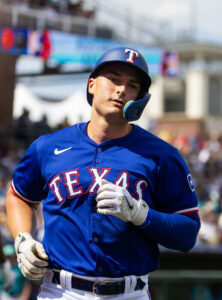
Foscue, 25, is a bat-first prospect with a hit-over-power skill set. His outstanding bat-to-ball skills have been on play in each of the past two seasons in the upper minors; he slashed .288/.367/.483 in 460 Double-A plate appearances in 2022 and .266/.394/.468 in 563 Triple-A plate appearances last year. Foscue struck out in only 14.3% of those Double-A plate appearances and notched an even better 12.4% strikeout rate in a 2023 season that saw him draw walks at a gaudy 15.1% rate.
While Foscue doesn’t have the plus power we so often see from bat-first prospects, that doesn’t mean he’s strictly a slap hitter. He popped 15 homers in ’22 and another 18 last year. He also piled up 31 doubles in each of the past two seasons and has chipped in another five triples along the way. Foscue draws below-average grades for his speed but was able to swipe 14 bags in Triple-A last year — albeit in 21 tries (66.7% success rate).
The main knock on Foscue throughout his professional career has been his defense. He’s played primarily second base (1933 innings) but has also logged time at the hot corner (410 innings) and at first base (92 innings). He’s not regarded as a strong defender at any of those positions, however. Baseball America ranked him as the Rangers’ No. 4 prospect this season, lauding his offensive future but noting that Foscue “does not have the range, mobility or arm strength to stick up the middle or at third base.” He could eventually serve as a platoon partner for Nathaniel Lowe at first base, a part-time designated hitter and perhaps log some time in left field, but defense doesn’t appear likely to ever be a vital part of his skill set. Even if the Rangers were more bullish on his abilities at second base than rival scouts, he’s blocked at his natural position, with Marcus Semien signed through 2028.
The Rangers likely aren’t calling Foscue up simply to play sparingly. Utilityman Ezequiel Duran could also see time at third base in Jung’s absence, but both Duran and Foscue bat right-handed, so a conventional platoon isn’t likely to be deployed — at least at third base. With Lowe on the shelf, however, Foscue can be a righty complement to Jared Walsh against lefties. Beyond that, he figures to draw starts at designated hitter and third base versus right-handed pitching.
From a service time vantage point, Foscue is being recalled early enough that he’d garner a full year if he sticks on the big league roster. In that scenario, he’d be arb-eligible following the 2026 season and slated for free agency following the 2029 season. Even a short-term optional stint back in the minors at any point in the next few seasons could push his free agency back a year, though.
Given the crowded Texas infield — where a healthy Jung, Semien, Lowe and Corey Seager are all entrenched in their spots — it’s quite possible Foscue could see some time back in Triple-A, particularly if he struggles at all in his initial taste of the big leagues. If he hits from the outset, however, he could eventually move into a regular DH role who occasionally spells the Texas regulars around the infield.