
Jake Woodford Elects Free Agency
The Brewers designated Jake Woodford for assignment on Friday. As of today, he has cleared waivers and rejected an outright assignment in favor of free agency (per Adam McCalvy of MLB.com).
Woodford, 29, signed a minor league contract with the Rays this offseason. The deal included an upward mobility clause, which he triggered before Opening Day, prompting a trade to the Brewers. They added him to their active roster, and he pitched in 16 games for the club, tossing 23 1/3 innings with a 6.94 ERA. Woodford has never been a strikeout arm, which means he needs to generate groundballs and limit hard contact to succeed. He wasn’t doing that for Milwaukee. Indeed, it’s now been several years since the right-hander was a solid swingman for the Cardinals from 2021-22. Over the last four seasons, he’s 3-13 with a 6.83 ERA in 142 1/3 innings pitched.
Despite that, Woodford shouldn’t have much trouble finding another minor league contract. He has seven years of MLB experience with the Cardinals, White Sox, Pirates, Diamondbacks, and Brewers, and he’ll still be under 30 for the rest of the season. His arsenal is deep and diverse, highlighted by a sweeper with good movement and a sinker he consistently throws for strikes. Perhaps there’s another team that wants to tinker with his pitch mix, and even if there isn’t, there’s always someone looking for inexpensive bullpen depth.
Rangers Trade Richie Martin Jr. To Rockies
The Rangers have traded Richie Martin Jr. to the Rockies, according to the infielder’s transaction log on MLB.com. He has been assigned to Triple-A Albuquerque. There’s no word on what Colorado is sending Texas in return, although it’s likely cash considerations.
Martin, now 31, was the Athletics’ first-round pick in the 2015 draft. Three years later, the Orioles took him with the first pick in the 2018 Rule 5 draft. He would play 120 games for Baltimore in his rookie season and another 50 between 2021 and ’22. Throughout his time with the O’s, he hit .212 with seven home runs and a .572 OPS, swiping 13 bases on 17 attempts. In the field, he mostly played shortstop, though he also started a handful of games at second base. Defensive metrics like DRS and OAA rated him as a well-below-average glove. All told, Martin produced -1.1 fWAR in 170 games from 2019-22. He has not played in the majors since.
Over the last few years, Martin has signed minor league contracts with the Reds, Nationals, Angels, and Rangers. He also spent time in the independent Atlantic League. In a total of 316 games at the Triple-A level, he owns a .238/.339/.352 slash line with 12 home runs, 95 stolen bases, and an 84 wRC+. He will now offer the Rockies some infield depth with MLB experience.
Randy Dobnak Has Upward Mobility Clause In Mariners Deal
Randy Dobnak signed a minor league deal with the Mariners last November, and he’s spent the first 10 weeks of the season with Triple-A Tacoma. However, Ari Alexander of 7News Boston reports that the right-hander has a June 15 upward mobility clause in his contract. Presuming Dobnak triggers the clause, Seattle will have to offer him to the league’s other 29 teams. If another club wants to put him on its 40-man roster, the Mariners must either add him to their 40-man or trade him to a team that’s willing to do so. If no other teams are interested in rostering Dobnak, he will remain in Seattle’s minor league system. It’s worth noting that Dobnak still has minor league options and less than five years of major league service time, so a team that adds him to its 40-man roster could still keep him stashed at Triple-A.
They say there’s no such thing as too much pitching depth, but the 2026 Mariners might be the closest thing you’ll find to an exception. They’re currently running a six-man rotation of Bryan Woo, Logan Gilbert, George Kirby, Emerson Hancock, Bryce Miller, and Luis Castillo. They also have Cooper Criswell in their bullpen and veteran Casey Lawrence pitching alongside Dobnak in the Tacoma Rainiers rotation. While the M’s would surely like to keep Dobnak around as depth, the question is whether or not they’re willing to give up a 40-man spot to do so. They’re currently running a seven-man bullpen to accommodate their six-man rotation, and they have four players on the 10-day IL. That means space on their 40-man is at a premium.
Most teams aren’t as well-off as the Mariners in the starting pitching department, so it wouldn’t be surprising to see someone else trade for Dobnak. The 31-year-old has 39 games of MLB experience and perfectly respectable numbers at Triple-A this year. He has pitched into at least the fifth inning in all 12 of his starts, averaging 5 1/3 per outing. While his 4.50 ERA doesn’t jump off the page, it’s important to keep in mind that he’s playing in the hitter-friendly Pacific Coast League. His ERA- is 85, which is 15% better than the league average, and his 59.9% groundball rate is the highest among all qualified Triple-A pitchers.
Photo courtesy of Frank Bowen IV, Imagn Images
Blue Jays Designate Yariel Rodríguez For Assignment
The Blue Jays have designated right-hander Yariel Rodríguez for assignment, as first reported by Francys Romero. Taking his spot in the major league bullpen is Tommy Nance, returning from a three-week stint on the injured list. This leaves the Blue Jays with an open spot on their 40-man roster.
Rodríguez signed a five-year, $32MM contract with Toronto during the 2023-24 offseason. He started 21 games for the Jays in 2024 before transitioning to a bullpen role the following season. The righty led the team with 73 innings pitched out of the bullpen, finishing with a 3.08 ERA and a 4.27 SIERA. However, he ran into problems in the latter half of the year, with a 4.58 ERA and 5.46 SIERA over his final 20 regular season appearances, plus another three earned runs in 2 2/3 innings of work in October. This prompted Toronto to remove him from its 40-man roster over the offseason. Due to his poor second half and the $21MM remaining on his contract, he passed through waivers, and the Blue Jays sent him outright to Triple-A Buffalo.
In 11 appearances for the Buffalo Bisons to start the year, Rodríguez pitched to a 2.63 ERA. He struck out 43.1% of his opponents, generated grounders on 47.8% of balls in play, and didn’t allow a home run. Six weeks into the season, he got the call back to Toronto. Since then, however, the 29-year-old has looked a lot less like the arm that dominated Triple-A hitters and a lot more like the pitcher who struggled down the stretch in 2025. In 9 1/3 innings, he gave up 11 runs (eight earned) on 12 hits, seven walks, and a hit-by-pitch. He only struck out six of the 45 batters he faced.
Presumably, Toronto is hoping for a similar situation to last time: Rodríguez and his contract pass through waivers unclaimed, and he stays in the organization. Despite his recent issues, he has flashed promising stuff in NPB, Triple-A, and occasionally in MLB. In a best-case scenario, the Blue Jays finally figure out how to help him thrive in the majors. In a worst-case scenario, he’s endlessly DFA-able bullpen depth.
Nance hit the IL on May 17 with forearm discomfort. Thankfully for Toronto, it seems to have been relatively minor. The 35-year-old has been surprisingly reliable for the Blue Jays over the past two seasons, pitching to a 2.73 ERA and 2.86 SIERA in 52 2/3 innings of mostly lower-leverage work. Injuries have hit Toronto’s rotation harder than its bullpen this season, but there’s no question the team is glad to have Nance back in the fold. His return means the Blue Jays now only have nine pitchers on their big league IL.
Tigers Notes: Skubal, Verlander, Mize, Jansen
Tigers ace Tarik Skubal made a rehab start today for High-A West Michigan. The two-time Cy Young winner put on a masterclass for his minor league teammates, tossing five scoreless innings on 54 pitches (44 strikes). He struck out six and gave up just a pair of singles. As ESPN’s Jeff Passan pointed out, it’s only been a month since Skubal went for NanoScope arthroscopic surgery to remove loose bodies from his left elbow. Whether his quick recovery says more about the surgical technology or Skubal himself, it’s remarkable either way.
Following his start this afternoon, Skubal went to the bullpen to throw some more pitches (per The Athletic’s Cody Stavenhagen). In other words, he wasn’t removed after 54 bullets because that’s all he could throw. That’s a good indication that Skubal’s next start could be for the Tigers. Before his rehab outing, manager A.J. Hinch suggested he might only need the one tune-up start as long as all went well. It certainly seems as if all did, in fact, go well.
Skubal isn’t the only pitcher working his way back to Detroit. Earlier today, Hinch also offered updates on Justin Verlander, Casey Mize, and Kenley Jansen (per reporter Chris McCosky). Verlander is set to make a second rehab start for Triple-A Toledo on Wednesday. He made his first rehab start last week, tossing five scoreless innings with three strikeouts. The Tigers legend has been on the shelf since his first start of the season with inflammation in his left hip. Barring a setback, a third rehab start seems unlikely.
Mize and Jansen are both lined up to pitch on Tuesday. Mize has not been out for long; right adductor inflammation sent him to the injured list at the end of May. His outing this week for Single-A Lakeland should be the only rehab start he needs before he can also rejoin the Tigers’ rotation. Jansen hit the IL around the same time as Mize with pelvic inflammation. Given that timeline, it’s plausible that he, too, will be ready to come back after one rehab appearance.
With Skubal, Verlander, and Mize all nearing their returns, the Tigers will have to figure out how to fit three arms into their starting rotation. They currently have four healthy starters: Framber Valdez, Jack Flaherty, Keider Montero, and Troy Melton. Melton is the most likely candidate to be optioned or moved to the bullpen, but even then, Detroit would have six starters for five spots. Hinch acknowledged this issue without revealing his cards, although he did suggest that a six-man rotation is a possibility: “We’ll work our way through how to slide guys in…but it’s not as simple as just ‘disrupt everything’ and insert three-fifths of a rotation or three-sixths of a rotation if we go to the sixth man” (per Evan Petzold of the Detroit Free Press).
Hazen: Diamondbacks To Seek Bullpen Upgrades On Trade Market
Diamondbacks general manager Mike Hazen discussed his team’s trade deadline priorities on MLB Network Radio today. The GM confirmed previous reports that he would like to add at least one left-handed bat, explaining: “I probably need a little more thump in the lineup, probably a little more power, probably need to get a little more left-handed.” Entering play today, the D-backs ranked among the league’s bottom three teams in batting average, on-base percentage, and slugging percentage against right-handed pitching, while their 85 wRC+ was the worst in MLB. However, the lineup isn’t the only area in which this team could use some help.
Hazen also touched on Arizona’s pitching needs: “I’m sure we’re going to need bullpen, everybody needs bullpen.” The Diamondbacks have managed to avoid working their bullpen too hard over their first 64 games. While their starters rank fifth in the majors with 357 1/3 innings pitched, their relievers rank second-to-last with just 209 1/3 innings on the books. D-backs relievers have combined for a 4.13 ERA and 3.84 SIERA, both around the middle of the pack. Yet, a struggling Brandon Pfaadt and Andrew Hoffman – the two of whom are now at Triple-A Reno – skewed those numbers. Paul Sewald, Juan Morillo, Kevin Ginkel, Ryan Thompson, Jonathan Loáisiga, Taylor Clarke, and Brandyn Garcia have thrown 75% of Arizona’s bullpen innings with a collective 2.51 ERA and 3.41 SIERA. Only Sewald, the eldest and most experienced of the group, has an ERA higher than 3.00, and there’s no denying he’s been successful in the closer role this season. The 36-year-old is 15-for-16 in save opportunities, with a 3.47 ERA and 3.58 SIERA.
Nonetheless, Hazen has good reason to want to add to his arm barn. All of the Diamondbacks’ best bullpen arms have their question marks, and none is the type to strike true fear into opposing lineups late in games. The only ones who haven’t struggled with injury and inconsistency are those whose major league careers are just beginning. And while Arizona’s relievers have not been overworked to this point, depth is still going to matter as the season goes on. A.J. Puk and Justin Martinez could help eventually, but the D-backs won’t want to rely too heavily on a pair of arms that have been out for over a year. All of this to say, the Diamondbacks’ bullpen isn’t in a terrible spot, but it has room to improve. If Hazen views his team as a serious contender, he’d be smart to pursue another back-end arm to pitch in high-leverage spots, as well as some depth to fill innings over the next four months.
Indeed, filling innings could soon become much more important. Diamondbacks starters are averaging just under 5 2/3 innings per game. It might be unrealistic to expect them to keep up that pace, especially since Hazen is hoping he won’t need to bring in any outside reinforcements for the rotation. As the GM put it: “Do we need a starting pitcher? At this point, I’m hoping Brandon Pfaadt gets going down in Triple-A to the point where that may not be a spot where we have to expend resources.”
The Diamondbacks can’t count on Corbin Burnes to come to the rescue anymore. The 2021 NL Cy Young winner will most likely be sidelined until September after suffering a teres major strain. As for the healthy arms, Michael Soroka is enjoying an excellent season, but he hasn’t been a full-time starter since 2019. He threw 89 2/3 innings in the majors last year, and he’s on pace to pass that number in the next couple of weeks. Eduardo Rodriguez, Merrill Kelly, Zac Gallen, and Ryne Nelson should be fine to provide innings, but it’s fair to worry about the quality of those innings. Rodriguez has a 2.52 ERA but a 4.57 SIERA. Kelly, Gallen, and Nelson have combined for a 5.17 ERA and 4.83 SIERA. Given their track records of durability, the D-backs can ride all of those arms, but it doesn’t mean they should. The same goes for Pfaadt, who is stretching out as a starter again at Triple-A. With a rotation like that, the benefits of a deeper bullpen are plain to see.
The Pirates Finally Have an Offense
No team scored less often in 2025 than the Pirates. Of course, that wasn’t anything new. Since Pittsburgh’s playoff drought began in 2016, only one team, the Marlins, has scored fewer runs. The 2016 season was the last time the Bucs ranked among the top half of NL teams in scoring, while 2018 was the last time they finished a season with an OPS above the NL average. In recent years, the easiest way to sound like a broken record in Pirates circles was to ask when the team was going to give their talented young pitchers the kind of run support they deserved.
Through 61 games in 2026, it’s starting to sound like Ben Cherington and Co. have finally taken that broken vinyl off the player. The Pirates rank among the league’s top eight in all three triple-slash categories (BA, OBP, & SLG), as well as walks, wOBA, xwOBA, OPS, and wRC+. They also lead the majors in stolen base success rate, while their 61 steals rank third. Most importantly, all of that hitting, walking, and running is helping them drive runs across the plate. Pittsburgh is averaging 5.1 runs per contest, fifth in MLB.
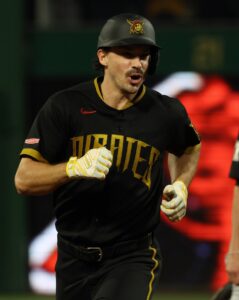
The team’s top producers have been a nice combination of homegrown heroes and shiny new toys. Bryan Reynolds, the longest-tenured Pirate, leads the team with a .403 on-base percentage; among qualified outfielders, only Mike Trout and James Wood have reached base at a higher rate. Acquired in the 2018 Andrew McCutchen trade, Reynolds broke out as a star in 2019 and ’21, his first two full seasons. However, his next few years were more good than great, and his 2025 campaign was genuinely disappointing; he saw his wRC+ dip below league average, while his .157 isolated power (ISO) was the lowest of his career. He hardly resembled the middle-of-the-order bat who convinced a famously stingy organization to open the purse strings and sign him to the largest contract in franchise history (at the time) a few years back. Through the first two months of 2026, Reynolds looks like that kind of player again. His power numbers are still down, but he’s compensating with discipline. He walked 57 times in 2025, 57 times in 2024, 53 times in 2023, and 56 times in 2022. This year, the switch-hitter has already drawn 44 free passes, and Pittsburgh has 101 games left to play. Add in his four hit-by-pitches, and he’s on pace to stroll to first base nearly 130 times in 2026; his previous career-high is 83. All told, the offensive production is right up there with that of his best years: an .835 OPS and a 138 wRC+.
While Reynolds is bringing the walks, another resurgent veteran is bringing the power. Brandon Lowe, acquired in a three-team trade this winter, leads the club in home runs, extra-base hits, and wRC+. His 15 long balls are tied for fourth in the National League. If he keeps hitting them at this rate, he’ll be the Pirates’ first 40-homer hitter since Willie Stargell in 1973, and it isn’t unrealistic to think he can pull that off. Lowe has always had big power, but frequent injuries have held him back; he hit 31 home runs in 134 games last year and 39 in 149 games in 2021. The fact that PNC Park isn’t very homer-friendly hasn’t hurt him either. Instead, it’s helped him hit 12 doubles, putting him on pace for a new career-high in total bases and extra-base hits.
There’s no one Reynolds or Lowe has driven in more often than Oneil Cruz, who leads the Pirates in runs scored and RBI. Cruz is a flawed player. He’s struck out in more than one-third of his trips to the plate, and he drives too many balls straight into the ground. The thing is, those flaws are almost trivial when the 6-foot-7 Cruz is making the most of his ridiculous strength and speed. His 119-mph double from April 16 remains the hardest batted ball any player has hit this year – and that’s still nearly 4 mph slower than Cruz’s personal best (which is also the Statcast-era record). In 2026, Cruz has taken advantage of having the third-fastest average swing speed and the highest hard-hit rate in baseball to smack 14 home runs, just seven back of his career high. He is also tied for third in MLB with 19 stolen bases in 22 attempts. That makes him the only player on pace for a 30-30 season.
In many ways, Spencer Horwitz is the anti-Cruz. The 5-foot-10 first baseman doesn’t run well, swing fast, or hit the ball hard. Yet, only 10 qualified hitters have a lower swing-and-miss rate, and only four have a higher walk-to-strikeout ratio. Thanks to his high-contact approach, Horwitz ranks third on the Pirates with an .843 OPS and a 137 wRC+. And while he doesn’t have as long a track record as many of his teammates, he owns a shockingly impressive 146 wRC+ since last year’s All-Star break. Only five qualified NL batters are ahead of him in that time: Shohei Ohtani, Juan Soto, Kyle Schwarber, Brice Turang, and Corbin Carroll. The catch is that the Pirates have done everything in their power to shield the lefty-batting Horwitz from same-handed pitching. Nearly 87% of his plate appearances over the last two years have come against right-handers, and he owns a career .561 OPS and 66 wRC+ without the platoon advantage. Nonetheless, he has proven incredibly valuable, even with his limitations. It seems like the Pirates knew exactly what they were doing when they acquired him in (essentially) another three-team trade two offseasons ago.
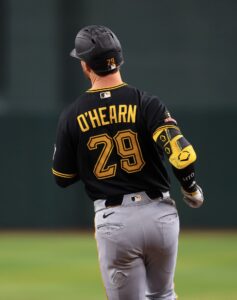
Speaking of righty mashers, Ryan O’Hearn returned from a brief stint on the injured list over the weekend, and he celebrated with a home run off a right-hander in his first at-bat back. The two-year, $29MM deal O’Hearn signed over the winter represented the largest guarantee the franchise has ever given to a free agent hitter. While a contract like that wouldn’t count as a big swing for most teams, it was for the Pirates. So far, it’s looking like they picked the right player to take that swing on. With eight home runs in 46 games, O’Hearn is tracking to surpass 20 for the first time. His .845 OPS and 136 wRC+ would also be his best marks in both categories since his 44-game rookie season in 2018. The Pirates haven’t protected O’Hearn from southpaws the same way they have for Horwitz, so they must be hoping he’ll improve on his .669 OPS and 84 wRC+ against lefty pitching. Even if he doesn’t, his numbers against righties make it easy to overlook his same-handed shortcomings.
The Pirates’ platoon issues go beyond any individual player. Their offense has been relentless against right-handed pitching, but unfortunately, they still have to face left-handers about 30% of the time. With lefties on the mound, the Pirates have a middling .690 OPS and 94 wRC+. Reynolds is doing just fine, and the lefty-batting Cruz has reverse platoon splits, but Lowe, Horwitz, and O’Hearn have struggled to do much damage. That’s compounded by the fact that none of the right-handed hitters in the lineup have stepped up to mash southpaws. Designated hitter Marcell Ozuna, another offseason signing, is showing his 35 years at the plate, while third baseman Nick Gonzales has had most of his success against righties. The good news for the Pirates is that they have at least one righty bat they can count on a whole lot more from.
Konnor Griffin was widely considered the top prospect in baseball entering the season. No one understood the hype better than the Pirates themselves, who agreed to a $140MM extension with their star rookie just a few days into his MLB career. Through 208 PA, Griffin has a modest .729 OPS and 104 wRC+, with roughly even platoon splits. However, he was still finding ways to be a major contributor to Pittsburgh’s offense before he hit the IL over the weekend. (He has a flexor tendon strain, and he isn’t expected to miss much time.) The lightning-fast 20-year-old is 14-for-15 in stolen bases, and he leads the majors in the FanGraphs baserunning metric, BsR. Thus, despite his pedestrian performance at the plate, he has already scored 30 runs in 51 games. If he taps into more of his potential, he can help protect against regression from some of his teammates, and Pittsburgh’s platoon splits should start to even out.
The Pirates haven’t had an offensive core like this in a long time. Lowe, Reynolds, Horwitz, and O’Hearn all rank among the top 20 qualified NL batters in wRC+. In the last decade, only one Pittsburgh hitter – Reynolds in 2021 – has finished a season with a wRC+ high enough to crack the NL’s top 20. Meanwhile, Cruz is on pace to score more runs than any Pirates hitter since Brian Giles in 2001, and he’s hoping to join Barry Bonds as just the second player to go 30-30 in franchise history. Then there’s Griffin, who has the tools to be the organization’s biggest position player star since McCutchen.
This team isn’t without its problems. The Pirates would make the playoffs if the season ended today, but it doesn’t. They have to show they can keep this up for another four months. To do that, they need their veterans to stay hot, their young guys to take the next step, and Endy Rodríguez to finally prove he can be the answer behind the plate. Yet, as early as it still is in the season, there’s something about this version of the Pirates that truly feels different. For the first time in a long time, the Pirates have an offense.
Images courtesy of Charles LeClaire and Mark J. Rebilas, Imagn Images.
White Sox Call Up David Sandlin For MLB Debut
May 26th: The White Sox officially announced their recall of Sandlin today. In a corresponding move, Schultz was placed on the 15-day injured list due to right knee patellar tendinitis, retroactive to May 25th.
May 25th: The White Sox are planning to promote right-hander David Sandlin, reports Elijah Evans of Just Baseball and Future Sox. The 25-year-old is already on Chicago’s 40-man, but the team will need to make space for Sandlin on the active roster. Confirming the move, James Fegan of Sox Machine noted that Sandlin is likely going to start for the White Sox, although it’s not entirely clear how he would fit into the rotation. It’s possible he’s only coming up to make a spot start, considering Chicago is in the midst of playing 13 games without a day off.
Sandlin, 25, began his professional career with the Royals in 2022, and Kansas City traded him to Boston in 2024. The Red Sox then dealt the righty to the White Sox this past winter – along with Jordan Hicks, two players to be named later, and cash – in exchange for Gage Ziehl. Sandlin was the prize of the deal for the White Sox, who were willing to take on most of Hicks’ remaining salary to acquire him. In fact, at the time of the trade, general manager Chris Getz even described Sandlin as “essentially” part of the return for Luis Robert Jr., since the GM was able to use some of the money he saved by trading Robert (and his $20MM salary) to pay Hicks, and, therefore, to secure Sandlin. Getz went on to say that Sandlin would compete for a spot on Chicago’s Opening Day roster, praising his “mid-rotation” arsenal and stuff. “He’s got a chance to really impact our starting rotation this year,” Getz explained (per MLB.com’s Scott Merkin).
Sandlin didn’t end up pitching in big league spring training. Back and forearm soreness (per Fegan) forced him to start the season on the minor league injured list instead. However, from his first rehab start at High-A Winston-Salem to his latest outing for Triple-A Charlotte, he has been nothing short of electric. Leading with a four-seam fastball that flirts with triple digits, he’s given up just 12 hits in 16 1/3 innings, striking out 26. While his walk rate is high, he hasn’t let the free passes lead to much damage; Sandlin didn’t allow an earned run until his most recent start.
Most prospect evaluators roughly agree with Getz’s assessment of Sandlin. He has No. 3 or 4 starter upside, but he needs to improve his control and hone the rest of his arsenal (besides that high-velocity heater) if he’s going to get there. While his results this season have been promising, his Triple-A numbers from 2025 demonstrate why there’s cause for concern. In his first 23 2/3 innings at the highest minor league level, he walked 13 batters, beaned two more, and gave up 35 hits en route to a 7.61 ERA and 5.27 FIP.
Davis Martin has been a revelation for the White Sox this season. Anthony Kay and Sean Burke have been solid, despite their ups and downs. Noah Schultz and Erick Fedde have struggled badly. Even so, it’s hard to imagine that Sandlin would take either of their spots in the rotation. Schultz could be optioned, while Fedde could be DFA’d. Yet, Sandlin isn’t stretched out to take on a full starter’s workload, and he’s never made more than 18 starts or thrown more than 106 innings in a professional season. So, it seems more likely that he’s joining the team to give the rest of the rotation an extra day of rest. Of course, that doesn’t mean he can’t stay in Chicago if he pitches well. This might be a spot start for now, but the White Sox aren’t going to send down anyone who can give them quality innings. They’re currently in a playoff position, despite a mediocre 4.47 ERA and 4.19 SIERA. If Sandlin succeeds, he shouldn’t have trouble sticking around.
Willson Contreras Is Thriving For The Red Sox
The 2025-26 offseason didn’t have a defining blockbuster like the Kyle Tucker trade in 2024-25 or the Juan Soto deal the winter before. However, what the trade market lacked in top-end quality, it made up for in quantity, with no shortage of big names switching teams. The Cardinals were arguably the top sellers, dealing away Nolan Arenado, Brendan Donovan, Sonny Gray, and Willson Contreras, while the Red Sox were one of the most active buyers, picking up Gray and Contreras, along with Caleb Durbin and Johan Oviedo. It’s still too early to crown any winners of the offseason’s trades, but so far, Contreras is looking like one of the best pickups of the winter. Things aren’t going so well for the Red Sox right now, but adding the slugging first baseman is looking like one thing they definitely did right.
Through 50 games, Contreras is hitting .281 with 11 home runs and 33 RBI. His .899 OPS, .393 wOBA, and 148 wRC+ all put him among the AL’s top 10 qualified hitters. His .397 expected wOBA ranks fifth, trailing only Yordan Alvarez, Aaron Judge, Mike Trout, and Ben Rice. For what it’s worth, his glove has also looked sharper in his sophomore season at first base. In 2025, he finished with -1 Defensive Runs Saved (DRS) and a +4 Fielding Run Value (FRV). This year, he has a +3 DRS and a +4 FRV in less than half as many innings. The result of it all is 2.0 Wins Above Replacement, according to both FanGraphs and Baseball Reference. That’s All-Star-caliber production, although fellow first basemen Rice, Nick Kurtz, and Munetaka Murakami will give Contreras tough competition when it comes to making this summer’s AL All-Star squad.
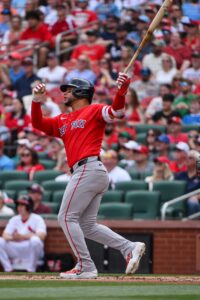
All-Star or not, there is no overstating how important Contreras has been to an otherwise floundering Red Sox offense. He leads the team in home runs, RBI, Win Probability Added, OPS, wRC+, and fWAR. Red Sox Nation held its collective breath earlier this month when Nick Martinez hit Contreras on the hand with a fastball, forcing him out of the game. Luckily, Contreras avoided any sort of serious injury. On the contrary, he’s hit .349 with a 1.061 OPS and a 190 wRC+ in 11 games since. It’s safe to say his hand is feeling just fine.
Contreras has never played more than 138 games in a season or taken more than 563 trips to the plate. That’s partly because he used to be a catcher and partly because he found himself on the injured list 10 times in the first 10 years of his career. This year, he and the Red Sox are hoping he can avoid the IL entirely for the first time in a full season since 2018. If he can, he’s on track to blow past his previous career-highs in almost every counting stat category, including home runs, runs scored, and RBI. Of course, the rate stats are impressive too; his OPS, wRC+, and xwOBA would also be the best of his career. If Contreras keeps going at this pace, he’ll finish with just over 6.0 Wins Above Replacement, according to both the FanGraphs and Baseball Reference models. That would be far and away the highest total of his big league tenure.
Most players never have the privilege to say they were at their best in their mid-thirties. Indeed, in the last decade, only three position players have had a six-win season at age 34 or older, whether by fWAR or bWAR: Paul Goldschmidt in 2022, Brandon Crawford in 2021, and Adrian Beltré in 2016. Meanwhile, Crawford is the only hitter in the 21st century to have his first six-win season at age 34 or older. Contreras is hoping to join him.
Admittedly, it’s dangerous to extrapolate 50 games’ worth of production over a full season. Contreras has played at a six-win pace over his last 50 games, but the 10 seasons and 1,000-plus games he played before this year are probably more representative of his true talent. Besides, the aging curve tells us he’s much more likely to be worse at age 34 than he is to be better than ever. Yet, it’s more fun to be optimistic, and there are some pretty compelling reasons to believe Contreras can keep this up.
For one thing, he isn’t catching anymore. Hopefully, that should help him remain stronger and healthier throughout the rest of the season. The underlying offensive data is also incredibly promising. Over the first nine years of his career, Contreras had a pull-air rate of 13.3% (per Statcast). Then, in 2025, he increased his pull-air rate to nearly 20%. It was the first time in his career that he hit balls in the air to his pull side at a better-than-average rate. This season, his pull-air rate is up again. Just over a quarter of all his balls in play have been pulled in the air.
Here’s why that matters. The league-average wOBA on balls in play typically hovers around .360 to .370. When those balls in play are pulled in the air, that wOBA rises to the .730 to .740 range. What’s more, Contreras has always been particularly successful with this type of contact. His .874 career wOBA on pulled balls in the air puts him in the league’s 92nd percentile. The majority of hitters will succeed when they pull the ball in the air consistently, and Contreras can benefit more than most. His excellent numbers so far in 2026 are the proof.
What makes this development even more encouraging for Contreras is that his swing speed is still elite. Generally speaking, bat speed starts to decline precipitously when a player reaches his thirties. Those older hitters sometimes increase their pull rate, which temporarily helps to cover for their declining strength. That’s not what’s going on for Contreras, at least not in any significant way. His average bat speed on non-pulled contact is down a bit, though it’s still well above league average. Meanwhile, his bat speed on pulled contract is slightly higher than it was through May of last year (or the year before). Because he’s pulling more of his contact overall, his average swing speed is right in line with where it’s been the last two years. Out of 218 qualified swingers, only 14 have a higher average swing speed than Contreras. He may be 34, but he’s swinging like a much younger man.
Simply put, there’s no question Contreras has earned his success to date. He may not keep hitting at quite this level over the next four months, but he’s already given himself a strong head start. As long as he stays healthy, there’s a very good chance this ends up as the best season of an already highly successful career.
Images courtesy of Bob DeChiara and Jeff Curry, Imagn Images.
Astros Release Daniel Johnson
The Astros have released Daniel Johnson, according to his transaction log on MLB.com. The outfielder played in eight games for Houston and another 12 for Triple-A Sugar Land this season. He went 2-for-14 in the majors with two singles, two walks, a hit-by-pitch, and a run scored.
Drafted by the Nationals in 2016, Johnson was traded to the Guardians in 2018 and made his MLB debut for Cleveland in 2020. He has since played in parts of five seasons for the Guardians, Orioles, Giants, and Astros. In 169 career plate appearances, the lefty batter has hit .191 with five home runs and a .554 OPS. His sprint speed is elite, although he’s only 3-for-4 in stolen base attempts at the major league level. On the other side of the ball, he has looked like a solid defender in the time he’s split between all three outfield positions.
Johnson signed a minor league contract with Miami this offseason but failed to make the big league club out of spring training. The 30-year-old started the season at Triple-A Jacksonville, but the Marlins organization released him after five games. Next, he inked a minors pact with the Astros and earned a call-up shortly after, when Taylor Trammell suffered a groin strain. A couple of weeks later, he was designated for assignment in favor of Zach Cole. While Johnson elected free agency at the time, he quickly re-signed with Houston on a new minor league deal. He then spent the next two weeks with the Sugar Land Space Cowboys before his release over the weekend.