
Final Mock Drafts Form Consensus At Top Of Draft
If you’re just realizing that tonight is the MLB Draft, you’ll need to catch up quickly. Baseball’s Rule 4 amateur draft will never have the drama (real or concocted) of the NFL version of the event, but it’s still a major moment for the sport. This year, new Orioles GM Mike Elias will make a franchise-defining pick to kick off the festivities … in just about half an hour, at 7pm eastern.
It’s often said that teams increasingly share common player assessments in baseball’s information age. And unlike football, where fit matters quite a bit, it’s generally believed that baseball teams ought to take the best player available since so few are able to make it to the majors in the short term.
So, does that mean the MLB draft is predictable? No … but maybe also yes, at least in some respects.
There’s still plenty of room for disagreement on amateur players; statistics are obviously less useful when they are logged against disparate competition of varying ability. The draft isn’t just a rank ordering of true talent, anyway. It involves considerations of overall draft bonus pools and off-the-books negotiations with unofficial player advisers. (For more on that side of the proceedings, read this great piece from Baseball America’s J.J. Cooper.)
That said, those behind-the-scenes factors can also leave some nuggets of information that allow other teams, agents, and draft observers to gauge the likely outcome of the draft’s earliest stages. It’s typically still difficult to know in advance how things will shake out, but this year there’s an unusual degree of consensus in the draft analysis community.
The final mock drafts all share a common top-five, predicting:
- Orioles to select Adley Rutschman
- Royals to select Bobby Witt, Jr.
- White Sox to select Andrew Vaughn
- Marlins to select J.J. Bleday
- Tigers to select Riley Greene
Baseball America, Fangraphs, MLB.com, and ESPN.com all have quite a few differences in their predicted boards, of course. But all except Fangraphs also agree on the next two picks (CJ Abrams to Padres and Nick Lodolo to Reds).
Whether anything will occur to shake things up remains to be seen. There’s still some rumblings of intrigue with the 1-1 selection; Kiley McDaniel of Fangraphs tweets that it may not be settled even at this point. Keith Law of ESPN.com also tweeted about some top-five possibilities that fall outside of the consensus expectation.
Beyond the final mock drafts, here are some other draft resources to check out or reference as the draft unfolds.
Angels Designate John Curtiss
The Angels have designated righty John Curtiss for assignment, per a club announcement. Infielder Taylor Ward will take the open active roster spot.
The club also announced that outfielder Michael Hermosillo has been reinstated from the 60-day IL. That move absorbs the newly opened 40-man spot. Hermosillo was optioned to Triple-A.
The 26-year-old Curtiss did not get into a game in his second stint of the year on the MLB roster; he made just one appearance earlier in the season. In 21 1/3 innings this year at Triple-A, Curtiss has allowed 14 earned runs on twenty hits with a 29:13 K/BB ratio.
Phillies Option Nick Williams, Activate Jay Bruce
If you weren’t watching the wire this weekend, the Phillies swung an early deal to add a lefty power bat. Today, the club announced that outfielder Nick Williams was optioned out to make way for veteran slugger Jay Bruce, who’s active for the team’s game this evening.
In another move, the Phils have optioned down lefty Cole Irvin. He’ll be replaced on the active roster by fellow southpaw Austin Davis, who’ll slip into the bullpen.
The 25-year-old Williams was already optioned out after receiving few opportunities during a rough start to the season. He came back onto the active roster following the arrest of outfielder Odubel Herrera, but has since struck out six times in eight plate appearances.
For the time being, Williams will get to work on finding his bat at Triple-A. The former top prospect will serve as a near-term depth piece for the Phils, who’ll also hope he can reclaim some of his former promise. It’s certainly possible to imagine the team exploring trade options involving Williams this summer or in the coming offseason.
Brewers Option Keston Hiura, Activate Travis Shaw
The Brewers have optioned second baseman Keston Hiura, the club announced today. He’ll leave the active roster to make way for the activation of Travis Shaw, who had been rehabbing a wrist injury.
Hiura, 22, certainly hasn’t shown himself in capable of keeping up at the game’s highest level. To the contrary, he’s slashing a hefty .281/.333/.531 with five home runs in 69 plate appearances. While there’s much to be desired in his combination of 23 strikeouts and three walks, Hiura has largely confirmed that the Brewers and prospect watchers were right to expect big things right out of the gates.
It’s tough to see that batting line leave the active roster, particularly given Shaw’s struggles to open the year. He’ll presumably return to his customary duties at the hot corner, with Mike Moustakas going back to second base. The defensive alignment is suboptimal, but passable; it’s the hitting department where this decision will likely be judged.
Before he hit the shelf, the 29-year-old Shaw managed only a .163/.266/.281 slash in 154 plate appearances. That’s far shy of the output he delivered in his first two seasons in Milwaukee, during which he launched 63 home runs and batted a cumulative .258/.347/.497.
GM David Stearns explained to reporters that the club made this move to “preserv[e] organizational depth.” (Via Tom Haudricourt of the Milwaukee Journal-Sentinel; links to Twitter.) Of course, Shaw could have been optioned down instead of Hiura, but Stearns says the veteran has earned the right to step back into the MLB lineup. That doesn’t mean he’s guaranteed to stay there. The pressure will be on Shaw and struggling first baseman Jesus Aguilar, who is out of options.
Stearns rejected the notion that service time played a role in the decision. Whether or not that was a motivating factor, there are implications for both players. Hiura’s initial promotion occurred on May 14th, meaning he could have run up 139 days of service by remaining in the majors all year long. That would have set him up for potential future Super Two qualification. Unless he comes back rather quickly, that’ll no longer be the case. On Shaw’s side, he’ll get the opportunity to reestablish his stock and boost his arbitration earning power by returning to the MLB roster. He has a strong starting point with this year’s $4.675MM salary, though that also means he’ll need to improve in order to be tendered by the Brewers (or command good money in free agency if he isn’t).
Royals Place Hunter Dozier On 10-Day IL
The Royals have placed third baseman Hunter Dozier on the 10-day injured list, per a club announcement. It’s backdated to May 31st, meaning Dozier could be activated by June 10th.
Details of the injury aren’t really clear, though Dozier has been limited by chest tightness. It seems to be a relatively minor muscular issue. The hope was that he’d bounce back quickly enough without an IL placement, but that obviously proved optimistic.
Any disruption to Dozier’s current run is unwelcome. The former top draft pick had failed to accomplish much at all in the majors until breaking out early this season at 27 years of age.
Through 216 plate appearances this season, Dozier carries a .314/.398/.589 slash with 11 home runs and 41:26 K/BB ratio. He still needs to prove that he can keep things up, particularly as opposing pitchers increasingly focus on him as a threat, but it’s obviously quite a promising run of results.
It doesn’t seem as if the present injury will present much of an obstacle. While Dozier is down, the Royals will presumably rely upon the just-recalled Cheslor Cuthbert at the hot corner. It wouldn’t be surprising to see Kelvin Gutierrez come back up to help fill out the infield mix; promoting him would not require a 40-man roster move.
Panda For Sale Or Rent
The Giants have some obviously appealing trade candidates. They also have some undesirable contracts. And then there’s the Kung Fu Panda … one of the most unique players in recent memory. He has had some low lows on the ballfield, but he did not start out as some woeful novelty. And he isn’t one now.
We’ve already seen the suggestion floated by some Giants reporters, so … can I interest you in a gently used Pablo Sandoval?
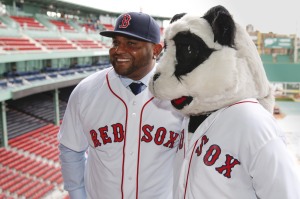
Let’s start on the contract side. Sandoval is way too expensive. But he’s also dirt cheap! He’s earning a cool $19MM this year. The Red Sox are paying all but $545K of it. They’re also on the hook for a $5MM buyout next year, at which time Sandoval will be back on the open market and searching for a much more modest contract than the $95MM deal he inked in November of 2014. It doesn’t get any cheaper than this, folks. You’re paying at least that much to fill the roster spot regardless, so this rental player comes with an effective cash cost of absolutely nothing.
The question remains … do you really want a rental Panda? If so, how much value should you really give to make this happen?
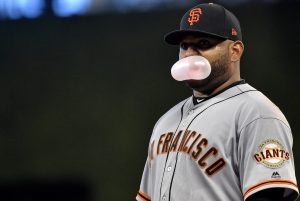
If you’ve followed the Giants from afar, you might assume that Sandoval has slumped with most of the rest of the roster. In fact, he’s leading the team in wRC+ (minimum 10 plate appearances) and fWAR (he’s tied with Buster Posey at 1.0 apiece, but Sandoval has done it in just over two-thirds the plate appearances).
Yep, it has been a vintage performance thus far — a deep cut, in fact. Sandoval hasn’t produced at these kinds of levels since way back in 2011, before he settled in as a solidly above-average but comfortably sub-elite hitter and then ultimately collapsed in Boston. Through 109 plate appearances, the switch-hitting Sandoval carries a .288/.321/.596 slash with seven home runs. He’s delivering well-graded glovework at the hot corner. Oh, and he has not only filled in at first and second in recent years, but he’s even making occasional scoreless appearances on the mound just for kicks.
No money down. Zero maintenance. Versatile. Stout. Below Kelley Blue Book?!
That’s the dealer’s pitch, anyway. Almost sounds too good to be true. Just to be safe, let’s check the Carfax and have a gander underneath the hood …
Hmm well there is one catch you ought to be aware of right off the bat. Sandoval is a switch-hitter, true, but he has been absolutely dreadful against left-handed pitching. And that’s really not a new thing, if we’re being honest. But hey … at least he’s good on the heavy side of the platoon!
Yeah, okay, you’re a little worried about the sample size? If we’re focusing on what he has done against righties … yeah, it’s eighty plate appearances of a thousand-plus OPS hitting. But yikes … a 4.8% walk rate to go with a 27.4% strikeout rate? A .360 BABIP is the only thing supporting his .345 OBP. And that 31.8% HR/FB rate … not gonna last. He’s feasting on some pitchers that aren’t all at the tops of their games. Hard to put too much stock in this kind of showing from a part-time player.
To be fair, Sandoval is legitimately ripping the baseball right now, at least when it is being thrown at him from someone’s right arm. Statcast it. 14.9% barrel rate … about triple what he was averaging during the Statcast Era. 45.2% hard-contact rate. The results are outstripping even that impressive contact (.385 wOBA vs. .362 wOBA), but not by a ridiculous margin. He’s hitting the ball to the opposite field more than ever, which perhaps hints at a change in approach that is helping to produce these results.
That’s all well and good, but the bottom line is that it’s just not a terribly sustainable formula. At his best, in his first stint with the Giants, Sandoval was a model of K/BB consistency, with solid walk rates (average for that era; around 8%) and low strikeout rates (between 13.1% and 13.5% in every season from 2009 and 2014). Now he’s at half that walk rate and twice that strikeout rate — well on the wrong side of current league average in both respects. Sandoval’s 15.9% swinging-strike rate is by far the highest of his career. The newly aggressive approach is working for now, but it doesn’t feel like it’ll last.
It’s not hard to imagine the Panda changing hands this summer. He could be a functional piece for the right team. But my expectation is that it’ll be for a rather minimal trade return, even though an acquiring team won’t have to come out of pocket for his services. You may be a buyer, but I’m walking away.
Pirates Halt Rehab Assignment Of Keone Kela
The Pirates have halted the rehab assignment of righty Keone Kela, the club informed reporters including Rob Biertempfel of The Athletic (Twitter link). He has been sidelined since early May with a shoulder issue that hasn’t yet fully dissipated.
Kela made one appearance at Triple-A on May 25th, at which time it seemed he was not far from a return to the majors. But he obviously did not bounce back and progress as hoped. There’s still no reason to believe that Kela is dealing with a major injury. His handling to this point suggests that’s not really a concern.
The team says recurrent discomfort has led to the decision to pull Kela from the assignment. He’ll be shut down for about ten days before any further steps are decided upon. What will happen at that point — reexamination, resumption of throwing, etc. — isn’t really clear.
It seems safe to presume that the Bucs will go without Kela for a decent while longer, even if he does show fairly quick improvement and is ready to begin ramping back up after ten days. He’s a reliever, which limits the need to build up innings, but the club will want to avoid any further setbacks by moving too rapidly. Once he does resume his rehab assignment, Kela will have thirty days to complete it.
Kela’s absence stings with the Pirates trying to weather a rough stretch for the rotation. The 26-year-old was not off to the best start to the present season, with a 4.63 ERA in 11 2/3 innings. His swinging-strike rate is down quite a bit and he had already allowed three long balls. Still, that’s a short sample and Kela is coming off of a very strong 2018 campaign.
Victor Arano Out For 10 To 12 Weeks After Surgery
Phillies reliever Victor Arano may not be able to make it back this year, though the club isn’t yet ruling out that possibility. Skipper Gabe Kapler told reporters, including Matt Gelb of The Athletic (via Twitter), that Arano’s rehab will require a layoff of at least ten to twelve weeks after his recent elbow surgery.
That timeline leaves only the narrowest of openings for a 2019 return for the 24-year-old right-hander. The most optimistic scenario would see Arano cleared to pick up a baseball in mid-August. He’d still need to begin a throwing program and build up his arm strength thereafter, all without experiencing any setbacks.
Though the Phils can still hope for the best, they’ll ultimately need to approach the summer trade period on the assumption that Arano is not going to make it back this year. While it was known already that he’d miss some time, the extent of the damage wasn’t clear.
Arano may not be a household name, but he’s a quality reliever who delivered big value on a league-minimum salary. Through 74 2/3 MLB frames, he carries a 2.65 ERA with 9.6 K/9 and 2.8 BB/9. He sits at a sturdy but unexceptional 94 mph but carries a smooth 16.6% swinging-strike rate owing to an excellent and oft-utilized slider.
Today’s news is only the latest blow to an increasingly battered and bruised Phillies bullpen. Rare is the contender that doesn’t consider mid-season relief upgrades, but this club seems in particular need of some pen acquisitions. It has been a middle-of-the-road unit to this point of the season, with a nice showing from Hector Neris in the closer’s role and mostly passable efforts otherwise, but there’s ample uncertainty with regard to some of the key veterans and more promising young arms.
Angels Select John Curtiss, Designate Matt Ramsey
The Angels have selected the contract of reliever John Curtiss. He’ll take the roster spot of fellow righty Matt Ramsey, who was designated for assignment. To create an active roster opening, the club optioned down Jake Jewell.
Curtiss, 26, came up to the majors for a single appearance earlier this year and was promptly designated. He has also seen limited MLB action in each of the prior two campaigns. He was carrying a 5.91 ERA in 21 1/3 innings over 13 outings to open the year at Triple-A, recording 29 strikeouts but also issuing 13 walks.
Ramsey is following the course of Curtiss’s first look. He spun a scoreless frame of work after being summoned for his first trip to the majors, but now finds himself ticketed for a return to Triple-A on outright assignment — unless another team puts in a claim. Like Curtiss, Ramsey has been charged with more than five earned per nine during his time this year at the offensively charged environment of Salt Lake City. He posted a 15:8 K/BB ratio in 13 2/3 innings there and does have a history of racking up swings and misses in the upper minors.
Luke Weaver Will Attempt To Rehab Through UCL Injury
The Diamondbacks announced that righty Luke Weaver has been diagnosed with an injury to his right ulnar collateral ligament and flexor pronator but will not undergo surgery. Instead, he’ll “be treated conservatively.”
Weaver and the D-Backs did not arrive at this conclusion without quite some thought. He was checked out by four different physicians, per manager Torey Lovullo. The injury turned out to be rather significant — last we checked in, it had been labeled a forearm strain — but not quite bad enough to warrant a procedure that would likely have cost Weaver the remainder of this season along with a big chunk of 2020.
It’s obviously preferable to avoid Tommy John surgery whenever possible, since it’s a major procedure that isn’t foolproof and require a lengthy layoff. That said, there’s also some real risk in holding off when it may well be warranted. If a rehab approach fails to take, it can make for a delay that pushes back the ultimate return date.
Though it’s good to hear that the injury is on the mild side, there’s really no sugarcoating UCL issues. There’s enough time for Weaver to make it back to the mound this season, if all goes well in the healing process and there aren’t setbacks when he tries to ramp back up. But the injury will still rob him of a big portion of the present season and will hang over his head thereafter.
Weaver still holds plenty of promise. He boosted his stock after landing with the Snakes on the heels of a messy 2018 effort, opening the current season with 62 1/3 innings of 3.03 ERA ball while recording 9.8 K/9 against 2.0 BB/9. So long as he’s able to heal up, the 25-year-old should have many good years ahead of him. And the Diamondbacks have ample time to receive further production, as Weaver will be under team control through at least 2023.