
Orioles Sign Heston Kjerstad
The Orioles have signed second overall draft pick Heston Kjerstad, per a team announcement. The University of Arkansas product will receive a $5.2MM bonus, per MLB.com’s Jim Callis (Twitter link).
Kjerstad was expected to go near the top of the draft, but not with the second selection. The O’s obviously liked him quite a bit, but also saw an opportunity to save some bonus pool capacity to draft and sign other talented players in later rounds. The club was able to reapply over $2.5MM of the second overall slot value.
As things stand, the Orioles are known to have deals in place with five of their six selections. Jordan Westburg (30th overall) and Hudson Haskin (39th) secured at-slot bonuses. High schoolers Coby Mayo and Carter Baumler were lured with over-slot promises, though their deals aren’t yet official. That leaves Ole Miss infielder Anthony Servideo, the team’s third-round choice, left without a pact (so far as is publicly known).
Perhaps it’s easy to get caught up in the machinations and overlook Kjerstad’s own promise. While teams obviously see the appeal in spreading draft bonus pool availability over multiple players, they also aren’t generally inclined to spend premium draft choices on sub-premium talent.
All major draft pundits graded Kjerstad as one of the dozen or so top-available talents. Eric Longenhagen of Fangraphs had the highest ranking, listing him in the seventh slot.
Most agree on the profile here. Kjerstad is seen as a solid right fielder with big potential at the plate. He was drubbing high-end college pitching (.448/.513/.791) when the 2020 season was suspended. There are some concerns over his complicated swing and proclivity to strike out, but obviously the consensus is that Kjerstad will grow into a quality offensive performer at the game’s highest level.
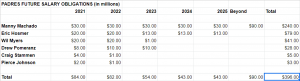
Manny & Hoz Account For Bulk Of Padres’ Long-Term Contract Commitments
2020 salary terms may finally be sorted out. But what about what’s owed to players beyond that point? The near-term economic picture remains questionable at best. That’ll make teams all the more cautious with guaranteed future salaries.
Every organization has some amount of future cash committed to players, all of it done before the coronavirus pandemic swept the globe. There are several different ways to look at salaries; for instance, for purposes of calculating the luxury tax, the average annual value is the touchstone, with up-front bonuses spread over the life of the deal. For this exercise, we’ll focus on actual cash outlays that still have yet to be paid.
We have now run through every team, with a big assist from the Cot’s Baseball Contracts database. Prior entries can be found here. The final team is the Padres:
*Manny Machado may opt out after 2023
*Eric Hosmer may opt out after 2022
*Includes buyouts on club options over Wil Myers, Craig Stammen, and Pierce Johnson
*Includes estimated distribution of signing bonus in Drew Pomeranz contract
(click to expand/view detail list)
Ian Desmond Opts Out Of 2020 Season
Rockies outfielder Ian Desmond will opt out of playing in the 2020 MLB season. He provided a thoughtful explanation of his decisionmaking process in an announcement on Instagram.
Desmond explains that “the COVID-19 pandemic has made this baseball season one that is a risk I am not comfortable taking.” He says he’s compelled to stay home “with a pregnant wife and four young children who have lots of questions about what’s going on in the world.”
Fortunately for all of us that care about the future of the game, the widely respected Desmond says he intends to work with his local Little League (in Sarasota, Florida) while he’s not playing this year. He did not offer an indication of his future plans for returning to the diamond.
Desmond’s announcement is essential reading for all baseball fans. It’s a powerful call to action to deal with glaring inequity in the game, from its lowest to its loftiest levels.
Three other big leaguers preceded Desmond in announcing that they would not participate in the 2020 season. No doubt others will follow. It is not known whether Desmond had any personal medical issue that will allow him to opt out while still accruing salary and service time. If not, he will forego a pro-rated portion of his $15MM salary for the year. He remains under contract with the Rockies through 2021; the club also controls him in 2022 via club option.
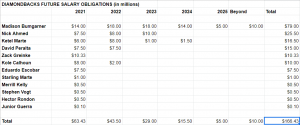
MadBum And The Rest Of The D-Backs’ Future Payroll Promises
2020 salary terms may finally be sorted out. But what about what’s owed to players beyond that point? The near-term economic picture remains questionable at best. That’ll make teams all the more cautious with guaranteed future salaries.
Every organization has some amount of future cash committed to players, all of it done before the coronavirus pandemic swept the globe. There are several different ways to look at salaries; for instance, for purposes of calculating the luxury tax, the average annual value is the touchstone, with up-front bonuses spread over the life of the deal. For this exercise, we’ll focus on actual cash outlays that still have yet to be paid.
We’ll run through every team, with a big assist from the Cot’s Baseball Contracts database. Prior entries can be found here. Next up is the Diamondbacks:
*Reflects deferred salary in Madison Bumgarner contract
*Includes buyouts on club options over Ketel Marte, Starling Marte, Merrill Kelly, Stephen Vogt, Hector Rondon, and Junior Guerra
*Includes remaining signing bonus to be paid to Nick Ahmed
*Includes remaining salary obligation to Zack Greinke
*Does not include buyout of Mike Leake mutual option, which is owed by Mariners
(click to expand/view detail list)
Latest On Blue Jays’ Training Plans
Every MLB club faces a difficult task in launching and sustaining a 2020 season. But the Blue Jays face some unique challenges as the only affiliated organization located outside of the United States.
The Toronto organization announced today that it will gather its players and personnel at its facility in Dunedin, Florida. The club says it will “begin the intake screening and isolation process” there.
[RELATED: Blue Jays 60-Man Player Pool]
The Jays’ next step will depend upon the views of the relevant Canadian authorities. If approval is granted, the club says it’ll charter a flight to train in Toronto “under a modified quarantine, isolated from the general public.” Otherwise, it’ll keep its employees at the Dunedin facility and undertake Summer Training there.
It was just ten days ago that the Blue Jays halted activities at its spring complex as coronavirus cases hit the neighboring Phillies facility and soared in the state of Florida generally. There was indeed cause for concern, as several players and staff members ended up testing positive for COVID-19 infections.
That mini-outbreak served to highlight the need for strict measures if this campaign is to occur in a reasonably safe manner. That’s all the more true for the Jays. With cases within the organization already, and the situation in Florida only continuing to worsen, gathering in Dunedin will have to be done carefully.
No doubt the Blue Jays are aware of all that and planning accordingly. The team’s stated preference is to train and play in Toronto, which will mean convincing the Canadian federal, provincial, and local governments that it can be done without unreasonable risk. As Shi Davidi of Sportsnet.ca reported earlier today on Twitter, it seems as if that process is moving towards a favorable outcome for the Jays.
Minor Leaguers Left Out Of Player Pools May Be Able To Play Indy Ball
8:31pm: Cooper now tweets that minor-league players will need to receive authorization from their team before joining an indy ball roster. But he adds that the expectation is that many teams are amenable to doing so.
7:12pm: Wondering what’ll happen to those minor-league players who weren’t named to MLB teams’ 60-man player pools? While teams are paying stipends to those minor-leaguers they’ve retained, those players’ contracts were formally suspended.
Accordingly, as J.J. Cooper of Baseball America reports, Major League Baseball has determined that clubs lack grounds to prevent minor-leaguers from signing on with independent league outfits. The inverse is also true: MLB teams can’t encourage players to sign on with indy clubs. The situation is different for 40-man players, as MLB contracts were never declared suspended.
As a practical matter, relatively few players will likely end up landing new gigs. The independent leagues aren’t generally rolling in cash, needless to say, and their revenue stream faces even greater challenges than those of MLB teams since in-person attendance is the whole ballgame. Those that are cobbling together 2020 seasons obviously won’t be at full tilt.
That said, the appeal is obvious for players, many of whom would surely make a buck for playing ball rather than sitting dormant and losing a year of development. The calculus would obviously change if there’s some sort of minor-league season to speak of — a decision that could soon be made.
At the same time, there’s obviously some risk in playing outside the affiliated ranks. The controlling MLB team wouldn’t necessarily be on the hook for any injuries or health issues that may arise. And it’s an open question whether an otherwise available team stipend would be withheld from a player earning money for playing baseball in an unaffiliated uniform.
Mets To Sign Second-Rounder J.T. Ginn
The Mets have inked second-round draft pick J.T. Ginn, Tim Healey of Newsday reports on Twitter. He’ll receive a $2.9MM bonus, per Joe DeMayo of SNY.tv (Twitter link).
This puts a bow on the Mets’ 2020 draft class. The club had already inked their other five draftees, with its four selections after Ginn all going for well under the slot values attached to their picks.
The New York org needed every penny to reel in Ginn. He was taken 52nd overall, a position that came with a $1,403,200 pool allocation. Clearly, he wasn’t willing to turn pro for that amount.
Ginn, a draft-eligible sophomore out of Mississippi State, is working his way back from Tommy John surgery. But the Mets obviously feel the talent is compelling enough to roll the dice on a full recovery.
Most draft watchers graded Ginn as a first-round talent, in spite of the obvious risk. He was already selected there once before, but spurned the Dodgers back in 2018. Ginn is said by some to possess a potentially front-of-the-rotation arsenal — a big heater, compelling slider, and promising change-up — though others anticipate he’ll settle in more as a back-of-the-staff starter or late-inning reliever.
Explaining The 2020 MLB Roster Rules
Major League Baseball is days away from a rapid-fire Summer Training, which will set the stage for a mad 60-game dash for postseason position, followed by a typically wild October … all while trying to manage the many challenges posed by the still-raging pandemic that disrupted the 2020 season in the first place. Sounds like a lot when you put it that way.
As one might expect, the typical roster rules for a MLB season would not work well in this scenario. Among other things, there’s a need for an actively engaged reserve corps of players with the minor-league season still on ice. Teams need a way to protect players who are injured or who contract COVID-19. The issue is all the more pressing in the early stages of the season.
MLBTR has learned and clarified many of the key details regarding the new roster rules. Here’s how things will work for the 2020 campaign:
- Each team can establish a maximum 60-man player pool, with the initial list due by Sunday at 3pm CST. Teams are not required to fill all sixty slots.
- No other players will be permitted to participate in camp. Teams are permitted to operate two separate camps if they so choose. All teams will operate an alternative training site once the season begins.
- Players on the 40-man roster need not be included in the 60-man player pool. Likewise, of course, pool players need not be on the 40-man roster — unless and until they are added to the active MLB roster.
- If a player is removed from a 60-man player pool, he cannot be added back to that team’s pool but can be added to another team’s pool. Players cannot be freely removed from the 60-man player pool without roster implications. Put otherwise: other than injured list placement, suspension, and some other infrequent designations, teams will be forced to surrender (or risk surrendering) control over a player (trade, release, DFA, outright, etc.) to remove him from the 60-man player pool.
- Teams may otherwise add already controlled or newly acquired players to their 60-man player pool. Players can be signed to the 60-man player pool without being added to the 40-man roster, but that requires 60-man player pool space (just like a typical minor-league deal requires space at a certain affiliate).
- The active MLB roster will consist of up to 30 players (and at least 25 players) at the start of the season. After two weeks of play, that number goes down to 28. After two more weeks, it drops again to 26, with a 27th player available for double-headers.
- Teams will travel with an unofficial 3-man taxi squad, the identity of which need not be disclosed. One player must be a catcher. There is no official designation or roster status associated with being a member of that group.
- As usual, a player must be on a 40-man roster in order to be added to the active MLB roster.
- Once a player is placed on the active roster, standard rules apply. Players eligible to be optioned can be sent back to camp just as if it were a minor-league affiliate. An optioned player must stay on optional assignment for ten days, unless called back owing to an injured list placement. Players who are not eligible to be optioned must be designated for assignment (and then traded or exposed to outright waivers) to be removed from the active roster.
- The trade deadline is August 31st. ONLY players in the 60-man player pool may be traded. Any player that is traded must go into an acquiring team’s player pool. (As a practical matter, it seems there’s nothing to stop teams from adding prospects to the 60-man player pool specifically in order to trade them. The acquiring team would need to be capable of carrying such players in their own 60-man player pool while still fielding a 26-man active roster of capable big leaguers.)
Indians Sign First-Rounder Carson Tucker
The Indians have agreed to terms with first-round draft choice Carson Tucker, according to Robert Murray (via Twitter). He’ll receive a $2MM bonus.
Tucker will follow older brother Cole Tucker, an infielder with the Pirates, in chasing the big league dream. The younger sibling was chosen 23rd overall, a choice that came with a $2.93MM slot value.
Most draft pundits graded Tucker as a second-round talent. But that’s not quite how the Indians saw — though they did get him for an under-slot rate.
ESPN.com’s Kiley McDaniel slapped the highest ranking on the younger Tucker brother, listing him as the 33rd-best available player. Per McDaniel, the Arizona high-schooler “is a hit-first plus athlete” who was on the rise as the draft approached.
Giants Release Tyson Ross, Nick Vincent
The Giants have released former MLB hurlers Tyson Ross and Nick Vincent, KNBR’s Mark Sanchez reports on Twitter. Also cut loose was utilityman Jamie Westbrook.
Ross and Vincent are each 33-year-old righties who had inked minor-league deals in the offseason. The former is best known for his days in the Padres rotation. The latter, a reliever, was also once an effective hurler in San Diego as well as with the Mariners.
Though he struggled in limited big league action last year, and has never recovered from serious shoulder injuries, Ross has a lifetime 4.04 ERA in ten MLB campaigns. He didn’t have much hope of cracking the starting staff, but was perhaps a multi-inning relief candidate. Ross struggled in his three outings in camp before the pandemic paused the action.
As for Vincent, he struggled with the long ball during a stint with the Giants last year. But he turned in a strong 14-inning run to end the season — 1.93 ERA with 17:4 K/BB — with a Phillies team that was managed by new Giants skipper Gabe Kapler. Vincent had coughed up three homers and seven earned runs in four Spring Training frames.
Westbrook has yet to appear in the majors, having reached minor league free agency after seven seasons in the Diamondbacks system. He turned in 514 plate appearances of .281/.358/.451 hitting in the upper minors last year, but obviously didn’t show enough in camp for the Giants to keep him in their 60-man player pool.